econstor
www.econstor.eu Der Open-Access-Publikationsserver der ZBW – Leibniz-Informationszentrum Wirtschaft The Open Access Publication Server of the ZBW – Leibniz Information Centre for EconomicsNutzungsbedingungen:
Die ZBW räumt Ihnen als Nutzerin/Nutzer das unentgeltliche, räumlich unbeschränkte und zeitlich auf die Dauer des Schutzrechts beschränkte einfache Recht ein, das ausgewählte Werk im Rahmen der unter
→ http://www.econstor.eu/dspace/Nutzungsbedingungen nachzulesenden vollständigen Nutzungsbedingungen zu vervielfältigen, mit denen die Nutzerin/der Nutzer sich durch die erste Nutzung einverstanden erklärt.
Terms of use:
The ZBW grants you, the user, the non-exclusive right to use the selected work free of charge, territorially unrestricted and within the time limit of the term of the property rights according to the terms specified at
→ http://www.econstor.eu/dspace/Nutzungsbedingungen By the first use of the selected work the user agrees and declares to comply with these terms of use.
zbw
Leibniz-Informationszentrum Wirtschaft Leibniz Information Centre for Economics Juanah, MomohWorking Paper
The Role of Micro-financing in Rural
Poverty Reduction in Developing
Countries
Wismarer Diskussionspapiere, No. 18/2005
Provided in cooperation with:
Hochschule Wismar
Suggested citation: Juanah, Momoh (2005) : The Role of Micro-financing in Rural Poverty Reduction in Developing Countries, Wismarer Diskussionspapiere, No. 18/2005, http:// hdl.handle.net/10419/23326
Faculty of Business
Fachbereich Wirtschaft
Momoh Juanah
The Role of Micro-financing in Rural Poverty Reduction
in Developing Countries
Heft 18/2005
W
D
P
ness and Design bietet die Präsenzstudiengänge Betriebswirtschaft, Management so-zialer Dienstleistungen, Wirtschaftsinformatik und Wirtschaftsrecht sowie die Fernstu-diengänge Betriebswirtschaft, International Management, Krankenhaus-Management und Wirtschaftsinformatik an. Gegenstand der Ausbildung sind die verschiedenen As-pekte des Wirtschaftens in der Unternehmung, der modernen Verwaltungstätigkeit im sozialen Bereich, der Verbindung von angewandter Informatik und Wirtschaftswissen-schaften sowie des Rechts im Bereich der Wirtschaft.
Nähere Informationen zu Studienangebot, Forschung und Ansprechpartnern finden Sie auf unserer Homepage im World Wide Web (WWW): http://www.wi.hs-wismar.de/. Die Wismarer Diskussionspapiere/Wismar Discussion Papers sind urheberrechtlich geschützt. Eine Vervielfältigung ganz oder in Teilen, ihre Speicherung sowie jede Form der Weiterverbreitung bedürfen der vorherigen Genehmigung durch den Herausgeber. Herausgeber: Prof. Dr. Jost W. Kramer
Fachbereich Wirtschaft
Hochschule Wismar
University of Technology, Business and Design Philipp-Müller-Straße Postfach 12 10 D – 23966 Wismar Telefon: ++49/(0)3841/753 441 Fax: ++49/(0)3841/753 131 e-mail: [email protected]
Vertrieb: HWS-Hochschule Wismar Service GmbH Phillipp-Müller-Straße Postfach 12 10 23952 Wismar Telefon:++49/(0)3841/753-574 Fax: ++49/(0)3841/753-575 e-mail: [email protected] Homepage: www.hws-startupfuture.de ISSN 1612-0884 ISBN 3-910102-72-7
JEL-Klassifikation O16, I32, I38, O15 Alle Rechte vorbehalten.
© Hochschule Wismar, Fachbereich Wirtschaft, 2005. Printed in Germany
Preface 5 Dedication 6 Acknowledgement 6 Abstract 6 1. General Introduction 8 1.1. Introduction 8
1.2. Statement of the Problem 8
1.3. The Hypothesis 9
1.4. Justification of the Study 10 1.5. Objectives of the Study 10
1.6. Research Questions 11
1.7. Description of the Study Area 12 1.8. Limitation of the Study 12 1.9. Organization of the Study 13
2. Research Methodology 13
2.1. Introduction 13
2.2. The Case Study Method 14 2.3. Classification and Sources of Data 15 2.3.1. Secondary Data Sources 15 2.3.2. Primary Data Sources 15
3. Review of Relevant Literature 16
3.1. Introduction 16
3.2. The Concept of Poverty in Developing Countries 16 3.2.1. Historical Perspective of Poverty 16 3.2.2. Nature and Incidence of Poverty in Developing Countries 17
3.2.3. Types of Poverty 22
3.2.4. The Concept of Rural Poverty and Poverty Reduction Strategy 22 3.2.4.1. Meaning of “Rural” 22 3.2.4.2. Rural Poverty in Developing Countries 23 3.2.5. Rural Poverty Reduction Strategies in Developing Countries 25 3.3. The Concept of Microfinance in Developing Countries 29
3.3.1. Nature and Scope of Microfinance in Developing Countries 29 3.3.2. Microfinance Institutions and Services in Selected Developing
Countries 30
3.3.2.1. The Formal Sector 31 3.3.2.2. The Informal Sector 35
4. Contribution of Microfinance to Rural Poverty Reduction 37
4.1. Introduction 37
4.2. Impacts of Microfinance Services on Rural Poverty 38
4.2.1. Savings Facilities 38
4.2.2. Credit Facilities 38
4.2.3. Insurance Services 39
4.2.4. Payments and Money Transfer Services 39 4.2.5. Concluding Observations 39
5. Conclusion and Recommendations 40
5.1. Conclusion 40
5.2. Recommendations 41
5.2.1. Policy and Legal Framework 41 5.2.2. Institutional Capacity Building 42 5.2.3. Community Participation Mobilization 42
5.2.4. Donor Support 42
5.2.5. Gender Issues 42
References 43
Preface
2005 has been declared the international year of microcredit and microfinance. Therefore, it is not surprising that microfinance is currently discussed as one of the possible paths towards poverty reduction in developing countries.
This research paper by Momoh Juanah, which has been submitted in the fall of 2004 at SPRING Centre, University of Dortmund, takes a closer look at its contribution towards this aim. Momoh Juanah not only evaluates the concept as presented in today’s scientific discussion, but also outlines a research pro-gramme on how to measure the real effects of microfinance.
The topics and problems that are addressed in this paper are numerous as well as complex. Each individual aspect deserves a detailed discussion, a task which is not lessened by the high degree of inter-linkage among them. Such a study-in-depth, however, is not provided by this paper. Instead, it aims at pro-viding an outline for further and additional research. Therefore, it is more of a management brief on the chosen topic than a detailed study on all relevant as-pects.
Due to this character, it names areas for future research and, it is hoped, will also provide an incentive for increased interest in microfinance and its effects on poverty reduction, especially in rural areas of developing countries.
It was a pleasure for me to read Momoh Juanah’s paper and therefore I am glad to make his thoughts available to a greater public with the help of the Wismar Discussion Papers. Hopefully, it will prove to be another step forward within this year of microcredit and microfinance.
Wismar, September 2005
Dedication
This work is dedicated to the memory of my mother, late Madam Lucia Maamu. May her soul Rest in Perfect Peace. I also dedicate this work to all those poor rural men, women and children, who on most occasions may not even know from where the next meal will come.
Acknowledgement
I would like to acknowledge the assistance I received from different people in producing this work and during my studies here in Germany. I am greatly in-debted to Professor Dr. Günter Kröse for his guidance. I am also thankful to all the staff of the SPRING Centre, Faculty of Spatial Planning at the Univer-sity of Dortmund, Germany.
In a special way, I am highly grateful to the Evangelischer Enwicklungs-dienst (EED) for sponsoring my studies here in Germany and in Kumasi, Ghana. I would like to thank on a special note the staff of the EED Scholarship Desk in Bonn, Germany for their great cares and concerns for my well-being while in Germany.
I am also grateful to my wife, Mrs. Khadiatu Juanah, who traveled all the way from Sierra Leone to Germany to comfort me on my course, providing me most needed companionship and food. I also extend sincere thanks to my friends in Germany, including Momoh Kobba, Foday Nyandewa, Roland Al-lieu, Late Mrs. Janet Bunduka, Pastor Golden, Sister Natascha and her mother, Angelica, who contributed in various ways to making life in Germany more interesting for me. I am very much grateful to the Echoes Evangelical Mission (CEEM) members in Bochum for their spiritual and moral support to me and my wife.
Over and above all, I thank God almighty, whose grace and abundant bless-ings upheld me through high and low periods during my stay in Germany.
Abstract
Throughout the developing world, there is a desperate quest for a way out of the financial predicament confronting the rural poor. In most countries of the developing regions, especially South Asia and Sub-Saharan Africa, the rural population forms the larger proportion of the entire population and poverty is prevalent among them. According to the International Fund for Agricultural Development (IFAD 2001), in an assessment of poverty in West and Central Africa, poverty in West and Central Africa is essentially a rural phenomenon with three quarters of the population being located in rural areas.
Following the theoretical methodology, this study has examined the role of microfinance in developing countries and has described some measures which
can enhance the effectiveness and efficiency of microfinance as an instrument for reducing rural poverty in developing countries. The thesis of this study is that with a well planned and coordinated institutionalized microfinance system operating within the appropriate legal and policy framework, the rural poor may be able to get out of the chronic poverty trap that plagues their lives.
By means of a review of relevant literature and a conceptual framework on poverty in general, rural poverty in particular and microfinance services and institutions in the developing countries (using the cases of selected countries), the increase in popularity of microfinance as an instrument for addressing the problem of rural poverty in most developing countries was discovered.
Although there is empirical evidence that microfinance can contribute im-mensely to improving the lives of the rural poor, much evidence points to the fact that the impact of microfinance on the lives of the poorest of the poor is yet to be up to the expectations of developers. Existing evidence also indicate that microfinance services, such as savings, insurance, money transfers, entre-preneurial training and so on, which are more attractive to this class of clients, are yet to be provided. Regulation and supervision is deemed to inhibit the op-eration of the market but in the case of rural microfinance provision a reason-able amount of regulation and supervision is discovered to be necessary, par-ticularly to protect the mostly illiterate rural poor, from usury interest rates, for example.
In all the selected countries and most other developing countries, govern-ment regulation and supervision of microfinance operations are present, either directly or indirectly.
This paper is sub-divided into five chapters. In Chapter one, the problem, objectives, study area and the research questions of the study are presented. In Chapter two, the research is operationalized through the formulation of a framework of the research methodology. The case study approach which is the major analysis approach for this study is discussed in-depth in this section. Existing literature and studies on rural poverty and microfinance are reviewed in Chapter three. Also in this chapter, microfinance practices in four countries in the developing regions, Bolivia, Ethiopia, Ghana and the Philippines, se-lected at random are discussed. Chapter Four examines the contribution of mi-crofinance to rural poverty reduction under the various categories of services which include credit, savings, insurance and money transfers. In Chapter five, recommendations are advanced for improving on the provision of microfi-nance in order for its full impact on rural poverty to be realized.
1. General Introduction
1.1. Introduction
Impoverished people, carrying out very small businesses, can improve their standard of living through the proper use of financial services designed spe-cifically for them. Savings mechanisms allow them to conveniently and safely accumulate surplus funds to create financial stability, while credit services al-low them to expand their enterprises and improve earnings. The provision of these crucial, specialized services to “small-scale rural farmers and business people” and how to ensure the effectiveness and sustainability of the services is what this study is all about.
This research paper presents a general theoretical framework for the actual research to be undertaken for the final thesis in Ghana. My intention is to make a comprehensive assessment of the role of microfinance services in the reduction of rural poverty, using selected rural area situations in Ghana. Fo-cusing on the rural poor, I am not by any means suggesting that poverty does not exist in the urban areas of developing countries. Indeed there are a consid-erable number of the urban poor in all developing countries. I have concen-trated on the rural poor because, according to Todaro (1992: 249); if ‘devel-opment’ is to take place and become self-sustaining, it will have to start in the rural areas in general and the agricultural sector in particular. There can be no national development without rural development.
Although the idea of micro-credit had long existed among the rural people and more so urban communities in Developing Countries (for instance in West Africa), there has been no organized form of a microfinance system that em-braces ‘best practices’ until recently. A most common form of microfinance practice which had existed among small business operators in most developing countries like Ghana, Uganda, Bangladesh, and many more is the Rotating Savings and Credit Associations (commonly called RoSCA). The main objec-tive here is to make a lump sum available to members to be able to make bulk purchase of the goods they trade in and durable household goods. The empha-sis of this study, however, is on institutionalized microfinance systems.
1.2. Statement of the Problem
Microfinance could be a powerful strategy or instrument, among several oth-ers, for alleviating poverty in general and rural poverty in particular in devel-oping countries. Although many develdevel-oping countries, such as Bangladesh in Asia (the Grameen Bank) and Ghana, to name but two, have scored relative successes in using microfinance as an instrument for alleviating poverty in general, and rural poverty in particular, it has not been so for many other de-veloping countries, especially in Africa and some South Asian Countries.
Rather than improve the conditions of the poor, most of the microfinance pro-grams operated in these countries have left the so-called beneficiaries in debts. In a similar vein, most organizations involved in providing microfinance ser-vices, including government institutions, cooperatives and Non-governmental organizations (NGOs) have in most cases performed very poorly. High rates of non-repayment of loans by clients have on several occasions led to the col-lapse of microfinance institutions. Not withstanding this, microfinance has continued to gain popularity among rural developers as a viable tool for im-proving rural agricultural practices and the diversification of economic activi-ties of small-holder farming households. Lack of adequate loan funds, inade-quate institutional capacities, poor coordination, little or no participation of the beneficiaries in the planning of microfinance programs, lack of effective train-ing programs for both beneficiaries and operators of the programs are some of the reasons behind the ineffectiveness of microfinance as a strategy for allevi-ating rural poverty in developing countries. Another very serious problem militating against microfinance is the attempt by governments to use it as a tool to gain political favor and stability rather than for the primary purpose of enhancing economic activities among the poor, so as to improve their overall standard of living.
The entire situation outlined above, has contributed to the lack of access to sufficient capital by the rural poor and thus inhibited them from venturing into other economic activities like small-scale industries and businesses, and adopt-ing appropriate modern farmadopt-ing technologies, in order to increase their yield and earnings.
1.3. The Hypothesis
Finance is described by many business scholars and practitioners as the lubri-cant which keeps the business machinery smoothly and successfully running. I think this is equally true for all types of groups, be they commercial, religious, political or a rural farming household. It must be noted that most poor rural households depend mostly on agriculture, yields from which never guarantees a substantial standard of living for them. A diversification of the economic activities of the rural people and enabling them to access appropriate modern farming technologies can be a very effective and sustainable way of ensuring an improved standard of living for them.
My assertion here therefore is that with an effective and efficient microfi-nance system operating in the rural areas of developing countries, coupled with other enabling factors such as legal and policy framework, good govern-ance and adequate physical infrastructure, the poor rural people will undertake diversified business activities, and also be able to adopt more appropriate modern farming technologies. This, it is assumed, will lead to the reduction of rural poverty and an increased overall standard of living of the rural poor in
developing countries in general, and the least developed countries (LDCs) like those in Sub-Saharan Africa and South Asia, in particular.
1.4. Justification of the Study
The core problems of widespread poverty, growing inequality, rapid popula-tion growth and rising unemployment all find their origins in the stagnapopula-tion and often retrogression of economic life in rural areas (Todaro 1992: 249). Todaro (1992: 249) further asserts that “a greater importance than sheer num-ber is the fact that the vast majority (almost 70%) of the world’s poorest peo-ple are located in rural area.” The International Fund for Agricultural Devel-opment (IFAD) estimated in 2001 that three quarters of the world’s extremely 1.2 billion poor people live in rural areas (http://www.ifad.org/poverty).
This is why I consider it most justifiable to undertake an in-depth investiga-tion into the operainvestiga-tions and impact of micro-financing, as an instrument for reducing rural poverty, which enhances the diversification of economic activi-ties and improve on agricultural practices in rural areas. Many African coun-tries like Sierra Leone, Uganda, Congo, Liberia, Sudan, to name a few, have experienced devastating civil wars that have disrupted almost all economic structures and left a vast majority of the people impoverished. In Asia and the Middle East, countries like Bangladesh, Iran, Palestine and Iraq have experi-enced either natural disasters or wars. In all of this, the rural poor are mostly affected because they are already disadvantaged with low income, high illiter-acy, and inadequate physical and social infrastructure and so on. I am strongly convinced that well coordinated and efficiently operated microfinance services can contribute immensely to the reduction of rural poverty in developing countries.
1.5. Objectives of the Study
The main objective of this study is to critically examine how micro-financing can be used as an effective instrument or strategy to reduce the high level of poverty in rural areas of respective developing countries, especially in Africa and South Asia. The paper is the theoretical and conceptual framework for the thesis on the Assessment of the Role of Microfinance in the Reduction of Rural Poverty in Ghana. My intention was to do an assessment of the same for post-war Sierra Leone but because of the economy of time, institutional constraints and logistical problems, I will have to look at the Ghana situation. Other perti-nent objectives of the paper are listed below:
• To examine how microfinance institutions operate in selected rural settings in the country.
• To analyze the strengths, weaknesses, opportunities and threats (SWOT Analysis) of microfinance institutions in the selected region.
• To investigate into and analyze the types and nature of microfinance ser-vices provided in selected rural settlements in the country.
• To assess the problems encountered by microfinance services consumers in rural areas.
• To evaluate how microfinance has impacted on the lives of household and its contribution to the reduction of poverty in the selected rural setting.
• To suggest ways in which efficient and effective microfinance service provision in rural areas can be enhanced.
• To produce a document that could be useful to other scholars intending to undertake a similar study and to people providing or intending to go into microfinance provision.
1.6. Research Questions
In a bid to make this piece of work operational and logical, relevant questions have been developed from the problem statement, hypothesis and objectives of the study. These questions relate to rural poverty, poverty reduction strategy and microfinance. The main purpose of the questions is to establish a relation-ship between rural economic activities and poverty on one hand, and between microfinance and poverty on the other hand.
The first set of questions will examine the relationship between rural eco-nomic activities and rural poverty. What are the main ecoeco-nomic activities that the rural poor are engaged in? Are they poor because of the type and nature of economic activities they are involved in? What are the nature, depth and inci-dence of poverty in the selected areas? What are the existing systems and methods of addressing the issue of poverty in the areas under investigation? How do the poor rural households perceive poverty? How can they reduce or escape the chronic and excruciating poverty they live in?
The second group of questions addresses the role of microfinance in rural poverty reduction. Can microfinance be an effective tool for reducing rural poverty? What are the shortcomings of microfinance institutions operating in the selected rural areas? Who are benefiting from microfinance services? What gender issues are involved in microfinance operations in the regions under re-view? What are the viable measures for improving on the provision of micro-finance services in rural areas? How do rural people perceive the concept of microfinance?
Essentially, the above questions will facilitate the critical analysis of the op-erational link between micro financing and rural poverty reduction. They also enlighten decision making regarding the provision of effective and efficient services appropriate for, and attractive to the rural poor, especially the poorest of the poor.
1.7. Description of the Study Area
The purpose of this section is to give a brief description of the area on which this paper, which is essentially general and theoretical, is based. The words “developing Countries,” have different meanings to different people and at different times. To the economists, Developing Countries may mean: Coun-tries in which the average annual income is low, most of the population is usu-ally engaged in agriculture and the majority live near the subsistence level (World Trade Organization – WTO). Most African states, many of the states in South America and the Caribbean, and most of Asia except Japan and the East Asian Tiger countries are considered developing counties. The United Nations Human Development Index (HDI 2003) list classifies countries of the world into highly developed, medium and low developed. 54 countries are listed as highly developed with a human development index of at least 0.80, 85 are medium with an index between 0.50 and 0.80. The rest 34 are least de-veloped with HDI under 0.50.
According to Hope Olson at the University of Alberta’s School of Library and Information Studies (Angiel 2000): “The increased level of global aware-ness has shifted the terminology that has been assigned to certain countries when discussing their status on the world stage. For example, there has been a visible shift in replacing the term Third World Countries with Developing Countries. I use the term developing countries when I refer to countries that have such characteristics as widespread poverty, debt, and illiteracy. There are obvious problems with the using of the term "developing countries". Some now refer to these countries as simply the "the South". This term as well has its problems. It is therefore too simplistic to refer to countries as either devel-oped or developing, or as the North or the South, as this dichotomous relation-ship can not adequately define the grey area that lies in between these two po-lar concepts.”
For the purpose of this paper, developing countries refer to most of the countries in the middle level of the United Nations human development index and all of those in the least developed category in general. The study is spe-cifically focused on countries in South Asia, South America and Africa. These are countries which are characterized by high dependence on agriculture, high unemployment rate, inadequate social and physical infrastructure, high level of adult illiteracy, low life expectancy, low percentage of primary school en-rolment, and high population growth rates, with a large proportion of the population living in the rural areas. (See appendix 1 for map of the world showing developing regions).
1.8. Limitation of the Study
field survey, secondary data and experience have been mostly relied on. Lim-ited time is another very serious constraint of this work. Much time was not available for an intensive research into the subject matter.
1.9. Organization of the Study
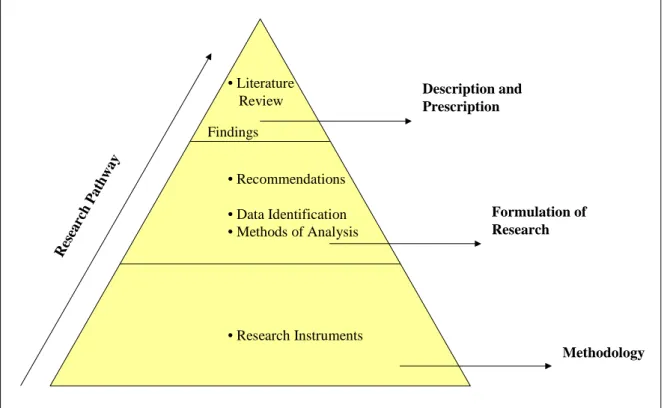
The organization of the process of this work is presented in the diagram be-low:
Figure 1: Framework of the research process
• Recommendations • Data Identification • Methods of Analysis • Research Instruments • Literature Review Findings Description and Prescription Formulation of Research Methodology Res earc h P ath way Source: Original. 2. Research Methodology 2.1. Introduction
The successful outcome of the report of any scientific study largely depends on, and is a direct function of, the quality and accuracy of data collected and used during the research. This chapter is concerned with the development of the logical framework of the research method. The development of the frame-work of the research methodology is based on the problem statement, hy-pothesis and objectives of the research, and the research questions. In fact it embraces the entire research up to the analysis and deduced conclusions. Al-though this paper is mainly general and theoretical in nature, it lays the basis
for a further and more empirical study of the subject matter – the role of mi-cro-financing in rural poverty reduction. This section discusses the approach adopted for data collection and analysis (the case study method), data classifi-cation and sources and the major instruments of data collection.
2.2. The Case Study Method
As I have earlier stated, this work is not strictly situational although the spatial aspect is addressed by reference to the developing countries in general and rural areas in particular. For the purpose of this paper, I have selected a num-ber of developing countries and briefly analyzed the operation of microfinance in the individual countries. I must make it clear here that there is danger in making any generalization on the basis of what has been discussed on the four countries, although to a very large extent, there are more commonalities than differences, and generalizations are made out of the extensive literature that has been reviewed and personal experience.
For the actual research in Ghana, I will have to adopt the case study method for the assessment of the impact of microfinance on the lives of the rural poor
in selected rural settings in the country. The case study method is a research method for empirical inquiry that investigates a contemporary phenomenon within the real-life context; it addresses a situation in which the boundaries between phenomena and context are not clearly evident, and uses multiple sources of evidence (Yin 1993) quoted by Richard Conteh (2001: 32). The issue of poverty reduction is a phenomenal one, which has to do with “why” and “how” questions and it involves a wide range of variables which the re-searcher has no control over. Outlining the way of live, interactions and at-tempts of the rural poor to escape poverty is a complex social phenomenon that can not easily be done by using quantitative or statistical analysis. It is because of this fact that the case study approach is deemed appropriate for this study, so that the descriptive element of the case study approach can explain those issues which mere statistical mean or standard deviation, for example, can not do. According to Conteh (2001: 32), case studies enable researchers to study in-dept peculiarities and idiosyncrasies that may shed light on the prominence of certain, hitherto uncovered, complex events and processes-most of which may escape statistical manipulations.
Although a real-life situation will be examined by the selection of villages and households for analysis, quantitative methods will have to be used along-side descriptive and explanatory analyses, where appropriate. To some extent, quantitative elements like percentages, ratios and graphs will be used to give more meaning to data analysis and interpretation. From the discussions above, it can be deduced that this researcher seeks to explore two contemporary phe-nomena of poverty and microfinance, and their relationship within the context of rural settings. The research deals with issues like norms, values, perceptions
of the poor and non-poor with regards to poverty and microfinance, and inter-actions between individuals and groups; factors which the researcher has little or no control over. A relevant issue that must be highlighted here is that this research is a people-centered one because it commences from the rural house-hold, the people directly affected. The people are made to identify their prob-lems and explain ways in which microfinance as a poverty reduction instru-ment can be made effective and sustainable.
2.3. Classification and Sources of Data
The traditional classification of data for an empirical study like this will be followed in this section. Both secondary and primary data sources will be used for data collection. The most important limitation to this paper is the data gap. It is in fact the reason why a general theoretical approach has been developed for this study. The fact that a field research can not be conducted reduces the whole exercise to developing a thesis proposal for the actual research phase in Ghana. This section therefore discusses formulation of the research frame-work, that is, how data collection and analysis for the actual thesis writing on this subject will be conducted.
2.3.1. Secondary Data Sources
Secondary data sources are the foundation on which the theoretical and con-ceptual framework of the research is built. Relevant literature from existing empirical studies and reports, district or regional records on microfinance and poverty reduction and records of organizations and institutions related to the microfinance sector and rural poverty reduction programs, are to be carefully reviewed.
2.3.2. Primary Data Sources
First hand data, in simple terms, will form the bedrock of explanations, gener-alizations, conclusions and recommendations for this research. Much emphasis will be placed on the collection of accurate and reliable data so as to be able to come up with objective evaluations and to make informed conclusions and judgments. In the light of the above, the following research instruments will be used.
Interviewing Key Informants
Key informants such as coordinators of microfinance institutions, regional or district development departments, members of civil society or community based organizations and non-governmental organizations will be interviewed. These interviews will be in-depth and open ended so as to be able to solicit as
much independent and objective information as possible. In the case of the community people sample households and individuals in the society will be selected at random and interviewed, using appropriate approaches to ensure a balance.
Personal participative observation
The researcher’s involvement in community activities where possible and touring of the research area will largely buttress data collected from interviews and by other means. Microfinance intervention projects will be the target of such observations.
Administration of Questionnaires
Although this research is based on the case study approach involving selected microfinance institutions (MFIs) and households, some quantitative analysis will be required. For this purpose, sets of questionnaires will be administered to coordinators of MFIs, NGOs and CBOs who are involved in microfinance provisions and rural poverty reduction programs in the area of study. A set of questionnaires will also be used for a sample group of microfinance clients in the selected areas.
3. Review of Relevant Literature
3.1. Introduction
This chapter of the study reviews empirical evidence on two crucial and con-temporary phenomena. The first issue is poverty in general and specifically rural poverty in developing countries. The second issue is the concept of mi-crofinance and mimi-crofinance services in countries of the developing world as instrument for rural poverty reduction or alleviation.
3.2. The Concept of Poverty in Developing Countries
In this section the concepts of poverty in general and rural poverty in particu-lar, on the one hand, and poverty reduction strategy on the other hand, which form the bedrock and focal point of this study, will be discussed in some de-tail.
3.2.1. Historical Perspective of Poverty
Poverty and efforts and the strategies to escape it are not new issues as is evi-dent in a good number of studies that have been undertaken at different stages in economic development history. According to Peter Townsend (1970: ix), in the mid-1950s a number of studies appearing in Britain showed that despite post-war social reforms, high taxation and low levels of unemployment, there
was poverty among old people, fatherless families, the unemployed and the sick. Up to that stage few people in any advanced industrial societies believed that, following the 1939 war, substantial poverty remained.
By 1960 public assumptions were transformed. Michael Harrington’s The Other America was published in 1959 and official studies in the United States showed that, according to new definitions which became widely accepted, more than a fifth of the population was living in conditions of poverty (Town-send 1970: ix). On the issue of poverty reduction, Town(Town-send further states that in 1964 the American war on poverty was launched, and throughout the early 1960s, in many parts of Europe, problems of squalor, deprivation and want were gradually acknowledged. In Britain two government studies of pension-ers and families with children, found substantial numbpension-ers living below subsis-tence standard which society had approved.
Unfortunately, well planned and calculated efforts to address the issues of poverty reduction are relatively new in so-called developing countries, espe-cially in most part of Africa and south Asia, where the poorest of the poor are found. Serious efforts to combat poverty in so-called developing countries date back to the later part of the last century.
3.2.2. Nature and Incidence of Poverty in Developing Countries
Poverty has no precise definition. It is a multi-dimensional phenomenon re-lated to the inadequacy or lack of social, economic, cultural, and political enti-tlements. Poverty is hunger. Poverty is lack of shelter. Poverty is being sick and not being able to see a doctor. Poverty is not being able to go to school and not knowing how to read. Poverty is not having a job, is fear for the future and living one day at a time. Poverty is losing a child to illness brought about by unclean water. Poverty is powerlessness, lack of representation and free-dom (World Bank 2000).
Poverty has many faces, changing from place to place and across time, and has been described in many ways. Most often, poverty is a situation people want to escape. So poverty is a call to action – for the poor and the wealthy alike – a call to change the world so that many more may have enough to eat, adequate shelter, access to education and health, protection from violence, and a voice in what happens in their communities (World Bank 2000).
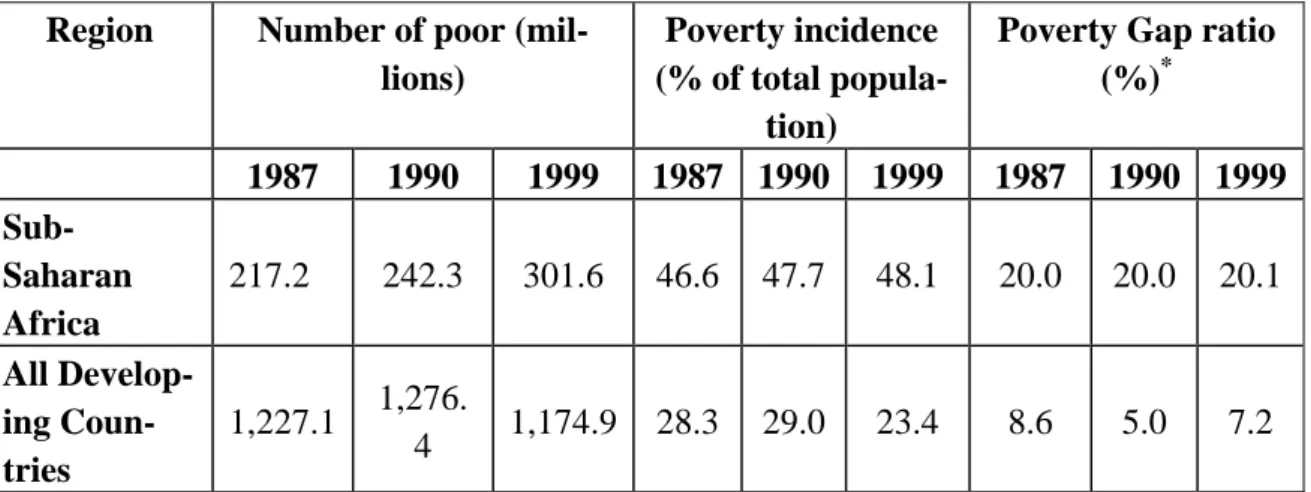
Globally, 1.2 billion people are living in extreme poverty. Nearly two thirds of them live in Asia; South Asia accounts for half of them. About one fourth of the extremely poor people live in Sub-Saharan Africa (IFAD 2001: 11). Ta-ble 1 below shows that Sub-Saharan Africa is one of the poorest regions in the world. When measured in terms of the US One Dollar per day poverty line, poverty seems to be on the increase in the region. The table also shows that the incidence of poverty in the rest of the developing regions slightly declined be-tween 1987 and 1999, when compared to Sub-Saharan Africa. Most
disheart-ening is the fact that, while poverty gap in the entire developing regions put together dropped to 7.2 %, the situation in Sub-Saharan Africa remained at a constant 20% (IFAD 2001: 14).
Table 1: Poverty Incidence and Poverty Gap-in Sub-Saharan Africa and the Rest of the Developing Regions
Region Number of poor (mil-lions)
Poverty incidence (% of total
popula-tion)
Poverty Gap ratio (%)* 1987 1990 1999 1987 1990 1999 1987 1990 1999 Sub-Saharan Africa 217.2 242.3 301.6 46.6 47.7 48.1 20.0 20.0 20.1 All Develop-ing Coun-tries 1,227.1 1,276. 4 1,174.9 28.3 29.0 23.4 8.6 5.0 7.2 Source: World Bank (2000).
Poverty is not just an issue of low income. Social factors must also be consid-ered in addressing the issue of poverty, although an improvement over time does not necessarily mean that the conditions of all the poor have improved. Social factors are usually measured through outcome indicators in health and education. Infant mortality, life expectancy, adult literacy and primary school enrolments are most often considered. Table 2 compares social indicators of West and Central Africa with those of the whole of Sub-Saharan Africa. It shows that social indicators for West and Central Africa have slightly im-proved but at an uneven rate. Female illiteracy in particular is shown to reduce over the period. The drop in life expectancy has been attributed by develop-ment experts to the impact of HIV/AIDS epidemic in the region over the pe-riod.
*
Poverty gap ratio (%) is the mean distance below the $1 (1993 PPP US$) a day pov-erty line, expressed as a percentage of the povpov-erty line. The mean is taken over the entire population, counting the non-poor as having zero pov-erty gap. The measure reflects the depth of poverty as well as its incidence.
Table 2: Selected Social Indicators: A Comparison of West and Central Af-rica and Sub-Saharan AfAf-rica
Indicators
West and Central Africa
1970 1980 1990 1999 Female Illiteracy Rate (% of total population) 90 81 71 54 Infant Mortality (no. of deaths per 1000 live
births)
150 126 108 88 Life Expectancy (years) 42 46 49 48 Primary School Enrolment (% of
school-going age children)
53 78 68 Not available Sub-Saharan Africa
Female Illiteracy (% of total population) 82 72 60 Not available Infant Mortality (no. of death/1000 live
births)
137 115 101 92 Life Expectancy (years) 44 48 50 47 Primary School Enrolment (% of
school-going-age children)
51 81 76 Not available Source: World Bank (2000).
To know what helps to alleviate poverty, what works and what does not, what changes over time, poverty has to be defined, measured, and studied, and even lived. As poverty has many dimensions, it has to be looked at through a vari-ety of indicators – levels of income and consumption, social indicators and now, increasingly, indicators of vulnerability to risks and of socio-political access. So far, much more work has been done using consumption or income-based measures of poverty, but some work has also been done on non-income dimensions of poverty.
According to Karen Brock and Rosemary McGee (2002: 45), the dynamics of poverty are complex and mostly not easy to explain only by using economic models such as price equilibrium, perfect competition, and surplus extraction and so on. However, there are many variables that may explain why people enter into, escape from, or remain in poverty over the short, medium and long terms. These variables interact in ways that are hard to understand and predict. Using the parameters of social change has become a very popular approach for analyzing poverty and its implications among people in societies. However, ‘the inherent complexity of processes of poverty-related social change would seem to call for detailed empirical studies of actual processes of change with a view to a better understanding of their underlying dynamics. Typically this is not how the analysis of poverty proceeds in economics.’ From the above, it can be inferred that the two approaches, economic analysis and social change analysis could be used to analyze poverty and its dynamics. Brock/McGee also
postulate that a major limitation of economic analysis of the poverty processes is its highly stereotype account of poverty processes which inform them.
The authors recommend the social change approach and express preference for the use of the Participatory Rural Appraisal (PRA) method. They argue that ‘in this context, PRA-type or the participatory analyses of poverty proc-esses have a central role to play in examining actual procproc-esses of social change and the forces that constrain or impel them. There are a number of spe-cial problems that arise, however, when attempting to draw policy conclusions from PRA-type analyses of poverty dynamics’ (Brock/McGee 2002: 45).
In participatory rural appraisal, a range of techniques borrowed from an-thropology and sociology are used to understand why people become poor and how their livelihoods change. Methods such as group discussions, semi-structured interviews and timelines and so on are used in this approach.
The great strength of participatory analyses of poverty is to focus attention squarely on actual, empirically informed processes of social change and the mechanism that generate them, as articulated by people experiencing them’ (Brock/McGee 2002: 46). A disadvantage of this process, however, is that the small-scale and local nature of the data generated by most of such analyses raises immediate questions about its applicability for drawing policy conclu-sions over a broader area. Questions may relate to comparability, reliability, generalizability, and casual weighting.
Contrarily, economic analyses of poverty, as stated earlier, relies on models which depict the flow of income and expenditure within an economy between production activities, factors of production (land, labor capital), institutions (households, firms and governments), capital accounts (investments and sav-ings) and external transactions. Additionally, indicators such as household welfare, per capita income and consumption, to name a few are used in eco-nomic analysis. Most critiques say development can not only be measured or seen from economic perspectives. The issue of inequality in the distribution of wealth within regions and countries, and even between countries has always been crucial.
On the issue of measurement of poverty, Tridiv Borah (2001: 16), states that, to address the human problems of poverty we need analysis, policies and programs. He further states that in order to conceptualize poverty, two things are required: a method of identifying a group of people as poor (identification) and a method of aggregating the characteristics of the set of poor people into an over-all image of poverty. Borah further asserts (2001: 17), that the identi-fication method involves the simple process of counting the number of the poor and then expressing poverty as the ratio of the number of the poor to the total number of people in the community in question. This ratio he refers to as the Head Count Ratio (HCR). Limitations are the failure of the method to take account of the extent and depth of poverty and its insensitivity to the
distribu-tion of income among the poor.
‘Poverty Line’ is the second method elaborated by Tridiv Borah. He de-scribes it as the cut-off point between the poor and the non-poor based on in-come or consumption on a per capita basis. A person is considered as poor when his measured standard of living is below the minimum accepted level, known as the “poverty line”. This line is said to be set in relative and absolute terms. Presently the US One Dollar per day per person is the international pov-erty line
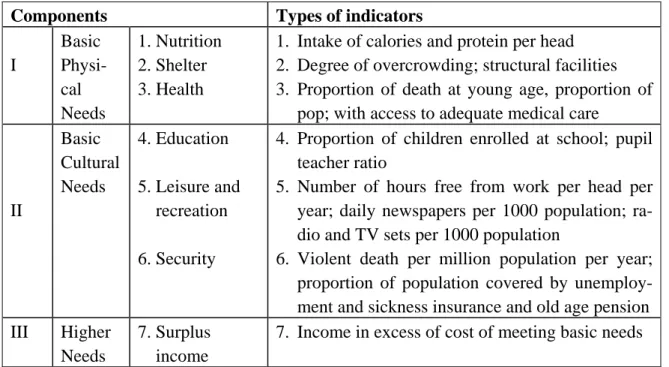
According to Peter Townsend (1970: 6), whether development is defined restrictedly in terms of economic variables alone or broadly to cover eco-nomic, social and political variables, there is a problem not only of selecting the variables, but of relating variables of different weights, many of which may not be quantifiable. If a broad definition is adopted, how would the indi-cator for higher education be weighted with that of the number of inhabitants per physician? Table 3 below is a summary of a broad definition established on behalf of the United Nations Research Institute for Social Development (UNRISD) by Drewnowsk/Scott (1966). In the table, the index represents an attempt to produce an operational definition of social development. Level of Living is defined as, ‘the level of satisfaction of the needs of the population assured by the flow of goods and services enjoyed in a unit of time’ (Town-send 1970: 6). The authors give equal weight to the entire variables and de-clare that any weighting applied to them will be arbitrary.
Table 3: Level of Living Index
Components Types of indicators I Basic Physi-cal Needs 1. Nutrition 2. Shelter 3. Health
1. Intake of calories and protein per head 2. Degree of overcrowding; structural facilities 3. Proportion of death at young age, proportion of
pop; with access to adequate medical care II Basic Cultural Needs 4. Education 5. Leisure and recreation 6. Security
4. Proportion of children enrolled at school; pupil teacher ratio
5. Number of hours free from work per head per year; daily newspapers per 1000 population; ra-dio and TV sets per 1000 population
6. Violent death per million population per year; proportion of population covered by unemploy-ment and sickness insurance and old age pension III Higher
Needs
7. Surplus income
7. Income in excess of cost of meeting basic needs Source: Drewnowski/Scott (1966: 44-45).
3.2.3. Types of Poverty
There are different types of poverty. Lack of money or limited income ( in-come poverty) is common to any definition of poverty. When we think of poverty we may think of starving people, living without proper housing, cloth-ing or medical care – people who struggle to stay alive (Sen 1984). This is known as absolute poverty. Most people in the developing nations, especially Sub-Saharan Africa and South Asia, experience this type of poverty.
Unlike developing countries, the type of poverty experienced in developed countries, is more usually called relative poverty. In this case, people are con-sidered to be living in poverty if their standard of living is substantially less than the general standard of living in society. The national anti-poverty strate-gies of governments must reflect this: that people are living in poverty if their income and resources (material, cultural and social) are inadequate to preclude them from having a standard of living that is regarded as acceptable by the society generally. As a result of inadequate income and resources, people may be excluded and marginalized from participating in activities that are con-sidered the norm for other people (Sen 1984: 335).
Relative poverty is made up of two key elements: income poverty and dep-rivation. The combination of these two elements is called consistent poverty. The focus of this paper is on both income poverty and absolute poverty ex-plained above. These two types of poverty remain to be the main type of pov-erty in most developing countries, especially South Asia and Sub-Saharan Af-rica.
3.2.4. The Concept of Rural Poverty and Poverty Reduction Strategy
3.2.4.1. Meaning of “Rural”
In order to put rural poverty into a theoretical concept, it is first pertinent to establish what is meant by rural. The problem of defining “rural” is not new. In most cases authorities have to make difficult decisions on how to allocate resources on some quantifiable basis. However, it must be noted that numbers are not adequate to define rural because they miss the essence of what it means to be rural, and seldom satisfy those on the receiving end of the definition (Rios 1988: 1).
There is no concise and generally accepted definition of rural and I will make no attempt here to provide one. My intention is to show the complexity of the problem of defining rural and to provide some examples of definitions used by other people and agencies in order to make this exercise operational.
Developing a definition for rural has been a problem for some time. For ex-ample, in an analysis of 178 rural mental health workers and sociology sources published from 1971 through 1980, 43% did not define the “rural” they
dis-cussed, 48% used local or “homemade quantitative” definitions, and 23% used “external quantitative” definitions, such as census data (Bosak/Perlman 1982) quoted by Rios (1982: 1).
Quantitative definition of rural restricts the meaning to the number of peo-ple in a geographical area. According to Whitaker (1982), “rural” was first used by the United States Bureau of Census in 1874 when it was defined as indicating the population of a country exclusive of any to cities or towns with 8,000 or more inhabitants. This specific definition was dropped over the years by the 1980 Census. In this piece of work, emphasis is placed on the qualita-tive definitions of rural which considers major features such as simple life, agriculture, smallness, homogenity, and dullness.
3.2.4.2. Rural Poverty in Developing Countries
Rural poverty is a complex problem that has several characteristics: low in-comes, low consumption resulting from low productivity, inequality in owner-ship and access to productive assets, poor health and education, degradation of natural resources, vulnerability to risk, and weak political power. Despite their importance, rural areas tend to be neglected and problems have been dealt with on an ad hoc basis. Rural poverty is heterogeneous, resulting variously as it does from lack of opportunity, of empowerment, and of security.
In its Rural Poverty Report 2001 – The Challenge of Ending Rural Poverty – the International Fund for Agricultural Development (IFAD), states that three quarters of the world’s 1.2 billion extremely poor people live and work in rural areas (2001: 1). Tridiv Borah (2002: 26), quoting Chambers et al, states: “The challenge is the scale and awfulness of rural poverty in India. There are other countries where poverty and suffering is immense and pros-pects grim, but India has one sixth of humankind, and nowhere outside India is there such a concentration of so many rural people who are so poor. In 1988, perhaps more than 200 million rural people were below the ‘poverty line.’”
In Volume 37, December 2000 edition of “The FINANCE,” a quarterly magazine of the International Monetary Fund (IMF), Mahmood Hassan Khan writes under the topic – Rural Poverty in Developing Countries – that rural poverty accounts for nearly 63 percent of poverty world wide, reaching 90 percent in China and Bangladesh, and between 65 and 90 percent in Sub-Saharan Africa. Khan maintains that in all countries, conditions – in terms of personal consumption and access to education, health care, portable water and sanitation, housing, transport, and communications – faced by the rural poor are far worse than those faced by the urban poor. The article, Rural Poverty in Developing Countries, goes further to postulate that persistently high levels of rural poverty, with or without overall economic growth, have contributed to rapid population and migration to urban areas; and that, in fact, much urban poverty is created by the rural poor’s effort to get out of poverty by moving to the cities
The IFAD report (2001: 25), mentioned earlier in this section, states that the rural poor are disadvantaged by remoteness, lack of education and health care, insecure and unproductive jobs, high fertility and (often) discrimination as women or ethnic minority.
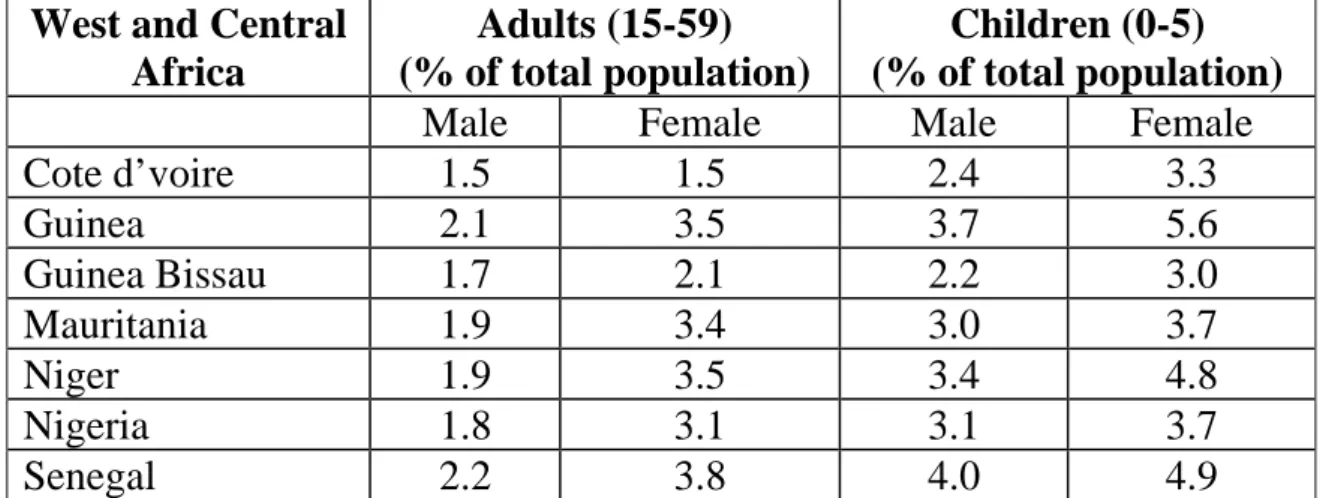
IFAD argues that the rural poor, especially women, normally have higher age-specific mortality rates than the non-poor. It also states that the population of malnourished children in the bottom quintile is typically twice in the top (see table 4 below).
Table 4: Poor/Non-poor Mortality Ratios (Selected West and Central African Countries)
West and Central Africa
Adults (15-59) (% of total population)
Children (0-5) (% of total population)
Male Female Male Female
Cote d’voire 1.5 1.5 2.4 3.3 Guinea 2.1 3.5 3.7 5.6 Guinea Bissau 1.7 2.1 2.2 3.0 Mauritania 1.9 3.4 3.0 3.7 Niger 1.9 3.5 3.4 4.8 Nigeria 1.8 3.1 3.1 3.7 Senegal 2.2 3.8 4.0 4.9 Source: IFAD 2001.
In economic terms, the rural poor depend largely on agriculture, fishing and forestry, and related small-scale industries and services. Some authors have classified the rural poor into two economic-related groups namely, cultivators and non-cultivators. Cultivators are described as those who have access to land as small landowners and tenants, and non-cultivators as landless, unskilled workers. Several authors (including Jaizary et al 1992; Ghaiha/Deolalikar 1993) have come up with factors both internal and external which influence, create and perpetuate rural poverty. Among these factors are;
• Grossly inadequate physical infrastructure such as roads, electricity and water supply systems;
• Political instability and civil strife;
• Systematic discrimination on the basis of gender, race, ethnicity, religion, or caste;
• Ill-defined property rights or unfair enforcement of rights to agricultural land and the natural resources;
• Corrupt politicians and rent-seeking public bureaucracies;
• Economic policies that discriminate against or exclude the rural poor from the development process;
• Large and rapidly growing families with high dependency ratios;
• Market imperfection owing to the high concentration of land and other as-sets and the distortion public policies;
• External shocks stemming from natural causes (for example, climatic changes) and changes in the international economy.
This discussion has basically focused on the incidence of rural poverty in de-veloping countries, principally because the developed countries have almost, if not completely overcome the type of chronic and excruciating poverty rural people in developing countries are now experiencing. The experiences are quite different. For instance, according to Niles M. Hansen (1970: 31), in March 1967, about 57 million persons lived in rural America. Of this total, 47 million were in the non-farm population. Since World War II the average number of persons engaged in agricultural production has dropped from 10 million to about 5.2 million. Of these, about three-fourths are farm operators and members of their families; the rest are hired workers. This is just an indi-cator that the characteristics of the rural settings in the developed countries are at great variance with those of the developing countries in general, and much more greater for those of the least developed countries (LDCs) in particular.
3.2.5. Rural Poverty Reduction Strategies in Developing Countries
After comprehensively dilating on poverty in general and rural poverty in par-ticular, the next most important question is: how do households escape from poverty and enjoy all the other benefits of development? IFAD (2001: 15), asserts that the majority of the world’s poor are rural and will remain so for several decades. Poverty reduction programs must therefore be refocused on rural people if they are to succeed. Poverty is not gender neutral: women enjoy less access to, and control over, land, credit, education, technology, health care, and skilled work. Therefore, a meaningful and sustainable rural poverty development program must aim at promoting knowledge and learning for in-creased rural well-being and broad-based rural development that takes into account all dimensions of poverty in rural areas. The multidimensional nature of poverty and its specific characteristics in a rural context require a compre-hensive approach to rural poverty reduction that accounts for changes in to-day’s development context: the new situation created by the forces of global-ization, the challenges of decentralglobal-ization, institutional development, inade-quate governance, the increased role of the private sector and civil society, as well as the rising number of conflicts.
In the 2001 Assessment of Rural Poverty - West and Central African
re-gions by the International Fund for Agricultural Development (IFAD), it is
observed that during the 1990s, in Africa and elsewhere, “getting prices right” became the overarching theme for advocates of structural adjustment. In the
late 1980s and early 1990s, as adjustment efforts stalled in many countries – sometimes exacerbating social tensions – and researchers began to detect dif-ferential impacts of adjustments on social groups, poverty problems became more visible and calls for social safety nets became more pronounced (IFAD 2001: iii). Worst still, governments and the international community regarded safety nets as charities and instruments for buying political stability. They failed to recognize the essence of making poverty reduction the central theme of economic and social development efforts.
The good news is that, from the mid 1990s to date, the development com-munity has recognized the dire need for poverty reduction. This became evi-dent when the United Nations General Assembly adopted Resolution 47/196
in 1992 recognizing that an increase in public awareness was necessary in or-der to eradicate poverty around the world and declared 17th October the International Day for the Eradication of Poverty (IDEP). In a similar vein, in 1995, the World Social Summit placed poverty reduction on the global devel-opment agenda, resulting in the decision to halve global poverty by 2015. This position was re-enforced by the Millennium Summit in 2000, where it was emphasized by governments and international donors that development can only be sustainable – socially, economically and politically – when poverty reduction is explicitly taken into account.
These affirmations have been followed by actions by both international and bilateral donor organizations. In module one of the series An overview of
Pov-erty Reduction Strategy, published by the Asian Development Bank Institute,
Sheila Marnie (2004: 1) explains that the World Bank and the International Monetary Fund have made the preparation of national Poverty Reduction Strategy Papers (PRSPs), a prerequisite for concessional lending. United Na-tions organizaNa-tions are working on setting country targets and indicators for the Millennium Development Goals; income and non-income targets that should be fulfilled by 2015. The African Development Bank (ADB) has de-clared poverty reduction as its prime objective, and like other international donor organizations, has adopted the Millennium Development Goals as prin-cipal target for poverty alleviation.
The three major ways in which policies affect the rural poor are: through markets, infrastructure (including public services), and transfers. The markets, in which the rural poor participate are those for products, inputs (labor and non-labor), and finance (formal and informal sources). The infrastructure that directly affects the rural sector’s productivity and the rural poor’s quality of life include the economic (transport, communications, extension services, and irrigation) and social services (education, health care, sanitation and water). Quality of service: access of the rural poor to public services and infrastruc-ture has important impacts on human capital and productivity in rural areas. Public transfers can take the form of redistribution of assets, like land,
em-ployment on public works and projects, and targeted subsidies for inputs and some consumer products (Khan 2000: 5).
Although in early years, several different approaches were taken by differ-ent countries as measures for poverty reduction, national Poverty Reduction Strategy Papers (PRSPs) have become prevalent in recent years because of the position taken by the World Bank and International Monetary Find (IMF) on poverty reduction in poor countries. PRSPs are a requirement for countries in order to receive concessional assistance from the World Bank (through the International Development Association) and the IMF (through the Poverty Reduction and Growth Facility). They are also a basis for the provision of debt relief under the enhanced Highly Indebted Poor Countries (HIPC) Initiatives. Seventy low income countries around the world have PRSPs on their agenda (World Bank Group-Poverty Net, http://www.worldbank.org/poverty). In or-der not to delay their access to concessional assistance, very poor countries that have not developed a full Poverty Reduction Strategy Paper are allowed to prepare Interim Poverty Reduction Strategy Papers (I-PRSP).
According to the World Bank Group-Poverty Net, the core principles under-lying the preparation and implementation of PRSP should include the follow-ing:
• A description of the participatory process that was used: A PRSP will de-scribe the format, frequency, and location of consultations; a summary of the main issues raised and the views of participants; an account of the im-pact of the consultations on the design of the strategy; and a discussion of the role of civil society in future monitoring and implementation.
• Comprehensive poverty diagnostics: A good understanding of the poor and where they live allows the PRSP to analyze the macroeconomic, social, structural and institutional constraints to faster growth and poverty reduc-tion.
• Clearly presented and costed priorities for macroeconomic, structural and social policies: In light of a deeper understanding of poverty and its causes, the PRSP sets out the macroeconomic, structural and social policies that together comprise a comprehensive strategy for achieving poverty re-ducing outcomes. It is important that policies are costed and prioritized as far as possible so that they do not become a "wish list."
For the most part, I-PRSPs and PRSPs, to date have focused on economic and structural policies to achieve higher growth rates and on social sector invest-ments (World Bank). A Joint Staff Assessment (JSA) team, comprising na-tional staff and staff of the World Bank and the IMF evaluates the soundness of each PRSP, and accompanies the PRSP to the Boards of Executive Direc-tors of the World Bank and IMF. This document is an assessment of whether or not the strategy presented in the Poverty Reduction Strategy Paper consti-tutes a sound basis for concessional assistance and debt relief. It should be
noted that a positive Joint Staff Assessment does not signify agreement with all the analysis, targets, or public actions included in the PRSP or that the PRSP represents the best possible strategy for the country. Rather, it indicates that the PRSP is a credible framework which the World Bank and IMF will support.
Besides the World Bank and the IMF, almost all external development part-ners have expressed their strong support for the objectives and principles of the PRSP approach, their eagerness to work with governments in preparing strategies, and their intention to adjust their own programs to support these strategies. For example, the European Union decided to base its five-year as-sistance programs in African, Caribbean, and Pacific countries on PRSPs. Key bi-lateral donors, including the Netherlands and the United Kingdom, see PRSPs as playing a leading role in shaping their development assistance. Many governments have begun to use the PRSP process as a means to im-prove aid coordination. To this end, certain countries have presented their strategies to donors (Burkina Faso and Uganda). The PRSP approach has its own challenges. These include tensions that were recognized from the begin-ning as inherent. The most important of these are the tension between quality and speed in preparing country strategies; and between country ownership on the one hand and the World Bank and IMF assessment of country strategies on the other. The World Bank Group-Poverty Net (WBG-PN 2000) explains the aforementioned challenges of PRSPs as follows;
The “quality versus speed” tension is related to two competing needs – the need to ensure that country-owned strategies are based on broad-based partici-pation and effective analysis, versus the goal of moving forward quickly with strategy preparation so as to enable access to concessional assistance and debt relief. This tension is alleviated by the use of Interim-PRSPs, which do not require the participatory processes or the degree of analysis expected for full PRSPs. However, both countries and development partners have become in-creasingly concerned about the time required to move from I-PRSPs to full PRSPs. To give countries more time where needed, the World Bank and IMF have recently modified the original expectation that a full strategy be com-pleted within a year of I-PRSP preparation. The government will need to sub-mit a short progress report to the World Bank and IMF, providing a revised submission date and outlining the progress made to date since the I-PRSP.
The “ownership versus assessment” tension reflects two competing prin-ciples – that strategies genuinely reflect country priorities, but that the Bank and Fund ensure, on behalf of their shareholders, that concessional assistance and debt relief will be wisely used in a policy environment and for purposes that promote poverty reduction. This tension can be reduced by a constructive policy dialogue with countries, openness on the part of the Bank and IMF to countries’ “home-grown” approaches, and the exercise of good judgment in
light of specific country conditions and international experience (World Bank Group-Poverty Net 2004).
The essence and appropriateness of the Poverty Reduction Strategy Papers to developing countries in their quest to reduce/alleviate national and rural poverty is that PRSPs are all inclusive and places emphasis on full participa-tion of all stakeholders including the rural communities.
3.3. The Concept of Microfinance in Developing Countries
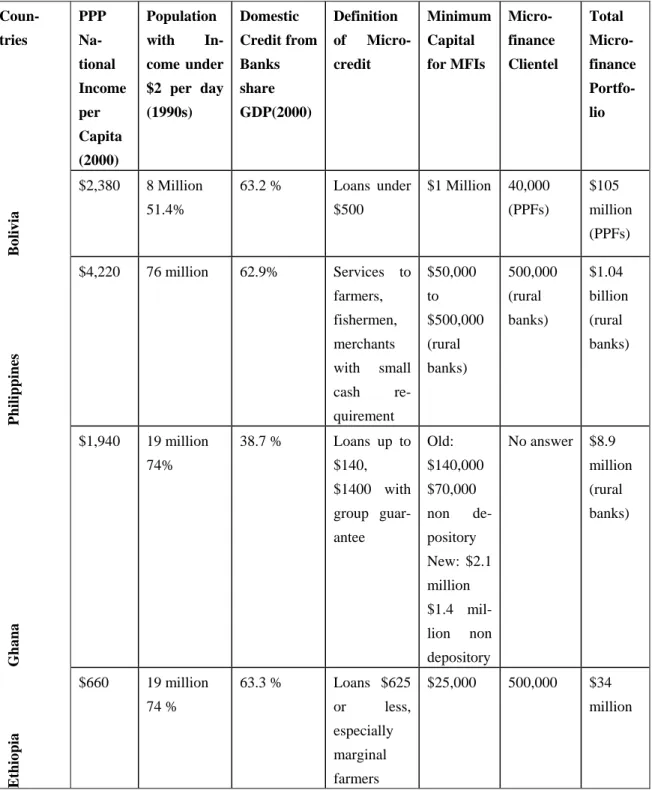
A conceptual and theoretical framework of microfinance in developing coun-tries is the subject of this section. Existing literature and available empirical data relevant to the purpose of this study will be reviewed with the aim of cre-ating a meaningful link between the problem statements, hypothesis and ob-jectives of the study and the research questions. I will examine microfinance issues in four countries selected arbitrarily in Asia, South America and Africa.
3.3.1. Nature and Scope of Microfinance in Developing Countries
In a strict sense, micro-credit and microfinance do not mean the same thing. While micro-credit may have a narrower meaning (the provision of small loans), microfinance extends beyond just providing loans. To most people, microfinance means providing very poor families with very small loans (mi-cro-credit) to help them engage in productive activities or grow their tiny businesses. Over time, microfinance has come to include a broader range of services such as savings, credits, insurance, and remittances from abroad and other related products. “We have come to realize that, the poor and the very poor, who lack access to traditional and formal financial institutions, require a variety of financial products” (Microfinance Gateway; www.microfinance-gateway.org). In this piece of work much attention will not be paid to the strict technical difference between the two terms, and so I will use them inter-changeably. For ease of presentation and for the purpose of this paper, the working definition of microfinance or micro-credit will be the lending out of small amounts of money for short periods with frequent repayment, rural sav-ings scheme, insurance services, and other related services such as money transfers and payments.
In one way or the other, almost every country in the world has seen the need to adapt its structure of financial services to improve outreach to the many as yet “unbanked” people and enterprises. This was the genesis of thrift institu-tions, local savings associations and cooperatives across the world over the rest of the century and more. The same need motivated the rise of formal Mi-crofinance institutions in developing countries since the Grameen Bank came into being in the 1970s. Patrick Meagher (2002: 1) asserts that microfinance across the world began variously as the activities of informal savings and