Pipelines
A Thesis
Submitted to the Faculty of
Drexel University by
Josep Valls Vargas in partial fulfillment of the requirements for the degree
of
Doctor of Philosophy December 2017
Josep Valls Vargas.
This work is licensed under the terms of the Creative Commons Attribution-ShareAlike 4.0 International license. The license is available at
Acknowledgments
First and foremost, I would like to thank my advisors, Dr. Santiago Ontañón and Dr. Jichen Zhu for all their guidance and support over the last few years. Then, the members of my PhD dissertation committee, Dr. David Elson, Dr. Mark Riedl, and Dr. Dario Salvucci. Additionally, I would like to thank Dr. Marcello Balduccini, Dr. Christopher Geib and Dr. Rachel Greenstadt for their involvement and valuable feedback in the candidacy and proposal stages of my PhD, and Dr. Michael Mateas and Dr. Luc Lamontagne for their mentorship and support earlier in my PhD. I would also like to thank Dr. Mark Finlayson, who kindly shared his translated corpus and annotations with us, and all the authors, researchers and scholars whose work I referred to throughout this dissertation. I should not forget all my colleagues, friends and family who supported and encouraged me through this journey. They all contributed to this dissertation and I would not had been able to finish it without them.
Finally, I would also like to thank all the administrative personnel who supported me and my fellow graduate students; the social organizations that kept us sane; and the amazing staff from the recreation athletics center that kept us healthy. All their work is often forgotten but has been an integral part of the last few years of my life.
Contents
List of Tables . . . ix
List of Figures . . . xiii
Abstract . . . xvi
1. Introduction . . . 1
1.1 Open Problems . . . 2
1.2 Thesis Statement . . . 4
1.3 Organization . . . 5
2. Background and Related Work. . . 7
2.1 Natural Language Processing . . . 7
2.1.1 Segmentation, Chunking and Tokenization . . . 8
2.1.2 Morphological Analysis. . . 8
2.1.3 Part-Of-Speech (POS) tagging. . . 9
2.1.4 Grammatical and Syntactic Parsing. . . 9
2.1.5 Named Entity Recognition (NER) and Information Extraction (IE) . . . 10
2.1.6 Coreference Resolution . . . 11
2.1.7 Semantic Role Labeling (SRL). . . 11
2.1.8 Word Sense Disambiguation, Common Sense and Domain Knowledge . . . 11
2.1.9 Natural Language Processing Pipelines . . . 12
2.1.10 Natural Language Generation . . . 13
2.1.11 Neural Networks . . . 14
2.2 Narrative . . . 15
2.2.1 Narratology . . . 15
2.2.2 Computational Narrative. . . 17
2.3.1 Annotating Narratives . . . 18
2.4 Applications. . . 20
2.5 A Taxonomy of CN. . . 26
2.5.1 Narrative Generation and Storytelling . . . 26
2.5.2 Narrative Analysis and Narrative Information Extraction . . . 29
2.5.3 Statistical Models . . . 31
2.6 Information Extraction. . . 32
2.6.1 Automatically Extracting Narrative Information . . . 33
2.6.2 Evaluation of NLP Pipelines. . . 35
3. Proppian Stories . . . 37
3.1 Corpus of Russian Stories . . . 38
3.2 Synthetic Dataset. . . 44
3.3 Discussion . . . 47
4. Automated Narrative Inf. Extraction . . . 48
4.1 Infrastructure: Voz . . . 50
4.2 Extracting Mentions . . . 52
4.3 Identifying Characters . . . 54
4.3.1 Verb Extraction . . . 55
4.3.2 Computing Features from Extracted Mentions . . . 56
4.3.3 Case-Based Reasoning . . . 60
4.3.4 Extending Mention Classification . . . 65
4.3.5 Improving Mention Classification . . . 66
4.4 Identifying Narrative Roles . . . 68
4.5 Improving Coref. Resolution. . . 73
4.6 Narrative Functions . . . 80
4.7 Dialogue Participants . . . 91
4.7.2 Evaluating IE with Dialogue. . . 104 4.8 Discussion . . . 105 5. Evaluation of IE Pipelines . . . 107 5.1 Systematic Methodology . . . 108 5.2 Evaluating Voz . . . 110 5.2.1 Incremental Dataset . . . 110
5.2.2 Individual Module Evaluation . . . 111
5.2.3 Error Propagation . . . 116
5.3 Discussion . . . 120
6. Non-linear IE Pipelines . . . 123
6.1 Probabilistic Inference . . . 123
6.1.1 Module Outputs to Probability Distributions . . . 124
6.1.2 Aggregating Probability Distributions . . . 125
6.2 Feedback Loops in Voz . . . 127
6.2.1 Coreference Resolution . . . 132
6.2.2 Verb Argument Extraction. . . 133
6.3 Discussion . . . 134
7. Bridging the Gap . . . 135
7.1 End-to-end Computational Narrative Systems . . . 135
7.1.1 Mapping Computational Narrative Models . . . 136
7.2 Connecting Voz and Riu . . . 138
7.2.1 Riu . . . 139
7.3 Evaluation of Riu’s Output . . . 145
7.3.1 Analytical Evaluation . . . 145
7.3.2 Empirical Evaluation . . . 150
7.4 Discussion . . . 159
8. Conclusions and Future Work . . . 162
8.1 Dissertation Summary . . . 163 8.2 Contributions . . . 166 8.3 Discussion . . . 170 8.4 Future Work . . . 172 Bibliography . . . 176 Appendix A: Publications . . . 187
A.1 Journal Articles. . . 187
A.2 Peer-Reviewed Conference Proceedings . . . 187
A.3 Workshops. . . 188
A.4 Other Peer-Reviewed Publications . . . 188
Appendix B: User Study on Connecting Voz+Riu . . . 190
Appendix C: Narrative Functions Identified by Propp . . . 197
C.1 Tables . . . 197
Appendix D: Alexander Afanasyev’s Stories . . . 200
D.1 Story Titles . . . 200
Appendix E: Story-based PCG. . . 207
E.1 Story-based Procedural Content Generation . . . 207
E.1.1 Experimental Evaluation . . . 218
E.2 Conclusions and Future Work . . . 221
List of Tables
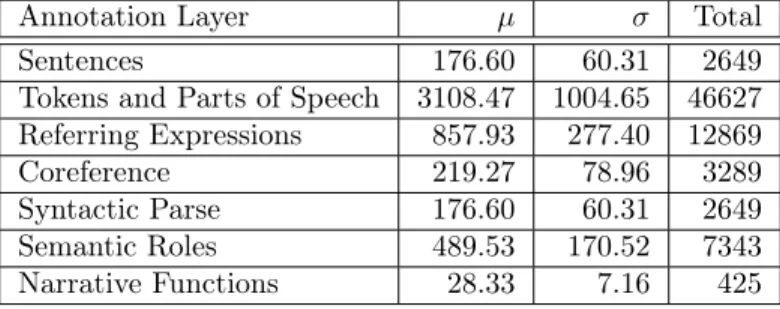
3.1 Annotation present in Finlayson’s 15 story dataset that we use in our work and the number of annotations for each.. . . 42
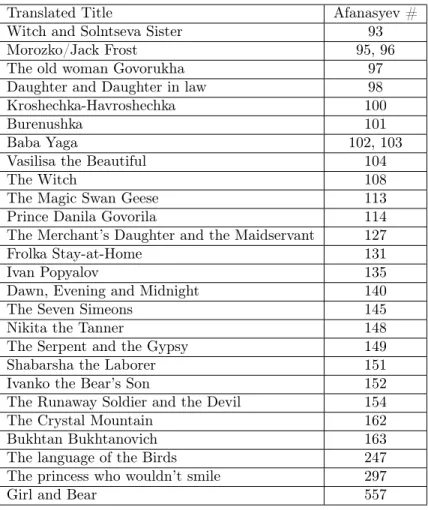
3.2 Stories in our dataset. The second column lists the numerical identifier of the stories in the new Afanasyev collections. . . 45
3.3 Annotation present in Finlayson’s 15 story dataset that we use in our work and the number of annotations for each.. . . 47
4.1 Performance of the different distance measures over the complete dataset (1122 instances) measured as classification accuracy (Acc.), Precision (Prec.) and Recall (Rec.). . . 63
4.2 Performance of the different distance measures over the filtered dataset removing the instances that contain personal pronouns measured as classification accuracy (Acc.), Pre-cision (Prec.) and Recall (Rec.).. . . 64
4.3 Performance of theSwJdistance measure with different feature subsets: Acc. onlyreports
the accuracy only using features of a given type, andAcc. all exceptreports the accuracy using all the features except the ones of the given type. N reports the number of features of each type. . . 65
4.4 Confusion matrix for predictions in the 15 class labels in our classification process with counts for all the 21 stories using the leave-one-story-out protocol. The two letter la-bels stand for (from top to bottom): “N/A” for parsing errors, AA: anthropomorphic animal character, AN: animal (non-character), AO: anthropomorphic object character, FE: female character, GR: group of characters, HA: happening, MA: male character, MB: magical being character, OB: object or prop, PA: part of characters, PO: part of non-characters, SC: scenery that is mentioned, SS: locations that the characters visit, and ST: temporal references. Bold face indicates correct predictions (diagonal) and the color gradient illustrates the normalized value over the total count of instances for each class. . . 67
4.5 Effect of coreference information on the majority voting processes. Rows report results without coreference information, using the automatically computed coreference graph and using the coreference from the ground truth. The columns report the accuracy, precision and recall on the binary classification task. Note that the dataset used for this experimental evaluation is larger than the one used in the results reported in Tables 4.1 and 4.2. . . 68
4.6 One of the role-action matrices used in our experiments. The largest one is7×7, with 506 verbs. . . 70
4.7 Averaged performance results of our role assignment using the topmost assignment versus weighting all the assignments in the last iteration. . . 73
4.8 Performance of the first three iterations ofVoz using 6 role classes. Last two rows display the theoretical upper bound using the ground truth and a random baseline. . . 78
4.9 Performance of the first three iterations ofVoz using 3 role classes. Last two rows display the theoretical upper bound using the ground truth and a random baseline. . . 78
4.10 Performance comparison with different weights for m5, built form the feed back role
information. . . 80
4.11 Enumeration of the narrative functions for our experimental evaluation (|F|= 34). The table includes the symbols Propp used to refer to them, and the total number of instances in our dataset of 15 stories. The third column is the total number of instances annotated, the fourth column, the number of those that are actually realized in the text (i.e., explicit) and the fifth column the number of instances once the direct speech (e.g., dialog) is filtered out. . . 82
4.12 Classification accuracy obtained in different scenarios. The first five columns describe which predictors were used. The remaining three columns report the classification accu-racies for narrative function predictions in three different scenarios. The last row shows the accuracy obtained by predicting the most common function in the dataset. . . 89
4.13 Results on theManual Russian Storiesdataset for several approaches concerning: number of patterns generated, the number of patterns after pruning, the accuracy in predicting thespeaker,listener and their weighted average for each quote and the coverage for the same slots. . . 103
4.14 Comparative between the scenarios without using and using the dialogue participant information extracted by the work described in this section. The triplets column reports the number of triplets available for the Narrative Function Identification module to use. The remaining two columns are the accuracy and number of functions identified. The last row reports the total annotations present in the dataset. . . 106
5.1 Character’s actions: Performance of the verb extraction when checking the verb, the verb and its subject, and the verb, subject and object arguments. # in GT is the number of expanded triplets in the ground truth. . . 114
5.2 Results of the character identification process (m5) using the ground truthGT1 and the
automatic process of processing the input with the mention extraction module (GT0+m1). 117
5.3 Effect of the verb features (from m3) on the character and role identification processes
(m5 andm7). Rows report results using the automatically extracted verb features (m3),
using the verb features from the ground truth GT3, and completely removing the verb
features (GT4w/o Verbs). . . 118
5.4 Effect of coreference information (from m2) on the majority voting processes (m6 and
m8). Rows report results without coreference information, using the automatic
corefer-ence (m2) and using the coreference from the ground truth GT2. . . 118
6.1 The first three rows report the performance of the coreference resolution task on three aggregation scenarios: 1) the first run through the pipeline (m1, . . . , m4), the aggregation
used in the iterative feedback loop (usingm1, . . . , m6), and 3) an aggregation where we
replace m5 and m6 with the ground truth variants m5GT and m6GT. The next eight
rows report the individual performance of the parallel modules. The goal is to achieve
|Gr|= 258withC/Gr= 1andGr/C= 1. . . 131
6.2 The first three rows report the performance of the verb extraction task on three aggre-gation scenarios: 1) the first run through the pipeline (m7), 2) the aggregation used in
the iterative feedback loop (m7+m8) and 3) an aggregation where we replace m8 with
the ground truth variant m8GT. The next three rows report the individual performance
of the modules. |Rel|= 11321 is the target. . . 134
7.1 Number of responses, average and spread of the overall scores for each of the scenarios included in the questionnaire. N=90 participants, 1678 data points. Figure 7.5 provides a visual representation of this data.. . . 156
7.2 Average score and spread for each scenario (columns) and the 4 follow-up questions (rows) included in the questionnaire. Scores have been normalized and inverted for the third and fourth question (higher is better). N=90 participants, 1678 data points. Figure 7.6 provides a visual representation of this data. . . 156
7.3 Counts for codes and example instances for comments where they are instanciated. The numeric columns stand forOriginal,Annotations+Riu,Voz+Riu,LSTM, andTotal. . . 160
D.1 Relationship of numbered Alexander Afanasyev’s stories used in Propp’s work and their titles. The last column provides correspond to freely available sources from Project Gutenberg. . . 200
E.1 Planning results for different experiments. |P| is the number of plot points, |L| is the number of locations, |K|is the number of paths or edges in the spatial configurationE,
Gis the number of goals and|SE|is the number of stories found. . . 220
E.2 Number of stories found (|SE|) in a series of spatial configurations, and their evaluation
List of Figures
2.1 Part-Of-Speech (POS) tagging example. . . 9
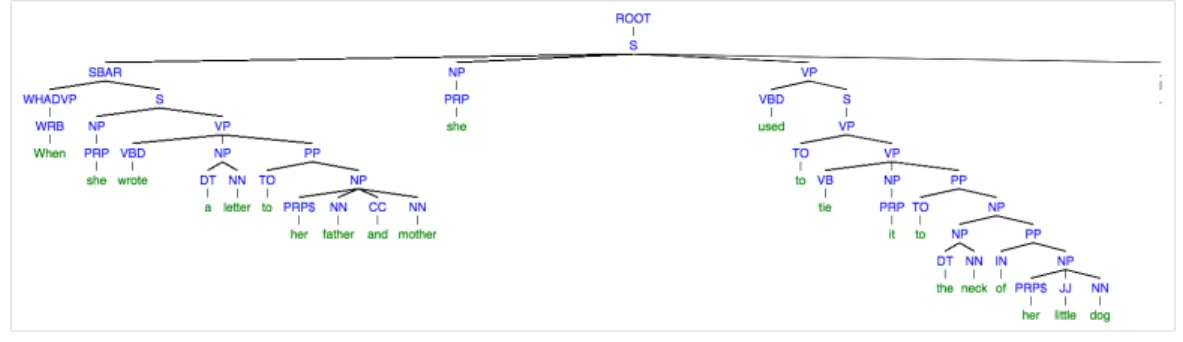
2.2 Syntactic parse example.. . . 10
2.3 Pronominal coreference resolution example. . . 11
2.4 Example of a template that could be used to generate natural language text. Tokens starting with a colon are placeholders for substituting the relevant information to be shown to the final user. . . 14
2.5 Chatman’s taxonomy of narrative elements. In Chatman’s work, plot is also referred as story orcontent; discourse is also referred asexpression. . . 17
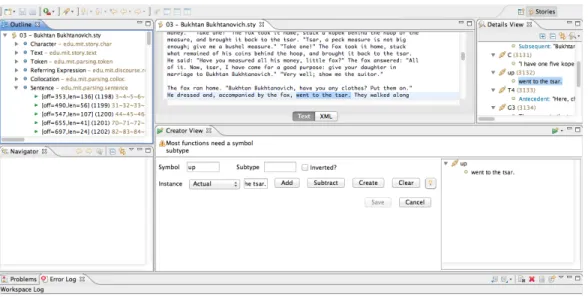
2.6 Screenshot of the Story Workbench annotation tool by Finlayson1. . . . . 19
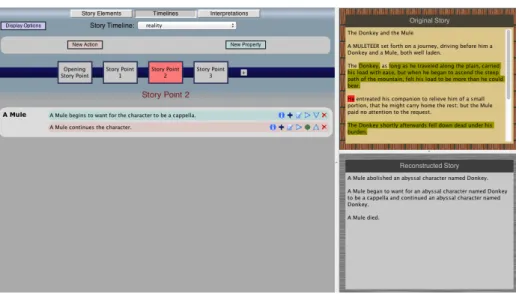
2.7 Screenshot of the Scheherazade annotation tool by Elson2. . . . . 20
2.8 An excerpt of the story format used by Riu3;4. . . . . 21
2.9 An excerpt of an example story generated by Tale-spin5. . . . . 22
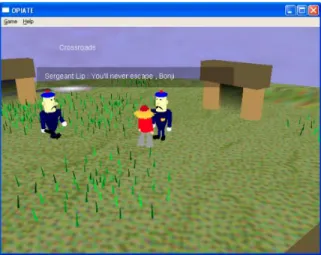
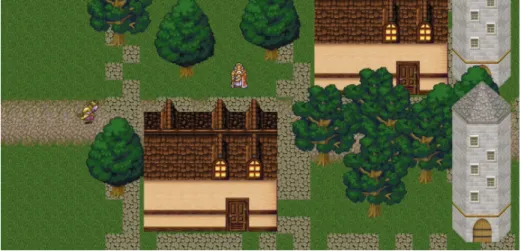
2.10 Screenshot from an interactive storytelling session in OPIATE by Fairclough6 (repro-duced with permission). . . 23
2.11 Virtual environment generated by Game Forge by Hartsook et al.7.. . . 24
2.12 A social network automatically extracted from Jane Austen’s Mansfield Park by Elson8. The size of the nodes represent the relevance of a character and the width of the edges the relative number of interactions (reproduced with permission). . . 25
2.13 Typical NLP pipeline, specially prevalent in applications related to information extraction and text understanding. . . 34
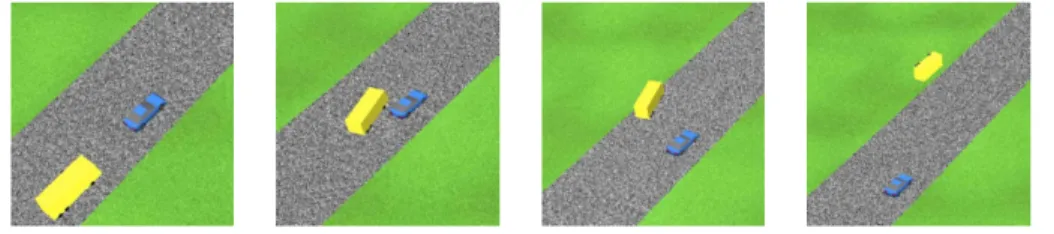
2.14 Frames from an animated sequence generated from a text report in natural language by CarSim9. . . . . 35
4.1 Example story world information used in OPIATE by Fairclough6 (reproduced with permission). . . 49
4.2 Example of one Proppian narrative sequence used by OPIATE6 to guide the interactive storytelling session (reproduced with permission).. . . 49
4.3 Fragment of a possible natural language description of part of the story world represented in Figure 4.1. . . 49
4.5 Syntactic parse of a sentence annotated by Voz after the mention extraction process. Mentions or referring expressions are colored. Note how there is a compound mention (shaded in blue) that is recursed and mentions to 3 entities are found (shaded in purple, pink and orange).. . . 53
4.6 Syntactic parse of a sentence annotated byVozafter the mention extraction process. Lists are identified (shaded in purple and light orange) and references to individual mentions extracted. . . 53
4.7 An excerpt of a story from our dataset. . . 69
4.8 Example pair-wise coreference restrictions and preferences adjacency matrix. Indepen-dent weights are assigned to each, aggregated, and a threshold used to determine pair-wise coreference grouping between mentions. . . 76
4.9 Overall system diagram. Both databases indicate automatically learned training sets from our annotated dataset. Vozis our previous narrative information extraction system which we use to automatically compute feature vectors from text segments in a given story. The output is a sequence of narrative function predictions such as: hα, β, δ, A, B, C,↑ , H, I, K,↓, Wi . . . 84
4.10 Overview of our narrative information extraction system, the shaded boxes represents the dialogue participant identification modules introduced in this work. The new modules are highlighted in grey. The feedback loop is still present but has been removed from the figure for clarity. . . 94
5.1 Directed acyclic graph encoding a representation of the dependencies inVoz, our narrative information extraction pipeline. Note that the DAG includes twoMajority Vote modules not included in Figure 4.4 but described in Chapter 4 Section 4.3.5. Also, theFunction Identification module was not considered in this work. . . 109
5.2 Architecture of the Voz system and a summary of the error for each module. The first two rows report performance baselines for each module. Rand. reports a random baseline and Inf. B.an informed baseline using the most common class in the training set to cast predictions. Then, we report the performance of each module running the fully automated narrative extraction pipeline (Auto) and applying our methodology to isolate the error introduced by each module using our incremental dataset (w/GT). In this scenario, modulemi is given as input the annotated output of the previous module
(GTi−1). . . 112
5.3 Summary of error distribution through the pipeline when running Voz using GT0 as
input. The error of a module goes to 0 when a subsequent module does not use the output of the module. m4 is not included since we did not evaluate the error introduced
by the external knowledge sources. . . 121
6.1 a) Illustrates a non-linear scenario where the output of modulembis expected to inform
the task of module ma. b) Illustrates our proposed solution which solves this scenario
by introducing a new auxiliary module ma0 and a decision maker, without modifying
modulesma normb. . . 124
6.2 Architecture of Voz. Arrows describe information workflow and dashed arrows highlight the feedback loops. . . 127
7.1 Overview of input and output in computational narrative applications in the main two ar-eas of research within computational narrative. Black arrows indicate existing approaches (solid arrows indicate automated approaches, dashed arrows indicate manual and semi-automatic approaches). The pink arrow shows the related work by Li et al.10, and the
blue arrow indicate our work for text-based end-to-end computational narrative systems as described in Section 7.2; these are highlighted since they are end-to-end approaches combining both areas of work. . . 136
7.2 Overview of our end-to-end story generation system. The knowledge structures required byRiu are generated automatically byVoz from natural language. . . 140
7.3 Example input used by Riu. Bold labels identify information fromVoz. Different colors illustrate linked parts. . . 142
7.4 Example section from the questionnaire showing one variation for a story consisting on a story setup, that is, the first segment of a story used to query Riu, and one of the continuations, in this case from theVoz+Riu scenario. . . 155
7.5 Plot comparing the 4 overall score ratings given by the users for each of the 4 continuation scenarios included in the questionnaire. N=90. . . 156
7.6 Plot comparing the 4 continuation scenarios and the scores for the 4 follow-up questions included in the questionnaire. Scores have been normalized and inverted for the third and fourth question (higher is better). N=90. . . 157
E.1 Example story causal link graph inspired by the plots produced by Tale-Spin. Boxes represent plot points and arrows precondition/postcondition dependencies. . . 212
E.2 Example story planned from the story space described by Figure E.1. Nodes represent lo-cations, edges represent movement between locations and are annotated with the ordered plot points describing a story. . . 213
E.3 Example environment configuration for an environment inspired by the plots produced byTale-Spin (input A in our experiments). . . 216
E.4 Example environment configuration embedding for the environment in Figure E.3. with additional connecting nodes u andv. . . 216
E.5 Graph with character and location information automatically extracted from a story and two-dimensional embedding and realization of the locations in the graph. . . 223
Abstract
Narrative Information Extraction with Non-Linear Natural Language Processing Pipelines Josep Valls Vargas
Santiago Ontañón and Jichen Zhu
Computational narrative focuses on methods to algorithmically analyze, model, and generate narratives. Most current work in story generation, drama management or even literature analysis relies on manually authoring domain knowledge in some specific formal representation language, which is expensive to generate.
In this dissertation we explore how to automatically extract narrative information from unanno-tated natural language text, how to evaluate the extraction process, how to improve the extraction process, and how to use the extracted information in story generation applications. As our applica-tion domain, we use Vladimir Propp’s narrative theory and the corresponding Russian and Slavic folktales as our corpus. Our hypothesis is that incorporating narrative-level domain knowledge (i.e., Proppian theory) to core natural language processing (NLP) and information extraction can improve the performance of tasks (such as coreference resolution), and the extracted narrative information. We devised a non-linear information extraction pipeline framework which we implemented inVoz, our narrative information extraction system. Finally, we studied how to map the output ofVoz to an intermediate computational narrative model and use it as input for an existing story generation system, thus further connecting existing work in NLP and computational narrative. As far as we know, it is the first end-to-end computational narrative system that can automatically process a corpus of unannotated natural language stories, extract explicit domain knowledge from them, and use it to generate new stories. Our user study results show that specific error introduced during the information extraction process can be mitigated downstream and have virtually no effect on the perceived quality of the generated stories compared to generating stories using handcrafted domain knowledge.
Chapter 1: Introduction
Computational narrative is an emergent field of research at the intersection of traditional narratology, artificial intelligence, natural language processing and cognitive science. Computational narrative focuses on methods to algorithmically analyze, model, and generate narratives. Moreover, compu-tational models of narrative have applications to tasks such as machine translation, summarization or information extraction in the contexts of reporting, education, and entertainment. For example
Narrative Science is an enterprise services company leading the transition to artificial intelligence systems that ingest data and automatically generate written reports and provide high level insights1.
Computational narrative is also a key element in some of the latest trends around digital assistants such as Apple’sSiri2, Amazon’sAlexa3 and Facebook’s chatbots4as a novel communication
mech-anism to engage with their customers. A notable problem in computational narrative is that most of the aforementioned systems and implementations rely on either large amounts of annotated data in a machine readable format for training or, handcrafted models in some knowledge representation formalism or human authored text templates. Moreover, these models and annotations tend to use complex specifications and need to be authored by knowledgeable technical people making their development tedious and expensive. This represents an even heavier burden when considering that the input annotations and models for one system typically cannot be reused for another, leading to the well known authorial bottleneck problem11;12.
Recent advances in natural language processing (NLP), information extraction (IE) and related disciplines have recently led to a renewed interest in automatically extracting structured information from text. Toward alleviating the aforementioned authorial bottleneck problem, in recent years, the field of computational narrative has experienced cross-pollination with NLP and IE and seen sub-stantial advancements in tasks such as automatically identifying characters13;14, narrative and plot
1https://narrativescience.com/Offers/Outlook-on-AI-Research-Report 2http://www.apple.com/ios/siri/
3https://developer.amazon.com/alexa
structure15;16, and character relationships17–19. This efforts could enable computational narrative systems to exploit vast amounts of existing material in the form of natural language that is cur-rently available. This would not only allow the automatic processing of the existing body of human literature or text in the Internet, but, would also allow non-technical people to input knowledge into computational narrative systems by using natural language.
In this dissertation we explore how to automatically extract information for computational mod-els of narrative from text, how to evaluate the extraction process, how to improve the extraction process, and how to use the extracted information in story generation applications. We focus our work on several individual tasks that allow for automatically acquiring structured narrative infor-mation directly from natural language text. At the same time, we also look at the evaluation of information extraction pipelines and how to improve the performance of narrative information ex-traction tasks and off-the-shelf general-purpose natural language processing (NLP) systems in the particular domain of fictional stories. We also survey computational models of narrative and how to use the extracted narrative information in existing computational narrative applications. Our hypothesis is that by leveraging existing work in NLP and computational narrative we can ease the development of end-to-end computational narrative systems that can use natural language text as their input.
In the next section we review some open problems in the fields of computational narrative and natural language processing related to the research questions we address in this dissertation. Then we provide a brief outline of this dissertation.
1.1
Open Problems
The main research question addressed in this work is wether we can automatically extract information for computational models of narrative from text and use them in other computational narrative applications. There is a collection of open research questions that are intimately related to the work described in this dissertation. These are open problems that we will discuss and try to address in the following chapters.
Authorial Bottleneck: Some computational narrative systems, such as story generators4;20;21, or experience managers22–24, require a significant amount of domain knowledge. Authoring such knowledge is complex and time consuming, leading to the well known authorial bottleneck problem11;12. How to ease the generation and encoding of such domain knowledge is still an open problem.
Models of Computational Narrative: Two of the main areas of research within the field of com-putational narrative are: research focused on modeling existing narratives in order to study existing literature or validate narrative theories; and research focused on expressing narrative spaces in order to study computational creativity and generate stories or interactive experi-ences. Despite a long history of work on formal models to characterize narratives, starting from the seminal work of Vladimir Propp25, or more recent AI-based representations such as plans20;21, frames4, or plotpoints22–24, the problem of how to computationally model narra-tives remains open. Large parts of what constitutes the plot and discourse of narranarra-tives, such as authorial intent, conflict, or character subjectivity are not properly captured by existing models26. Given the complexity of the current approaches, system builders tend to favor de-veloping customized ad-hoc models to suit their particular implementation needs, leading back to the authorial bottleneck problem previously identified.
Narrative Information Extraction: With recent advances and with a limited scope to standard English language, several key tasks in NLP such as part-of-speech tagging and syntactic pars-ing are mostly solved, tasks such as coreference resolution or semantic role labelpars-ing have seen great progress over the recent years, but other tasks that depend on deep understanding of the text such as question answering, dialog systems, paraphrasing or automatic summarization still pose important problems. Moreover, with the goal of extracting narrative information, when applying existing NLP techniques to specific literary domains such as folktales, we observe higher error rates than previously reported in the literature for other more general domains. We attribute this phenomena to the specific complexities in literary text (which includes fan-tastic situations, anthropomorphic characters, specific rhetorical figures and different cultural
backgrounds) which differs vastly from to the standard corpora used in the NLP community for training and testing NLP techniques. Besides some domain-specific approaches27, there are no general methodologies to adapt and reuse general-purpose NLP tools for specific domains without requiring corpus re-annotation and retraining the NLP models.
Evaluation of Information Extraction Systems: Information extraction systems usually in-tegrate several modules ranging from off-the-shelf parsers to specialized domain knowledge databases into a pipeline. Basic modules used in NLP and IE pipelines have been studied ex-tensively, often within the context of shared task competitions (e.g., CoNLL coreference resolu-tion shared task28;29). These studies are typically conducted on a single module isolated from a pipeline since no standard methodology exists to evaluate how error propagates in pipelined architectures. However, when the information extracted by the system is not accurate, it is hard to pinpoint which is the module responsible since there is no general methodology that can be applied to arbitrary pipelined information extraction systems in order to evaluate how error propagates down the pipeline and affects the final output of the system.
1.2
Thesis Statement
The central idea of this thesis is:
We can automatically extract structured narrative information from text and use the extracted narrative information in computational narrative applications. Moreover, our hypothesis is that incorporating narrative domain knowledge into the extraction process will improve the perfor-mance of certain tasks within the extraction process and the final output of the process.
With this research statement to frame our work, in this dissertation we will try to answer the question: How do we automatically extract structured narrative information from text?. In order to answer this question we need to look at the narrative elements we are interested in extracting and how to extract them. In our work we focused on several individual tasks related to natural language processing and information extraction which we will assemble together using a pipeline architecture.
Once we have a system capable of automatically extracting narrative information from text, we will address follow-up questions such as How do we evaluate and improve narrative information extraction pipelines?. Finally, and in order to tie our work with the first and second open problems described in the previous section, we will also address the question How do we use the extracted information in computational narrative systems, specifically, story generation applications?.
1.3
Dissertation Organization
The rest of this dissertation is organized as follows:
Background and Related Work: In this chapter we first introduce some background concepts
relevant to our research and that will be used throughout the rest of the document, specially related to natural language processing (NLP). Then we will present the fields of narratology and computational narrative, review related work in the areas of information extraction, com-putational narrative, how to model and annotate narratives, and finally some applications that illustrate how computational narrative models can be used.
Proppian Stories: In this chapter we expand on describing the work of Vladimir Propp, a Soviet folklorist and scholar who studied Russian and Slavic folk tales. We also talk about the folk tales collected by Alexander Afanasyev, the Russian counterpart to the brothers Grimm and describe the corpus and datasets used throughout our work.
Automated Narrative Inf. Extraction: In this chapter we describeVoz, our narrative
informa-tion extracinforma-tion pipeline that has become the infrastructure of our experimental evaluainforma-tion and the individual contributions that we incorporated into that pipeline. We first describe the individual tasks we addressed and then we describe our proposed framework to assemble those task into a non-linear information extraction pipeline. Finally we describe additional tasks we worked on and incorporated as modules of the pipeline.
Evaluation of IE Pipelines: In this chapter propose a methodology designed to assess how error is introduced and propagated in information extraction pipelines and apply it to Voz, our narrative information extraction pipeline.
Non-linear IE Pipelines: In this chapter we revisit the feedback loop introduced in Chapter 4
and describe our proposed general purpose framework for defining non-linear pipelines. We then present an empirical study of this methodology applied to Voz for two different tasks.
Bridging the Gap: In this chapter we present a taxonomy of computational models of narrative
reported in the literature and outline our approach to connect Voz to an existing story gen-eration system in order to implement a full-fledged end-to-end, text-based, story gengen-eration system. We report our analytical findings and the results of a user study on the system.
Conclusions and Future Work: In this chapter we summarize our work and revisit our
contribu-tions and how we addressed the open problems described before. We conclude the dissertation with some directions for future work.
In the appendices we provide additional information about the Proppian stories used for our work, detailed results from our work and early work that motivated the research presented in this disser-tation.
Chapter 2: Background and Related Work
In this chapter we first introduce some background concepts relevant to our research and that will be used throughout the rest of the document and review related work in the areas of information extraction and computational narrative, how to model and annotate narratives, and finally some applications that illustrate how computational narrative models can be used.
2.1
A Brief Introduction to Natural Language Processing
The field of natural language processing (NLP) has received a lot of attention since the early days of computing and artificial intelligence. NLP has had successful applications in areas such as infor-mation extraction or machine translation. The history of NLP generally starts in the 1950s. Some notably successful NLP systems were developed in the 1960s but up to the 1980s, most NLP systems were based on complex sets of hand-written linguistic rules. Starting in the late 1980s, however, there was a revolution in NLP with the introduction of statistical methods and machine learning algorithms for natural language processing30.
Work in NLP in the last decade has been dominated by unsupervised and semi-supervised learn-ing algorithms on large annotated corpora (i.e. treebanks)15;31and statistical work on large datasets and exploiting the web10. The latest trends involve using deep and or recurrent neural networks to tackle specific NLP tasks. We will discuss these at the end of this section.
NLP is a broad research area addressing a wide range of different problems. Some of the most prominent subfields and concentrations within NLP, relevant to this dissertation, are:
• Information Extraction (IE): focuses on automatically extracting structured information from unstructured textual documents. IE plays a big role in document classification, indexing and information retrieval32.
• Text Understanding: also known as machine reading, text understanding is related to IE but differs in that its scope goes beyond information storage and seeks to extract a structured
representation that enables further computation, such as problem solving applications to op-erate on natural language input33. Text understanding implementations usually complement the information obtained from text with additional common sense knowledge used to perform inference and address problems such as question answering.
• Text Generation: also known as natural language generation (NLG), this field studies meth-ods to convert computational representations of information into natural language that can be used to interface with a human audience34. Dialogue agents or interactive fiction systems use NLG to communicate an internal state to the user. Paraphrasing and summarization are text generation tasks heavily related to text understanding.
Work on the aforementioned fields shares a collection of tasks and subtasks commonly referred to “core” NLP tasks. In the remaining of this subsection we describe and provide an overview on some of these core NLP tasks we will discuss later in the context of automatically extracting computational models of narrative.
2.1.1
Segmentation, Chunking and Tokenization
Given a string of characters representing a chunk of text (or document) these tasks involve segment-ing words, sentences or other elements like paragraphs or individual morphemes from compound words. Sentence segmentation and document chunking are usually implemented using a combi-nation of rule-based methods and heuristics. Tokenization usually involves punctuation splitting and separation of some affixes like possessives. For English, state-of-the-art, high-performing im-plementations rely on finite-state machines35. Other languages with different spacing rules such as Chinese rely on statistical approaches36. Other languages such as Arabic require more extensive token pre-processing35.
2.1.2
Morphological Analysis
Related to the previous tasks, given one or more tokens or words, the goal of this task is to identify individual morphemes and recognize the lemma, stem or root for inflected words along with inflection information (e.g., “singing” ⇒sing7→lemma, -ing7→present continuous). This task includes other
Figure 2.1: Part-Of-Speech (POS) tagging example.
operations such as word segmentation, lemmatization or stemming. Implementations for this task are usually language dependent. Rule-based and heuristic approaches have been developed for English37 and have been improved by adding dictionaries and contextual information to resolve ambiguities35.
2.1.3
Part-Of-Speech (POS) tagging
Given a sentence, this task determines the part-of-speech each word plays for a specific language grammar (e.g., “the red truck” ⇒ the 7→ determiner, red 7→ adjective, truck 7→ noun). Imple-mentations for this task are also language dependent and a mixture of statistical and rule based approaches have demonstrated high accuracies for English35;38. Figure 2.1 illustrate this task for processing English using the Stanford CoreNLP.
2.1.4
Grammatical and Syntactic Parsing
Given a sentence, the goal of this task is to generate the structures of the syntactic and grammatical roles and relationships between the words and phrases (e.g., “My truck is red.” ⇒ (S (NP (PRP$ My) (NN truck)) (VP (VBZ is) (ADJP (JJ red))) (. .))). Approaches to syntactic parsing typically combine formal grammars with statistical models to deal with the complexity of natural language. The use of simple grammars such as context free grammars is not feasible due to the ambiguity and size of the lexicon of any typical natural language. Common approaches use probabilistic context-free grammars (PCFG), which extend context-free grammars by assigning probabilities to production rules. The probability of a derivation (parse) is the product of the probabilities of the productions used in that derivation. A trained model including the production rules and the probabilities is typically computed by machine learning algorithms over large annotated corpora (called treebanks). Lexicalized PCFGs (where head words annotate phrasal nodes) are used for high performance PCFG parsing. Great success in terms of parse disambiguation and language modeling has been achieved by various lexicalized PCFG models39. Additional work combined lexicalized and
Figure 2.2: Syntactic parse example.
unlexicalized PCFG for phrase structure and lexical dependency parsing39. Recent work has focused on languages other than English, parsing ungrammatical sentences (e.g., microtext) and semantic parsing. These approaches use combinatory categorial grammar40, conditional random fields and neural networks41;42. Figure2.2illustrate the output of this process using the Stanford CoreNLP.
2.1.5
Named Entity Recognition (NER) and Information Extraction (IE)
Given a document, the goal of named entity recognition is to identify items in the text that map to specific entities and recognize the type of each such entity (e.g., “Barack Obama is the president of the United States” ⇒ Barack Obama7→ person, United States 7→ country). Broadly speaking, information extraction is tasked with extracting other items of interest such as relationships between entities. Common approaches use patterns and regular expressions matched against the text of the document in order to identify the entities or items of interest. For example, regular expressions can define character level patterns for identifying named entities in specific domains of bioinformatics (e.g., protein and gene names)43. Similar to regular expressions,Tregex44, are a collection of utility classes that allow matching patterns in trees, based on tree relationships and regular expression matches on nodes from different annotation layers added by different tasks such as POS-tags or parse information. Another prominent example of such approach is the Sundance Parser45. Sundance uses patterns that match certain tokens and grammatical categories and because those patterns may be complex or not straightforward, the system is complemented with theAutoSlog utility to extract such patterns from a given set of examples. Another approach for extracting information from text is to use noun-verb tuples derived from the dependency parse of the document43;46;47.
Figure 2.3: Pronominal coreference resolution example.
2.1.6
Coreference Resolution
Given a document, the goal of this task is to determine which referring expressions (i.e. mentions in the text) refer to the same entities (e.g., “Alice is a beautiful girl. She is also intelligent.” ⇒She 7→ Alice). Automatic identification of corefering entities and events has been a difficult problem in NLP because in many situations may require inference and common sense knowledge, and because of the limited amount of annotated training data48. State of the art techniques use entity-centric, precision-ranked rules learned using machine learning29;49. Moreover, some systems tend to incorporate ad-hoc domain-specific rules and heuristics to solve coreference16 due to the difficulty of this task beyond pronominal coreference. Figure2.3illustrate this process using the Stanford CoreNLP.
2.1.7
Semantic Role Labeling (SRL)
Given a verb with multiple arguments (i.e. subject, direct object and multiple indirect objects), the goal of this task is to map the arguments to semantic roles (e.g., “Bob bought a computer from Alice.” ⇒Bob 7→buyer,Alice 7→seller,computer 7→good being sold). Some of the best performing implementations use hybrid approaches of machine learning, inference and constraint satisfaction50. Recent work also uses convolutional neural networks41.
2.1.8
Word Sense Disambiguation, Common Sense and Domain
Knowl-edge
Given a token or multi-word expression with multiple possible senses, the goal of this task is to identify the intended sense in the context it appears (e.g., “He was sent to the pen for burglary.” ⇒ pen 7→ penitentiary) and map it to a database with additional knowledge that can be used for further inference (e.g.,penitentiary 7→state institution). Although there are some hybrid statistical and rule-based approaches51, this task usually involves mapping to rich databases of common sense
and domain knowledge52;53using contextual information and inference. Common sense and domain knowledge are studied in the field of knowledge representation which seeks methods for encoding general common sense or specific domain knowledge so it can be exploited by NLP applications54.
2.1.9
Natural Language Processing Pipelines
Most of NLP applications, and specially information extraction systems, involve one or more of the NLP tasks presented in the previous enumeration. Moreover, some tasks such as parsing, typically depend on part-of-speech tags which in turn depend on properly tokenized text. Because of this interdependency, a pattern for a pipeline has emerged and pipelined architectures are used in many NLP tasks55, and are specially prominent in text understanding, information extraction56;57 and natural language generation34. Figure2.13shows a workflow diagram for this pipeline9;58.
There are several projects readily available that implement different modules in an NLP pipeline and are widely used in both industry and academic environments35;55. For example, Stanford CoreNLP is a package that includes Java implementations of several Stanford NLP tools including the POS tagger, the named entity recognizer (NER), the Stanford parser, the coreference resolu-tion system, and the sentiment analysis tools, and provides model files for processing English text
1. Natural Language Tool Kit (NLTK) is a suite of text processing libraries for classification,
tok-enization, stemming, tagging, parsing, and semantic reasoning written in Python with interfaces to external tools and corpora. A book is also provided to introduce technical and non-technical people to developing applications that feature NLP and computational linguistics2. Apache OpenNLP is
another Java toolkit for the processing of natural language text supporting the most common NLP tasks, such as tokenization, sentence segmentation, POS tagging, named entity extraction, chunking, parsing, and coreference resolution. OpenNLP also includes maximum entropy and perceptron based machine learning algorithms and models3. General Architecture for Text Engineering (GATE)is an
integrated development environment for building NLP applications. It provides a user interface for several text processing workflows (including annotation and visualization), and includes ANNIE (A
1Available:http://nlp.stanford.edu/software/corenlp.shtml 2Available:http://www.nltk.org/
Nearly-New Information Extraction System) focused on IE tasks on top of many common NLP tasks and can be used programmatically using its Java API4.The Curator (U. of Illinois)is a Java suite integrating several natural language processing tools including a semantic role labeling (SRL) tool using verb frame information5. Combining several third-party systems, toolkits likeOpinionFinder
(U. of Pittsburg, Cornell and U. of Utah)6 provide means of identifying subjectivity and sentiment
analysis along various other information extraction tasks. It is worth noting that recent work avoids pipelines altogether for some tasks by using neural networks. Fonseca et al. proposed an architecture based on deep convolutional neural networks that accomplish several NLP tasks and implemented NLPNET7 that implements POS tagging, dependency parsing and semantic role labeling42.
2.1.10
Natural Language Generation
Related to natural language processing, the field of natural language generation (NLG) focuses on methods to convert computational representations of information into natural language that can be used to interface with a human audience34. Story generation and interactive fiction systems use NLG to communicate an internal representation of the story to the user. Other related areas of application include dialogue agents, machine translation paraphrasing and text summarization.
There are several techniques to approach different NLG tasks; focusing on computational narra-tive and story generation systems, usually there is a specialized module often referred as arealizer
or surface realizer that produces the final output from the given intermediate representation. For this task, simple template-based approaches have been widely used with successful results59. These template-based solutions (often referred to ascanned text) are easy to implement and appropriate for some situations, however, have several limitations; the main drawback is the necessity of authoring a large database of annotated templates. The resulting systems are relatively inflexible and their expected output has to be anticipated ahead of time. Additionally, these tend to work best when the expected output is brief60. Figure2.4shows a simple synthetic example of a template that could be used to generate natural language text for a flight reservation system using substitutions.
4Available:http://gate.ac.uk/ 5Available:
http://cogcomp.cs.illinois.edu/page/software_view/Curator
6Available:http://mpqa.cs.pitt.edu/opinionfinder/ 7Available:https://github.com/erickrf/nlpnet
Searching flights from :SRC to :DEST on :DATE. One moment please.
Figure 2.4: Example of a template that could be used to generate natural language text. Tokens starting with a colon are placeholders for substituting the relevant information to be shown to the final user.
Modern text generation systems are designed to produce fluent multiparagraph text in response to a goal presented to the system. A commonly used architecture implements a pipeline with four major modules: a domain-specific knowledge module that completes gaps given an internal data representation and a communication goal; a high-level text planning module that organizes the relevant information and decides how to present the content to the reader; a sentence generation module based on a large systemic grammar of the desired output language; and an evaluation and plan-perturbation module which revises generated text generation plans and adapts them as required34. Recent research has focused data-driven and trainable systems that can learn directly from a corpus of text61.
2.1.11
Neural Networks for Natural Language Processing
As mentioned earlier in this chapter, the latest trends in NLP involve the use of deep and recurrent neural network approaches. Instead of pipelines of individual core NLP tasks that build upon one another to achieve higher-level tasks (as described in Section2.1.9), the latest developments exploit access to large datasets or corpus of text which are processed directly by statistical methods such as deep and recurrent neural networks. These networks are usually fine-tuned for task specific approaches but have shown high performance and great flexibility in a number of areas.
Neural networks were first used to find novel encodings for text information and phrase and word representations that could then be operated onto for different tasks (e.g., word embeddings)62. These have been used to beat the state-of-the-art on other methods discussed earlier in this chapter in tasks such as coreference resolution63 but also to address higher-level composite tasks such as document modeling and sentiment analysis64and all the way to the implementation of fully-fledged
machine understanding and question answering systems, directly from text65.
The same family of approaches have been used in other areas such as natural language gener-ation (described in Section2.1.10), where pipeline-based approaches have yield to neural network architectures as well. Again, here we see different neural network architectures to tackle specific high-level tasks that involve natural language generation ranging from generating captions for images66 to fully fledged machine-translation systems67 and conversational agents for question answering68. Relevant to our research, at the end of the next section we will discuss work on story generation using recurrent neural networks69;70.
2.2
Narrative
Narratives are found in all kinds of everyday situations: from video games to movies or news reports to scientific articles and informal conversations with friends. Narratives are used to communicate complex ideas, deliver precise accounts of events or argument about one’s beliefs. Narratology work in the early XIX century focusing on folkloric fantasy stories25 provided ground work for narrative theory71and has been revised and updated for the study, systematic analysis and criticism of contemporary media72. From a computer science perspective, since the 1970s, narratives and storytelling have been a prominent test bed for evaluating human cognition theories and validating the scientific method in the field of artificial intelligence73;74. Rooted in narratology, computational narrative bridges humanities and computing fields by analyzing and modeling narratives, narrative understanding in terms of human cognition, and computer-readable representations of narrative spaces that enable computers to become storytellers 75;76.
2.2.1
Narratology
Narratology is a discipline dedicated to the study of the logic, principles, and practices of narrative representation and storytelling, including common themes, conventions and symbols. Core elements and ideas for narratological modeling of narrative were introduced by Greek philosophers. Narra-tology has been dominated by structuralist approaches since the 1900s, and has developed into a variety of theories, concepts, and analytic procedures26. There are several branches and theories but for the scope of this dissertation we will focus on thematic narratology, tightly coupled with the
study of the plot of a narrative; and cognitive narratology that focuses on the reader’s interpretation of a story.
Thematic narratology focuses on the semiotic formalization of the sequences of the actions told in the narrative. One of the main influences was the structuralist work of Propp25. Propp focused on an empirical analysis of Russian folk tales and presented a model of the elementary components of narratives and the way they are combined. Propp describes Russian and Slavic fairy tales in terms of a sequence of abstract “functions” that are fulfilled by characters with specific narrative “roles”. Lakoff71 operationalized Propp’s theory and presented a story grammar based on Propp’s functions providing ground work to structuralist approaches to narratology that in turn influenced some of the computational approaches described in the next section. Similar to Propp’s work but with a broader scope, Joseph Campbell’s monomyth, or the hero’s journey77has been used widely in the study of narratives from around the world and the criticism of contemporary media.
In contrast to thematic narratology that focuses on the plot of a story (i.e., what is being told), modal narratology78 focuses on the discourse, that is, the way a story is told during a storytelling session, stressing voice, point of view, transformation of the chronological order, rhythm and fre-quency. Chatman72 presented a unified study of narrative that defines a dual model that separates but relates the plot and the discourse of a narrative. Furthermore, Chatman provides a taxonomy of characteristic elements from the plot of a narrative and the means in which the narrative is communicated (Figure2.5) that we will reference later in this thesis.
Cognitive narratology79focuses on the human intellectual and emotional processing of narratives and looks at the interpretation of the character’s purposes and motivations in order to infer specific narratology primitives like volitional cause and logical sequences of actions. Related to cognitive narratology, we will later make reference to the concept of the hermeneutic circle, developed in the age-old field of hermeneutics as the study of human interpretation of complex text. When making sense of the text, scholars argue that we move back and forth between its individual parts and the larger whole — our understanding of the text as a whole is hinged on our understanding of the individual parts, which in turn is shaped by how we understand the larger whole. This circular
Narrative Story Events ( Actions Happenings Existents ( Characters Settings Discourse
Structure of narrative transmission
Manifestation Verbal Cinematic Pantomimic etc.
Figure 2.5: Chatman’s taxonomy of narrative elements. In Chatman’s work, plot is also referred asstory orcontent; discourse is also referred asexpression.
process of understanding text is the most basic form ofthe hermeneutic circle80. Work in the area of story understanding is grounded in the early work of Roger Schank81, focused on the higher level constructs humans use to understand, memorize and reason about stories. In their work they introduce the concept ofscripts as a method of representing chains of events or episodic knowledge, such as the sequence of events in the plot of a story.
2.2.2
Computational Narrative
Computational narrative is an emergent field at the intersection of traditional narratology, artificial intelligence and natural language processing. Computational narrative studies how to algorithmically represent, understand, and generate stories. Computational narrative has applications in areas of digital entertainment such as digital storytelling4;20;21 or experience management22–24;82 and can provide insights into computational creativity83and the analysis and understanding of literature8;84. The field of computational narrative itself is coarsely divided in two groups: research focused on modeling existing narratives in order to study literature or validate narrative theories8;26;84;85; and research focused on representing narrative spaces and algorithms to generate stories or interactive experiences and study computational creativity12;21;86.
2.3
Computational Models of Narrative
Generative storytelling applications such as story generation systems and interactive fiction require computational models abstracted from a specific story and that instead define a story space. On the other hand, other applications rely on machine readable versions of a story, often annotated over an existing text. Regardless of the application, different computational models of narrative usually focus on specific elements of a narrative depending on the domain and application and although there are some efforts toward holistic models of narrative26, usually there is a separation between modeling plot (i.e. what happens in the story) and the discourse (i.e. how the story is told).
Discourse models deal with high-level narrative primitives, sequence, point-of-view (i.e., focal-ization), the audience mental model and embedded narratives.
When looking at computational models for plot, several different elements such as the elements in Chatman’s taxonomy, have also been modeled separately. Considering a minimal model of the plot of a story as a chronologically ordered set of plot points, ideas from the field of automatedplanning, have been used to model events in the plot of a story with preconditions and postconditions for defining temporal and causal link relationships between events. Tale-Spin5 is an early example that used a planning approach. More recently, planning approaches have been used to encode authorial intent87and encode a story space around an event10.
Annotated narratives and plot sequences have also been used incase-based reasoningapproaches to drive the plot of story generation systems and storytelling in interactive systems6;88;89. Models of theexistentsor thespaceof a narrative have also been used in planning, simulation and multi-agent systems to generate virtual environment76;89;90. Also related is the use of a model of characters and a social model of interaction to drive an interactive storytelling system91.
2.3.1
Annotating Narratives
A common step to model a narrative is to author a computational model or machine readable ver-sion of a story from an existing text. Several annotation schemes and annotation environments have been proposed that combine layers of discourse and plot annotations on top of natural language
Figure 2.6: Screenshot of the Story Workbench annotation tool by Finlayson1.
text. These annotation schemes add different layers of computer readable information representing different parts of the narrative. The annotations can then be used to extract different models of the plot or discourse of the narrative for further processing. For example a model of a sequence of states from a story can be extracted in the form of a script-like representation for plot points92. TheStory Workbench project8 by Finlayson1 provides an integrated framework supporting several annotation layers. It provides a number of common text annotation operations, including represen-tations (e.g., tokens, sentences, parts of speech), functions (e.g., generation of initial annorepresen-tations by algorithm, checking annotation validity by rule, fully manual manipulation of annotations) and tools (e.g., distributing texts to annotators via version control, merging doubly-annotated texts into a single file). It was designed to support multiple annotation workflows and it integrates with ver-sion control systems. Figure2.6shows a screenshot of the Story Workbench. A related approach is the Scheherazade system9by Elson2. The Scheherazade system is a platform for symbolic narrative encoding. It provides tools to define common sense knowledge regarding a story and then a graphical interface for manually encoding narrative semantics such as timelines, states, events, characters and goals. Although narrative primitives can be mapped to text, the system can be used for generating symbolic representations of a story independent from the text. Figure 2.7 shows a screenshot of
8Available:http://projects.csail.mit.edu/workbench/
9Available:http://www.cs.columbia.edu/~delson/software.shtml
Figure 2.7: Screenshot of the Scheherazade annotation tool by Elson2.
the Scheherazade. Despite both Story Workbench and Scheherazade aiming to be general purpose tools, with no consensus on computational models to represent narrative, researchers tend to de-velop ad-hoc approaches to suit their particular implementation needs that are time-consuming and expensive to generate. For example the Riu system (described in the next section) uses a complex encoding format to represent the story space and annotate the text of the story. Figure2.8 repro-duces an excerpt of Riu’s story format showing the story space structure (under:structure) and text annotations (under:templates).
2.4
Applications of Computational Narrative
Computational models of narrative have many applications. In this section we summarize some applications from the digital entertainment research community.
Narrative Generation and Storytelling
Narratives are complex intellectual products. Additionally, storytelling is an activity that requires a wide range of skills and cognitive abilities intrinsic to humans. Despite that, there have been research efforts aiming at achieving computers inventing and telling stories. In the context of storytelling, creativity implies inventing a satisfactory story in terms of believable characters, their personalities, goals, feelings and emotions; interesting situations and events; and a discourse that facilitates the
\resizebox{\textwidth}{!}{ (setf *riu-STORY-DAG* ’( (STORY-6-FACTORY-JOB (:discourse (:clauses (c0 (:s phase1 phase2))
(phase1 (:s t1a t2a t3a t4a (:m phase1))) [...]
(:templates
(t1a "After counting street numbers and puzzling over the scrawl of a 4, which turned out to be a 9,")
(t2a (s6-notice (ales "Ales") " found a " (s6-in-door (s6-small-door "small " (door "door")) " in the side of an " (s6-big-factory "immense " (factory "factory"))) " that matched the Aristobots description.")) (t3a "Soon after knocking, " (s6-open "a solid, " (workbot "grubby
workbot") " opened up") " and greeted " (ales "Ales") " with a scowl of pure skepticism.")
(t4a (s6-explain (ales "Ales") " stammered out his situation, describing in too great of detail the recent " (theft "theft incident,")))
[...]
(:structure (common
(:entities (ales :type robot) (robot :type animate) (workbot :type robot) (factory :type inanimate))
(:expressions
((big factory) :name s6-big-factory) )
) (phase1
(:entities (door :type inanimate) (theft :type inanimate)) (:expressions
((small door) :name s6-small-door) ((big factory) :name s6-big-factory) ((notice ales door) :name s6-notice)
((tell ales workbot theft) :name s6-explain) ((in door factory) :name s6-in-door)
((open workbot door) :name s6-open)
((fd-agonist ales phase1) :name s6-p1-agonist)
((fd-antagonist workbot phase1) :name s6-p1-antagonist)
((fd-stronger s6-p1-agonist phase1) :name s6-p1-strong-agonist) [...]
}
Figure 2.8: An excerpt of the story format used byRiu3;4.
Joe Bear was hungry. He asked Irving Bird where some honey was. Irving refused to tell him so Joe offered to bring him a worm if he’d tell him where some honey was. Irving agreed. But
Joe didn’t know where any worms were, so he asked Irving, who refused to say.
Figure 2.9: An excerpt of an example story generated byTale-spin5.
reader to understand the characters’ motivations, associate characters intentions with feelings, and develop empathy towards the characters and situations12.
Tale-spin5is a story generation system that generates stories of woodland creatures using back-ward chaining for resolving goals and subgoals and forback-ward chaining to compute consequences of narrative events. Tale-spin simulates a small world populated with characters, each with their own problems and motivations. Each character uses planning in order to satisfy their own goals given the current world state. Complex relations between characters are modeled using simulation over the events and the outcome is used to select plot points with satisfied preconditions. After the sim-ulation and problem-solving phase, a separate component is used to generate a textual description of the generated narrative. Figure2.9shows an excerpt of an example story generated byTale-spin.
Minstrel83 tells stories about the Knights of the Round Table. Minstrel uses case-based rea-soning instead of planning, and introduces concepts such as author goals in order to guide the plot generation. Minstrel implemented a general theory of creativity based around the concept of Transform Recall Adapt Methods (TRAMs). TRAMs are used to query an episodic memory and retrieve schemas or scripts that define the story. In the case that a query fails, the query process allows TRAMs to be modified and additional queries issued recursively, the output of which can be combined and adapted to match the initial query constraints. ProtoPropp93 generates stories step by step by using a simplified Case-Based Reasoning approach with a Proppian ontology that transforms annotated stories using a simulator and explicit domain knowledge. Riu3;4 is a text-based interactive storytelling system. Riu uses computational analogy with a force-dynamics text-based story representation to create stories. The narrative oscillates between two worlds: the main story world and the memory world that share parts of the structure and influence each other. Riu uses
Figure 2.10: Screenshot from an interactive storytelling session in OPIATE by Fairclough6 (reproduced with permission).
two repositories of authored data encoding the story world and the protagonist’s memories and an analogy module based on thestructure-mapping engine94 finds mappings between scenes.
Storytelling not only happens in written stories but also in other media and realizations such as computer games. Computational models of narrative have been used to achieve systems that automatically adapt the plot of a game to maximize engagement of the player and maintain a dramatic arc defined by the author. For example,OPIATE6;89is an interactive storytelling engine that generates new stories using multiagent system similar to Tale-spin. Opiate incorporates a drama manager agent that uses a Case-Based Reasoning (CBR) approach with a case base of tales analyzed in terms of Proppian functions in order to guide plot generation. Figure 2.10shows a screenshot from an interactive storytelling session generated by OPIATE. TheAutomated Story Director95uses a planning approach to model a narrative space. It automatically considers all possible breaks in the original story that can be caused by the actions of the player and proposes contingency narratives for each rupture, in order to allow the game narrative to proceed. PAST96 builds on top of the
Automated Story Directorand uses it in combination with player modeling to generate player-specific game narratives while still maintaining authorial intent on the original narrative space.
Computational narrative may play other support roles within digital entertainment applications such as a part of a procedural content generation system. Procedural content generation (PCG)