International Journal of Advanced Research and Development ISSN: 2455-4030, Impact Factor: RJIF 5.24
www.advancedjournal.com
Volume 2; Issue 1; January 2017; Page No. 31-36
ITS
for teaching the 7 characteristics for living things
Mohammed A. HamedDepartment of Information Technology, Faculty of Engineering & Information Technology, Al-Azhar University, Gaza, Palestine
Abstract
Recently, due to the rapid progress of computer technology, researchers develop an effective computer program to enhance the achievement of the student in learning process, which is Intelligent Tutoring System (ITS). Science is important because it influences most aspects of everyday life, including food, energy, medicine, leisure activities and more. So learning science subject at school is very useful, but the students face some problem in learning it. So we designed an ITS system to help them understand this subject easily and smoothly by analyzing it and explaining it in a systematic way.
In this paper, we describe the design of an Intelligent Tutoring System for teaching science for 7th grade to help students know the
7 characteristics for living things smoothly. The system provides all topics of living things and generates some questions for each topic and the students should answer these questions correctly to move to the next level.
An evaluation was done for checking the students and teachers satisfaction of the ITS. The results of the evaluation showed that the students and teachers liked the system and they said that the system is very useful for them and for their studies.
Keywords: Intelligent Tutoring System, Expert system, The 7 characteristics for living things, Education
1. Introduction
Intelligent Tutoring Systems use Artificial Intelligent skills and methodology to the development of computer-based learning systems so as to build adaptive systems. An ITS emphases education as a course of collaboration among tutor and student in which the tutor attempts to demonstrate concepts to the student. Generally, the procedure is controlled by the tutor, who needs to investigate the behavior, the knowledge and the satisfaction of the student. The tutor has to regulate and apply the more suitable teaching approaches at every minute. These strategies must answer a sequence of questions to guarantee that the learning process is carried out
effectively. These questions are: what detail level is necessary, what to explain, when and how to interrupt the student and how to detect and to correct errors [5].
One trademark of the field of AI and education is by means of intelligence to reason about teaching and learning. Representing what, when, and how to teach necessitates foundation from within a few academic disciplines, containing computer science, education, and psychology [6].
Several methods and tools of computer science, education, and psychology are complementary and jointly supply closely comprehensive coverage of the field of AI and education as seen in Figure 1 [7].
Fig 1: The field of AI and education is grounded in three disciplines: computer science, psychology, and education.
The aim of this paper is the design of an intelligent tutoring system to teach the 7 characteristics for living things using Intelligent Tutoring System Builder (ITSB). ITSB is a tool designed and developed to assist teachers in building intelligent tutoring systems in multidisciplinary areas [6].
2. ITS Architecture
The main four basic components that classically are identified in Intelligent Tutoring System are: domain module, pedagogical module, student module, and dialogue module.
International Journal of Advanced Research and Development
2.1 Domain Module
Domain module represents expert knowledge, or how experts perform in the domain. The content of the 7 characteristics for living things are presented in the ITSB format to be suitable for presenting for the students.
There are seven activities which make organisms different from non-living things. These are the seven characteristics of living organisms [1, 4].
1. Growth: All living things should be able to gather resources to use them to make their cells bigger, making their entire system enlarge.
2. Reproduction: All living things should be able to create another of its species. If it couldn't, species would not be able to survive because no young would be born to keep the species going. There are two kinds of reproduction: asexual and sexual. Asexual involves only one parent, for example, bacteria dividing their cells in two, creating two new beings. Sexual involves two parents.
3. Movement: All things should be able to move in some way. It is noticeable that a human, dog, centipede, can all move, but then what about plants? Plants move, only they move so slowly it is only noticeable after a certain number of times. For example, sunflowers move into the direction of the sun, flowering plants open their petals. The roots move down into the earth. Although it is not obvious, like a running animal, plants do move.
4. Response: Response is when an organism has the ability to respond to changes in its environment and to things happening in their bodies. Organisms respond to light, sound, and touch. Again, plants do not seem to be responding much, when you pull of one of their leaves, they don't jump back from shock and pain. But plants do respond. They have no nervous system, so they won't respond to touch, but they grow toward the light. If the sun changes place, they adapt themselves so that they end up back towards the sun. Another example would be that if a seed that is growing finds itself the wrong way, with its roots in the air, then the plant will respond to gravity and shift so that it's roots are back down in the earth.
5. Metabolism: This is how an organism uses its food, which food it requires, and how much of it requires, and also what is poisonous to the organism. It is also the ability to create energy, and to divide it for separating it into different parts of the organism. A living thing must be able to metabolize.
6. Organization: This characteristic doesn't mean that living things should be organized in their daily life but chemically. They have to be composed of atoms, which form molecules, which form cells. Similar cells put together make a tissue, and two or more tissues make organs. Organs then make a system.
7. Nutrition Living things take in materials from their surroundings that they use for growth or to provide energy. Nutrition is the process by which organisms obtain energy and raw materials from nutrients such as proteins, carbohydrates and fats.
2.2 Pedagogical Module
Pedagogical module represents teaching strategies, (examples, and analogies) and includes methods for encoding reasoning about the feedback. In another words, pedagogical
module controls the overall functions of the intelligent tutoring system.
2.3 Student Model
Student module represents students’ mastery of the domain and defines how to reason about their understanding. It comprises both stereotypic student knowledge of the domain (usually student skills) and information about the present student (e.g., time spent on problems, possible misconceptions, correct answers, preferred learning style, and hints requested).
Each student has a profile which contains some information about the student, such as name and student number in addition to the student's major, dates of login. This student model determines the level of the students according to his answers for the questions, if the results >75%, the students can move to a higher level which is more difficult than the previous one, showing the student percentage for each level and the number of questions answered successfully.
2.4 Dialogue Module
Dialogue module represents methods for communicating between students and computers. It includes discussing student reasoning, managing communication, and sketching graphics to illustrate a point, showing or detecting emotion, and explaining how conclusions were reached.
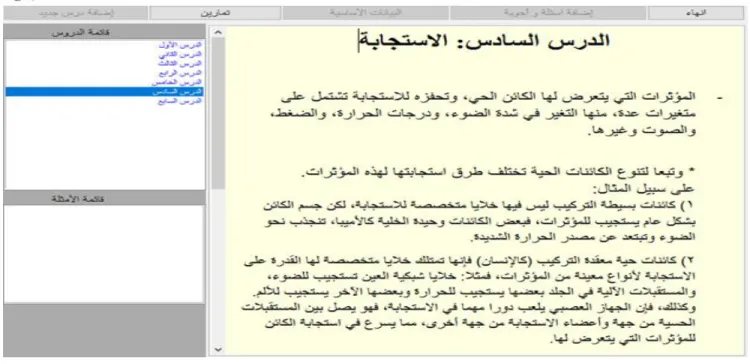
The ITSB contains two interfaces for two users: the teacher and the student. The student can use his/her interfaces through the login screen using the student number showing the student name and student last session on the system. Figure 2 shows the login interface. Figure 3 – Figure 11 shows the interfaces of the intelligent tutoring system. The teacher interface presents three main parts, the first one, the teacher adds the material and the lessons with the ability to add video and pictures to help the students understand the lessons. The second interface presents the questions and the answers. And the third interface offers some modification on font name, font size and font color, list boxes, combo boxes, labels, buttons, page sheet and rich edit, also adds some users.
3. Literature Review
Recently, Intelligent Tutoring System becomes a very popular and useful in our universities, schools, Factories. There are some of them, such as An Intelligent Tutoring System Authoring Tool designed by Abu Naser teaches how to use java program[6], SQL-Tutor, developed by Mitrovic
and Ohlsson, teaches and explains to students the way of writing queries in relational database through several lessons in the basics of writing query[35], ITS for teaching advanced
topics in information security[32], development and evaluation
of the Oracle Intelligent Tutoring System (OITS)[33], ITS for
learning Computer Theory[34], e-learning system[9,12],
ADO-Tutor: Intelligent Tutoring System for leaning ADO.NET[19],
dance Learning from Bottom-Up Structure (DL-BUS) based on automated lesson generation systems, teaches beginners basic dance movements through analyzing and dividing dance into lessons[36]. PIXIE Design by Sleeman in 1987 is
based on Leeds Modeling System (LMS) to examine errors in algebra [37]. MYCIN is expert system for diagnosing diseases
such as cancers, based on MYCIN, Designed GUIDON to display the lessons of the disease and symptoms, showing
rules in the knowledge base of the student [38], an agent based
ITS for Parameter Passing in Java Programming [30], Java
Expression Evaluation[26], Linear Programming [14, 23], an
Intelligent Tutoring System for Entity Relationship Modeling
[29], an Knowledge-based Intelligent Tutoring System for
Teaching Mongo Database [5], Design and Development of an
Intelligent Tutoring System for C# Language [15],
effectiveness of e-learning [31], computer aided instruction [6],
effectiveness of the CPP-Tutor [26], teaching AI searching
algorithms [28], teaching database to sophomore students in
Gaza [25], and Predicting learners performance using NT and
ITS [21], ITS which called CPP-Tutor for helping student to
learn C++ Programming Language [27], a comparative study
between Animated Intelligent Tutoring Systems (AITS) and Video-based Intelligent Tutoring Systems (VITS) [7], authors
in [20] developed a stomach disease Intelligent Tutoring
System, authors in [13] presented an Intelligent Tutoring
System that mentors diabetics, giving them the ability to develop the necessary capability, in [11] the authors built an
Intelligent Tutoring System for Learning Java Objects that will help students to study Java objects by present the area of Java objects and administers automatically generated problems for the students to work out and the system dynamically adopt at run time to the student's individual progress, and ITS teaching grammar English tenses [10].
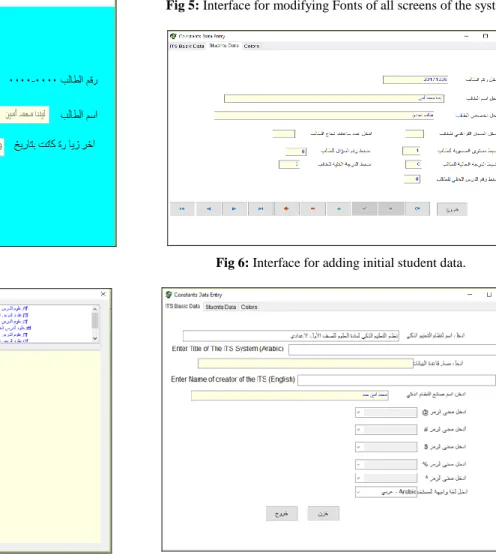
Fig 2: Logging Interface
Fig 3: Interface for adding Lessons and Examples
Fig 4: Interface for adding questions and answers
Fig 5: Interface for modifying Fonts of all screens of the system.
Fig 6: Interface for adding initial student data.
International Journal of Advanced Research and Development
Fig 8: Student lessons and examples interface.
Fig 9: Student Exercises interface.
Fig 10: Student Exercises Difficulty Level Score Interface.
Fig 11: Student Exercises Difficulty Level Score Interface.
4. Conclusion
In this paper, we have designed an intelligent tutoring system for teaching science subject (the 7 characteristics of living things) for grade seven by using ITSB tool. The system is designed to help students study or learn the material easily and to enhance their education achievement.
In an initial evaluation of the system, the students and teachers were satisfied with it.
In the future we will modify the intelligent tutoring systems to include the rest of the material of the 7th grade science
35
References1. Albatish, I., et al. (2018). "ARDUINO Tutor: An Intelligent Tutoring System for Training on ARDUINO." International Journal of Engineering and Information Systems (IJEAIS) 2(1): 236-245.
2. Abu Hasanein, H. A. and S. S. Abu Naser (2017). "An intelligent tutoring system for cloud computing.". 3. Abu Naser, S. (2008). "An Agent Based Intelligent
Tutoring System For Parameter Passing In Java Programming." Journal of Theoretical & Applied Information Technology 4(7).
4. Abu Naser, S. S. (1999). "Big O Notation for Measuring Expert Systems complexity." Islamic University Journal Gaza 7(1): 57-70.
5. Abu Naser, S. S. (2001). "A comparative study between animated intelligent tutoring systems AITS and video-based intelligent tutoring systems VITS." Al-Aqsa Univ. J 5(1): 72-96.
6. Abu Naser, S. S. (2006). "Intelligent tutoring system for teaching database to sophomore students in Gaza and its effect on their performance." Information Technology Journal 5(5): 916-922.
7. Abu Naser, S. S. (2008). "Developing an intelligent tutoring system for students learning to program in C++." Information Technology Journal 7(7).
8. Abu Naser, S. S. (2008). "Developing visualization tool for teaching AI searching algorithms." Information Technology Journal, Scialert 7(2): 350-355.
9. Abu Naser, S. S. (2012). "A Qualitative Study of LP-ITS: Linear Programming Intelligent Tutoring System." International Journal of Computer Science & Information Technology 4(1): 209.
10. Abu Naser, S. S. and I. S. Zaqout (2016). "Knowledge-based systems that determine the appropriate students major: In the faculty of engineering and information technology." World Wide Journal of Multidisciplinary Research and Development 2(10): 26-34.
11. Abu Naser, S. S. and S. H. ALmursheidi (2016). "A Knowledge Based System for Neck Pain Diagnosis." World Wide Journal of Multidisciplinary Research and Development (WWJMRD) 2(4): 12-18.
12. Abu Naser, S. S., et al. (2008). "A Proposed Expert System For Guiding Freshman Students In Selecting A Major In Al-Azhar University, Gaza." Journal of Theoretical & Applied Information Technology 4(9). 13. Abu Naser, S., et al. (2011). "Human Computer
Interaction Design of the LP-ITS: Linear Programming Intelligent Tutoring Systems." International Journal of Artificial Intelligence & Applications (IJAIA) 2(3). 14. AbuEloun, N. N. and S. S. Abu Naser (2017).
"Mathematics intelligent tutoring system." International Journal of Advanced Scientific Research 2(1).
15. AbuEl-Reesh, J. Y. and S. S. Abu-Naser (2018). "An Intelligent Tutoring System for Learning Classical Cryptography Algorithms (CCAITS)." International Journal of Academic and Applied Research (IJAAR). 16. Abu-Naser, S. S. (2008). "JEE-Tutor: An Intelligent
Tutoring System for Java Expression Evaluation." 17. Abu-Naser, S. S. (2016). "ITSB: An Intelligent Tutoring
System Authoring Tool." Journal of Scientific and
Engineering Research 3(5): 63-71.
18. Abu-Naser, S., et al. (1995). "& Beattie, GA (2000)." Expert system methodologies and applications-a decade review from: 9-26.
19. Abu-Naser, S., et al. (2011). "An intelligent tutoring system for learning java objects." International Journal of Artificial Intelligence and Applications.
20. Akkila, A. N. and S. S. Abu Naser (2017). "Teaching the right letter pronunciation in reciting the holy Quran using intelligent tutoring system." International Journal of Advanced Research and Development 2(1): 64-68. 21. Alawar, M. W. and S. S. Abu Naser (2017).
"CSS-Tutor: An intelligent tutoring system for CSS and HTML." International Journal of Academic Research and Development 2(1): 94-98.
22. Al-Bastami, B. G. and S. S. Abu Naser (2017). "Design and Development of an Intelligent Tutoring System for C# Language." EUROPEAN ACADEMIC RESEARCH 6(10): 8795.
23. Al-Bayed, M. H. and S. S. Abu Naser (2017). "An intelligent tutoring system for health problems related to addiction of video game playing." International Journal of Advanced Scientific Research 2(1): 4-10.
24. Al-Bayed, M. H. and S. S. Abu-Naser (2018). "Intelligent Multi-Language Plagiarism Detection System." International Journal of Academic Information Systems Research (IJAISR) 2(3): 19-34.
25. Aldahdooh, R. and S. S. Abu Naser (2017). "Development and Evaluation of the Oracle Intelligent Tutoring System (OITS)." EUROPEAN ACADEMIC RESEARCH 6(10): 8711-8721.
26. Alhabbash, M. I., et al. (2016). "An Intelligent Tutoring System for Teaching Grammar English Tenses." EUROPEAN ACADEMIC RESEARCH 6(9): 7743-7757.
27. Al-Hanjori, M. M., et al. (2017). "Learning computer networks using intelligent tutoring system." International Journal of Advanced Research and Development(2): 1.
28. Almurshidi, S. H. and S. S. Abu Naser (2017). "Design and Development of Diabetes Intelligent Tutoring System." EUROPEAN ACADEMIC RESEARCH 6(9): 8117-8128.
29. Almurshidi, S. H. and S. S. Abu Naser (2017). "Stomach disease intelligent tutoring system." International Journal of Advanced Research and Development 2(1): 26-30.
30. Al-Nakhal, M. A. and S. S. Abu Naser (2017). "Adaptive Intelligent Tutoring System for learning Computer Theory." EUROPEAN ACADEMIC RESEARCH 6(10): 8770-8782.
31. Anderson, J., et al. (2005). "Adaptation of Problem Presentation and Feedback in an Intelligent Mathematics Tutor." Information Technology Journal. 32. Azaab, S., et al. (2000). "A proposed expert system for
selecting exploratory factor analysis procedures." Journal of the College of Education 4(2): 9-26.
33. Baker, J., et al. "& Heller, R.(1996)." Information Visualization. Information Technology Journal 7(2). 34. Baker, J., et al. (1996). "Information Visualization."
International Journal of Advanced Research and Development
36
Information Technology Journal 7(2): pp: 403-404. 35. Buhisi, N. I. and S. S. Abu Naser (2009). "Dynamic
programming as a tool of decision supporting." Journal of Applied Sciences Research.
36. Chen, R.-S., et al. (2008). "Evaluating structural equation models with unobservable variables and measurement error." Information Technology Journal. 37. El Agha, M. I., et al. (2018). "SQL Tutor for Novice
Students." International Journal of Academic Information Systems Research (IJAISR) 2(2): 1-7. 38. El Haddad, I. A. and S. S. Abu Naser (2017).
"ADO-Tutor: Intelligent Tutoring System for leaning ADO. NET." EUROPEAN ACADEMIC RESEARCH 6(10): 8810-8821.
39. Elnajjar, A. E. A. and S. S. Abu Naser (2017). "DES-Tutor: An Intelligent Tutoring System for Teaching DES Information Security Algorithm." International Journal of Advanced Research and Development 2(1): 69-73.
40. Hamed, M. A. and S. S. Abu Naser (2017). "An intelligent tutoring system for teaching the 7 characteristics for living things." International Journal of Advanced Research and Development 2(1): 31-45. 41. Hilles, M. M. and S. S. Abu Naser (2017).
"Knowledge-based Intelligent Tutoring System for Teaching Mongo Database." EUROPEAN ACADEMIC RESEARCH 6(10): 8783-8794.
42. Hissi, H. E.-., et al. (2008). "Medical Informatics: Computer Applications in Health Care and Biomedicine." Journal of Artificial Intelligence 3(4). 43. Li, L., et al. (2011). "Hybrid Quantum-inspired genetic
algorithm for extracting association rule in data mining." Information Technology Journal 12(4). 44. Mahdi, A. O., et al. (2016). "An intelligent tutoring
system for teaching advanced topics in information security." World Wide Journal of Multidisciplinary Research and Development 2(12): 1-9.
45. Naser, S. (2009). "Evaluating the effectiveness of the CPP-Tutor an intelligent tutoring system for students learning to program in C++." Journal of Applied Sciences Research 5(1): 109-114.
46. Ng, S., et al. (2010). "Ad hoc networks based on rough set distance learning method." Information Technology Journal 10(9).
47. Owaied, H. H., et al. (2009). "Using rules to support case-based reasoning for harmonizing melodies." Journal of Applied Sciences 11(14): pp: 31-41.
48. Shaath, M. Z., et al. (2017). "Photoshop (CS6) intelligent tutoring system." International Journal of Academic Research and Development 2(1): 81-87. 49. Sulisel, O., et al. (2005). "Growth and Maturity of
Intelligent Tutoring Systems." Information Technology Journal 7(7): 9-37.
50. Khella, R. A. and S. S. Abu-Naser (2018). "An Intelligent Tutoring System for Teaching French." International Journal of Academic Multidisciplinary Research (IJAMR) 2(2): 9-13.
51. Marouf, A., et al. (2018). "An Intelligent Tutoring System for Learning Introduction to Computer Science." International Journal of Academic
Multidisciplinary Research (IJAMR) 2(2): 1-8.
52. Mosa, M. J., et al. (2018). "ASP. NET-Tutor: Intelligent Tutoring System for leaning ASP. NET." International Journal of Academic Pedagogical Research (IJAPR) 2(2): 1-8.
53. Qwaider, S. R. and S. S. Abu-Naser (2018). "Excel Intelligent Tutoring System." International Journal of Academic Information Systems Research (IJAISR) 2(2): 8-18.
54. Akkila, A. E.-D. N. and S. S. Abu Naser (2018). ITS-Tutor for Teaching Rules of Tajweed the Holy Quran, Al-Azhar University, Gaza, Palestine.
55. Akkila, A. N. and S. S. Abu-Naser (2018). "Rules of Tajweed the Holy Quran Intelligent Tutoring System." International Journal of Academic Pedagogical Research (IJAPR) 2(3): 7-20.
56. Abu Ghali, M. J., et al. (2018). "An Intelligent Tutoring System for Teaching English Grammar."