IOB Evaluation | no. 352 | Making a difference in basic education | IOB Evaluation | no. 352 | Making a difference in basic education | IOB Evaluation | no. 352 | Making a
Unfinished business:
Making a difference in basic
education
An evaluation of the impact of education policies in Zambia
and the role of budget support
AmMainBelgradoTorontoAddisAbebaAnkaraSarajevoPortOfSpainAiresStockholmAmsterdamAbebaTripoliLaPazKairoManaguaBagdadLosAngelesKiev AnkaraColomboWarschauRomeBernKingstonLissabonBoedapestBoedapestNewYorkMaputoColomboNewYorkRiyadBamakoTelAvivKingstonMontevid eoLaPazPraagDubaiWenenCotonouBerlijnLaPazDüsseldorfKampalaTeheranSeoelMontevideoBrasiliaPretoriaAnkaraBomaySofiaTorontoRomeZagreb WashingtonAmmanAtheneLaPazMoskouAlgiersAbidjanParamariboMaputoManillaKinshasaBarcelonaCaracasManaguaBarcelonaLusakaAntwerpenSa oPauloBagdadLaPazParijsTorontoBrusselBerlijnPekingMontevideoAbuDhabiTelAvivLondenIstanboelAlmatyBangkokHelsinkiSanJoséParamariboAnkar aSaoPauloPretoriaBangkokMilaanBamakoHoustonHarareBrasiliaKairoSarajevoBratislavaWindhoekZagrebBrusselRiyadMoskouAlmatyMaputoKarach iVancouverSantiagoDeChileTunisManaguaTeheranCotonouTokioTunisHelsinkiBoekarestHamburgKopenhagenStockholmWellingtonMelbourneKopenh agenRabatBerlijnAntwerpenSanJoséRomeLuxemburgSofiaHoustonRiyadDüsseldorfAmmanAccraPraagKarachiKairoSarajevoAlgiersAnkaraLondenBam akoJakartaParamariboOttawaMontrealAlgiersMuscatWindhoekRiyadLuandaMadridVaticaanstadWarschauBrasiliaVancouverAntwerpenDakarDarEsSa laamDubaiTripoliMaputoDublinBrusselSanJoséTelAvivMilaanBoedapestLusakaFrankfurtAmMainMelbourneMünchenAtheneDüsseldorfKampalaCanbe rraBamakoIslamabadSofiaLissabonBangkokRomeChicagoAlgiersRiyadhYaoundéRiyadhMuscatKampalaParijsMadridBelgradoBelgradoSarajevoPraag KaapstadMelbourneLaPazTunisMoskouLosAngelesNewDelhiAddisAbebaAntwerpenBrusselWashingtonLusakaWenenHongKongBogotáLuandaRabatT okioWellingtonTokioMoskouAlmatyMilaanHamburgTelAvivMontevideoMaputoAlgiersMilaanMontevideoVancouverAnkaraBarcelonaPraagColomboW arschauMadridPretoriaBonnAtheneIstanboelWashingtonWellingtonKhartoemBonnLusakaDublinShanghaiWenenJakartaStockholmSanJoséManaguaN ewYorkKhartoemAddisAbebaBagdadBrasiliaBelgradoMuscatLuandaSantiagoDeChileLusakaBomayRabatBomayOttawaBratislavaBagdadHavannaHa vannaBerlijnHongKongMilaanCanberraHamburgNairobiPraagIslamabadAbuDhabiQuitoTripoliWashingtonDubaiRomeJakartaLimaLondenStockholm MoskouNewYorkAddisAbebaNewYorkSingaporeSeoelHongKongFrankfurtAmMainKarachiBratislavaLosAngelesBoekarestAtheneSingaporeAnkaraBratis lavaTunisLuxemburgZagrebMontrealSofiaSydneySantiagoDeChileLondenDüsseldorfAtheneNewYorkBrusselJakartaKarachiLuxemburgNairobiDarEsSala amAntwerpenAddisAbebaRabatSantiagoDeChileHamburgKobeYaoundéAddisAbebaMadridBangkokDüsseldorfTelAvivParijsSeoelParamariboCotonouL aPazHelsinkiPortOfSpainParijsKievBarcelonaAccraZagrebRiyadLosAngelesMilaanDarEsSalaamOsloLuandaNewYorkKhartoemBoedapestAbuDhabiHa mburgSaoPauloMexicoManillaBangkokMünchenBuenosAiresSarajevoAnkaraStPetersburgShanghaiBagdadJakartaKoealaLoempoerTunisOsloBratislav aMontrealDhakaKigaliTelAvivIstanboelHongKongChicagoIslamabadKingstonDamascusTunisBogotáKopenhagenWenenCaracasBernKoealaLoempoerT okioDublinAlmatyNewDelhiAtheneRiyadPortOfSpainBonnShanghaiRiyadKhartoemZagrebSofiaLagosKobeDublinQuitoLondenPretoriaAlmatyKarachiA nkaraTokioHavannaBonnBerlijnBuenosAiresLagosShanghaiKopenhagenBagdadHongKongAlmatyMuscatAbuDhabiWenenSanJoséKoeweitWenenKiev ParijsBuenosAiresMadridKoeweitHarareParijsMoskouPretoriaTripoliMadridDamascusPraagKobeKoealaLoempoerKaapstadLuandaKievLusakaDarEsSa laamMelbourneZagrebParijsHoustonWindhoekParamariboBamakoBonnCotonouOttawaJakartaMuscatColomboManillaOsloNairobiDubaiSaoPauloPr etoriaMaputoAmmanBagdadNewDelhiLimaLaPazQuitoBogotáBamakoHamburgAlgiersLuandaKingstonRiyadMoskouLagosManaguaBuenosAiresMa nillaLimaMelbourneMexicoColomboCanberraAbuDhabiMelbourneWenenDarEsSalaamBrasiliaKoeweitParijsJakartaIstanboelTeheranKhartoemAbujaP arijsStockholmTorontoNewDelhiQuitoSeoelBangkokWenenLaPazParamariboBoekarestSarajevoKoealaLoempoerBoekarestKingstonAlgiersStockholmL osAngelesDubaiSingaporeAnkaraAmmanCanberraBogotáParijsLaPazWenenAccraVaticaanstadPortOfSpainHoustonPretoriaLaPazIstanboelBoedapest HamburgVancouverDhakaDubaiBangkokAnkaraAlgiersKhartoemDubaiKobeBrusselMexicoStPetersburgParamariboAnkaraRabatBelgradoRabatAthen eHarareNewYorkAntwerpenBuenosBogotáKairoHarareLagosManaguaQuitoHamburgLagosColomboMexicoBratislavaLusakaBangkokSarajevoDamasc usHoustonBonnAnkaraBrusselDarEsSalaamKobeSofiaKoealaLoempoerWellingtonAlgiersAnkaraAbujaChicagoMuscatDakarStockholmKopenhagenCot onouBuenosAiresAddisAbebaLissabonParijsRabatDüsseldorfTokioLuxemburgMontevideoChicagoBagdadPortOfSpainBoekarestLuxemburgDakarHoust onAlmatyDubaiRomeBamakoBelgradoHamburgRomeDarEsSalaamSofiaDubaiColomboRabatAtheneDublinSydneyKobeBogotáPraagOuagadougouAl giersKingstonStPetersburgAmmanMilaanMexicoTeheranAbuDhabiFrankfurtAmMainBelgradoTorontoAddisAbebaAnkaraSarajevoPortOfSpainAiresStoc kholmAmsterdamAbebaTripoliLaPazKairoManaguaBagdadLosAngelesKievAnkaraColomboWarschauRomeBernKingstonLissabonBoedapestBoedapest NewYorkMaputoColomboNewYorkRiyadBamakoTelAvivKingstonMontevideoLaPazPraagDubaiWenenCotonouBerlijnLaPazDüsseldorfKampalaTeheran SeoelMontevideoBrasiliaPretoriaAnkaraBomaySofiaTorontoRomeZagrebWashingtonAmmanAtheneLaPazMoskouAlgiersAbidjanParamariboMaputoM anillaKinshasaBarcelonaCaracasManaguaBarcelonaLusakaAntwerpenSaoPauloBagdadLaPazParijsTorontoBrusselBerlijnPekingMontevideoAbuDhabiT elAvivLondenIstanboelAlmatyBangkokHelsinkiSanJoséParamariboAnkaraSaoPauloPretoriaBangkokMilaanBamakoHoustonHarareBrasiliaKairoSaraje voBratislavaWindhoekZagrebBrusselRiyadMoskouAlmatyMaputoKarachiVancouverSantiagoDeChileTunisManaguaTeheranCotonouTokioTunisHelsinki BoekarestHamburgKopenhagenStockholmWellingtonMelbourneKopenhagenRabatBerlijnAntwerpenSanJoséRomeLuxemburgSofiaHoustonRiyadDüsse ldorfAmmanAccraPraagKarachiKairoSarajevoAlgiersAnkaraLondenBamakoJakartaParamariboOttawaMontrealAlgiersMuscatWindhoekRiyadLuanda MadridVaticaanstadWarschauBrasiliaVancouverAntwerpenDakarDarEsSalaamDubaiTripoliMaputoDublinBrusselSanJoséTelAvivMilaanBoedapestLusa kaFrankfurtAmMainMelbourneMünchenAtheneDüsseldorfKampalaCanberraBamakoIslamabadSofiaLissabonBangkokRomeChicagoAlgiersRiyadhYaou ndéRiyadhMuscatKampalaParijsMadridBelgradoBelgradoSarajevoPraagKaapstadMelbourneLaPazTunisMoskouLosAngelesNewDelhiAddisAbebaAntw erpenBrusselWashingtonLusakaWenenHongKongBogotáLuandaRabatTokioWellingtonTokioMoskouAlmatyMilaanHamburgTelAvivMontevideoMaput oAlgiersMilaanMontevideoVancouverAnkaraBarcelonaPraagColomboWarschauMadridPretoriaBonnAtheneIstanboelWashingtonWellingtonKhartoem BonnLusakaDublinShanghaiWenenJakartaStockholmSanJoséManaguaNewYorkKhartoemAddisAbebaBagdadBrasiliaBelgradoMuscatLuandaSantiago DeChileLusakaBomayRabatBomayOttawaBratislavaBagdadHavannaHavannaBerlijnHongKongMilaanCanberraHamburgNairobiPraagIslamabadAbu DhabiQuitoTripoliWashingtonDubaiRomeJakartaLimaLondenStockholmMoskouNewYorkAddisAbebaNewYorkSingaporeSeoelHongKongFrankfurtAm MainKarachiBratislavaLosAngelesBoekarestAtheneSingaporeAnkaraBratislavaTunisLuxemburgZagrebMontrealSofiaSydneySantiagoDeChileLondenDü sseldorfAtheneNewYorkBrusselJakartaKarachiLuxemburgNairobiDarEsSalaamAntwerpenAddisAbebaRabatSantiagoDeChileHamburgKobeYaoundéAdd isAbebaMadridBangkokDüsseldorfTelAvivParijsSeoelParamariboCotonouLaPazHelsinkiPortOfSpainParijsKievBarcelonaAccraZagrebRiyadLosAngelesMi laanDarEsSalaamOsloLuandaNewYorkKhartoemBoedapestAbuDhabiHamburgSaoPauloMexicoManillaBangkokMünchenBuenosAiresSarajevoAnkara StPetersburgShanghaiBagdadJakartaKoealaLoempoerTunisOsloBratislavaMontrealDhakaKigaliTelAvivIstanboelHongKongChicagoIslamabadKingston DamascusTunisBogotáKopenhagenWenenCaracasBernKoealaLoempoerTokioDublinAlmatyNewDelhiAtheneRiyadPortOfSpainBonnShanghaiRiyadKha rtoemZagrebSofiaLagosKobeDublinQuitoLondenPretoriaAlmatyKarachiAnkaraTokioHavannaBonnBerlijnBuenosAiresLagosShanghaiKopenhagenBagd adHongKongAlmatyMuscatAbuDhabiWenenSanJoséKoeweitWenenKievParijsBuenosAiresMadridKoeweitHarareParijsMoskouPretoriaTripoliMadridDa mascusPraagKobeKoealaLoempoerKaapstadLuandaKievLusakaDarEsSalaamMelbourneZagrebParijsHoustonWindhoekParamariboBamakoBonnCoto nouOttawaJakartaMuscatColomboManillaOsloNairobiDubaiSaoPauloPretoriaMaputoAmmanBagdadNewDelhiLimaLaPazQuitoBogotáBamakoHam burgAlgiersLuandaKingstonRiyadMoskouLagosManaguaBuenosAiresManillaLimaMelbourneMexicoColomboCanberraAbuDhabiMelbourneWenenDar EsSalaamBrasiliaKoeweitParijsJakartaIstanboelTeheranKhartoemAbujaParijsStockholmTorontoNewDelhiQuitoSeoelBangkokWenenLaPazParamaribo BoekarestSarajevoKoealaLoempoerBoekarestKingstonAlgiersStockholmLosAngelesDubaiSingaporeAnkaraAmmanCanberraBogotáParijsLaPazWenenA ccraVaticaanstadPortOfSpainHoustonPretoriaLaPazIstanboelBoedapestHamburgVancouverDhakaDubaiBangkokAnkaraAlgiersKhartoemDubaiKobeBr usselMexicoStPetersburgParamariboAnkaraRabatBelgradoRabatAtheneHarareNewYorkAntwerpenBuenosBogotáKairoHarareLagosManaguaQuitoHa mburgLagosColomboMexicoBratislavaLusakaBangkokSarajevoDamascusHoustonBonnAnkaraBrusselDarEsSalaamKobeSofiaKoealaLoempoerWelling tonAlgiersAnkaraAbujaChicagoMuscatDakarStockholmKopenhagenCotonouBuenosAiresAddisAbebaLissabonParijsRabatDüsseldorfTokioLuxemburgM ontevideoChicagoBagdadPortOfSpainBoekarestLuxemburgDakarHoustonAlmatyDubaiRomeBamakoBelgradoHamburgRomeDarEsSalaamSofiaDubai ColomboRabatAtheneDublinSydneyKobeBogotáPraagOuagadougouAlgiersKingstonStPetersburgAmmanMilaanMexicoTeheranAbuDhabiFrankfurtAm MainBelgradoTorontoAddisAbebaAnkaraSarajevoPortOfSpainAiresStockholmAmsterdamAbebaTripoliLaPazKairoManaguaBagdadLosAngelesKievAnk araColomboWarschauRomeBernKingstonLissabonBoedapestBoedapestNewYorkMaputoColomboNewYorkRiyadBamakoTelAvivKingstonMontevideoLa PazPraagDubaiWenenCotonouBerlijnLaPazDüsseldorfKampalaTeheranSeoelMontevideoBrasiliaPretoriaAnkaraBomaySofiaTorontoRomeZagrebWashi ngtonAmmanAtheneLaPazMoskouAlgiersAbidjanParamariboMaputoManillaKinshasaBarcelonaCaracasManaguaBarcelonaLusakaAntwerpenSaoPaul oBagdadLaPazParijsTorontoBrusselBerlijnPekingMontevideoAbuDhabiTelAvivLondenIstanboelAlmatyBangkokHelsinkiSanJoséParamariboAnkaraSaoP auloPretoriaBangkokMilaanBamakoHoustonHarareBrasiliaKairoSarajevoBratislavaWindhoekZagrebBrusselRiyadMoskouAlmatyMaputoKarachiVanc ouverSantiagoDeChileTunisManaguaTeheranCotonouTokioTunisHelsinkiBoekarestHamburgKopenhagenStockholmWellingtonMelbourneKopenhagen RabatBerlijnAntwerpenSanJoséRomeLuxemburgSofiaHoustonRiyadDüsseldorfAmmanAccraPraagKarachiKairoSarajevoAlgiersAnkaraLondenBamakoJ akartaParamariboOttawaMontrealAlgiersMuscatWindhoekRiyadLuandaMadridVaticaanstadWarschauBrasiliaVancouverAntwerpenDakarDarEsSalaa mDubaiTripoliMaputoDublinBrusselSanJoséTelAvivMilaanBoedapestLusakaFrankfurtAmMainMelbourneMünchenAtheneDüsseldorfKampalaCanberA
Unfinished business:
Making a difference in basic
education
| 3 |
Preface
The past 15 years have witnessed a shift in development cooperation from a project approach to a sector-wide approach and sector and general budget support. These new aid modalities were introduced in response to the perceived lack of efficiency, effectiveness and sustainability of project aid, which was caused by fragmentation, and the lack of coordina-tion and ownership.
Zambia is no exception in this paradigm shift. There, education was one of the first sectors where the sector-wide approach (SWAp) was introduced at the end of the 1990s. By then, the sector had deteriorated and enrolment was low as a result of many years of budget cuts, emanating from the economic problems facing the country. Sector cooperation has proved to be rather successful and despite the enormous challenges, the sector could point to impressive results. Increased resources contributed to a large increase in the number of pupils enrolled in basic education. The collaboration contributed to further harmonization and alignment with the introduction in 2007 of the Joint Assistance Strategy for Zambia and general budget support, called Poverty Reduction Budget Support (PRBS), which was aligned with Zambia’s Fifth National Development Plan for the period 2006–2010. The
Netherlands and Ireland became lead donors for the education sector. The Netherlands also provided general budget support (GBS).
The shift to GBS was effectively accompanied by increases in the national education budget and thus no crowding-out effects were registered. Public expenditures on education increased substantially, from 2.7% of the budget in 2005 to more than 4% in 2009. That year (i.e. 2009), budget support and pooled sector funding accounted for about 12% of the total resources of the Ministry of Education and about 30% of the discretionary budget. There is evidence that the poorest groups benefited relatively more from these investments in education and the introduction of free primary education: disparities in school attendance have become much smaller and thus expenditures on basic education are strongly pro-poor. Examination pass rates have improved and the gender gap has narrowed significantly.
The introduction of budget support created new challenges as well. While there was a strong feeling among partner countries, Cooperating Partners and academics that budget support would be a more efficient, effective and sustainable mode of aid delivery, it also proved complicated to analyze its impact. The lack of information on tangible results has contributed to debates in a number of partner countries about the effectiveness of this aid modality. In response, the evaluation departments of the (cooperating) partners took the initiative to assess the effectiveness of budget support in recipient countries in order to provide empirical evidence regarding the contribution of budget support to the realization of government objectives, i.e. (economic) development, poverty reduction and improved service delivery.
| 4 |
This report contributes to an evaluation of budget support in Zambia. It analyzes the impact of budget support on the education budget and education policies, as well on the impact of these policies. The long-term and consistent involvement of a number of donors, including the Netherlands government, in supporting basic education in Zambia offered a suitable framework for an in-depth analysis of the key variables that influence the effectiveness and impact of the cooperation. The main purpose of the report is to contribute to and enhance the effectiveness of sector policies and sector collaboration, resulting in further improve-ments in the quality of basic education in Zambia.
The evaluation shows that substantial progress has indeed been made, and that the results can be partly attributed to the selected budget support modalities. Much work remains to be done, however, both to enhance teacher quality and ensure the equitable regional distribution of education. While some of the results have been impressive, the quality of education generally remains low. This is partly the result of the large increase in enrolment of pupils in poor, remote areas. The socioeconomic backgrounds of pupils and language barriers have had an impact on their test and examination results. These challenges have not been effectively addressed. Through budget support and the sector pool, the govern-ment and Cooperating Partners have invested mainly in the ‘hardware’ (more teachers, more classrooms, more books), thereby paying insufficient attention to the ‘software’: teacher education and training, and especially school management and strengthening the standards section. Aided by sector and PRBS targets, they have focused too much on symptoms such as high pupil–teacher and pupil–classroom ratios. A detailed analysis of the determinants of examination results points to the importance of improving teacher education and school management as key variables that could guarantee cost-effective pathways to further improvements in the quality of basic education. Improving education in the rural areas requires a more holistic approach, taking into account cultural values and language barriers. In sum, the support of development partners to basic education is still unfinished business.
The research for the (overall) study of budget support in Zambia has been conducted within the framework of a joint evaluation of budget support by the Policy and Operations Evaluation Department (IOB) of the Netherlands Ministry of Foreign Affairs, the Evaluation and Audit Department of the German Federal Ministry for Economic Cooperation and Development (BMZ-E) and the Secretariat for Evaluation of the Swedish International Development Cooperation Agency (Sida), in collaboration with the Ministry of Finance and National Planning (MoFNP) in Zambia.
Antonie de Kemp (IOB) and Charles Ndakala, systems development manager, Directorate of Planning and Information of the Ministry of Education (MoE/DPI) coordinated the study of the basic education subsector and wrote the report. Many other individuals also contribu-ted to this report: Mwila Chikwekwe (Impreuna Consulting), Joe Kanyika, Teza N. Musakanya and Shadreck Nkoya (Examinations Council of Zambia, ECZ), Bupe Musonda, Valentine Chitambala and Noel Chiluba Mulopa (MoE/DPI), Dominic Nyambe (MoE/ Standards), and Justine Lupele (EQUIP II). Support from the ECZ and the Central Statistical Office is gratefully acknowledged. The report also owes a lot to Chola Chabala of the
| 5 | Monitoring and Evaluation Department of the MoFNP and Alexander Chileshe, executive
director of the Economics Association of Zambia, Miyanda Kwambwa and Yvonne Chomba (Irish Embassy in Lusaka, Leo van de Zwan (Netherlands Embassy in Lusaka), and Vincent Snijders (Netherlands Ministry of Foreign Affairs), who commented on a draft of the report. This evaluation is also an input to the Dutch education sector policy evaluation.
The final responsibility for this report rests with IOB. Professor Dr Ruerd Ruben
Director, Policy and Operations Evaluation Department Netherlands Ministry of Foreign Affairs
| 7 |
Contents
Preface 3
Acronyms and Abbreviations 9
Summary and conclusions 11
1 Introduction
18
2
Research questions and methodology
22
2.1 Introduction 23
2.2 Research questions and definitions 23
2.3 Budget support and the measurement of impact 24
2.4 Methodology 25 2.5 Data 27
3
Education policy
28
3.1 Introduction 29 3.2 Sector policies 30 3.3 Sector cooperation 33 3.4 Sector dialogue 373.5 Budget and expenditures 38
3.6 Impact of budget support 41
3.7 Targeted budget support 44
3.8 Assessment 47
3.9 Summary and conclusions 51
4
Induced outputs and outcomes
54
4.1 Introduction 55
4.2 Development of key indicators 55
4.3 Determinants of enrolment growth 60
4.4 Summary and conclusions 64
5
Allocation of resources
66
5.1 Introduction 67
5.2 Disparities in pupil–teacher ratios 67
5.3 Urban–rural disparities 69
5.4 Inefficiencies in teacher deployment 72
5.5 School grants 75
5.6 Summary and conclusions 77
6
Outcomes: learning achievements
80
6.1 Introduction 81
6.2 Grade 7 examinations 81
6.2.1 Absenteeism of candidates 82
| 8 |
6.2.3 Determinants of grade 7 examination results 89
6.3 Grade 9 examinations 98
6.3.1 Introduction 98
6.3.2 Urban–rural differences 100
6.3.3 Determinants of grade 9 examination results 101
6.4 Cost effectiveness of interventions 102
6.4.1 Introduction 102
6.4.2 Results 103
6.5 International comparison 107
6.6 Summary and conclusions 109
7
District performance
112
7.1 Introduction 113 7.2 Resources 114 7.4 Equity 118 7.5 Progress 120 7.6 Underperforming districts 1217.7 Summary and conclusions 126
8
Effectiveness and sustainability of projects
128
8.1 Introduction 129
8.2 Western Province Education Programme 129
8.3 Sustainability 130
8.4 Summary and conclusions 133
References 134
Annexes 140
Annex 1 About IOB 141
Annex 2 Maps of Zambia 142
Annex 3 Determinants of enrolment growth 149
Annex 4 Efficiency 150
Annex 5 Regression techniques 151 Annex 6 Determinants of absenteeism from examinations 152 Annex 7 Determinants of grade 7 achievements 154 Annex 8 Determinants of grade 9 achievements 159 Annex 9 Assumptions in the analysis of cost effectiveness 161
| 9 |
Acronyms and Abbreviations
BESSIP Basic Education Sub-sector Investment Programme
BMZ Federal Ministry for Economic Cooperation and Development (Germany) CPCC Cooperating Partner Coordination Committee
CSO civil society organization
DDCC District Development Coordinating Committee DEO District Education Office
DFID Department for International Development (UK)
DPI Directorate of Planning and Information, Ministry of Education (Zambia) ECZ Examinations Council of Zambia
EMIS Education Management Information System ESIP Education Sector Investment Plan
FAWEZA Forum for African Women Educationalists of Zambia FBE free basic education
FE fixed effects
FNDP Fifth National Development Plan FTI Fast Track Initiative
GLS generalized least squares GNI gross national income GRZ Government of Zambia
IOB Policy and Operations Evaluation Department, Netherlands Ministry of Foreign Affairs
JAR Joint Annual Review
JASZ Joint Assistance Strategy for Zambia
JSSLE Junior Secondary School Leaving Examination LCMS Living Conditions Monitoring Surveys MDGs Millennium Development Goals MoE Ministry of Education (Zambia) MoESP Ministry of Education Strategic Plan
MoFNP Ministry of Finance and National Planning (Zambia) MoU Memorandum of Understanding
MTEF Medium-Term Expenditure Framework M&E monitoring and evaluation
NBTL New Break Through to Literacy NGO non-governmental organization NIF National Implementation Framework
OECD/DAC Organisation for Economic Co-operation and Development, Development Assistance Committee
OVCs Orphans and Vulnerable Children PAF Performance Assessment Framework
PITC Policy and Implementation Technical Committee PRBS Poverty Reduction Budget Support
PRP Primary Reading Programme PSRP Public Sector Reform Programme
| 10 |
PSLCE Primary School Leaving Certificate Examination PTR pupil–teacher ratio
SAG Education and Skills Development Sector Advisory Group
SACMEQ Southern and Eastern Africa Consortium for Monitoring Educational Quality Sida Swedish International Development Cooperation Agency
SNDP Sixth National Development Plan SWAp sector-wide approach
UNICEF United Nations Children’s Fund WEPEP Western Province Education Programme WLS weighted least squares
| 11 |
Summary and conclusions
Education is one of the most important instruments for reducing poverty and stimulating economic growth. Governments all over the world have recognized this. Partly as a result of the Education for All initiative in 1990 and the Millennium Development Goals (MDGs), the sector became one of the most popular and most crowded sectors of development cooperation. Zambia has been no exception in this respect. At the end of the 1990s, the education sector had deteriorated as a result of budget cuts in the preceding decades, with enormous consequences for enrolment and learning achievements. At the start of the new millen-nium, the country was far from realizing the MDG targets for education.
Recognizing this, the Government of the Republic of Zambia (GRZ) and its Cooperating Partners began to cooperate to revitalize the sector. The introduction of the sector-wide approach (SWAp) created the financial preconditions for large investments in basic education and for the abolition of school fees in 2002. As a result, enrolments have grown enormously since then. The successful sector cooperation catalyzed further harmonization and alignment of external support, culminating in a Joint Assistance Strategy for Zambia (JASZ, 2007). As part of this process, in 2005 the government of Zambia and a number of Cooperating Partners signed a Memorandum of Understanding for the provision of Poverty Reduction Budget Support (PRBS). With the introduction of general budget support (GBS) in 2005/2006 and the acceptance of the JASZ, several Cooperating Partners ended their active participation in the SWAp and direct funding of the education sector.
This report analyzes the impact of the move to general budget support on the education sector, and the basic education subsector in particular. The report contributes to a wider analysis of the impact of budget support in Zambia. In order to be able to analyze this impact, the report discerns two specific levels:
a) the level of policy formulation, including the policy dialogue and development of the budget;
b) the impact of the implementation of (government) policies on basic education. The main purpose of this report is to contribute to insights that could enhance the effectiveness of sector policies and sector collaboration, resulting in improvements in the quality of basic education in Zambia.
| 12 |
Conclusions
1. Between 2005 and 2009 the move to general budget support had a positive impact on the development of the education budget and the funding of the education sector.
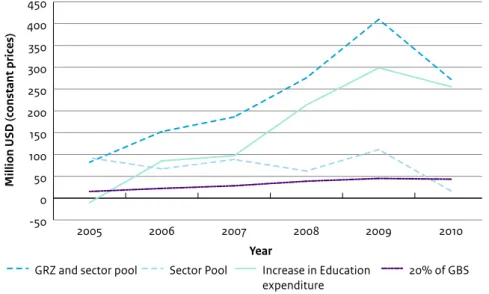
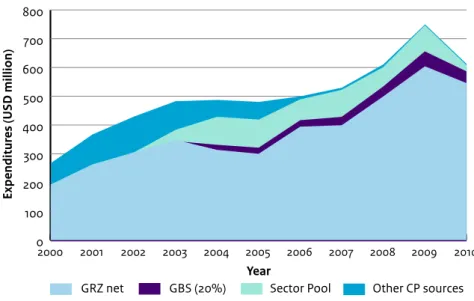
The financial resources of the Cooperating Partners created the preconditions for the implementation of policies aimed at achieving the MDG education targets and the introduction of free (basic) education. The shift to budget support has not reduced total allocations to the Ministry of Education. Several Cooperating Partners have continued to provide funding directly to the Ministry and domestic spending increased enormously until 2009. Until recently, there has been no evidence of funds being moved from education to other sectors. Between 2005 and 2009, real (domestic) expenditures on education rose by more than 50%. The increase was much higher than the reduction of disbursements from the sector pool and the importance of the education sector in the total budget grew. Budget support and the sector pool account for about 12% of the total resources of the Ministry of Education and about 30% of the discretionary budget. Moreover, the move to general budget support enhanced the allocative efficiency. The insistence of Cooperating Partners on increasing domestic resources for education, through the sector dialogue and through the PRBS meetings, was successful.
2. The PRBS and sector dialogue were effective in contributing to the development of sector policies. Strong ownership by the government and the convergence of sector objectives and strategies were important conditions for this result.
Sector cooperation in the education sector worked smoothly. First, there was strong ownership by the government. Education, especially basic education, is politically important and the government has shown its commitment through its coordinating role in the sector, through the introduction of free primary education and through large increases in the (domestic) budget. The Cooperating Partners have helped to strengthen sector planning and budgeting, to improve transparency, accountability and monitoring and evaluation in the sector, and have contributed to the decentralization of the sector. The JASZ and the move to PRBS have enhanced harmonization and coordination in the sector and have reduced transaction costs on the side of the Ministry. The lead donors on the other hand had to take on a huge work load because of the distribution of labour and the consequent exit of some donors from the sector. The exit of donors also meant stripping the sector of much needed technical expertise in some areas.
Recently, Cooperating Partners have become more critical of the effectiveness of coopera-tion in the educacoopera-tion sector. There is a sense that the current sector dialogue mechanisms are not working effectively. These concerns are partly a reaction to irregularities in other sectors and the slowness of the government in responding to them, as well as the lack of progress towards targeted budget support. Follow up on the recommendations of the Fiduciary Risk Assessments of 2008 has been slow, which impedes the timely move towards targeted budget support. Other issues have also contributed to an increasing focus on fiduciary issues. While it is important to ensure that funds are spent correctly and in
| 13 | accordance with their original objectives, there is also a risk that this focus detracts from the
effectiveness of education policies.
3. Investments in the education sector have effectively contributed to the achievement of sector targets.
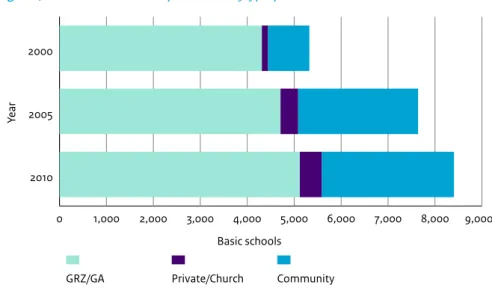
The extra resources were used to recruit more teachers, build more schools and construct more classrooms. Between 2005 and 2009, the number of basic schools increased by 475, of which 275 were GRZ and grant-aided schools, and remainder (mainly) community schools. The government recruited 9000 extra teachers for the basic education sector and construc-ted 5000 extra classrooms. These resources both encouraged and were necessary to cope with a huge growth in enrolments at the lower and middle basic levels (the primary level), from 2.6 million in 2005 to 2.9 million in 2009. Among these, enrolments at the upper basic level rose from less than 300,000 pupils in 2005 to more than 400,000 in 2009. There is evidence that especially the school attendance of children from the poorest households improved. In line with the enrolment growth, the number of examination candidates at grades 7 and 9 grew very rapidly, and pass rates improved. In 2005, 50% of grade 7 candi-dates passed their examination; in 2010 this figure had increased to 84%. The pass rates of grade 9 candidates did not improve, however.
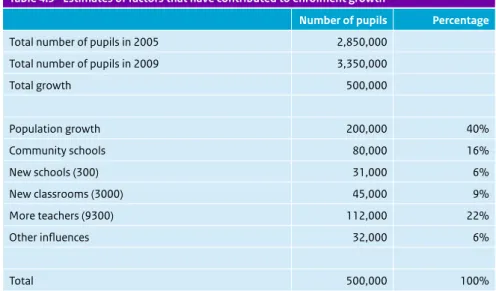
The investments in education explain almost 40% of the enrolment growth between 2005 and 2009. For a large part, these investments were also necessary to accommodate the enrolment growth due to population growth or other factors. Although total enrolments continued to increase, the investments also contributed to slight reductions in pupil–tea-cher, pupil–classroom and pupil–book ratios. Overall, GRZ and grant-aided schools accounted for 63% of the total enrolment growth between 2005 and 2009, and community schools for most of the remainder.
4. While the situation is improving, education spending is still regressive and regional imbalances remain. Nevertheless, these imbalances are also the result of large differences in enrolment growth.
Mainly as a result of the high enrolment growth, pupil–teacher ratios remain high, especially in rural areas. In line with the urban–rural disparities there are also large differences between districts. The distribution of teachers among districts is regressive, with relatively fewer teachers employed in the poorest districts. Teacher allocation has improved only slightly. However, this is partly the result of the relatively high enrolment growth in the poorest districts (and in rural areas). The deployment of teachers in rural areas and the construction of classrooms attracted new children. As a result, pupil teacher ratios and pupil classroom ratios improved less than anticipated. Therefore, precisely because of the impact on enrolment, the investments have been more effective than the changes in pupil teacher ratios and pupil classroom ratios suggest. Nevertheless, for poor rural areas, investments in classrooms and in new teachers have hardly been enough to compensate for the increased enrolments. As a result, some children have to sit on the floor, without books and, in the case of double shifts, school hours are short. So far, the ministry has not succeeded in finding a system that leads to a more equal allocation of teachers. The 20% bonus paid to teachers in rural areas is not enough, and many teachers in urban areas can
| 14 |
compensate for this bonus by teaching two shifts, which is an incentive for maintaining this system.
Disbursements to basic schools are progressive, with the poorest districts receiving relatively more money. At the same time, it must be noted that the budget per pupil is far too low to have an impact. The payment of school grants is erratic and the average grant per pupil has decreased by more than 60% (in real terms) over the years.
A specific district analysis showed large differences between districts in terms of resources, examination results, equity issues and the development of basic education. Overall, the worst-performing districts are in the Northern, Southern and North Western provinces. In order to improve the performance of these districts it is necessary to:
1. improve the allocation of resources, and the collaboration of NGOs and bilateral Cooperating Partners with the Ministry of Education;
2. develop more effective programmes to resolve the problems with English in rural areas; 3. develop more effective policies to reduce repetition and dropout rates in a number of
districts;
4. step up support to community schools; and
5. pay more attention to equity issues and develop specific programmes for girls focusing on districts with low gender parity indices.
5. There are serious inefficiencies in the allocation of resources, the deployment of teachers and the distribution of classrooms, all of which have had a negative impact on the effectiveness of basic education.
While total resources for basic education are too low to deal with all the challenges in basic education, the inefficient allocation of resources also has a negative impact on sector results. There are large differences in pupil–teacher ratios, even among GRZ schools. For almost 30% of pupils, this ratio is lower than 40:1, whereas for 10% of pupils it is above 100:1.
The allocation of resources is mainly based on the number of pupils, but given the lack of classrooms, deploying more teachers in a school will not always be the best option. In some schools the number of teachers (almost) equals the number of classes, rather than the number of classrooms. This means that teachers teach only one class (instead of two if the school has a system of double shifts). Moreover, the actual teaching by head teachers has decreased as well, while the absenteeism of teachers has increased. These findings imply a serious waste of scarce resources and of the most important, but also most expensive, resource in basic education. Improving the deployment of teachers could free up resources that could be used to improve the quality of basic education.
6. Access to education has improved enormously, but the quality of education generally remains low. However, the development of basic education over the past decade has been more successful than a superficial analysis suggests.
The numbers of pupils completing primary and upper basic education have increased enormously, but average test and examination results have not much improved.
| 15 | However, it must be stressed that several successes tend to disguise more positive sector
results:
1. The high enrolment growth in rural areas had a negative impact on efforts to reduce pupil–teacher and pupil–classroom ratios. The numbers of teachers and classrooms increased more rapidly in rural than in urban areas, but so did enrolments. Moreover, the deployment of more teachers and the construction of more classrooms attracted new pupils.
2. Related to this phenomenon is the effect of enrolment growth on learning achieve-ments. With the increased access of underprivileged groups, the composition of the children enrolled in basic education has changed. In 2010, many children in poor, remote rural areas now go to school, while their parents had no education. This had an important impact on average test and examination results. In general, children in poor rural areas have relatively poor results as their backgrounds and home environments are not conducive to learning. One of the problems is that few people in these areas speak English, yet school examinations are in English. As a result, many pupils do not master English and therefore perform poorly in the examinations. In this respect, the relatively stable results may be seen as an important achievement.
The problem with English appears to be one of the main challenges. Tests and examinations are in English, but in large parts of the country, people do not master English. At the beginning of the Millennium, Zambia was a forerunner in the introduction of New Break Through to Literacy (NBTL), an approach introducing learning in the local language up to grade 3 as a way of countering the potential effecting of learning in a foreign language. While in 2003 an evaluation concluded that the pilot was highly successful, it appears that the subsequent implementation was less effective.1 The teacher deployment system also
facilitates the continued use of local languages. Teachers continue to teach in one of the local languages, with the result that grade 7 pupils – and even many grade 9 pupils – do not master English. The evaluation also shows that this is a regional phenomenon (with the largest challenges in Northern Province and Southern Province).
This evaluation also pays attention to the persistent misunderstanding that underresourced community schools perform as well as GRZ schools. Community schools have had a very important role in improving access to education and one can only have great respect for the communities who created these schools and the teachers who volunteered to work in these schools. Many children in these schools are learning under very difficult and unconducive environments, with teachers who are in most cases untrained, and with minimal learning materials. However, there is enormous variation between community schools. Whereas many schools are solely supported by the community, other schools receive assistance from churches, NGOs or private enterprises. Only a few (about 100) of the almost 3,000 commu-nity schools are entitled to subject pupils to examinations. These schools are much better resourced than other community schools, and often even better than GRZ schools. The examination results of these schools are indeed comparable with the results of GRZ schools, but they are not representative for all community schools. The grade 7 pupils of other 1 In fact, already the IOB (2008) evaluation questioned the sustainability of the results in the pilot schools
| 16 |
community schools take their examinations in other examination centres, usually GRZ schools.
7. While there are important reasons why learning achievements have not improved, the quality of education can and should be improved.
There are a number of other reasons why learning achievements have not improved. A first explanation is the lack of resources. Resources have increased, but not enough to cope with the dilapidated state of the (basic) education sector in the 1990s and the high enrolment growth. As a result, in some schools children sit on the floor in overcrowded classrooms. The system of double shifts has led to a short contact time between teachers and pupils, and this has been further reduced by increasing teacher and pupil absenteeism. The failure by teachers to spend adequate time preparing lessons and marking has had devastating impacts on the teaching and learning process. Teacher motivation is low.
There are at least four reasons why interventions are not more (cost-)effective: 1. The problem with local languages has not been effectively resolved, and has
under-mined the effectiveness of teaching and the use of instructional materials. 2. The system of double and even triple shifts has led to shorter contact time between
teachers and pupils, and this has been aggravated by increasing teacher and pupil absenteeism.
3. The extremely low school grants mean that schools cannot pay their bills and cannot afford the most fundamental teaching and learning materials, with serious impacts on the effectiveness of teaching.
4. Many schools do not offer an environment that is conducive to learning. Increased teacher and pupil absenteeism has a negative impact on education results and may lead to higher dropout rates.
Investing in the quality of school management (through education and training as well as strengthening of the standards unit) is the most effective way to improve results. Well-managed schools perform better, and investing in the quality of management is a relatively cheap way to improve results. A well-managed school ensures pupil and teacher attendance, motivates teachers, encourages the efficient allocation of resources and offers a child-friendly environment. If the quality of school management is raised, teachers become considerably more (cost-)effective. And naturally, well-trained teachers raise the cost-effec-tiveness of books. As a result, pupils perform better. Line items that contribute to improved quality e.g. standards and curriculum must receive adequate allocation of resources. Given the scarce resources, it is important to strategically allocate resources to those components that will have significant/maximum impact.
Improving education in rural areas also requires a more holistic approach. It appears that in the past decade, the government and Cooperating Partners have tended to focus on the ‘hardware’ (more teachers, more classrooms, more books), thereby paying insufficient attention to the ‘software’, i.e. teacher education and training, and especially school management and strengthening the standards unit, localized target setting, and
commu-| 17 commu-| nity participation and empowerment. Cooperating Partners and the ministry have focused
too much on symptoms such as high pupil–teacher and pupil–classroom ratios. However, more teachers will not be a solution if each teacher teaches only for three hours per day. More classrooms are also needed, but that is also only part of the solution. It is necessary to invest more in the causes of underperformance in rural areas, which are related to cultural values and language barriers, rather than just focusing on pupil–teacher or pupil–classroom ratios. If these problems are not resolved, deploying more teachers or constructing more classrooms will not have a large effect. In the end, money remains key: more resources are needed to deal with the challenges facing the sector.
The analysis also shows that it is illusory to think that in general a project approach would be more effective. Many projects, such as the Dutch Western Province Education
Programme (WEPEP), implemented in the late 1990s, have proved to be unsustainable. In other cases, like a context where funding centrally has risks because of a weak system, projects may be more effective. Overall, it appears that a combination of modalities leads to the best results: sector budget support or pooled funding are the most adequate instru-ments to discuss sector issues, general budget support helps to raise issues at a higher level and projects may help to address specific (regional) issues or function as a pilot for the development of new instruments.
8. Recent developments endanger the sector results achieved, and create the risk of a new erosion of the sector.
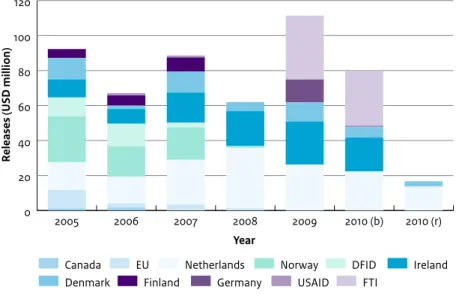
In spite of all investments, total resources for the education sector remain too low. Zambia spends less than 4% of its GDP on education, against an average of 5% in comparable countries. Even though the education budget has increased, it is still far too low to deal adequately with the challenges facing the sector. In 2010, the total releases of the Ministry of Finance and National Planning (MoFNP) and Cooperating Partners were much lower than the budget and commitments, and also much lower than disbursements in 2009.2 This
contributed to a delay of investments and a further reduction in the already very low school grants. Moreover, disbursements often come very late (in the fourth quarter) and this prevents effective utilization of resources. This has especially a negative impact on (class-room) construction.
Apparently, the interest of GRZ and Cooperating Partners in basic education is waning. Several partners are withdrawing from the education sector, have reduced their budget support or are ending their bilateral support to Zambia. This will likely have negative consequences for the development of the basic education subsector. Large investments are still needed to deal with the low level of education and the high population growth.
2 In late 2010 some partners decided to delay disbursement because they felt that not enough progress had been made on a number of issues, including the introduction of targeted budget support, fiduciary issues, and substantial weaknesses in financial and accounting systems, and because of the lack of follow-up on a number of reports.
| 19 | Education is one of the most important instruments for poverty reduction and economic
growth. Partly as a result of the Education for All initiative in 1990 and the Millennium Development Goals (MDGs), the sector became one of the most popular and most crowded sectors of development cooperation. Until recently, this was the case in Zambia, where in the late 1990s education was one the first sectors where the sector-wide approach (SWAp) was introduced. The successful collaboration between the government and Cooperating Partners in the education sector contributed to the further harmonization and alignment of aid, resulting in the move to general budget support in 2005.
The shift from project aid to sector support and general budget support was not unique to Zambia, but rather a reflection of the perceived lack of efficiency and effectiveness of project aid, which was caused by fragmentation and the lack of coordination, ownership and sustainability. However, this shift created new challenges as well. While there was a strong feeling among partner countries, Cooperating Partners and academics that budget support would be a more efficient, effective and sustainable mode of aid delivery, it also became more complicated to analyze its impact. A lack of information on tangible results contribu-ted to the debate in development partner countries about the effectiveness of this aid modality. The evaluation departments of (cooperating) partner agencies have therefore taken the initiative to assess the effectiveness of budget support in recipient countries. The objective of these evaluations has been to provide empirical evidence regarding the contribution of budget support to the realization of its objectives, i.e. (economic) develop-ment, poverty reduction and improved service delivery.
The evaluation of budget support to Zambia includes, apart from an overall analysis of the development and impact of budget support, several sector case studies: infrastructure, agriculture, health and (basic) education. The choice of sectors was based on:
• their role within the MDGs;
• their role within the Poverty Reduction Budget Support (PRBS) and the Performance Assessment Framework (PAF);
• their budgetary importance; and
• discussions with the government of Zambia and the Cooperating Partners.
The synthesis report discusses the development of budget support in Zambia and analyzes its impact on government reforms, service delivery and households.
This report represents the contribution of the education sector to the budget support evaluation. The evaluation focuses on the development of the policy dialogue and funding of the basic education subsector, as well as on the impact of government policies, to which the Cooperating Partners have contributed. If these policies have been successful, then external support, including budget support, was well spent. Nevertheless, the main purpose of the report is to contribute to enhancing the effectiveness of sector policies and sector collaboration, resulting in improvements in the quality of basic education in Zambia. In order to ensure the practical use of the report, the Directorate of Planning and Information of the Ministry of Education (MoE/DPI) contributed to the formulation of the Terms of Reference and participated actively in the evaluation.
| 20 |
This case study builds on the results of an earlier collaboration.3 While the previous study
focused on the impacts of selected education interventions in terms of incidence and educational results, the new evaluation seeks to provide empirical evidence of the contribu-tion of budget support to the realizacontribu-tion of its objectives, i.e. (economic) development, poverty reduction and improved service delivery. Moreover, the new evaluation covers the full nine years of basic education, focusing on:
• the impact of budget support on the MoE budget; • the impact of budget support on service delivery; • the distributional effects of improved service delivery;
• the impact of improved service delivery on enrolment and learning achievements; and • equity issues and causes of gender and regional disparities.
While for comparison the period 2000–2005 has been taken into account where relevant, the primary interest is in the years 2005–2010.
Chapter 2 explains the methodology used for this evaluation. This is a combination of field research and data analysis. The main source of information is the Education Management information System (EMIS), in combination with the Educational Statistical Bulletins. The report is an example of how these sources may be used for a policy evaluation. The Examinations Council of Zambia (ECZ) provided additional information, making it possible to link investments in education to learning achievements.
Chapter 3 describes and analyzes education policy in Zambia and the role of the Cooperating Partners in the sector. It assesses the impact of budget support on the sector dialogue as well as on the sector budget. The chapter concludes that the start of the new millennium may have marked the end of a decade of intensive and successful sector cooperation. Chapter 4 presents the direct results in terms of outputs (such as the recruitment of teachers and classroom construction) and outcomes (such as enrolment, girls’ access to education and completion rates). It also analyzes the determinants of enrolment growth, including policy interventions. Through this analysis, the evaluation was able to estimate the impact of investments in the education sector on enrolment growth. Once again, the focus is on 2005–2010, rather than on the first years of the decade.
Chapter 5 makes an excursion to the allocation of resources and does so in two ways. First, it analyzes disparities in the allocation of resources across districts in order to assess whether poor areas are relatively under-resourced. In many cases, such an analysis is static, conside-ring just one moment in time. The evaluators feel, however, that such an analysis should be dynamic. It is not very interesting to conclude that the allocation of resources is progressive or regressive; it is more important to determine the direction of and trends in resource allocations. Second, the chapter assesses the allocative efficiency of investments in the sector. It concludes that the sector may gain a lot from an improvement in allocative efficiency. The main challenge is to find the right incentives for the actors involved. 3 IOB (2008a), Primary Education in Zambia, IOB Impact Evaluation no 312.
| 21 | Chapter 6 provides a detailed analysis of the impact of interventions in the education sector
on learning achievements. The analysis has relied on a combination of qualitative research, using information from the literature, field visits, expert information from MoE officials and interviews with standards officers, (head) teachers, pupils and parents, as well as detailed quantitative information. While it may be tempting to focus solely on the impact of interventions, the evaluation team feels that it is more important to understand the actual process of teaching and learning. The chapter sketches some challenges for the (further) improvement of basic education in Zambia.
Chapter 7 shifts attention once again to the district level. Over the last two years, the ministry has been working on district profiles. These are valuable instruments for assessing developments in the education sector in each district. At the same time, the development of these district profiles raised interest in the causes of underperformance in several districts. While the district profile may give a comprehensive picture of developments in one district, chapter 7 tries to sketch a broader picture through a comparative analysis using a number of indicators developed for such an analysis.
Chapter 8 returns to one of the main objectives of the evaluation, which is to assess the impact of budget support. While the whole evaluation tries to assess the impact of budget support in itself, many policy makers want to know whether it is more or less effective than project aid. Curiously enough, the reverse question has never been raised in evaluations of project aid. Nevertheless, without attempting to answer this question, chapter 8 highlights some of the disadvantages of project aid. The Achilles heel of projects appears to be sustainability.
Research questions and
methodology
| 23 |
2.1 Introduction
This report is the result of a collaboration of the Policy and Operations Evaluation Department (IOB) of the Netherlands Ministry of Foreign Affairs and the Directorate of Planning and Information of Zambia’s Ministry of Education. The report serves two overlapping objectives. The first is to assess the contribution of budget support to the funding of the education sector in Zambia and the realization of sector objectives. Part of this evaluation involved an analysis of developments in service delivery – who benefitted and what was the impact? – following an agreed set of research questions and methodolo-gy.4 The second, related, objective is to assess the causes of underperformance in a number
of districts, in close collaboration with the Directorate of Planning and Information of the Ministry of Education.
2.2 Research questions and definitions
The evaluation seeks to provide empirical evidence on the contribution of budget support to the realization of objectives in the basic education subsector. The central questions are: 1. To what extent has budget support contributed to external funding for the education
sector and what was the impact on the sector dialogue? 2. What was the impact of sector policies on service delivery? 3. Who benefitted from changes in service delivery?
4. What was the impact of investments in the sector on access and learning achievements in the basic education subsector?
5. What are the causes of regional imbalances?
Central to the evaluation is the analysis of the impact of investments in the basic education subsector, to which Cooperating Partners have contributed through budget support and the sector pool (of funds for the National Implementation Framework of the Fifth National Development Plan).
In line with the OECD/DAC (2006), the evaluation defines sector budget support as un-earmarked funding to the national treasury. Nevertheless, the evaluation also includes the direct funding of the education sector through the sector pool and especially tries to analyze the relation between the two instruments.
The evaluation focuses on the basic education subsector, as this is the largest subsector of interest to the Cooperating Partners and especially PRBS partners. In line with the provisi-ons of Poverty Reduction Budget Support from 2005 onwards, attention is focused on the period 2005–2010, although other years have been taken into account where relevant. 4 The development of the methodology is an initiative of the Evaluation Unit of the Europe Aid
Co-operation Office of the European Commission. The Steering Group on budget support further includes the evaluation departments of Belgium, Canada (CIDA), Denmark (DANIDA), Finland, France (AFD), Germany (BMZ), Ireland (Irish Aid), the Netherlands (IOB), Norway (NORAD), Sweden (Sida), the United Kingdom (DFID) and the OECD/DAC secretariat.
| 24 |
2.3 Budget support and the measurement of impact
Budget support normally comprises four instruments or elements: a) the funds, b) the policy dialogue, c) the conditions attached to the support, and d) technical assistance and or capacity building activities (Hammond, 2006). It is the expectation that this mix of instru-ments – under the right conditions – will contribute to the realization of specific govern-ment outputs, such as increased funding for discretionary spending, resulting in increased quantity and quality of goods and services provided by the public sector.
The intervention logic underlying budget support renders an evaluation of the instrument’s effectiveness complex. In contrast with the evaluation of projects, there is no way to measure the effects directly. The impact of budget support on education is determined by the quality of national strategies and policies, the government’s commitment to pursue these policies, and the government’s political and administrative capacities to use the resources to implement these policies. Therefore, an analysis of the impact of budget support must include an analysis of the impact of sector policies efficiently and effectively. This does not mean that Cooperating Partners may fully claim the successes of these policies. Rather, it means that the evaluation analyzes the effectiveness of interventions to which PRBS partners have contributed. The evaluation also tries to assess how PRBS partners contributed to the development of these sector policies through funding and other non-financial contributions.
The road to the measurement of impact of education policies is also paved with methodolo-gical problems. Programmes may seem effective or ineffective, but many factors apart from direct interventions may have determined the results. Three related problems need to be addressed. First, there is the attribution problem. Which effects can be attributed to educatio-nal interventions? Many other factors interfere and may have an impact as well. An unbiased assessment of the effects of educational interventions on enrolment, for instance, must take into account the effects of the size, remoteness and poverty status of households, as these factors may also determine enrolment rates. For example, enrolment rates may improve as a result of increased incomes, the lowering or abolition of school and examina-tion fees, increased awareness of the importance of educaexamina-tion among parents, etc. Moreover, there are also certain factors that have a negative impact on learning and learning achievement. Poor education outcomes may be due to the poor quality of the schooling system (teachers, teaching methods, materials), to underfunding or to factors beyond the education policy.
The attribution problem is related to selection effects, which may occur when the characteris-tics of the intervention and control group(s) are different. The neglect of selection effects may lead to biased estimates (White et al., 2006, pp.3–4). As long as selection is based on observable characteristics, these may be included in the analysis. However, not all characte-ristics are observable. This is the third problem: selection of unobservables. If the effects of one particular intervention are evaluated, it is not necessary to include all relevant factors in the model as long as these other factors are not correlated with the intervention. This is what causes the problem of unobservables and endogeneity. For instance, one may be interested in the effect
| 25 | of class size on learning achievement.5 Class size may be endogenous or correlated with
school management (see, for instance, Glewwe and Kremer, 2005). However, school management is seldom included in the analysis. Moreover, it is often assumed that the school choice of motivated (and probably well-educated) parents is correlated with class size, as these parents tend to send their children to schools with low pupil–teacher ratios. The evaluation uses a number of techniques to deal with these challenges.
2.4 Methodology
Different methods were used to solve the methodological problems encountered. The evaluation relies on a mix of methods, including qualitative research as well as quantitative impact analysis. The impact of budget support and the policy dialogue on the MoE budget and MoE policies are evaluated through an analysis of evaluations and (sector) reviews (including Public Expenditure Reviews and the Fiduciary Risk Assessment), documentation of Cooperating Partners and GRZ (including the documentation on pooled funding, targeted sector budget support and general budget support), analysis of budget allocations and through interviews. The impact of budget support (including pooled funding) on service delivery is analyzed through the sector plans (especially the MoE’s Strategic Plan, MoESP, and the National Implementation Framework, NIF) and specific other plans (such as the Infrastructure Plan), budget allocations, monitoring information and available evaluations. The impact on service delivery is analyzed using information from the yearly Educational Statistical Bulletins and the Education Management Information System (EMIS) that contains information from the annual school censuses. As part of the analysis, the team visited the provincial education office of Eastern Province and the district education offices and basic schools in Chadiza and Chipata. In addition, the team visited the district councils in Kalomo and Sinazongwe in Southern Province and held focus group discussions in several wards in these districts.
Next, the evaluation analyzed the effects of the education policies and investments in the sector in terms of the impacts on enrolment and learning achievements. Basically, regression techniques were applied to resolve problems of (observed) confounding factors and selection effects (see Annex 5). The approach is known as the ‘estimation of education production functions’ (see Glewwe and Kremer, 2005). Differences in access and learning achievements are explained by:
• characteristics of the pupils (gender, age, where they live, work at home);
• specific characteristics of households (such as welfare and education of parents, language); • school-related factors (such as distance to school, availability of desks and books, teacher
qualifications, pupil–teacher contact time, teacher absenteeism).
5 In traditional usage, a variable is endogenous if it is determined within the context of a model. In econometrics, it is used to describe any situation where an explanatory variable is correlated with the disturbance term. Endogeneity arises as a result of omitted variables, measurement error or in situations where one of the explanatory variables is determined along with the dependent variable.
| 26 |
The main unit of analysis is the school. It therefore seems appropriate to distinguish a number of specific school-related factors: school characteristics, infrastructure, learning materials, teachers and management. In a formal mathematical notation:
Outcomei = a + biSi + ciMi + diIi + eiLi + fiTi + giPi + hiHi + kiRi + εi
where S, M, I, L, T, P, H and R denote vectors of observable characteristics, a denotes the estimated constant, bi through ki denote the estimated coefficients, and residual ε indicates all unobserved characteristics, which include:
S = vector of specific school characteristics M = vector of management characteristics I = vector of infrastructural characteristics L = vector of learning materials
T = vector of the number and quality of teachers P = vector of pupil characteristics
H = vector of household characteristics R = vector of regional characteristics.
The econometric analysis was complemented by qualitative research, including a review of the recent literature, interviews, field visits and focus group discussions.
The evaluation also analyzed the distributional effects of (basic) education, focusing on gender differences, and differences by income and by region. This analysis was carried out in two ways: 1) by linking administrative data (from the EMIS) to census data and poverty maps; 2) by using household survey data on the actual use of education services and other differences between groups (such as differences in income and urban/rural differences). The analysis examined differences in:
• the provision of education services (schools, teachers, classrooms); • enrolment;
• learning achievements.
An important aspect of this part of the evaluation is an analysis over time: it is more interesting to know if differences are decreasing than to describe existing differences. Of specific interest is the development of education services among the poorest groups. This analysis was based on household surveys as well as by linking of administrative data to poverty maps.
The assessment of distributional effects is linked to an analysis of the causes of underperfor-mance in some districts.
| 27 |
2.5 Data
The main data sources for the beneficiary incidence analysis and the impact analysis are: • Ministry of Education, Educational Statistical Bulletins 2000–2009;
• the Annual School Census for the years 2000–2010. This database contains information on school inputs (teachers, classrooms, books and other school facilities, school characteris-tics, enrolments and pupil characteristics);
• examination data (grade 7) of the Examinations Council of Zambia for 2001–2009, which provide information on learning achievements;
• the National Assessment Tests (1999, 2001, 2003 and 2006);
• the Zambian Demographic and Health Survey (ZDHS) (especially the DHS EdData Survey 2002). Relevant variables from the ZDHS include household characteristics and education (educational attainment, school attendance, repetition and dropout rates, and literacy); • the Population and Housing Census of 2000 (household characteristics, education and
economic activities);
• the Living Conditions Monitoring Surveys (LCMS), which include, apart from pupil and household characteristics, information on school attendance, (highest) education level and reasons for non-attendance and dropout;
| 29 |
3.1 Introduction
Zambia was a relatively rich country at independence in 1964. However, between 1975 and 2000 the economy developed unfavourably and could not keep pace with the population growth. GNI per capita declined from USD 590 in 1975 to USD 300 in 2000. At the end of the 1990s, Zambia was one of the poorest countries of sub-Saharan Africa. Even today, around 64% of the 13 million Zambians are classified as poor. As a result of the economic problems and a huge foreign debt, the government was forced to cut expenditures in the social sectors. At the end of the 1990s, average real government expenditure on education (per capita) was no more than about 60% of the level at the beginning of the decade (Das et al., 2004). The underfunding of the education sector led to substantial decline in non-salary expenditures and investments. School infrastructure deteriorated which led to insufficient furniture, teaching and learning materials. The enrolment of children decreased. By 1999, 37% of school-age children were not enrolled.
This context is important for understanding the development of the education sector and an adequate assessment of the impact of recent investments. By the end of the 1990s, the GRZ and Cooperating Partners started to work together to revitalize the education sector. They felt that with the enormous shortages, close sector collaboration would be more efficient and effective than the initiation of more or less isolated projects.
The sector cooperation proved to be rather successful. The goals of the Ministry of Education and Cooperating Partners coincided, and despite the enormous challenges, the sector could point to significant and impressive results. This contributed to the further harmonization and alignment of external support, as agreed in the 2007 Joint Assistance Strategy for Zambia (JASZ). During the JASZ negotiations, the GRZ indicated its preference for general budget support as the main aid modality. Several Cooperating Partners supported this initiative. In April 2005, the GRZ and four Cooperating Partners (the European Commission, the World Bank, DFID and the Netherlands) signed a Memorandum of Understanding on the provision of Poverty Reduction Budget Support, PRBS. Later, Sweden, Norway, Germany, Finland and the African Development Bank followed.
The JASZ and the PRBS had important consequences for the funding of the education sector. The number of Cooperating Partners that continued to fund the sector through the sector pool decreased, while other donors reduced their direct contribution to the sector in exchange for indirect funding through general budget support. The JASZ aimed at a more efficient division of labour among Cooperating Partners. As an outcome of the JASZ, it was agreed that fewer donors would participate actively in the education sector dialogue. This chapter describes and analyzes the development of the sector cooperation, culmina-ting (partly) in the move to general budget support. Section 3.2 describes policy develop-ments since the end of the 1990s and section 3.3 analyzes the role of the Cooperating Partners in this process. Section 3.4 proceeds with a description of the policy dialogue. Section 3.5 sketches the development of budget and expenditure and section 3.6 analyzes the impact of general budget support on the development of education sector budgets.
| 30 |
Section 3.7 describes the proposals to introduce targeted budget support and the hin-drances towards its implementation.
Section 3.8 assesses the impact of budget support, and section 3.9 presents a summary and conclusions.
3.2 Sector policies
In 1996, in response to the challenges in the education sector, the government of Zambia produced a policy document called Educating Our Future. This document marked the begin-ning of the revitalization of the education sector. The following year (1997) the government adopted the Education Sector Investment Plan (ESIP). Based on ESIP, the Ministry of Education developed the Basic Education Sub-Sector Investment Programme (BESSIP) for the period 1999– 2002. BESSIP brought together several national policies and interventions such as the Poverty Reduction Strategy Paper, the Public Sector Reform Programme (PSRP), National Gender Policy, HIV/Aids, etc., into one programme. With BESSIP, the MoE sought to redress the deterioration of the basic education subsector and to improve both access to and the quality of basic education.
BESSIP had a slow start. The slow restructuring process at the Ministry of Education and the slow pace of decentralization hindered effective implementation of BESSIP at the local level. The initial stages of the process were characterized by protracted consultations and long preparatory processes centred on procedures, funding modalities, accountability and the MoE’s capacity to sustain a programme of such magnitude (Chilangwa, 2002). In 1999, only 19% of the pooled funds were actually spent (Chisala and Cornelissen, 2003, p.86). The programme was more successful in its second phase, however.
In 2003, the programme was followed by the Ministry of Education Strategic Plan (MoESP) for 2003–2007, which covered the entire sector. The plan recognized the need for further investment in the education sector and expanded the focus from basic education to the whole sector, including basic school, high school and tertiary education.6 Whereas the
emphasis of BESSIP had been on enrolment at grades 1–7, the MoESP stressed the need to also expand enrolment in grades 8 and 9 (the higher basic education level). In addition, remote and disadvantaged areas were given special attention, and targeted for the deploy-ment of more teachers, and the allocation of additional resources for the construction or rehabilitation of infrastructure. The MoESP intended to improve the quality of education as well. According to the strategic plan, the qua