Active Object
An Object Behavioral Pattern for
Concurrent Programming
R. Greg Lavender
Douglas C. Schmidt
[email protected] [email protected]
ISODE Consortium Inc. Department of Computer Science Austin, TX Washington University, St. Louis An earlier version of this paper appeared in a chapter in
the book “Pattern Languages of Program Design 2” ISBN 0-201-89527-7, edited by John Vlissides, Jim Coplien, and Norm Kerth published by Addison-Wesley, 1996.
Abstract
This paper describes the Active Object pattern, which decou-ples method execution from method invocation in order to simplify synchronized access to an object that resides in its own thread of control. The Active Object pattern allows one or more independent threads of execution to interleave their access to data modeled as a single object. A broad class of producer/consumer and reader/writer applications are well-suited to this model of concurrency. This pattern is com-monly used in distributed systems requiring multi-threaded servers. In addition, client applications, such as window-ing systems and network browsers, employ active objects to simplify concurrent, asynchronous network operations.
1
Intent
The Active Object design pattern decouples method execu-tion from method invocaexecu-tion to enhance concurrency and simplify synchronized access to an object that resides in its own thread of control.
2
Also Known As
Concurrent Object and Actor
3
Example
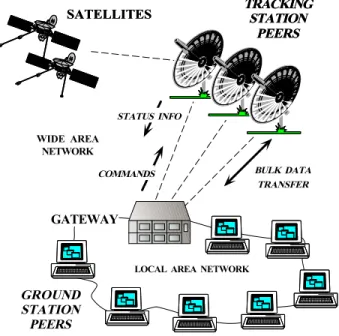
To illustrate the Active Object pattern, consider the design of a communication Gateway [1]. A Gateway decouples co-operating components and allows them to interact without having direct dependencies among each other [2]. The Gate-way shown in Figure 1 routes messages from one or more supplier processes to one or more consumer processes in a distributed system [3].
WIDE AREA NETWORK
SATELLITES
SATELLITES TRACKINGTRACKINGSTATIONSTATION PEERS PEERS
STATUS INFO
COMMANDS BULK DATA
TRANSFER
LOCAL AREA NETWORK
GROUND STATION PEERS
GATEWAY
Figure 1: Communication Gateway
In our example, the Gateway, suppliers, and consumers communicate over TCP, which is a connection-oriented pro-tocol [4]. Therefore, the Gateway software may encounter flow control from the TCP transport layer when it tries to send data to a remote consumer. TCP uses flow control to ensure that fast suppliers or Gateways do not produce data more rapidly than slow consumers or congested networks can buffer and process the data.
To improve end-to-end quality of service (QoS) for all suppliers and consumers, the entire Gateway process must not block waiting for flow control to abate over any one con-nection to a consumer. In addition, the Gateway must be able to scale up efficiently as the number of suppliers and consumers increase.
An effective way to prevent blocking and to improve per-formance is to introduce concurrency into the Gateway de-sign. Concurrent applications allow the thread of control of an objectOthat executes a method to be decoupled from the
threads of control that invoke methods onO. Moreover,
connections are flow controlled to block without impeding the progress of threads whose TCP connections are not flow controlled.
4
Context
Clients that access objects running in separate threads of con-trol.
5
Problem
Many applications benefit from using concurrent objects to improve their QoS, e.g., by allowing an application to handle multiple client requests in parallel. Instead of using single-threaded passive objects, which execute their methods in the thread of control of the client that invoked the methods, con-current objects reside in their own thread of control. How-ever, if objects run concurrently we must synchronize access to their methods and data if these objects are shared by mul-tiple client threads. In the presence of this problem, three forces arise:
1. Methods invoked on an object concurrently should not block the entire process in order to prevent degrading the QoS of other methods: For instance, if one outgoing TCP connection to a consumer in our Gateway example becomes blocked due to flow control, the Gateway process should still be able to queue up new messages while waiting for flow control to abate. Likewise, if other outgoing TCP connec-tions are not flow controlled, they should be able to send messages to their consumers independently of any blocked connections.
2. Synchronized access to shared objects should be sim-ple: Applications like the Gateway example are often hard to program if developers must explicitly use low-level syn-chronization mechanisms, such as acquiring and releasing mutual exclusion (mutex) locks. In general, methods that are subject to synchronization constraints should be serialized transparently when an object is accessed by multiple client threads.
3. Applications should be designed to transpar-ently leverage the parallelism available on a hard-ware/software platform: In our Gateway example, mes-sages destined for different consumers should be sent in par-allel by a Gateway over different TCP connections. If the entire Gateway is programmed to only run in a single thread of control, however, performance bottlenecks cannot be al-leviated transparently by running the Gateway on a multi-processor.
6
Solution
For each object that requires concurrent execution, decou-ple method invocation on the object from method execution.
This decoupling is designed so the client thread appears to invoke an ordinary method. This method is automatically converted into a method request object and passed to another thread of control, where it is converted back into a method and executed on the object implementation.
An active object consists of the following components. A Proxy [5, 2] represents the interface of the object and a Servant [6] provides the object’s implementation. Both the Proxy and the Servant run in separate threads so that method invocation and method execution can run concurrently: the proxy runs in the client thread, while the servant runs in a dif-ferent thread. At run-time, the Proxy transforms the client’s method invocation into a Method Request, which is stored in an Activation Queue by a Scheduler. The Scheduler runs continuously in the same thread as the servant, dequeueing Method Requests from the Activation Queue when they be-come runnable and dispatching them on the Servant that im-plements the Active Object. Clients can obtain the results of a method’s execution via the Future returned by the Proxy.
7
Structure
The structure of the Active Object pattern is illustrated in the following Booch class diagram:
Proxy Future m1() Future m2() Future m3() Scheduler dispatch() enqueue() INVISIBLE TO CLIENTS VISIBLE TO CLIENTS 1 1 2: enqueue(M1) 1: enqueue(new M1) 3: dispatch() loop { m = act_queue_.dequeue() if (m.guard()) m.call() } Servant1 m1() m2() m3() Activation Queue enqueue() dequeue() 1 1 n Method Request guard() call() 4: m1() 1 1 M1 M3 M2
There are six key participants in the Active Object pattern: Proxy
A Proxy [2, 5] provides an interface that allows clients
to invoke publically accessible methods on an Ac-tive Object using standard, strongly-typed program-ming language features, rather than passing loosely-typed messages between threads. When a client invokes a method defined by the Proxy, this triggers the con-struction and queueing of a Method Request object onto the Scheduler’s Activation Queue, all of which occurs in the client’s thread of control.
Method Request
A Method Request is used to pass context information
about a specific method invocation on a Proxy, such as method parameters and code, from the Proxy to a Scheduler running in a separate thread. An abstract Method Request class defines an interface for execut-ing methods of an Active Object. The interace also contains guard methods that can be used to determine when a Method Request’s synchronization constraints are met. For every Active Object method offered by the Proxy that requires synchronized access in its Ser-vant, the abstract Method Request class is subclassed to create a concrete Method Request class. Instances of these classes are created by the proxy when its methods are invoked and contain the specific context informa-tion necessary to execute these method invocainforma-tions and return any results back to clients.
Activation Queue
An Activation Queue maintains a bounded buffer of
pending Method Requests created by the Proxy. This queue keeps track of which Method Requests to exe-cute. It also decouples the client thread from the servant thread so the two threads can run concurrently.
Scheduler
A Scheduler runs in a different thread than its clients,
managing an Activation Queue of Method Requests that are pending execution. A Scheduler decides which Method Request to dequeue next and execute on the Servant that implements this method. This schedul-ing decision is based on various criteria, such as or-dering, e.g., the order in which methods are inserted into the Activation Queue, and synchronization con-straints, e.g., the fulfillment of certain properties or the occurrence of specific events, such as space becoming available for new elements in a bounded data structure. A Scheduler typically evaluates synchronization con-straints by using method request guards.
Servant
A Servant defines the behavior and state that is
be-ing modeled as an Active Object. Servants implement the methods defined in the Proxy and the correspond-ing Method Requests. A Servant method is invoked when its corresponding Method Request is executed by a Scheduler; thus, Servants execute in the Scheduler’s thread of control. Servants may provide other methods used by Method Requests to implement their guards. Future
A Future [7, 8] allows a client to obtain the results of
method invocations after the Servant finishes executing the method. When a client invokes methods through a
Proxy, a Future is returned immediately to the client. The Future reserves space for the invoked method to store its results. When a client wants to obtain these re-sults, it can “rendezvous” with the Future, either block-ing or pollblock-ing until the results are computed and stored into the Future.
8
Dynamics
The following figure illustrates the three phases of collabo-rations in the Active Object pattern:
INVOKE DEQUEUE SUITABLE METHOD REQUEST RETURN RESULT EXECUTE Client
Proxy ActivationQueue
METHOD OBJECTMETHOD OBJECT CONSTRUCTIONCONSTRUCTION
SCHEDULINGSCHEDULING // EXECUTIONEXECUTION COMPLETIONCOMPLETION m1() Servant Servant Scheduler Scheduler CREATE METHOD CREATE METHOD REQUEST REQUEST reply_to_future() future() RETURN FUTURE RETURN FUTURE INSERT INTO INSERT INTO ACTIVATION QUEUE ACTIVATION QUEUE enqueue(new M1) dequeue(M1) enqueue(M1) M1 call() dispatch(M1) m1() guard()
1. Method Request construction and scheduling: In this phase, the client invokes a method on the Proxy. This trig-gers the creation of a Method Request, which maintains the argument bindings to the method, as well as any other bind-ings required to execute the method and return its results. The Proxy then passes the Method Request to the Scheduler, which enqueues it on the Activation Queue. If the method is defined as a two-way [6], a binding to a Future is returned to the client that invoked the method. No Future is returned if a method is defined as a oneway, i.e., it has no return values. 2. Method execution: In this phase, the Scheduler runs continuously in a different thread than its clients. Within this thread, the Scheduler monitors the Activation Queue and de-termines which Method Request(s) have become runnable, e.g., when their synchronization constraints are met. When a Method Request becomes runnable, the Scheduler dequeues it, binds it to the Servant, and dispatches the appropriate method on the Servant. When this method is called, it can access/update the state of its Servant and create its result(s). 3. Completion: In the final phase, the results, if any, are stored in the Future and the Scheduler continues to monitor the Activation Queue for runnable Method Requests. After a two-way method completes, clients can retrieve its results by rendezvousing with the Future. In general, any clients that rendezvous with the Future can obtain its results. The Method Request and Future are deleted or garbage collected when they are no longer referenced.
9
Implementation
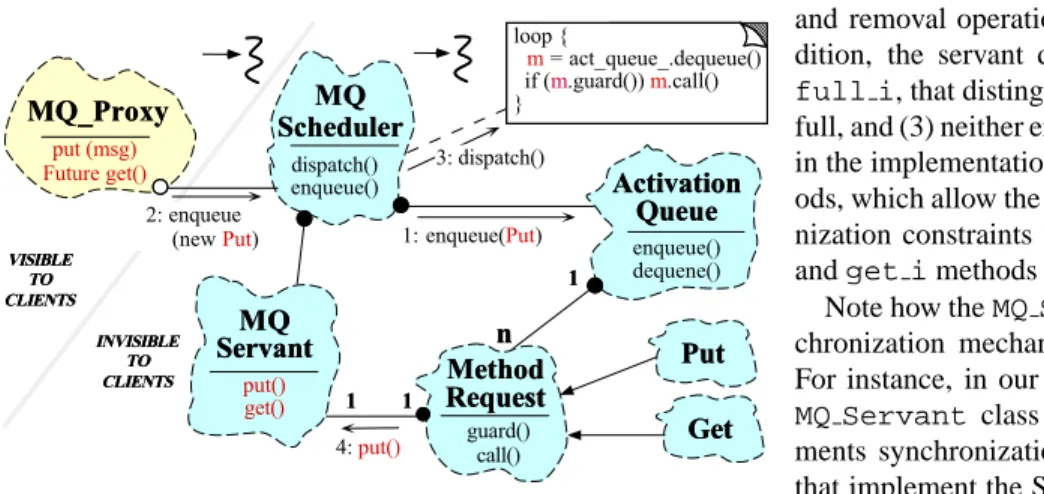
This section explains the steps involved in building a concur-rent application using the Active Object pattern. The appli-cation implemented using the Active Object pattern is a por-tion of the Gateway from Secpor-tion 3. Figure 2 illustrates the structure and participants in this example. The example in
MQ_Proxy MQ_Proxy put (msg) Future get() MQ MQ Scheduler Scheduler dispatch() enqueue() loop { m = act_queue_.dequeue() if (m.guard()) m.call() } MQ MQ Servant Servant INVISIBLE INVISIBLE TO TO CLIENTS CLIENTS VISIBLE VISIBLE TO TO CLIENTS CLIENTS 1: enqueue(Put) 2: enqueue (new Put) 3: dispatch() put() get() Activation Activation Queue Queue enqueue() dequene() Put Put Get Get Method Method Request Request guard() call() nn 11 4: put() 11 11
Figure 2: Implementing a Message Queue as an Active Ob-ject forConsumer Handlers
this section uses reusable components from the ACE frame-work [9]. ACE provides a rich set of reusable C++ wrappers and framework components that perform common commu-nication software tasks across a wide range of OS platforms. 1. Implement the Servant: A Servant defines the behav-ior and state that is being modeled as an Active Object. The methods a Servant implements are accessible by clients via a Proxy. In addition, a Servant may contain other methods that Method Requests can use to implement guards that allow a Scheduler to evaluate run-time synchronization constraints. These constraints determine the order in which a Scheduler dispatches Method Requests.
In our Gateway example, the Servant is a message queue that buffers messages that are pending delivery to con-sumers. For each remote consumer, there is aConsumer Handlerthat contains a TCP connection to the consumer process. In addition, a Consumer Handlercontains a message queue model as an Active Object and implemented with anMQ Servant. EachConsumer Handler’s Ac-tive Object message queue stores messages passed from sup-plier to the Gateway while they are waiting to be sent to their remote consumer. The following class provides an interface for this Servant:
class MQ_Servant {
public:
MQ_Servant (size_t mq_size);
// Message queue implementation operations. void put_i (const Message &msg);
Message get_i (void);
// Predicates.
bool empty_i (void) const; bool full_i (void) const; private:
// Internal Queue representation, e.g., a // circular array or a linked list, etc. };
Theput iandget imethods implement the insertion and removal operations on the queue, respectively. In ad-dition, the servant defines two predicates, empty i and full i, that distinguish three internal states: (1) empty, (2) full, and (3) neither empty nor full. These predicates are used in the implementation of the Method Requestguard meth-ods, which allow the Scheduler to enforce run-time synchro-nization constraints that dictate the order in which put i andget imethods are called on a Servant.
Note how theMQ Servantclass is designed so that syn-chronization mechanisms remain external to the Servant. For instance, in our Gateway example, the methods in the MQ Servant class do not include any code that imple-ments synchronization. This class only provides methods that implement the Servant’s functionality and check its in-ternal state. This design avoids the inheritance anomaly [10, 11, 12, 13] problem, which inhibits the reuse of Servant implementations if subclasses require different synchroniza-tion policies. Thus, a change to the synchronizasynchroniza-tion con-straints of the Active Object need not affect its servant im-plementation.
2. Implement the Proxy and Method Requests: The Proxy provides clients with an interface to the Servant’s methods. For each method invocation by a client, the Proxy creates a Method Request. A Method Request is an abstrac-tion for the context1
of a method. This context typically in-cludes the method parameters, a binding to the Servant the method will be applied to, a Future for the result, and the code for the Method Request’scallmethod.
In our Gateway example, theMQ Proxyprovides an ab-stract interface to theMQ Servantdefined in Step 1. This message queue is used by aConsumer Handlerto queue messages for delivery to consumers, as shown in Figure 2. In addition, theMQ Proxyis a factory that constructs instances of Method Requests and passes them to a Scheduler, which queues them for subsequent execution in a separate thread. The C++ implementation ofMQ Proxyis shown below: class MQ_Proxy
{ public:
// Bound the message queue size. enum { MAX_SIZE = 100 };
MQ_Proxy (size_t size = MAX_SIZE)
: scheduler_ (new MQ_Scheduler (size)), servant_ (new MQ_Servant (size)) {}
// Schedule <put> to execute on the active object. void put (const Message &m) {
Method_Request *method_request =
1
new Put (servant_, m);
scheduler_->enqueue (method_request); }
// Return a Message_Future as the ‘‘future’’ // result of an asynchronous <get>
// method on the active object. Message_Future get (void) {
Message_Future result;
Method_Request *method_request = new Get (servant_, result);
scheduler_->enqueue (method_request); return result;
}
// ... empty() and full() predicate implementations ... protected:
// The Servant that implements the // Active Object methods.
MQ_Servant *servant_;
// A scheduler for the Message Queue. MQ_Scheduler *scheduler_;
};
Each method of an MQ Proxy transforms its invoca-tion into a Method Request and passes the request to its MQ Scheduler, which enqueues it for subsequent acti-vation. A Method Request base class defines virtual guardand callmethods that are used by its Scheduler to determine if a Method Request can be executed and to execute the Method Request on its Servant, respectively, as follows:
class Method_Request {
public:
// Evaluate the synchronization constraint. virtual bool guard (void) const = 0;
// Implement the method. virtual void call (void) = 0; };
The methods in this class must be defined by subclasses, one subclass for each method defined in the Proxy. The ratio-nale for defining these two methods is to provide Sched-ulers with a uniform interface to evaluate and execute con-creteMethod Requests. Thus, Schedulers can be decou-pled from specific knowledge of how to evaluate the syn-chronization constraints or trigger the execution of concrete
Method Request.
For instance, when a client invokes the putmethod on the Proxy in our Gatway example, this method is trans-formed into an instance of thePutsubclass, which inher-its fromMethod Request and contains a pointer to the MQ Servant, as follows:
class Put : public Method_Request {
public:
Put (MQ_Servant *rep, Message arg)
: servant_ (rep), arg_ (arg) {} virtual bool guard (void) const {
// Synchronization constraint: only allow // <put_i> calls when the queue is not full. return !servant_->full_i ();
}
virtual void call (void) {
// Insert message into the servant. servant_->put_i (arg_); } private: MQ_Servant *servant_; Message arg_; };
Note how the guard method uses the MQ Servant’s full ipredicate to implement a synchronization constraint that allows the Scheduler to determine when thePutmethod request can execute. When aPutmethod request can be ex-ecuted, the Scheduler invokes itscallhook method. This callhook uses its run-time binding to theMQ Servant to invoke the Servant’sput imethod. This method is ex-ecuted in the context of that Servant and does not require any explicit serialization mechanisms since the Scheduler enforces all the necessary synchronization constraints via the Method Requestguards.
The Proxy also transforms the get method into an in-stance of theGetclass, which is defined as follows: class Get : public Method_Request
{ public:
Get (MQ_Servant *rep,
const Message_Future &f) : servant_ (rep), result_ (f) {} bool guard (void) const {
// Synchronization constraint: // cannot call a <get_i> method until // the queue is not empty.
return !servant_->empty_i (); }
virtual void call (void) {
// Bind the dequeued message to the // future result object.
result_ = servant_->get_i (); }
private:
MQ_Servant *servant_;
// Message_Future result value. Message_Future result_;
};
For every two-way method in the Proxy that returns a value, such as theget imethod in our Gateway example, a Message Futureis returned to the client thread that calls it, as shown in implementation Step 4 below. The client may choose to evaluate theMessage Future’s value immedi-ately, in which case the client blocks until the method request is executed by the scheduler. Conversely, the evaluation of a return result from a method invocation on an Active Ob-ject can be deferred, in which case the client thread and the thread executing the method can proceed asynchronously. 3. Implement the Activation Queue: Each Method Re-quest is enqueued on an Activation Queue. This is typically
implemented as a thread-safe bounded-buffer that is shared between the client threads and the thread where the Sched-uler and Servant run. An Activation Queue also provides an iterator that allows the Scheduler to traverse its elements in accordance with the Iterator pattern [5].
The
follow-ing C++ code illustrates how theActivation Queueis used in the Gateway:
class Activation_Queue {
public:
// Block for an "infinite" amount of time // waiting for <enqueue> and <dequeue> methods // to complete.
const int INFINITE = -1; // Define a "trait".
typedef Activation_Queue_Iterator iterator;
// Constructor creates the queue with the // specified high water mark that determines // its capacity.
Activation_Queue (size_t high_water_mark);
// Insert <method_request> into the queue, waiting // up to <msec_timeout> amount of time for space // to become available in the queue.
void enqueue (Method_Request *method_request, long msec_timeout = INFINITE); // Remove <method_request> from the queue, waiting // up to <msec_timeout> amount of time for a // <method_request> to appear in the queue. void dequeue (Method_Request *method_request,
long msec_timeout = INFINITE); private:
// Synchronization mechanisms, e.g., condition // variables and mutexes, and the queue // implementation, e.g., an array or a linked // list, go here.
// ... };
Theenqueueanddequeuemethods provide a
“bounded-buffer producer/consumer” concurrency model that al-lows multiple threads to simultaneously insert and remove Method Requests without corrupting the internal state of anActivation Queue. One or more client threads play the role of producers, enqueueingMethod Requests via a Proxy. The Scheduler thread plays the role of consumer, de-queueingMethod Requests when theirguards evaluate to “true” and invoking theircallhooks to execute Servant methods.
The Activation Queue is designed as a
bounded-buffer using condition variables and mutexes [14]. There-fore, the Scheduler thread will block formsec timeout amount of time when trying to removeMethod Requests from an empty Activation Queue. Likewise, client threads will block for up tomsec timeoutamount of time when they try to insert onto a full Activation Queue, i.e., a queue whose currentMethod Requestcount equals its high water mark. If anenqueuemethod times out, con-trol returns to the client thread and the method is not exe-cuted.
4. Implement the Scheduler: A Scheduler maintains the Activation Queue and executes pending Method Requests whose synchronization constraints are met. The public in-terface of a Scheduler typically provides one method for the Proxy to enqueue Method Requests into the Activation Queue and another method that dispatches method requests on the Servant. These methods run in separate threads, i.e., the Proxy runs in different threads than the Scheduler and Servant, which run in the same thread.
In our Gateway example, we define anMQ Scheduler class, as follows:
class MQ_Scheduler {
public:
// Initialize the Activation_Queue to have the // specified capacity and make the Scheduler // run in its own thread of control.
MQ_Scheduler (size_t high_water_mark); // ... Other constructors/destructors, etc., // Insert the Method Request into
// the Activation_Queue. This method // runs in the thread of its client, i.e., // in the Proxy’s thread.
void enqueue (Method_Request *method_request) { act_queue_->enqueue (method_request);
}
// Dispatch the Method Requests on their Servant // in the Scheduler’s thread.
virtual void dispatch (void); protected:
// Queue of pending Method_Requests. Activation_Queue *act_queue_;
// Entry point into the new thread. static void *svc_run (void *arg); };
The Scheduler executes itsdispatchmethod in a dif-ferent thread of control than its client threads. These client threads make the Proxy enqueue Method Requests in the Scheduler’s Activation Queue. The Scheduler monitors its Activation Queue in its own thread, se-lecting a Method Request whose guard evaluates to “true,” i.e., whose synchronization constraints are met. This Method Requestis then executed by invoking itscall hook method. Note that multiple client threads can share the same Proxy. The Proxy methods need not be thread-safe since the Scheduler and Activation Queue handle con-currency control.
For instance, in our Gateway example, the constructor of
MQ Schedulerinitializes theActivation Queueand
spawns a new thread of control to run theMQ Scheduler’s dispatchmethod, as follows:
MQ_Scheduler (size_t high_water_mark) : act_queue_ (new Activation_Queue
(high_water_mark)) {
// Spawn a separate thread to dispatch // method requests.
Thread_Manager::instance ()->spawn (svc_run, this); }
This new thread executes thesvc runstatic method, which is simply an adapter that calls the dispatchmethod, as follows:
void *
MQ_Scheduler::svc_run (void *args) {
MQ_Scheduler *this_obj =
reinterpret_cast<MQ_Scheduler *> (args); this_obj->dispatch ();
}
Thedispatchmethod determines the order thatPutand Getmethod requests are processed based on the underly-ingMQ Servantpredicatesempty iandfull i. These predicates reflect the state of the Servant, such as whether the message queue is empty, full, or neither. By evaluating these predicate constraints via the Method Requestguard methods, the Scheduler can ensure fair shared access to the MQ Servant, as follows: virtual void MQ_Scheduler::dispatch (void) { // Iterate continuously in a // separate thread. for (;;) { Activation_Queue::iterator i;
// The iterator’s <begin> call blocks // when the <Activation_Queue> is empty. for (i = act_queue_->begin ();
i != act_queue_->end (); i++) {
// Select a Method Request ‘mr’ // whose guard evaluates to true. Method_Request *mr = *i;
if (mr->guard ()) {
// Remove <mr> from the queue first // in case <call> throws an exception. act_queue_->dequeue (mr); mr->call (); delete mr; } } } }
In our Gateway example, thedispatch implementation of theMQ Schedulerclass continuously executes the next Method Requestwhoseguardevaluates to true. Sched-uler implementations can be more sophisticated, however, and may contain variables that represent the synchronization state of the Servant. For example, to implement a multiple-readers/single-writer synchronization policy several counter variables can be stored in the Scheduler to keep track of the number of read and write requests. The Scheduler can use these counts to determine when a single writer can proceed, that is, when the current number of readers is 0 and no other writer is currently running. Note that the counter values are independent of the Servant’s state since they are only used by the Scheduler to enforce the correct synchronization policy on behalf of the Servant.
5. Determine rendezvous and return value policies: The rendezvous policy determines how clients obtain return val-ues from methods invoked on active objects. A rendezvous policy is required since Active Object servants do not execute in the same thread as clients that invoke their methods. Im-plementations of the Active Object pattern typically choose from the following rendezvous and return value policies:
1. Synchronous waiting – Block the client thread syn-chronously in the Proxy until the Method Request is dispatched by the Scheduler and the result is computed and stored in the future.
2. Synchronous timed wait – Block only for a bounded amount of time and fail the result of a two-way call is not returned within the allocated time period. If the timeout is zero the client thread “polls,” i.e., it returns to the caller without queueing the Method Request if the Scheduler cannot dispatch it immediately.
3. Asynchronous – Queue the Method Request and return control to the client thread immediately. If the method is a two-way call that produces a result then some form of Future mechanism must be used to provide synchro-nized access to the value (or to the error status if the method call fails).
The Future construct allows two-way asynchronous invo-cations that return a value to the client. When a Servant com-pletes the method execution, it acquires a write lock on the Future and updates the Future with a result value. Any client threads that are currently blocked waiting for the result value are awakened and may access the result value concurrently. A Future object can be garbage collected after the writer and all readers no longer reference the Future. In languages like C++, which do not support garbage collection natively, the Future objects can be reclaimed when they are no longer in use via idioms like Counter Pointer [2].
In our Gateway example, thegetmethod invoked on the MQ Proxy ultimately results in the Get::call method being dispatched by theMQ Scheduler, as shown in Step 2 above. Since theMQ Proxy getmethod returns a value, a Message Futureis returned when the client calls it. The Message Futureis defined as follows:
class Message_Future public:
// Copy constructor binds <this> and <f> to the // same <Message_Future_Rep>, which is created if // necessary.
Message_Future (const Message_Future &f);
// Constructor that initializes <Message_Future> to // point to <Message> <m> immediately.
Message_Future (const Message &m);
// Assignment operator that binds <this> and <f> // to the same <Message_Future_Rep>, which is // created if necessary.
void operator= (const Message_Future &f); // ... other constructors/destructors, etc., // Type conversion, which blocks
// waiting to obtain the result of the // asynchronous method invocation. operator Message ();
};
TheMessage Futureis implemented using the Counted
Pointer idiom [2]. This idiom simplifies memory manage-ment for dynamically allocated C++ objects by using a refer-ence countedMessage Future Repbody that is accessed solely through theMessage Futurehandle.
In general, a client can obtain theMessageresult value from aMessage Futureobject in either of the followings ways:
Immediate evaluation: The client may choose to
evaluate theMessage Future’s value immediately. For example, a Gateway Consumer Handler running in a separate thread may choose to block until new messages ar-rive from suppliers, as follows:
MQ_Proxy mq; // ...
// Conversion of Message_Future from the // get() method into a Message causes the // thread to block until a message is // available.
Message msg = mq.get ();
// Transmit message to the consumer. send (msg);
Deferred evaluation: The evaluation of a return
re-sult from a method invocation on an Active Object can be deferred. For example, if messages are not avail-able immediately, a Consumer Handler can store the Message Futurereturn value frommqand perform other “bookkeeping” tasks, such as exchanging keep-alive mes-sages to ensure its consumer is still active. When the Consumer Handleris done with these tasks it can block until a message arrives from suppliers, as follows:
// Obtain a future (does not block the client). Message_Future future = mq.get ();
// Do something else here...
// Evaluate future in the conversion operator; // may block if the result is not available yet. Message msg = Message (future);
10
Example Resolved
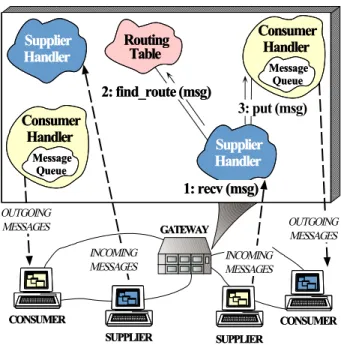
Internally, the Gateway software containsSupplier and Consumer Handlers that act as local proxies [2, 5] for remote suppliers and consumers, respectively. As shown in Figure 3, Supplier Handlersreceive messages from remote suppliers, inspect address fields in the messages, and use the address as a key into aRouting Tablethat iden-tifies which remote consumer should receive the message.
The Routing Table maintains a map of Consumer
GATEWAY GATEWAY Supplier Supplier Handler Handler Consumer Consumer Handler Handler Message Message Queue Queue OUTGOING MESSAGES Routing Routing Table Table INCOMING MESSAGES OUTGOING MESSAGES 2: find_route (msg) 2: find_route (msg) 3: put (msg) CONSUMER CONSUMER SUPPLIER SUPPLIER CONSUMER CONSUMER SUPPLIER SUPPLIER Consumer Consumer Handler Handler Message Message Queue Queue INCOMING MESSAGES Supplier Supplier Handler Handler 1: recv (msg) 1: recv (msg)
Figure 3: Communication Gateway
Handlers, each of which is responsible for delivering mes-sages to its remote consumer over a separate TCP connec-tion.
To handle flow control over various TCP connections,
eachConsumer Handlercontains aMessage Queue
implemented using the Active Object described in Section 9. TheConsumer Handlerclass is defined as follows: class Consumer_Handler
{ public:
Consumer_Handler (void);
// Put the message into the queue. void put (const Message &msg) {
message_queue_.put (msg); }
private:
// Proxy to the Active Object. MQ_Proxy message_queue_;
// Connection to the remote consumer. SOCK_Stream connection_;
// Entry point into the new thread. static void *svc_run (void *arg); };
Supplier Handlers running in their
own threadsputmessages into the appropriateConsumer Handler’sMessage Queue, as follows:
Supplier_Handler::route_message (const Message &msg) {
// Locate the appropriate consumer based on the // address information in the Message.
Consumer_Handler *ch =
routing_table_.find (msg.address ());
// Put the Message into the Consumer Handler’s queue. ch->put (msg);
To process the messages placed into its message queue,
each Consumer Handler spawns a separate thread of
control in its constructor, as follows:
Consumer_Handler::Consumer_Handler (void) {
// Spawn a separate thread to get messages // from the message queue and send them to // the consumer.
Thread_Manager::instance ()->spawn (svc_run, this); }
This new thread executes the svc run method, which gets the messages placed into the queue by Supplier Handlerthreads and sends them to the consumer over the TCP connection, as follows:
void *
Consumer_Handler::svc_run (void *args) {
Consumer_Handler *this_obj =
reinterpret_cast<Consumer_Handler *> (args); for (;;) {
// Conversion of Message_Future from the // get() method into a Message causes the // thread to block until a message is // available.
Message msg = this_obj->message_queue_.get (); // Transmit message to the consumer.
this_obj->connection_.send (msg); }
}
Since the message queue is implemented as an Ac-tive Object the send operation can block in any given Consumer Handlerobject without affecting the quality of service of otherConsumer Handlers.
11
Variants
The following are variations of the Active Object pattern. Integrated Scheduler: To reduce the number of compo-nents needed to implement the Active Object pattern, the roles of the Proxy and Servant are often integrated into the Scheduler component, though servants still execute in a dif-ferent thread than the proxies. Moreover, the transformation of the method call into a Method Request can also be inte-grated into the Scheduler. For instance, the following is an-other way to implement the Message Queue example using an integrated Scheduler:
class MQ_Scheduler public:
MQ_Scheduler (size_t size)
: act_queue_ (new Activation_Queue (size)) {}
// ... other constructors/destructors, etc., void put (const Message &msg) {
Method_Request *method_request = // The <MQ_Scheduler> is the servant. new Put (this, msg);
act_queue_->enqueue (method_request); }
Message_Future get (void) { Message_Future result;
Method_Request *method_request =
// The <MQ_Scheduler> is the servant. new Get (this, result);
act_queue_->enqueue (method_request); return result;
} // ... private:
// Message queue servant operations. void put_i (const Message &msg); Message get_i (void);
// Predicates.
bool empty_i (void) const; bool full_i (void) const; Activation_Queue *act_queue_; // ...
};
By centralizing where Method Requests are generated, the pattern implementation can be simplified since there are fewer components. The drawback, of course, is that the Scheduler must know the type of the Servant and Proxy, which makes it hard to reuse a Scheduler for different types of Active Objects.
Message passing: A further refinement of the integrated Scheduler variant is to remove the Proxy and Servant alto-gether and use direct message passing between the client thread and the Scheduler thread, as follows:
class Scheduler public:
Scheduler (size_t size)
: act_queue_ (new Activation_Queue (size)) {}
// ... other constructors/destructors, etc., // Enqueue a Message Request in the thread of // the client.
void enqueue (Message_Request *message_request) { act_queue_->enqueue (message_request);
}
// Dispatch Message Requests in the thread of // the Scheduler.
virtual void dispatch (void) { Message_Request *mr;
// Block waiting for next request to arrive. while (act_queue_->dequeue (mr)) {
// Process the message request <mr>. } } } protected: Activation_Queue *act_queue_; // ... };
In this design, there is no Proxy, so clients sim-ply create an appropriate type of Message Request
and call enqueue, which inserts the request into the Activation Queue. Likewise, there is no Servant, so thedispatchmethod running in theScheduler’s thread simply dequeues the next Message Request and pro-cesses the request according to its type.
In general, it is easier to develop a message passing mech-anism than it is to develop an Active Object since there are fewer components to develop. However, message passing is typically more tedious and error-prone since application developers are responsible for programming the Proxy and Servant logic, rather than letting the Active Object develop-ers write this code.
Polymorphic futures: A Polymorphic Future [15] allows parameterization of the eventual result type represented by the Future and enforces the necessary synchronization. In particular, a Polymorphic Future result value provides write-once, read-many synchronization. Whether a client blocks on a future depends on whether or not a result value has been computed. Hence, a Polymorphic Future is partly a reader-writer condition synchronization pattern and partly a producer-consumer synchronization pattern.
The following class illustrates a polymorphic future tem-plate in C++:
template <class T> class Future {
// This class implements a ‘single write, multiple // read’ pattern that can be used to return results // from asynchronous method invocations.
public:
// Constructor. Future (void);
// Copy constructor that binds <this> and <r> to // the same <Future> representation
Future (const Future<T> &r); // Destructor.
˜Future (void);
// Assignment operator that binds <this> and // <r> to the same <Future>.
void operator = (const Future<T> &r);
// Cancel a <Future>. Put the future into its // initial state. Returns 0 on success and -1 // on failure.
int cancel (void);
// Type conversion, which obtains the result // of the asynchronous method invocation. // Will block forever until the result is // obtained.
operator T ();
// Check if the result is available. int ready (void);
private:
Future_Rep<T> *future_rep_;
// Future representation implemented using // the Counted Pointer idiom.
};
A client can use a polymorphic future as follows:
// Obtain a future (does not block the client). Future<Message> future = mq.get ();
// Do something else here...
// Evaluate future in the conversion operator; // may block if the result is not available yet. Message msg = Message (future);
Distributed Active Object: In this variant, a distribution boundary exists between the Proxy and the Scheduler, rather than a threading boundary, as with the conventional Ac-tive Object pattern. Therefore, the client-side Proxy plays the role of a stub, which is responsible for marshaling the method parameters into a Method Request format that can be transmitted across a network and executed by a Servant in a separate address space. In addition, this variant also typ-ically introduces the notion of a server-side skeleton, which performs demarshaling on the Method Request parameters before they are passed to a Servant method in the server. Thread pool: A thread pool is a generalization of Ac-tive Object that supports multiple Servants per AcAc-tive Ob-ject. These Servants can offer the same services to increase throughput and responsiveness. Every Servant runs in its own thread and actively ask the Scheduler to assign a new request when it is ready with its current job. The Scheduler then assigns a new job as soon as one is available.
12
Known Uses
The following are specific known uses of the Active Object pattern:
CORBA ORBs: The Active Object pattern has been used to implement concurrent ORB middleware frameworks, such as CORBA [6] and DCOM [16]. For instance, the TAO ORB [17] implements the Active Object pattern for its de-fault concurrency model [18]. In this design, CORBA stubs correspond to the Active Object pattern’s Proxies, which transform remote operation invocations into CORBA Requests. The TAO ORB Core’sReactoris the Sched-uler and the socket queues in the ORB Core correspond to the Activation Queues. Developers create Servants that execute the methods in the context of the server. Clients can either make synchronous two-way invocations, which block the calling thread until the operation returns, or they can make asynchronous method invocations, which return a Poller fu-ture object that can be evaluated at a later point [19].
ACE Framework: Reusable implementations of the
Method Request,Activation Queue, andFuture
components in the Active Object pattern are provided in the ACE framework [9]. These components have been used to implement many production distributed systems.
Siemens MedCom: The Active Object pattern is used in the Siemens MedCom framework, which provides a black-box component-oriented framework for electronic medical systems [20]. MedCom employ the Active Object pattern
in conjunction with the Command Processor pattern to sim-plify client windowing applications that access patient infor-mation on various medical servers.
Siemens Call Center management system: This system uses the thread pool variant of the Active Object pattern. Actors: The Active Object pattern has been used to imple-ment Actors [21]. An Actor contains a set of instance vari-ables and behaviors that react to messages sent to an Actor by other Actors. Messages sent to an Actor are queued in the Actor’s message queue. In the Actor model, messages are executed in order of arrival by the “current” behavior. Each behavior nominates a replacement behavior to execute the next message, possibly before the nominating behavior has completed execution. Variations on the basic Actor model allow messages in the message queue to be executed based on criteria other than arrival order [22]. When the Active Ob-ject pattern is used to implement Actors, the Scheduler cor-responds to the Actor scheduling mechanism, Method Re-quest correspond to the behaviors defined for an Actor, and the Servant is the set of instance variables that collectively represent the state of an Actor [23]. The Proxy is simply a strongly-typed mechanism used to pass a message to an Ac-tor.
13
Consequences
The Active Object pattern provides the following benefits: Enhance application concurrency and simplify synchro-nization complexity: Concurrency is enhanced by allow-ing client threads and asynchronous method executions to run simultaneously. Synchronization complexity is simpli-fied by the Scheduler, which evaluates synchronization con-straints to guarantee serialized access to Servants, depending on their state.
Transparently leverage available parallelism: If the hardware and software platforms support multiple CPUs ef-ficiently, this pattern can allow multiple active objects to ex-ecute in parallel, subject to their synchronization constraints. Method execution order can differ from method invoca-tion order: Methods invoked asynchronously are executed based on their synchronization constraints, which may differ from their invocation order.
However, the Active Object pattern has the following liabil-ities:
Performance overhead: Depending on how the Scheduler is implemented, e.g., in user-space vs. kernel-space, con-text switching, synchronization, and data movement over-head may occur when scheduling and executing active object method invocations. In general, the Active Object pattern is most applicable on relatively coarse-grained objects. In con-trast, if the objects are very fine-grained, the performance overhead of active objects can be excessive, compared with other concurrency patterns such as Monitors.
Complicated debugging: It may be difficult to debug pro-grams containing active objects due to the concurrency and non-determinism of the Scheduler. Moreover, many debug-gers do not support concurrent applications adequately.
14
See Also
The Monitor pattern ensures that only one method at a time executes within a Passive Object, regardless of the number of threads that invoke this object’s methods concurrently. Mon-itors are generally more efficient than Active Objects since they incur less context switching and data movement over-head. However, it is harder to add a distribution boundary between client and server threads using the Monitor pattern. The Reactor pattern [24] is responsible for demultiplexing and dispatching of multiple event handlers that are triggered when it is possible to initiate an operation without blocking. This pattern is often used in lieu of the Active Object pattern to schedule callback operations to passive objects. It can also be used in conjunction of the Active Object pattern to form the Half-Sync/Half-Async pattern described in the next paragraph.
The Half-Sync/Half-Async pattern [25] is an architectural pattern that decouples synchronous I/O from asynchronous I/O in a system to simplify concurrent programming effort without degrading execution efficiency. This pattern typi-cally uses the Active Object pattern to implement the Syn-chronous task layer, the Reactor pattern [24] to implement the Asynchronous task layer, and a Producer/Consumer pat-tern to implement the Queueing layer.
The Command Processor pattern [2] is similar to the Ac-tive Object pattern. Its intent is to separate the issuing of requests from their execution. A command processor, which corresponds to the scheduler, maintains pending service re-quests, which are implemented as Commands [5]. These are executed on suppliers, which correspond to servants. The Command Processor pattern does not focus on concurrency, however, and clients, the command processor, and suppli-ers reside in the same thread of control. Thus, there are no proxies that represent the servants to clients. Clients create commands and pass them directly to the command processor. The Broker pattern [2] has many of the same components as the Active Object pattern. In particular, clients access Bro-kers via Proxies and servers implement remote objects via Servants. The primary difference between the Broker pat-tern and the Active Object patpat-tern is that there’s a distribution boundary between proxies and servants in the Broker pattern vs. a threading boundary between proxies and servants in the Active Object pattern.
The Mutual Exclusion (Mutex) pattern [26] is a simple locking pattern that is often used in lieu of Active Objects when implementing concurrent Passive Objects, also known as Monitors. The Mutex pattern can occur in slightly differ-ent forms, such as a spin lock or a semaphore. The Mutex pattern can have various semantics, such as recursive mu-texes and priority inheritance mumu-texes.
Acknowledgements
The genesis for the Active Object pattern originated with Greg Lavender. Thanks to Frank Buschmann, Hans Rohn-ert, Martin Botzler, Michael Stal, Christa Schwanninger, and Greg Gallant for extensive comments that greatly improved the form and content of this version of the pattern descrip-tion.
References
[1] D. C. Schmidt, “Acceptor and Connector: Design Patterns for Initializing Communication Services,” in Pattern Languages of Program Design (R. Martin, F. Buschmann, and D. Riehle, eds.), Reading, MA: Addison-Wesley, 1997.
[2] F. Buschmann, R. Meunier, H. Rohnert, P. Sommerlad, and M. Stal, Pattern-Oriented Software Architecture - A System of Patterns. Wiley and Sons, 1996.
[3] D. C. Schmidt, “A Family of Design Patterns for Application-level Gateways,” The Theory and Practice of Object Systems (Special Issue on Patterns and Pattern Languages), vol. 2, no. 1, 1996.
[4] W. R. Stevens, TCP/IP Illustrated, Volume 1. Reading, Mas-sachusetts: Addison Wesley, 1993.
[5] E. Gamma, R. Helm, R. Johnson, and J. Vlissides, Design Pat-terns: Elements of Reusable Object-Oriented Software. Read-ing, MA: Addison-Wesley, 1995.
[6] Object Management Group, The Common Object Request Broker: Architecture and Specification, 2.2 ed., Feb. 1998. [7] R. H. Halstead, Jr., “Multilisp: A Language for
Concur-rent Symbolic Computation,” ACM Trans. Programming Lan-guages and Systems, vol. 7, pp. 501–538, Oct. 1985. [8] B. Liskov and L. Shrira, “Promises: Linguistic Support for
Efficient Asynchronous Procedure Calls in Distributed Sys-tems,” in Proceedings of the SIGPLAN’88 Conference on Pro-gramming Language Design and Implementation, pp. 260– 267, June 1988.
[9] D. C. Schmidt, “ACE: an Object-Oriented Framework for Developing Distributed Applications,” in Proceedings of the
6 th
USENIX C++ Technical Conference, (Cambridge, Mas-sachusetts), USENIX Association, April 1994.
[10] P. America, “Inheritance and Subtyping in a Parallel Object-Oriented Language,” in ECOOP’87 Conference Proceedings, pp. 234–242, Springer-Verlag, 1987.
[11] D. G. Kafura and K. H. Lee, “Inheritance in Actor-Based Con-current Object-Oriented Languages,” in ECOOP’89 Confer-ence Proceedings, pp. 131–145, Cambridge University Press, 1989.
[12] S. Matsuoka, K. Wakita, and A. Yonezawa, “Analysis of Inheritance Anomaly in Concurrent Object-Oriented Lan-guages,” OOPS Messenger, 1991.
[13] M. Papathomas, “Concurrency Issues in Object-Oriented Languages,” in Object Oriented Development (D. Tsichritzis, ed.), pp. 207–245, Centre Universitaire D’Informatique, Uni-versity of Geneva, 1989.
[14] W. R. Stevens, UNIX Network Programming, Second Edition. Englewood Cliffs, NJ: Prentice Hall, 1997.
[15] R. G. Lavender and D. G. Kafura, “A Polymorphic Fu-ture and First-Class Function Type for Concurrent Object-Oriented Programming in C++,” in Forthcoming, 1995. http://www.cs.utexas.edu/users/lavender/papers/futures.ps.
[16] D. Box, Essential COM. Addison-Wesley, Reading, MA, 1997.
[17] D. C. Schmidt, D. L. Levine, and S. Mungee, “The Design and Performance of Real-Time Object Request Brokers,” Com-puter Communications, vol. 21, pp. 294–324, Apr. 1998. [18] D. C. Schmidt, “Evaluating Architectures for Multi-threaded
CORBA Object Request Brokers,” Communications of the ACM special issue on CORBA, vol. 41, Oct. 1998.
[19] Object Management Group, CORBA Messaging Specifica-tion, OMG Document orbos/98-05-05 ed., May 1998. [20] P. Jain, S. Widoff, and D. C. Schmidt, “The Design and
Per-formance of MedJava – Experience Developing PerPer-formance- Performance-Sensitive Distributed Applications with Java,” IEE/BCS Dis-tributed Systems Engineering Journal, 1998.
[21] G. Agha, A Model of Concurrent Computation in Distributed Systems. MIT Press, 1986.
[22] C. Tomlinson and V. Singh, “Inheritance and Synchronization with Enabled-Sets,” in OOPSLA’89 Conference Proceedings, pp. 103–112, Oct. 1989.
[23] D. Kafura, M. Mukherji, and G. Lavender, “ACT++: A Class Library for Concurrent Programming in C++ using Actors,” Journal of Object-Oriented Programming, pp. 47–56, Octo-ber 1992.
[24] D. C. Schmidt, “Reactor: An Object Behavioral Pattern for Concurrent Event Demultiplexing and Event Handler Dis-patching,” in Pattern Languages of Program Design (J. O. Coplien and D. C. Schmidt, eds.), pp. 529–545, Reading, MA: Addison-Wesley, 1995.
[25] D. C. Schmidt and C. D. Cranor, “Half-Sync/Half-Async: an Architectural Pattern for Efficient and Well-structured Con-current I/O,” in Proceedings of the2
nd
Annual Conference on the Pattern Languages of Programs, (Monticello, Illinois), pp. 1–10, September 1995.
[26] Paul E. McKinney, “A Pattern Language for Parallelizing Ex-isting Programs on Shared Memory Multiprocessors,” in Pat-tern Languages of Program Design (J. O. Coplien, J. Vlis-sides, and N. Kerth, eds.), Reading, MA: Addison-Wesley, 1996.