University of South Carolina
Scholar Commons
Theses and Dissertations
2017
The Effectiveness of Self-Regulated Strategy
Development for School-Age Children with
Hearing Loss
Jessica Rice
University of South Carolina
Follow this and additional works at:https://scholarcommons.sc.edu/etd
Part of theSpeech Pathology and Audiology Commons
This Open Access Thesis is brought to you by Scholar Commons. It has been accepted for inclusion in Theses and Dissertations by an authorized administrator of Scholar Commons. For more information, please [email protected].
Recommended Citation
THE EFFECTIVENESS OF SELF-REGULATED STRATEGY DEVELOPMENT FOR SCHOOL-AGE CHILDREN WITH HEARING LOSS
by
Jessica Rice
Bachelor of Arts
University of Wisconsin-Madison, 2009
Bachelor of Science Illinois State University, 2014
Submitted in Partial Fulfillment of the Requirements
For the Degree of Master of Speech Pathology in
Speech Pathology
The Norman J. Arnold School of Public Health
University of South Carolina
2017
Accepted by:
Krystal Werfel, Director of Thesis
Angela McLeod, Reader
Jason Wigand, Reader
Gina Crosby-Quinatoa, Reader
Jamy Claire Archer, Reader
ACKNOWLEDGEMENTS
This study was conducted in partial fulfillment of the requirements for the degree
of Master of Speech Pathology through the Arnold School of Public Health at the
University of South Carolina Graduate School. The content is the sole responsibility of
the author, and does not necessarily reflect the views of the Arnold School of Public
Health, the University of South Carolina, or the University of South Carolina Graduate
School. The author appreciates the guidance and assistance of Krystal Werfel, PhD,
CCC-SLP, Angela McLeod, PhD, CCC-SLP, Gina Crosby-Quinatoa MSP, CCC-SLP,
ABSTRACT
Purpose: The two-fold purpose of this feasibility study was to determine if (a)
self-regulated strategy development intervention would improve the writing skills of
children with hearing loss and (b) if self-regulated strategy development intervention
would improve the reading comprehension skills of children with hearing loss.
Method: One eleven year-old child with bilateral sensorineural hearing loss
participated in this single-subject, multiple probe across behaviors design treatment study
which examined the effectiveness of using writing intervention to improve reading
comprehension in children with hearing loss. The participant completed three seven-week
writing interventions focused on narratives, opinion essays, and persuasive essays.
Intervention was delivered one-on-one for 60 minutes one day per week.
Results: Comparison of pre- and post-test measures of writing and reading
comprehension indicated that the writing intervention was effective for improving
narrative and opinion essay writing performance and reading comprehension for the
participant.
Conclusions: Self-regulated strategy development writing intervention can be an
effective intervention strategy to improve writing, as well as reading comprehension,
TABLE OF CONTENTS
Acknowledgements ... iii
Abstract ... iv
List of Tables ... vi
List of Figures ... vii
List of Abbreviations ... viii
Chapter 1: Introduction ...1
Chapter 2: Method ...6
Chapter 3: Results ...17
Chapter 4: Discussion ...21
References ...25
Appendix A: Progress Monitoring Written Prompts ...28
Appendix B: Example of Graded Rubric (STOP + DARE Condition) ...30
Appendix C: Example of Graphic Organizer (STOP + Dare Condition) ...31
LIST OF TABLES
LIST OF FIGURES
LIST OF ABBREVIATIONS
ES ... Effect Size
SLP ... Speech-language pathologist
CHAPTER
1
INTRODUCTION
The poor literacy skills of students in the United States have been well
documented. As a result of difficulties with reading and writing, students in the U.S. do
not possess the skills that are necessary for success in school, post-secondary education,
or the increasingly literate job market (Hebert, Graham, Rigby-Wills, & Ganson, 2014;
National Center for Educational Statistics, 2010). According to the National Assessment
of Educational Progress (NAEP; National Center for Educational Statistics, 2010), 62%
of high school seniors do not possess “proficient” reading skills. Proficient skills are the
skills necessary to perform appropriately for one’s grade level (Hebert et al., 2014).
Additionally, 40% of U.S. high school graduates do not possess the literacy skills that
employers require (Graham & Hebert, 2010; National Governors Association, 2005).
Poor literacy is not a problem that solely affects individual students or families. These
nationwide deficits in reading and writing cost universities, employers, and the country as
a whole billions of dollars per year to remediate (Graham & Hebert, 2010).
Although the aforementioned trends in poor literacy are ominous enough on their
own, when hearing loss is a contributing factor, reading and writing outcomes become
even more alarming. Children with hearing loss perform significantly worse on measures
of literacy than their normal-hearing peers (e.g. Qi & Mitchell, 2012; Moeller, Tomblin,
Yoshinaga-Itano, Connor, & Jerger, 2007; Geers & Hayes, 2011). Despite drastic
hearing loss continue to stagnate in regard to reading and writing abilities. A third grade
reading level has been reported as the median performance level for 18 year-olds with
hearing loss (Qi & Mitchell, 2012). Few children, even among those who receive
cochlear implants before the age of two, have experienced literacy skills that are
consistent with their hearing peers (Geers & Hayes, 2011). The combination of receiving
education in a country where the majority of students with normal hearing do not achieve
proficient literacy skills and the additional difficulties that hearing loss entails results in
detrimental reading and writing outcomes for students with hearing loss in the U.S. today.
Even children who use cochlear implants or those who have only mild
sensorineural hearing loss experience difficulty succeeding academically (Bess,
Dodd-Murphy, & Parker, 1998; Geers & Hayes, 2011). Geers & Hayes (2011) found that
written expression and phonological processing were the most problematic areas of
literacy for high school students with cochlear implants who were implanted as young
children. Among children who were implanted with cochlear implants at a young age,
only 47-66% of them performed within the average range (Geers & Hayes, 2011).
Furthermore, thirty-seven percent of children with hearing loss will fail at least one grade
(Bess et al., 1998). The current body of evidence supports that children with hearing loss
require immediate intervention in the areas of reading and writing in order to be able to
succeed in an increasingly literacy-focused world.
Limited research has been done regarding the effectiveness of writing intervention
to aid in reading comprehension for children with hearing loss. However, one study did
examine the effects of storybook reading and joint writing between mothers with typical
joint literacy interactions of 30 kindergarten children with hearing loss who had
amplification devices. As part of a larger study, the researchers asked mothers to assist
their children in completing a writing task wherein children were instructed to write
novel pairs of semantically related nouns (Aram et al., 2006). Aram et al. (2006) found
that the mother-mediated writing task was a predictor of alphabet skills in these
kindergarten children. Children with hearing loss can benefit from receiving similar types
of literacy instruction as their hearing peers. However, children with hearing loss may
need more direct instruction than their hearing peers (Aram et al., 2006). Although this
study targeted pre-literacy skills rather than reading comprehension, the principle that
writing can improve reading for children with hearing loss remains consistent. If writing
nouns can help young children with hearing loss to improve their alphabet knowledge, it
is worthwhile to investigate whether or not the SRSD strategy can improve the reading
comprehension of older children with hearing loss.
One type of literacy intervention that has been successful for children with normal
hearing is the use of writing as a means to improve reading skills (Graham & Hebert,
2010). In a meta-analysis, Graham & Hebert (2010) found that 93% of the studies that
they reviewed yielded positive outcomes for writing-to-read intervention styles.
Additionally, Hebert et al. (2014) discovered that students as young as fourth grade could
benefit from writing-to-read interventions when reading comprehension was measured by
a multiple-choice exam that required the students to make inferences. If writing to read
allows children with normal hearing to improve their overall literacy skills, it is
reasonable to attempt to use these same evidence-based intervention strategies for
intervention was used with one child with hearing loss to determine the effectiveness of
this intervention method. The participant received intensive therapy with the SRSD
intervention style in order to determine if SRSD is helpful in remediating the poor
literacy outcomes for children with hearing loss.
SRSDhas been documented to be an effective intervention for children with
writing difficulties (Harris, Graham, Mason, & Sadler, 2002). “SRSD is designed to help
students become fluent, independent, self-regulated, goal-oriented learners” (Harris et al.,
2002, p. 110). In order to achieve this, the program follows a specific format. First,
students are taught that writing is a process which includes: planning to write, writing,
and proofreading one’s own work. Next, scaffolding and support from instructors is
utilized to assist students in learning how to self-correct during the writing process.
Lastly, students engage in activities that are meant to increase their confidence
surrounding their abilities as writers (Harris et al., 2002). Although SRSD focuses on the
core areas of self-instruction, goal setting, self-monitoring, and self-reinforcement, it is
worthwhile to note that the program can be modified to suit the needs and skills of
individual students (Harris et al., 2002).
In 2003, Graham and Harris conducted a meta-analysis on the effectiveness of
SRSD intervention across 19 different studies. Graham and Harris (2003) examined
studies that ranged in publication date from 1985 to 2003, and included both
single-subject and group studies. SRSD was found to be an effective writing intervention tool
for students with learning disabilities, students with below-average writing abilities, and
students with average writing abilities (Graham & Harris, 2003). Additionally, the
initial writing abilities over time (Graham & Harris, 2003). Writing quality, for example,
was improved through the use of SRSD intervention (effect size [ES] = 1.47). Essay
length (ES = 2.07), writing elements (ES = 1.87), and story grammar (ES = 3.52) all
improved significantly with SRSD intervention as well (Graham & Harris, 2003).
Maintenance of these effects were also strong; effect sizes ranged from 0.74 (quality) to
1.60 (writing elements). Considering that SRSD has been proven to be an effective
writing intervention tool for children with normal hearing across multiple decades and
dozens of studies, it is reasonable to explore the effectiveness of SRSD for children with
hearing loss.
Although writing-to-read intervention styles have been studied with children with
normal hearing, no studies have investigated the efficacy of writing-to-read interventions
with children with hearing loss. The purpose of this study was to determine if (a) SRSD
intervention would improve the writing skills of children with hearing loss and (b) if
SRSD intervention would improve the reading comprehension skills of children with
hearing loss. Therefore, our hypotheses were two-fold. First, we hypothesized that
participation in SRSD intervention would lead to increased performance on measures of
reading comprehension for our participant with hearing loss. Second, we predicted that
the participant’s writing skills would improve as a result of completing the SRSD
CHAPTER 2
METHOD
The research protocol for this study was approved by the Institutional Review
Board at the University of South Carolina.
The participant was an eleven-year-old African-American girl with profound,
bilateral, sensorineural hearing loss. For the purposes of this paper, the participant will be
called “Madison.” Madison has two cochlear implants; she was implanted with her right
cochlear implant at age 2;6 and her left cochlear implant at age 6;7. Per parent report,
Madison is a monolingual English speaker. Pre-testing revealed that Madison performed
in the lower end of the average range on a variety of language and literacy measures (see
Table 3.1 in the Results section).
The following standardized tests were administered during pre-testing: the Test of
Written Spelling-Fifth Edition (TWS-5; Larsen, Hammill, & Moats, 2013), the Clinical
Evaluation of Language Fundamentals-Fifth Edition (CELF-5; Wiig, Semel, & Secord,
2013), the Test of Silent Contextual Reading Fluency-Second Edition (TOSCRF-2;
Hammill, Wiederholt & Allen, 2014), the Test of Silent Word Reading Fluency-Second
Edition (TOSWRF-2; Mather, Hammill, Allen & Roberts, 2014), the Test of Written
Language-Fourth Edition (TOWL-4; Hammill & Larsen, 2009), and the Woodcock
Reading Mastery Test-Third Edition (WRMT-III; Woodcock, 2011). All measures had
adequate reliability (>.80) reported in test manuals. Pre-test scores can be found in Table
Written prompts were utilized to establish baseline writing skills, monitor
progress, and measure maintenance of writing skills over time. Prompts were designed to
elicit either narrative, opinion essay, or persuasive essay writing. Examples of the written
prompts that were used can be found in Appendix A. During progress monitoring, the
author provided the participant a sheet of paper with a prompt typed or written at the top
of the page. Next, the author read the prompt aloud and instructed the participant that five
minutes would be provided to complete the writing task. The participant wrote until the
five minutes were complete.
The author developed three different categories of writing prompts to elicit either
a narrative, opinion essay, or persuasive essay from the participant. For narrative
prompts, the author included some narrative details (i.e. “Buddy is a black and white
puppy that likes to play.”) and then encouraged the participant to write a story (i.e. “Tell
me a story about Buddy.”). Opinion essay prompts were worded as questions to
encourage the participant to provide her opinion on a given topic. These question prompts
began with the word “should” and were written in an effort to relate to the age and
interests of the participant. For example, one opinion essay prompt was, “Should children
tell their parents the truth?” In these opinion essays, the participant was meant to simply
state her opinion on various topics. Persuasive essay prompts differed from opinion essay
prompts in wording, in an effort to evoke a higher level of persuasive writing from the
participant. Persuasive essay prompts began with the word “convince” as a reminder to
the participant that the purpose of the essay was to influence the mind of the person
girls should be allowed to play the same sports as boys.” Again, emphasis was placed on
including themes that were relevant to the age and interest of the participant.
Rubrics were used to score the progress monitoring written prompts. Rubrics were
created by the author and thesis project director. An example of a graded rubric can be
found in Appendix B. Rubrics were specific to each of the three writing styles, and a
variety of components were assessed on a scale in which the participant could receive 0,
1, 2, or 3 points for each category. For the narrative rubric, points were awarded for
inclusion of WWW criteria (i.e. who, what, when, where etc.), use of sophisticated
adjectives (also called “million dollar words”), and grammar. For the opinion essay
rubric, points were awarded for inclusion of TREE criteria (i.e. topic sentence, reasons,
explanation, and ending), word choice, grammar, and organization of the essay. For the
persuasive essay rubric, points were awarded for inclusion of STOP + DARE criteria (i.e.
topic sentence, supporting ideas, rejection of opposing arguments, and conclusion),
linking words, grammar, and organization of the essay.
Two raters utilized the grading rubrics to score each of the written prompts. The
order of the written prompts was randomized, and all dates were removed from prompts
in an effort to eliminate scoring bias. Interrater reliability was assessed by comparing
rubric scores from each of the raters for one third of the written prompts in each of the
narrative, opinion essay, and persuasive essay sections. Scores were considered to be in
agreement if one rater’s score on the rubric fell within 2 points of the other rater’s rubric
score. Interrater reliability was high. For narratives, interrater reliability was 80%;
The average interrater reliability for this study was 86%. Only one essay did not meet the
criterion for agreement; the raters differed by 3 points on that essay.
The following standardized tests were used during post-testing: the Test of
Written Spelling-Fifth Edition (TWS-5, Larsen, Hammill, & Moats, 2013), the Clinical
Evaluation of Language Fundamentals-Fifth Edition (CELF-5; Wiig, Semel, & Secord,
2013), the Test of Silent Contextual Reading Fluency-Second Edition (TOSCRF-2;
Hammill, Wiederholt & Allen, 2014), the Test of Silent Word Reading Fluency-Second
Edition (TOSWRF-2; Mather, Hammill, Allen & Roberts, 2014), the Test of Written
Language-Fourth Edition (TOWL-4; Hammill & Larsen, 2009), and the Woodcock
Reading Mastery Test-Third Edition (WRMT-III; Woodcock, 2011). Results of
post-testing can be found in Table 3.1 in the Results section.
Three seven-week lessons were derived from Harris, Graham, Mason, and
Friedlander (2008). The first seven weeks of the one-on-one intervention centered on
instruction regarding the preparation, organization, and execution of writing narratives.
Over the course of seven weeks, the author followed detailed lesson plans created by
Harris et al. (2008). There were seven lessons in total, and each lesson was completed in
a 60 minute session, once per week. These lessons focused on the mnemonic POW +
WWW. POW stands for, “pick my idea, organize notes, write and say more.” WWW
stands for answering the following questions in each story, “Who is the main character?”,
“When does the story take place?”, “Where does the story take place?”, “What does the
main character want to do?”, “What happens then”, “How does the story end?”, and
The participant was explicitly taught that writing is a process, and that planning to
write occurs before the act of writing. The lessons began with the author modeling
desired writing behaviors and the participant’s identification of story parts in stories
written by others. Next, the author and participant utilized graphic organizers and
mnemonic devices to write narratives collaboratively. Gradually, scaffolding and the use
of graphic organizers were reduced at each subsequent session, and the participant began
completing writing exercises independently at the close of the seven-week session. The
participant was also provided with five minutes of grammar instruction during the first
seven weeks of the intervention, because it was noted at baseline that the participant
produced multiple grammatical errors while writing baseline prompts. These were
addressed each week near the beginning of the session. Topics of instruction included
subject-verb agreement, irregular plurals, and more.
The second seven weeks of instruction focused on the composition of opinion
essays. The author explicitly taught the participant what an opinion entails, and that this
style of writing can be used to share ideas with readers. Similar to the narrative section,
the author utilized lesson plans created by Harris et al. (2008) for instruction regarding
opinion essays. Of note, five lesson plans were provided for the opinion essay chapter.
Harris et al. (2008) stated that lessons four and five could be repeated if the student
would benefit from additional instruction. Therefore, the participant completed lessons
four and five twice. This resulted in seven total sessions of opinion essay instruction.
Each lesson was again conducted by the author during one-hour weekly sessions.
Opinion essays were taught utilizing the mnemonic device of POW + TREE.
inclusion of TREE added the following meaning: “Topic sentence”, “Reasons”,
“Explanations” and “Ending.” Explicit modeling was utilized by the author at the onset of
the opinion essay segment. Early sessions entailed the author and participant identifying
necessary components of opinion essays written by others, and use of the graphic
organizers and mnemonic devices by the author while the participant observed. As the
sessions progressed, the participant and author began composing opinion essays together.
Gradually, use of graphic organizers, mnemonics, and assistance from the author was
reduced, and the participant planned, organized, and wrote opinion essays independently.
The final seven-week segment consisted of instruction focused on the
composition of persuasive essays. Again, the author facilitated one-on-one hour-long
sessions with the participant utilizing materials created by Hebert et al. (2008). Similar to
the opinion essay section, five lessons were present in the persuasive essay instructional
segment. The fourth and fifth lessons were each conducted twice, resulting in seven total
lessons centered on persuasive essay instruction. Persuasive essay instruction added the
idea of STOP + DARE to the participant’s writing repertoire. STOP stands for “Suspend
judgment, Take a side, Organize notes, and Plan as you write.” DARE stands for
“Develop a topic sentence, Arguments, Reject opposing arguments, End with a
conclusion.” The same type of instruction was utilized by the author in this final section.
At the onset of the seven weeks, baseline performance of persuasive essays was measured
via written prompts wherein the participant was provided with a persuasive essay prompt
and five minutes to write. Examples of writing prompts can be seen in Appendix A. Next,
the participant and author worked together to identify necessary components of
modeled desired writing behaviors for persuasive essays. As sessions progressed, the
author and participant wrote essays together. During the last two sessions, the participant
planned, organized, and wrote persuasive essays independently. Cues were provided by
the author only when the participant asked for help or demonstrated difficulty completing
the writing task. Materials used for this final segment can be found in Appendix C.
Although persuasive essay instruction followed a similar trajectory to that of
narrative and opinion essay instruction, the participant repeatedly reported that this type
of essay construction was the most challenging during the intervention. More cueing and
assistance from the author was required for completion of persuasive essays than during
the narrative and opinion essay sections. It is also worth noting that there was roughly a
two month break between the conclusion of the second section and the onset of the third
section. Due to holidays and breaks from school, there were 10 weeks between the
second and third sections. In an effort to counteract possible regression in writing skills,
the author assigned 10 essay prompts for the participant to complete during the break.
However, only four opinion essay-writing assignments were completed in total during the
10 week break.
Throughout the 21 weeks of intervention, the author assigned weekly homework
assignments in an effort to solidify understanding of the material and to facilitate
generalization of planning and writing strategies. Homework assignments consisted of
studying various mnemonic devices, creating outlines and notes to demonstrate the
planning stage of the writing process, and completing additional written prompts with
unlimited time and the ability to proofread and correct mistakes. The participant
completed assignments quickly the night before intervention sessions. Of note, these
homework assignments were not a part of the Harris et al. (2008) curriculum. Instead,
assignments were intended for additional practice of SRSD strategies in the home
environment.
The study consisted of four components: pre-testing, three-part SRSD
intervention, progress monitoring, and post-testing. To begin, the participant completed
pre-testing to determine baseline performance on a variety of language and literacy
measures. Next, the single-subject, multiple probe across behaviors SRSD intervention
was initiated and progress was monitored via written probes. Lastly, post-testing was
conducted in order to compare the participant’s performance before and after the
intervention.
Procedural fidelity checklists were created by the author in accordance with the
recommended sequence of events described by Hebert et al. (2008). Sessions were
recorded via video. Three sessions from each of the three sections were chosen for
treatment fidelity; therefore, nine total sessions were viewed via video to measure
treatment fidelity. Undergraduate and graduate students who were blind to the research
question measured treatment fidelity by watching the videos of the sessions and
completing procedural fidelity checklists. An example of a procedural fidelity checklist
can be found in Appendix D.Procedural fidelity was found to be an average of 95.8%
across the nine randomly chosen sessions.
This study aimed to determine if use of SRSD writing strategies would be
effective in improving reading comprehension and writing performance in children with
writing performance across time. Additionally, reading comprehension was assessed
before and after the intervention was delivered in order to see if the SRSD intervention
yielded increased results in reading comprehension for the participant. Results of writing
performance were graphed in order to visually analyze both sets of data, consistent with
single-subject, multiple probe across behaviors design.
The first of the three intervention conditions focused on assisting Madison with
preparation and execution of writing narratives via explicit instruction in planning to
write, organizing notes, and necessary components of a story. Progress was monitored at
15 points over the course of the study and, as can be seen from Figure 3.1 (please see
below in the Results section), Madison made continued progress over the course of the
seven week intervention as measured by a scoring rubric. A total of 27 points were
possible for each narrative progress monitoring prompt. At baseline, Madison scored an
average of 8 on the grading rubric for narratives. Seven weeks into the narrative
intervention, Madison’s score was 11, suggesting that inclusion of necessary story
components had improved. Progress also was assessed using six different probes after the
narrative intervention had ended. Madison’s scores after intervention ended ranged from
7 to 13, with an average score post-intervention of 10. This suggests maintenance of
improved narrative component writing.
The second of the three intervention conditions focused on assisting Madison with
topic sentence construction, statement of reasons for an opinion, explanation of stated
opinions, and construction of an ending sentence. Progress was monitored at 12 points
over the course of the study. Figure 3.1 (please find below in the Results section) displays
measured by a scoring rubric. At baseline, Madison scored a 5 on the grading rubric for
opinion essays. A total of 24 points were possible for each narrative progress monitoring
prompt. Seven weeks into the opinion essay intervention, her score was 16, suggesting
that construction of opinion essay elements had improved. Progress also was assessed at
five different points after the opinion essay intervention had ended. Madison’s scores
ranged from 6 to 14 after the intervention ended, with an average score of 10.4 on the
graded rubric. Although this average score decreased from the time of the intervention, it
was still markedly above the baseline score for this type of essay. This suggests moderate
maintenance of improved opinion essay element writing.
The last of the three intervention conditions focused on assisting Madison with
preparation and execution of writing persuasive essays via explicit instruction in
construction of topic sentences, formation of supporting ideas, rejection of opposing
arguments, and finalizing essays with a conclusion. Progress was monitored at 13 points
during the course of the study and as can be seen from Figure 3.1 (please find below in
the Results section), Madison made mixed progress over the course of the seven-week
intervention. At baseline, Madison scored an average of 8 on the grading rubric for
persuasive essays. A total of 24 points were possible for each narrative progress
monitoring prompt. During the first week of the persuasive essay instruction, her score
was 15, suggesting that construction of persuasive essays had improved. Four weeks into
the persuasive essay intervention, her score was 12, suggesting that construction of
persuasive essays had diminished slightly. Interestingly, at week seven of the persuasive
essay intervention Madison’s score on the grading rubric was 8. This decrease in scores
construction despite the intervention. Progress also was monitored after the persuasive
essay intervention had ended. Madison earned an average score of 8 on the graded rubric
during maintenance sessions, which was similar to the baseline. Madison’s performance
during the persuasive essay intervention did not improve consistently, and results were
not maintained over time, evidenced by average ending scores that were equal to average
baseline scores. Of note, this type of essay was reportedly the most challenging for
Madison, and is the highest level of writing that was used during the entire 21-week
CHAPTER 3
RESULTS
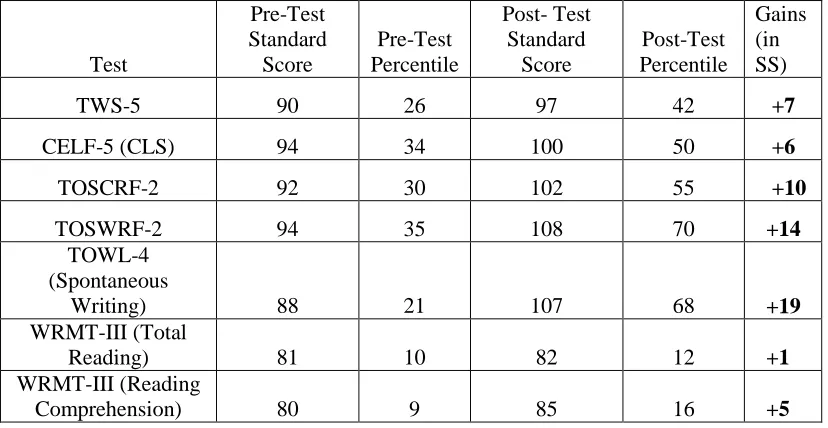
Table 3.1displays pre- and post-test scores for the participant. Madison
demonstrated gains from pre- to post-test on all standardized measures. Gains in
performance ranged from 1 to 19 standard score points. The largest gains in performance
from pre- to post-test were observed on spontaneous writing (TOWL-4), silent word
reading fluency (TOSWRF-2), and silent contextual reading fluency (TOSCRF-2).
Table 3.1 Pre- and Post-Test Scores
Test Pre-Test Standard Score Pre-Test Percentile Post- Test Standard Score Post-Test Percentile Gains (in SS)
TWS-5 90 26 97 42 +7
CELF-5 (CLS) 94 34 100 50 +6
TOSCRF-2 92 30 102 55 +10
TOSWRF-2 94 35 108 70 +14
TOWL-4 (Spontaneous
Writing) 88 21 107 68 +19
WRMT-III (Total
Reading) 81 10 82 12 +1
WRMT-III (Reading
Comprehension) 80 9 85 16 +5
The first purpose of this study was to determine if SRSD intervention is an
effective clinical tool for improving writing performance in children with hearing loss.
with hearing loss. Figure 3.1 displays data for baseline performance, writing
progress during intervention, and maintenance of writing abilities over time for the
participant.
As seen in Figure 3.1.1, visual analysis of the data for the participant revealed that
writing performance did improve across the intervention for narrative and opinion essays,
and that the benefits of the intervention lasted for those two writing styles across time,
even after intervention for that skill was discontinued. Notably, however, consistent
improvement and maintenance were not found for the persuasive essay section of the
intervention. Figure 3.1 displays baseline, intervention, and maintenance data for the
participant.
In addition to improvement with written progress monitoring prompts, Madison
also displayed improvement of writing performance as assessed by standardized
measures. Table 3.1 displays that prior the intervention, Madison earned a standard score
of 88 and a percentile rank of 21 on the TOWL-4 spontaneous writing subtest; this placed
her in the “low average” category for her age in spontaneous writing. After the
intervention, Madison earned a standard score of 107 and a percentile rank of 68 on the
TOWL-4 spontaneous writing subtest; this placed her in the “average” range for her age
in spontaneous writing.
With regard to spelling performance, Table 3.1 displays that prior the
intervention, Madison earned a standard score of 90 and a percentile rank of 26 on the
TWS-5; this placed her in the lower end of the average range for her age in spelling.
After the intervention, Madison earned a standard score of 97 and a percentile rank of 42
spelling, this increase in scores suggests that improvement was made in spelling during
the intervention.
Figure 3.1Progress Monitoring for Written Prompts.
The second purpose of this study was to determine if SRSD intervention is an
effective clinical tool for improving reading comprehension for children with hearing
loss. In order to assess this study aim, a reading comprehension measure was given to the
participant before and after the intervention took place. Table 3.1 displays that prior the
intervention, Madison earned a standard score of 80 and a percentile rank of 9 on the
WRMT-III reading comprehension subtest; this placed her in the “below average”
category for her age in reading comprehension. After the intervention, Madison earned a
comprehension subtest; this placed her in the low end of the average range for her age in
reading comprehension. Reading comprehension was also assessed via the TOSCRF-2.
Table 3.1 displays that prior the intervention, Madison earned a standard score of 92 and
a percentile rank of 30 on the TOSCRF-2; this placed her in the “average” range for her
age in contextual reading comprehension. After the intervention, Madison earned a
standard score of 102 and a percentile rank of 55 on the TOSCRF-2; while this still
placed Madison in the “average” range for her age in contextual reading comprehension,
this increase in scores suggests that improvement in reading comprehension took place
CHAPTER 4
DISCUSSION
This investigation was the first study that investigated the effectiveness of SRSD
writing intervention for children with hearing loss. Because this type of intervention has
been shown to be effective for school-age children with typical hearing, we aimed to
determine if similar benefits could be achieved for children with hearing loss. Thus, the
purpose of this study was to determine if SRSD intervention would improve (a) the
writing skills of children with hearing loss, and (b) the reading comprehension skills of
children with hearing loss. The a priori hypotheses were two-fold. First, we predicted that
the participant’s writing skills would improve as a result of completing the SRSD
intervention. Second, we hypothesized that participation in SRSD intervention would
lead to increased performance on measures of reading comprehension for our participant
with hearing loss. These hypotheses were both supported by the data. The participant
with hearing loss showed marked improvement in the writing skills necessary for
narrative and opinion essay instruction after completion of the 21 week SRSD
intervention, as well as general writing and reading comprehension skills on standardized
assessments. However, it is important to note that consistent improvement was not made
in the area of persuasive essay construction.
The first important finding of this study is that SRSD writing intervention can
improve writing performance for children with hearing loss. The participant benefited
improvement over baseline performance for narrative and opinion essays, and the
ability to maintain these improved writing skills after the intervention ended. This finding
was also demonstrated by improvement on standardized tests that measure general
writing abilities. However, it is important to note that the same benefits were not seen as
a result of the persuasive essay intervention. Persuasive essay construction was the most
advanced form of writing used during this 21 week intervention, and was reportedly the
most challenging conceptually for the participant to grasp. It is suspected that more
intervention sessions, and perhaps a more in-depth intervention program would be
necessary in order for Madison to improve persuasive essay writing skills consistently.
The next important finding of this study was that writing intervention can be an
effective strategy to improve reading comprehension in children with hearing loss. The
intervention used in this study did not target reading comprehension at all, yet the
participant’s reading comprehension scores improved from below average to in the
average range over the course of the study. Speech-language pathologists, teachers, and
other professionals who work with children with hearing loss can and should utilize this
strategy in an effort to improve the reading comprehension outcomes of these children.
Although core language skills and word-level literacy were not explicitly targeted
during this intervention, improvements in both areas were seen. For example, the
participant’s Core Language Score on the CELF-5 increased 6 standard score points (can
be seen in Table 1) over the course of the intervention. Similarly, word-level literacy
improved during the intervention, evidenced by an increase in 14 standard score points on
the TOSWRF-2 (can be seen in Table 1). Though neither spoken language nor word-level
performance in each of these areas as a result of the intervention. Speech-language
pathologists and teachers may see similar increases in overall language and word-level
literacy performance as a result of using this intervention style.
Lastly, it is worth noting that this intervention is simple to administer and cost
effective. Each lesson used in this study was derived from Harris et al. (2008), and
included detailed, step-by-step lesson plans that were simple to follow. The instructor for
each session was a trained second-year graduate student in speech-language pathology.
Also, at the time this study was written, the book by Harris et al. (2008) could be
purchased for less than $40. Although this study was completed with one participant,
these lessons can be used small groups or even an entire classroom of students at one
time. It also would be possible to provide one seven-week intervention if time constraints
were a factor.
With any study, limitations should be considered when interpreting findings. This
study included only one participant, and utilized a single-subject, multiple probe across
behaviors design format. Therefore, findings should be generalized only to children who
are similar to the participant. The participant did not present with any other
developmental delays or deficits. Application of these findings to other populations is not
advised without supported evidence from other research findings. Future research should
evaluate the effectiveness of this intervention approach with a variety of children with
hearing loss.
To the knowledge of the researchers, this study was the first to analyze the
effectiveness of SRSD writing intervention to improve writing and reading
evidence-based reading comprehension intervention for children with hearing loss. The
findings of this study indicate that SRSD writing intervention can be an effective way to
improve reading comprehension and writing skills focused on narrative and opinion essay
construction in children with hearing loss. In conclusion, SRSD intervention is effective
as a means to improve literacy outcomes for children with hearing loss. Future research
in this area is necessary to analyze the effects of SRSD in groups of children with hearing
REFERENCES
Aram, D., Most, T., & Mayafit, H. (2006). Contributions of mother-child storybook
telling and joint writing to literacy development in kindergarteners with hearing
loss. Language, Speech, and Hearing Services in Schools, 37, (209-223).
Bess, F. H., Dodd-Murphy, J., & Parker, R. A. (1998). Children with minimal
sensorineural hearing loss: Prevalence, educational performance, and functional
status. Ear & Hearing, 19(5), 339-354.
Graham, S., & Hebert, M. (2010). Writing to Read: Evidence for how writing can
improve reading. New York, NY: Carnegie Corporation of New York.
Geers, A. E. & Hayes, H. (2011). Reading, writing, and phonological processing skills of
adolescents with ten or more years of cochlear implant experience. Ear Hear,
32(1), 495-595.
Graham, S., & Harris, K. R. (2003), Students with learning disabilities and the process of
writing: A meta-analysis of SRSD studies. In L. Swanson, K. R, Harris & S.
Graham (Eds.), Handbook oflearning disabilities (pp. 383-402). New York:
Guilford.
Hammill, D. D., & Larsen, S. C. (2009). Test of written language-fourth edition
(TOWL-4). San Antonio, TX: Pearson Assessments.
Hammill, D. D., Wiederholt, J. L., & Allen E. A. (2014). Test of silent contextual reading
Harris, K. R., Graham, S., Mason, L. H., & Saddler, B. (2002). Developing self-regulated
writers. Theory Into Practice (41), 110-115.
Harris, Graham, Mason, and Friedlander (2008). Powerful writing strategies for all
students. Baltimore, MD: Paul H. Brookes Publishing Co.
Hebert, M., Graham, S., Rigby-Wills, H., & Ganson, K. (2014). Effects of note-taking
and extended writing on expository text comprehension: Who benefits? Learning
Disabilities: A Contemporary Journal, 12(1), 43-63.
Larsen, S. C., Hammill, D. D., & Moats, L. (2013). Test of written spelling-fifth edition
(TWS-5). Austin, TX: PRO-ED.
Mather, N., Hammill, D. D., Allen, E. A., & Roberts, R. (2014). Test of silent word
reading fluency-second edition (TOSWRF-2). Austin, TX: PRO-ED.
Moeller, M. P., Tomblin, J. B., Yoshinaga-Itano, C., Connor, C. M., & Jerger, S. (2007).
Current state of knowledge: Language and literacy of children with hearing
impairment. Ear and hearing, 28(6), 740-753.
National Center for Educational Statistics. (2010). Grade 12 reading and math 2009
national and pilot state results. Washington, DC: Institute of Educational
Sciences.
National Governors Association (2005) Reading to achieve: A governor’s guide to
adolescent literacy. Washington DC: NGA Center for Best Practices.
Qi & Mitchell (2012) Large-scale academic achievement testing of deaf and\
hard-of-hearing students: Past, present, and future. Journal of Deaf Studies and
Deaf Education, 17, 1-18.
fundamentals-fifth edition (CELF-5). San Antonio, TX: Pearson.
Woodcock, R. W. (2011). Woodcock reading mastery tests-third edition (WRMT-III).
APPENDIX A
PROGRESS MONITORING WRITTEN PROMPTS
Writing Style
Prompt
Narrative Tyler’s mom is teaching him how to cook. Today his mom is teaching him
something new. Write a story about what Tyler is doing today.
Narrative Zoe is a cat with a long tail. Her fur is orange with white feet. Write a story about Zoe.
Narrative Kevin and Matthew are best friends. They are in the same class and live next
door to each other. Write a story about Kevin and Matthew.
Narrative Billy is a turtle who lives in Blue Pond. He has a hard shell and a long neck. Write a story about Billy.
Narrative Ryan saw a sign at school that said “Pizza party tonight at 7 pm”. Write a story about what happens at the pizza party.
Narrative Charlie and Stella are monkeys and live in the zoo. Stella is very tall and Charlie is very short. Write a story about Charlie and Stella.
Narrative Sam has an old cat liked to take naps in the sun. Sam’s family just got a new little brown puppy. Write a story about the old cat and the little brown puppy.
Narrative Addison and her family are going to the beach today. Write a story about
what happens at the beach.
Narrative When Jordan got to school this morning she saw a big bunch of balloons.
Write a story about what happens at school today.
Narrative Hannah was taking a walk and found some bright red magic beans. Write a
story about what happened next.
Narrative John has big sister Mary-Anne. She is very tall and likes run and read books. Write a story about what Mary-Anne does on the weekends.
Narrative Lena and Holly love to go to the beach and swim in the ocean. Write a story
about Holly and Lena.
Narrative Danny and Colleen just got a new puppy named Jack. Jack loves to play fetch
and chew on Colleen’s shoes. Write a story about Danny, Colleen, and Jack.
Narrative Buddy is a black and white puppy. He loves to play Frisbee and do tricks.
Write a story about Buddy.
Narrative Annie went to Girl Scout Camp for two weeks with her two best friends,
Bianca and Charlotte. Write a story about what the girls did at camp. Narrative Alexis loves to climb trees. Her dad built her a tree house in the backyard.
Write a story about Alexis.
Narrative You woke up yesterday morning and discovered that you have the super
power that you always wanted. Describe your new super power, and explain why you have always wanted it.
Opinion Do you think Netflix is better than watching regular TV?
Opinion Do you think students should be allowed to wear Halloween costumes at school?
Opinion Is Halloween better than Christmas?
Opinion Should teachers let students use calculators on math tests?
Opinion Should children be required to wear uniforms at school?
Opinion Should girls be allowed to play on any sports team they want?
Opinion Should children tell their parents the truth?
Opinion Should kids be able to use their iPads at school?
Opinion Should children be allowed to vote for the President?
Opinion Should people have to obey the speed limit?
Persuasive Convince me why children should be allowed to choose their own bed time.
Persuasive Convince me if it is better to have siblings or to be an only child.
Persuasive Convince me why you should receive presents for Christmas this year.
Persuasive Convince me why children should not have to do homework on Christmas Day.
Persuasive
Convince me why children should have their own cell phones.
Persuasive Convince me why people should eat dessert after dinner,
Persuasive Convince me why people should buy Girl Scout cookies.
Persuasive Would you rather go on a road trip or on an airplane for vacation? Convince me why in your answer.
Persuasive What is your favorite flavor of ice cream? Convince me why it is the best.
Persuasive Do you like going to summer camp? Convince me why or why not you think summer camp is fun.
Persuasive Should children have to do homework? Convince me why or why not.
Persuasive What is your favorite thing to do over summer vacation? Convince me why it is the best thing to do during summer.
Persuasive Convince me why you should/should not get candy and presents for Easter.