1- Introduction 2- Longitudinal Data Analysis 3- Survival Analysis 4- The Standard Joint Model 5- Extensions of the Standard Joint Model
Longitudinal + Reliability = Joint Modeling
Carles Serrat
Institute of Statistics and Mathematics Applied to Building
CYTED-HAROSA International Workshop November 21-22, 2013 – Barcelona
Mainly from Rizopoulos, D (2012)
Joint Models for Longitudinal and Time-to-Event Data with Applications in R
1- Introduction 2- Longitudinal Data Analysis 3- Survival Analysis 4- The Standard Joint Model 5- Extensions of the Standard Joint Model
Outline
1- Introduction
2- Longitudinal Data Analysis
3- Survival Analysis
4- The Standard Joint Model
5- Extensions of the Standard Joint Model
1- Introduction
2- Longitudinal Data Analysis 3- Survival Analysis 4- The Standard Joint Model 5- Extensions of the Standard Joint Model
Goals
Illustrative Datasets Inferential Objectives
Goals
I In follow-up studies, we are interested in studying the association structure between several longitudinal responses and the time until an event of interest (e.g. biomarkers with strong prognostic capabilities for even time outcomes)
I Dynamic nature (i.e. between patients and within patients across time)
I Former works bySelf and Pawitan (1992)andDeGrutola and Tu (1994)in AIDS research
I Seminal papers byFaucett and Thomas (1996)andWulfshon and Tsiatis (1997)introducing the“standard joint model”
1- Introduction
2- Longitudinal Data Analysis 3- Survival Analysis 4- The Standard Joint Model 5- Extensions of the Standard Joint Model
Goals
Illustrative Datasets Inferential Objectives
Goals
I In follow-up studies, we are interested in studying the association structure between several longitudinal responses and the time until an event of interest (e.g. biomarkers with strong prognostic capabilities for even time outcomes)
I Dynamic nature (i.e. between patients and within patients across time)
I Former works bySelf and Pawitan (1992)andDeGrutola and Tu (1994)in AIDS research
I Seminal papers byFaucett and Thomas (1996)andWulfshon and Tsiatis (1997)introducing the“standard joint model”
I JM R package to for joint modelling byRizopoulos (2012, 2010)
1- Introduction
2- Longitudinal Data Analysis 3- Survival Analysis 4- The Standard Joint Model 5- Extensions of the Standard Joint Model
Goals
Illustrative Datasets
Inferential Objectives
A Motivating Dataset
I A cohort of 467 HIV-infected patients during antiretroviral treatment who had failed or were intolerant to zidovudine therapy.
I Main goal: To compare the efficacy of two alternative drugs, didanosine (ddI) and zalcitabine (ddC), in the time-to-death.
I Longitudinal information: CD4 cell counts at 0 (randomization), 2, 6, 12 and 18 months
I More details inAbramset al. (1994)
Other Applications/Examples
I In sociology or educational testing
1- Introduction
2- Longitudinal Data Analysis 3- Survival Analysis 4- The Standard Joint Model 5- Extensions of the Standard Joint Model
Goals
Illustrative Datasets
Inferential Objectives
A Motivating Dataset
I A cohort of 467 HIV-infected patients during antiretroviral treatment who had failed or were intolerant to zidovudine therapy.
I Main goal: To compare the efficacy of two alternative drugs, didanosine (ddI) and zalcitabine (ddC), in the time-to-death.
I Longitudinal information: CD4 cell counts at 0 (randomization), 2, 6, 12 and 18 months
I More details inAbramset al. (1994)
Other Applications/Examples
I In sociology or educational testing
I In civil engineering or building construction
1- Introduction
2- Longitudinal Data Analysis 3- Survival Analysis 4- The Standard Joint Model 5- Extensions of the Standard Joint Model
Goals
Illustrative Datasets
Inferential Objectives
Inferential Objectives in Longitudinal Studies
Explicitversusimplicitoutcomes
I Explicit: Those variables explicitly specified in the study protocol
I Implicit: Those outcomes that are not of direct interest in the study but they condition the analysis (e.g. missing data or visit times issues)
Research questions in longitudinal studies(Rizopoulos and Lesaffre, 2012)
I Effect of covariates on a single outcome
I Association between outcomes
I Complex hypothesis testing
I Prediction
1- Introduction
2- Longitudinal Data Analysis 3- Survival Analysis 4- The Standard Joint Model 5- Extensions of the Standard Joint Model
Goals
Illustrative Datasets
Inferential Objectives
Inferential Objectives in Longitudinal Studies
Explicitversusimplicitoutcomes
I Explicit: Those variables explicitly specified in the study protocol
I Implicit: Those outcomes that are not of direct interest in the study but they condition the analysis (e.g. missing data or visit times issues)
Research questions in longitudinal studies(Rizopoulos and Lesaffre, 2012)
I Effect of covariates on a single outcome
I Association between outcomes
I Complex hypothesis testing
I Prediction
I Statistical analysis with implicit outcomes
1- Introduction
2- Longitudinal Data Analysis
3- Survival Analysis 4- The Standard Joint Model 5- Extensions of the Standard Joint Model
Linear Mixed-Effects Model
LME Estimation and Implementation Illustration
Linear Mixed-Effects Models
Letyij denote the response of subjectsi, i= 1, . . . , nat time
1- Introduction
2- Longitudinal Data Analysis
3- Survival Analysis 4- The Standard Joint Model 5- Extensions of the Standard Joint Model
Linear Mixed-Effects Model
LME Estimation and Implementation Illustration
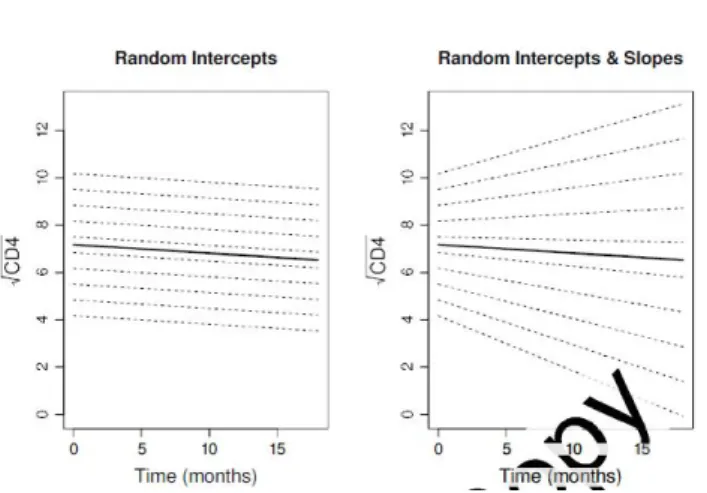
Linear Mixed-Effects Models (cont’)
First linear approach:
yij=βi0+βi1tij+ij
withij∼ N(0, σ2)
Second linear approach:
yij= (β0+bi0) + (β1+bi1)tij+ij
where
I β= (β0, β1)0 fixed effects
I bi= (bi0, bi1)0 random effectswithbi∼ N2(0, D)
I ij∼ N(0, σ2)
1- Introduction
2- Longitudinal Data Analysis
3- Survival Analysis 4- The Standard Joint Model 5- Extensions of the Standard Joint Model
Linear Mixed-Effects Model
LME Estimation and Implementation Illustration
LME formulation
yi = Xiβ+Zibi+i bi ∼ N(0, D) i ∼ N(0, σ2Ini) whereI XiandZi known design matrices for the fixed and random effects
I Ini denotes theni-dimensional identity matrix
I biare supposed to be independent oni
Main advantages
I It allows to describe how the mean response changes in the population
I It allows to estimate individual response profiles over time
I It can accommodate any degree of imbalanced data
I The random effects part accounts for the correlation structure between the repeated measurements for each subject in a relative parsimonious way
I Errors can be modeled likei∼ N(0,Σi), if it is necessary
1- Introduction
2- Longitudinal Data Analysis
3- Survival Analysis 4- The Standard Joint Model 5- Extensions of the Standard Joint Model
Linear Mixed-Effects Model
LME Estimation and Implementation Illustration
LME formulation
yi = Xiβ+Zibi+i bi ∼ N(0, D) i ∼ N(0, σ2Ini) whereI XiandZi known design matrices for the fixed and random effects
I Ini denotes theni-dimensional identity matrix
I biare supposed to be independent oni Main advantages
I It allows to describe how the mean response changes in the population
I It allows to estimate individual response profiles over time
I It can accommodate any degree of imbalanced data
I The random effects part accounts for the correlation structure between the repeated measurements for each subject in a relative parsimonious way
I Errors can be modeled likei∼ N(0,Σi), if it is necessary
(Verbeke and Molenberghs, 2000; Pinheiro and Bates, 2000)
1- Introduction
2- Longitudinal Data Analysis
3- Survival Analysis 4- The Standard Joint Model 5- Extensions of the Standard Joint Model
Linear Mixed-Effects Model
LME Estimation and Implementation
Illustration
LME estimation
The conditional (hierarchical) formulation implies the marginal model foryi yi=Xiβ+∗i with∗i ∼ N(0, Vi=ZiDZi0+σ2Ini)
I IfViis knownβcan be estimated by generalized least squares.
I IfViis not known,β is estimated by REML(Harville, 1974)
I Standard errors for the fixed-effects via robust estimation by sandwich estimator
EM algorithm(Dempsteret al.,1977)and Newton-Raphson algorithms (Lange, 2004)are needed.
Implementations can be found inLaird and Ware (1982)andLindstrom and Bates (1988).
1- Introduction
2- Longitudinal Data Analysis
3- Survival Analysis 4- The Standard Joint Model 5- Extensions of the Standard Joint Model
Linear Mixed-Effects Model
LME Estimation and Implementation
Illustration
LME implementation in R
Two main packages has been implemented
I nlmepackage(Pinheiroet al., 2012; Pinheiro and Bates, 2000)for continuous data and complex error structures.
I lme4package(Bateset al., 2011)for continuous and categorical responses and correlation in the repeated measurements only using random effects.
JM package by Dimitris Rizopoulos has been implemented considering the
lmeclass of objects coming from thelme()function in thenlmepackage.
1- Introduction
2- Longitudinal Data Analysis
3- Survival Analysis 4- The Standard Joint Model 5- Extensions of the Standard Joint Model
Linear Mixed-Effects Model LME Estimation and Implementation
Illustration
1- Introduction 2- Longitudinal Data Analysis
3- Survival Analysis
4- The Standard Joint Model 5- Extensions of the Standard Joint Model
Notation and definitions
Estimation
Time dependent covariates Extended Cox Model
Notation and definitions
I LetTi∗be a true survival time of interest with density functionf I Survival function: S(t) =P(T∗> t) =R∞
t f(s)ds
I Hazard function: h(t) = limdt→0
P(t≤T∗< t+dt|T∗≥ t) dt Consequently,S(t) = expn−Rt 0h(s)ds o .
Under the presence of right censoring....
I LetCibe the censoring time
I δi=I(Ti∗≤Ci) the event indicator
I Ti the observed survival time, i.e. Ti= min{Ti∗, Ci}
1- Introduction 2- Longitudinal Data Analysis
3- Survival Analysis
4- The Standard Joint Model 5- Extensions of the Standard Joint Model
Notation and definitions
Estimation
Time dependent covariates Extended Cox Model
Estimation
I Non-parametric approach: K-M estimator(Kaplan and Meier, 1958; Greenwood, 1926)
I Semi-parametric approach: Proportional Hazards model(Cox, 1972), by maximizing the partial loglikelihood function
Under the Relative risk regression models
hi(t|wi) =h0(t) exp(γ0wi)
where
I w0i= (wi1, . . . , wip) is a vector of covariates
I γ0= (γ1, . . . , γp) is the corresponding regression coefficients
and the ratio of hazards for two subjectsiandkis
hi(t|wi)
hk(t|wk) = exp{γ
0
1- Introduction 2- Longitudinal Data Analysis
3- Survival Analysis
4- The Standard Joint Model 5- Extensions of the Standard Joint Model
Notation and definitions Estimation
Time dependent covariates
Extended Cox Model
Time dependent covariates
ExogenousversusEndogenouscovariates
I Exogenous or external: when the covariate vectory(.) is associated with the rate of failure over time, but its future path up to timet > s
is not affected by the occurrence of failure at times. It is a predictable process(Kalbfleisch and Prentice, 2002)(e.g. time of the day, season of the year, predeterminated administrative therapy, environmental factors,...)
I Endogenous or internal: otherwise. (e.g. often measurements taken on the subjects under study, like biomarkers and clinical parameters)
I typically measured with error
I their complete path up to timetis not fully observed
1- Introduction 2- Longitudinal Data Analysis
3- Survival Analysis
4- The Standard Joint Model 5- Extensions of the Standard Joint Model
Notation and definitions Estimation
Time dependent covariates
Extended Cox Model
Extended Cox Model: Implementation
The Cox model can be extended to handle exogenous time-dependent covariates(Andersen and Gill, 1982)
hi(t|Yi(t), wi) =h0(t)Ri(t) exp(γ0wi+αyi(t))
where
I Yi(t) is the covariate history ofyiup to timet I Ri(t) is a left continuous at risk process
(Ri(t) = 1 iff subjectiis at risk a timet)
and parametersγandαare again estimated by partial loglikelihood maximization.
Implementation: survivalpackage(Therneau and Lumley, 2012)
1- Introduction 2- Longitudinal Data Analysis
3- Survival Analysis
4- The Standard Joint Model 5- Extensions of the Standard Joint Model
Notation and definitions Estimation
Time dependent covariates
Extended Cox Model
Extended Cox Model: Illustration in R
1- Introduction 2- Longitudinal Data Analysis 3- Survival Analysis
4- The Standard Joint Model
5- Extensions of the Standard Joint Model
The survival submodel
The longitudinal submodel Impementation in R Further reading
The survival submodel: Notation and definitions
I Aim: To measure the association between the longitudinal marker level and the risk for an event
I Letmi(t)be thetrue and unobservedvalue of the longitudinal outcome at timet(Remark: mi(t)6=yi(t))
I LetMi(t) ={mi(s),0≤s < t}be the longitudinal process up to time
t
I The relative risk model is formulated in the form
hi(t|Mi(t), wi) =h0(t) exp(γ
0
wi+αmi(t))
Remark: To leth0(t) without specifying may lead to an underestimation of
the starndard errors of the parameteres(Hsiehet al., 2006))
1- Introduction 2- Longitudinal Data Analysis 3- Survival Analysis
4- The Standard Joint Model
5- Extensions of the Standard Joint Model
The survival submodel
The longitudinal submodel Impementation in R Further reading
The survival submodel (cont’)
Options for specifying the baseline riskI To use known parametric distributions
I To use parametric but flexible specifications of baseline hazard I Step functions and linear splines(Whittemore and Killer, 1986)
I B-splines(Rosenberg, 1995)
I Restricted cubic splines(Herndon and Harrell, 1996)
Under the piecewise-constant model we formulate
h0(t) = Q X q=1 ξqI(vq−1< t≤vq) where
I 0 =v0< v1< . . . < vQdenotes a partition of the time scale, withvQ
larger than the larger observed time
I ξq constant hazard in the interval (vq−1, vq]
1- Introduction 2- Longitudinal Data Analysis 3- Survival Analysis
4- The Standard Joint Model
5- Extensions of the Standard Joint Model
The survival submodel
The longitudinal submodel
Impementation in R Further reading
The longitudinal submodel
By using the linear mixed effects paradigmyi(t) is modeled like
yi(t) = mi(t) +i(t) mi(t) = Xi0(t)β+Z 0 ibi bi ∼ N(0, D) i(t) ∼ N(0, σ2) where
I xi(t) andzi(t) are time-dependent design vectors andi(t) is also time-dependent
I errors terms are mutually independent and independent of the random effects.
1- Introduction 2- Longitudinal Data Analysis 3- Survival Analysis
4- The Standard Joint Model
5- Extensions of the Standard Joint Model
The survival submodel
The longitudinal submodel
Impementation in R Further reading
The longitudinal submodel
Intuitive representation of joint models
1- Introduction 2- Longitudinal Data Analysis 3- Survival Analysis
4- The Standard Joint Model
5- Extensions of the Standard Joint Model
The survival submodel The longitudinal submodel
Impementation in R
Further reading
Implementation of Joint Models in R
I JMpackage byDimitris Rizopoulos (2010, 2012)follows the random effects strategy.
Currently only works with linear mixed-effects submodels with iid error terms and no serial correlation structure.
I The main function isjointModel()that needs andlmeclass of mixed-effects model under an unstructured variance-covariance matrix for the random effects and acoxphmodel for the survival submodel.
methodargument injointModel()allowspiecewise-PH-GH, spline-PH-GH, Cox-PH-GH, weibull-PH,GHandweibull-AFT-GH
1- Introduction 2- Longitudinal Data Analysis 3- Survival Analysis
4- The Standard Joint Model
5- Extensions of the Standard Joint Model
The survival submodel The longitudinal submodel Impementation in R
Further reading
Further reading
I Semiparametric maximul likelihood estimation(Wulfshon and Tsiatis, 1997; Hendersonet al., 2000; Hsiehet al., 2006)
I Asymptotic properties under unspecified baseline hazard(Zeng and Cai, 2005)
I Bayesian estimation of joint models using MCMC(Hansonet al., 2011; Chi and Ibrahim, 2006, Xu and Zeger, 2001)
I Conditional score approach for the random effects as a nuisance parameter(Tsiatis and Davidian, 2001)
1- Introduction 2- Longitudinal Data Analysis 3- Survival Analysis 4- The Standard Joint Model
5- Extensions of the Standard Joint Model
Parameterizations Parameterizations Other Issues
Parameterizations (1/3)
I Interaction effects hi(t) =h0(t) exp(γ 0 wi1+α 0 {wi2×mi(t)}) I Lagged effects1- Introduction 2- Longitudinal Data Analysis 3- Survival Analysis 4- The Standard Joint Model
5- Extensions of the Standard Joint Model
Parameterizations
Parameterizations
Other Issues
Parameterizations (2/3)
I Time-Dependent slopes parameterization
hi(t) =h0(t) exp(γ0wi+α1mi(t) +α2m0i(t))
1- Introduction 2- Longitudinal Data Analysis 3- Survival Analysis 4- The Standard Joint Model
5- Extensions of the Standard Joint Model
Parameterizations
Parameterizations
Other Issues
Parameterizations (3/3)
I Cummulative effects parameterization
hi(t) =h0(t) exp{γ0wi+α
Z t
0
mi(s)ds}
I Random effects parameterization
1- Introduction 2- Longitudinal Data Analysis 3- Survival Analysis 4- The Standard Joint Model
5- Extensions of the Standard Joint Model
Parameterizations Parameterizations
Other Issues
More on the Standard Joint Model
I To handle Exogenous time-dependent covariates
I To fit stratified relative risk models
I Allows for Multiple failure times (e.g. competing risks or recurrents events)
I To fit accelerated failure time models
I Diagnostics and Prediction
1- Introduction 2- Longitudinal Data Analysis 3- Survival Analysis 4- The Standard Joint Model
5- Extensions of the Standard Joint Model
Parameterizations Parameterizations
Other Issues
1- Introduction 2- Longitudinal Data Analysis 3- Survival Analysis 4- The Standard Joint Model
5- Extensions of the Standard Joint Model
Parameterizations Parameterizations
Other Issues
Prediction examples
1- Introduction 2- Longitudinal Data Analysis 3- Survival Analysis 4- The Standard Joint Model
5- Extensions of the Standard Joint Model
Parameterizations Parameterizations
Other Issues