Improving Test Case Generation for Web Applications
Using Automated Interface Discovery
William G.J. Halfond and Alessandro Orso
College of ComputingGeorgia Institute of Technology
{whalfond, orso}@cc.gatech.edu
ABSTRACT
With the growing complexity of web applications, identify-ing web interfaces that can be used for testidentify-ing such applica-tions has become increasingly challenging. Many techniques that work effectively when applied to simple web applica-tions are insufficient when used on modern, dynamic web applications, and may ultimately result in inadequate test-ing of the applications’ functionality. To address this issue, we present a technique for automatically discovering web application interfaces based on a novel static analysis algo-rithm. We also report the results of an empirical evaluation in which we compare our technique against a traditional ap-proach. The results of the comparison show that our tech-nique can (1) discover a higher number of interfaces and (2) help generate test inputs that achieve higher coverage. Categories and Subject Descriptors: D.2.5 [Software Engineering]: Testing and Debugging;
General Terms: Algorithms, Experimentation, Reliabil-ity, Verification
Keywords: Web application testing, interface extraction
1.
INTRODUCTION
Web applications play an increasingly important role in our day-to-day activities, such as banking and shopping. The growing popularity of web applications has been driven by the introduction of new web technologies that allow for a higher level of integration among services and provide a richer user experience. Whereas web applications used to be a collection of mostly static content and involved minimal user interaction through simple forms, modern web appli-cations are increasingly customizable, generate content dy-namically, combine information gathered from a range of sources, and interact extensively with the user.
This growing complexity has made testing these web ap-plications more challenging because their interfaces tend to be difficult to identify. In testing, a general assumption is that the interfaces of the software being tested are known
Permission to make digital or hard copies of all or part of this work for personal or classroom use is granted without fee provided that copies are not made or distributed for profit or commercial advantage and that copies bear this notice and the full citation on the first page. To copy otherwise, to republish, to post on servers or to redistribute to lists, requires prior specific permission and/or a fee.
ESEC/FSE’07, September 3–7, 2007, Cavtat near Dubrovnik, Croatia.
Copyright 2007 ACM 978-1-59593-811-4/07/0009 ...$5.00.
(e.g., the API for a library or the options and parameters for a command-line utility). For simple web applications that consist of static HTML pages only, identifying the ap-plication interface is generally straightforward—it is enough to parse each web page within the application and identify the entities in the page that represent input elements, such as forms’ input fields. However, the complexity of modern web applications precludes such a straightforward solution. Modern web applications often have interfaces that are com-pletely hidden, in that they do not correspond to any input elements exposed on a static or dynamically-generated page. Incomplete information about web application interfaces can limit the effectiveness of testing because it may pre-vent testers from exercising parts of an application that are accessible only through unidentified interfaces. This can re-sult in unexpected behaviors in the field or even in the de-ployment of vulnerable applications that could be exploited by attackers. Unfortunately, current techniques for testing web applications either require manual specification of an application’s interfaces (e.g., [1, 11, 14]) or use automated approaches that are purely dynamic and, consequently, in-herently incomplete (e.g., [4, 5, 10, 12]).
To address the limitations of existing approaches, we present a new technique for automatically discovering the interfaces of a web application. The core of our approach is a novel static analysis algorithm that can analyze web applications that are highly dynamic and have multiple, possibly hid-den, interfaces. Our algorithms works in two phases. In the first phase, it identifies domain information (i.e., informa-tion about type and possible values) for the parameters that may be part of a web application’s set of interfaces. In the second phase, the algorithm identifies how these parameters are grouped in the different interfaces exposed by the web application. The final output of the algorithm is a set of interfaces, where each interface consists of a set of named parameters and domain information for those parameters. This set of interfaces can then be used to support web ap-plication testing and verification.
In this paper, we also present a set of studies that eval-uate our approach. To perform the studies, we developed a prototype tool,wam, that implements our technique and compared it to a widely-used approach for interface extrac-tion based on web crawling. The results of the comparison show that, for the web applications considered, (1) our ap-proach identifies a considerably higher number of web in-terfaces, and (2) the additional accuracy in the interface identification provided by our approach can significantly im-prove the effectiveness of testing (measured in terms of the
structural coverage achieved on the web applications under test). These results are promising, in that they show that our technique has the potential to improve the effectiveness of web application testing and, consequently, the quality of web applications. The contributions of this paper are:
• A novel algorithm for accurately extracting web applica-tion interfaces.
• An implementation of the algorithm in a prototype tool.
• Two empirical studies that show the effectiveness of our approach and the usefulness of the information it pro-duces.
2.
BACKGROUND
Aweb application is a software system that users can ac-cess over the Internet. Web applications are used extensively to provide a number of online services, such as banking and shopping. Typical web applications take user input and gen-erate dynamic pages, customize their response for the user, and interact with other systems such as databases and enter-prise servers. Users typically access a web application using a client application, such as a web browser, that allows them to enter input data (e.g., into a form) and submit such data to the web application.
At an abstract level, web applications interact with client applications through logical interfaces that consist of a col-lection of named Input Parameters (IP), each of which is associated with a domain. More precisely, we define a logi-cal interface for a web application as follows:
interf ace=IP∗
IP=name, domain inf ormation name=< string >
domain inf ormation=domain type, relevant value∗ domain type=AN Y|N U M ERIC
relevant value=< string >|< number >
Each interface consists of zero or more IPs; each IP con-sists of a name and some domain information; domain infor-mation consists of a domain type, which is either ANY or NUMERIC, and zero or more relevant values, which can be string or numeric literals. IPs can carry data that includes user input (e.g., web form data fields), cookie session data, and state information for the web application. In order to access a web application, a client issues an HTTP request that contains a set ofhname, valueipairs corresponding to an interface, and submits it to the web application.
A typical, but unsound, approach for identifying web ap-plication interfaces is to assume that the interfaces to a web application can be accurately identified through examina-tion of the HTML pages generated by the applicaexamina-tion. The approach is based on parsing each HTML page generated by the application to identify its web input forms and assum-ing that (1) each identified form corresponds to an interface, and (2) each input element in the form (e.g., text box, radio button, or hidden field) corresponds to an IP in that inter-face. Such an approach is incomplete and inaccurate, in that it can produce a set of interfaces that do not correspond to the actual interfaces of the web application.
In general, this mismatch can exist for several reasons. First, developers are not required to make all interfaces ac-cessible via HTML web forms. Second, even if an interface is made available via a web form, it might be difficult to inter-act with the application so as to ensure that all possible web forms that can be generated are actually generated. Third,
even when a given web form that correspond to an interface can be generated and analyzed, the web application may use a subset (or even a superset) of the parameters exposed as input elements in the web form. (We provide examples of these situations when we discuss our empirical results, in Sections 5.2 and 5.3.) Such discrepancies between visible and hidden interfaces occur frequently and could occur be-cause of a coding error or could be purposely created by a developer (e.g., to provide additional functionality that is intended to be accessed only by certain clients or to account for future extensions).
Since there is generally no formal definition of a web ap-plication’s interfaces, and examining exposed web forms can produce inaccurate and incomplete results, analyzing a web application’s source code is the only way to conservatively identify the application’s interfaces; the source code contains information on the actual interfaces of a web application, which are the interfaces accessed along specific paths of ex-ecution in the application. However, examining the code of a web application and extracting these implicit interfaces is a fairly complex task because of the way IPs are accessed within the application and because different paths in the application can correspond to different interfaces. (i.e., in-terfaces cannot be extracted by a simple local analysis).
A web application accesses IPs that compose an interface by invoking a specific library functionPF (Parameter Func-tion), which parses the HTTP request containing the IP and returns the values of the requested IPs. More precisely, given a web requestwr, and an IP with name “foo,” the valueval of the IP can be retrieved as val = wr.P F(”f oo”). Note that retrieving the value of an IP that is not defined inwr or not retrieving the value of an IP that is defined in wr does not typically result in an error in the web applications. Typically, the domain of an IP is also implicitly defined in the code and can be inferred by analyzing the operations performed on the IP value after it is returned by PF. For example, the fact that an IP value is cast to an integer along a path implies that the domain of the IP is expected to be an integer on that path. Similarly, the fact that an IP is compared against a specific value implies that such value is relevant in the IP’s domain. We refer to IPs for which such relevant values can be identified asstate parameters, as they are commonly used by web applications to maintain state across web requests.
Web applications can be implemented using a wide range of languages, such as C, Java, or Perl. In Java-based web applications, which we target in our evaluation, the basic component is called a servlet. Aservlet is a Java program that runs on a web server and provides aroot method that is invoked when a web request from a client application to the servlet is received. A web application is generally com-prised of many servlets, each of which implements part of the application functionality.
3.
MOTIVATING EXAMPLE
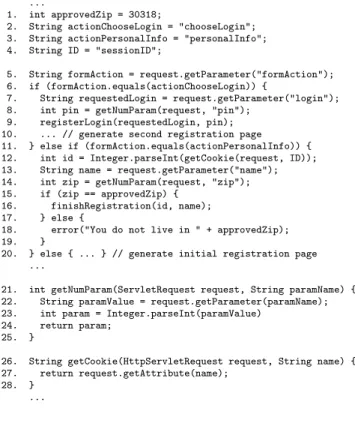
Before discussing our technique, we introduce an exam-ple servlet that is partially shown in Figure 1. This servlet implements the different steps of a generic user-registration process. In the servlet, state parameterformActionis used to identify the current phase of the registration process. As-sume that, when a user accesses the registration servlet for the first time, the value of state parameter formAction is not defined. The servlet would then execute the body of the
else statement at line 20 and generate an initial registra-tion page with a form where users can choose a login and pin. This form would invoke the same servlet with the login and pin chosen by the user and with parameterformAction
set to “chooseLogin.” On this second invocation, the servlet, based on the value of formAction, would execute the body of theifstatement at line 6 and retrieve the values for the IPs named “login” and “pin.” To retrieve the value of the “login” IP, the server calls the PF directly with string “lo-gin” as a parameter. To get the value of the IP named “pin,” it calls method getNumParam, which in turns calls the PF and casts the retrieved IP value to an integer. The servlet then registers the new login and generates a second page with a form that collects additional personal information. This form would also invoke the same servlet with the user-provided input and withformActionnow set to “personal-Info.” When the user submits this form, the servlet would check the state parameter and execute the body of theelse
statement at line 11, which collects and validates the infor-mation provided by the user. It does this by calling method
getNumParam, which ensures that the value of the IP named
“zip” is an integer and matches a pre-defined zip code. One of the interfaces for our example servlet is the following: interface={‘formAction’, ‘login’, ‘pin’}, where:
formAction’s domain type isANY, with relevant values ‘chooseLogin’ and ‘personalInfo’,
login’s domain type isANY, with no relevant values, pin’s domain type isNUMERICwith no relevant values.
Knowing this interface, we could generate several test in-puts for the servlet by creating a URL consisting of the loca-tion of the servlet followed byhname, valueipairs for each IP in the interface. For example, assuming that the servlet is accessible at http://my.dom/myservlet.jsp, a possible in-vocation of the servlet through the above interface would be
http://my.dom/myservlet.jsp?formAction=chooseLogin&login= foo&pin=1234.
Although this is a simple servlet, it has a number of interesting characteristics: (1) it uses a state parameter
(formAction) to drive the execution along three different
paths, each of which accesses a different set of IPs; (2) its different parts can be executed only by specifying the cor-rect values forformActionor by entering the right data in the various forms it generates; (3) it accepts two IPs, pa-rameter “zip” and cookie field “sessionID,” that can only be numeric; and (4) it requires parameter “zip” to have a spe-cific value to successfully complete the registration process. These are exactly the kind of characteristics that make the identification and testing of a servlet’s interfaces difficult for conventional approaches.
4.
INTERFACE DISCOVERY ALGORITHM
The goal of our approach is to automatically identify the different interfaces that a web application exposes. The ap-proach is based on a two-phase static analysis algorithm that computes the set of interfaces for each servlet in a web ap-plication. In the first phase, our analysis computes domain information (i.e., types and possibles values) for each IP in the servlet. In the second phase, our analysis identifies IP names and groups them into logical interfaces based on the servlet’s control and data flow. In the following sections, we explain the two phases of the algorithm in detail and illustrate how they work using our example servlet.
...
1. int approvedZip = 30318;
2. String actionChooseLogin = "chooseLogin"; 3. String actionPersonalInfo = "personalInfo"; 4. String ID = "sessionID";
5. String formAction = request.getParameter("formAction"); 6. if (formAction.equals(actionChooseLogin)) {
7. String requestedLogin = request.getParameter("login"); 8. int pin = getNumParam(request, "pin");
9. registerLogin(requestedLogin, pin); 10. ... // generate second registration page 11. } else if (formAction.equals(actionPersonalInfo)) { 12. int id = Integer.parseInt(getCookie(request, ID)); 13. String name = request.getParameter("name"); 14. int zip = getNumParam(request, "zip"); 15. if (zip == approvedZip) {
16. finishRegistration(id, name); 17. } else {
18. error("You do not live in " + approvedZip); 19. }
20. } else { ... } // generate initial registration page ...
21. int getNumParam(ServletRequest request, String paramName) { 22. String paramValue = request.getParameter(paramName); 23. int param = Integer.parseInt(paramValue)
24. return param; 25. }
26. String getCookie(HttpServletRequest request, String name) { 27. return request.getAttribute(name);
28. } ...
Figure 1: Example servlet.
4.1
Phase 1: Discover Domain Information
In Phase 1 our technique analyzes each IP in each servlet and computes its domain information. The input of the analysis is the set of servlets in the web application, and its output is anInterprocedural Control Flow Graph (ICFG)of the web application annotated with domain information. The algorithm annotates two kinds of nodes: nodes that contain a call to a PF and nodes that represent a call to a method that invokes, directly or indirectly, a PF. An anno-tation for a nodencontains three elements: (1) the location of the PF call that retrieved the original IP valuev, (2) the domain type ofv, and (3) possible values forv.
The general approach that we use to compute annotations is to start from a PF call, identify the variable that is de-fined by the return value of the PF call (i.e., the variable that stores the IP value), identify the operations performed on that variable along chains of definitions and uses, and use this information to compute domain information. More specifically, if a variable that contains an IP value is con-verted to any numeric value, we can infer that the domain type of the corresponding IP value is NUMERIC. Also, if a variable that contains an IP value is compared against a specific valueval, we can deduce thatvalis a special value for that IP and addvalto the IP’s set of relevant values.
Algorithm 1 shows our Phase 1 algorithms, GetDomain-Info and GDI. Without loss of generality, in the rest of the discussion we assume that (1) there are no global vari-ables in the applications under analysis, (2) each node in the ICFG contains only one definition, and (3) the variable defined with the value returned by a function (in particular, a PF) is used in only one statement. Note that we make these assumptions only to simplify the presentation of the
algorithms, and they do not limit the applicability of the approach in any way; any program could be automatically transformed so that it satisfies all three assumptions.
GetDomainInfo first builds an ICFG for the servlets in the web application and computes data-dependence infor-mation. We assume that data-dependence information is available through functionDU chain(v, n), which returns the set of nodes that (1) are reached by the definition of variable vat nodenand (2) use variablev.
After computing ICFG and data-dependence information, GetDomainInfo identifies and processes each PF call.1
For each PF call, it first identifiesP F node, the ICFG node that contains the PF call considered (line 4) andP F var, the vari-able defined with the return value of the PF call (line 5). Then, GetDomainInfo creates a new annotation and initial-izes its IP node toP F node(lines 6–7), its type to ANY (line 8), and its values to the empty set (line 9), and associates the newly-created annotation withP F node. Finally, it in-vokes the GDI algorithm, providing as input the node that uses the definition ofP F var atP F node,P F var,P F node, and an empty set. When all PF calls have been processed, GetDomainInfo returns the resulting annotated ICFG.
GDI is a recursive algorithm that computes domain infor-mation for an IP. GDI takes four parameters as input: node is the node to be analyzed;IP varis the variable that stores the current IP value or a value derived from the current IP value and that is used at node; root node is the node to be annotated with the discovered domain information; visited nodes is the set of nodes encountered in the path being traversed (used to ensure that cyclic data dependen-cies are explored only once in a path). To understand the algorithm, it is important to note that, by construction, the statement represented by nodeis always a use of variable IP var, which stores the current IP value or a value derived from it. The output of GDI is the set of annotations added to the ICFG while processing its nodes.
Ifnodeis not in thevisited nodesset (line 1), GDI per-forms one of three different operations based on the type of statement represented bynode. Ifnodeis an exit node (i.e.,
it corresponds to a return statement), GDI first identifies all return sites for the method that containsnode(line 3). Then, for each return site,retsite, it identifies the variable defined atretsite,retvar (which contains the IP value af-ter the call returns) (line 5), copiesroot node’s annotation (line 6), and associates the annotation with node retsite (line 7).2
Finally, it invokes GDI recursively, passing as in-puts the node that uses the definition ofretvarat retsite, retvar, retsite, and the current set of visited nodes plus node(line 8).
If noderepresents a statement that performs a compar-ison ofIP var against a specific value (line 11), GDI adds that value to the set of values in the annotation associated with root node (lines 12–13). Currently, our implementa-tion handles comparisons with string and numeric constants. It also handles a subset of cases whereIP var is compared against a variable; to do this, it tries to identify the value of the variable at the point of the comparison by following definition-use chains to the variable’s initialization. (This
1
The specific set of PFs considered depends on the language in which the web application is written.
2
Annotations are copied to ensure that domain information is computed in a context-sensitive fashion, which improves the precision of Phase 2, as explained in Section 4.2.
Algorithm 1 – Phase1
/*GetDomainInfo*/
Input: servlets: set of servlets in the web application
Output: ICF G: ICFG for the servlets, annotated with domain in-formation
begin
1:ICF G←ICFG for the web application
2:compute data-dependence information for the web application
3:for eachP F callintheservletsdo
4: P F node←ICFG’s node representingP F 5: P F var←lhs of the PF call statement
6: newannot←new annotation
7: newannot.IP node←P F node 8: newannot.type←ANY
9: newannot.values← {}
10: associatenewannotwithP F node
11: GDI(DU chain(P F var, node), P F var, P F node,{})
12: end for
13: returnICF G/*returns annotated ICF G*/
end
/*GDI*/
Input: node: current node to examine
IP var: variable storing the IP value and used atnode root node: node to be annotated
visited nodes: nodes visited along current path
begin
1:if node6∈visited nodesthen 2: if nodeis an exit nodethen
3: returnsites←possible return sites fornode’s method
4: for eachretsite∈returnsitesdo 5: retvar←variable defined atretsite 6: newannot←root node’s annotation
7: associatenewannotwith noderetsite 8: GDI(DU chain(retvar, retsite), retvar, retsite,
visited nodes∪ {node})
9: end for 10: else
11: ifnoderepresents a comparison with a constantthen 12: compval←value used in the comparison
13: addValueToAnnotation(root node, compval)
14: else ifnodeis a type cast/conversion ofIP varthen 15: casttype←target type of the cast operation
16: setDomainTypeInAnnotation(root node, casttype)
17: end if
18: ifnodecontains a definition of a variablethen 19: var←variable defined atnode
20: for eachn∈DU chain(var, node)do
21: GDI(n, var, root node, visited nodes∪ {node})
22: end for
23: end if 24: end if 25: end if end
type of value resolution is similar to the one we use to iden-tify IP names in Phase 2, as described in Section 4.2.)
Otherwise, ifnoderepresents a type cast statement per-formed onIP var, GDI updates the domain type of the an-notation associated withroot node(lines 15–16).
At this point, GDI checks whether the statement repre-sented by node defines a variable (line 18). If so, it first identifies variable vardefined atnode(line 19). Then, for each nodenthat uses the definition of variablevarat node node(line 20), GDI invokes itself recursively, providing as inputn,var, the currentroot node, and the current set of visited nodes plusnode(line 21).
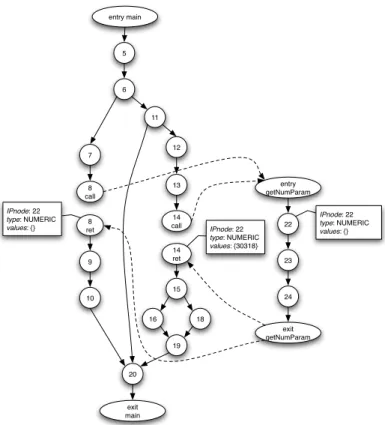
To illustrate Phase 1 with a concrete example, we show the application of algorithm GDI to the PF at line 22 of our ex-ample servlet in Figure 1, whose partial ICFG is represented in Figure 2. The first call to GDI, performed by the GetDo-mainInfo algorithm, is “GDI(23, paramV alue,22,{})” node 23 has not been visited before, so GDI proceeds to check whether the node is an exit node, which is not the case. GDI then checks whether the node corresponds to a
pred-entry main 5 6 20 exit main 8 call 7 9 10 11 12 13 14 call 15 16 18 19 entry getNumParam 22 23 24 exit getNumParam 8 ret 14 ret IPnode: 22 type: NUMERIC values: {} IPnode: 22 type: NUMERIC values: {30318} IPnode: 22 type: NUMERIC values: {}
Figure 2: Annotated control flow graphs for two of the methods in the code of Figure 1.
icate statement, which is also not the case. Finally, the algorithm checks whether the node represents a type cast operation. Because the statement at node 23 is indeed a type cast (it parses an integer in a string), it annotates the root node, node 22, with domain type NUMERIC. node 23 also contains a definition of variable param, so GDI com-putesDU chain(param,23), which returns a set containing only node 24, and invokes itself recursively as
“GDI(24, param,22,{23})”
Because node 24 is an exit node, GDI identifies the cor-responding return sites: nodes 8ret and 14ret. At this point, GDI associates the current annotation ofroot node with nodes 8retand 14ret. Then GDI calls itself recursively twice, once for each return site, as
“GDI(9, pin,8ret,{23,24})” and “GDI(15, zip,14ret,{23,24})”
The first of these two invocations of GDI would identify node 9 as a definition of the formal parameter ofregisterLogin corresponding to the actual parameterpinand continue by exploring uses of that formal parameter in registerLogin (not shown here). The second invocation of GDI would iden-tify node 15 as a predicate node that performs a comparison with value 30318 (by identifying the initialization of variable approvedZip) and add that value to the set of values in the annotation for the currentroot node(node 14ret). At this point, the algorithm would terminate because node 15 does not contain a definition and, thus, there are no further data dependencies to follow.
The final result after GDI processes this PF would be the three annotations attached to nodes 8ret, 14ret, and 22 shown in Figure 2.
4.2
Phase 2: Compute Interfaces
In its second phase our analysis identifies IP names, groups them into logical interfaces, and associates the domain in-formation computed in the first phase with the identified IP names. The input of the analysis is the annotated ICFG produced by GetDomainInfo, and its output is the set of in-terfaces exposed by each servlet. Intuitively, Phase 2 works by grouping sets of IPs that are used along a path and, thus, could be part of the same interface. To avoid an ex-ponential explosion of the computational cost, the analysis processes one method at a time, computes summary infor-mation for the method, and then uses the summary informa-tion when analyzing methods that invoke methods already analyzed. Within each method (or set of strongly connected methods), the analysis computes summary information us-ing a worklist-based forward iterative algorithm. Methods involved in recursion are handled by treating them as one “super-method” and assigning the same summary to each of them. The analysis terminates when each servlet’s root method has been processed. At that point, the summary of a servlet’s root method represents all of the interfaces exposed by the servlet.
Algorithm 2 shows our Phase 2 algorithms, ExtractInter-faces and SummarizeMethod. ExtractInterExtractInter-faces first builds aCall Graph (CG) for the web application servlets. Then, it identifies the sets of strongly connected components in the CG, SCC, and creates a set, CC, which consists of SCC plus singleton sets, one for each node that does not belong to any set in SCC. In this way, every element of CC is either a set of strongly connected nodes in the CG or a single node.
In the presentation, we assume that the ICFG is globally available, together with the individualControl Flow Graphs (CFGs). We also assume that the following functions are available: target(n), which returns the method called at a call site n;succ(n), which returns all successors ofninn’s CFG; and pred(n), which returns all predecessors of n in n’s CFG. If n is a call (resp., return) site, succ(n) (resp., pred(n)) returns the corresponding return (resp., call) site. For example, pred(14ret), for the ICFG in Figure 2, would return 14call.
ExtractInterfaces iterates over the sets in CC in reverse topological order to ensure that a method is processed be-fore any method that calls it. When all methods have been processed, the algorithm simply returns the interfaces com-puted for each servlet’s root method.
SummarizeMethod is the core algorithm of Phase 2. It takes as input methodset, a set of one or more methods, computes the interfaces exposed by these methods, and at-taches these interfaces to the methods as summaries. The output of the algorithm is the set of summaries associated to the methods inmethodset.
SummarizeMethod first initializes the data structures used in the rest of the algorithm. In particular, setN is initial-ized with all of the nodes in all of the methods inmethodset (line 1) andGensets for a node nare initialized in one of four ways.
Ifnrepresents a PF call, a new IP entity that corresponds to the parameter accessed at noden is created, initialized, and used to initialize theGenset forn(lines 6–14). If Phase 1’s annotation for nodencontains domain information (i.e.,
type or values), SummarizeMethod associates such informa-tion with the IP entity (lines 9–13). All successors ofnare then added to the worklist (line 10).
Ifnis a callsite and the target of the call is a summarized method with summarys,n’sGenset is initialized with the value returned by function map invoked on n and s (line 17). Themap function takes a method m’s summary and a callsite invokingmand modifies the summary by replac-ing each IP name that is not concrete (i.e., each IP name that corresponds to a variable or to a formal parameter— see below) with the corresponding actual parameter at the callsite. Then, for each IP entity in each interface contained inn’sGenset, SummarizeMethod checks whether the anno-tations created by Phase 1 forn’s return site apply to any of the IP entity, that is, whether they refer to the same IP node (line 19–21). If so, it updates the domain information for the IP entity using the domain information in the rele-vant annotations (line 22). After performing this operation, SummarizeMethod adds n’s successors to the worklist. If n is a method entry point, its Gen set is initialized to a set containing an empty set (line 28) andn’s successors are added to the worklist.
Finally, ifnis not a callsite, SummarizeMethod initializes n’sGenset to the empty set (line 31).
TheOutset fornis then initialized with the value ofn’s Genset (line 33).
Note that, for this algorithm, the Out set for a node n represents the set of interfaces exposed by n (where each interface is a set of IP elements, as described in Section 2), and the set of interfaces for a method consists of the Out set of its exit node.
After initializing sets and data structure, SummarizeMethod enters its iterative part, where it keeps processing nodes un-til the worklist is empty (lines 35–52). For each noden in the worklist, SummarizeMethod computes the value ofn’s InandOutsets as follows. TheInset is computed straight-forwardly as the union of theOutsets of n’s predecessors. SummarizeMethod computesn’s Outset as the product of n’sIn andGensets; for each interface (i.e., set of IP ele-ments)iinIn(line 39) and each interfaceginGen(line 40), SummarizeMethod generates an interface that is the union ofiandgand adds it toOut(line 41).
If theOutset forn changed since the previous iteration overn(line 44), SummarizeMethod updatesn’sOutset (line 45) and updates the worklist as follows. Ifnis a callsite and its target methodmis one of the methods in the input set (i.e., mis in the same strongly connected component of the CG as the current method), SummarizeMethod adds m’s entry node to the worklist (line 47).3
Otherwise, Summa-rizeMethod simply addsn’s successors to the worklist (line 49). Note that, ifnis a callsite but its target methodmis not in the input set,m’s return site would be added to the worklist.
When the worklist is empty, SummarizeMethod performs the following operations for each methodmin the input set. First, it associates the set of interfaces in the Out set of m’s exit node tomas its summary (lines 54–55). Then, it considers all IPs in all such interfaces whose name is not a concrete value and tries to resolve them by calling function resolve. If successful, the resolution of a reference provides the actual names of the IPs in an interface. For space consid-erations, we do not show functionresolveand only provide an intuitive description of it.
3
By doing so, SummarizeMethod treats nodes in a set of strongly connected methods as a single super-method, as described above.
Algorithm 2 – Phase 2
/*ExtractInterfaces*/
Input: ICF G: annotated ICFG produced by GetDomainInfo
Output: interf aces[]: interfaces exposed by each of the servlets
begin
1:CG←call graph for the web application
2:SCC←set of strongly connected components in CG
3:SIN GLET ON S←set of singleton sets, one for each node in CG that is not part of a strongly connected component
4:CC←SCC∪SIN GLET ON S
5:for eachmset∈CC, in reverse topological orderdo 6: SummarizeMethod(mset)
7:end for
8:return interfaces of each servlet’s root method
end
/*SummarizeMethod*/
Input: methodset⊂CG nodes: singleton set or set of strongly con-nected methods in the call graph
begin 1:N←S m∈methodsetnodes in m ′ s CF G 2:worklist← {} 3:for eachn∈Ndo 4: In[n]← {}
5: if ncorresponds to a PF callthen 6: newIP←newIP
7: newIP.node←n
8: newIP.name←parameter of the PF call
9: if n’s annotation has domain informationdominf othen 10: newIP.domaininf o←dominf o
11: else
12: newIP.domaininf o←null 13: end if
14: Gen[n]← {{newIP}}
15: add nodes insucc(n) toworklist
16: else ifnis a callsiteAN Dtarget(n) has summarysthen 17: Gen[n]←map(n, s)
18: for eachinterf ace∈Gen[n]do 19: for eachIP∈interf acedo
20: annot←annotation associated withn’s return site
21: if IP.node==annot.IP nodeAND
annothas domain informationdominf othen 22: IP.domaininf o←dominf o
23: end if
24: end for
25: end for
26: add nodes insucc(n) toworklist 27: else ifnis a method entry pointthen 28: Gen[n]← {{}}
29: add nodes insucc(n) toworklist 30: else 31: Gen[n]← ∅ 32: end if 33: Out[n]←Gen[n] 34: end for 35: while|worklist| 6= 0do 36: n←first element inworklist 37: In[n]←S
p∈pred(n)Out[p] 38: Out′
[n]← {}
39: for eachi∈In[n]do 40: for eachg∈Gen[n]do
41: Out′ [n]←Out′ [n]∪ {i∪g} 42: end for 43: end for 44: ifOut′ [n]6= Out[n]then 45: Out[n]←Out′ [n]
46: ifnis a callsite AND target(n)∈methodsetthen 47: add target(n)’s entry node toworklist
48: else
49: add nodes in succ(n) toworklist 50: end if
51: end if 52: end while
53: for eachm∈methodsetdo 54: summary←Out[m’s exit node]
55: associatesummaryto methodm 56: for eachinterf ace∈summarydo
57: for eachIP∈interf acesuch thatIP.nameis not a concrete valuedo 58: IP.name←resolve(IP) 59: end for 60: end for 61: end for end
Functionresolvetakes as input a string variable and at-tempts to find one or more statements in the current method where the variable is initialized. To do this, it follows back-ward definition-use chains starting from the variable and without crossing the current method’s boundaries until it reaches a definition involving (1) a string constant, (2) an expression, or (3) a method parameter. In the first case, resolve terminates successfully and returns the identified string constant. In the second case, it tries to compute a conservative approximation of the values of the string ex-pression using the Java string analysis developed by Chris-tensen, Møller, and Schwartzbach [2]. If the analysis termi-nates,resolvereturns the resulting set of strings. Finally, in the third case,resolve returns the formal parameter iden-tified. In this latter case, (1) the formal parameter will be mapped to the corresponding actual parameter when the summary information is used in one of the current method’s callers, and (2) resolve will be invoked on the actual pa-rameter when computing the summary information for that caller.
We illustrate Phase 2 using our example servlet. In the interest of clarity, we focus only on excerpts that illustrate some of the subtleties of the algorithm and ignore annota-tions and calls toresolve. The first two methods processed by the algorithm aregetNumParamandgetCookie. The pro-cessing of getNumParambegins at node 22, which contains a PF call, so its Gen set consists of a newly created IP entity for that PF, whose name is “paramName” (the pa-rameter of the PF call). Traversing nodes 23 and 24 does not add any additional information. After reaching node 24, SummarizeMethod creates a summary with a single interface in it, consisting of the newly created IP. The processing of methodgetCookieis almost identical and creates a similar summary. In the main method, processing starts at node 5, which is a PF call. Therefore, also in this case, itsGenset contains a newly created IP entity for that PF, with name “formAction.”
SummarizeMethod then proceeds to node 6, at which point either branch can be taken; we assume that SummarizeMethod follows the branch to node 7 first. Node 7 is also a PF call and results in aGenset with another newly created IP en-tity, whose name is “login.” Node 8 is a call to method
get-NumParam, whose summary we computed above. The map
function, applied to this summary, replaces formal
param-eter paramName with actual parameter pin. Nodes 9 and
10 do not add any information, so theOutset of node 10 contains the set of three IPs whose names are “formAction,” “login,” and “pin.”
Along the branch starting with node 11 and ending at node 19, the analysis generates an Out set (for node 19) consisting of four IPs, with names “formAction,”sessionID, “name,” and “zip.” At node 20, SummarizeMethod computes the union of the Out sets of nodes 10, 11, and 19, which results in a set containing three possible interfaces: {{ “for-mAction”, “login”, “pin”}, {“formAction”}, {“formAction”, “sessionID”, “name”, “zip”}}.
5.
EMPIRICAL EVALUATION
In our empirical evaluation, we assess the usefulness of our approach in supporting web application testing. To do this, we comparewam’s performance with the performance of an approach based on web crawling (spider, hereafter). Web crawlers, also known as web spiders, are widely used tools
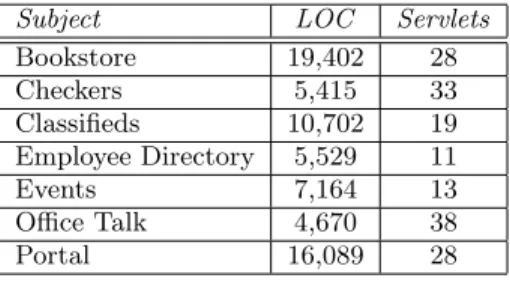
Table 1: Subject programs for our empirical studies.
Subject LOC Servlets
Bookstore 19,402 28 Checkers 5,415 33 Classifieds 10,702 19 Employee Directory 5,529 11 Events 7,164 13 Office Talk 4,670 38 Portal 16,089 28
that explore web sites by visiting web pages, identifying links in the visited pages, and visiting the linked pages recursively. Web spiders provide an ideal baseline for our evaluation be-cause they are the tools most commonly used for extracting web application interfaces, and many approaches to web ap-plication testing rely on the information produced by web spiders. In the evaluation, we investigate the following two research questions:
RQ1: Does wam discover a higher number of interfaces thanspider?
RQ2: Does testing effectiveness improve when using inter-face information generated by wam instead of interface information generated byspider?
In the following sections, we describe our experiment setup, present the studies we performed to address RQ1 and RQ2, and discuss the results of these studies.
5.1
Experiment Setup
5.1.1
Experimental Subjects
Our experimental subjects consist of seven Java-based web applications: five commercial applications available from GotoCode (http://www.gotocode.com/) and two student-deve-loped projects. This set of subjects was used in previous work by us and also other researchers [7–9]. Table 1 provides general information about the subject applications. For each application, the table lists the application’s size (LOC) and number of servlets (Servlets).
5.1.2
Tools Used in the Evaluation
The spider we use in our study is based on the web crawler available as part of the widely-used OWASP WebScarab Project [13]. This is a state-of-the-art implementation that is representative of most spider-based approaches. We ex-tended the OWASP spider by adding to it the capability of extracting from web pages (1) form-related information, including information about<form>and<input>elements, and (2) default values specified for those elements. Addi-tionally, we gave the spider administrator-level access to the web applications used in the study by providing it with lo-gin information for the various applications. In this way, we enabledspiderto perform a more thorough exploration.
For the evaluation we developed a prototype tool, wam, that implements our approach for web applications devel-oped using the JEE framework (http://java.sun.com/javaee/). As inputwamtakes the set of Java classes in a web application. For each servlet in the application, wam analyzes its bytecode and outputs a list of the servlet’s interfaces. To generate
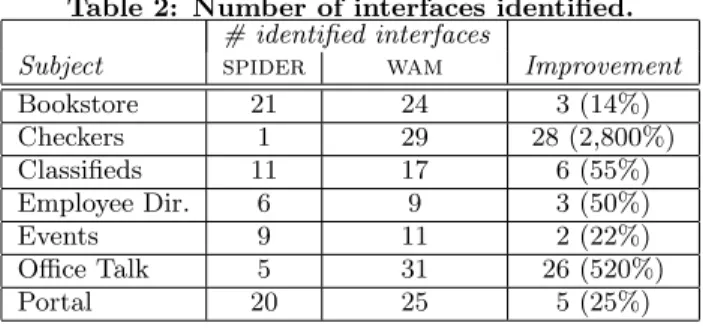
anal-Table 2: Number of interfaces identified. # identified interfaces
Subject spider wam Improvement
Bookstore 21 24 3 (14%) Checkers 1 29 28 (2,800%) Classifieds 11 17 6 (55%) Employee Dir. 6 9 3 (50%) Events 9 11 2 (22%) Office Talk 5 31 26 (520%) Portal 20 25 5 (25%)
ysis framework (http://www.sable.mcgill.ca/soot/). To com-pute data-dependency information,wamleverages indus(http:
//indus.projects.cis.ksu.edu/), a data analysis library built on top ofsoot. Lastly, theresolvefunction that we use in Phases 1 and 2 uses the Java String Analysis (JSA) library [2] to com-pute a conservative approximation of the different values a string can assume at a given point in a program.
5.2
Study 1
To address RQ1, we ranspiderand wamon our subject ap-plications, counted the number of interfaces extracted by the two tools, and compared these numbers. Table 2 shows our results. For each application, the table reports the number of interfaces identified byspider(spider), the number of interfaces identified bywam(wam), and the absolute and relative (in parentheses) in-crease in the number of interfaces identified bywamwith respect tospider.
As the table shows, wam always identifies a higher number of interfaces thanspider, and in some cases the increase in the number of interfaces identified is dramatic.
We manually inspected several of the servlets that showed a high difference in the number of interfaces discovered byspider andwamto check the correctness of our results and improve our understanding of the reasons forwam’s better performance. We found that the difference in the results is generally due to a com-bination of two factors.
First, many servlets interact with users through a series of forms that must be completed in sequence and by providing a suitable set of values. One example of this situation is a registra-tion servlet, similar to the servlet example in Figure 1, that we found in one of our subjects. The servlet required users to select a login and then enter their password twice before proceeding to the next form, which prompted them for additional information. Unless a spider could provide appropriate information for the var-ious forms, it would only be able to discover the initial default form. While a spider can be trained to solve specific instances of this problem, the problem of generating suitable values for a form is, in general, unsolvable without specific knowledge of the application and its underlying database.
Second, many servlets contain hidden interfaces. These inter-faces would not appear in any web page and, thus, could not be detected by a web spider. We found many occurrences of this type of hidden interfaces that were used as a mechanism for inter-servlet communication, where one servlet would invoke an-other servlet and pass parameters to it for processing. Although designed for inter-servlet use, these interfaces are accessible ex-ternally because each servlet in a web application can be invoked directly. Therefore, they should be identified and suitably tested.
Additional findings.
During manual inspection of the results, we found some additional evidence of the usefulness of our ap-proach that, although not directly related to the results of Study 1, is worth reporting. Specifically, we encountered many situa-tions where web forms contained input elements that were never actually retrieved by the servlet (i.e., their corresponding in-put values were simply ignored during execution of the servlet). Without additional information, it is difficult to asses whetherthese situations correspond to errors in the application. However, they do represent cases in which our technique would identify a more accurate set of interfaces and provide testers or developers with more relevant information; sincespiderreports all input el-ements it identifies, regardless of whether they are actually used by the application, as being part of the application’s interface, this could result in wasted testing effort that targets the unused input elements.
5.3
Study 2
Our goal in investigating RQ2 is to assess whether identify-ing more interfaces actually results in a more thorough testidentify-ing of web applications. In other words, we want to confirm that the additional interfaces discovered by our technique actually provide value for the tester. To address this question, we compared the coverage achieved by a test-input generation technique when rely-ing on the interfaces identified bywamand on the ones generated byspider. Although higher coverage does not necessarily imply better fault detection, coverage is an objective and commonly-used indicator of the quality of a test suite.
We measured and compared coverage for four criteria: basic-block, branch, command-form, and input-parameter coverage. Basic-block coverage and branch coverage measure the percentage of basic-blocks and branches exercised, respectively. Command-form coverage [9] measures the number of distinct types of database commands and queries (i.e., commands and queries that differ in their structure) generated by an application that interacts with an underlying database. Since most web applications are data-centric, this measure is useful in determining whether a test suite has caused a servlet to exhibit different behavior with regards to its interactions with the underlying database. Lastly, input-parameter coverage measures the percentage of an application’s unique IPs that are accessed by a servlet during its execution, which is an indicator of how thoroughly the possible input chan-nels have been exercised.
To exercise the subject applications, we generated two test suites for each application: one based on the interfaces identi-fied bywamand one based on the interfaces identified byspider. To avoid introducing bias into the test suite generation, we used the same process to create both test suites. For each interface identified by the two approaches, we iterated over each input pa-rameterparamin the interface and created a set of test cases that varied the value ofparamby setting it to a “normal” value (e.g.,
a random string or number), the empty string, or an erroneous value (e.g., a numeric parameter when a non-numeric value is expected). The empty string and erroneous values were used to try to exercise error checking code in the application. The other parameters in the interface were set to legal values. In the case of spider-discovered interfaces, we used the default legal values supplied by the crawled HTML pages. Forwam-discovered inter-faces, we used the set of relevant values discovered by wam. In this way, we were able to generate test cases in the exact same way for bothwam and spider, and differences in the resulting test sets were due only to differences in the interfaces identified by the two approaches.
After generating the sets of test inputs, we deployed versions of the subject applications instrumented to monitor the differ-ent types of coverage. We used theInsectJ framework [16] to handle instrumentation and monitoring for basic block, branch, and input-parameter coverage, and the ditto tool [9] to mea-sure command-form coverage. We then ran all of the test in-puts against the instrumented applications and computed the amount of coverage achieved using each criterion. The results of this study are presented in Table 3. For each application, we show the amount of basic block (Block), branch (Branch), command-form (Cmd-form), and input-parameter (Param) cov-erage achieved. For each covcov-erage criterion, we also show the coverage achieved by thespider-based approach (S), the cover-age achieved by thewam-based approach (W), and the percentage improvement achieved when using our approach (±). Note that,
in the table, command-form coverage is reported only in absolute terms because we do not currently have a way of computing the exact number of test requirements for this criterion.
Table 3: Test criteria coverage achieved using the spider-based and the wam-based test generation approaches.
Block (%) Branch (%) Cmd-form (abs.) Param (%)
Subject S W ± S W ± S W ± S W ± Bookstore 62 70 13 50 63 26 59 102 73 97 100 4 Checkers 17 31 86 5 10 100 7 14 100 29 63 120 Classifieds 58 70 20 44 61 39 35 77 120 96 98 2 Employee Dir. 69 78 13 52 64 22 27 51 89 98 100 2 Events 58 71 22 46 61 34 27 64 137 97 100 3 Office Talk 25 37 49 12 24 100 16 26 63 27 69 150 Portal 65 71 10 55 64 17 88 156 77 99 100 1 Average 51 61 30 38 50 48 37 70 94 78 90 40
The results reported in the table show that test input gen-eration based on the interfaces discovered by wam resulted in consistently higher coverage across the four testing criteria con-sidered. There is an average increase of 30% for basic block cov-erage, 48% for branch covcov-erage, 94% for command-form covcov-erage, and 40% for input-parameter coverage. These results provide ev-idence that, for the subjects considered, the discovery of more interfaces, along with the domain information extracted by our analysis, allows testers to create test inputs that will more thor-oughly exercise the different parts of a web application.
In an inspection of several servlets, we found that it was com-mon that large sections of code were either executed or skipped based on the values of state parameters. The ability to set these state parameters to meaningful values, provided by our approach, allows for exercising these sections of code. Conversely, spiders cannot, in general, discover legal values for these state parame-ters without human intervention or some form of heuristics-based guessing. As the results confirm, this limits the ability of spider-based approaches to thoroughly exercise web applications. We also found that the way many web applications handle parame-ters of the incorrect type (e.g., string instead of numeric) often involves exiting the servlet with an error message or an exception. In these cases, the domain information provided by our analysis can help generate test inputs that satisfy type constraints and can execute larger parts of the servlets.
For two of the applications, Officetalk and Checkers, the av-erage increase in covav-erage achieved by thewam-based approach is considerably higher than for the other applications. Through manual inspection of the code, we found that the servlets in the other five applications read all input parameters as soon as in-voked and perform an extensive and systematic error checking on all of them. Therefore, even if a test input causes an error during input validation, it would still execute a considerable percent-age of the servlets’ code (albeit not its main logic). Conversely, the servlets in Officetalk and Checkers check state parameters first and, based on their values, direct the execution along dif-ferent paths that access and check difdif-ferent input parameters as needed. As a result, identifying the right relevant values for the state parameters, aswamdoes, leads to test inputs that achieve a considerably higher coverage.
A final observation is that command-form coverage exhibited a much higher increase than other criteria. Intuitively, the different types of queries generated by a web application represent differ-ent types of behaviors that an application can perform. Such a high increase correlates to our intuition that accurately identify-ing interfaces and domain information can result in a larger and more varied set of behaviors exhibited by the servlets under test.
Threats to validity.
As with all empirical evaluations, there are threats to the validity of our results. The threats that we identified include the quality ofspider’s implementation, subject selection, and test input generation strategies. First, a flawed im-plementation ofspidercould result in an inadequate exploration of the web applications and, thus, in missing interfaces that aspi-der could indeed identify. To mitigate this issue, we used exist-ing spider infrastructure built by the OWASP group and simply extended its functionality. This infrastructure is actively sup-ported and implements state-of-the-art practices and strategies for web crawling. Second, if the selection of experimental sub-jects is not representative, our results may not generalize. To mitigate this issue, we used seven different applications that were gathered from different sources and have been used previously in related work [7–9]. Finally, the use of an inadequate test in-put generation strategy may negatively affect the coverage results achieved using one or both of the considered approaches. To mit-igate this threat, we applied standard test-generation techniques and used the same test generation strategy for both approaches. The only difference is that we leveraged the specific information provided bywamandspiderwhen creating the set of test inputs for the two approaches.
6.
RELATED WORK
Many techniques for testing web applications have been pro-posed in the literature. Most of the spider-based approaches have been developed in the commercial sector and are based on tradi-tional web crawling, with the notable exception of WAVES [10]. WAVES is a sophisticated web spider that uses heuristics to ad-dress many of the shortcomings of conventional crawlers. How-ever, these heuristics have to be customized for a particular web application and require extensive developer intervention.
Many approaches generate test inputs for a web application based on a model of the application. An early technique by Ricca and Tonella [14] is based on UML models. In this approach, developers model the links and interface elements of each page in the web application, and these models are used to guide test input generation and estimate coverage of the web application. Jia and Liu [11] propose a similar technique that rely on a formal specification instead of a UML model. These techniques tend to be limited in their ability to capture the dynamic and state-based behavior of modern web applications. Later work addresses this issue by modeling web applications as finite-state machines [1]. The primary drawback of these techniques, as compared to our approach, is that developers must accurately and manually define the web application model, whereas our approach is completely automated. Moreover, our approach is also useful for discovering interfaces that the developer may have inadvertently built into the application.
Subsequent work based on modeling investigates automated ways of extracting interfaces. The approach by Elbaum and col-leagues [4] builds a model of a web-application interface by sub-mitting a large number of requests to the application, observing the results of the requests, and dynamically inferring constraints on the domain of the input parameters. Their approach is similar to ours in terms of the type of information it tries to extract, but the underlying technique is significantly different because it is based on purely-dynamic analysis. Therefore, a drawback of their technique is that it is inherently incomplete and relies on the often unsafe assumption that web applications are stateless
and deterministic. However, an advantage of their technique is that, unlike ours, it can be used when the source code of a web application is unavailable.
Deng, Frankl, and Wang [3] propose a technique based on static analysis for modeling web applications. Their analysis builds a model of the web application by scanning its code to identify links and names of input parameters. Our technique makes several im-provements over their approach. In particular, the static analysis that we use in Phase 2 is context- and flow-sensitive, which al-lows us to be more precise and to capture distinct interfaces that correspond to different paths of execution. Also, in addition to identifying distinct interfaces, our analysis can associate domain information with the elements of the discovered interfaces. As we noted in Section 5.3, the ability to identify domain information, in terms of both type and relevant values of state parameters, can result in a much more thorough testing of a web application.
Another family of approaches is based on capturing user-session data and using this information to guide test case generation. An early approach by Kallepalli and Tian [12] mines server usage logs to build a statistical model of a web application usage that can be used to guide testing and measure the reliability of a web application. A subsequent approach by Sant, Souter, and Green-wald [15] focuses on how these statistical models could be used to generate better test cases. Another approach by Elbaum and col-leagues [5,6] captures user-session data and uses the captured data directly as test inputs. Their empirical evaluation of the approach shows that the technique can be as effective as model-based tech-niques in terms of exposing faults, while being able to generate test cases at a lower cost. Sprenkle and colleagues [17, 18] pro-pose an automated tool that can support the approach propro-posed in [5, 6] and generate additional test cases based on the captured user-session data. Compared to our approach, these techniques are limited by the quality of the user-session data collected. A nice feature of these approaches, however, is that the values used as test inputs already correspond to legal values. A combination of the two approaches may lead to interesting results.
7.
CONCLUSION
In this paper we presented a novel, fully automated static anal-ysis technique for discovering web application interfaces and sup-porting web application testing. Most existing techniques either require developers to manually specify the interfaces to an ap-plication or, if automated, are often inadequate when applied to modern, complex web applications. We evaluated our approach by comparing it to a traditional approach based on web crawling. Our technique was able to discover a higher number of interfaces for all seven web applications considered. The evaluation also showed that using the discovered interfaces and domain informa-tion to guide test input generainforma-tion led to a significantly higher coverage than test input generation based on the results of con-ventional web-crawling techniques.
In future work, we plan to combine our approach with symbolic execution, which could allow us to associate path conditions and more precise domain information to specific interfaces. We also plan to improve test input generation for web applications by combining our interface discovery method with user-session cap-ture techniques.
Acknowledgments
This work was supported by NSF award CCF-0541080 to Geor-gia Tech and by the Department of Homeland Security and US Air Force under Contract No. FA8750-05-2-0214. Any opinions expressed in this paper are those of the authors and do not nec-essarily reflect the views of the US Air Force.
8.
REFERENCES
[1] A. A. Andrews, J. Offutt, and R. T. Alexander. Testing Web Applications by Modeling with FSMs. InSoftware Systems and Modeling, pages 326–345, Jul. 2005.
[2] A. S. Christensen, A. Møller, and M. I. Schwartzbach. Precise Analysis of String Expressions. InProceedings 10th International Static Analysis Symposium, pages 1–18, Jun. 2003.
[3] Y. Deng, P. Frankl, and J. Wang. Testing Web Database Applications.SIGSOFT Software Engineering Notes, 29(5):1–10, 2004.
[4] S. Elbaum, K.-R. Chilakamarri, M. F. II, and
G. Rothermel. Web application characterization through directed requests. InInternational Workshop on Dynamic Analysis, pages 49–56, May 2006.
[5] S. Elbaum, S. Karre, and G. Rothermel. Improving Web Application Testing with User Session Data. In
International Conference on Software Engineering, pages 49–59, Nov. 2003.
[6] S. Elbaum, G. Rothermel, S. Karre, and M. F. II. Leveraging user-session data to support web application testing.IEEE Trans. on Software Engineering, 31(3):187–202, Mar. 2005.
[7] C. Gould, Z. Su, and P. Devanbu. Static Checking of Dynamically Generated Queries in Database Applications. InProceedings of the 26th International Conference on Software Engineering, pages 645–654, May 2004. [8] W. G. Halfond and A. Orso. AMNESIA: Analysis and
Monitoring for NEutralizing SQL-Injection Attacks. In
Proceedings of the IEEE and ACM International Conference on Automated Software Engineering, pages 174–183, Nov. 2005.
[9] W. G. Halfond and A. Orso. Command-form Coverage for Testing Database Applications. InProceedings of the IEEE and ACM International Conference on Automated Software Engineering, pages 69–78, Sep. 2006.
[10] Y. Huang, S. Huang, T. Lin, and C. Tsai. Web Application Security Assessment by Fault Injection and Behavior Monitoring. InProceedings of the 12th International World Wide Web Conference, pages 148–159, May 2003. [11] X. Jia and H. Liu. Rigorous and Automatic Testing of Web
Applications. In6th IASTED International Conference on Software Engineering and Applications, pages 280–285, Nov. 2002.
[12] C. Kallepalli and J. Tian. Measuring and Modeling Usage and Reliability for Statistical Web Testing.IEEE Transactions on Software Engineering, 27(11):1023–1036, 2001.
[13] Open Web Application Security Project (OWASP). OWASP WebScarab Project.
http://www.owasp.org/index.php/Category: OWASP_WebScarab_Project, Mar. 2007.
[14] F. Ricca and P. Tonella. Analysis and Testing of Web Applications. InInternational Conference on Software Engineering, pages 25–34, May 2001.
[15] J. Sant, A. Souter, and L. Greenwald. An Exploration of Statistical Models for Automated Test Case Generation. In
Proceedings of the Third International Workshop on Dynamic Analysis, pages 1–7, May 2005.
[16] A. Seesing and A. Orso. InsECTJ: A Generic Instrumentation Framework for Collecting Dynamic Information within Eclipse. InProceedings of the eclipse Technology eXchange (eTX) Workshop at OOPSLA 2005, pages 49–53, Oct. 2005.
[17] S. Sprenkle, E. Gibson, S. Sampath, and L. Pollock. Automated Replay and Failure Detection for Web
Applications. In20th IEEE/ACM International Conference on Automated Software Engineering, pages 253 – 262, Nov. 2005.
[18] S. Sprenkle, E. Gibson, S. Sampath, and L. Pollock. A Case Study of Automatically Creating Test Suites from Web Application Field Data. InWorkshop on Testing, Analysis, and Verification of Web Services and Applications, pages 1–9, Jul. 2006.