QUEENSLAND
ELECTION 2009
SATURDAY
21 MARCH 2009
E
V
A
L
U
A
T
I
O
N
R
E
P
O
R
T
A
N
D
S
T
A
T
I
S
T
I
C
A
L
R
E
T
U
R
N
S
S T A T I S T I C A L R E T U R N S
2
0
0
9
E
V
A
L
U
A
T
IO
N
R
E
P
O
R
T
A
N
D
S
T
A
T
IS
T
IC
A
L
R
E
T
U
R
N
S
Electoral Commission of Queensland
2009
DETAILS OF POLLING AT QUEENSLAND GENERAL
ELECTION
Held on SATURDAY 21 MARCH 2009
The Honourable Cameron Dick MP
Attorney-General and
Minister for Industrial Relations
Dear Attorney
Pursuant to section 19(2) of the
Electoral Act 1992
, I am pleased to submit for
presentation to Parliament, the Evaluation Report and details of polling at the
State General Election held on 21 March 2009.
David Kerslake
Electoral Commissioner
CONTENTS
Page No.
Foreword... 5
Part 1: Innovations ... 7
Part 2: Conduct of the Election ... 9
Part 3: Where can we improve?... 19
Part 4: Client Feedback ... 24
Part 5: Statistical Returns ... 31
Queensland State General Election 2009
Statistical Returns
Electoral Commission of Queensland
ISBN No. 978-0-7242-6867-2
CONTENTS
Page No.
Foreword... 5
Part 1: Innovations ... 7
Part 2: Conduct of the Election ... 9
Part 3: Where can we improve?... 19
Part 4: Client Feedback ... 24
Part 5: Statistical Returns ... 31
Queensland State General Election 2009
Statistical Returns
Electoral Commission of Queensland
ISBN No. 978-0-7242-6867-2
FOREWORD
The Electoral Commission of Queensland is an independent body set up by the Queensland Parliament under the Electoral Act 1992. Its responsibilities include the conduct of State elections. The General Election held on 21 March 2009 was the seventh conducted by the Commission since its formation in 1991.
One of the Commission’s key responsibilities is to ensure public confidence in the integrity and impartiality of our electoral system. We also aim at each electoral event to maintain and improve ease of access to voting facilities for all electors. To measure its success in meeting these objectives, the Commission conducts a comprehensive evaluation of each general election and reports publicly on the outcome. This report is tabled in Parliament and further copies can be downloaded from the Commission’s website www.ecq.qld.gov.au
The writ for the 2009 Election was issued on Monday 23 February 2009, allowing an election period of 27 days. In accordance with section 80 of the Electoral Act, the cut-off day for the close of the Electoral Roll was Saturday 28 February 2009. A total of 2,660,940 eligible Queenslanders were enrolled at that point. 90.93% of enrolled electors, or 2,419,559 in total, actually voted at the election, compared with 90.47% participation at the 2006 Election.
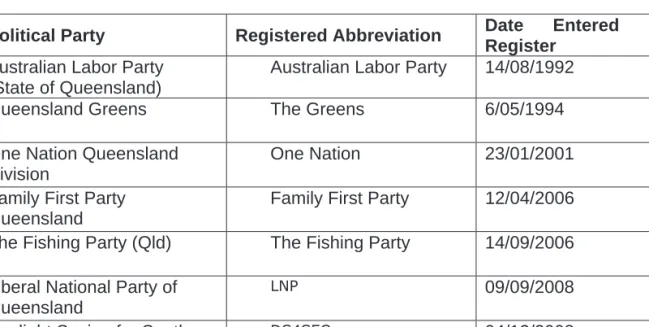
By the close of nominations at 12.00 noon on Tuesday 3 March 2009, a total of 397 candidate nominations had been lodged, compared with 329 candidates in 2006. All but one of the seven political parties registered for State electoral purposes contested the election.1 At the conclusion of counting the overall result2 was as follows:
Australian Labor Party 51 seats
LNP 34 seats
Independent 4 seats
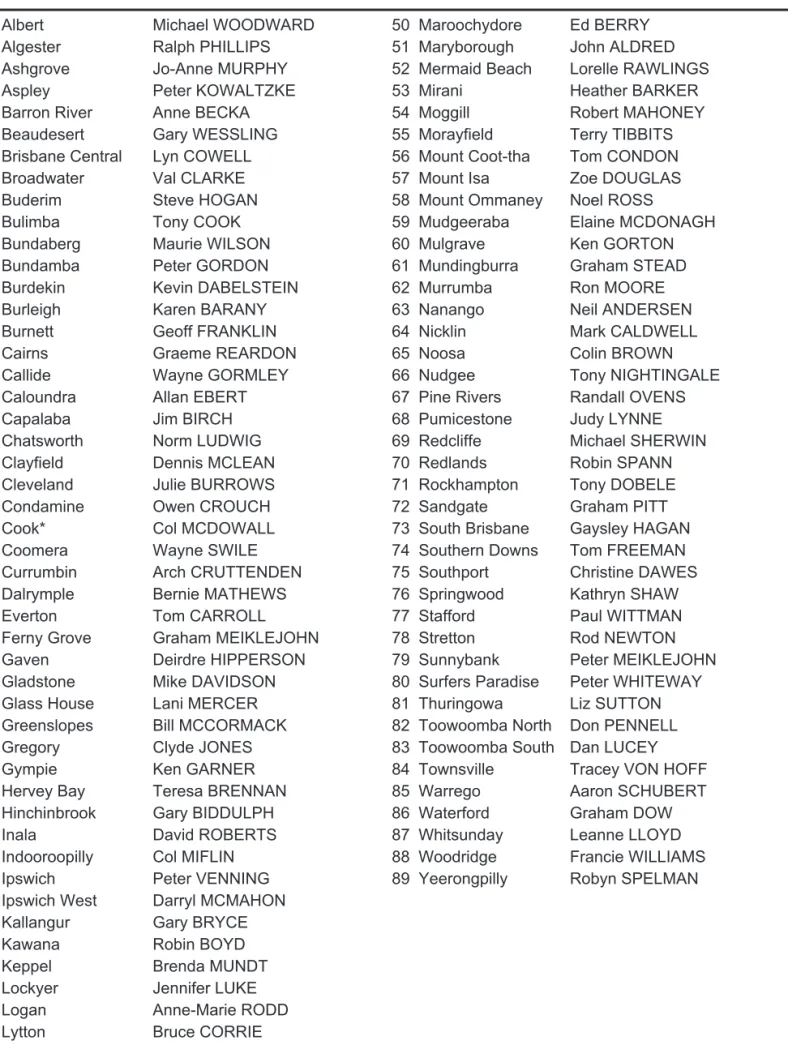
In the absence of fixed term elections, the planning and coordination of a State general election is a particularly complex challenge - a small agency with just over 30 full time staff responsible for coordinating the biggest single event held in Queensland every three years. The period in between general elections is therefore critical, allowing the Commission to upgrade and test its election systems and procedures, as well as training staff such as Returning Officers in readiness for the next event. In the lead up to 2009, the time available for planning and development was restricted by the Commission’s responsibility for conducting other major events such as the 2008 City of Brisbane elections, the 2008 Quadrennial Local Government elections (the first time the Commission was given this responsibility) and redistributions for both the Queensland Parliament and the Brisbane City Council. Despite the limited lead time, feedback to the Commission indicates that the overall conduct of the election was a resounding success.
Evaluation of the Commission’s election performance was undertaken in two ways. The first encompassed systematic surveys to measure levels of satisfaction among clients and stakeholders. These included voters, candidates, political parties and polling officials. A detailed analysis of client feedback can be found at part 4 of this report. The second was an internal evaluation process that reviewed the conduct of key operational areas and project management. It should be acknowledged that the second part of the evaluation was to some extent subjective. The Commission was nevertheless pleased with the effectiveness of recent enhancements to our election technology. A number of innovative systems and procedures were trialled to improve the experience of voters. These are reported on below.
It is no mean feat to conduct an event as major as a State general election (catering for over 2.6 million eligible voters), at such short notice and within such a tight timeframe. During the actual
1 The Fishing Party (Qld) did not contest this election.
FOREWORD
The Electoral Commission of Queensland is an independent body set up by the Queensland Parliament under the Electoral Act 1992. Its responsibilities include the conduct of State elections. The General Election held on 21 March 2009 was the seventh conducted by the Commission since its formation in 1991.
One of the Commission’s key responsibilities is to ensure public confidence in the integrity and impartiality of our electoral system. We also aim at each electoral event to maintain and improve ease of access to voting facilities for all electors. To measure its success in meeting these objectives, the Commission conducts a comprehensive evaluation of each general election and reports publicly on the outcome. This report is tabled in Parliament and further copies can be downloaded from the Commission’s website www.ecq.qld.gov.au
The writ for the 2009 Election was issued on Monday 23 February 2009, allowing an election period of 27 days. In accordance with section 80 of the Electoral Act, the cut-off day for the close of the Electoral Roll was Saturday 28 February 2009. A total of 2,660,940 eligible Queenslanders were enrolled at that point. 90.93% of enrolled electors, or 2,419,559 in total, actually voted at the election, compared with 90.47% participation at the 2006 Election.
By the close of nominations at 12.00 noon on Tuesday 3 March 2009, a total of 397 candidate nominations had been lodged, compared with 329 candidates in 2006. All but one of the seven political parties registered for State electoral purposes contested the election.1 At the conclusion of counting the overall result2 was as follows:
Australian Labor Party 51 seats
LNP 34 seats
Independent 4 seats
In the absence of fixed term elections, the planning and coordination of a State general election is a particularly complex challenge - a small agency with just over 30 full time staff responsible for coordinating the biggest single event held in Queensland every three years. The period in between general elections is therefore critical, allowing the Commission to upgrade and test its election systems and procedures, as well as training staff such as Returning Officers in readiness for the next event. In the lead up to 2009, the time available for planning and development was restricted by the Commission’s responsibility for conducting other major events such as the 2008 City of Brisbane elections, the 2008 Quadrennial Local Government elections (the first time the Commission was given this responsibility) and redistributions for both the Queensland Parliament and the Brisbane City Council. Despite the limited lead time, feedback to the Commission indicates that the overall conduct of the election was a resounding success.
Evaluation of the Commission’s election performance was undertaken in two ways. The first encompassed systematic surveys to measure levels of satisfaction among clients and stakeholders. These included voters, candidates, political parties and polling officials. A detailed analysis of client feedback can be found at part 4 of this report. The second was an internal evaluation process that reviewed the conduct of key operational areas and project management. It should be acknowledged that the second part of the evaluation was to some extent subjective. The Commission was nevertheless pleased with the effectiveness of recent enhancements to our election technology. A number of innovative systems and procedures were trialled to improve the experience of voters. These are reported on below.
It is no mean feat to conduct an event as major as a State general election (catering for over 2.6 million eligible voters), at such short notice and within such a tight timeframe. During the actual
PART 1: INNOVATIONS
The Commission put in place a number of organisational and technological innovations for the 2009 State General Election, some of which had been trialled at the 2008 Quadrennial Local Government elections.
‘Office in a Box’
The Commission finds out that an election has been called at the same time as everyone else in the community. This late notice creates enormous difficulties in having offices in each electoral district (with the telecommunications infrastructure necessary to meet Returning Officers’ needs) up and running immediately. The only way that this could be managed in the past was to rent and equip offices well in advance, with unavoidable add on costs.
The development of the ‘Office in a Box’ has helped to address this problem. The system employs wireless technology to connect Returning Officers in regional and remote areas to the Commission’s central information systems. It consists of a networking device, notebook computers and multi function laser printers which, with the addition of mobile phones, provide Returning Officers with a portable, multi-functional office. The equipment is designed to be assembled by Returning Officers themselves, which enables it to be deployed rapidly. Linking the system to the Commission via a private network provides a high level of security, as well as allowing technical support to be provided directly from our head office. Associated costs are comparable to equivalent fixed line solutions. The value of this new concept is demonstrated by the high level of interest generated among our electoral counterparts elsewhere in Australia.
Hand held computers (PDA)
Absent voting has customarily taken much longer that ordinary voting, partly because of the time taken for polling officials to check each elector’s enrolment details. That has changed with the roll out, at all polling booths and pre-poll centres, of hand held computers equipped with an electronic copy of the State electoral roll. This equipment allows polling officials to verify an elector’s enrolment details quickly and easily and ensure the correct ballot paper is issued.
Computerised issue of ballot papers
Managing absent voting is particularly challenging at the All Districts booth in the heart of Brisbane, which at each election takes a large volume number of votes from all over Queensland, in the past with lengthy queues and polling officials busily trying to direct electors to the voting station for their particular electorate. For the 2009 State Election the Commission deployed lap top computers, each loaded with a full copy of the electoral roll and with its own printer attached. Electors were marked off the roll electronically and had their ballot paper issued, all within a matter of seconds (especially if they brought with them the tear off card from their voter’s letter, which was bar-coded to speed up the process). Instead of queuing at a particular point, electors could go to any voting station. This initiative was an outstanding success and the Commission will look to deploying this system in other busy inner-city areas in future.
Braille ballot papers
In the past, blind and vision impaired electors have been denied the right to a secret vote because they needed assistance when filling out the ballot paper. For the 2009 Election, the Commission made Braille ballot papers available to blind electors on request.
Candidate portal
The Electoral Act provides that, to be eligible to nominate, candidates must be on the Queensland Electoral Roll and must be nominated (in the case of endorsed candidates) by the registered officer of a political party or (for independent candidates) by six or more persons enrolled for that electoral district.
At previous elections, problems occurred when some candidates left it to the last minute to submit their nomination, only to find that there was a defect in their nomination. For 2009, the Commission established a ‘candidate portal’ on its website which enabled parties and candidates election period, the Commission expands significantly from its permanent complement of staff.
Returning Officers are employed in every one of the State’s 89 electoral districts, as well as a significant number of temporary staff at head office. Around 9000 polling officials are employed throughout Queensland just for election day. I would like to take this opportunity to thank as well as congratulate all of our staff for their outstanding efforts. I also extend my thanks to key stakeholders: CITEC for its expertise in the development of election information systems; the Australian Electoral Commission (AEC) for its assistance with the preparation of roll products for the election; Salmat for the scanning of certified lists and assistance with the preparation of other key products; McCall’s Public Relations and George Patterson for their expert assistance in media and advertising matters respectively; the Government Printer; political parties and candidates; and a range of other organisations for their co-operation and assistance.
The Commission prides itself on being a forward-looking organisation constantly on the lookout for ways that it can improve its level of service and will continue to look for innovative ways to improve service delivery at future elections. This evaluation will contribute to that ongoing improvement.
David Kerslake
PART 1: INNOVATIONS
The Commission put in place a number of organisational and technological innovations for the 2009 State General Election, some of which had been trialled at the 2008 Quadrennial Local Government elections.
‘Office in a Box’
The Commission finds out that an election has been called at the same time as everyone else in the community. This late notice creates enormous difficulties in having offices in each electoral district (with the telecommunications infrastructure necessary to meet Returning Officers’ needs) up and running immediately. The only way that this could be managed in the past was to rent and equip offices well in advance, with unavoidable add on costs.
The development of the ‘Office in a Box’ has helped to address this problem. The system employs wireless technology to connect Returning Officers in regional and remote areas to the Commission’s central information systems. It consists of a networking device, notebook computers and multi function laser printers which, with the addition of mobile phones, provide Returning Officers with a portable, multi-functional office. The equipment is designed to be assembled by Returning Officers themselves, which enables it to be deployed rapidly. Linking the system to the Commission via a private network provides a high level of security, as well as allowing technical support to be provided directly from our head office. Associated costs are comparable to equivalent fixed line solutions. The value of this new concept is demonstrated by the high level of interest generated among our electoral counterparts elsewhere in Australia.
Hand held computers (PDA)
Absent voting has customarily taken much longer that ordinary voting, partly because of the time taken for polling officials to check each elector’s enrolment details. That has changed with the roll out, at all polling booths and pre-poll centres, of hand held computers equipped with an electronic copy of the State electoral roll. This equipment allows polling officials to verify an elector’s enrolment details quickly and easily and ensure the correct ballot paper is issued.
Computerised issue of ballot papers
Managing absent voting is particularly challenging at the All Districts booth in the heart of Brisbane, which at each election takes a large volume number of votes from all over Queensland, in the past with lengthy queues and polling officials busily trying to direct electors to the voting station for their particular electorate. For the 2009 State Election the Commission deployed lap top computers, each loaded with a full copy of the electoral roll and with its own printer attached. Electors were marked off the roll electronically and had their ballot paper issued, all within a matter of seconds (especially if they brought with them the tear off card from their voter’s letter, which was bar-coded to speed up the process). Instead of queuing at a particular point, electors could go to any voting station. This initiative was an outstanding success and the Commission will look to deploying this system in other busy inner-city areas in future.
Braille ballot papers
In the past, blind and vision impaired electors have been denied the right to a secret vote because they needed assistance when filling out the ballot paper. For the 2009 Election, the Commission made Braille ballot papers available to blind electors on request.
Candidate portal
The Electoral Act provides that, to be eligible to nominate, candidates must be on the Queensland Electoral Roll and must be nominated (in the case of endorsed candidates) by the registered officer of a political party or (for independent candidates) by six or more persons enrolled for that electoral district.
election period, the Commission expands significantly from its permanent complement of staff. Returning Officers are employed in every one of the State’s 89 electoral districts, as well as a significant number of temporary staff at head office. Around 9000 polling officials are employed throughout Queensland just for election day. I would like to take this opportunity to thank as well as congratulate all of our staff for their outstanding efforts. I also extend my thanks to key stakeholders: CITEC for its expertise in the development of election information systems; the Australian Electoral Commission (AEC) for its assistance with the preparation of roll products for the election; Salmat for the scanning of certified lists and assistance with the preparation of other key products; McCall’s Public Relations and George Patterson for their expert assistance in media and advertising matters respectively; the Government Printer; political parties and candidates; and a range of other organisations for their co-operation and assistance.
The Commission prides itself on being a forward-looking organisation constantly on the lookout for ways that it can improve its level of service and will continue to look for innovative ways to improve service delivery at future elections. This evaluation will contribute to that ongoing improvement.
David Kerslake
PART 2: CONDUCT OF THE ELECTION
Election snapshot Electoral districts 89 Candidate nominations 397 Enrolled electors 2,660,940 Votes counted 2,419,559 Polling places: Polling Booths 1,700 Declared Institutions 569 Pre-Poll Centres 243Employed election staff 9,690
Cost:
Cost of election operations $14.25 million
Public funding for candidates and parties $3.6 million
Election timetable
The logistical challenges involved in successfully conducting a State general election are illustrated by the chain of critical events that needs to be put in place in order for an elector’s vote to be cast and counted.
The chain begins with a process of voter registration – every Australian citizen aged 18 or over is required to enrol to vote. Once the writ for the 2009 Election was issued, electors had a period of five days in which to enrol or to update their enrolment details. After the cut-off point (Saturday 28 February) the Commission had a period of 24 hours to prepare the roll in readiness for the onrush of elector enquiries. The Australian Electoral Commission provided invaluable assistance with this task.
Nominations for candidates closed on Tuesday 3 March. Unlike federal elections (where a 24 hour processing period is allowed after the close of nominations), at a State election the Commission’s Returning Officers are required to conduct the draw for ballot paper positions immediately.
Electors unable to attend a polling booth on election day have the option of voting beforehand at a pre-poll centre or can apply for a postal vote. Once the ballot paper draw is completed, the Commission is required to commence the printing and distribution of ballot papers immediately in readiness for pre-poll voting (which for this election commenced on Monday 9 March). Despatch of postal votes commenced on Wednesday 4 March.
Polling day for the 2009 Election was Saturday 21 March, 26 days after the issue of the writ. Although the elector’s involvement ceases at that point, electoral officials are required to continue counting votes for a period of 10 days after polling day to allow for the return of postal votes, as well as conducting a full preference count. Results in particular electorates often cannot be declared until the preference count is concluded. The result of the general election was formally communicated to the Governor on 7 April 2009, two weeks earlier than the deadline specified in the writ.
to fill in their nomination details online. This form still needed to be downloaded and signed (in accordance with legislative requirements) but enrolment details for candidates and nominators could be verified online beforehand to ensure that everything was in order.
Online applications for employment as a polling official
For the first time at a State election, prospective polling officials were able to register their interest online. The registration process enabled the provision of personal and contact details, a brief outline of election experience and details of work preferences. This process provided a fast and efficient registration process with offers of employment and appointment documentation sent and received via electronic email wherever possible. A total of 17,012 expressions of interest were received for the 9,943 positions offered at the election.
Centralised postal voting
The Commission established a Central Postal Vote Centre to handle the processing of postal vote applications. The centre was located at Woolloongabba and was responsible for the receipt and initial processing of all applications for postal voting material. Each application was entered into the Commission’s computerised system, electronically scanned to assist with the scrutiny process and electronically forwarded to the relevant Returning Officer who was responsible for issuing each vote locally.
The centralisation of the initial phase of the postal voting process was aimed at reducing the pressure placed on Returning Officers by the ever increasing rate of postal voting, allowing them more time for other important tasks. Returning Officers were no longer responsible for the actual processing of applications, while forwarding the processed application to them allowed ballot material to be despatched locally, as far as possible speeding up mail delivery. It should be noted that the effectiveness of any system the Commission adopts ultimately relies upon a number of variables: the overall number of applications and the number arriving at any particular time; the length of time before an elector actually applies; the prompt passing on of applications sent in the first instance to political parties; and the passage of mail particularly to and from remote parts of Queensland.
Facility for tracking the progress of postal vote applications
For the first time at any Queensland election, postal vote applicants with access to the internet were able to enter the Commission’s website and check on the progress of their application to ascertain when they could expect to receive their ballot material.
Public access to tally room
Given the importance of democracy being ‘seen’ in action, as well as the public investment in the cost of staging the event, the Commission decided to open the tally room to the public for the first time. Fortunately the Brisbane Convention and Exhibition Centre at Southbank was available on polling day (the absence of fixed term elections makes it impossible to book such a facility well in advance), providing a venue that was both secure and readily accessible to the public. The Commission was delighted with the public response, which added considerably to the atmosphere and ‘drama’ of the occasion, and we were particularly pleased to see the number of young people who attended with other members of their family. The Commission expresses its appreciation of the assistance provided by members of the media in letting the public know they were able to attend.
PART 2: CONDUCT OF THE ELECTION
Election snapshot Electoral districts 89 Candidate nominations 397 Enrolled electors 2,660,940 Votes counted 2,419,559 Polling places: Polling Booths 1,700 Declared Institutions 569 Pre-Poll Centres 243Employed election staff 9,690
Cost:
Cost of election operations $14.25 million
Public funding for candidates and parties $3.6 million
Election timetable
The logistical challenges involved in successfully conducting a State general election are illustrated by the chain of critical events that needs to be put in place in order for an elector’s vote to be cast and counted.
The chain begins with a process of voter registration – every Australian citizen aged 18 or over is required to enrol to vote. Once the writ for the 2009 Election was issued, electors had a period of five days in which to enrol or to update their enrolment details. After the cut-off point (Saturday 28 February) the Commission had a period of 24 hours to prepare the roll in readiness for the onrush of elector enquiries. The Australian Electoral Commission provided invaluable assistance with this task.
Nominations for candidates closed on Tuesday 3 March. Unlike federal elections (where a 24 hour processing period is allowed after the close of nominations), at a State election the Commission’s Returning Officers are required to conduct the draw for ballot paper positions immediately.
Electors unable to attend a polling booth on election day have the option of voting beforehand at a pre-poll centre or can apply for a postal vote. Once the ballot paper draw is completed, the Commission is required to commence the printing and distribution of ballot papers immediately in readiness for pre-poll voting (which for this election commenced on Monday 9 March). Despatch of postal votes commenced on Wednesday 4 March.
Polling day for the 2009 Election was Saturday 21 March, 26 days after the issue of the writ. Although the elector’s involvement ceases at that point, electoral officials are required to continue counting votes for a period of 10 days after polling day to allow for the return of postal votes, as well as conducting a full preference count. Results in particular electorates often cannot be declared until the preference count is concluded. The result of the general election was formally communicated to the Governor on 7 April 2009, two weeks earlier than the deadline specified in the writ.
to fill in their nomination details online. This form still needed to be downloaded and signed (in accordance with legislative requirements) but enrolment details for candidates and nominators could be verified online beforehand to ensure that everything was in order.
Online applications for employment as a polling official
For the first time at a State election, prospective polling officials were able to register their interest online. The registration process enabled the provision of personal and contact details, a brief outline of election experience and details of work preferences. This process provided a fast and efficient registration process with offers of employment and appointment documentation sent and received via electronic email wherever possible. A total of 17,012 expressions of interest were received for the 9,943 positions offered at the election.
Centralised postal voting
The Commission established a Central Postal Vote Centre to handle the processing of postal vote applications. The centre was located at Woolloongabba and was responsible for the receipt and initial processing of all applications for postal voting material. Each application was entered into the Commission’s computerised system, electronically scanned to assist with the scrutiny process and electronically forwarded to the relevant Returning Officer who was responsible for issuing each vote locally.
The centralisation of the initial phase of the postal voting process was aimed at reducing the pressure placed on Returning Officers by the ever increasing rate of postal voting, allowing them more time for other important tasks. Returning Officers were no longer responsible for the actual processing of applications, while forwarding the processed application to them allowed ballot material to be despatched locally, as far as possible speeding up mail delivery. It should be noted that the effectiveness of any system the Commission adopts ultimately relies upon a number of variables: the overall number of applications and the number arriving at any particular time; the length of time before an elector actually applies; the prompt passing on of applications sent in the first instance to political parties; and the passage of mail particularly to and from remote parts of Queensland.
Facility for tracking the progress of postal vote applications
For the first time at any Queensland election, postal vote applicants with access to the internet were able to enter the Commission’s website and check on the progress of their application to ascertain when they could expect to receive their ballot material.
Public access to tally room
Given the importance of democracy being ‘seen’ in action, as well as the public investment in the cost of staging the event, the Commission decided to open the tally room to the public for the first time. Fortunately the Brisbane Convention and Exhibition Centre at Southbank was available on polling day (the absence of fixed term elections makes it impossible to book such a facility well in advance), providing a venue that was both secure and readily accessible to the public. The Commission was delighted with the public response, which added considerably to the atmosphere and ‘drama’ of the occasion, and we were particularly pleased to see the number of young people who attended with other members of their family. The Commission expresses its appreciation of the assistance provided by members of the media in letting the public know they were able to attend.
Item Expenditure as at 30 June 2009
Final Anticipated Costs
Staff & Related Payments 6,116,928 6,119,500
Pre-poll Voting 325,130 325,130
Mobile Polling 19,917 19,917
Scanning Operations 162,917 162,917
Tally Room 257,041 257,041
City Hall Booth 33,170 33,170
Call Centre 455,199 455,199
Election Warehouse Operation 88,141 92,200
Finance & Payroll Process 196,268 196,268
Central Postal Vote Process 374,693 374,693
Returning Officer Offices 633,468 633,468
Media/Advertising Campaigns 2,559,785 2,559,785
Election Operating Costs 1,555,993 1,559,767
Printing 923,531 923,531
Courier Costs 394,200 394,200
Training 145,214 145,214
Estimated 2009 Election Costs 14,241,596 14,252,000
In addition to operational costs, the projected cost of public election funding for political parties and candidates is $3.6 million (based on public funding of $1.547 per vote).
Communications strategy
As in the 2006 Election, a letter was sent to each enrolled elector advising them of their obligation to vote, the district they were enrolled in, voting options and the location of polling booths in their area. The letter incorporated a small tear off slip with a unique number for each elector, making it quicker and easier to mark them off the electoral roll and issue the correct ballot paper. It continues to be well received and widely used by electors with 83% of electors surveyed reporting that they took the tear off slip with them to the polling booth and 85% confirming that they found the list of polling booths to be useful.
The Commission received a very small number of complaints criticising the use of the letter. Some questioned the expense. The letter is in fact cost effective, reducing the need for wider and more expensive media advertising. A small number of other electors advised that the polling official they dealt with did not ask for the slip. The Commission acknowledges that in some cases, approved procedures were not followed by polling officials, a difficulty that can arise when such a large number of staff are employed at relatively short notice. Notwithstanding these errors, the overall positive feedback from electors was very pleasing.
Dealing with elector enquiries
At each election the Commission receives a huge volume of enquiries from members of the public, typically wishing to check their enrolment details, voting options or the location of polling booths in their electoral district. For the 2006 Election the Commission’s call centre for handling such enquiries was located and managed in-house. In 2009 the decision was taken to outsource the operation, with the role of Commission staff confined to assisting with election-specific training of Key dates
Issue of Writ Monday 23 February 2009
Close of Roll 5:00 PM Saturday 28 February 2009
Close of Nominations 12:00 PM Tuesday 3 March 2009
Pre-Poll Voting - Declaration (Postal) Applications Start: Monday 23 February 2009 End: 6:00 PM Thursday 19 March 2009
Pre-Poll Voting - Electoral Visitor Applications Start: Monday 23 February 2009 End: 6:00 PM Thursday 19 March 2009
Pre-Poll Voting - Declaration (In Person) Start: Monday 9 March 2009
End: 6:00 PM Friday 20 March 2009
Pre-Poll Voting - Declaration (Postal) Voting Start: Wednesday 4 March 2009 End: 6:00 PM Saturday 21 March 2009
Pre-Poll Voting - Electoral Visitor Voting Start: Wednesday 4 March 2009 End: 6:00 PM Saturday 21 March 2009
Pre-Poll Voting - Declared Institution Start: Tuesday 10 March 2009
End: 6:00 PM Saturday 21 March 2009 Cut-Off for Lodgement of How-to-Vote Cards to be
distributed on Polling Day 5:00 PM Friday 13 March 2009
Cut off for postal vote applications 6.00 pm Thursday 19 March 2009
Polling Day 8:00 AM - 6:00 PM Saturday 21 March 2009
Cut-Off for Return of Postal Ballot Papers 6:00 PM Tuesday 31 March 2009
Deadline Return Writ Monday 20 April 2009
Actual Return of Writ Tuesday 7 April 2009
Election cost
The Commission is funded by the Queensland Government for conducting State elections. The overall cost of the 2009 Election was $14.25 million3, compared with a budget estimate of $13.4 million. The increased expenditure was mainly attributable to the increased cost of printing ballot papers, higher postage costs (due to a significant increase in the number of postal votes) and special arrangements for flood affected regions. These factors were beyond the Commission’s control. A full outline of the Commission’s election expenditure is set out in the following table.
Item Expenditure as at 30 June 2009
Final Anticipated Costs
Staff & Related Payments 6,116,928 6,119,500
Pre-poll Voting 325,130 325,130
Mobile Polling 19,917 19,917
Scanning Operations 162,917 162,917
Tally Room 257,041 257,041
City Hall Booth 33,170 33,170
Call Centre 455,199 455,199
Election Warehouse Operation 88,141 92,200
Finance & Payroll Process 196,268 196,268
Central Postal Vote Process 374,693 374,693
Returning Officer Offices 633,468 633,468
Media/Advertising Campaigns 2,559,785 2,559,785
Election Operating Costs 1,555,993 1,559,767
Printing 923,531 923,531
Courier Costs 394,200 394,200
Training 145,214 145,214
Estimated 2009 Election Costs 14,241,596 14,252,000
In addition to operational costs, the projected cost of public election funding for political parties and candidates is $3.6 million (based on public funding of $1.547 per vote).
Communications strategy
As in the 2006 Election, a letter was sent to each enrolled elector advising them of their obligation to vote, the district they were enrolled in, voting options and the location of polling booths in their area. The letter incorporated a small tear off slip with a unique number for each elector, making it quicker and easier to mark them off the electoral roll and issue the correct ballot paper. It continues to be well received and widely used by electors with 83% of electors surveyed reporting that they took the tear off slip with them to the polling booth and 85% confirming that they found the list of polling booths to be useful.
The Commission received a very small number of complaints criticising the use of the letter. Some questioned the expense. The letter is in fact cost effective, reducing the need for wider and more expensive media advertising. A small number of other electors advised that the polling official they dealt with did not ask for the slip. The Commission acknowledges that in some cases, approved procedures were not followed by polling officials, a difficulty that can arise when such a large number of staff are employed at relatively short notice. Notwithstanding these errors, the overall positive feedback from electors was very pleasing.
Dealing with elector enquiries
At each election the Commission receives a huge volume of enquiries from members of the public, typically wishing to check their enrolment details, voting options or the location of polling booths in their electoral district. For the 2006 Election the Commission’s call centre for handling such Key dates
Issue of Writ Monday 23 February 2009
Close of Roll 5:00 PM Saturday 28 February 2009
Close of Nominations 12:00 PM Tuesday 3 March 2009
Pre-Poll Voting - Declaration (Postal) Applications Start: Monday 23 February 2009 End: 6:00 PM Thursday 19 March 2009
Pre-Poll Voting - Electoral Visitor Applications Start: Monday 23 February 2009 End: 6:00 PM Thursday 19 March 2009
Pre-Poll Voting - Declaration (In Person) Start: Monday 9 March 2009
End: 6:00 PM Friday 20 March 2009
Pre-Poll Voting - Declaration (Postal) Voting Start: Wednesday 4 March 2009 End: 6:00 PM Saturday 21 March 2009
Pre-Poll Voting - Electoral Visitor Voting Start: Wednesday 4 March 2009 End: 6:00 PM Saturday 21 March 2009
Pre-Poll Voting - Declared Institution Start: Tuesday 10 March 2009
End: 6:00 PM Saturday 21 March 2009 Cut-Off for Lodgement of How-to-Vote Cards to be
distributed on Polling Day 5:00 PM Friday 13 March 2009
Cut off for postal vote applications 6.00 pm Thursday 19 March 2009
Polling Day 8:00 AM - 6:00 PM Saturday 21 March 2009
Cut-Off for Return of Postal Ballot Papers 6:00 PM Tuesday 31 March 2009
Deadline Return Writ Monday 20 April 2009
Actual Return of Writ Tuesday 7 April 2009
Election cost
The Commission is funded by the Queensland Government for conducting State elections. The overall cost of the 2009 Election was $14.25 million3, compared with a budget estimate of $13.4 million. The increased expenditure was mainly attributable to the increased cost of printing ballot papers, higher postage costs (due to a significant increase in the number of postal votes) and special arrangements for flood affected regions. These factors were beyond the Commission’s control. A full outline of the Commission’s election expenditure is set out in the following table.
level of efficiency and voter satisfaction. No adverse reports were received on the day about queues at polling booths and this was confirmed by the elector survey with only 4% of electors in this category reporting a wait of longer than 10 minutes to cast their vote. The manner of polling officials was also well reported, with 95% of those surveyed finding staff to be helpful, while an even higher number (99%) found the standard and location of their polling booth to be of a satisfactory or better standard.
Assistance with voting was available from polling staff for anyone who requested it, such as blind and vision impaired electors or people with writing difficulties. Magnifying sheets for vision impaired electors were provided in every polling booth. Electors were also entitled to be accompanied by an interpreter or to seek assistance from a friend or family member. One change that the Commission is considering for future elections is the translation of voting instructions into different languages on our website.
Declaration and other forms of voting
Electors were entitled to a pre-poll or postal vote if they:
were not going to be in their electoral district on election day;
would not be within eight kilometres of a polling place on election day; would be travelling under conditions that prevent voting at a polling booth;
were ill, pregnant or had a disability that would prevent their attendance at a polling booth on election day; or
were unable to attend a polling place because of their religious beliefs.
The Electoral Act provides that to be eligible for a pre-poll or postal vote, electors must make a declaration that they fall into one of the above categories. The Act also provides, however, that if an elector requests a declaration vote, the polling official must comply with the request. The Act clearly does not envisage polling official’s quizzing electors about their eligibility, nor would it be appropriate for them to do so. Not surprisingly, there has been a steady increase in declaration voting at recent elections. For example, in 2009 a total of over 530,000 votes were placed in declaration envelopes, compared with 400,000 in 2006 and only 330,000 at the 2004 General Election. This increase is not merely a reflection of the increase in Queensland’s population in that time. Rather, it is becoming increasingly apparent that many electors either cannot or prefer not to vote on election day. Pre-poll and postal voting in particular seem to have transformed into a form of early voting, with a three week rather than one day poll now being the reality. This begs the question whether the legislative requirements should be relaxed to reflect that reality.
Pre-polling
Of the total votes cast in this election, 6.23%, or 150,846 in total, were issued as pre-poll votes. This was a 70% increase on the 2006 General Election. A total of 243 pre-poll centres were established across Queensland to cater for early voting. These included Returning Officers’ offices, Q-Gap centres and Magistrates’ Courts.
Pre-poll voting is similar to election day voting in that the elector is required to physically attend a polling centre. It differs in one important respect. Before being issued with a ballot paper, the elector is required to fill out an envelope containing their personal particulars and declaring that they satisfy the legislative criteria for voting in this way.
Of those pre-poll voters who participated in the Commission’s elector survey, 99% reported that the ballot papers were easy to follow, 97% found the staff at the pre-poll centre to be helpful and 94% were satisfied with the location of the pre-poll voting facility.
One area where the Commission believes that pre-poll voting can be improved in future concerns the current requirement to make a declaration vote. The Commission can see no reason why the legislation does not allow electors who are casting a pre-poll vote in their own electoral district to do so as an ordinary vote.
enquiry officers and being available to assist with more complex enquiries when necessary. This approach proved to be an effective means of dealing with elector enquiries, while allowing the Commission’s permanent staff to concentrate on other election projects.
Although the volume of contacts with the call centre remains high, the number has diminished somewhat as electors increasingly turn to the internet for the information they seek. The number of calls dropped to around 79,000 during the 2009 election period, compared with approximately 100,000 for the 2008 Local Government elections, with the average handling time for each call being halved. By comparison, hits on our website increased substantially to almost 31 million during the 2009 election period. The number of hits on election night alone was over 5.3 million, compared with 2.9 million on election night for the 2008 Local Government elections.
The Commission’s website proved to be a particularly valuable source of information for the 20% of electors who found themselves in a different electoral district following the 2008 redistribution. The site contained a description and maps of the new boundaries, as well as a portal which allowed individual electors to check their current enrolment status. The website also contained:
the election timetable;
an explanation of Optional Preferential Voting;
Google maps showing polling booth locations (including disability access); information on alternative forms of voting;
information for prospective candidates; names of candidates;
employment opportunities; and election results.
The website was positively received by electors, with 97% of those surveyed rating it satisfactory or better.
Voting
The Electoral Act allows voting to take place in a number of different ways, depending upon the each elector’s particular circumstances – where they live, their state of health, whether they are working or travelling on election day, their religious beliefs, and so on.
The following table sets out the number and percentages of electors who voted in different categories.
Vote Category Count Total Votes (%)
Ordinary 1,867,047 77.16%
Postal and Unenrolled 180,293 7.45%
Pre-Poll in Person 150,846 6.23%
Absent 200,423 8.28%
Electoral Visit 2,365 0.10%
Declared Institution 18,585 0.77%
TOTAL VOTES 2,419,559
Voting at polling booths
A total of 1345 polling booths were in operation across Queensland on election day. Booths were open from 8.00 am until 6.00 pm. As shown in the above table, a total of 1,867,047 votes were cast on election day, or 77% of all votes cast.
A total of 2000 randomly selected voters were asked about their experience with voting at a polling booth. Five hundred and three responses were received, with overall feedback indicating a high
level of efficiency and voter satisfaction. No adverse reports were received on the day about queues at polling booths and this was confirmed by the elector survey with only 4% of electors in this category reporting a wait of longer than 10 minutes to cast their vote. The manner of polling officials was also well reported, with 95% of those surveyed finding staff to be helpful, while an even higher number (99%) found the standard and location of their polling booth to be of a satisfactory or better standard.
Assistance with voting was available from polling staff for anyone who requested it, such as blind and vision impaired electors or people with writing difficulties. Magnifying sheets for vision impaired electors were provided in every polling booth. Electors were also entitled to be accompanied by an interpreter or to seek assistance from a friend or family member. One change that the Commission is considering for future elections is the translation of voting instructions into different languages on our website.
Declaration and other forms of voting
Electors were entitled to a pre-poll or postal vote if they:
were not going to be in their electoral district on election day;
would not be within eight kilometres of a polling place on election day; would be travelling under conditions that prevent voting at a polling booth;
were ill, pregnant or had a disability that would prevent their attendance at a polling booth on election day; or
were unable to attend a polling place because of their religious beliefs.
The Electoral Act provides that to be eligible for a pre-poll or postal vote, electors must make a declaration that they fall into one of the above categories. The Act also provides, however, that if an elector requests a declaration vote, the polling official must comply with the request. The Act clearly does not envisage polling official’s quizzing electors about their eligibility, nor would it be appropriate for them to do so. Not surprisingly, there has been a steady increase in declaration voting at recent elections. For example, in 2009 a total of over 530,000 votes were placed in declaration envelopes, compared with 400,000 in 2006 and only 330,000 at the 2004 General Election. This increase is not merely a reflection of the increase in Queensland’s population in that time. Rather, it is becoming increasingly apparent that many electors either cannot or prefer not to vote on election day. Pre-poll and postal voting in particular seem to have transformed into a form of early voting, with a three week rather than one day poll now being the reality. This begs the question whether the legislative requirements should be relaxed to reflect that reality.
Pre-polling
Of the total votes cast in this election, 6.23%, or 150,846 in total, were issued as pre-poll votes. This was a 70% increase on the 2006 General Election. A total of 243 pre-poll centres were established across Queensland to cater for early voting. These included Returning Officers’ offices, Q-Gap centres and Magistrates’ Courts.
Pre-poll voting is similar to election day voting in that the elector is required to physically attend a polling centre. It differs in one important respect. Before being issued with a ballot paper, the elector is required to fill out an envelope containing their personal particulars and declaring that they satisfy the legislative criteria for voting in this way.
Of those pre-poll voters who participated in the Commission’s elector survey, 99% reported that the ballot papers were easy to follow, 97% found the staff at the pre-poll centre to be helpful and 94% were satisfied with the location of the pre-poll voting facility.
One area where the Commission believes that pre-poll voting can be improved in future concerns the current requirement to make a declaration vote. The Commission can see no reason why the enquiry officers and being available to assist with more complex enquiries when necessary. This
approach proved to be an effective means of dealing with elector enquiries, while allowing the Commission’s permanent staff to concentrate on other election projects.
Although the volume of contacts with the call centre remains high, the number has diminished somewhat as electors increasingly turn to the internet for the information they seek. The number of calls dropped to around 79,000 during the 2009 election period, compared with approximately 100,000 for the 2008 Local Government elections, with the average handling time for each call being halved. By comparison, hits on our website increased substantially to almost 31 million during the 2009 election period. The number of hits on election night alone was over 5.3 million, compared with 2.9 million on election night for the 2008 Local Government elections.
The Commission’s website proved to be a particularly valuable source of information for the 20% of electors who found themselves in a different electoral district following the 2008 redistribution. The site contained a description and maps of the new boundaries, as well as a portal which allowed individual electors to check their current enrolment status. The website also contained:
the election timetable;
an explanation of Optional Preferential Voting;
Google maps showing polling booth locations (including disability access); information on alternative forms of voting;
information for prospective candidates; names of candidates;
employment opportunities; and election results.
The website was positively received by electors, with 97% of those surveyed rating it satisfactory or better.
Voting
The Electoral Act allows voting to take place in a number of different ways, depending upon the each elector’s particular circumstances – where they live, their state of health, whether they are working or travelling on election day, their religious beliefs, and so on.
The following table sets out the number and percentages of electors who voted in different categories.
Vote Category Count Total Votes (%)
Ordinary 1,867,047 77.16%
Postal and Unenrolled 180,293 7.45%
Pre-Poll in Person 150,846 6.23%
Absent 200,423 8.28%
Electoral Visit 2,365 0.10%
Declared Institution 18,585 0.77%
TOTAL VOTES 2,419,559
Voting at polling booths
A total of 1345 polling booths were in operation across Queensland on election day. Booths were open from 8.00 am until 6.00 pm. As shown in the above table, a total of 1,867,047 votes were cast on election day, or 77% of all votes cast.
difficult, because of infirmity, to attend a polling booth on polling day. Electoral officials visit the institutions at a pre-arranged time leading up to 6.00pm on polling day and issue votes to electors. Other electors who, because of illness or disability, have difficulty attending a polling booth on polling day, may apply for an electoral visit vote. Electoral officials make arrangements to visit the elector’s residence before 6.00 pm on polling day so that the elector can cast a vote. In both cases, candidates are advised of the times and places where visits are to occur so that they have the opportunity to have scrutineers present when voting takes place.
For the 2009 Election 18,585 votes (0.77% of the total vote) were issued at declared institutions and a further 2365 electoral visitor votes (0.1%) were recorded.
Remote polling
Given the remoteness of parts of Queensland, the conduct of remote polling has always been a challenge. The Commission deploys a combination of aircraft, boats and four wheel drives to ensure that people in these areas are able to vote. For the 2009 Election polling officials visited 20 remote communities in the Torres Strait Islands and in the Gulf of Carpentaria, taking votes from 2268 electors. Mobile polling occurred as follows:
Monday 16 March 2009 St Pauls
Badu Island Dauan Island Stephen Island Hammond Island
Tuesday 17 March 2009 Boigu Island
Murray Island Saibai Island Coconut Island
Wednesday 18 March 2009 Kubin
Warraber Island Mabuiag Island Yam Island
Thursday 19 March 2009 Yorke Island
New Mapoon Darnley Island Seisia
Umagico
Friday 20 March 2009 Injinoo
To maximise awareness of the election and of visits by mobile teams, an advertisement was placed in the Torres News and special posters were distributed to communities. The Electoral Commissioner also conducted a number of interviews with Indigenous radio stations. For the first time, a message about the importance of electors having their say on polling day was translated into a number of Aboriginal languages and broadcast on specific community radio stations throughout Queensland.
As always, however, the most effective communication tool was the ‘bush telegraph’, with word soon getting out to members of each community once a mobile team arrived. In some communities polling was disrupted by torrential rain but with flexibility by both polling officials and electors, and the assistance of local councils and community members, mobile polling was able to be conducted successfully.
Rain and flooding was also an issue in areas of north Queensland where electors normally would opt to vote by post. In areas subject to extensive flooding, such as Normanton and Croydon, the Postal voting
The number of Postal Vote Applications increased by over 50% compared to the 2006 Election, largely as a result of assistance offered to electors by political parties through extensive mail-outs. Despite this increase, the Commission was successful in processing and despatching all applications received during the election period. As the volume of applications steadily increased throughout the election period, the Commission progressively increased staffing numbers at our processing centre to cope with the demand. The Commission has no control, however, over possible delays in delivery once applications are processed, or the fact that some electors leave it to the last minute to apply. Nevertheless, overall feedback from this category of electors was positive, with 97% of those surveyed indicating that they received ballot papers on time and 99% reporting that the ballot material was clear and easy to use.
There were a small number of complaints from political parties who were concerned that there may have been delays in the actual processing of applications. It is common for parties to mail postal vote applications to electors. Electors who choose to use this service return their applications to the party, which records them and passes them to the Commission for processing. The Commission agreed to provide each party with regular lists of processed applications. However, over 20,000 electors returned more than one application, for example responding to material from both major parties. Where this happened the Commission could obviously only process one application, which meant an elector’s name would end up on one party’s list of processed applications but be missing from the other’s. Without realising this, party officials began to contact the Commission to query why there had (apparently) been a delay in responding to applications they had forwarded to us, whereas in fact the applications had been processed promptly, some names were simply on another party’s list.
At any election, there is always a proportion of postal voters who leave it to the last minute to apply for a postal vote. The Electoral Act allows until close of business on the last Thursday before polling day to lodge applications, but obviously the only electors with any realistic likelihood at that stage of receiving their ballot material in time to vote are those with a post office box within the Brisbane CBD.4 The Commission has in the past sought an amendment to bring the cut-off point forward to the Wednesday prior to polling day and will continue to press for this change to occur. Special Postal Voters
The Commission maintains a Register of Special Postal Voters (silent voters or electors in remote areas) to whom ballot papers are sent automatically as soon as they are available. In a small number of cases in particular rural areas, material was delayed in the mail because of changes to official addresses. Six per cent of respondents in this category reported experiencing problems in this regard.
Should an official place name be changed, the official addresses on the electoral roll (managed by the AEC) are adjusted accordingly. This is the address to which ballot material must be sent (as required by the Act, unless the elector has registered a separate mailing address). In some cases this meant that mail containing ballot material was sent to the ‘official’ post office for an area, but this may not have been the post office nearest to the elector’s residence – hence the delays. (Apparently these changes can lead to initial delays in delivery of other types of mail as well.) Once the Commission became aware of the delays (through a media report) it immediately contacted Australia Post to arrange for voting material to be redirected. Although these instances were in no way the fault of the Commission, plans are in hand to meet with relevant organisations to discuss ways around such problems in future.
Declared Institutions and Electoral Visitor Voting
For electoral events the Commission arranges for certain institutions, such as nursing homes and aged care facilities, to be declared as mobile polling booths. Residents of these institutions find it
4 The Electoral Act requires that such ballot material must be completed, signed and witnessed prior to 6.00 pm on
difficult, because of infirmity, to attend a polling booth on polling day. Electoral officials visit the institutions at a pre-arranged time leading up to 6.00pm on polling day and issue votes to electors. Other electors who, because of illness or disability, have difficulty attending a polling booth on polling day, may apply for an electoral visit vote. Electoral officials make arrangements to visit the elector’s residence before 6.00 pm on polling day so that the elector can cast a vote. In both cases, candidates are advised of the times and places where visits are to occur so that they have the opportunity to have scrutineers present when voting takes place.
For the 2009 Election 18,585 votes (0.77% of the total vote) were issued at declared institutions and a further 2365 electoral visitor votes (0.1%) were recorded.
Remote polling
Given the remoteness of parts of Queensland, the conduct of remote polling has always been a challenge. The Commission deploys a combination of aircraft, boats and four wheel drives to ensure that people in these areas are able to vote. For the 2009 Election polling officials visited 20 remote communities in the Torres Strait Islands and in the Gulf of Carpentaria, taking votes from 2268 electors. Mobile polling occurred as follows:
Monday 16 March 2009 St Pauls
Badu Island Dauan Island Stephen Island Hammond Island
Tuesday 17 March 2009 Boigu Island
Murray Island Saibai Island Coconut Island
Wednesday 18 March 2009 Kubin
Warraber Island Mabuiag Island Yam Island
Thursday 19 March 2009 Yorke Island
New Mapoon Darnley Island Seisia
Umagico
Friday 20 March 2009 Injinoo
To maximise awareness of the election and of visits by mobile teams, an advertisement was placed in the Torres News and special posters were distributed to communities. The Electoral Commissioner also conducted a number of interviews with Indigenous radio stations. For the first time, a message about the importance of electors having their say on polling day was translated into a number of Aboriginal languages and broadcast on specific community radio stations throughout Queensland.
As always, however, the most effective communication tool was the ‘bush telegraph’, with word soon getting out to members of each community once a mobile team arrived. In some communities polling was disrupted by torrential rain but with flexibility by both polling officials and electors, and the assistance of local councils and community members, mobile polling was able to be conducted successfully.
Postal voting
The number of Postal Vote Applications increased by over 50% compared to the 2006 Election, largely as a result of assistance offered to electors by political parties through extensive mail-outs. Despite this increase, the Commission was successful in processing and despatching all applications received during the election period. As the volume of applications steadily increased throughout the election period, the Commission progressively increased staffing numbers at our processing centre to cope with the demand. The Commission has no control, however, over possible delays in delivery once applications are processed, or the fact that some electors leave it to the last minute to apply. Nevertheless, overall feedback from this category of electors was positive, with 97% of those surveyed indicating that they received ballot papers on time and 99% reporting that the ballot material was clear and easy to use.
There were a small number of complaints from political parties who were concerned that there may have been delays in the actual processing of applications. It is common for parties to mail postal vote applications to electors. Electors who choose to use this service return their applications to the party, which records them and passes them to the Commission for processing. The Commission agreed to provide each party with regular lists of processed applications. However, over 20,000 electors returned more than one application, for example responding to material from both major parties. Where this happened the Commission could obviously only process one application, which meant an elector’s name would end up on one party’s list of processed applications but be missing from the other’s. Without realising this, party officials began to contact the Commission to query why there had (apparently) been a delay in responding to applications they had forwarded to us, whereas in fact the applications had been processed promptly, some names were simply on another party’s list.
At any election, there is always a proportion of postal voters who leave it to the last minute to apply for a postal vote. The Electoral Act allows until close of business on the last Thursday before polling day to lodge applications, but obviously the only electors with any realistic likelihood at that stage of receiving their ballot material in time to vote are those with a post office box within the Brisbane CBD.4 The Commission has in the past sought an amendment to bring the cut-off point forward to the Wednesday prior to polling day and will continue to press for this change to occur. Special Postal Voters
The Commission maintains a Register of Special Postal Voters (silent voters or electors in remote areas) to whom ballot papers are sent automatically as soon as they are available. In a small number of cases in particular rural areas, material was delayed in the mail because of changes to official addresses. Six per cent of respondents in this category reported experiencing problems in this regard.
Should an official place name be changed, the official addresses on the electoral roll (managed by the AEC) are adjusted accordingly. This is the address to which ballot material must be sent (as required by the Act, unless the elector has registered a separate mailing address). In some cases this meant that mail containing ballot material was sent to the ‘official’ post office for an area, but this may not have been the post office nearest to the elector’s residence – hence the delays. (Apparently these changes can lead to initial delays in delivery of other types of mail as well.) Once the Commission became aware of the delays (through a media report) it immediately contacted Australia Post to arrange for voting material to be redirected. Although these instances were in no way the fault of the Commission, plans are in hand to meet with relevant organisations to discuss ways around such problems in future.
Declared Institutions and Electoral Visitor Voting
For electoral events the Commission arranges for certain institutions, such as nursing homes and aged care facilities, to be declared as mobile polling booths. Residents of these institutions find it