Business Service Management
Volume 2 - Service and Service Quality
17th May 2010
Established and supported under the Australian Government’s Cooperative Research Centres
Authors
Taizan Chan, Erwin Fielt, Guy Gable, Karen Stark Queensland University of Technology
Acknowledgment
We are very grateful to the comments and input to previous versions of this paper that we received from members of the CRC Smart Services Business Service Management project. In particular, we thank Paul Reedman (Suncorp), Rohit Shawarikar (Infosys), Paul York (Queensland Government) and Julien Vayssière (CRC Smart Services).
Disclaimer
This report is a deliverable for the Business Service Management project and contains references, comments and projections regarding the topic of “Service and Service Quality”. The recipient acknowledges that these references, comments and projects reflect assumptions by Smart Services CRC Pty Ltd concerning the future, which may or may not prove correct.
The Business Service Management Project team will produce a series of white papers on this topic. The Service and Service Quality White Paper is Volume Two in the series.
Smart Services CRC Pty Ltd and its respective directors and officers expressly disclaim any liability, representations or warranties express or implied contained in this report or any omissions from it. This disclaimer extends to any other information whether written or not, provided at any time to a partner, researcher or student by or on behalf of Smart Services CRC Pty Ltd.
All trademarks mentioned in this document are the property of their respective owners.
This work is licensed under the
Creative Commons Attribution-Noncommercial-No Derivative Works 2.5 Australia License. To view a copy of this license, visit
http://creativecommons.org/lice nses/by-nc-nd/2.5/au/
Smart Services CRC Pty Ltd Australian Technology Park Locomotive Workshop
Suite 9003, 2 Locomotive Street Eveleigh NSW, Australia 2015 www.smartservicescrc.com.au T: 61 2 8374 5080
P
ar
tners
Smart Services CRC Partners
Services economy
growth through innovation
Queensland University of Technology
Executive Summary
Managing service quality is of primary importance for organizations that are increasingly service oriented, and offering a growing range of services to external and internal customers. Managing service quality requires the capacity to measure service quality, concomitantly requiring explicit conceptions of ‘service’ and ‘service quality’. This white-paper explores three keys areas of service and service marketing literature: service definition and conceptualisation, service classifications, and service quality models, and make the following observations and proposals.
Proposal 1
While conceptualisation of services has its root in product marketing literature and hence began as a “non-product” market offering, focusing on characteristics such as Intangibility, Heterogeneity, Inseparability, and Perishability, contemporary definitions are focusing more on the interactive nature of services, and stressing more the interactive processes and capabilities of the service provider on one hand, and the experience, benefits, and notion of value-in-use to the service consumers on the other hand. We propose that these differing conceptions be abstracted into a single, related view of service as follows:
“A service is a (market) offering by one party (the provider) to create value for another party (customer) through interaction in a co-production process (with the consumer)”.
Proposal 2
There are complex and diverse perspectives on the purposes of, domains of, types of, and participants of services. This complexity will increase as boundaries between products and services become blurred, the role of ICT in providing and using services increases, the alternative channels and combinations of channels by which services are delivered multiply, and as more organisations (including those in traditionally product-based industries) rely on new and innovative services for revenue and profit growth. This complexity poses a dilemma: on one hand, the need for a generic service quality model that enables comparison and parsimonious management of quality of different services continues to increase as organisations strive to provide more and better services; on the other hand, the complexity also means that such a generic model may not be possible. If we strive for an abstraction that is independent of the complexities identified, we will end up with a model that is too simplistic. However, if we strive for a detailed measurement model that could cater to all the possible variations outlined, the model will be too complex for it to be pragmatically useful.
To mitigate the complexity identified, we propose that our scope of research into service quality be restricted to the consumer experience of business-to-consumer service encounters, over potentially multiple channels, with the purpose of seeking insights into how we can improve upon consumers’ satisfaction.
Proposal 3
Based on this scope, and building upon the existing conceptualisations of service quality in traditional services, electronic services, and multi-channelled services, we propose the following hierarchical model of service quality:
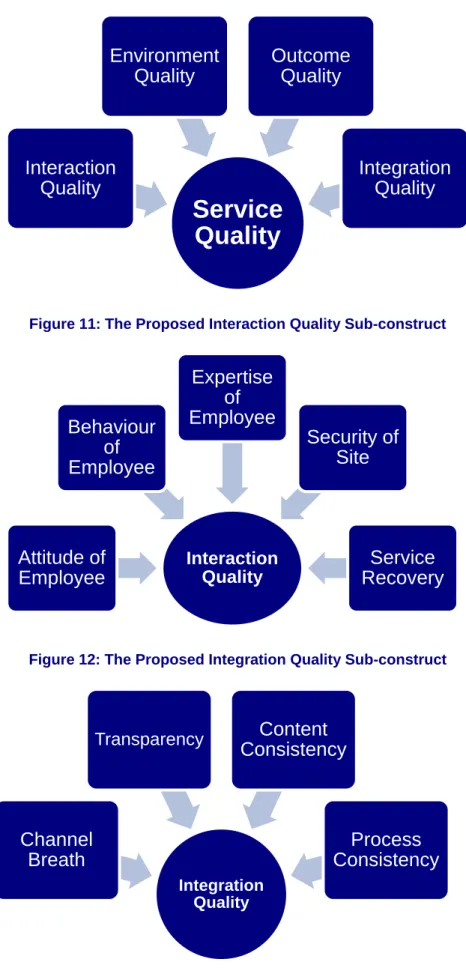
This model proposes that the quality of a multi-channel service as perceived by a consumer or customer comprises perception of four aspects of the service: interaction quality, which measures the quality of delivery of service by the provider, such as attitude, expertise, behaviour of employee (if the service involves employee interaction), and perceived security and service recovery quality (if the service is electronic); environment quality, which measures the quality of the environment in which the service is delivered, such as the design of the office or service counter or web site, ambient conditions(non-visual aspects such as temperature, music, etc), and social factors (which captures such aspects as the number and types of other people and their behaviour in the environment);outcome quality, which measures such aspects as waiting time, tangible evidence of the outcome, and valence which captures attributes (such as losing money in a casino) that control whether customers believe the service outcome is good or bad; and integration quality, which measures the cross-channel quality such as the breadth of channel offerings, transparency of these offerings, and consistency of content and process across the channels.
Service
Quality
Interaction
Quality
Environment
Quality
Outcome
Quality
Integration
Quality
Service Governance
Service Portfolio Management Service Capability Management Service Innovation
Management
Service Marketing and Sales
Service Retirement Service Ops &
Maintenance Service Implement Service Design Service Analysis Service Strategy Management
Introduction
Organisations rely increasingly on service differentiation for survival and growth. Even traditionally product-based organisations are turning to associated services for new sources of revenue (Allmendinger and Lombreglia, 2005). In this increasingly competitive service market, service quality has come to be recognised as a strategic source of competitive advantage; it is thus not surprising there has been extensive research into service quality. However, the conceptualisation and measurement of service quality continues to be hotly debated, particularly in the services marketing literature (Brady and Cronin, 2001; Pollack 2009). While there has been considerable progress as to how service quality perceptions should be measured; there is little agreement on what should be measured (Brady and Cronin, 2001).
Nevertheless, it is recognised, both by the smart services CRC and by the wider community, that a general conceptualisation of service quality is much needed for both academic and practical purposes. From the academic perspective, it would provide a common foundation upon which knowledge regarding services and service quality can be accumulated, compared, and extended. From the practice perspective, the lack of an agreed service quality model means various types of services continue to be measured idiosyncratically, on a type-by-type basis, thereby undermining confidence in each unique approach, impeding comparison of quality across services, thereby compromising potential for a common quality standard. A general service quality model could also inform and facilitate the management of service quality, one of the key enabling disciplines for effective management of business service life cycles (Rosemann, Fielt, Kohlborn, and Korthaus, 2009) as shown in Figure 1 below.
Figure 1: The Detailed Business Service Management Framework (Rosemann, Fielt, Kohlborn, and Korthaus, 2009)
Service Supplier Management Service Performance Management Service Compliance & Risk Service Customer Management Service Publishing
Service Quality Management
Service Master Data Management
Service Purchasing
This white paper begins to address the suggested gap, by first exploring the extant literature to understand the complexities impeding derivation of such a generic service quality model, and subsequently by suggesting a means of containing this complexity in order to enable us to propose a sufficiently general model of service quality. As the following discussion reveals, due to a lack of a unifying theory, the main difficulties stem from the different perspectives, purposes, participants, types, channels of delivery, and/or characteristics of services that underlie the various reported research. This white paper proposes that, to meet the needs of Smart Services CRC, we focus on the perception of the quality of multi-channelled services from a consumer’s perspective (with the underlying aim of improving consumers’ satisfaction).
The remainder of the paper proceeds as follows. The exploration begins with review of the literature on service definitions and conceptualisations. The review of service definitions highlights the different views defined by various perspectives and purposes, implicit and explicit, as embraced by the different researchers. Based on observations from the literature, and adopting recommendations made in more recent research, we next define the scope of our conceptualisation and attempt to arrive at a broad definition of a service that represents an integrated synthesis of these differing views. We then review literature on service classifications. The initial purpose of this review was to identify any existing, generic classification or ontology, that suggests possible core attributes of a general conceptualisation of service. We found, however, that just as there are myriad conceptualisations of services based on different perspectives and purposes, there are too a diversity of classifications that are based on different attributes of services. This paper selectively presents those more widely adopted classifications that highlight the complexities associated with any attempt to synthesize an all-purpose service definition and model. Review of service quality literature further reveals the richness and variety of models that have been developed to account for different service industries (retail, healthcare, banking etc), types of services (traditional, electronic, multi-channelled), and types of participants (business-to-business, consumer-to-business, consumer-to-consumer, etc). Using our proposed service definition as the scope of our service quality model, we propose an integrated service quality model. Finally, we conclude by highlighting the recommendations from this research and a proposed research agenda.
Service Definitions
In this section we discuss the definition of ‘service’, drawing mainly from the services marketing and operations literature, wherein service conceptualisation has received much attention (see Table 1 for representative samples). While service is also the object of research in many other disciplines, such as economics, management, engineering, information systems, and software engineering, to name a few, our review focus on these two disciplines as they have had a longer history in establishing general conceptualisations of service that are often technology-agnostics, a key defining characteristic of business services within the business service management research agenda of this work package. Service Marketing research has a long tradition. A ground-breaking article by Shostack (1977) argues that Service Marketing is an uncharted frontier, requiring new concepts to succeed. In particular she argues that “it is wrong to imply that services are just like products ‘except’ for intangibility”
(or offerings) consist of ‘combinations of discrete elements which are linked together in molecule-like wholes.’ This enables the definition of a market entity that can be partly tangible and partly intangible and does not neglect either aspect. It makes it possible to describe an array of market entities along a continuum from tangible to intangible being dominant. ‘The greater the weight of intangible elements in a market entity, the greater will be the divergence from product marketing in priorities and approach.’
Service as “Not-product” market offering
In the early days there was a strong need to differentiate services from products; to argue the need for Service Marketing as a separate discipline with its own body of knowledge. Early attempts to define the nature of the service act, seem to be either definitions by exclusion or by illustrative lists (Judd, 1964). Judd defined ‘marketed services’ saying: ‘Pending the development of a positive definition, some progress can be made by returning to the principle of definition by exclusion. Such a definition, limited to marketed services, is: “A market transaction by an enterprise or entrepreneur where the object of the market transaction is other than the transfer of ownership (and title, if any) of a tangible commodity.”’(Judd, 1964: 59) This resulted in a relentless pursuit of the characteristics that differentiate services from products. The most cited such service characteristics are Intangibility, Heterogeneity (or non-standardisation), Inseparability (of production and consumption), and Perishability (or exclusion from inventory) (Zeithaml, Parasuraman, & Berry, 1985), often referred to as IHIP. Of these characteristics, intangibility is often considered the most prominent, denoting that services are activities and not physical objects. However, Lovelock and Gummesson (2004) argue that intangibility is an ambiguous and limited concept, and that many services are directed at achieving tangible changes in customers themselves or their possessions.
The IHIP characteristics are often criticised because they are based upon what a service is not. The IHIP characteristics are often seen as a contra-view of service (e.g. as non-goods), overly emphasizing the view of the provider (Vargo & Lusch, 2004), and does not capture the essence of services; in particular their process and interactive nature (Edvardsson, Gustafsson, & Roos, 2005). Vargo and Lusch warn that such a perspective may point service management in the wrong direction, i.e. to make service provision more good-like. Moreover, Vargo and Lusch argue that many of these characteristics apply equally to goods as they do to services (e.g. the intangible benefits of goods can be more important than their tangible attributes) and can be used to make goods production more service-like. Edvardsson et al. (2005) suggest the need to differentiate those services for which each of the IHIP characteristics are relevant and situations where they are useful and fruitful. Broadly, instead of drawing a distinction between goods and services, it makes more sense to see the goods and services as the extremes of a goods-services continuum, as already suggested by Shostack (1977).
Service as Processes
Subsequent to IHIP, many new definitions that emphasise services as processes, and addressing the interactions between provider and customer and the role of the customer as co-producer appear. Grönroos (2006) defines service as ‘a process consisting of a series of more or less intangible activities, that normally, but not necessarily, take place in interactions between the customer and service employees and/or physical resources or goods and/or systems of the service provider, which are provided as solutions to customer problems.’ According to Grönroos (2006, p.319) ‘services
emerge in “open” processes where customers participate as co-producers and hence can be directly influenced by the progress of these processes;’ while, traditionally, ‘physical goods are produced in “closed” production processes where the customer only perceives the goods as outcomes of the process.’ This means that the consumption and production of services are at least partly simultaneous processes and that the customer at least partly enters the production sphere, and the service provider at least partly enters the consumption sphere (Grönroos, 2006). This perspective on service is not only wide-spread in Service Marketing; it is also the dominant perspective in Service Operations literature. Teboul (2006) differentiates between processes in the front-stage (service) where the interaction with the customer takes place, and processes in the back-stage (production). An organization is more a service organization when the relative share of the processes in the front-stage compared to the back-stage increases. A slightly different perspective comes from Sampson and Froehle (2006), who emphasize the role of customer inputs by stating that customers act as suppliers in a service production process. They see this as different from other forms of customer involvement such as selecting and consuming the output.
Services as Benefits
In the Grönroos (2006) definition of service, in addition to emphasizing the process, Grönroos also states that services are provided as solutions to customer problems; a value-generating service provides a solution to customer problems, irrespective of whether this solution is based on a physical product or not. Similarly, Johnston & Clark (2005) state that, from the customers’ perspective, service is the combination of the customers’ direct experience of the service process and their perception of the outcome of the service, i.e. the result of service delivery to the customer. These views address service as solutions, outcomes, benefits or value for the customer. Grönroos (2006) suggests a good enough core solution (a physical product, a service, or a combination of goods and services) is necessary to compete in the marketplace, but is not sufficient for a competitive advantage. This requires an enhanced offering consisting of physical product components, service components, information, personal attention and other elements of customer relationships. Grönroos labels this combination a ‘service offering’, even when the core solution is based on a physical product, because all elements of the offering are combined to provide a value-generating service for customers. Lusch and Vargo (2006) also refer in their definition to services being for ‘the benefit of another entity or the entity providing the service itself’. Moreover, they state that what matters is value-in-use or value created (and determined) at the moment of consumption, not value-in-exchange or value added to goods during the production process. Another benefit perspective is provided by Lovelock and Gummesson (2004), who present services as ‘offering benefits through access or temporary possession rather than ownership, with payments taking the form of rentals or access fees.’
Services as Resources/Capabilities
The ‘service as benefit’ perspective, discussed above, however, also implies that rather than exchanging products for products, actors exchange capabilities for capabilities (Vargo & Lusch, 2004). They stress the role of operant resources, i.e. resources employed to act on operand resources (and other operant resources) to produce effects, as opposed to operand resources, i.e. resources on which an operation or act is performed to produce an effect. They consider knowledge and skills as the ultimate operant resource. Related to this, Grönroos (2006, p.324) states that service is ‘a process where a set of resources interact with each other and with the customer aiming at supporting the
customer’s processes in a value-creating way.’ He stresses that services are value-supporting processes, unlike goods that are value-supporting resources. This has relevance to views on selecting and deploying resources in strategic management, as discussed in the resource-based view and the dynamic capabilities approach (e.g. Makadok, 2001). Services as the process of using one’s resources for the benefit of another entity or the entity itself, is the basis of the ‘Service-Dominant Logic’ of Vargo and Lusch (2004), who argue that organizations, markets, and society are fundamentally concerned with exchange of service. This implies that all firms are service firms; all markets are centred on the exchange of services, and all economies and societies are service based.
Service as Perspective
While Service Marketing literature has become increasingly prominent and voluminous, as evident from the preceding discussion, the research community has yet to achieve consensus on what ‘service’ means. It may transpire that the search for a generally accepted definition is to no avail. An extensive literature review by Edvardsson et al. (2005) suggests that service definitions are too narrow, and that cited characteristics are outdated as generic service characteristics. They conclude that at a general level, a service is better conceived as a ‘perspective’ on value creation, rather than a category of market offerings. They further suggest, that at lower levels of abstraction (or detail or specificity), a generic service definition is not possible, as these more specific conceptions are by definition more specific to a particular provider, a particular time, the particular service itself, and a particular perspective. Edvardsson et al. (2005) consider why definitions refer to either ‘services’ (plural) or ‘service’ (singular), and suggest that these have different meanings depending on whether ‘we view the definitions as an objective way of portraying services or as a way of constructing them in terms of value-creation.’ On the one hand, ‘services’ are seen as activities that are the object of exchange relating to something that can be offered to the customer. On the other hand, ‘service’ can be perceived as a perspective on value creation relating to the performance of the whole organization providing the customer with a good experience and outcome.
Conclusion
In this section we discussed different service definitions and their elements. Contemporary definitions seem to be moving away from the market offering definition and IHIP characteristics to the interactive nature of services, and stressing more the interactive processes and capabilities of the service provider on one hand, and the experience, benefits, and notion of value-in-use to the service consumers on the other hand. Based on the above observations, we propose that the differing conceptions be abstracted into a single, related view of service integrating the perspective of service as a marketing offering, interactions, processes, capabilities, and benefits, as follows:
A service is a (market) offering by one party (the provider) to create value for another party (customer) through interaction in a co-production process (with the consumer).
Figure 2: Proposed Service Conceptualisation
Consumer:
Value creation, interaction, experience, outcome
A Market Offering
Provider:
Processes, activities, capabilities
It is important to note that embodied within this definition is two perspectives of service: service is both (1) an offering, or a service concept, that specifies what is being offered to a potential customer, e.g. a banking service, a customer service at department store, etc; and (2) an encounter, or what happens, when service (provider) and consumer interacts, e.g. when a consumer makes a withdrawal at a bank or funds transfer through internet banking, or when a consumer returns an item at a department store. The first perspective, which will impact upon the purchase or engagement intention of the customer, embodies the potential value and benefit from a (potential) customer’s point of view, and the processes, activities, and the capabilities put in place by a provider to deliver that value or benefit. The second perspective, which has impact upon the re-purchase or re-engagement intention of the consumers, embodies the co-production interaction that bring the provider’s capabilities to bear, and put the processes and activities in action to provide an experience and an outcome that delivers value and provides satisfaction to the consumer of the service.
The first perspective has clear implications for other research within the business service management framework, particularly the service life-cycle management, service marketing and sales, service purchasing, and parts of service value management (such as service portfolio management and service innovation management) while the second perspective is important for research such as service quality management and service performance management.
Table 1: Salient Service Definitions from Service Marketing and Service Operations
SOURCE DEFINITION
SERVICE MARKETING
Zeithaml, Bitner & Gremler (2009)
Services are deeds, processes, and performances provided or coproduced by one entity or person for another entity or person.
Grönroos (2000, p.46) A service is a process consisting of a series of more or less intangible activities, that
normally, but not necessarily, take place in interactions between the customer and service employees and/or physical resources or goods and/or systems of the service provider, which are provided as solutions to customer problems. Lovelock & Wirtz
(2007, p.15)
Services are economic activities offered by one party to another, most commonly employing time-based performances to bring about desired results in recipients themselves or in objects or other assets for which purchasers have responsibility. In exchange for their money, time, and effort, service customers expect to obtain value from access to goods, labor, professional skills, facilities, networks, and systems; but they do not normally take ownership of any of the physical elements involved. Vargo & Lusch (2004)
Lusch & Vargo (2006)
Service [is] the application of specialized competences (knowledge and skills), through deeds, processes, and performances for the benefit of another entity or the entity itself.
SERVICE OPERATIONS
Johnston & Clark (2005) From the customers’ perspective, service is the combination of the customers’
experience and their perception of the outcome of the service. (OR Service is the combination of outcomes and experiences delivered to and receive by a customer.) The service experience is the customers’ direct experience of the service process and concerns the way the customer is dealt with by the service provider. The service outcome is the result for the customer of service delivery.
Fitzsimmons &
Fitzsimmons (2006, p.4)
A service is a time-perishable, intangible experience performed for a customer acting in the role of a co-producer.
Teboul (2006) Service is front stage. Delivering a service involves a contract, an interaction
between the service provider and the customer. Customers are an integral part of the service delivery as they are “transformed” or simply interact during the transaction.
Service Classifications
Cook, Goh and Chung (1999) believe that ‘no single definition of service is capable of encompassing the full diversity of services and the complex attributes that accompany them, a conclusion which is arrived at by many researchers. Zeithaml et al. (1985, p.43) suggest that ‘Diverse businesses, such as garbage collection, retail banking, and management consulting are often tied together under the heading of "services" in the literature, based on little more than a perception that they are intangible and do not manufacture anything. Such definitions inadequately identify managerial and operational implications common among, and unique to, services.’ Therefore, many authors have turned to typologies, taxonomies, or classification schemes to more fully address the complexities of services.’ Service classification schemes ‘identify key commonalities across seemingly disparate service businesses’ (Sampson & Froehle, 2006). The suitability of a classification scheme depends on its purpose. Most service classification schemes have been developed in the Marketing field (e.g. Lovelock, 1983) with a few from the field of operations management (Wemmerlöv, 1990), and may not be suitable in other contexts. Wemmerlöv (1990) contends that when considering a taxonomy ‘it is necessary to address the following four issues:
Purpose: ‘A taxonomy should structure a complex field of interest and facilitate its understanding. It can also be used as a decision-making device for design-related problems.’ (p. 24)
Level of Analysis (at which the taxonomy is to be applied): ‘The chosen level of analysis can vary depending on purpose. A classification scheme for organisations (macro level) is not likely to be applicable with the same relevance to individual work activities (micro level), and vice versa.’ (p. 24)
The categorising variables: The key dimensions used for distinguishing the different types of services.
Possibility of operationalising the variables: ‘If a taxonomy is to be more than just an aid to stimulate thinking, the variables it relies on should be measurable. ... However, if the intent with a taxonomy is to analyse and evaluate organisational design issues, the analyst is more interested in relative than absolute comparisons. Categorisation of processes can then be done based more on judgement than on objective measurement.’ (p.28)
A survey by Cook, Goh and Chung (1999) of four decades of service typologies found that different classification schemes have different levels of analysis, and even at the same level of analysis, may use differing set of categorising variables, because they are conceptualised for different purposes (some of which are discussed below). Below, we review some of the key classifications to highlight the range of purposes and categorising variables used in these classifications.
Some key traditional service classifications
Judd (1964) outlined three broad, yet mutually exclusive areas of services, within each of which a more detailed list might be developed. These three areas arise from: (1) the right to possess and use a product (Rented Goods Services) ; or (2) the custom creation of, repair, or improvement of a product (Owned Goods Services) ; or (3) no product elements but rather an experience or what might be termed experiential possession (Non-Goods Service).’
Chase (1981, p.698) holds that ‘the potential efficiency of a service system is a function of the degree of customer contact entailed in the creation of the service product’. Chase (1978, 1981) developed a contact based classification scheme for services. ‘For Chase, contact refers to the duration of a customer's presence in the service system. According to this scheme, hotels are high contact, "pure" services, while the postal service is low contact. Repair shops are medium contact services, lying in between the prior extremes’ (Schmenner, 1986, p.23). 'The strength of the customer contact based taxonomy suggested by Chase is that it, unlike most other taxonomies, is not merely descriptive. Attached to it is a normative ... set of guidelines to aid in the design and operation of service systems.’ (Wemmerlöv, 1990, p.22).
Mersha (1990) broadened the definition of customer contact to incorporate services provided without requiring the physical presence of the customer. A customer contact matrix was developed for classifying service systems using low and high levels of active vs passive contact (Figure 3). ‘Where contact is low, most of the tasks are performed in the back office, but where contact is high the customer is in direct contact with the service system through most of the service delivery process’ (Mersha, 1990, p.394). Active contact ‘involves direct customer-service interaction’ e.g. health care. Passive contact does not involve direct customer-service interaction’ e.g. riding a bus. A service is deemed as consisting of both active and passive contact elements, but varies according to the level of each type of these contacts. For example, an inpatient service has high active and high passive contact components because the patient requires both direct contact with the physician during consultation and indirect contact through the taking of medication and monitoring blood pressure that was prescribed during the consultation.
Figure 3: Customer contact (Mersha, 1990)
Passive contact A c ti ve c o nt ac t low high high
Health care centres
Psychiatric services
Dental services
Hospital inpatient care
Restaurants
Schools
low
Data processing
Catalogue merchandising
Home offices of banks &
insurance companies
Hotels/Motels
Public transportation
Lovelock (1983) believed that if classification schemes ‘are to have managerial value they must offer strategic insights’ (p.10). He classified services in order to aid their marketing efforts. His classifications were aimed at assisting managers to ‘obtain a better understanding of the nature of the service act, of the types of relationships their service organizations have with customers, of the room for customisation and judgement, of the factors underlying any sharp variations in demand and supply, and of the characteristics of their service delivery systems. This understanding should help them identify how these factors shape marketing problems and opportunities and thereby affect the nature of the marketing task. Second, by recognizing which characteristics their own service shares with other services, often in seemingly unrelated industries, managers will learn to look beyond their immediate competitors for new ideas as to how to resolve marketing problems that they share in common with firms in other service industries’ (p. 19).
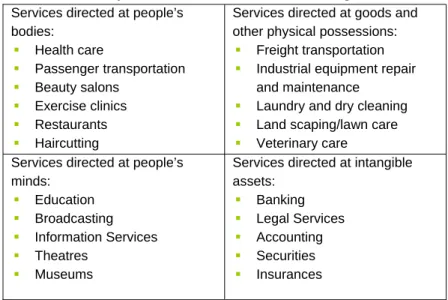
We next consider two of Lovelock’s classification schemes in more detail: the nature of the service act, and the type of customer relationship. For the nature of the service act, Lovelock identifies two fundamental dimensions: (a) at whom (or what) is the service act directed and (b) is the act tangible or intangible in nature? This results in a four-way classification scheme (Figure ) involving services directed at (1) people’s bodies, (2) people’s minds, (3) tangible assets and (4) intangible assets. This classification helps address questions like does the customer need to be physically present, does the customer need to be mentally present, and in what way is the target of the service act modified.
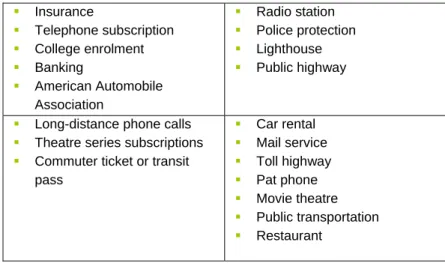
For the type of customer relationship, Lovelock identifies two fundamental issues: (a) how is the service delivered (discrete or continuous) and b) does this require a membership? This results in a four-way classification scheme (Figure). One of the major advantages of membership is that the service provider knows who its current customers are and, mostly, how they use the service. A major difference between continuous and discrete services is often in their pricing.
Figure 4: Nature of the service act (adapted from Lovelock, 1983)
Who or what is the direct recipient of the service?
People Things
What is the nature of the service act?
Tangible actions
Services directed at people’s bodies: Health care Passenger transportation Beauty salons Exercise clinics Restaurants Haircutting
Services directed at goods and other physical possessions:
Freight transportation
Industrial equipment repair
and maintenance
Laundry and dry cleaning
Land scaping/lawn care
Veterinary care
Intangible actions
Services directed at people’s minds: Education Broadcasting Information Services Theatres Museums
Services directed at intangible assets: Banking Legal Services Accounting Securities Insurances
Figure 5: Type of customer relationship (adapted from Lovelock, 1983)
Type of relationship between the service organisation and its customers?
‘Membership’ No formal relationship
Nature of service delivery? Continuous delivery of service Insurance Telephone subscription College enrolment Banking American Automobile Association Radio station Police protection Lighthouse Public highway Discrete transactions
Long-distance phone calls
Theatre series subscriptions
Commuter ticket or transit
pass Car rental Mail service Toll highway Pat phone Movie theatre Public transportation Restaurant
Shostack (1987) considered that ‘every service could be analysed according to its overall complexity and divergence’ (Figure ). A service’s complexity is determined by analysing the number and intricacy of the steps required to perform it. Divergence relates to the latitude for variability - a highly divergent service would be one in which virtually every performance of the process is unique while a service of low divergence would be one that is largely standardized. By viewing processes as the service equivalent of a product's "raw materials" services can be designed, managed, and changed for positioning purposes the way physical goods are.
Figure 6: Complexity and divergence (Shostack, 1987)
High complexity
Forensic–testing lab
Hospital Services
General practitioner: Diagnosis
& treatments
Specialist Treatment only
Diagnostic services only
Low divergence Retailer of orthopaedic supplies X-ray lab High divergence Medical counselling
Outpatient clinic: Limited
treatment, e.g. broken bones / minor burns only
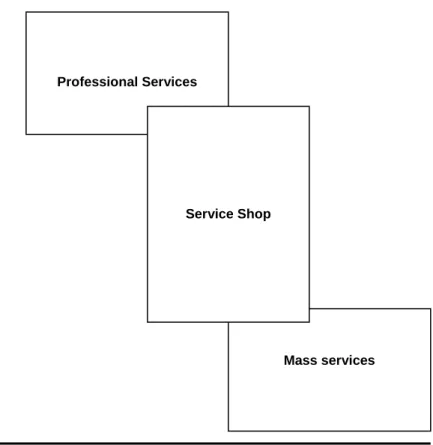
Silvestro, Fitzgerald, Johnston and Voss (1992) propose a model of service processes (Figure 7), which is analogous to the production process model in manufacturing operations. Silvestro et al. suggest that there are three types of service process: professional, mass, and service shop. Each service type is characterized in terms of six dimensions drawn from the service operations literature. Silvestro et al. state: ‘On the basis of evidence from a small sample of service organizations these dimensions appear to correlate with volume of customers processed per unit per day. Just as production volume is the unifying mechanism in the manufacturing process model, so it seems this volume measure can be used to integrate the previously disparate service typologies.’ (p.73) The definitions given for the three service archetypes are as follows:
Professional services: organizations with relatively few transactions, highly customized, process-oriented, with relatively long contact time, with most value added in the front office, where considerable judgement is applied in meeting customer needs’ (p.73)
‘Mass services: organizations where there are many customer transactions, involving limited contact time and little customization. The offering is predominantly product-oriented with most value being added in the back office and little judgement applied by the front office staff’ (p.73)
‘Service shops: a categorization which falls between professional and mass services with the levels of the classification dimensions falling between the other two extremes’ (p.73)
Figure 7: Service process model (Silvestro et al., 1992)
People Contact time Customisation Discretion Front-office Process High People/equipment Contact time Customisation Discretion Front/back office Process/product Equipment Contact time Customisation Discretion Back-office Product Medium Low Professional Services Mass services Service Shop
A unified service classification scheme?
Looking across these different (traditional) classifications schemes as well as others, Cook et al. (1999) attempt to provide a unified framework that captures all the important purposes, and dimensions of the classification schemes found in the literature. They found that, in general, a classification scheme is designed to achieve one or more of the following purposes:
Definitional (e.g. Judd, 1964)
Services marketing (e.g. Lovelock, 1983; Shostack, 1977) Identify and quantify services (e.g. Kellogg & Chase, 1995) Service system efficiency (e.g. Mersha, 1990)
Strategy (e.g. Murphy & Enis, 1986; Shostack, 1977) Productivity
Goods/services classification Organizational design
Managerial issues (e.g. Schmenner, 1986) Formal marketing function
Predict consumer behaviour
Service design (e.g. Kellogg & Chase, 1995; Shostack, 1987; Wemmerlöv, 1990) Service quality (e.g. Grove & Fisk, 1983)
Consumerism
Analytic models of service (e.g. Karmarkar & Pitbladdo, 1995; Rust & Metters, 1996)
In addition, they provide a schematic representation of the various categorizing variables found in the literature (Figure 8). The number in the parenthesis beside each service dimension indicates its rank where a dimension’s rank is based on the frequency with which it has appeared in the sample of literature on which the study was based (e.g., customer contact, which is ranked number one, received the most attention in the literature).
While C are some not taken addition There is unified c rectified general c research services
Includi
With the new type services self-serv of electr Fed Ex), (e.g. Goo services, Fig Cook et al. (1 e key issues w n into accou , the scheme s a lack of a classification d with further conceptualis in progress and derive aing electro
e growing rol e of service. have emerge vice (Rowley onic services , (2) substitu ogle maps). T , and they alsgure 8: Unif
999) provide with this sch unt the newe e is still very an underlyin n. While the r research, th ation or clas of this work a purpose-dri
onic servi
le of ICT in Two commo ed: (1) electr y, 2006). Hof s: (1) comple utes for existiThese electro so have some ied Schema e a starting p heme. This sc er types of se y much simp ng ontology former issu he latter is a sification. N package is b iven classific
ces in ser
service prov on conceptua ronic service facker, Golds ements to ex ing offline se onic services e unique cha atic Represe point for a po cheme is bas ervices, such ly a list of d that integra ue is an issue a reflection o Nevertheless, build upon C cation of servrvice class
visioning and alizations of es as informa smith, Bridg isting offline ervices (e.g. A s have charac aracteristics o entation (Co otentially ge sed mainly on h as electron different cate ates these di e of datedne of the compl while outsid Cook’s work vice typologisification
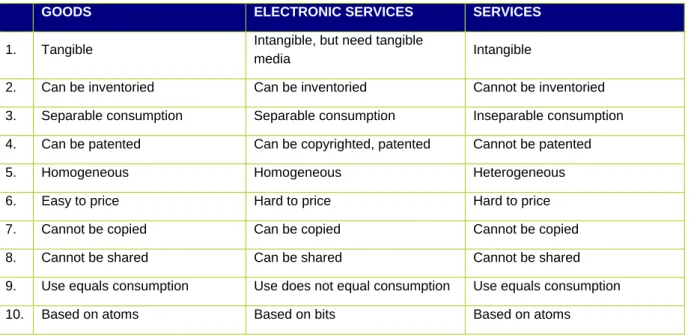
d usage, elect the technolo ation services es, & Swille e services an Amazon), an cteristics tha of their own ook et al., 19 eneric classif n traditional nic services ( egorising var ifferent dime ess of the res lexities unde de the scope and to incorp ies. tronic service ogy-mediated s and (2) elec y (2007) dist nd goods (e.g nd (3) unique at are found b (see Table 2 999) fication schem services and (discussed b riables or dim ensions into search, whic erlying any a of this white porate newer es have beco d nature of el ctronic servic tinguish thre g. parcel trackely new core both in goods 2). me; there d thus has elow). In mensions. a single ch can be attempt at e paper, a r types of ome a lectronic ces as ee types king for services s and
Table 2: Distinguishing electronic services (Hofacker et al., 2007)
GOODS ELECTRONIC SERVICES SERVICES
1. Tangible Intangible, but need tangible
media Intangible
2. Can be inventoried Can be inventoried Cannot be inventoried
3. Separable consumption Separable consumption Inseparable consumption
4. Can be patented Can be copyrighted, patented Cannot be patented
5. Homogeneous Homogeneous Heterogeneous
6. Easy to price Hard to price Hard to price
7. Cannot be copied Can be copied Cannot be copied
8. Cannot be shared Can be shared Cannot be shared
9. Use equals consumption Use does not equal consumption Use equals consumption
10. Based on atoms Based on bits Based on atoms
Summary
Just as the review of service definition and conceptualisation has revealed, there appears to be a lack of a common classification scheme that is widely adopted. There are many different perspectives adopted to make sense of the myriad service types, and these different perspectives often result in different dimensions used to distinguish services, resulting in starkly different classification schemes. As Cook et al. (1999) observed in their survey of 40 typologies and found that (up until that time) ‘most schemes have been developed and accepted on the basis of their intuitive appeal and have not been empirically tested’ (1999, p.323). Cook et al. believe that: ‘the fact that so few studies, attempting to empirically validate the proposed service typologies, have been conducted indicates this area of research is in its infancy’ (p.323). Shafti, van der Meer and Williams (2007) summarised critiques of existing classification schemes and conclude that they lack a cohesive framework, are hard to interpret, define the link between axes poorly, lose valuable information, fail to consider the whole service process, offer only limited clarification of complex issues, and lack a practical interpretation. This complexity will increase as boundaries between products and services become blurred, the role of ICT in providing and using services increases, the alternative channels and combinations of channels by which services are delivered multiply, and as more organisations (including those in traditionally product-based industries) rely on new and innovative services for revenue and profit growth.
This complexity poses a dilemma for our research: on one hand, the need for a generic service quality model that enables comparison and parsimonious management of quality of different services continues to increase as organisations strive to provide more and better services; on the other hand, the complexity also means that such a generic model may not be possible. If we strive for an abstraction that is independent of the complexities highlighted, we will end up with a model that is too simplistic. However, if we strive for a detailed measurement model that could cater to all the possible variations outlined, the model will be too complex for it to be pragmatically useful.
Service Quality
Based on our review above, we conclude that given the complexity, in both the number of dimensions by which one classifies services, and in the range of values associated with each dimension, there is no common best way to measure quality of all service types. Indeed, to mitigate this complexity, there is a need to decide first from whose perspective we are interested in measuring quality, and for what purpose. In addition, we will also need to decide what kind of services are to be covered by the quality model. We propose that our model of service quality be restricted to the following parameters:
Unit of analysis: A service encounter (in contrast to a service offering or a service industry) From the perspective of: Consumer (in contrast to the service provider)
Purpose: To provide insights into improving consumer’s satisfaction (in contrast to improving efficiency, strategic advantage, etc)
Participants: Business to consumer (in contrast to consumer to consumer or business to business)
Type of service: Services that can potentially be delivered across multiple channels (in contrast to purely traditional services or purely electronic services).
That is, we propose that our focus on service quality be on the consumer experience of business-to-consumer services, which could be delivered through a traditional channel, or electronic or multiple-channels, with the purpose of seeking insights into how we can improve upon consumers’ satisfaction.
Note that our focus on consumer does not exclude internal services that are provided internally to an employee. We believe such services account for a majority of service concerns and revenues, and are indeed the focus of investigations by the Smart Services CRC. Thus, our review of the service quality models and our proposal is made with this emphasis. To begin the development of such a model, however, we will need to first turn to the rich field of traditional service quality models.
Traditional Service Quality Models
Since the early 1980s’, there has been much research into understanding a key driver of service satisfaction—namely, service quality. The earliest attempts focused on measuring service quality without a broader conceptual framework, and are highly specific to the domains under study. Grönroos (1984, p. 36) in his publication, ‘A Service Quality Model and its Marketing Implications’, acknowledged the need for a singular definition of service quality, and outlined his proposed model termed the Nordic model (for its region of origin). The Nordic Model suggests that service quality as perceived by customers, consists of two dimensions, namely (1) functional quality (also called interaction quality) and (2) technical quality (outcome quality). Functional quality refers to the quality of the service delivery process, while technical quality measures the outcomes of the service (Gronroos, 1982, 1990).
At around the same time, Parasuraman, Zeithaml and Berry (1985) too published a paper which criticised the literature of the time for not providing a generalisable conceptual framework. This perceived lack was the motivation for their subsequent investigations and their SERVQUAL model (which was later classified as the North American model in contrast with the Nordic model). The current SERVQUAL model (the original model has undergone several modifications since its advent) measures the experience of customers of services on five dimensions of service encounter, namely, (1) tangibles, (2) reliability, (3) responsiveness, (4) assurance and (5) empathy (Parasuraman, Berry, & Zeithaml, 1988). Tangibles measures aspects such as physical facilities, equipment and appearance of employees involved in providing the service; reliability measures the employee’s ability to perform the promised service dependably and accurately; responsiveness measures the employee’s willingness to help customers and promptness of service; assurance measures the knowledge and courtesy of employees and their ability to inspire trust and confidence; and finally empathy measures the extent to which caring, individualised attention is provided to the consumer.
Both of the above models have received widespread support, although from two different groups of researchers (hence the term Nordic and North American schools of thought on Service Quality). Both too have been criticized; a main criticism being their use of the gap between expectation and experience as the basis for measuring service quality (there is little empirical support for the notion that customers judge service quality in terms of the gap between expectation and experience). The Nordic model too has been criticised for its lack of consideration for physical setting and environment (which SERVQUAL does); SERVQUAL for its lack of attention to outcome (which the Nordic model does).
A later three-component model by Rust and Oliver (1994) extended the Nordic model by including the third component - the service environment. While it has received some support, it has not been extensively cited in the literature.
More recently, Brady and Cronin (2001), employing a grounded instrument development approach, developed an integrated hierarchical model that incorporates the dimensions of both the Rust and Oliver (1994) model and the North American school model (at different levels in the hierarchy) (see Figure 9).
Figure 9: The Integrated, Hierarchical Model of Service Quality (Brady & Cronin, 2001)
*Note: R measure reliability, SP measures responsiveness, and E empathy. Attitude Behaviour Expertise Ambient
Conditions Design
Social Factors
Waiting
Time Tangibles Valence Interaction Quality Environment Quality Outcome Quality Service Quality R SP E R SP E R SP E R SP E R SP E R SP E R SP E R SP E R SP E
Brady and Cronin (2001) suggest that service quality may be made up of three different levels:
Level one: this level reflects the customers’ overall perceptions of service quality.
Level two: this level reflects the primary dimensions that consumers use to evaluate service quality. These dimensions correspond to the three components in the Rust and Oliver model.
Level three: this level identifies the sub-dimensions that make up the primary dimensions in the mode. These sub-dimensions correspond with dimensions from SERVQUAL and other related models. The three sub-dimensions that make up interaction quality are: attitude, which measures employee’s friendliness and willingness to help, behaviour, which measures actions taken by employees, while
expertise measures employee knowledge. The three sub-dimensions that make up the environment quality are: ambient conditions, which pertain to non-visual aspects such as temperature, scent, and music, design, which pertains to the layout or architecture of the environment, and social factors
which captures such aspect as the number and type of people evident in the setting as well as their behaviour. Lastly, the three sub-dimensions that make up the outcome quality are: waiting time, which measures the service punctuality, tangibles, which measure the tangible evidence of the outcome, and valence, which captures attributes that control whether customers believe the service outcome is good or bad, regardless of their evaluation of any other aspect of the experience (for example, losing money in a casino is a negative valence that will affect the gambler’s perception of service quality in the casino regardless of how well he was treated by the casino).
Level three: For each of the sub-dimensions, Brady and Cronin suggest that the three aspects (from the SERVQUAL model) of: reliability, responsiveness and empathy should be measured.
This model represents the most detailed and comprehensive accommodation of the dimensions consumers use when evaluating traditional service quality. Although it is relatively new, and thus has not been extensively tested (Pollack, 2009), we believe that the model, particularly the higher-level dimensions of the model (i.e. levels one and two), which also corresponds to the Rust and Oliver (1994) model, provides a good basis for a more general, abstract model of service quality that could also be extended for measuring electronic or internet-based services and mixed-channel services (see below). Appendix A-Traditional Services Quality Models - lists other selected general models of service quality, both prior and post Brady and Cronin (2001), that may use different terms for the same aspect of service quality (e.g. Input Quality vs Appearance vs Tangibles). However, a closer scrutiny suggests that Brady and Cronin’s model does capture many of these other dimensions, and does so in a conceptually parsimonious and comprehensive manner (Yap, 2009).
Electronic and Multi-Channel Services Quality Model
The internet boom has seen the convergence of electronic services (or ‘technology-based self-services’) and prompted research and discussion into their implications for service quality (Dabhokar, Bobbitt, & Lee, 2003, p.59). Whilst research and discussions on the impact of technology on service commenced prior to the year 2000, significant development and effort has been directed to the concept only in the past decade. Cox and Dale (2001, p.121) argue that the components of electronic service quality differ to those of traditional models and called for further research into the impact of this medium. Rowley (2006, p.342) too suggests there are distinct differences between the qualities of an electronic service provided as an information service or as a self-service. She suggests that e-service is part of a broader service delivery experience, stating that organisations are strategically utilising the concept of ‘multi-channelling’, for example through the use of the Internet, to enhance and support traditional marketing and sales channels (2006, p.346).
Many early models for evaluating electronic service tended to be based on traditional service quality models such as SERVQUAL, and the Nordic model (e.g. Lee & Lin, 2005; Zeithaml, 2002). This is not surprising as there are many parallels between a traditional and electronic service encounter. However, several more grounded attempts have also been made to determine a new e-service quality model. An example is the E-S-QUAL model developed by Parasuraman, Zeithaml and Malhotra (2005) (two of whom are co-authors of the original SERVQUAL model).
In addition to dimensions that are similar to the traditional service quality model (such as environment quality, albeit in the context of electronic services this pertains to the design and layout of the site, ease of navigation etc; and outcome quality) several “new” dimensions that appear to be important and unique to electronic services settings were proposed in the electronic service models (for details see Appendix B – Electronic Services Quality Models). The most salient of these are security and service recovery (the latter of which is later used in traditional services literature as well). Security covers such aspects as perceived freedom from danger, risk, or doubt during the service process (Madu & Madu, 2002; Santos, 2003). Service recovery is defined as the ability to restore consumer confidence after a failure or adverse service experience. Parasuraman et al. (2005) justified the importance of this aspect in electronic services based on the observation that consumers often did not experience any recovery, and hence were often unable to answer recovery related questions in the electronic service environment (p. 213). Collier and Bienstock (2006, p.264) further justified the importance of this aspect based on the principle that a prospective consumer can find an alternative online provider with minimal effort and hence the quality of recovery must be measured and managed to ensure consumer satisfaction and hence competitiveness. We believe that this is an important aspect of service quality, not just in the electronic service domain, but also particularly in an increasingly multi-channel service environment and hence should be included in a general service model (indeed this has been included in some traditional service model, such as Bai, et al. (2008)). However, we argue that from the perspective of the Brady and Cronin model, they fall under the interaction quality dimension, and in pure electronic services scenarios, could replace dimensions that pertain to behaviour and attitudes of employees.
As a consequence of increasing competitiveness in the service industry, coupled with the current generation’s demand for convenience and hence multiple alternative means to obtain services, services are increasingly being delivered via multiple channels (traditional face-to-face, web-based, terminals,
mobile devices, etc), either completely via a single channel or in combination. Sousa and Voss (2006) define multichannel services as, ‘a service composed of components - physical and/or virtual - that are delivered through two or more channels’ and argue that these two components must be clearly separated (2006, p.358).
Sousa and Voss (2006, p.359) suggest a multichannel service quality model must be comprised of three components; virtual (e.g. website), physical (people delivered-including logistics), and integration quality (seamless service experience across channels). The dimensions in the physical component are based mainly on the SERVQUAL and other traditional service quality models, while those in the virtual environment are based on the electronic services model (for details see APPENDIX C – Multichannel Service Quality Models). The dimensions under integration quality, such as breadth of channel choice, transparency of channel service configuration, content consistency across channels and process consistency across channels, are new and appear to well capture the cross/multiple channels aspect of service delivery.
A Proposed Service Quality Model
Our conceptualisation of service and review of service quality models suggests that the hierarchical model proposed by Brady and Cronin (2001), which builds upon and integrates earlier generic service quality model attempts, provides a sound conceptual foundation upon which we can develop our model. It comprises the major dimensions that align with our definition and scope of service: the interaction quality measures the interaction aspect of our service definition; the outcome quality addresses the benefit or value to consumers; while the environment quality measures the remaining aspects of consumers’ experience in a service encounter.
However, as reviewed earlier, the Brady and Cronin’s model was developed mainly with traditional services in mind and did not taken into account some of the quality aspects associated with electronic and multi-channelled services as identified by other researchers.
We thus propose a model of service quality that is adapted from the Brady and Cronin model; whereby we include an integration quality dimension alongside the interaction quality, outcome quality, and environment quality dimensions. This new dimension includes the four sub-dimensions as proposed by Sousa and Voss (2006): breadth of channel choice, transparency of channel service, content consistency and process consistency.
We also propose, however, that the actual dimensions used in a particular context will depend on whether the service in question is delivered over the traditional channel or multiple channels. If it is the former, then we exclude dimensions that pertain to the electronic channel (i.e. Integration Quality). Furthermore, the type of service for which quality is being measured, also influences the sub-dimensions to be included in the model. If the service is delivered only over the traditional channel, the sub-dimensions under interaction quality are those of the original model, i.e. attitude, behaviour and expertise. If the service is delivered entirely over electronic channel, we replace the behaviour and attitude sub-dimension with security/privacy and recovery sub-dimensions. If a service is delivered over multiple channels, then we include behaviour, attitudes, expertise, security, and recovery in the interaction quality dimension.
Figure 10: The Proposed Service Quality Construct
Figure 11: The Proposed Interaction Quality Sub-construct
Figure 12: The Proposed Integration Quality Sub-construct
Service
Quality
Interaction
Quality
Environment
Quality
Outcome
Quality
Integration
Quality
Interaction
Quality
Attitude of
Employee
Behaviour
of
Employee
Expertise
of
Employee
Security of
Site
Service
Recovery
Integration QualityChannel
Breath
Transparency
Content
Consistency
Process
Consistency
Contribution of the proposed model
The proposed model builds upon a strong conceptual foundation (Brady and Cronin, 2001), which itself is built upon both empirical data and earlier, more widely accepted general models of service quality. However, as discussed above, the Brady and Cronin’s model measures only quality of traditional service encounters. The pervasiveness of electronic and other channels as typified by the types of services offered by our industry partners suggest that this model will not be adequate as it does not take into account crucial aspects of a service that may be delivered over multiple channels. On the other hand, Sousa and Vess (2006) proposed a quality model that is designed explicitly for multi-channelled services. However, their focus is more specific to services that comprise at least one virtual component delivered through a virtual channel (e.g. online shopping), where the virtual component is the ordering of goods online and the physical component is the delivery of goods. That is, the multiple channels are complimentary in nature.
We recognise that traditional and multi-channelled services are two extremes of the various types of services that are of interest to the research community in general and our industry partners in particular. Many services, for example, could be delivered either exclusively via traditional channel or electronic channel (e.g. insurance claim, renewal of car registration etc). That is, the availability of the different alternative channels forms part of the market offering but not necessarily encounter as a consumer may choose a channel over the other. That is, the multiple channels are parallel in nature (Sousa and Vess, 2006).
To enable measurement, comparison, and consistent management of these different types of services, we need a model that is conceptually general by capturing the core aspects of the service types as defined by our scope and yet not exclude key elements that are unique to different service types. In that regard, our model makes the following conceptual contributions:
Our conceptualisation enables us to potentially measure encounter of services that are delivered over traditional channel only, or electronic channel only, or both (see the description above of which dimensions should be included or excluded depending on the channel through which a service is delivered). This implies that the service types covered by the model include traditional, purely electronic, multi-channelled or parallel-channelled.
Our conceptualisation enables comparison and benchmarking of service quality (the level-one dimension) across different service types as three of the four level-two dimensions in the model, which we believe will explain a large proportion of variability in service quality perception, are common across the different service types (interaction, environment, and outcome quality).
Our conceptualisation enables specific sub-dimensions to be included or excluded depending on the nature of service delivery and/or important aspects of a particular service offering that define that service (e.g. for an internal service delivery, the ambient condition sub-dimension may not be crucial but consistency is).
Conclusion
Our exploration of the extensive literature on service definitions, classification, and quality models suggest that a common model of service quality that is generic for all service types for all possible purposes may not be achievable. However, by identifying the underlying variables that make such a generalisation difficult if not impossible, and by constraining the scope of the conceptualisation by choosing what to focus on, we are able to propose a generic definition of service and the corresponding service quality model within that scope. We propose, based on our understanding of the Smart Services CRC that we adopt the following definition of service:
A service is a (market) offering by one party (the provider) to create value for another party (customer) through interaction in a co-production process (with the consumer).
In addition, we also recommend that the types of service that should be the target of the research are business to consumer services that could be multi-channelled (i.e. services that could be delivered via traditional channels, electronically, both, or in parallel), with the focus of service quality being on the consumer’s experience. With regard to this recommended scope, we propose a conceptualisation of service quality that comprises four dimensions: interaction quality, environment quality, outcome quality, and integration quality.
In order to progress this research and validate the conceptualisation, we propose the following research agenda:
Qualitative research, through focus-groups and open-ended questionnaires with consumers of services provided by our industry partners, to establish the initial validity of the quality dimensions proposed, and more importantly to establish the completeness through identifying additional dimensions that our current conceptualisation may have missed.
Development of a quality measurement instrument for gathering consumers’ perceptions of service quality that could serve to provide early indication of qualities of critical services that are of importance to the industry partners. The quantitative data will also be useful for further testing the validity of the dimensions proposed in the service quality model, and particularly the refinement of the quality model.
Further refinement of the model to provide better insights to enhancing satisfaction. By testing the service quality model construct as a driver of consumer satisfaction in a nomological net, we will be able to identify which key aspects of a service encounter impact consumer satisfaction the most, and make further refinement to the model to improve its predictability of consumer satisfaction.
The development of a software tool for semi-automatic collection of service quality data to build up a service quality database for benchmarking and comparisons (either across business units within an industry partner or across industry partners).
The development of a quality-driven service management framework. Our preliminary investigation suggests that existing service management framework may provide extensive guidelines, procedures, and processes detail for service management, the quality considerations in such frameworks are usually lacking or implicit. Our service quality model, once fully validated, will provide a solid foundation upon which quality factors can be included explicitly for improved customer satisfaction.