Chapter 5 from Multiliteracies in Motion: Current theory and practice edited by David Cole and David Pullen, Routledge, 2010 (pp141-159)
Chapter 5
Using the Principles of Multiliteracies to Inform Pedagogical Change.
Dr Geoff Bull and Dr Michèle Anstey Anstey & Bull Consultants in Education
NB Figures that do not appear in text appear at end of chapter.
Over the past decade two areas of educational theory, literacy and leadership, have focussed upon the issue of responding to rapid and significant change. The concept of Multiliteracies, first coined in 1996, arose from the concerns of a group of literacy educators about developing appropriate pedagogical responses for teaching literacy in a world undergoing significant economic, social and technological change. Soon after 1996 the literature on educational leadership began addressing the issue of assisting teachers to respond to the educational demands that resulted from such rapid change.
This chapter reports on the successful implementation of a professional development program that focused on Multiliteracies and produced pedagogical change at individual, year and school level. The program, implemented at primary and secondary level, embodied beliefs and principles from the literature on Multiliteracies and Educational Leadership. As it has been implemented in various educational sectors and systems at individual, regional and whole-school levels, it is now possible to draw conclusions about how implementation of professional development around a multiliterate pedagogy can produce successful long-term outcomes and contribute to school renewal.
The Multiliteracies Professional Development Program was based on a definition of Multiliteracies that includes a focus on pedagogy. Therefore the chapter will commence with a review of the relationship between
multiliteracies and pedagogy and the development of the term Multiliteracies since its origin in 1996.
Following this, the chapter will describe how the structure of the program evolved and the theoretical constructs that informed it. The program had three main foci:
1. Defining multiliteracies and identifying the participants’ current understandings and practices around it;
2. Developing strategies for analysing and changing participants’ individual classroom pedagogies, and,
3. Responding to and managing change as an individual and in the broader school context.
1. Defining and Understanding a Multiliterate Pedagogy
Our beliefs about quality literacy education derive from the concept of Multiliteracies (The New London Group, 1996; Cope and Kalantzis, 2000; Kalantzis and Cope, 2005; Anstey, 2002; Anstey and Bull, 2004; Bull and Anstey, 2005; Anstey and Bull, 2006). We construct Multiliteracies as a term that goes beyond the discipline area of English. It is essential to, and an integral part of, all disciplines from Science and Mathematics to the Arts. It is socio-culturally derived yet influenced by psychological factors. Literacy education addressed from a multiliteracies perspective concerns both literacy and pedagogy.
Too often literacy education becomes entrenched in debates about ‘Should it be about Literacy or English?’ and ‘What is the relationship between the two?’ These two questions are reminiscent of many similar debates we have had in literacy education, for example Whole Language or Genre approaches. The
Chapter 5 from Multiliteracies in Motion: Current theory and practice edited by David Cole and David Pullen, Routledge, 2010 (pp141-159)
veracity of these debates encourages teachers to take sides or ignore, rather than take responsibility for, moving literacy education forward through their teaching practices. A larger and more important question is ‘What is the pedagogy that informs better literacy education?’ If we accept that literacy education is about multiliteracies and the broader concept of curriculum rather than debating which discipline it ‘belongs in’ then we can focus on the pedagogy and how to do it better (Lingard, Hayes, Mills and Christie, 2003; Lingard, Hayes and Mills, 2003; Anstey and Bull, 2004; Edwards-Groves 2003; Anstey and Bull, 2003). We take the position that while being passionate about teaching literacy is important, being critically reflective and knowledgeable about pedagogy and practice is essential. As we have worked with many teachers through the ‘research in context’ approach that is embodied in the various Multiliteracies Projects that we have jointly developed, it has been continually demonstrated that the link between multiliteracies and pedagogy is very strong. In these projects, we (as facilitators of the process) and teachers (as the action learners) have come to realise that the literacy curriculum supplies the ‘what’ of the teaching and learning process and pedagogy supplies the ‘how’. In this way we have come to see literacy and pedagogy as co-dependent.
The bases of our ideas about the co-dependency of literacy and pedagogy go back over thirty years. The work of Bernstein (1973) who conceptualised formal education as realised through three message systems: curriculum (what counts as valid knowledge), pedagogy (what counts as valid transmission of knowledge) and evaluation (what counts as a valid realisation of this knowledge on the part of the taught) has assisted us to explore the relationship of learning and pedagogy. More recently the work of Lingard, Hayes, Mills and Christie (2003) and Lingard, Hayes and Mills (2003) further developed our ideas about the alignment of pedagogy and student learning during their research for the Queensland Schools Reform Longitudinal Study. In pointing
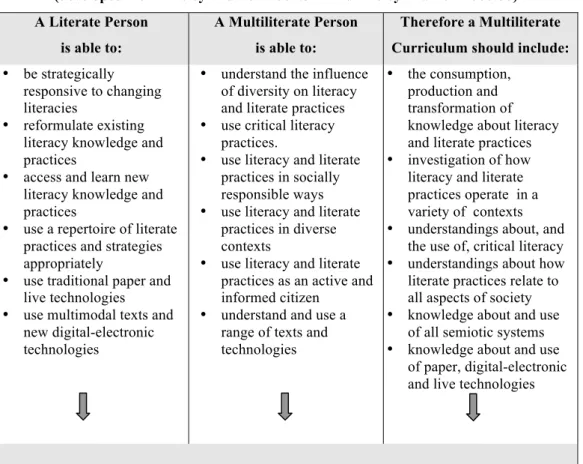
out that teachers’ talk about pedagogy should be at the core of the professional culture of schools Young (1998) has convinced us that schools must be learning communities where both teachers and students are engaged in learning through talk. We have summarised our position on the interrelation of literacy, multiliteracies and pedagogy in the following figure (Figure 5.1).
Chapter 5 from Multiliteracies in Motion: Current theory and practice edited by David Cole and David Pullen, Routledge, 2010 (pp141-159)
Figure 5.1: Identifying and Defining a Multiliterate Pedagogy (developed from Anstey and Bull 2004:314 and Anstey and Bull 2006:57) A Literate Person
is able to:
A Multiliterate Person is able to:
Therefore a Multiliterate Curriculum should include: • be strategically
responsive to changing literacies
• reformulate existing literacy knowledge and practices
• access and learn new
literacy knowledge and practices
• use a repertoire of literate
practices and strategies appropriately
• use traditional paper and
live technologies
• use multimodal texts and
new digital-electronic technologies
• understand the influence
of diversity on literacy and literate practices
• use critical literacy practices.
• use literacy and literate
practices in socially responsible ways
• use literacy and literate
practices in diverse contexts
• use literacy and literate
practices as an active and informed citizen
• understand and use a
range of texts and technologies
• the consumption,
production and transformation of knowledge about literacy and literate practices
• investigation of how
literacy and literate practices operate in a variety of contexts
• understandings about, and
the use of, critical literacy
• understandings about how
literate practices relate to all aspects of society
• knowledge about and use
of all semiotic systems
• knowledge about and use
of paper, digital-electronic and live technologies
Therefore the following Characteristics are desirable in a Multiliterate Pedagogy: 1. Characteristics of Classroom Interaction
• Match interaction to desired learning outcomes
• Use explicit talk that balances Informative, Process and Utility Functions • Use of accurate and consistent Metalanguage
• Model and practice Metacognitive Processes
• Balance the use of Initiation Response Feedback (IRF) Models, Substantive Conversation
and Classroom Narratives (oral and written) as ways of exploring and learning literacy and literate practices
2. Construction and Realisation of Literacy and Literate Practices through Pedagogy • Acknowledge that literacies and literate practices will continue to change
• Use of real and simulated contexts
• Use of authentic texts and tasks
• Learn and apply the literacies and literate practices of all disciplines • View literacy as a strategic problem-solving activity
• Engage in the consumption, production and transformation of knowledge about literacy
and literate practices
3. Expectations and Responsibilities
• The locus of control and responsibility between students and teachers changes with regard
to selection of content, and nature of participation
• Self regulation is expected and supported • Expectations and learning outcomes are specified
We have indicated what we believe are the characteristics of a literate and multiliterate person and how these characteristics determine a multiliterate curriculum. We have then used the relationships presented to derive what a multiliterate pedagogy might encompass. For us, the crucial feature of Figure 5.1 is that it represents the co-dependency of literacy, multiliteracy and pedagogy. It was on this basis that we designed the Multiliteracies Project in order to use the principles of multiliteracies to affect pedagogical change in classrooms.
2. Developing Strategies for affecting Pedagogical Change.
The Multiliteracies Project was designed with the aim of supporting teachers as they changed their professional practice. In order to achieve this, the Project was based on a number of beliefs that we felt would promote a focus on literacy and pedagogy and encourage pedagogical change in classrooms.
• Literacy education is as much about pedagogy as it is about literacy. • Successful professional development needs to be based on Action
Learning and encourage collegial and self-reflective conversations. • Validation of learning and change in practice and pedagogy is essential
to success.
• Change in practice and pedagogy requires knowledge of the change process.
• Literacy education is not advanced in a culture of blame but rather in one where there is an acceptance of responsibility.
Chapter 5 from Multiliteracies in Motion: Current theory and practice edited by David Cole and David Pullen, Routledge, 2010 (pp141-159)
Responding to and Managing Change
The five belief statements became the underlying tenets on which all the subsequent projects were based. We then used these beliefs to determine the goals of the project drawing on the work Fullan of (2001, 2002, 2004, 2005). From Fullan’s work we identified the concepts of capability, sustainability and thriveability to give direction to the Project and also provide a means of establishing whether it was succeeding. In the early stages of the Project the goal was to increase the capacity of individual teachers by developing their knowledge about literacy and their ability to change pedagogy in their classroom. In this way teachers would have increased capability. Sustainability was addressed firstly by encouraging teachers to implement the Project from an action research perspective that was designed to change existing pedagogy rather than add extra dimensions to an already crowded curriculum. Secondly, suggestions regarding creating and maintaining support for capability were made to school leadership and other teacher leaders. This was designed to create a whole-school focus that would lead to sustainability and resilience. The involvement of school leadership and a school-wide focus proved to be a key ingredient for promoting all three goals. Thriveability, or the potential to continue to grow and create new knowledge and further develop literacy education in the school was taken to be a measure of the success of a project. If a project continued to thrive beyond the initial action research project and led to further change in pedagogy in the classroom then the original project could be deemed successful.
Key features of the Multiliteracies Project
1. Duration of the project
Duration of the project was seen to be critical. The two authors share a strong belief that significant and lasting pedagogical change can only be attained over
time. The Project was therefore designed to run for a minimum of six months to a maximum of two to three years depending on the wishes of individual schools or networks. We believe that effective PD (and by this we mean Professional Development and Professional Dialogue) needs time to develop and flourish. This allows participants time to develop and trial ideas and approaches so that follow-up can become a feature of the process of change in pedagogy.
2. ‘Tailored’ Professional Development and Professional Dialogue
The conditions for Professional Dialogue require that teachers have a shared knowledge in a particular area of the curriculum – in this case multiliteracies and pedagogical change. For this reason the introduction to the Multiliteracies Project included a minimum of two days specific Professional Development based on jointly identified needs plus regular follow-up. We found that the relationship between professional dialogue and shared knowledge developed best when it was conducted around needs that had been identified by the teachers concerned. The on-going PD was therefore always specific to a particular project although each project had some commonalities with others. 3. Knowledge about Change Management
Because one of the main belief statements that drives the Multiliteracies Project involves change in pedagogy and practice there is an expectation that significant change will take place at the classroom and school level. We have found that this change is more likely to take place, and is less likely to produce undue anxiety, if teachers have knowledge of the change process and understand that there are some predictable reactions to the process that are experienced by many individuals. The highs and lows of the change process, and the periodic plateaus, are all part of normal development – and teachers need to appreciate this. For these reasons the research of Michael Fullan on working in a culture of change forms an important component of the Project.
Chapter 5 from Multiliteracies in Motion: Current theory and practice edited by David Cole and David Pullen, Routledge, 2010 (pp141-159)
4. Role of Leadership Team
The participation of the leadership team, including the principal, is particularly important to the success of the Multiliteracies Project. In our research into what makes an effective Project, a consistent finding has been that completion rates and satisfaction with the outcomes of the project are related to the participation of teacher leaders. Such participation is central to success within a particular school, and is a noticeable factor in distinguishing progress between schools when the project is run in a network of schools. When a network of schools participate in a project a special PD day is provided for teacher leaders to introduce them to the variety of changes that are likely to occur in their schools
5. Multiliteracies Matrix and Reflection Tool
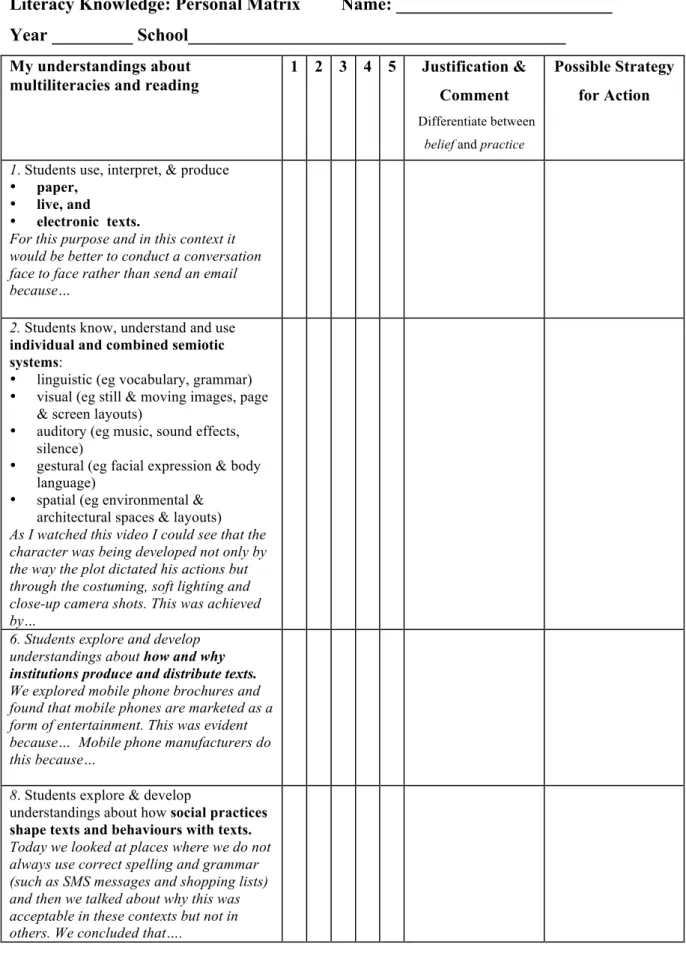
The authors designed the Multiliteracies Matrix (to be explored fully later in this chapter) specifically for use in the Multiliteracies Project. Participants engaged with the Matrix a number of times during a project depending on the purpose at the time. Initially, the Matrix was used to define the concept of multiliteracies through the twenty-four items that were contained in it. It was then used as a Self Reflection Tool for participants to reflect on their classroom pedagogy through the use of rating scales. Refection was also encouraged through the use of a Reflection Journal that was used as a daily diary to record ideas and as a record of professional reading around the topic under investigation. Finally participants selected items from the Matrix that were then transferred to an Action Plan to form the basis of on-going, classroom-based action research. Successful engagement with the Matrix depended on participants having a shared knowledge about multiliteracies that made the PD outlined (in 2 above) essential.
6. Action Plans
The Matrix proved very useful in assisting participants to develop their Action Plans and allowed them to self-select the area that they wanted to research. This enabled participants to begin their research at a level they were comfortable with and to proceed at a pace that was suitable for their level of expertise. Because participants were able to self-select their preferred area for research, it was quite common for teachers of different year levels to select the same area. This enabled participants to become aware of what was happening across the school. In some cases this meant that the primary section of the school was working closely with the secondary section. In all cases the project encouraged a whole-school approach to multiliteracies teaching and learning. From the outset the Action Plans were to focus on changing teacher practice and pedagogy rather than student behaviour. Participants were also required to collect evidence for all the changes that they identified had taken place in their classrooms. The teacher focus and the evidence-based focus on pedagogical change became a feature of the Multiliteracies Project.
7. Pedagogical Analyses
As part of implementing Action Plans, participants were required to audiotape a thirty-minute lesson and prepare a transcript. The transcripts were analysed to identify the different phases of lessons present and the types of teacher talk. (For further detail on this analysis see Anstey, 2003.) While this proved to be a time-consuming activity that caused some stress to participants, it was frequently identified as one of the most useful parts of the project in identifying features of pedagogy that needed to be changed. Many participants prepared a second or third transcript once they had identified the phase or phases of the lessons they wished to focus on. These later transcripts allowed comparisons about teacher talk or use of phases to be made over time.
Chapter 5 from Multiliteracies in Motion: Current theory and practice edited by David Cole and David Pullen, Routledge, 2010 (pp141-159)
8. Follow-up Support
Regular follow-up sessions were incorporated in the Project to allow for clarification and feedback to occur. Participants also used these sessions to negotiate modifications to Action Plans. These sessions were also used by the authors to re-focus participants on up-coming tasks and to meet identified needs as they arose. Participants found these sessions to be invaluable and often remarked that they provided the time and space for them to step back and reflect on their practice and the chance to talk with fellow teachers. Participants also had access to the authors through phone and email contact although this option was not taken up very often because face-to-face contact was preferred.
9. Validation Day
At the conclusion to the Project a Validation or Sharing Day was organised. Participants were asked to make a 15-20 minute oral presentation on a feature of their action research that they felt was noteworthy. These sessions were aimed at providing validation of their study through the evidence they had collected. These sessions proved to be a very powerful way of recognizing and sharing the progress that participants had made and were highly valued by the teachers.
10. Reports
At the conclusion of the Multiliteracies Project participants submitted an evidence-based written report on their Action Research. This report was initially used as the basis for their oral presentation on Validation Day. It fulfilled the objective of being a record of the progress and pedagogical change in a classroom. It also was a record of further questions to be explored that had arisen during the initial study. Participants then used these questions to embark on further Action Research. This proved to be a very common
response deriving from the written report and possibly accounts for the high levels of sustainability and thriveability present in schools that the authors have noted long after the completion of the various Multiliteracies Projects. The written report was also structured into sections so that it was in an appropriate form to submit to a university faculty as part of an independent study in an undergraduate or postgraduate degree program. A number of participants in the various Multiliteracies Projects have submitted their written reports to a university faculty and received credit for their research.
3. Tools specifically developed for the Multiliteracies Project The Multiliteracies Matrix
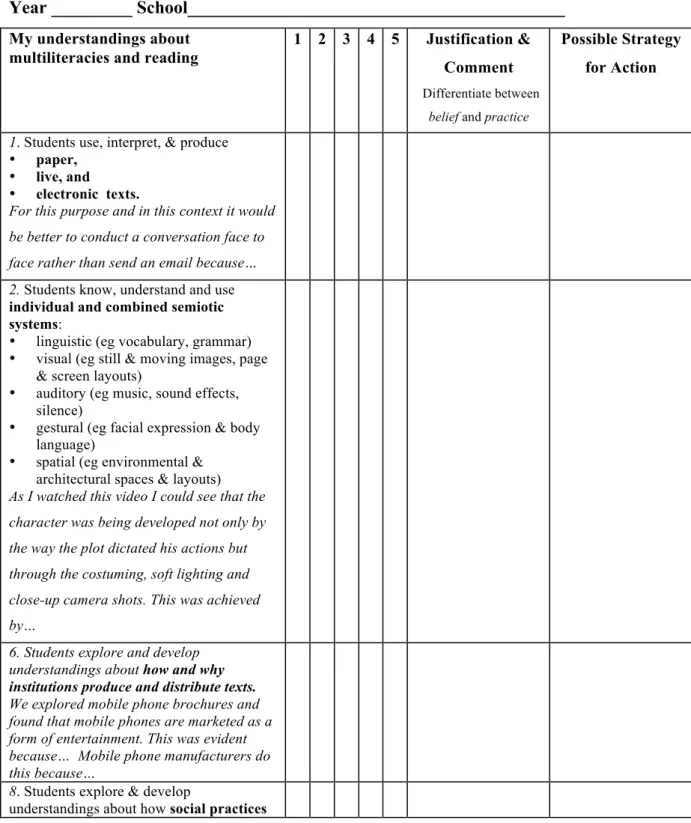
We developed two tools, the Multiliteracies Matrix and the Action Plan, specifically for the Multiliteracies projects. The Multiliteracies Matrix is a self-reflective tool of twenty-four items about Multiliteracies. It was designed to assist teachers in determining their current literacy knowledge and practice in the three domains of text, context and pedagogy. Teachers used a five point self-rating scale to rate their level of knowledge in each of the twenty-four items. They then had to justify the rating they had chosen and, where possible, propose a strategy for action. The Matrix was used at the beginning of the projects to identify the areas participants might need specific professional development and to stimulate professional conversation among participants. Teachers selected two or three items as goals for change and developed an Action Plan that specified the actions to be taken and data collection methods for validating change in their knowledge, pedagogy and practice. Action Plans were incorporated into their normal classroom program. Figure 5.2 below illustrates six of the twenty-four items from the Matrix – numbers 1, 2 and 6 from the Text Domain, 8 from the Context Domain and 13 and 14 from the Pedagogy Domain.
Chapter 5 from Multiliteracies in Motion: Current theory and practice edited by David Cole and David Pullen, Routledge, 2010 (pp141-159)
Figure 5.2: Sample Items from the Multiliteracies Matrix Reflection Tool
Literacy Knowledge: Personal Matrix Name: ________________________Year _________ School__________________________________________ My understandings about
multiliteracies and reading
1 2 3 4 5 Justification & Comment Differentiate between
belief and practice
Possible Strategy for Action
1. Students use, interpret, & produce
• paper, • live, and • electronic texts.
For this purpose and in this context it would be better to conduct a conversation face to face rather than send an email because…
2. Students know, understand and use
individual and combined semiotic systems:
• linguistic (eg vocabulary, grammar) • visual (eg still & moving images, page
& screen layouts)
• auditory (eg music, sound effects,
silence)
• gestural (eg facial expression & body
language)
• spatial (eg environmental &
architectural spaces & layouts)
As I watched this video I could see that the character was being developed not only by the way the plot dictated his actions but through the costuming, soft lighting and close-up camera shots. This was achieved by…
6. Students explore and develop understandings about how and why institutions produce and distribute texts.
We explored mobile phone brochures and found that mobile phones are marketed as a form of entertainment. This was evident because… Mobile phone manufacturers do this because…
8. Students explore & develop
understandings about how social practices shape texts and behaviours with texts. Today we looked at places where we do not always use correct spelling and grammar (such as SMS messages and shopping lists)
multiliteracies and reading
Comment Differentiate between
belief and practice
for Action
13. The class literacy learning and teaching program is informed by reference to the
Four Resource Model. There is not only a
balance between the four reading practices but the program clearly articulates what each practice looks like in different disciplines and year levels.
When I am planning I ensure that students are engaged in all four reading practices across all disciplines. I am also careful to select appropriate materials and teaching strategies for the reading practice I am focussing upon.
14. Teachers and students have a
metalanguage for exploring and talking about texts and their semiotic systems
When we discuss texts the students and I use the correct terminology, so for example we talk about technical codes, parallel cutting and close-ups when we deconstruct or construct moving images
Scale for Rating Personal Knowledge Planning and Practice. • This is a new concept to me and I have no understanding of it.
• I have some understanding of this concept but have not attempted to apply it in my
classroom planning and practice.
• I understand this concept and have begun exploring ways I can implement this as
part of my classroom planning and practice.
• I fully understand this concept and it is an important part of my classroom planning
and practice.
• This concept is fully embedded in my understanding and consistently implemented in my classroom planning and practice.
Chapter 5 from Multiliteracies in Motion: Current theory and practice edited by David Cole and David Pullen, Routledge, 2010 (pp141-159)
Each item in the Matrix contained a statement of a feature of a multiliterate classroom (e.g. Students use, interpret, and produce paper, live and electronic texts) followed by an italicised section that was meant to illustrate a possible response by a student if these features were present. This second (italicised) section was intended to focus participants’ attention on what students should be able to do if the feature of the classroom was operating successfully. When earlier versions of the Matrix did not contain this statement, participants tended to rate themselves highly on an item giving justifications like ‘I cover this in a number of lessons’. When the italicised statements were added then participants were more likely to say ‘Well I may have covered it but I don’t think the students would be able to say that’. By making these modifications we felt that teacher ratings were more realistic particularly when they had to justify their ratings in the third column of the Matrix. The important rider in the justification column was that the teacher statement had to reflect actual
practice rather than just a belief that something was important.
The Scale for Rating Personal Knowledge Planning and Practice section was included to provide further support to participants to complete the five-point rating scale. Each of the five statements contained two parts, the first part being a statement about teacher knowledge while the second part described teacher practice. Knowing about a particular item on the Matrix was not sufficient unless it was accompanied by actual classroom practice.
The Action Plan Proforma
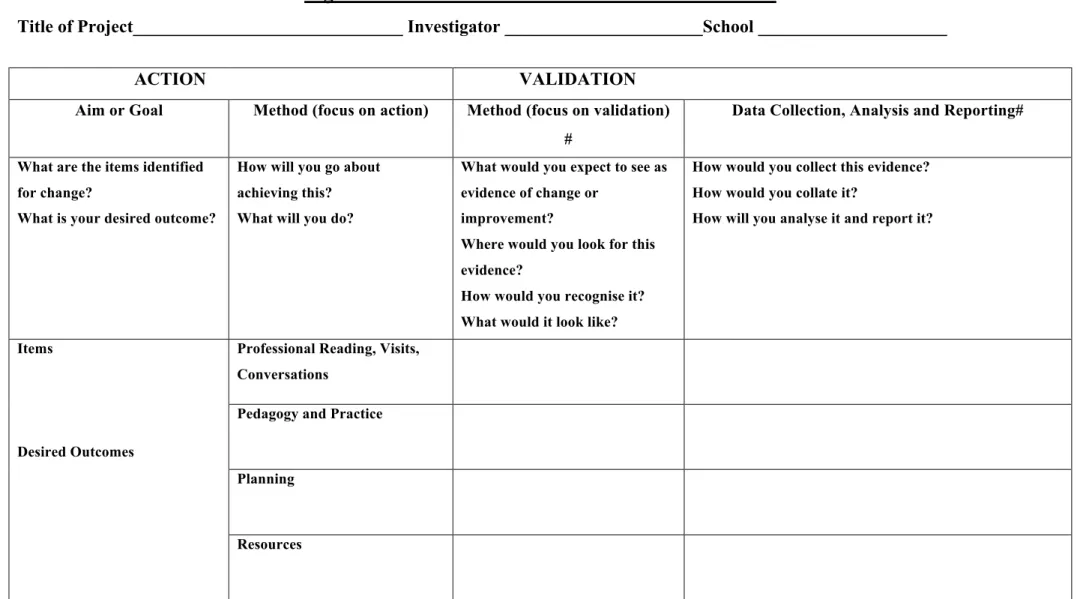
The Action Plan Proforma was developed to support teachers in planning toward the achievement of their personal goals. It provided a structure to assist teachers in identifying their goal, the actions to be taken and how they would collect data to measure change in their knowledge, pedagogy and practice. The focus on validating any action that they took as a result
of self-rating on the Matrix was a key component. The Proforma is illustrated in Figure 5.3 below.
Insert Figure 5.3 here
The Proforma is divided into two sections the first of which, comprising the first two columns, is focused on what action is to be taken in the Action Research (or Action Learning) Project and the second section, comprising the second two columns focuses on validating the action taken. Our approach to the use of the proforma was that for every action a teacher planned to take in the classroom there needed to be a corresponding validation. In each of the four columns there is a set of italicised questions that is meant to give direction to the project. Each of the participants was meant to take some action in professional reading, pedagogy and practice, planning and resources. The emphasis in the Action Research Projects was always on collecting evidence to validate any desired outcome and the focus was always on investigating the change in teacher pedagogy. The Action Research projects were therefore all about change in teacher behaviour rather than change in student behaviour (although the two are obviously related). Initially participants had some difficulty with this approach because their natural inclination was to focus on students. However the recording of a half hour lesson and the construction of a transcript reinforced the concept of pedagogical change and enabled participants to re-orient their approach. For the authors the crucial advantages brought about by the use of the proforma centred on evidence-based research and validation of change. The use of the proforma allowed participants to answer many questions about pedagogy and multiliteracies but also discover new questions to follow up in future projects.
Chapter 5 from Multiliteracies in Motion: Current theory and practice edited by David Cole and David Pullen, Routledge, 2010 (pp141-159)
Outcomes of Multiliteracies Projects
1. One of the positive features of the Multiliteracies Projects overall was the willingness of teachers to participate in the projects. All of the projects met their quota of participants and in a number of cases the entire school staff took part. There was a relatively low drop out rate among participating teachers although there was an expected attrition caused by teacher transfer and illness. When teachers did withdraw from a project we found that this was often related to participation by administrators or teacher leaders. Where participation rates for teacher leaders were high then completion rates for teachers were high. Conversely, when participation rates were low for teacher leaders, then completion rates for teachers tended to be lower. This trend was identified early in the first three Multiliteracies Projects and proved to be constant through all the projects.
2. Another key factor was the opportunities provided for teacher professional dialogue. Where a whole school staff, or a major proportion of the staff, participated in a project then there were many opportunities for professional talk among the participants. Such talk provided support for participants as they conducted their action research and learning projects. Where a project involved a network of schools, the feedback from teachers who were part of a group from a particular school reported that they derived crucial support throughout the project from their fellow participants by constantly talking about issues raised by the project. Where a participant was the sole teacher from a particular school, the feedback consistently mentioned the lack of opportunity to talk with colleagues back at the school. While the talk at shared sessions during the Multiliteracies Project was seen as a positive feature, the less formal, opportunistic talk back at school was seen as a great advantage. Similar
feedback was obtained from any participant who was the sole representative from a school. This trend indicated the necessity of provision for professional dialogue during professional development sessions.
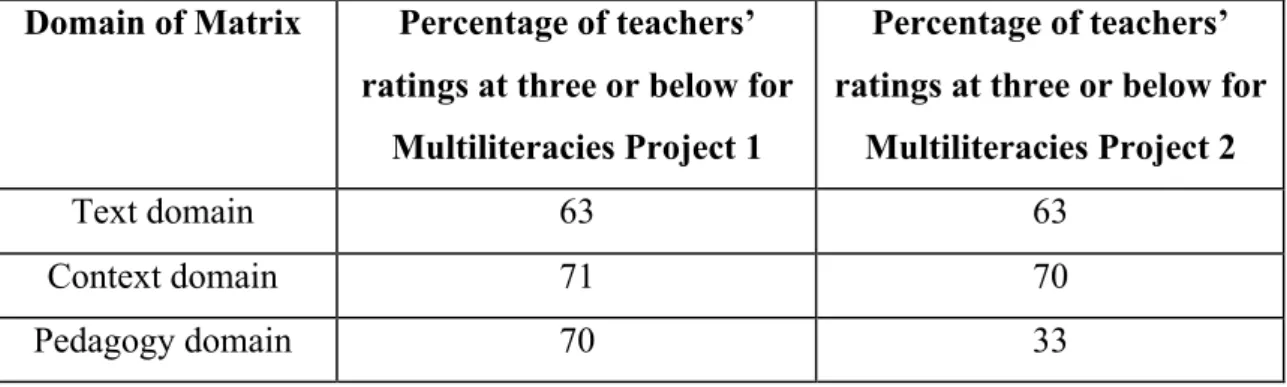
3. One of the methods that was used to test the effectiveness of the Multiliteracies Matrix was to compare the ratings that teachers gave themselves when rating their knowledge about, and implementation of, the twenty-four items about multiliteracies. Table 5.1 below shows a comparison of teacher self-ratings in two Multiliteracies Projects, one in an independent school and one in a government school.
Insert Table 5.1 here
Table 5.1 illustrates the consistency of the teachers’ self-ratings across education systems. While this comparison was not drawn for every Multiliteracies Project, a similar one was undertaken in a catholic school with similar results. Of further interest in Table 5.1 is the difference in the rating for the independent school in the Pedagogy Domain. The government school had entry to a large-scale, long-term, statewide professional development program that focused on literacy pedagogy that the independent school was not able to access. Interestingly the catholic school was able to take up the opportunity for the professional development and their self-ratings were at a similar level to the government school. We found it encouraging that the Matrix appeared to be consistent across schools and systems. The effectiveness of the professional development in raising teachers’ self-ratings may have been due to the long-term nature of the program.
Chapter 5 from Multiliteracies in Motion: Current theory and practice edited by David Cole and David Pullen, Routledge, 2010 (pp141-159)
4. Because of reasons of space it is not possible to provide examples of entire Action Plans prepared by the teachers. However the following extracts do illustrate the professional level at which the teachers were working. The extracts serve to illustrate the range of strategies teachers used to collect evidence-based data, the range of methods they used to validate change and what they judged to be appropriate evidence to indicate that change had taken place.
Extract 1: Method of collecting data
Invite a colleague into my classroom to give specific feedback on whether or not my planning is resulting in the practice of metacognition in my classroom. Identify how often I ask the students ‘how’ and ‘why’.
Reflection log – as I apply the different strategies, consider how effective I have found them in terms of achieving a reflective classroom. This will involve qualitative data from both my own evaluation/reflection as well as feedback from students.
Extract 2: Method of validating pedagogical change
Provide colleague/s with a feedback proforma to complete with some guided questions, some open feedback opportunities. If repeated several times over a period of time, I can use quantitative and qualitative data to analyse whether there is improvement evident in the explicitness of my talk / pedagogical strategies chosen.
Reflection log – allows me to consider my perceptions of the success or otherwise of different strategies for different purposes. Could tabulate findings across time and task, perhaps? Should be able to analyse student talk and questioning from transcripts and see an increase in invited and uninvited observations as to how a particular understanding could be reached
Extract 3: Use of evidence to indicate change in pedagogy
Excerpts of transcripts of three audiotaped lessons will be analysed for the language which I use, and encourage my students to use, at the commencement and conclusion of my lessons. It is envisaged that evidence of an increase in the metacognitive language use by my students and myself will be analysed in terms of the number of utterances that they constitute and this can be recorded over three lessons. This will be analysed in terms of a percentage of total utterances for those two phases. Where my professional reading has led to successful implementation of strategies and types of talk, will be referenced in my final written report.
5. The extracts from the Action Plans in 4 above give some idea of the goals that a range of participants aspired to at the beginning of a Multiliteracies Project. The following extracts are from the written reports that the participants submitted on Validation Day at the conclusion to the Project. The most pleasing features of these comments are that they are over-whelmingly positive and that they demonstrate that participants were able to achieve the goals they had set themselves. It is also interesting to note that while the Multiliteracies Projects require a considerable amount of work, the participants remain very positive and appear to have enjoyed the process of change. What is also of interest is that the participants have tended to identify the same elements of the projects as successful that the authors have regarded as the strengths of the project.
This project has been highly significant to my teaching practice. It has been an exhilarating experience for me as a professional. I found it valuable because of its sheer practicality and I feel that I have grown as a teacher in so many ways. The paradigm shift I have made as a result of taking part in this project has provided enormously enhanced learning for
Chapter 5 from Multiliteracies in Motion: Current theory and practice edited by David Cole and David Pullen, Routledge, 2010 (pp141-159)
my students. I have made positive growth and change as a teacher and a learner.
I felt that the biggest gain I have made is in professional discourse with my colleagues from a P-12 basis. In our busy working lives there is rarely any time to sit and discuss educational matters, especially with people who work outside my area of the school. By being part of this project I have been given this time and have really appreciated learning more about how others work, their amazing ideas and pedagogy and feel more part of the ‘whole’ school than was previously the case.
I have struggled from the beginning to understand what the actual project was, how it was relevant to teaching, how I would go about implementing strategies and gathering data in order to reflect on and improve my teaching practice. It is only in the latter few months, at this reflection stage of writing a report and preparing for the Validation Day that I have come to acknowledge what it is that I have trialled, what has worked for me and my students, what has been achieved and how I have gained from the experience.
This final extract is from administrators/school leaders who were commenting on the change in the school staff as a whole.
One of the most pleasing outcomes of this project has not been “literacy” based. It has been the development of collegiality and the palpable respect for one another, and the work done in each sector of the school. Group members have been impressed by the knowledge, experience, expertise and enthusiasm they possess as a group, and are immensely respectful of their different roles in the education chain. They are interested in, and supportive of the teachers, the students and the learning that occurs outside of their own area.
The following points represent a summary of the strengths identified by participants across all of the Multiliteracies Projects. The projects: -
• Focused on development of professional knowledge about teaching in general and literacy in particular;
• Focused on change in teacher behaviour and classroom practice;
• Highlighted the value of transcript analysis on change in pedagogy and practice;
• Foregrounded the role of teacher talk in supporting interaction in the classroom and promoting different learnings;
• Emphasised the impact of explicit teaching on student learning and teacher practice;
• Valued the interaction between metacognition and teacher and student thinking and learning;
• Highlighted the role that reflection plays in student and teacher learning;
• Encouraged and supported the development of collegiality within the group.
6. Both teachers and teacher leaders were asked a series of questions at the conclusion to the Multiliteracies Projects relating to what they identified as positive outcomes from the teachers’ Action Research projects. Table 5.2 below presents a summary of the outcomes identified
Chapter 5 from Multiliteracies in Motion: Current theory and practice edited by David Cole and David Pullen, Routledge, 2010 (pp141-159)
by teacher leaders in one project that is typical of the responses that were obtained across all of the projects.
Insert Table 5.2 here
What is of interest in these responses is the range of changes in teacher behaviours that have been identified. In comparing this range of responses to the twenty-four items on the Multiliteracies Matrix it becomes evident that teachers took up many of the suggested areas for study mentioned in the Matrix. This highlights the usefulness of the Matrix in guiding teachers in their choice of study in their Action Research Projects.
When teachers were asked to identify the benefits of the Multiliteracies Projects, they selected a smaller range of outcomes that nevertheless had much in common with those suggestions by their teacher leaders. In Tables 5.3, 5.4 and 5.5 below are presented the responses from the teachers in the same Multiliteracies Project as those described in Table 5.2 above.
Insert Table 5.3 here Insert Table 5.4 here Insert Table 5.5 here
In comparing the responses of teacher leaders with teachers (from tables 5.3 to 5.5) it can be seen that both groups have identified strategies, teacher talk and explicit teaching as areas of major benefit. The teachers also identified strategies and pedagogies as areas that they wished to follow up in the future. This is a very encouraging feature of the feedback
about the success of the process of teacher learning that took place since these areas formed the major emphases of the Multiliteracies Projects.
Conclusion
This chapter reported on the successful implementation of a professional development program that focused on Multiliteracies and produced pedagogical change at individual, year and school level at both primary and secondary level. We have shown how implementation of professional development around a multiliterate pedagogy can produce successful long-term outcomes and contribute to school renewal. The analyses that we have undertaken indicate that specific characteristics of the Multiliteracies Project contributed to the successful attainment and sustainability of participants’ goals. The focus on pedagogy in particular contributed to considerable change in participants’ classroom practices and the implementation of a multiliterate pedagogy.
References
Anstey, M. (2002) Literate Futures: Reading, Coorparoo, Australia, Queensland Department of Education.
Anstey, M. and Bull, G. (2004) The Literacy Labyrinth. 2nd Edition, Sydney, Pearson.
Anstey, M. and Bull, G. (2006) Responding to Rapid Change: Multiliteracies and ICT EQ Australia Curriculum Corporation Winter, 17-18.
Anstey, M. and Bull, G. (2005) One School’s Journey: Using Multiliteracies to promote school renewal. Practically Primary, 10,3, 10-13.
Chapter 5 from Multiliteracies in Motion: Current theory and practice edited by David Cole and David Pullen, Routledge, 2010 (pp141-159)
Anstey, M. and Bull, G. (2006) Teaching and learning Multiliteracies: Changing Times, Changing Literacies, International Reading Association, Newark, Delaware.
Bernstein, B. (1973) Class and pedagogy visible and invisible in Class, Codes and Control (Vol. 3), London, Routledge and Kegan Paul.
Bull, G. and Anstey, M. (2003)(eds) The Literacy Lexicon. 2nd Edition, Sydney, Pearson.
Bull, G. and Anstey, M. (2004) Inala Multiliteracies Project Report,
submitted to Mark Campling, Principal, Forest Lakes State School for Inala Cluster of Schools, Brisbane.
Bull, G. and Anstey, M. (2005) Townsville Multiliteracies Project Report, submitted to Janelle Pepperdene, Co-ordinator Townsville LDC (Literacy) and Melinda Webb, Education Advisor, Literacy-Productive pedagogies, Townsville.
Bull, G. and Anstey, M. (2005) Toowoomba Learning and Development Centre (Literacy) Multiliteracies Project Report,
submitted to Jo Jones, Co-ordinator, Toowoomba Learning and Development Centre (Literacy).
Bull, G. and Anstey, M. (2007) Moreton Bay College Multiliteracies Project Report, submitted to Ngaire Tagney Principal (Primary) Moreton Bay College, Brisbane.
Bull, G. and Anstey, M. (2007) What’s so Different About
Multiliteracies?Curriculum Leadership 5, 11 April, available at:
http://cmslive.curriculum.edu.au/leader/default.asp?id=17181&issueID=1 0766
Calabrese, R. L. (2002) The Leadership Assignment: Creating change,
Boston, Allyn and Bacon.
Cope, B. and Kalantzis, M. (2000) Multiliteracies: Literacy learning and the Design of Social Futures, South Yarra, Macmillan.
Kalantzis, M. and Cope, B. (2005) Learning by Design, Melbourne, Victorian Schools Commission in association with Common Ground. Edwards- Groves, C. (2003) Building an inclusive classroom through explicit pedagogy: a focus on the language of teaching in Bull, G. and Anstey, M. (eds) The Literacy Lexicon 2nd Edition, Sydney, Pearson. Edwards- Groves, C. (1999) Explicit teaching: Focusing teacher talk on LiteracyPEN 118 Rozelle, NSW, PETA.
Fullan, M. (2001) Leading in a Culture of Change, San Francisco, Jossey-Bass.
Fullan, M. (2002) Leadership and Sustainability, Principal Leadership, December, Vol. 3, No. 4, pp. 1-9.
Fullan, M. (2004) Leadership & Sustainability, Thousand Oaks, CA,
Corwin Press.
Fullan, M. (2005) Resiliency and Sustainability The School Administrator, February, pp. 16-18.
Goleman, D. (2000) Leadership that gets results, Harvard Business Review, 82-83.
Goss, D. N. and Anderson, J. (1995) Creating the Conditions: Leadership for quality schools, Chapel Hill, New View.
Lake, D. (2002) Stress, How to cope with pressure, Sydney, ACP. Lingard, B. Hayes, D. Mills, M. (2003) Teachers and Productive Pedagogies: contextualising, conceptualising, utilising in Pedagogy Culture and Society, 11: 3, 399- 424.
Lingard, B. Hayes, D. Mills, M. and Christie, P. (2003) Leading Learning: Making Hope Practical in Schools, Buckingham, Open University Press.
Luke, A. and Freebody, P. (2000) Literate Futures: Report of the literacy review for Queensland State Schools, Coorparoo, State of Queensland (Department of Education).
Chapter 5 from Multiliteracies in Motion: Current theory and practice edited by David Cole and David Pullen, Routledge, 2010 (pp141-159)
The New London Group. (1996) A Pedagogy of Multiliteracies: Designing Social Futures Harvard Educational Review, 66:1, 60-92. Wilson, B. (2003) How we got the curriculum wrong. Paper presented at the Queensland Secondary Principals’ Association (QSPA) Conference, 4-6 June, Gold Coast, Australia.
Winsborough, D. and Allen, K. (1997) The Less Stress Book,
Marrickville, Choice Books.
Young, M. (1998) The Curriculum of the Future from The ‘New Sociology of Education’ to a Critical theory of Learning, London, Falmer.
(developed from Anstey and Bull 2004:314 and Anstey and Bull 2006:57) A Literate Person is able to: A Multiliterate Person is able to: Therefore a Multiliterate Curriculum should include: • be strategically
responsive to changing literacies
• reformulate existing literacy knowledge and practices
• access and learn new literacy knowledge and practices
• use a repertoire of literate practices and strategies appropriately
• use traditional paper and live technologies • use multimodal texts and
new digital-electronic technologies
• understand the influence of diversity on literacy and literate practices • use critical literacy
practices.
• use literacy and literate practices in socially responsible ways • use literacy and literate
practices in diverse contexts
• use literacy and literate practices as an active and informed citizen
• understand and use a range of texts and technologies
• the consumption, production and transformation of knowledge about literacy and literate practices • investigation of how literacy and literate practices operate in a variety of contexts • understandings about, and
the use of, critical literacy • understandings about how
literate practices relate to all aspects of society • knowledge about and use
of all semiotic systems • knowledge about and use
of paper, digital-electronic and live technologies
Therefore the following Characteristics are desirable in a Multiliterate Pedagogy: 1. Characteristics of Classroom Interaction
• Match interaction to desired learning outcomes
• Use explicit talk that balances Informative, Process and Utility Functions • Use of accurate and consistent Metalanguage
• Model and practice Metacognitive Processes
• Balance the use of Initiation Response Feedback (IRF) Models, Substantive Conversation and Classroom Narratives (oral and written) as ways of exploring and learning literacy and literate practices
2. Construction and Realisation of Literacy and Literate Practices through Pedagogy • Acknowledge that literacies and literate practices will continue to change
• Use of real and simulated contexts • Use of authentic texts and tasks
• Learn and apply the literacies and literate practices of all disciplines • View literacy as a strategic problem-solving activity
• Engage in the consumption, production and transformation of knowledge about literacy and literate practices
3. Expectations and Responsibilities
• The locus of control and responsibility between students and teachers changes with regard to selection of content, and nature of participation
• Self regulation is expected and supported • Expectations and learning outcomes are specified
Chapter 5 from Multiliteracies in Motion: Current theory and practice edited by David Cole and David Pullen, Routledge, 2010 (pp141-159)
Figure 5.2: Sample Items from the Multiliteracies Matrix Reflection Tool
Literacy Knowledge: Personal Matrix Name: ________________________ Year _________ School__________________________________________
My understandings about multiliteracies and reading
1 2 3 4 5 Justification & Comment
Differentiate between belief and practice
Possible Strategy for Action
1. Students use, interpret, & produce
• paper,
• live, and • electronic texts.
For this purpose and in this context it would be better to conduct a conversation face to face rather than send an email because… 2. Students know, understand and use individual and combined semiotic systems:
• linguistic (eg vocabulary, grammar) • visual (eg still & moving images, page
& screen layouts)
• auditory (eg music, sound effects, silence)
• gestural (eg facial expression & body language)
• spatial (eg environmental & architectural spaces & layouts) As I watched this video I could see that the character was being developed not only by the way the plot dictated his actions but through the costuming, soft lighting and close-up camera shots. This was achieved by…
6. Students explore and develop understandings about how and why institutions produce and distribute texts.
We explored mobile phone brochures and found that mobile phones are marketed as a form of entertainment. This was evident because… Mobile phone manufacturers do
multiliteracies and reading
Comment
Differentiate between belief and practice
for Action
shape texts and behaviours with texts.
Today we looked at places where we do not always use correct spelling and grammar (such as SMS messages and shopping lists) and then we talked about why this was acceptable in these contexts but not in others. We concluded that….
13. The class literacy learning and teaching program is informed by reference to the Four Resource Model. There is not only a balance between the four reading practices but the program clearly articulates what each practice looks like in different disciplines and year levels.
When I am planning I ensure that students are engaged in all four reading practices across all disciplines. I am also careful to select appropriate materials and teaching strategies for the reading practice I am focussing upon.
14. Teachers and students have a metalanguage for exploring and talking about texts and their semiotic systems When we discuss texts the students and I use the correct terminology, so for example we talk about technical codes, parallel cutting and close-ups when we deconstruct or construct moving images
Scale for Rating Personal Knowledge Planning and Practice. • This is a new concept to me and I have no understanding of it.
• I have some understanding of this concept but have not attempted to apply it in my classroom planning and practice.
• I understand this concept and have begun exploring ways I can implement this as part of my classroom planning and practice.
• I fully understand this concept and it is an important part of my classroom planning and practice.
• This concept is fully embedded in my understanding and consistently implemented in my classroom planning and practice.
Chapter 5 from Multiliteracies in Motion: Current theory and practice edited by David Cole and David Pullen, Routledge, 2010 (pp141-159)
Figure 5.3: Proforma for Action Plan and Validation
Title of Project______________________________ Investigator ______________________School _____________________
ACTION VALIDATION
Aim or Goal Method (focus on action) Method (focus on validation)
#
Data Collection, Analysis and Reporting# What are the items identified
for change?
What is your desired outcome?
How will you go about achieving this? What will you do?
What would you expect to see as evidence of change or
improvement?
Where would you look for this evidence?
How would you recognise it? What would it look like?
How would you collect this evidence? How would you collate it?
How will you analyse it and report it?
Professional Reading, Visits, Conversations
Pedagogy and Practice
Planning Items
Desired Outcomes
Projects (M.P.)
Domain of Matrix Percentage of teachers’
ratings at three or below for Multiliteracies Project 1
Percentage of teachers’ ratings at three or below for
Multiliteracies Project 2
Text domain 63 63
Context domain 71 70
Pedagogy domain 70 33
Table 5.2: Changes identified by Administrators/teacher leaders on Evaluation Form
Items Focus of Administrator comments
Change in teacher talk
about multiliteracies •• More aware of the need for different strategies. Increase in teacher knowledge. • Deeper understanding of student empowerment. • More risk taking by teachers.
• Development of collegiality. Changes to classroom
practice, pedagogy and planning.
• Increased teacher confidence • More explicit teaching
• An ability to explain teaching practice • A greater focus on professional reading • Improved student listening
• Changes to belief systems • The importance of reflection • More focussed instructions • Increased student responses • Student articulation of concepts
Chapter 5 from Multiliteracies in Motion: Current theory and practice edited by David Cole and David Pullen, Routledge, 2010 (pp141-159)
Table 5.3: Teachers’ Responses to Question 1 on Evaluation Form
(What have you learned that is of interest and benefit to you during the project?)
Area identified by teachers % of teachers identifying this area
Types of teacher talk 23%
Metacognition 23%
Strategies across discipline areas 31%
Explicitness in teacher talk 31%
Table 5.4: Teachers’ Responses to Question 2 on Evaluation Form
(What changes to classroom practice, planning and pedagogy have you made as a result of the project?)
Area identified by teachers % of teachers identifying this area
Types of teacher talk 31%
Different approaches to teaching strategies
31%
New approaches to planning 38%
Explicitness in teacher talk 46%
Changes in phases of lessons 46%
Table 5.5: Teachers’ Responses to Question 3 on Evaluation Form
(What do you need to know more about and what issues will you explore in the future)?
Area identified by teachers % of teachers identifying this area
Teacher reflection strategies 31%
New pedagogies to support student learning