UNIVERSITY OF VAASA FACULTY OF BUSINESS STUDIES
DEPARTMENT OF ACCOUNTING AND FINANCE
Jouni Laitinen
THE EFFECT OF LIMITING AUDITORS’ LIABILITY ON AUDIT QUALITY
Master’s thesis in Accounting and Finance Financial Accounting
1
TABLE OF CONTENTS page
1. INTRODUCTION 7
2. EUROPEAN LIABILITY REGIMES 10
2.1 Legal foundation of and the basis for auditors’ liability 13
2.2. Liability caps 14
2.3. Liability regimes in different European countries 16
2.3.1. Belgium 16 2.3.2. Finland 17 2.3.3. France 17 2.3.4. Germany 18 2.3.5. Greece 20 2.3.6. Sweden 20 3. LIABILITY RISK 22
3.1. Liability risk and decision making 23
3.2. Liability insurance 24
4. AUDIT QUALITY 27
4.1. Measuring audit quality 29
4.2. Factors affecting audit quality and earnings management 30
4.2.1. Legal system 30
4.2.2. Auditor size 33
4.2.3. Other factors 33
5. DATA AND METHODOLOGY 35
5.1. Sample selection and descriptive statistics 35
5.2. Research design 38 5.2.1. Univariate analysis 40 5.2.2. Multivariate analysis 40 6. EMPIRICAL RESULTS 43 6.1. Univariate results 43 6.2. Multivariate results 53 6.3. Sensitivity analyses 59 7. CONCLUSIONS 63 REFERENCES 65
3
LIST OF FIGURES page
Figure 1. The causal chain from liability regime to audit quality. 8 Figure 2. Liability regulation in the causal chain from liability regime to audit quality.13 Figure 3. Liability risk in the causal chain from liability regime to audit quality. 22
Figure 4. Audit quality framework. 27
Figure 5. Audit quality in the causal chain from liability regime to audit quality. 29
LIST OF TABLES
Table 1. Main features of the auditor liability regimes in Belgium, Finland, France,
Germany, Greece, and Sweden. 19
Table 2. Mandatory insurance for audit firms. 26
Table 3. Sample size by country. 36
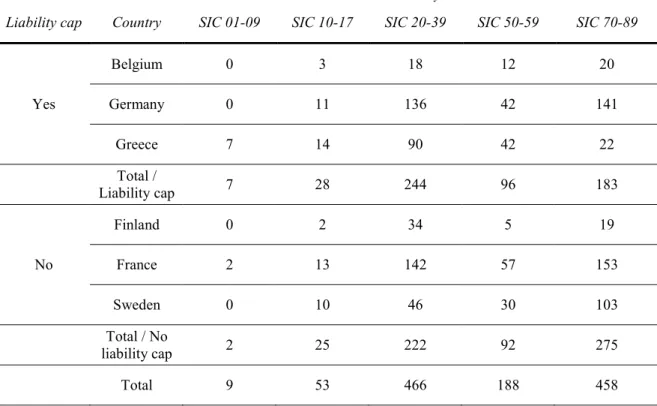
Table 4. Sample size by industry. 36
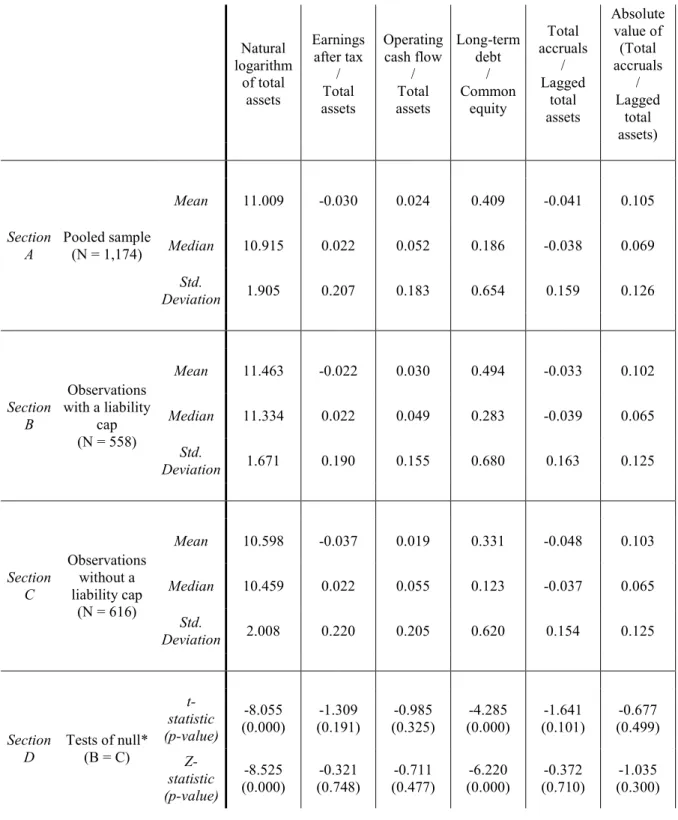
Table 5. Descriptive statistics of the sample. 37
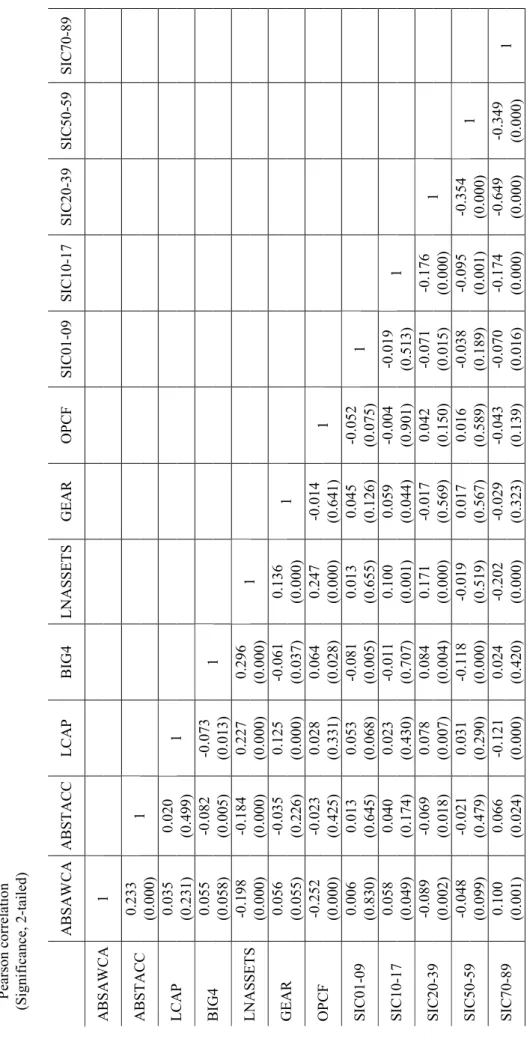
Table 6. Pearson correlation matrix. 44
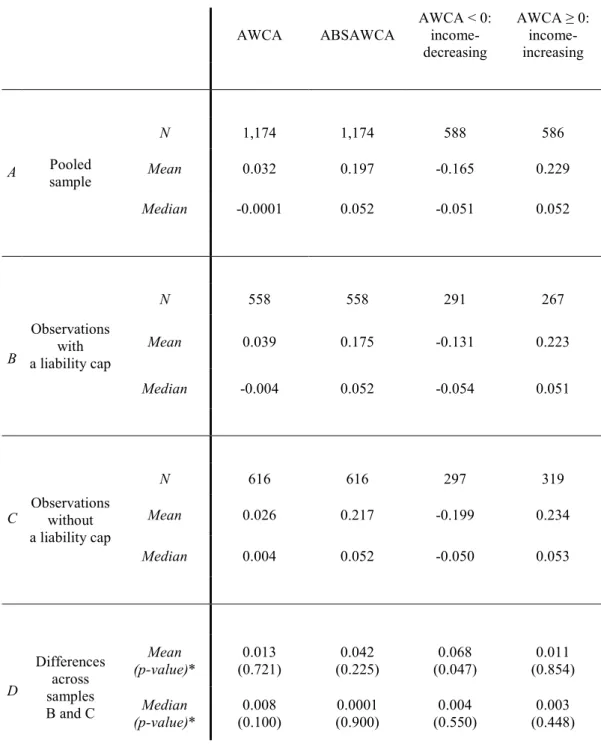
Table 7. Univariate results for discretionary accruals. 46 Table 8. The magnitude of income-decreasing and income-increasing discretionary
accruals. 48
Table 9. Univariate results of discretionary accruals, differences between auditor types. 49 Table 10. Univariate results of discretionary accruals, differences between samples by
auditor type. 51
Table 11. OLS regression results for pooled sample. 54
Table 12. OLS regression results for samples with and without a liability cap. 56 Table 13. OLS regression results for samples with and without a Big 4 auditor. 57 Table 14. OLS regression results for pooled sample with an independent variable for the combined effect of a liability cap and a Big 4 auditor. 58 Table 15. OLS regression results for pooled sample with absolute value of total accruals
as the dependent variable 60
5
______________________________________________________________________
UNIVERSITY OF VAASA Faculty of Business Studies
Author: Jouni Laitinen
Topic of the Thesis: The Effect of Limiting Auditors’ Liability on Audit Quality
Name of the Supervisor: Mikko Zerni
Degree: Master of Science in Economics and Business
Administration
Department: Department of Accounting and Finance
Major Subject: Accounting and Finance
Line: Financial Accounting
Year of Entering the University: 2005
Year of Completing the Thesis: 2011 Pages: 70
______________________________________________________________________
ABSTRACT
The need for uniform financial information has brought about efforts to harmonise ac-counting and audit regulation in the European Union. The European Commission has recommended that the EU member states should limit the civil liability of statutory auditors. It is argued that limiting auditors’ liability could lead to lower audit quality as a result of smaller liability risk. It is also argued that Big 4 auditors produce more con-sistent audit quality than other auditors regardless of legal environment, meaning that limiting the liability affects the audit quality produced by Big 4 auditors less than other auditors. This study examines the effect of the existence of a liability cap for statutory auditors on audit quality measured by the magnitude of earnings management. Abnor-mal working capital accruals are used for estimating earnings manipulation. The effect of a liability cap is also examined by comparing companies audited by Big 4 auditors to those that are not. The study examines the financial data from 2008 of 1,174 listed com-panies in six European countries. The results of univariate and multivariate analyses provide no evidence that the existence of a liability cap affects audit quality as measured by the magnitude of earnings management or that this effect differs between companies audited by Big 4 auditors and non-Big 4 auditors.
______________________________________________________________________
KEYWORDS: accounting harmonisation, audit quality, audit regulation, auditor liabil-ity, earnings management
7
1. INTRODUCTION
The academic interest in audit quality has augmented following major accounting scan-dals, most particularly the Enron and Parmalat cases in the early 2000s. The Enron scandal led to the collapse of Arthur Andersen, one of the largest audit partnerships in the world. This has brought about a general awareness of the fact that such collapses of major accounting companies are possible. Audit quality also is a key issue in interna-tional trade. Auditing is facing major challenges associated with internainterna-tional markets as there are significant differences in audit regulation across countries. There is unani-mous agreement that an international accounting harmonisation process is needed (López Combarros 2000: 644). There is need for more uniform financial information as wealth crosses national borders. The comparability of financial information regardless of its country of origin is important for financial markets. As accounting regulation in different countries is very heterogeneous at present, comparability poses a problem. The harmonisation process of accounting regulation in the European Union began in the 1960s as part of its program of Company Law harmonisation. Since then the process has been underway, and harmonisation has been promoted through legal instruments such as Directives. (Gornik-Tomaszewski 2005: 70.) The harmonisation of audit regulation is an essential part of this harmonisation process. Statutory audit is currently regulated by the Audit Directive (2006/43/EC) accompanied by an amending directive (2008/30/EC). Auditor liability as a part of audit regulation is of particular current interest, as the European Commission has in 2008 given a recommendation concerning the limitation of the civil liability of statutory auditors and audit firms (2008/473/EC). In the docu-ment the Commission recommends that member states of the European Union should take action to limit auditors’ liability.
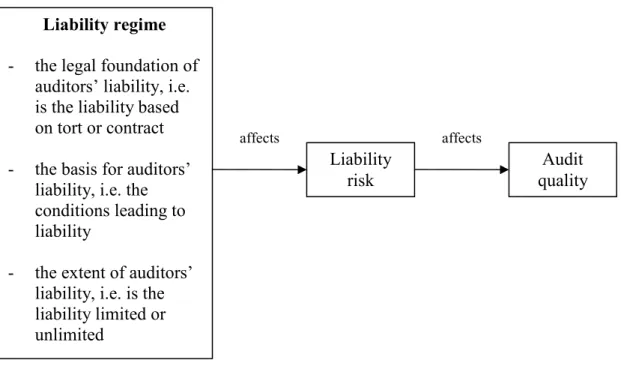
The effect of auditor’s liability on audit quality can be depicted with the concept of auditor’s client risk. For the auditor, there always is an element of risk included in audit engagements. Liability risk constitutes a part of an auditor’s client risk. The existence and the extent of liability affect client risk, which in turn causes the auditor to react ac-cordingly. From a purely financial standpoint, liability risk can be seen as the expected value of damages to be paid. However, there are other aspects in the matter that need to be considered, for example the effect of possible litigation on the auditor’s reputation. It can be assumed that the auditor seeks to react to increased liability risk by increasing audit quality, thus lowering the probability of litigation and the expected value of
dam-ages to be paid. Figure 1 portrays the causal chain of how liability regime affects audit quality through liability risk.
Figure 1. The causal chain from liability regime to audit quality.
The purpose of this study is to examine the effect of limiting statutory auditors’ liability on audit quality. However, audit quality cannot be measured directly, so a proxy meas-ure has to be used. In this study the proxy measmeas-ure used for audit quality is the magni-tude of earnings management, i.e. the absolute value of discretionary accruals. At present auditors’ liability is limited in five member states of the European Union. In this study it is argued that the existence of a liability cap reduces auditors’ liability risk, which in turn might affect the quality of statutory audits. It is also argued that higher liability risk gives auditors extra incentive to produce higher quality audits, as auditors try to decrease the expected value of liability. Thus, an existence of a liability cap is expected to lead to lower audit quality compared to unlimited liability, leading to the following hypothesis:
H1: Companies in EU member states where statutory auditors’ liability is limited by a liability cap report relatively higher absolute values of discretionary accruals compared to companies in EU member states where statutory auditors’ liability is not limited by a liability cap.
Furthermore, it is argued that Big 4 auditors produce more consistent audit quality com-pared to non-Big 4 auditors regardless of legal environment. This is due to Big 4 audi-tors’ bigger incentives for protecting their reputation (see e.g. DeAngelo 1981). In this study it is argued that Big 4 auditors are less affected by the existence of a liability cap than non-Big 4 auditors. In other words, the audit quality that Big 4 auditors produce under a regime of limited liability differs less from the quality they produce under unlimited liability compared to non-Big 4 auditors. The following hypothesis is con-structed:
Liability regime Liability risk Audit quality
9
H2: The magnitude of the absolute value of discretionary accruals is less affected by the existence of a liability cap in the case the company is audited by a Big 4 audit firm compared to a non-Big 4 audit firm.
This study contributes to the discussion on accounting and auditing harmonisation in Europe, particularly concerning limiting of auditors’ liability and its effect on audit quality. Six member states of the European Union are examined. Three of them have a liability cap: Belgium, Germany, and Greece. Three countries have a regime of unlim-ited liability: Finland, France, and Sweden.
The study is organised as follows. In Chapter 2, an overview of liability regulation in the European Union and the main features of the liability regimes in the six countries are presented. Chapter 3 explains the concept of liability risk and its role in how the liability regime presumably affects audit quality. Chapter 4 examines previous research on different factors affecting audit quality and the ways of measuring it. In Chapter 5 the data is described as well as the statistical methods used for testing the hypotheses. Chapter 6 presents the empirical results of the study. In Chapter 7, the results and their implications are discussed.
2. EUROPEAN LIABILITY REGIMES
There is no one common legal system in the European Union. Each member country has its own regime and there are notable differences in the legal systems across member countries. Different commercial laws originate from the countries’ different legal tradi-tions. Legal systems are based on either common law or civil law, which is divided further into three families: French, German, and Scandinavian civil law (La Porta, Lo-pez-de-Silanes, Shleifer & Vishny 1998: 1115). All six countries examined in this study have legal systems based on the civil law tradition.
A country’s legal system and legal tradition affect the regulation concerning accounting and auditing in the country in question. In addition to legislation, there are differences in the extent to which accounting practice is determined by formal standards (Ball, Kothari & Robin 2000: 4). In the recent years financial scandals such as the Enron case has lead to changes in these corporate governance and auditing standards (Ojo 2008: 3– 4).
Investor protection was an early rationale for audit regulation. This was based on the fact that investors do not have access to as much company information as directors and auditors. According to agency theory this creates a situation of information asymmetry. Audit regulation is needed to ensure the credibility of financial information given to investors (Eilifsen & Willekens 2008). The level of investor protection varies across countries. Legal systems based on civil law give investors weaker rights than common law systems, French civil law countries being the weakest and German and Scandina-vian countries falling in between French civil law and common law systems (La Porta et al. 1998: 1116). In international transacting, a common law approach to accounting is prevalent (Ball et al. 2000: 47). Less earnings management has been detected in legal environments with stronger investor protection (Leuz, Nanda & Wysocki 2003). Thus, it could be claimed that presumably more earnings management occurs in French civil law countries than in German and Scandinavian regimes.
In addition to regulation, the level of enforcement can be seen as an important element of the legal environment. According to Ball et al. (2000: 4), the efficiency of accounting standards depend on the level of public enforcement. The incentive to follow the stan-dards varies across countries as it depends on penalties under different enforcement institutions. On the other hand, La Porta, Lopez-de-Silanes and Shleifer (2006: 27–28) found in their study that criminal sanctions have no effect on the efficiency of security
11
laws. According to them, the effect is rather based on facilitating private contracting. Stronger legal enforcement also leads to less earnings management (Leuz et al. 2003). Statutory audit is at present regulated at the European Union level by two directives: (1) Directive 2006/43/EC of the European Parliament and of the Council on statutory audits of annual accounts and consolidated accounts, amending Council Directives 78/660/EEC and 83/349/EEC and repealing Council Directive 84/253/EEC, and
(2) Directive 2008/30/EC of the European Parliament and of the Council amending Directive 2006/43/EC on statutory audits of annual accounts and consolidated ac-counts, as regards the implementing powers conferred on the Commission.
The two directives do not regulate auditor liability in any way. The 2006 directive sim-ply states that the member states’ liability regimes vary considerably, that unlimited liability may cause problems for auditors to obtain professional insurance, and that these matters will be investigated further. Article 31 of the directive in question states that a report will be published on the impact of national liability rules and, if appropriate, rec-ommendations submitted to the member states. The mentioned report Consultation on auditors’ liability: Summary report was published in 2007. The European Commission published the Commission Recommendation concerning the limitation of the civil li-ability of statutory auditors and audit firms 2008/473/EC in 2008.
The main content of the Commission Recommendation 2008/473/EC is as follows: - The civil liability of statutory auditors and of audit firms arising from a breach
of their professional duties should be limited expect in cases of intentional breach of duties;
- The limitation should apply against the company audited and any third party; - The limitation should not prevent injured parties from being fairly compensated; - The use of any one or more of the following methods for limiting liability is
rec-ommended:
a) A maximum financial amount of a formula allowing the calculation of such an amount;
b) A set of principles by which a statutory auditor or audit firm is not liable be-yond its actual contribution to the loss suffered and is not jointly and sever-ally liable with other wrongdoers;
c) Allowing the auditee and the auditor to limit liability contractually.
As does audit regulation in general, regulation of auditor liability varies across coun-tries. Ex ante regulation and ex post liability are two very different approaches to
con-trol for activities (Eilifsen & Willekens 2008: 10). Also the basis for auditor liability is different from country to country. Firstly, liability can be based on special laws con-cerning auditors, or the same civil liability laws as other professionals or the general public, or a combination of the two. Secondly, liability can be based on a contractual relationship between the auditor and the client, or it can be based on tort. Thirdly, there are liability caps in place in some countries, when in others they do not exist. (European Commission 2001.) Furthermore, in some countries liability can be limited contractu-ally.
Whether liability is based on contract or tort can have a significant impact on various issues. These include liability limitations, the amount and nature of recoverable dam-ages, and the level of the auditor’s duty of care (European Commission 2001: 7). Dif-ferent liability regimes may affect the behaviour of auditors and auditees difDif-ferently and may result in alternative resource allocations, some of which might not be socially effi-cient (Eilifsen & Willekens 2008: 11).
Legal liability environment also is an important factor explaining audit fee variation across countries. The strictness of a country’s liability regime affects audit fees: the stricter the regime, the higher the fees (Choi, Kim, Liu & Simunic 2008: 56; Liu & Wang 2006: 1055). From the point of view of investor protection, higher auditor liabil-ity raises the investor’s expected damage compensation and thus the value of the in-vestment. This makes the investment opportunity more attractive and increases the probability of revealing worthless investment opportunities (Liu & Wang 2006: 1067). The implementation of auditors’ liability in the national laws is an important question regarding regulation harmonisation. If general rules of civil liability are applied to auditors, fundamental changes to the civil liability regimes, or the creation of specific rules, are needed. A regime of specific laws concerning auditors would make the har-monisation process easier (European Commission 2001: 6). The European Commission has conducted consultations concerning whether a need to reform the auditor liability regime exists. Different options for a change have been presented; these will be dis-cussed further in Section 2.2. As the EU is pursuing harmonisation of accounting and audit regulation, the Commission Recommendation (2008/473/EC) suggests various ways of liability limitation, as mentioned earlier.
13
Figure 2. Liability regulation in the causal chain from liability regime to audit quality.
A country’s liability regime affects auditors’ liability risk, which in turn arguably has an effect on audit quality. Figure 2 presents the main features of a country’s liability re-gime affecting liability risk as a part of this causal chain.
2.1 Legal foundation of and the basis for auditors’ liability
In any human activity there always is a possibility of damage occurring. The basic prin-ciple is that the one facing with damage must suffer the damage. If a person can be shown to be liable for the damage as defined by law, this person has the obligation to compensate the damage he is liable over. Liability can be based on fault or negligence. (Hoppu & Hoppu 2004: 231.) Fault means negligent and intentional conduct (Köhler, Marten, Quick & Ruhnke 2008: 133). For example, an auditor’s fault or negligence can cause damage to the audited company. Depending on the degree and gravity of the fault or negligence and the applicable legislation the auditor may be liable for this damage.
Liability in tort works through the effect of possible damage lawsuits after harm has occurred (Eilifsen & Willekens 2008: 11). Tort liability can be further divided into two categories: negligence liability and strict liability. Hoppu and Hoppu (2004: 232) define
Liability regime
- the legal foundation of auditors’ liability, i.e. is the liability based on tort or contract - the basis for auditors’
liability, i.e. the conditions leading to liability
- the extent of auditors’ liability, i.e. is the liability limited or unlimited Liability risk Audit quality affects affects
negligence as careless conduct. By this definition a person is considered negligent if he fails to act to avoid harm as a reasonable person in his position would. Liu and Wang (2006: 1054–1055) define negligence as failure to exercise due diligence. They also state that strict liability can be viewed as a special case of negligence liability where an auditor is always judged negligent when a corporate failure occurs. It can be added that this includes cases where the auditor has been acting deliberately (Hoppu & Hoppu 2004: 234).
Liability can also be based on a contractual relationship between parties. Liability based on a breach of contract is called contractual liability, as opposed to liability in tort. Contractual liability may or may not be a result of negligent behaviour on the part of the liable party (Hoppu & Hoppu 2004: 245–246).
Liability can reach beyond damages to the audited company. Individual shareholders and creditors among others may suffer damages because they use company information and the auditor’s report to make decisions (European Commission 2001: 7). Standards of liability as a means of investor protection are associated with larger stock markets (La Porta et al. 2006: 28). Liability to third parties is generally based on tort, since there is no contractual relationship between the auditor and the third party (European Com-mission 2001: 8).
Two fundamental questions concerning damages can be raised regardless of the legal foundation of liability (tort or contractual). First, the basis for liability, that is, what are the conditions that result in liability, and second, what is the extent of the liability, that is, what must a person pay or compensate when liable. (Hoppu & Hoppu 2004: 232.) Despite this study’s emphasis on the latter, differences between countries in the legal foundation and conditions leading to liability are also briefly discussed.
2.2. Liability caps
A liability cap is a means of limiting auditors’ liability by instituting a maximum amount for liability. In the European Union, the existence of a liability cap varies across countries and depends on the member states’ national regulation. Statutory liability caps are in use in some countries, while in others liability is not limited (European Commis-sion 2001: 102). At present, five EU member countries have a liability cap: Austria, Belgium, Germany, Greece, and Slovenia. There also exists a possibility for the auditor
15
and the audited company to limit liability contractually in some of the member states. The regulation concerning this is different between countries as well as the possibility of direct actions by shareholders or others (Doralt, Hellgardt, Hopt, Leyens, Roth & Zimmermann 2008: 63). There are different options for implementing a liability cap: (1) a fixed monetary cap, (2) a cap based on the size of the audited company, (3) a cap based on audit fees, and (4) the principle of proportionate liability (Ojo 2008: 4).
According to Koch and Schunk (2008: 1) there are several goals which liability caps are meant to achieve. One goal mentioned also in the Audit Directive (2006/43/EC) is to ensure the insurability of audit services and thus their availability to clients. Other goals are reducing the risk of a Big 4 firm collapse and encouraging middle-sized audit firms to offer their services to listed clients. The Commission Recommendation (2008/473/EC) in theory extends liability caps to all member states, but in practice it does not require the member states to take action (Ojo 2008: 5).
A study by London Economics (2006) proposes that auditors’ liability should be limited throughout Europe. The main reasons for this are: (1) the poor availability of auditor insurance especially for higher levels of liability, (2) the increased risk of litigation that would lead to a Big 4 firm collapse, and (3) the increased overall risk of the audit pro-fession. The study does not recommend any particular form of liability cap, but con-cludes that a relatively high cap is needed for Big 4 firms to promote audit quality, when at the same time middle-tier firms should be encouraged to audit larger firms by keeping the liability limit low enough. Liability should also be limited to keep audit fees reasonable, as increased liability leads to increased fees (Choi et al. 2008). A study by the Swedish justice department (SOU 2008: 79) points out that the company’s manage-ment is responsible for financial reporting. Despite this, it is the auditor that is held li-able for any damages due to negligence. Therefore, in practice liability actualises only on the auditor’s part. According to the Swedish study this is highly questionable and should be attended to by limiting auditors’ liability.
There is also evidence prompting that auditors’ liability should not be limited. For ex-ample, Doralt et al. (2008: 63) claim that limiting auditors’ liability protects auditors unfairly, as they are treated differently compared to other professions as lawyers or phy-sicians. Köhler et al. (2008: 143) agree with this and add that a liability cap’s fairness can be questionable since the relative compensation for the loss suffered increases with the declining extent of damage. Ojo (2008: 3–4) states that in the case of negligence, the auditor should be held accountable for any consequences. From investor protection’s
point of view, higher auditor liability also raises investors’ expected damage compensa-tion and thus the value of the investment (Liu and Wang 2006). In addicompensa-tion, according to Doralt et al. (2008: 63) a liability cap should never apply in the case of intentional wrongdoing from the part of the auditor. This is the case with the currently existing li-ability caps in the EU, as they do not apply in case of intentional conduct (European Commission 2008: 77). Finally, unlimited liability can be seen as an incentive for better audit quality, as it would deter auditors who are not experienced in special kinds of au-dit from performing such auau-dits. It could also increase public confidence in the auau-dit of financial statements. (Köhler et al. 2008: 143.)
2.3. Liability regimes in different European countries
Legal liability regimes vary across member states in the EU. There are differences in the way auditors’ liability is implemented in the legislation. Some countries have special laws concerning auditors; while in other countries general civil liability laws are applied to them. Furthermore, the basis for liability varies from contractual to tort. Liability caps restricting auditors’ liability are in use in some countries.
Six countries were selected for this study. Three of them have no statutory liability caps: Finland, France, and Sweden. The three other countries have implemented a statutory liability cap: Belgium, Germany, and Greece. From legal system’s point of view, Finland and Sweden represent the Scandinavian civil law family, Germany and Greece are from the German civil law family, and Belgium and France have French civil law systems. Both Scandinavian and German civil law systems are considered to have a moderate level of investor protection, that is, weaker than common law countries and stronger than French civil law countries. Both the German and Scandinavian systems are also assumed to have a higher quality of law enforcement than French civil law countries (La Porta et al. 1998: 1116). The main characteristics of the liability regimes of the six countries are presented in Table 1 on page 19.
2.3.1. Belgium
The liability of statutory auditors in Belgium in regulated by the general rules of civil liability accompanied by the law of 23 December 2005. In Belgium a system of propor-tional liability is in use, meaning that liability is placed upon defendants according to their contribution in the damage. Liability towards a client can be based on a contract or
17
tort, whereas the basis for liability towards third parties is tort. (European Commission 2008: 74; Vanstraelen & Willekens 2008: 29.)
Insurance for auditors covering liability is required in Belgium (London Economics 2006: 94). Since 2006 (the law of 23 December 2005), there has been a liability cap per mandate, and its amount depends on whether the audited company is publicly listed or not. The cap for an audit of an unlisted company is three million euro, and twelve mil-lion for an audit of a listed company (European Commission 2008: 77). There is a time limit of five years after the issue of the auditor’s report for bringing an action against the auditor (Vanstraelen & Willekens 2008: 29).
2.3.2. Finland
The liability of auditors is based on the Auditing Act § 51, which defines when the auditor is deemed liable. Other specific issues related to liability, e.g. calculation of damages, are regulated by general civil liability legislation. Auditor is only liable if negligence is shown (Niemi & Sundgren 2008: 91). This applies to both liability to the client and liability to third parties. Both the individual statutory auditor in charge of the audit and the audit firm are liable, as is the signing person. They are also liable for the damages caused by their employees. Associates may be liable for the breach of a gen-eral provision of civil law. If the statutory auditor is an individual who works in an audit firm, the audit firm may be liable only in case of a breach of the contract. (European Commission 2001: 10.)
The risk of litigation in Finland is relatively small, as is the number of complaints against auditors (Niemi & Sundgren 2008: 91). No legal obligation for insurance cov-ering liability exists (London Economics 2006: 94). There is no statutory liability cap in Finland. Contractual limitation to liability is possible in theory, but does not exist. There is a time limit for bringing an action against the auditor. The length of this limit depends on the plaintiff, and is three years if the plaintiff is the audited company, and ten years if the plaintiff is a third party. (European Commission 2001: 11.)
2.3.3. France
Statutory auditors’ liability is governed by a specific provision contained in Article 234 of the Company Law of 24 July 1966. Liability can only be based on auditors’ “negli-gent acts committed by them in the exercise of their functions”. (European Commission
2001: 11; Baker, Bédard & Prat dit Hauret 2008: 108.) This applies to liability towards the auditor’s clients as well as towards third parties. The auditor, either an individual or an audit firm, may be liable. In case of an audit firm, the signatory of the report is jointly and severally liable with the firm. The associates cannot be liable under the spe-cific provision of the Company Law. (European Commission 2001: 11–12.)
Auditors are required to have insurance for liability (London Economics 2006: 94). There is no statutory liability cap in France, and the parties cannot limit the amount of damages nor reduce the scope of auditor’s liability by contract. There is a time limit of three years from the occurrence of the damage for bringing an action against the auditor. (European Commission 2001: 12.)
A distinctive feature of the French auditing system is the requirement of two auditors for companies with quoted shares. The two auditors are to be engaged in the auditing of the company’s accounts at the same time. (Baker et al. 2008: 99.)
2.3.4. Germany
In Germany, statutory auditors’ liability arises from specific statutory provisions as contained in Article 323 of the Handelsgesetzbuch, which provides for auditors’ con-tractual liability. Auditors are also liable in tort, which is based on the general rules for civil liability. Some of the statutory provisions applicable to auditors’ liability are also found in the professional rules contained in the Act on the Profession of Auditors. Li-ability to the audited company is based primarily on contract and secondarily in tort, and liability to third parties generally in tort. However, there is a possibility of contrac-tual liability to third parties in the case of an implied contract between the auditor and the third party, or of a contract with protective effects towards the third party. Not only the statutory auditor but also all his assistants, as well as the statutory representatives of an auditing company, participating in the audit are directly liable to the injured party. (European Commission 2001: 12.)
Insurance for auditors covering liability is required in Germany (London Economics 2006: 95). There is a liability cap per audit or group audit, and its amount depends on whether the audited company is publicly listed or not. The cap for an audit of an unlisted company is one million euro, and four million for an audit of a listed company (European Commission 2008: 77). There are time limits for bringing an action against
19 T a b le 1 . M ai n f ea tu re s o f th e au d it o r li ab il it y r eg im es i n B el g iu m , F in la n d , F ra n ce , G er m an y , G re ec e, a n d S w ed en . C o u n tr y L eg a l sy st em A u d it o rs ' li a b il it y re g u la te d b y g en er a l ci vi l li a b il it y ru le s A u d it o rs ' li a b il it y re g u la te d b y sp ec if ic r u le s B a si s fo r li a b il it y to w a rd s a n a u d it ee B a si s fo r li a b il it y to w a rd s a th ir d p a rt y L ia b il it y ca p T h e a m o u n t o f th e li a b il it y ca p B el g iu m F re n ch c iv il la w Y es Y es C o n tr ac tu al / T o rt T o rt Y es € 3 m il li o n ( u n li st ed c o m p an y ) € 1 2 m il li o n ( li st ed c o m p an y ) F in la n d S ca n d in av ia n ci v il l aw Y es Y es T o rt T o rt N o - F ra n ce F re n ch c iv il la w Y es Y es T o rt T o rt N o - G er m an y G er m an c iv il la w Y es Y es C o n tr ac tu al / T o rt C o n tr ac tu al / T o rt Y es € 1 m il li o n ( u n li st ed c o m p an y ) € 4 m il li o n ( li st ed c o m p an y ) G re ec e G er m an c iv il la w Y es Y es C o n tr ac tu al T o rt Y es C al cu la te d b as ed o n t o ta l an n u al fe es o f th e au d it o r o r th e sa la ry o f th e P re si d en t o f th e S u p re m e C o u rt , w h ic h ev er g iv es t h e h ig h er v al u e. S w ed en S ca n d in av ia n ci v il l aw Y es Y es C o n tr ac tu al T o rt N o -
the auditor. The limits are five years for an action in contract and three years for an ac-tion in tort (European Commission 2001: 12).
2.3.5. Greece
Auditors’ liability in Greece is based on general civil liability and special legislation including the Codified Law 2190/20, which sets forth civil liability of auditors towards the company, and Article 19 of the Presidential Decree 226/1992, which contains spe-cial provisions limiting auditors’ liability. The statutory auditor’s liability to the audited company arises in contract and to any third parties from a breach of duty in tort. The appointed statutory individual auditor or firm is liable for the damages that he as well as his associates caused. If the appointed auditor is a firm, the signatory of the report is jointly and severally liable with the firm. (European Commission 2001: 13.)
Insurance covering auditor liability is required (London Economics 2006: 95). There is a liability cap of either the quintuple of the annual salary of the President of the Su-preme Court or the total amount of fees received by the Chartered Auditor during the previous fiscal year, whichever is higher. The parties cannot limit the legal liability of the auditor by contract. There is a time limit for bringing an action against the auditor. If the plaintiff is the audited company, the limit is two years. If the plaintiff is a third party, the limit is five years. (European Commission 2001: 13.)
2.3.6. Sweden
Civil liability for statutory auditors in Sweden is specifically regulated in Chapter 15, Section 230 of the Swedish Companies Act, but a statutory auditor may also be liable under the general damage rules of the Tort Liability Act. The liability to the audited company is based on contract between the auditor and the client, and hence is contrac-tual in nature. Liability to any third parties results from a breach of duty in tort. The auditor is also liable for the damages caused by the associates. (European Commission 2001: 18.)
Insurance or guarantee for auditors covering liability is required in Sweden (Kaisanlahti & Timonen 2006: 202; London Economics 2006: 96). There is no statutory liability cap, and the amount of damages or the scope of auditor’s liability cannot be limited by con-tract. There is a time limit for bringing an action against the auditor. The length of this
21
limit depends on the plaintiff, and is five years if the plaintiff is the audited company, and ten years if the plaintiff is a third party. (European Commission 2001: 18.)
3. LIABILITY RISK
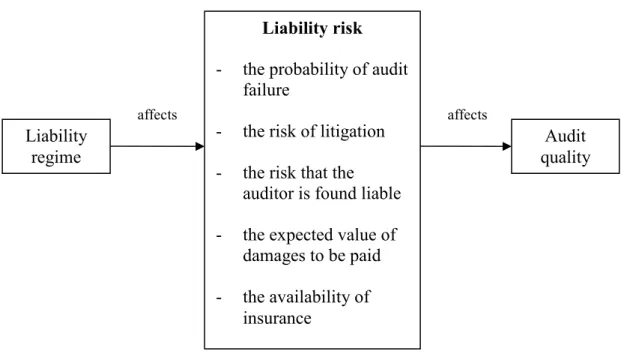
As any type of business, auditing includes risks. Auditors’ risk associated with audit engagements includes different components. One of these components is liability risk. It consists firstly of the risk of an occurrence of an audit failure, and secondly the risk that the auditor would be found liable for the audit failure, which depends on the legal re-gime. The economical aspect of liability risk is the expected value of damages the com-pany has to pay. This value affects auditors’ decision making, which in turn is expected to affect audit quality. The decisions auditor make and actions they take correspond-ingly affect the expected value of the damages. One important way to control the ex-pected economical value of liability risk is insurance. The lack of availability of adequate insurance coverage poses a threat to individual auditors as well as audit com-panies (e.g. London Economics 2006). Figure 3 presents the main features of auditors’ liability risk affected by a country’s liability regime and affecting audit quality as a part of the causal chain from liability regime to audit quality.
Figure 3. Liability risk in the causal chain from liability regime to audit quality.
As one function of liability rules is to ensure that plaintiffs are reimbursed for damages caused by auditors (Gietzmann, Ncube & Selby 1997: 24), the existence of liability
Liability risk
- the probability of audit failure
- the risk of litigation - the risk that the
auditor is found liable - the expected value of
damages to be paid - the availability of insurance Audit quality affects affects Liability regime
23
leads logically to the conclusion that in the presence of a risk of an audit failure occur-ring, there always is a risk that an auditor has to pay damages. An audit engagement never is without risk, as it is practically impossible for an auditor to reach full certainty that financial reports are free of material error. According to Liu and Wang (2006: 1055), since audit procedures are not perfect in detecting error and an auditor’s effort is not easily observable, it is possible that, in practice, the court tends to judge an auditor with hindsight and conclude that an auditor did not perform enough audit procedures.
3.1. Liability risk and decision making
Liability risk affects the decisions auditors make regarding audit effort and client ac-ceptance. The logical outcome of a higher risk would be that auditors expend audit ef-fort to lower the probability of audit failure, thus achieving a smaller liability risk. This would lead to higher audit quality. Litigation risk is an important factor that motivates auditors to expend their effort in the performance of audits (Choi et al. 2008: 56). Ac-cording to Gietzmann et al. (1997: 24) auditors’ incentives to commit to independence and high degree of care, i.e. produce high quality audits, could weaken if liability is less strict. Hence, the risk of litigation should lead to higher audit quality. Laux and New-man (2010) have found that audit quality does increase with the auditor’s expected liti-gation losses from audit failures.
In his study, Heninger (2001) examines the relation between earnings management and auditor litigation. Auditor litigation increases with the extent to which client firms re-port higher (i.e. income-increasing) abnormal accruals. This is because external stake-holders hold auditors responsible for letting their clients to release false information about their financial situation. The study's results also indicate that litigation risk is greater for clients in weaker financial condition and for larger clients.
Koch and Schunk (2008) studied how the extent of liability affects auditors’ decision making. Examining decisions under an environment of limited and unlimited liability, they found that unlimited liability has deterrence effects that can lead to an inefficiently high level of auditors’ effort, or even auditors stopping their activity entirely.
Audit fees increase with the auditor’s expected litigation losses from audit failures (Laux & Newman 2010). As the fees grow with the risk, a country’s litigation environ-ment plays a crucial role in audit pricing (Choi et al. 2008: 56). Expected losses must be
incorporated into audit fees because the fee cannot be adjusted retrospectively (Zerni 2009: 21). Nevertheless, the risk may not be fully transferred to the audit fees charged from the client. A study by London Economics (2006) found that in the case of Big 4 firms this is because of competition. A part of the risk premiums are also passed on to non-audit clients (London Economics 2006: 97).
Client acceptance decisions are affected by litigation risk. When making these deci-sions, auditors evaluate the client’s risk and the potential fee and determine whether the risk and return already are at an acceptable level. If the client’s risk and return are not acceptable, the auditor can consider whether additional audit investment or charging a higher fee would result in an acceptable risk and return rate. (Johnstone & Bedard 2003: 1006.) It could be assumed that increased litigation risk would lead to higher client re-jection rate, since the clients’ willingness to pay a higher audit fee would not compen-sate for the high risk. Laux and Newman (2010) found that rising litigation risk can either increase or decrease the probability of client rejection. For both weak and strong legal liability regimes, rejection rates are high compared to more moderate legal liability regimes.
Auditor switching becomes more costly when litigation risk increases, as the new audi-tor wants to become familiar with the new client firm in greater detail. In countries with strict liability regimes, this leads to underpricing of auditing services in the initial audit engagement year as auditors compete for clients. (Kallunki, Sahlström & Zerni 2007.)
3.2. Liability insurance
Audit firms manage statutory audit risks by implementing internal risk management and by insurance (London Economics 2006: 91). An auditor can obtain insurance covering liability risks to bring the risk to a more reasonable level. The trust in auditors is not only based on the possibility to sue auditors for suffered economic losses, but also on a certain security that auditors are actually capable of paying for them (Holm & Warm-ing-Rasmussen 2008: 70). Insurance is a way of not only ensuring the auditor’s ability to pay damages, but a way of communicating this ability to clients and third parties. In the case of an audit failure, an individual auditor and the management of the audit firm can be jointly liable for damages. In practice demands for compensation may be directed at the auditor alone, when the auditor is known to be insured (Andersson 2010:
25
61–62). At the same time, commercial insurers and reinsurers do not provide much cover, since insuring auditor liability is not a profitable business from their point of view (London Economics 2006: 112). This is mainly due to large losses sustained by the insurance industry in the underwriting of auditor professional insurance in the eighties and nineties (London Economics 2006: 116).
The availability of insurance is important for ensuring the continuing supply for audit services. Auditing always contains an element or risk, and it is necessary for auditors to be able to perform in their risky profession. Liability risk normally rises as the auditee size grows. If the auditee is a large company, liability can reach large amounts. This affects auditors’ possibility to insure themselves by removing this possibility entirely or by extremely high insurance charges (Andersson 2010: 61–62).
Insurance for liability is mandatory in most European Union member states. The avail-ability for this legally required insurance for low level liavail-ability normally is not a prob-lem. This has in many cases been taken care of by agreements between national auditor organisations and insurance companies. The availability of insurance poses a bigger problem with larger domestic and international risks. (London Economics 2006.) The requirements for insurance in the six countries of this study are presented in Table 2. Obtaining comprehensive insurance coverage for large liability risks is difficult. The availability of commercial insurance for large domestic and international risks has fallen sharply, and is now at a level which would cover less than five percent of the large claims some audit firms face. Insurance premiums have at the same time doubled for Big 4 companies during the first five years of the century. The difficult obtainability of insurance brings about the risk of audit firm collapse in the event that liability turns out to be too burdensome for the company to bear. The collapse of a Big 4 audit firm would lead to a situation where the audit market would be more centralised and arguably less competitive. This risk of a company collapse is growing with the reduction in commer-cial insurance coverage combined with the risk that a case is pursued by a plaintiff in-terested only in maximising recovery. (London Economics 2006: 115–116.)
Auditor liability is not only designed to offer compensation for those suffering losses but also to act as an incentive to avoid professional malpractice. In other words, liability risk is meant to lead to better audit quality. For this reason it is reasonable that the auditor bears a part of the liability risk and that insurance does not cover liability com-pletely (London Economics 2006: 100). If insurance would cover all of the risk, there
would be no incentive to produce better quality audits as the auditor would not bear a risk at all.
Table 2. Mandatory insurance for audit firms (London Economics 2006: 94–96).
Country Mandatory insurance required
by law / others Minimum coverage
Belgium By the professional association €619,733 per event
Finland
In practice, in Finland all auditors cover their work with voluntary insurance protection provided by the group insurance policy of the Authorised Public Accountants’
Institute
-
France By law €2,500,000 minimum per claim
Germany By law
Minimum coverage of €1 million for unlisted companies and €4 million for
listed companies
Greece By law
Insurance must not be less than the 150% of the total fees which the Certified Auditors received in the previous financial
year and in no case less than 10 times the total annual remuneration of the President
of the Supreme Court
Sweden By law
Depends above all on the number of auditors in the practice. The amount varies
between €440,000 per claim and up to €880,000 per claim or €2.65 million per
27
4. AUDIT QUALITY
The major accounting scandals in the beginning of the century have led to growing in-terest on audit quality. These scandals have proven that poor quality can lead to disas-trous consequences and has brought the matter’s importance to public knowledge. Audit quality is the basis for credibility of auditors and the audit industry as a whole.
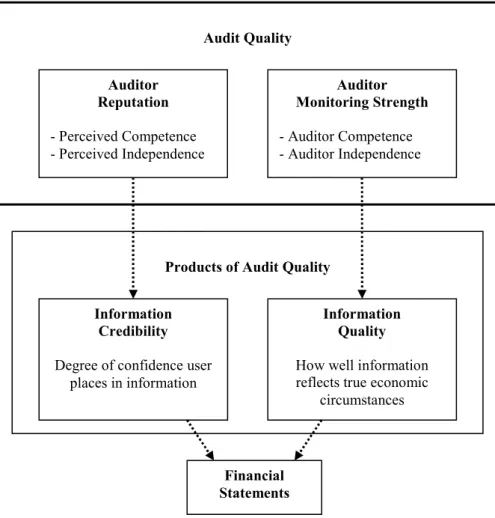
Figure 4. Audit quality framework (Watkins et al. 2004: 155).
Audit quality consists of two components: audit quality in fact and market perceived audit quality (Zerni 2009: 17). Watkins, Hillison and Morecroft (2004) presented an audit quality framework (see Figure 4) that divides audit quality into actual and per-ceived quality, and used auditor monitoring strength and auditor reputation to depict these components. In the framework auditor monitoring strength includes two
compo-Audit Quality Auditor Reputation - Perceived Competence - Perceived Independence Auditor Monitoring Strength - Auditor Competence - Auditor Independence Information Credibility
Degree of confidence user places in information
Information Quality
How well information reflects true economic
circumstances
Products of Audit Quality
Financial Statements
nents: auditor competence and auditor independence. Competence refers to auditor finding existing material errors and independence to auditor reporting those errors (see e.g. DeAngelo 1981). Auditor reputation consists of perceived competence and per-ceived independence. The framework also defines the products of audit quality as in-formation quality and inin-formation credibility. The former refers to how well the audited financial statements reflect true economic circumstances and the latter to the degree of confidence a user of this information places in it.
Audit quality has been the focus of several studies and the interest in the topic has grown especially after the accounting scandals of the early 2000s. The field of audit quality research has been reviewed comprehensively in articles by Francis (2004) and Watkins et al. (2004). The research has concentrated on different elements affecting audit quality, as legal environment (e.g. Ball et al. 2000; DeFond & Francis 2005; Fran-cis & Wang 2004; FranFran-cis & Wang 2008; Heninger 2001; La Porta et al. 1998; Leuz et al. 2003; London Economics 2006; Maijoor & Vanstraelen 2006), auditor size (e.g. Becker, Defond, Jiambalvo & Subramanyam 1998; DeAngelo 1981; Francis et al. 1999; Francis & Wang 2004; Francis & Wang 2008), audit effort (e.g. Caramanis & Lennox 2008), and auditor independence (e.g. Chung & Kallapur 2003; Frankel, Johnson & Nelson 2002).
Francis (2004) listed the most important findings of audit quality research so far. These findings are:
- Auditing is relative inexpensive, less than 0.1 per cent of aggregate client sales; - Outright audit failures with material economic consequences are very
infre-quent;
- Audit reports are informative, despite the presence of false positives and nega-tives;
- Audit quality is positively associated with earnings quality;
- Audit quality is affected by legal regimes and the incentives they create;
- There is evidence of differential audit quality by Big 4 firms and industry ex-perts, and differential audit quality across individual offices of Big 4 firms and across different legal regimes;
- Academic research has had little impact on regulations and policy-making in the US, although it may have had more influence in other countries such as the United Kingdom.
29
Figure 5. Audit quality in the causal chain from liability regime to audit quality.
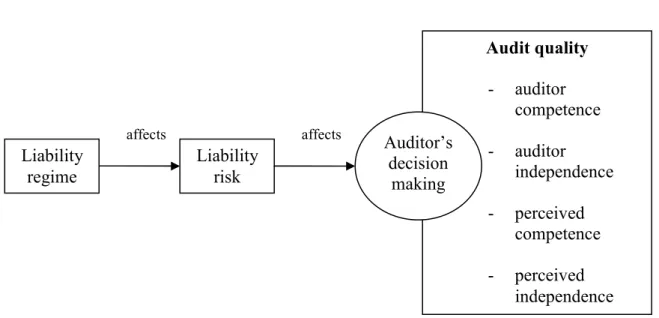
As the purpose of this study is to find out if the existence of a liability cap affects audit quality, the most interesting of the findings Francis (2004) listed is that audit quality is affected by legal regimes and the incentives they create. There is evidence of such an effect, and it can be assumed that there is a chance of a connection between limiting liability and audit quality. Another important finding is that audit quality is positively associated with earnings quality, as earnings quality is the proxy used for measuring audit quality in this study. Figure 5 presents audit quality as a part of the causal relation-ship leading from liability regime to liability risk to audit quality. Auditor’s decision making links liability risk and audit quality together. Liability risk affects auditors’ de-cisions concerning e.g. client acceptance and audit effort. These dede-cisions affect the different components of audit quality.
4.1. Measuring audit quality
Audit quality is largely unobservable and difficult to measure. As audit working papers and the data generated in the audit process are usually not accessible for research pur-poses, other ways to measure audit quality are needed. Typically this is done by using proxy measures. There are different proxies that have been used; European research has concentrated on audit fees, earnings management, and audit reporting. (Eilifsen & Willekens 2008: 3–4.) affects affects Liability regime Liability risk Audit quality - auditor competence - auditor independence - perceived competence - perceived independence Auditor’s decision making
In this study earnings management is used as the proxy measure for audit quality. Higher quality auditing leads to less earnings management. Managers have incentives to adjust earnings to maximise firm or manager wealth, which is due to contracts that have their outcome depend on reported earnings (Becker et al. 1998: 5–6). There is evidence that earnings management is frequent in the case of earnings decreases or losses. In a study by Burgstahler and Dichev (1997), evidence was found that 8–12 percent of the firms that had small pre-managed earnings decreases, managed earnings to report earn-ings increases. In the case of negative pre-managed earnearn-ings, 30–44 percent of the firms exercised discretion to report positive earnings.
Detection of earnings management is a key objective of an audit (London Economics 2006: 156). Since earnings management is a factor that reduces the accuracy and thus the quality of financial reporting, it can be argued that better audit quality should reduce the amount of earnings management. High quality auditing acts as a deterrent to earn-ings management because management's reputation is likely to be damaged and firm value reduced if misreporting is detected and revealed (Becker at al. 1998: 6).
Earnings management is in practice conducted by manipulating accounting accruals. Accruals are temporary adjustments that resolve timing problems in cash flows by making assumptions and estimates, and their quality is defined as the extent to which accruals project into cash flow realisations (London Economics 2006: 156). Since man-agers have limited ability to manipulate accruals attributable to normal business opera-tions, any such earnings manipulations should manifest as abnormal accruals (Heninger 2001: 124). In this study, earnings management is measured by the magnitude of dis-cretionary accruals, and the concepts of abnormal and disdis-cretionary accruals are used interchangeably.
4.2. Factors affecting audit quality and earnings management
Earlier research has studied various factors affecting audit quality. These factors are presented in the following sections.
4.2.1. Legal system
In the European Union the existence of a liability cap is a matter of national regulation of the member states. Thus the legal system an auditor operates in is most relevant for
31
this study, especially regulation concerning auditor liability. However, there are other approaches to the question of legal system effect of audit quality besides limiting liabil-ity. Some of these approaches and related earlier research are discussed in this section. One approach of interest has been the difference in audit quality between legal systems based on civil law and common law. Different legal traditions have given the national regulatory systems their contemporary form, including legislation concerning auditing. Since audit regulation depends partly on a country’s legal tradition, it is reasonable to assume that it affects audit quality. There is evidence that managers have greater discre-tion in reporting earnings in code law countries than in common law countries (Ball et al. 2000: 3). The Big 4 auditors are more conservative, i.e. more restrictive concerning accruals reporting, in common law countries. The legal regime and investor protection environment seem to directly affect Big 4 auditor incentives. The conservatism varies across countries and is stronger in stronger investor protection environments. (Francis & Wang 2004.) These results are explained by the differences in the level of investor pro-tection; higher levels of investor protection are usually associated with common law countries. In this study all six countries are civil law countries, two from each of the civil law subfamilies: French, German, and Scandinavian. Belgium and France have French civil law systems, Germany and Greece German civil law, and Finland and Sweden Scandinavian civil law tradition. The level of investor protection is considered to be average in German and Scandinavian systems, French civil law countries having the weakest protection (La Porta et al. 1998: 1116).
In a study by Leuz et al. (2003) the results were that stronger investor protection leads to less earnings management. The factors the study found out to lower the amount of earnings management were strong minority shareholder rights and legal enforcement. These characteristics are typical for countries with high level of investor protection, dispersed ownership and large stock markets (Leuz et al. 2003). Francis and Wang (2008) argue that earnings quality varies across countries mainly due to differences in enforcement by Big 4 auditors. In countries with stronger investor protection, Big 4 auditors apply a more conservative approach than in countries with weaker investor protection. There is no such difference in the case of non-Big 4 auditors. The incentives for Big 4 auditors seem to be affected by legal consequences on auditors from a failure to detect client misreporting (Francis & Wang 2008).
The ability to sue auditors is one element of investor protection environment (Francis & Wang 2004: 22). This ability shows itself to auditors as litigation risk, thus increasing
the expected value of liability costs. Litigation risk is considerably lower in civil law countries when compared to common law countries due to differences in investor pro-tection regimes. In his study, Heninger (2001) examines the relation between earnings management and auditor litigation. Auditor litigation increases with the extent to which client firms report higher (i.e. income-increasing) abnormal accruals. The study's results also indicate that litigation risk is greater for clients in weaker financial condition and for larger clients.
Maijoor and Vanstraelen (2006) report evidence that the amount of earnings manage-ment is not uniform across countries. They studied three European countries, namely France, Germany, and the United Kingdom. These countries all have different legal environments and subsequently different levels of investor protection. France has a French civil law system, Germany represents the German civil law family, and the UK is a common law country. The results of the study were that a stricter audit environment reduces earnings management, as companies in countries with flexible audit quality regimes report significantly higher absolute values of discretionary accruals compared to companies in countries with strict audit quality regimes. Thus national differences in earnings management are dominant and are not removed by the presence of a Big 4 au-dit firm. (Maijoor & Vanstraelen 2006.) These results support the findings of Francis and Wang (2004) on legal regime effect on Big 4 auditor conservatism.
Limiting auditors’ liability was examined as a part of a study by London Economics (2006). The study found no evidence that the existence of a liability cap significantly affects audit quality as proxied by earnings management, i.e. accruals. The London Economics (2006) study ended up recommending a liability cap for reasons such as ensuring auditor insurability and the risk of an audit firm collapse. Results from a study by Koch and Schunk (2008) suggest that limiting liability affects auditors’ decision making, thus it could affect audit quality.
A large selection of research confirms that legal environment really does affect audit quality. Differences in legal systems and regulation give auditors incentives to act dif-ferently across legal regimes. Despite the evidence that legal system and regulation matters, the question of an optimal legal environment producing optimal audit quality remains unanswered (DeFond and Francis 2005: 13).
33
4.2.2. Auditor size
Audit quality can be argued to vary from auditor to auditor. The effectiveness of audit-ing is expected to vary with the quality of the auditor, as high quality auditors are more likely to detect errors and report them (Becker at al. 1998: 6). Big 4 auditors are often assumed to be of higher quality than other auditors. This assumption is supported by earlier research (e.g. Becker et al. 1998; Francis et al. 1999). However, it is not conclu-sive that the linkage is causal from auditor size to audit quality. Clients with better pre-audit financial information quality may more likely choose Big 4 pre-auditors, in which case selection bias may explain outcomes instead of audit quality (Zerni 2009: 18). If non-Big 4 auditors have clients with high levels of earnings management, they may be preventing a higher proportion of it than Big 4 auditors, thus detecting more errors and producing higher audit quality (Becker at al. 1998: 19).
Big 4 auditors are often referred to being more conservative that non-Big 4 auditors. Auditor conservatism is a term used to describe the restraining effect of an auditor on clients’ accruals. It is a consequence of Big 4 firms having incentives to protect their brand name reputations. Clients are aware of this and try to convey the credibility of their reported earnings by hiring a more conservative auditor. (Francis et al. 1999: 17; Francis & Wang 2008: 1.)
In summary, auditor size is widely assumed to affect audit quality, and there is empiri-cal evidence to support this. If audit quality is defined to consist of actual and perceived quality, auditor credibility is an important factor. If Big 4 auditors are perceived to be more conservative and audits conducted by them more credible than other auditors, the perceived quality component of audit quality certainly is higher for Big 4 auditors. 4.2.3. Other factors
This section briefly discusses the factors affecting audit quality besides legal environ-ment and auditor size. For example, audit effort and auditor independence directly affect the probability of an auditor detecting and reporting a problem, hence affecting audit quality (Caramanis & Lennox 2008: 116).
Audit effort is a factor that implicitly affects audit quality, as it affects the probability that the auditor detects an existing problem. Audit effort can be measured by audit hours, i.e. the time the auditor uses for the audit. A study by Caramanis and Lennox
(2008) examined the effect of audit hours on reported earnings. They found out that audited companies report more income-increasing accruals when auditors work fewer hours. Lower audit hours lead to more income-increasing than income-decreasing ac-cruals and higher likelihood of managing earnings upwards to just meet or beat zero earnings (Caramanis & Lennox 2008). Thus it can be argued that higher audit effort decreases earnings management.
Auditor independence affects the probability that the auditor reports a detected problem (DeAngelo 1981). Higher level of independence arguably leads to higher audit quality. Non-audit fees are a factor claimed to compromise auditor independence (e.g. Chung & Kallapur 2003; Frankel et al. 2002). The evidence from these studies is controversial. According to Francis (2004), other factors affecting audit quality include cross-office quality differences, industry expertise, auditor tenure, audit committees, and accounting firm alumni. Research on cross-office quality differences is based on the presumption that the audit industry should rather be studied on the office level instead of national or international level. Industry expertise studies lean on the facts that Big 4 accounting firms actively promote their industry expertise and industry market shares are not evenly distributed among the large accounting firms. Audit tenure research is motivated by the requirement of auditor rotation. The effect of existence or independence of audit committees on audit quality is studied in audit committee research. Another line of re-search investigates if accounting firm alumni in senior management positions of audit clients can potentially compromise audit quality. (Francis 2004: 354–358.)
There exists research on yet other factors affecting audit quality than the ones men-tioned here. An example of such is the study on how audit quality in initial public of-ferings (IPO) differs from post-IPO audits by Venkataraman, Weber and Willenborg (2008).
35
5. DATA AND METHODOLOGY
The data collected for the study, the method for calculating discretionary accruals, and the univariate and multivariate methods used for testing the hypotheses are presented in this chapter.
5.1. Sample selection and descriptive statistics
The data are collected from the Amadeus database, which contains data on over 15 mil-lion companies in 43 countries across Europe. The countries selected for this study are Belgium, Finland, France, Germany, Greece, and Sweden. Three of these countries, namely Belgium, Germany, and Greece, have limited statutory auditors’ liability by the means of a liability cap. The three other countries, Finland, France, and Sweden, have a regime of unlimited liability. The sample consists of listed companies with their finan-cial year ending during the year 2008.
To acquire the data needed for this study, a search from the Amadeus database was con-ducted using suitable search criteria. The search included all listed companies in afore-mentioned countries with available financial data from 2008, and data from 2007 needed for analysis and calculating abnormal working capital accruals, which is the measure for earnings management in this study. Consistent with earlier research (Becker et al. 1998; Maijoor & Vanstraelen 2006), financial institutions (US SIC industry codes 6000–6999) and utility companies (US SIC 4000–4999) were excluded from the search. This is due to these industries’ specific accounting requirements, high degree of com-plexity, and different accrual generating process (Maijoor & Vanstraelen 2006: 37). The initial search returned 1,287 observations, of which 21 companies were missing the information on auditors, and further nine companies were missing a US SIC industry code. These 30 companies were excluded from the sample. The effect of outliers on the results was reduced by excluding all observations in the top and bottom 1% of all the continuous variables included in the regression model presented in Section 5.2.2.: ab-normal working capital accruals scaled by sales, natural logarithm of total assets, ratio on long term debt and common equity, and operational cash flow scaled by total assets. Further 83 observations were removed from the sample for having outlier values, re-sulting in final sample size of 1,174 companies in total. The number of observations by country is presented in Table 3 and is as follows: Belgium 53 companies, Finland 60,
Table 3. Sample size by country.
Liability cap Country N % Cumulative %
Belgium 53 4.5 4.5
Yes Germany 330 28.1 32.6
Greece 175 14.9 47.5
Total / Liability cap 558 47.5 47.5
Finland 60 5.1 52.6
No France 367 31.3