A thesis submitted to the University of Gloucestershire in accordance with the
requirements of the degree of
Doctor of Business Administration
in the School of Business and Management
Revenue recognition under IFRS 15
A critical evaluation of predefined purposes and
implications for improvement
Abstract
This study investigates problems and major challenges that may arise during the implementation of IFRS 15 and assesses the likely impact on firms’ profitability and performance. Scientific discussions on IFRS 15 are far from reaching an in-depth understanding of the implementation issues and various interpretations of the new standard as previous research projects were conducted at a point in time that only allowed a preliminary and superficial assessment as companies were not yet prepared to implement the new standard. This study aims to provide a significantly deeper level of detail and profound insights as it was conducted during the time that IFRS 15 became effective.
The author applies a qualitative approach. Based on a constructivist paradigm, qualitative data is gathered through 15 semi-structured in-depth interviews in Germany with auditors, mainly certified public accountants with outstanding experience in IFRS 15, and accountants involved or in charge of the implementation of IFRS 15 in their companies. The interview guide was developed based on the implications from other accounting studies, theoretical concepts and knowledge gaps identified in the literature review. A qualitative analysis of the 2017 annual reports of the German DAX 30 companies is conducted to triangulate the results related to the likely impact on firms’ profitability and performance.
The results of the study indicate that IFRS 15 is mainly addressing specific industries, which had difficulties in applying previous IFRS revenue recognition requirements due to missing or unspecific guidance forcing them to use standards outside of IFRS. Due to its complexity, however, IFRS 15 also affects companies with simple business models and its implementation may be unexpectedly time-consuming, work-intensive and difficult without leading to material changes. Although no indication is detected that earnings management or manipulation may be related to the adoption of IFRS 15, the standard still requires interpretation and professional judgment that may be subject to erroneous or divergent accounting for transactions. Although IFRS 15 appears to be necessary, it is anticipated that it rather represents a complex combination of various existing standards and consequently fails to help the profession. Therefore, the predefined purposes of IFRS 15 formulated by the IASB are, at minimum, questionable from a practical viewpoint.
Author’s Declaration
I hereby declare that this dissertation entitled “Revenue recognition under IFRS 15 – A critical evaluation of predefined purposes and implications for improvement”, submitted to the University of Gloucestershire in accordance with the requirements of the degree of Doctor of Business Administration in the School of Business and Management, is my own original work and, to the best of my knowledge and belief, contains no material previously published except where acknowledgement is made. I certify that the substance of this dissertation has not, either in whole or in part, already been or is not currently being submitted for any other degree at this or any other university.
I certify that any help received in preparing this dissertation and all sources used have been acknowledged.
Signature of Candidate:
Sascha Haggenmüller
Master of Arts (M.A.) Munich, Germany April 2019
Disclaimer
Note of Liability
The information in this dissertation is distributed on an ‘as-is’ basis without warranty. While every precaution has been taken in its preparation, neither the author nor the University of Gloucestershire shall have any liability to any person or entity with respect to liability, loss, or damage caused or alleged to be caused directly or indirectly by the information described herein.
Acknowledgements
At first, it is most important to note that this research project would not have been completed without the support and expertise of various people. Due to anonymity reasons, I cannot individually acknowledge each auditor or accountant whose insights formed the basis for the research findings and also improved the structure and content of the interview guide in the course of pilot interviews. These people gave their time, expertise and energy during their participation in the data collection interview. Please accept my sincerest thanks for your valuable contributions.
On an individual basis, I owe an enormous debt of gratitude to my first supervisor, Dr Kerry Sullivan. At an early stage of this research project, Kerry guided me along the difficult path of research, rather as a sparring partner than a micro-managing supervisor ensuring a great degree of freedom and creativity. Secondly, I want to say thank you to my second supervisor, Dr Doaa Aly. Joining the research project at a later stage in fall 2016, she was guiding me through the RD1 process and helping me along as major questions arose in the course of the project. Their profound experience, insights and knowledge, combined with accessibility, short notice feedbacks and also a good sense of humor, made the journey rewarding and unforgettable.
To the DBA staff: Ms Charley Sercombe, Ms Daniela Sommer, Dr Philippa Ward, Dr Robin Bown and Prof Dr Volker Wittberg, I sincerely thank you for your assistance received over the course of this research.
To the other students of Cologne Cohort 5: You became real friends in the past few years and made this journey unforgettable. Our great weekends in Cologne, learning meetings all over Germany and in Cheltenham gave me valuable insights to develop my research project.
Finally, I would like to thank my partner Nicole Saleh, who moved from the United States to Germany so that we could live together, and my parents, Andrea and Hans Haggenmüller. The love, support and patience of these people mean everything to me and such a project would not be possible without their backing. Therefore, I dedicate this dissertation to them.
Table of Contents
Abstract ... 1 Author’s Declaration ... 2 Disclaimer ... 3 Acknowledgements ... 4 List of Abbreviations ... 11 List of tables ... 14 1. Introduction ... 201.1 Background and rationale ... 20
1.2 Research aim and questions ... 22
1.3 Method of study ... 25
1.4 Constraints and limitations ... 26
1.5 Structure of the thesis ... 27
1.6 Remarks on vocabulary ... 28
1.7 Conclusion ... 29
2. IFRS: History, background, and revenue recognition requirements ... 30
2.1 History and background of IFRS ... 30
2.1.1 Terminology ... 30
2.1.2 History and implementation of IFRS ... 31
2.1.3 IFRS development process ... 34
2.2 Previous revenue recognition requirements under IFRS ... 35
2.2.1 The amount of revenues ... 35
2.2.2 Timing of revenue recognition ... 36
2.2.3 IAS 11 – Construction Contracts ... 36
2.2.4 IAS 18 – Revenue ... 38
2.2.5 Related interpretations ... 39
2.3 New revenue recognition requirements under IFRS ... 41
2.3.1 History of IFRS 15 ... 41
2.3.2 Scope of IFRS 15 ... 42
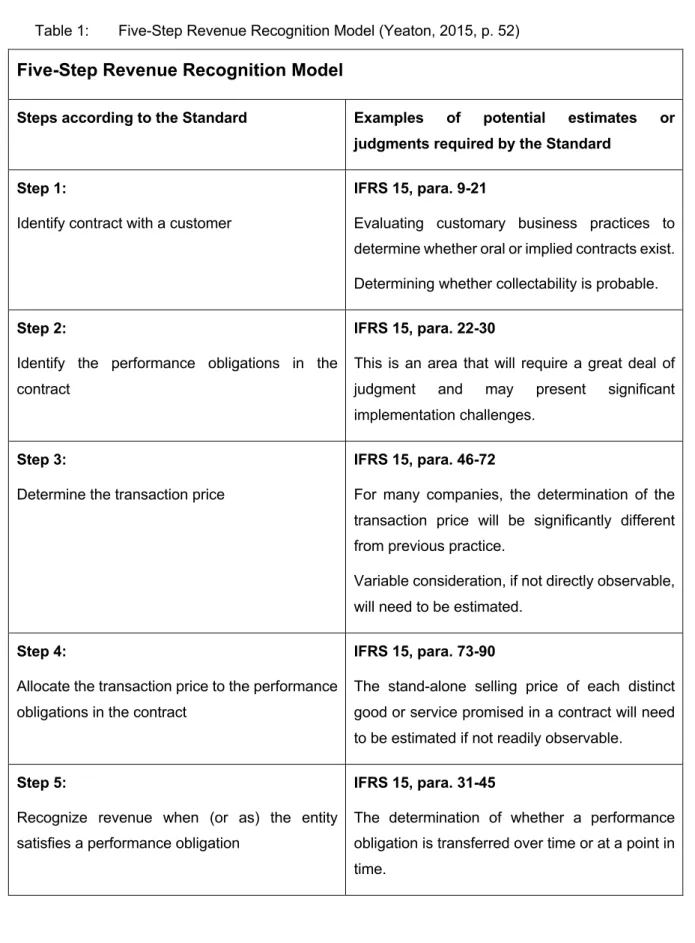
2.3.3 Concept of IFRS 15 – The five-step model and disclosures ... 42
2.3.3.1 Identification of the contract(s) with the customer ... 44
2.3.3.4 Allocation of the transaction price to the performance obligations ... 46
2.3.3.5 Revenue recognition when (or as) the entity satisfies a performance obligation ... 47
2.3.3.6 Disclosures ... 47
2.4 Conclusion ... 48
3. Literature review ... 51
3.1 Previous IAS on revenue recognition ... 51
3.2 Revenue recognition under IFRS 15 ... 54
3.2.1 Importance and relevance of IFRS 15 ... 55
3.2.2 IFRS 15 readiness ... 56
3.2.3 Potential effects of IFRS 15 ... 58
3.2.4 IFRS 15 implementation ... 61
3.3 Adoption and implementation of IFRS ... 63
3.3.1 Push towards accounting harmonization ... 63
3.3.2 Effect on quality as well as profitability and performance ... 65
3.3.3 Implementation of IFRS ... 67
3.4 Interpretation and judgment within IFRS ... 70
3.4.1 Principles-based standards and professional judgment ... 71
3.4.2 Language and probability and uncertainty expressions ... 73
3.5 Manipulative actions in IFRS ... 76
3.5.1 Motivation and incentives for earnings management ... 76
3.5.2 Earnings management techniques ... 78
3.5.3 Earnings management in the context of IFRS ... 80
3.6 Knowledge gap and research questions ... 82
3.6.1 Perceptions regarding the implementation of IFRS 15 ... 82
3.6.2 Different potential interpretations and manipulation in IFRS 15 ... 84
3.6.3 The likely impact of IFRS 15 on firms’ profitability and performance ... 87
3.7 Conclusion ... 88
4. Theoretical framework ... 90
4.1 Institutional theory ... 90
4.1.1 Conception of DiMaggio and Powell ... 91
4.1.2 Previous studies on institutional theory ... 92
4.2 Discussion ... 95
4.2.1 Critical assessment of further theoretical concepts ... 96
4.2.2 Justification of institutional theory as the theoretical lens ... 97
4.3 Conclusion ... 98
5.1.1 The ontological question ... 100
5.1.2 The epistemological question ... 101
5.1.3 The methodological question ... 102
5.1.4 Research paradigms ... 102
5.1.5 Discussion of research paradigms in accounting ... 103
5.2 Research approach and design ... 104
5.2.1 Paradigm ... 104
5.2.2 Research methodology ... 106
5.2.2.1 Quantitative approach ... 106
5.2.2.2 Qualitative approach ... 107
5.2.2.3 Mixed methods ... 107
5.2.2.4 Discussion and justification of the constructivist approach ... 108
5.2.3 Research method ... 109
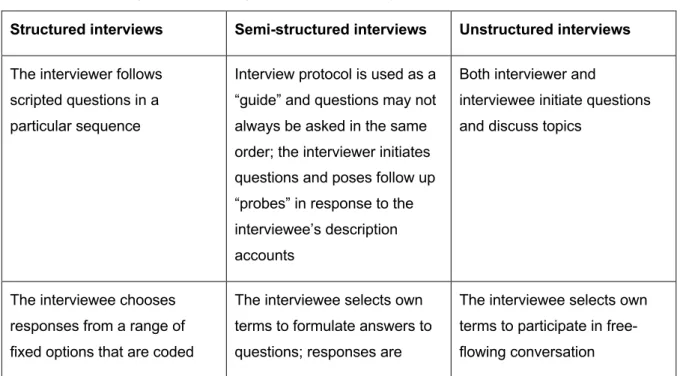
5.2.3.1 Interview types ... 109
5.2.3.2 Discussion and justification of semi-structured interviews for the research ... 111
5.2.3.3 Supplementary document analysis ... 112
5.2.4 Data collection ... 113
5.2.4.1 Sample size ... 113
5.2.4.2 Sampling technique ... 115
5.2.4.3 Data collection process ... 121
5.2.4.3.1 Pilot study ... 122
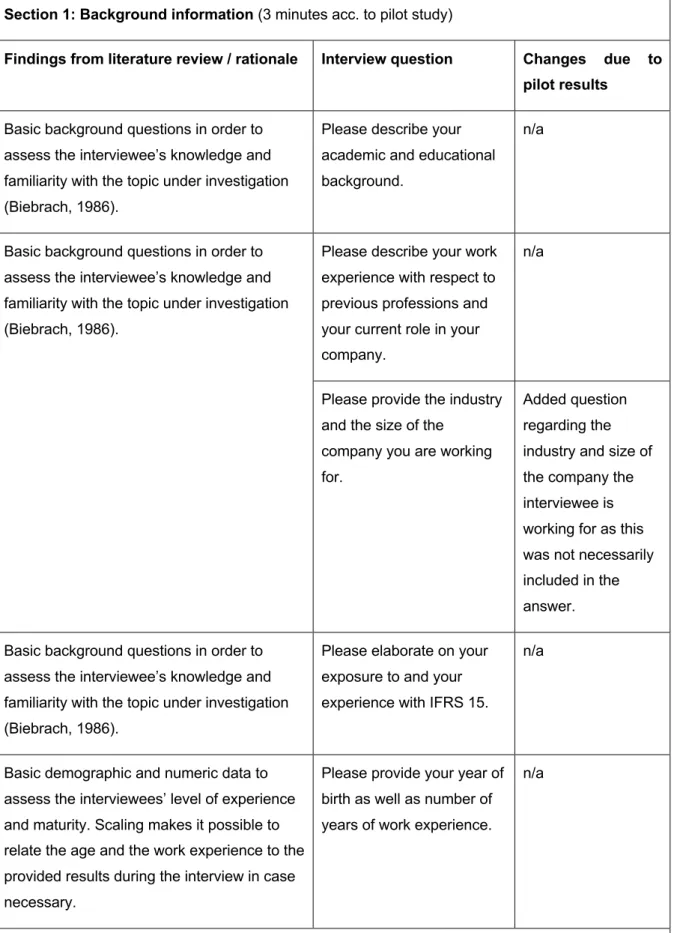
5.2.4.3.2 Development of interview guide ... 122
5.2.4.3.3 Scaling ... 141
5.2.4.3.4 Interview process ... 142
5.2.4.3.5 Transcribing and translating data ... 144
5.2.4.3.6 Selection of documents for triangulation purposes ... 144
5.2.5 Data analysis ... 145
5.2.5.1 Data analysis process ... 145
5.2.5.2 Content analysis ... 147
5.2.5.3 Data presentation ... 151
5.3 Quality criteria ... 151
5.3.1 Reliability and validity in qualitative research ... 152
5.3.2 Implemented measures for validity and reliability ... 153
5.4 Ethical considerations ... 156
5.4.1 Ethics in research ... 157
5.4.2 Ethics framework ... 157
6. Analysis and results ... 159
6.1.2 Missing or unspecific guidance ... 163
6.1.3 Practical considerations ... 167
6.1.4 Necessity for a new revenue recognition standard ... 170
6.2 IFRS 15 implementation ... 174
6.2.1 Assessment of IFRS 15 readiness ... 174
6.2.1.1 Update as of December 2017 ... 174
6.2.1.2 Drivers influencing IFRS 15 readiness ... 176
6.2.1.3 Disclosures ... 182
6.2.2 Project planning and scheduling ... 185
6.2.2.1 Preparation ... 185
6.2.2.2 Workstreams ... 189
6.2.2.2.1 Understand IFRS 15 ... 189
6.2.2.2.2 Understand the business ... 192
6.2.2.2.3 Merge business and IFRS 15 know-how ... 194
6.2.2.3 Stakeholder analysis ... 196 6.2.2.3.1 Intra-group aspects ... 196 6.2.2.3.2 Internal stakeholders ... 200 6.2.2.3.3 External stakeholders ... 211 6.2.2.3.4 Training of stakeholders ... 217 6.2.3 Identified challenges ... 220 6.2.3.1 Complexity of IFRS 15 ... 220 6.2.3.2 Practical implications ... 224
6.2.4 Implications for organizational structure and procedures ... 230
6.2.4.1 Internal controls ... 230
6.2.4.3 Processes ... 236
6.2.5 Paradigm shift of revenue recognition ... 239
6.3 Interpretation of IFRS 15 ... 242
6.3.1 Change of revenue recognition principle ... 242
6.3.2 Five-step model applications ... 246
6.3.2.1 Identification of the contract with the customer ... 246
6.3.2.2 Identification of performance obligations ... 248
6.3.2.2.1 Distinct goods or services ... 248
6.3.2.2.2 Alternative use ... 252
6.3.2.3 Determination of the transaction price ... 255
6.3.2.3.1 Variable consideration ... 255
6.3.2.3.2 Financing components ... 258
6.3.2.4 Allocation of transaction price ... 260
6.3.2.4.1 Stand-alone selling price ... 261
6.3.2.5.1 Measuring progress of performance obligations ... 265
6.3.2.5.2 Contract costs ... 266
6.3.2.5.3 Transaction-specific interpretational areas ... 266
6.3.3 Influential factors for interpretation and discretion ... 272
6.3.3.1 Earnings management ... 272
6.3.3.2 Practical application ... 275
6.3.4 Robustness of the IFRS 15 framework ... 278
6.4 Likely impact on firm’s profitability and performance through IFRS 15 ... 280
6.4.1 Conversion method ... 280
6.4.2 Likely impact on financial statements ... 284
6.4.2.1 Quantification ... 284
6.4.2.2 Key performance indicators ... 291
6.4.2.3 Disclosures ... 295
6.4.3 Before and after IFRS 15 ... 299
6.5 Implications for improvement of IFRS 15 ... 301
6.6 Critical evaluation of predefined purposes of IFRS 15 ... 304
7. Conclusion ... 313
7.1 Reflection on the research aim and objectives ... 313
7.1.1 Supplementary analysis of previous standards ... 314
7.1.2 Implementation of IFRS 15 ... 315
7.1.3 Different potential interpretations and risk of manipulation ... 320
7.1.4 Likely impact on firms’ profitability and performance ... 323
7.1.5 Overall results ... 326 7.2 Major implications ... 327 7.2.1 Practical implications ... 327 7.2.2 Theoretical implications ... 334 7.3 Limitations ... 338 7.4 Future research ... 342 7.5 My research journey ... 345 References ... 348
Appendix 1: IAS 11 application example ... 368
Appendix 2: IFRS 15 application example ... 369
Appendix 3: Interview Guides ... 371
Appendix 4: Informed Consent Cover Letter ... 386
Appendix 6: Exemplary interview transcript ... 389 Appendix 7: NVivo 12 coding scheme for qualitative analysis ... 420
List of Abbreviations
AAA American Accounting Association AEM Accruals-based earnings management
AG Aktiengesellschaft (German for “stock corporation“) ARC Accounting Regulatory Committee
ASOBAT A Statement of Basic Accounting Theory ASU Accounting Standards Update
BC IASB Basis for Conclusion
BDL Bund Deutscher Leasinggesellschaften (Association of German Leasing Companies)
BilReG Bilanzrechtsreformgesetz
BilRUG Bilanzrichtlinie-Umsetzungsgesetz BRIC Brazil, Russia, India, China
CEO Chief Executive Officer CFO Chief Financial Officer CPA Certified Public Accountant DAP Delivered at Place (Incoterm) DM Deutschmarks
DPR Deutsche Prüfstelle für Rechnungslegung (German Financial Reporting Enforcement Panel)
DRSC Deutsche Rechnungslegungs Standards Committee (Accounting Standards Committee of Germany)
EC European Commission e.g. Exampli gratia (for example)
EFRAG European Financial Reporting Advisory Group EITF Emerging Issues Task Force (of the FASB)
ESMA European Securities and Markets Authority et seqq. and the following
EU European Union EUR Euro
F IASB Framework
FASB Financial Accounting Standards Board FRRP Financial Reporting Review Panel
GAAP Generally Accepted Accounting Principles HFM Hyperion Financial Management
HGB Handelsgesetzbuch (German Commercial Code) i.a. Inter alia (among others)
IAS International Accounting Standards
IASC International Accounting Standard Committee ICS Internal control system
i.e. id est (that means)
IFAC International Federation of Accountants
IFRIC International Financial Reporting Interpretations Committee IFRS International Financial Reporting Standard
IKS Internes Kontrollsystem (Internal control system / ICS) IMF International Monetary Fund
IOSCO International Organization of Securities Commissions
KoR Zeitschrift für internationale und kapitalmarktorientierte Rechnungslegung (Magazine for capital market oriented and international accounting)
NAS Non-audit services
NYSE New York Stock Exchange
ÖPR Österreichische Prüfstelle für Rechnungslegung (Austrian Financial Reporting Enforcement Panel)
para. Paragraph
PoC Percentage-of-completion PPA Purchase Price Allocation PP&E Property, Plant and Equipment REM Real Earnings Management R&D Research & Development SAS Spanish Accounting Standards
SEC Securities and Exchange Commission
SFAC Statement of Financial Accounting Concepts SIC Standard Interpretation Committee
SME Small and medium-sized enterprises SOP Statement of Position (under US GAAP) SOX Sarbanes-Oxley Act
SSP Stand-alone selling price TEG Technical Expert Group TRG Transition Resource Group UAE United Arab Emirates UK The United Kingdom
US The United States of America USD US-Dollar
VFE-Lage Vermögens-, Finanz- und Ertragslage (Assets, financial and earnings position)
List of tables
Table 1: Five-Step Revenue Recognition Model (Yeaton, 2015, p. 52) ... 43
Table 2: Comparison of standards (Dalkilic, 2015, p. 10) ... 48
Table 3: Uncertainty expressions in IAS (Doupnik & Richter, 2003, p. 20) ... 73
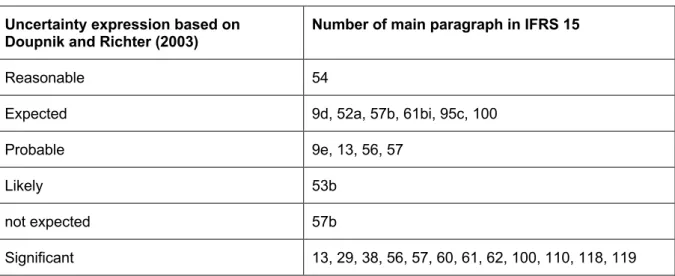
Table 4: Uncertainty expressions Doupnik and Richter (2003) in IFRS 15 ... 85
Table 5: Range of interviews (Roulston, 2010, p. 14) ... 109
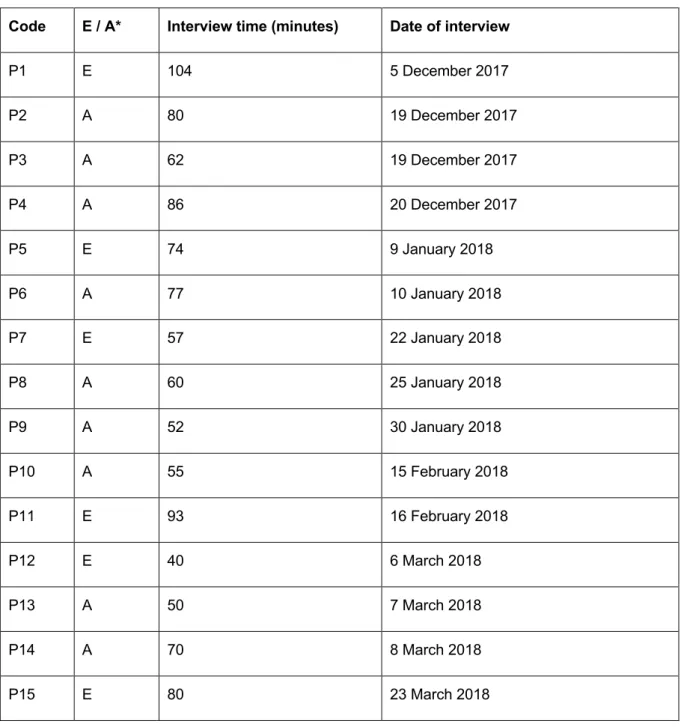
Table 6: List of research participants ... 117
Table 7: Preparation and adjustments of the basis for the interview guide ... 123
Table 8: Interview process ... 143
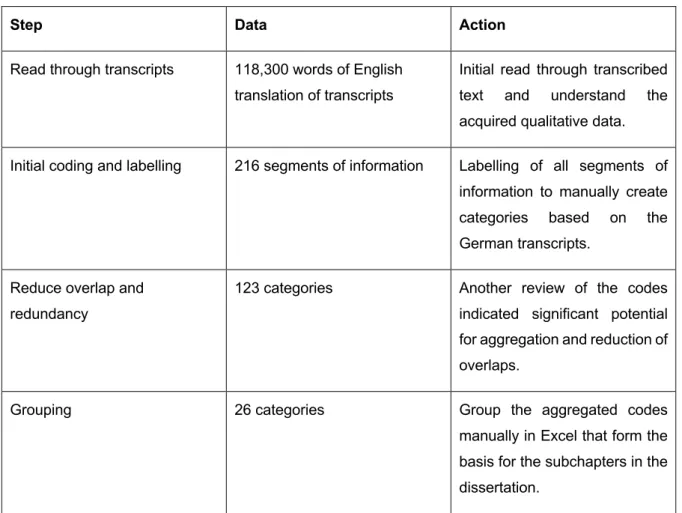
Table 9: Five-step qualitative data analysis approach ... 146
Table 10: Coding process ... 148
Table 11: Identified themes based on qualitative analysis ... 150
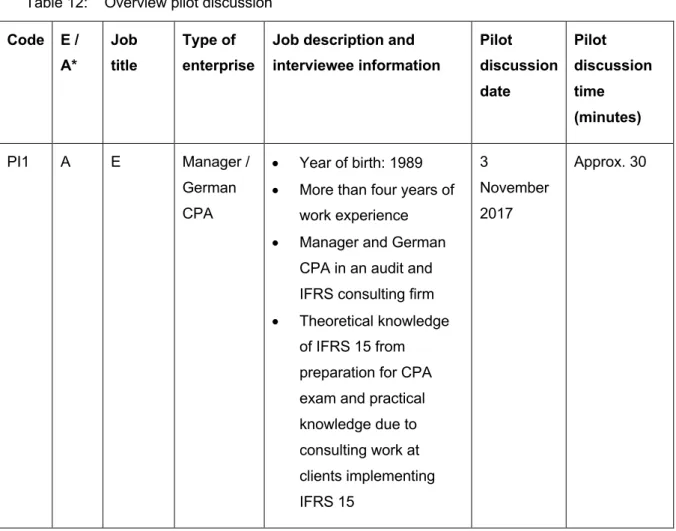
Table 12: Overview pilot discussion ... 154
Table 13: Overview pilot interviews ... 154
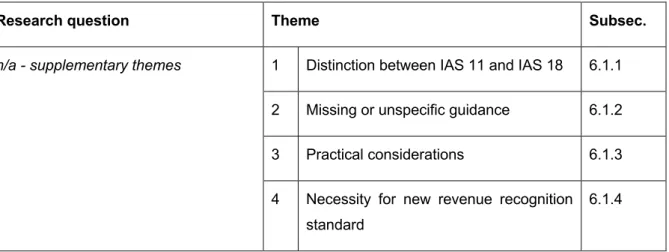
Table 14: Identified supplementary themes ... 159
Table 15: Interviewees’ familiarity with previous IFRS on revenue recognition . 160 Table 16: Supplementary analysis: Theme 1 - Evidence 1 ... 161
Table 17: Supplementary analysis: Theme 1 - Evidence 2 ... 162
Table 18: Supplementary analysis: Theme 2 - Evidence 1 ... 164
Table 19: Supplementary analysis: Theme 2 - Evidence 2 ... 165
Table 20: Supplementary analysis: Theme 2 - Evidence 3 ... 165
Table 21: Supplementary analysis: Theme 3 - Evidence 1 ... 167
Table 22: Supplementary analysis: Theme 3 - Evidence 2 ... 168
Table 23: Supplementary analysis: Theme 3 - Evidence 3 ... 169
Table 24: Supplementary analysis: Theme 4 - Evidence 1 ... 170
Table 27: Identified themes related to research question 1 ... 174
Table 28: Assessment of IFRS 15 readiness as of December 2017 ... 175
Table 29: Analysis related to research question 1: Theme 5 - Evidence 1 ... 176
Table 30: Analysis related to research question 1: Theme 5 - Evidence 2 ... 177
Table 31: Analysis related to research question 1: Theme 5 - Evidence 3 ... 178
Table 32: Analysis related to research question 1: Theme 5 - Evidence 4 ... 178
Table 33: Analysis related to research question 1: Theme 5 - Evidence 5 ... 180
Table 34: Analysis related to research question 1: Theme 5 - Evidence 6 ... 182
Table 35: Analysis related to research question 1: Theme 5 - Evidence 7 ... 183
Table 36: Analysis related to research question 1: Theme 5 - Evidence 8 ... 183
Table 37: Analysis related to research question 1: Theme 5 - Evidence 9 ... 184
Table 38: Analysis related to research question 1: Theme 6 - Evidence 1 ... 185
Table 39: Analysis related to research question 1: Theme 6 - Evidence 2 ... 186
Table 40: Analysis related to research question 1: Theme 6 - Evidence 3 ... 187
Table 41: Analysis related to research question 1: Theme 6 - Evidence 4 ... 188
Table 42: Analysis related to research question 1: Theme 6 - Evidence 5 ... 188
Table 43: Analysis related to research question 1: Theme 6 - Evidence 6 ... 190
Table 44: Analysis related to research question 1: Theme 6 - Evidence 7 ... 191
Table 45: Analysis related to research question 1: Theme 6 - Evidence 8 ... 193
Table 46: Analysis related to research question 1: Theme 6 - Evidence 9 ... 193
Table 47: Analysis related to research question 1: Theme 6 - Evidence 10 ... 194
Table 48: Analysis related to research question 1: Theme 6 - Evidence 11 ... 197
Table 49: Analysis related to research question 1: Theme 6 - Evidence 12 ... 198
Table 50: Analysis related to research question 1: Theme 6 - Evidence 13 ... 199
Table 51: Analysis related to research question 1: Theme 6 - Evidence 14 ... 200
Table 54: Analysis related to research question 1: Theme 6 - Evidence 17 ... 203
Table 55: Analysis related to research question 1: Theme 6 - Evidence 18 ... 204
Table 56: Analysis related to research question 1: Theme 6 - Evidence 19 ... 204
Table 57: Analysis related to research question 1: Theme 6 - Evidence 20 ... 205
Table 58: Analysis related to research question 1: Theme 6 - Evidence 21 ... 206
Table 59: Analysis related to research question 1: Theme 6 - Evidence 22 ... 207
Table 60: Analysis related to research question 1: Theme 6 - Evidence 23 ... 207
Table 61: Analysis related to research question 1: Theme 6 - Evidence 24 ... 209
Table 62: Analysis related to research question 1: Theme 6 - Evidence 25 ... 209
Table 63: Analysis related to research question 1: Theme 6 - Evidence 26 ... 210
Table 64: Analysis related to research question 1: Theme 6 - Evidence 27 ... 211
Table 65: Analysis related to research question 1: Theme 6 - Evidence 28 ... 212
Table 66: Analysis related to research question 1: Theme 6 - Evidence 29 ... 213
Table 67: Analysis related to research question 1: Theme 6 - Evidence 30 ... 214
Table 68: Analysis related to research question 1: Theme 6 - Evidence 31 ... 216
Table 69: Analysis related to research question 1: Theme 6 - Evidence 32 ... 216
Table 70: Analysis related to research question 1: Theme 6 - Evidence 33 ... 217
Table 71: Analysis related to research question 1: Theme 6 - Evidence 34 ... 218
Table 72: Analysis related to research question 1: Theme 6 - Evidence 35 ... 219
Table 73: Analysis related to research question 1: Theme 7 - Evidence 1 ... 221
Table 74: Analysis related to research question 1: Theme 7 - Evidence 2 ... 221
Table 75: Analysis related to research question 1: Theme 7 - Evidence 3 ... 222
Table 76: Analysis related to research question 1: Theme 7 - Evidence 4 ... 223
Table 77: Analysis related to research question 1: Theme 7 - Evidence 5 ... 224
Table 78: Analysis related to research question 1: Theme 7 - Evidence 6 ... 225
Table 81: Analysis related to research question 1: Theme 7 - Evidence 9 ... 228
Table 82: Analysis related to research question 1: Theme 7 - Evidence 10 ... 229
Table 83: Analysis related to research question 1: Theme 7 - Evidence 11 ... 230
Table 84: Analysis related to research question 1: Theme 8 - Evidence 1 ... 231
Table 85: Analysis related to research question 1: Theme 8 - Evidence 2 ... 232
Table 86: Analysis related to research question 1: Theme 8 - Evidence 3 ... 232
Table 87: Analysis related to research question 1: Theme 8 - Evidence 4 ... 233
Table 88: Analysis related to research question 1: Theme 8 - Evidence 5 ... 235
Table 89: Analysis related to research question 1: Theme 8 - Evidence 6 ... 236
Table 90: Analysis related to research question 1: Theme 8 - Evidence 7 ... 237
Table 91: Analysis related to research question 1: Theme 9 - Evidence 1 ... 239
Table 92: Identified themes related to research question 2 ... 242
Table 93: Analysis related to research question 2: Theme 10 - Evidence 1 ... 243
Table 94: Analysis related to research question 2: Theme 10 - Evidence 2 ... 244
Table 95: Analysis related to research question 2: Theme 10 - Evidence 3 ... 245
Table 96: Analysis related to research question 2: Theme 11 - Evidence 1 ... 246
Table 97: Analysis related to research question 2: Theme 11 - Evidence 2 ... 247
Table 98: Analysis related to research question 2: Theme 11 - Evidence 3 ... 248
Table 99: Analysis related to research question 2: Theme 11 - Evidence 4 ... 249
Table 100: Analysis related to research question 2: Theme 11 - Evidence 5 ... 250
Table 101: Analysis related to research question 2: Theme 11 - Evidence 6 ... 251
Table 102: Analysis related to research question 2: Theme 11 - Evidence 7 ... 252
Table 103: Analysis related to research question 2: Theme 11 - Evidence 8 ... 253
Table 104: Analysis related to research question 2: Theme 11 - Evidence 9 ... 253
Table 105: Analysis related to research question 2: Theme 11 - Evidence 10 ... 254
Table 108: Analysis related to research question 2: Theme 11 - Evidence 13 ... 258
Table 109: Analysis related to research question 2: Theme 11 - Evidence 14 ... 259
Table 110: Analysis related to research question 2: Theme 11 - Evidence 15 ... 260
Table 111: Analysis related to research question 2: Theme 11 - Evidence 16 ... 261
Table 112: Analysis related to research question 2: Theme 11 - Evidence 17 ... 262
Table 113: Analysis related to research question 2: Theme 11 - Evidence 18 ... 263
Table 114: Analysis related to research question 2: Theme 11 - Evidence 19 ... 265
Table 115: Analysis related to research question 2: Theme 11 - Evidence 20 ... 266
Table 116: Analysis related to research question 2: Theme 11 - Evidence 21 ... 267
Table 117: Analysis related to research question 2: Theme 11 - Evidence 22 ... 268
Table 118: Analysis related to research question 2: Theme 11 - Evidence 23 ... 269
Table 119: Analysis related to research question 2: Theme 11 - Evidence 24 ... 270
Table 120: Analysis related to research question 2: Theme 11 - Evidence 25 ... 270
Table 121: Analysis related to research question 2: Theme 11 - Evidence 26 ... 271
Table 122: Analysis related to research question 2: Theme 11 - Evidence 27 ... 271
Table 123: Analysis related to research question 2: Theme 12 - Evidence 1 ... 272
Table 124: Analysis related to research question 2: Theme 12 - Evidence 2 ... 273
Table 125: Analysis related to research question 2: Theme 12 - Evidence 3 ... 274
Table 126: Analysis related to research question 2: Theme 12 - Evidence 4 ... 275
Table 127: Analysis related to research question 2: Theme 12 - Evidence 5 ... 276
Table 128: Analysis related to research question 2: Theme 12 - Evidence 6 ... 277
Table 129: Analysis related to research question 2: Theme 12 - Evidence 7 ... 278
Table 130: Analysis related to research question 2: Theme 13 - Evidence 1 ... 278
Table 131: Identified themes related to research question 3 ... 280
Table 132: Analysis related to research question 3: Theme 14 - Evidence 1 ... 281
Table 135: Analysis related to research question 3: Theme 15 - Evidence 1 ... 284
Table 136: Analysis related to research question 3: Theme 15 - Evidence 2 ... 285
Table 137: Analysis related to research question 3: Theme 15 - Evidence 3 ... 287
Table 138: Document analysis: Likely impact on DAX 30 companies ... 287
Table 139: Analysis related to research question 3: Theme 16 - Evidence 1 ... 291
Table 140: Analysis related to research question 3: Theme 16 - Evidence 2 ... 292
Table 141: Analysis related to research question 3: Theme 16 - Evidence 3 ... 293
Table 142: Analysis related to research question 3: Theme 16 - Evidence 4 ... 294
Table 143: Analysis related to research question 3: Theme 16 - Evidence 5 ... 295
Table 144: Analysis related to research question 3: Theme 16 - Evidence 6 ... 295
Table 145: Analysis related to research question 3: Theme 16 - Evidence 7 ... 296
Table 146: Document analysis: Disclosures of DAX 30 companies ... 297
Table 147: Analysis related to implications for improvement: Evidence 1 ... 301
Table 148: Analysis related to implications for improvement: Evidence 2 ... 303
Table 149: Analysis related to evaluation of predefined purposes: Evidence 1 .. 304
Table 150: Analysis related to evaluation of predefined purposes: Evidence 2 .. 305
Table 151: Analysis related to evaluation of predefined purposes: Evidence 3 .. 307
Table 152: Analysis related to evaluation of predefined purposes: Evidence 4 .. 308
Table 153: Analysis related to evaluation of predefined purposes: Evidence 5 .. 309
Table 154: Analysis related to evaluation of predefined purposes: Evidence 6 .. 310
1. Introduction
The objective of this chapter is to introduce the study and the structure of this thesis. The chapter consists of six subsections. The first subsection provides the background and rationale of the study. The second subsection explains the research aim and questions. The third subsection outlines the applied research methodology. The fourth subsection highlights constraints and limitations and the fifth subsection illustrates the structure of this thesis. The chapter is closed with remarks on the vocabulary used and the conclusion.
1.1 Background and rationale
In the 1990s and the early years of the twenty-first century, globalization on an unprecedented scale took place. The reason was the rapid development of information technology improving communication and leading to a reduction of transaction costs and increased economies of scale (Holban & Aldea, 2009; Tysiac, 2014). “Along with the globalization of business comes globalization of the language of business: accounting.” (Holban & Aldea, 2009, p. 87). At that time, the former IASC improved its IFRS and gained international attention and acceptance (Camfferman & Zeff, 2007). In May 2014, the IASB and FASB jointly issued IFRS 15 – Revenue from Contracts with Customers, which implies a new model for revenue recognition (Tong, 2014). After having been initially effective from periods beginning on or after 1 January 2017, IFRS 15 is applied from 1 January 2018 and supersedes all previous revenue recognition requirements according to IFRS, mainly IAS 11 – Construction Contracts, IAS 18 – Revenue as well as related interpretations (Peters, 2016).
Revenue has always been one of the most important financial figures for investors in their decision-making process and illustrates the development and growth of companies (Zhang, 2005). Therefore, it was often subject to manipulation. Recent studies confirm that different incentives are a key factor in revenue reporting to external stakeholders and earnings management (e.g. Judd, 2015; Lim, 2016; Son & Lim, 2017; Stice, Stice, Stice, & Stice-Lawrence, 2016). Examples for manipulation are ‘round tripping’ of contracts to increase revenues, ‘buy-and-hold’ transactions, in which early customer purchases are not really sales, and ‘principal vs. agent’ transactions, in which transactions are reported on a gross basis although the real
revenue earned was only a commission on that gross price (Ciesielski & Weirich, 2011).
In the US, ambiguity of the two main criteria has led to numerous cases of fraud over the last three decades, although the intention of SFAC No. 5 was to provide clear principles for revenue recognition (Gallistel, Phan, Bartlett, & Dodd, 2012). The most famous and significant cases related to corporate earning manipulation were Tyco International (misappropriation of USD 400m), WorldCom (false financial reporting with a subsequent loss to investors of about USD 11bn) and Enron (USD 3bn of undisclosed losses) (Basundara & Chariri, 2014).
It is argued that the new revenue standard was necessary to remove inconsistencies and weaknesses in previous revenue recognition requirements in IFRS and US GAAP as well as to create a single set of high-quality global accounting standards (Peters, 2016).
IFRS 15, para. BC2 states that
US GAAP comprised broad revenue recognition concepts and detailed guidance for particular industries or transactions, which often resulted in different accounting for economically similar transactions . . . [and] the previous revenue Standards in IFRS had different principles and were sometimes difficult to understand and apply to transactions other than simple ones. In addition, IFRS had limited guidance on important topics such as revenue recognition for multiple-element arrangements. Consequently, some entities that were applying IFRS referred to parts of US GAAP to develop an appropriate revenue recognition accounting policy.
Therefore, the joint project of the FASB and IASB to develop a common revenue standard for IFRS and US GAAP was pursued. According to IFRS 15, para. BC3, the new standard would
(a) Provide a more robust framework for addressing revenue recognition issues;
(b) Improve comparability of revenue recognition practices across entities, industries, jurisdictions and capital markets;
(c) Simplify the preparation of financial statements by reducing the amount of guidance to which entities must refer; and
(d) Require enhanced disclosures to help users of financial statements better understand the nature, amount, timing and uncertainty of revenue that is recognized
However, the introduction of IFRS 15 in May 2014 raised a vast number of questions due to its apparent significance for some industries and high degree of complexity. Not only is there uncertainty, but also very limited academic research available on IFRS 15.
1.2 Research aim and questions
Due to the limited level of existing knowledge in this field and the research questions, the study aims to rigorously investigate potential implementation issues based on the perceptions and opinions of very experienced auditors and accountants and to assess the likely impact IFRS 15 will have on the financial statements. Hereby, the research focuses on the practical implications for affected companies, auditors, standard setters and other stakeholders.
An early study to investigate the application of the new exposure draft of IFRS 15 shows that managers had difficulties in both applying the new principles-based IFRS 15, but also rules-based US GAAP requirements to revenue recognition topics (McCarthy, 2012). A survey by GAAPweb (2015) reveals that over a third of the 300 participants in the study conducted in the UK were not aware and over half of them not prepared for changes in revenue recognition requirements according to IFRS. Later studies in other countries confirm these findings, e.g. the research of Lim, Devi, and Mahzan (2015), Benavides (2015), Khamis (2016), Peters (2016) and Forshay (2017). This implies that accountants have difficulties and are unfamiliar with IFRS 15 although IFRS 15 has been introduced in May 2014 and effective from periods starting on or after 1 January 2018.
It may be complex to implement the standard in various sectors, and there is a high potential for various interpretations and professional judgment necessary in order to adopt it (Benavides, 2015; Forshay, 2017; Khamis, 2016; Lim et al., 2015; Peters, 2016). Other studies indicate that the adoption and implementation of IFRS 15 is a complex, time-consuming and costly project for every company and not only requires an adjustment of IT and ERP systems, but also of the mindset of the accountants
committee and executive sponsorship across the key functions finance, IT, IR and tax, including thorough documentation, is crucial for a successful implementation. IFRS 15 has a significant impact on accountants due to new requirements for the determination of the transaction price, whether a financing component affects the transaction price, the separation of performance obligations, the respective allocation of the transaction price, as well as new extensive disclosures (Khamis, 2016).
Stakeholders need to understand all implications as IFRS 15 has effects on one of the most important KPIs in financial reporting (Peters, 2016). Due to the importance of revenue as a KPI and its direct impact on other financial relations and bottom-line earnings, companies cannot afford to incorrectly apply the new requirements (Tysiac, 2017). This is especially important as financial officers view earnings as the most important figure communicated to stakeholders (Graham, Harvey, & Rajgopal, 2005). These studies Benavides (2015); (Dalkilic, 2015; Forshay, 2017; Khamis, 2016; Peters, 2016; Tysiac, 2017) address potential implementation issues, interpretations and the effects on firms’ profitability and performance only on an undetailed level and have major limitations due to their study design and early timing. There is little comprehensive research on which detailed steps are taken by companies to implement IFRS 15, such as considering and changing IT and ERP systems, personnel training and education, processes and other key functions, as well as how employees or external auditors perceive the conversion process. As the implementation process is expected to be at a later stage compared to previous studies (Benavides, 2015; Dalkilic, 2015; Forshay, 2017; Khamis, 2016; Peters, 2016; Tysiac, 2017) due to the effective date 1 January 2018, it is important to gain a deeper and more detailed understanding. Therefore, the first research question is stated as follows:
Research Question 1: How do auditors and accountants perceive the implementation of IFRS 15 in practice?
Additionally, potential different interpretations and professional judgment necessary to apply IFRS 15 are only defined on a preliminary and theoretical basis. However, there has been no examination how factors such as language, scope and complexity of IFRS 15 affect interpretation and therefore comparability of IFRS financial statements.
judgment applied to account for specific transactions, but also to the question how the scope of interpretation is used for earnings management or accounting discretion. Previous studies found that standard precision alone is not connected to a different reporting decision, but that the incentives are the decisive factor (Lim, 2016). This raises the question as to whether the scope of interpretation available in some areas still provides opportunities for the application of accounting creativity. Therefore, the second research question of this study is formulated as follows:
Research Question 2: What are the major interpretational areas within IFRS 15 and to what extent do these imply a risk for manipulation?
This raises further questions about the potential impact on the figures within financial statements. With respect to potential effects of the adoption of IFRS 15 on figures within financial statements, previous studies illustrate that the most affected industries are those with complex or long-term contracts such as telecommunications, pharmaceutical, construction, or aerospace (e.g. Peters, 2016). However, previous studies (e.g. Forshay, 2017; GAAPweb, 2015; Khamis, 2016; PwC, 2016) were conducted at an earlier stage and indicate that many companies were still insufficiently prepared for the adoption of the new revenue recognition requirements. Therefore, there is still no structured and detailed assessment of the likely impact on firms’ profitability and performance available that addresses the effects on the figures within financial statements. This defines the third research question:
Research Question 3: What is the likely impact of IFRS 15 on firms’ financial statements and therefore their profitability and performance?
With respect to the first research question, a comprehensive understanding of participants’ perceptions with respect to the implementation of IFRS 15 is sought. This includes an assessment of the main drivers for IFRS 15 readiness as well as the analysis of details regarding project planning and scheduling, practical examples on the organizational structure and procedures, as well as major challenges.
The expected output of the second research question is to understand the critical issues within IFRS 15 when it comes to interpretations or professional judgment of the principles-based standard. The aim is to identify and define critical areas and assess
which potential the new standard provides for earnings management or manipulation. The study purposes to assess if those areas are just areas that require interpretation due to their principles-based nature or if they provide room for accounting creativity or manipulative actions.
The third question aims to analyze the likely impact on firms’ profitability and performance. Due to the timing of the research, an empirical assessment is not possible as financial statements are not expected to be available before the first quarter of 2019. However, it is expected that companies can estimate the impact, especially on the figures in the financial statements, disclosures and key performance indicators.
By applying a structured literature review focusing on literature surrounding the research topic and a qualitative approach, this dissertation is expected to deliver a significant contribution to knowledge in the field of the largely unexplored topic of IFRS 15 and will therefore form a substantial foundation for further research.
1.3 Method of study
The author sees reality as contextually and historically and/or socially defined and therefore as subjective, relativist and non-material. This implies a relativistic ontology (Bisman, 2010). This set of beliefs and the explorative nature of the research questions require an elaboration on individual experiences (Gallard & Cartmell, 2014). Epistemologically, the applied constructivist approach focuses on “what people, individually and collectively, are thinking and feeling” (Easterby-Smith, Thorpe, & Lowe, 1991, p. 24) in order to handle the complexity of the real-life phenomena and to conduct the in-depth analysis required to achieve the research aim.
The data is gathered through semi-structured interviews, implying a dialogue between the interviewee and the interviewers, and allows a comparison of the interview results (Cousin, 2009). Semi-structured interviews with open-ended questions represent a powerful method for capturing opinions and offer flexibility to explore issues as they arise because they are not limited to a predefined scope (Silverman, 2015).
Each question within the interview guide was either developed by identifying knowledge gaps or considering findings and implications of previous studies in the
to factors surrounding the research topic. This is particularly important for topics with limited literature available in order to make a contribution to knowledge (Moustakas, 1994).
An empirical analysis involving a review of financial statements before and after the implementation of IFRS 15 is not possible as the effective date of the standard is for periods beginning on or after 1 January 2018 (Ernst & Young, 2016). However, as companies are obliged to publish information with respect to their status quo and expectation of the impact of IFRS 15 in accordance with IAS 8, the results addressing the third research question based on the semi-structured interviews are complemented by the preliminary results described by DAX 30 companies in their latest available annual reports as of the time this dissertation was prepared.
The interviews were audio recorded and transcribed. Content analysis, including a coding technique, is applied to break down the data into themes in order to organize and analyse them (Bell & Bryman, 2007). Although views may differ due to the various backgrounds, expertise and sectors, patterns and themes in the captured qualitative data by coding and categorizing the transcripts are identified (Coffey & Atkinson, 1996). The use of NVivo 12 provides an efficient approach to data analysis and avoids any anticipation of how the data should be interpreted (Alcock & Iphofen, 2007). Saturation was reached by interview number 12 of 15 as no significant new information was forthcoming (Marshall, Cardon, Poddar, & Fontenot, 2013; Pitney & Parker, 2009) based on the coding scheme.
1.4 Constraints and limitations
Although the methodology for this research project has been constructed in a sensitive and careful way and significant pilot work undertaken, potential limitations of the results need to be taken into consideration.
The major constraints and limitations include the sample size in qualitative research. The sample size of this research project is comprised of semi-structured interviews with six auditors and nine accountants; therefore, results may have been different if a larger or smaller sample size had been applied. However, the sample size was sufficient to achieve saturation by observing that no material new information was forthcoming (Marshall et al., 2013; Pitney & Parker, 2009).
Fontana and Frey (2005) mention that there is potentially always some transfer of beliefs, attitudes and feelings during semi-structured interviews from the interviewer to the interviewee. This limitation was addressed by avoiding suggestive follow-up questions, confirmatory questions or similar issues, and the interview guide was taken as a basis in every interview including follow-up questions.
Due to the various sectors and results, a limitation with respect to the depth of the research may be present. Furthermore, there is limitation on a German view, supported by one partially American view, as all interviews were conducted with German participants having their primary work location in Germany.
Research validity and reliability can be generally criticized in the context of qualitative research due to the different focus compared to quantitative research (e.g. Altheide, Johnson, Denzin, & Lincoln, 1998; Lincoln & Guba, 1985; Rubin & Rubin, 2011). The research shows that certain issues and results cannot be transferred to certain industries or expert or accountant groups as the circumstances are different in various companies, industries, business structures and processes and otherwise dependent on employees’ competencies, education, training, available resources and other factors.
1.5 Structure of the thesis
The thesis comprises seven chapters.
This chapter outlines the background and the rationale of the research topic, the research problem and the aim and objectives. Furthermore, the method of the study, including its constraints and limitations, is illustrated.
Chapter 2 and Chapter 3 represent the literature review divided into two chapters. Chapter 2 is descriptive to present an overview of the history and background of IFRS as well as previous and current revenue recognition requirements in order to provide the reader with the necessary context and technical basis for the later findings. Subsequently, Chapter 3 reviews literature of major importance to the topic in order to indicate areas which require further examination, as well as to contribute to current knowledge (Ticehurst & Veal, 2000).
The theory is used as a lens for a potential contribution to explanations of the phenomenon under investigation as institutional isomorphism can be a useful tool for the understanding of organizational life (DiMaggio & Powell, 1983).
Chapter 5 examines scientific research approaches and justifies the selection of the constructivist paradigm and the selection of qualitative data in order to meet the requirements for the research questions. Furthermore, the boundaries and advantages of qualitative interviewing are illustrated. The development of the interview guide as well as the manual and software-supported content analysis techniques are transparently explained. Finally, the chapter critically examines quality criteria and outlines ethical aspects.
Chapter 6 presents and discusses the insights gathered in the course of the semi-structured interviews. The results are classified based on the codes applied during the content analysis and aggregated into major themes that represent the contribution to knowledge. Furthermore, findings from previous studies are critically assessed and updated where possible. The triangulation of research results by reviewing the last available annual financial statements of the DAX 30 companies complements this chapter.
Chapter 7 concludes the study by reflecting on the research aim and objectives, limitations and potential for further research and providing a story of the researcher’s journey and personal development throughout the research project.
1.6 Remarks on vocabulary
IFRS have both a broad and a narrow meaning. In the narrow sense, IFRS are the new series of standards that the IASB is developing and issuing as the successors of IAS, issued by the IASC, the IASB’s predecessor. In the broad context, which is also applied within this dissertation, IFRS refer to the definition as per IAS 1, para. 7, stating that IFRS are comprised of IFRS, IAS, IFRIC Interpretations and SIC Interpretations. Within this dissertation, the terms ‘previous IFRS’, ‘old standards’, ‘previous standards’ or similar refer to IAS 11 – Construction Contracts and IAS 18 – Revenue, as well as related interpretations IFRIC 13 – Customer Loyalty Programs, IFRIC 15 – Agreements for the Construction of Real Estate, IFRIC 18 – Transfer of Assets from
Customers and SIC 31 – Revenue – Barter Transaction Involving Advertising Services.
‘Current requirements’, ‘New requirements’, ‘New IFRS on revenue recognition’ or similar mean IFRS 15 – Revenue from Contracts with Customers applicable from 1 January 2018. As this thesis was written partially before and after the effective date of IFRS 15, this distinction is important.
With respect to the reference to specific paragraphs in IFRS, e.g. if it is referred to IFRS 15, paragraph 35, it is abbreviated as IFRS 15, para. 35 or IFRS 15.35. The same applies for the Basis for Conclusions, which means that BC50 means ‘Basis for Conclusions, paragraph 50’, and the IASB Framework, which means that F5 means ‘IASB Framework, paragraph 5’.
GAAP always refers to the local accounting law in the specific country, e.g. ‘German GAAP’ meaning the local German accounting law according to the German Commercial Code and ‘US GAAP’ meaning the local American accounting law.
1.7 Conclusion
This chapter provides a summary for the research background as well as the research aim and the research questions. Furthermore, the research methodology and method are introduced. These explanations represent the foundation of the thesis.
2. IFRS: History, background, and revenue recognition
requirements
The purpose of this chapter is to present an overview of the history and background of IFRS, as well as their revenue recognition requirements, in order to provide the context for the investigation.
2.1 History and background of IFRS
The following subsection aims to provide a brief description of the historical development of IFRS, as well as their principles and impact on the worldwide accounting profession.
2.1.1 Terminology
Accounting, in general, or accountancy, is the measurement, processing and communication of financial information about economic entities (Needles, Powers, & Crosson, 2013). Accounting processes are often referred to as time consuming, painstaking, meticulous, and even boring in order to have a reliable statement of a company’s financial position (Edwards, 2013). Financial accounting is “aimed at reporting, in a somewhat aggregated way, the (economic) performance of the firm to essential external users such as shareholders, bankers, creditors, customers, unions, tax authorities, etc.” (Stolowy & Lebas, 2006, p. 10). All transactions are materialized and valuated considering financial and non-financial information of source documents. The reporting is structured through financial statements, generally including a balance sheet, income statement, cash flow statement, statement of changes in stockholders’ equity and notes (Kinney & Raiborn, 2012).
Financial statements are prepared for and presented to numerous external users or stakeholders by a vast number of enterprises. Although financial statements generally consist of the previously mentioned parts, a variety of social, economic and legal circumstances by different countries lead to material differences of the elements of financial statements, i.e. assets, liabilities, equity, and income as well as related disclosures (e.g. Bae, Tan, & Welker, 2008; Hellman, 1993; Pope & Rees, 1992; Pope & Walker, 1999).
These differences result from a variety of different GAAPs. GAAPs are used to accomplish the objectives of measurement, timing of recognition, disclosure or presentation. The two basic principles are recognition and disclosure. Recognition principles determine the timing and the measurement of items and need to be reflected numerically. Disclosure principles deal with factors that are not always numeric and include qualitative information for the decision-making process of the addressees of the financial statements. Qualitative information within financial statements comprise explanations regarding accounting principles, contingencies, and uncertainties, which are needed to be able to fully understand the financial presentation of a company (Epstein, Nach, & Bragg, 2009).
The first attempt to create GAAPs started in 1930, primarily as a consequence of the stock market crash of 1929 and the belief that an absence of financial reporting requirements contributed to speculations that lead to the crash (Zeff, 2005). Over time, different GAAPs have been developed in various countries. The consequence was that financial statements were not comparable and difficult for external addressees to interpret (Wiecek & Young, 2009). One example for accounting differences is from 1993, when Daimler Benz AG was the first German company to be listed on the New York Stock Exchange (NYSE), which made it obligatory to report their financial statements under US GAAP. While under German GAAP, the company reported a net income of DM 615 million in the financial year 1992, this was a loss of DM 1,839 million under US GAAP (Carmona & Trombetta, 2008). Another example from 1993 is British Airways, which reported a profit of USD 333 million under UK GAAP in contrast to profits of only USD 168 million under US GAAP (Sherman, Young, & Collingwood, 2003).
2.1.2 History and implementation of IFRS
In 1973, after substantiating and improving GAAPs, the International Accounting Standard Committee (IASC) was founded by 16 professional accountancy bodies in the countries Australia, Canada, France, Germany, Japan, Mexico, the Netherlands, UK and US. Sir Henry Benson, who had the idea for the IASC, realized in the 1960s, when a rise of the number of multinational companies could be observed, that a comparison of financial statements from different parts of the world was necessary and therefore a harmonization of different GAAPs across the nations (Camfferman &
Zeff, 2007). After its foundation, the IASC began to issue flexible accounting standards. However, those were only taken seriously by developing countries. Nevertheless, another purpose was to give smaller nations a basis, on which they could develop their own accounting standards (Paul & Burks, 2010). Street and Shaughnessy (1998) summarize that the main two purposes of the IASC were to formulate and publish the public interest accounting standards as well as to promote their acceptance and observance and to pursue the improvement and harmonization of regulations, accounting standards, and procedures relating to the presentation of financial statements.
In the 1980s and 1990s, when the globalization became even more significant, the IASC improved its standards to a level of quality that gained the attention and respect of national and regional regulators, national standard-setters, major multinational companies, and leading accountancy bodies (Camfferman & Zeff, 2007).
In 2000, major restructuring activities took place in the organization and the formal links with professional accounting bodies were cut. The result was the foundation of the IASB, a “free-standing non-governmental organization, funded by voluntary contributions and the sales of publications” (Raffournier & Walton, 2003, p. 35), which superseded the former IASC and is the standard-setting body of the IFRS Foundation. International organizations such as G20, World Bank, IMF, Basel Committee, IOSCO, and IFAC have publicly supported global accounting standards. As of February 2019, 166 jurisdictions used IFRS (IFRS Foundation, 2018, 2019a).
The mandatory adoption of IFRS in the EU was one of the largest regulatory experiments in financial reporting ever undertaken. EC 16/06/2002 required almost all listed firms in a regulated market to comply with IFRS in their consolidated financial statements no later than 2005 (Christensen, Lee, & Walker, 2007). This decision of the EC affected around 7,000 companies (Zeff, 2008). In 2004, the regulation was implemented into German law (para. 315a in the German Commercial Code) in the course of the Accounting Reform Law (BilReG) (Haller, Ernstberger, & Froschhammer, 2009). This was a necessary step by the EU to achieve capital market integration and to work towards convergence of financial reporting not only across Europe, but also the rest of the world. However, the European Commission has to endorse every standard before they are mandatory within the EU and can therefore reject any or parts of any IFRS if the criteria for endorsement is not met. This
endorsement mechanism is a two-tier process consisting of a political and a technical level. The political tier is the Accounting Regulatory Committee composed of representatives from EU governments. The technical tier became the TEG of EFRAG (Zeff, 2008). An example for a rejection of parts of IFRS happened when the EC endorsed all IFRS, but not IAS 32 and IAS 39, in the course of the ongoing protests and discussions in September 2003. However, after discussions of the committees, the EC followed the recommendation by the ARC and endorsed a carved-out version of IAS 39 (Armstrong, Barth, Jagolinzer, & Riedl, 2009).
With respect to the US, the FASB and the IASB issued the Norwalk Agreement in 2002 as a result of the growth of global markets, the desire for one set of financial statements and the demand for one common global reporting language (Paul & Burks, 2010). This implied that the two boards “make their existing financial reporting standards fully compatible as soon as is practicable [and] to coordinate their future work programs to ensures that once achieved, compatibility is maintained” (Pacter, 2005, p. 73). In November 2007, the SEC allowed foreign filers in the US to prepare a submission of IFRS financial statements without a reconciliation to US GAAP (Paul & Burks, 2010). The auditors were surprised about the immediate approval by the SEC and it was speculated that there was pressure from the Department of the Treasury receiving criticism from sources within the EU. Furthermore, there was the threat that also the EU might require a reconciliation from US GAAP to IFRS financial statements for US companies listed in Europe (Zeff, 2008). Another source of pressure may have been the Sarbanes-Oxley Act (SOX) of 2002 (Zeff, 2008). In the aftermath of Enron filing the largest bankruptcy claim in the history of the US, SOX was the answer to public skepticism regarding the accuracy of financial statements and the conduct of high-ranking executives. Those new requirements seemed to be effective, resulting in a series of scandals that unfolded after its introduction, i.a. WorldCom, Globa Crossing, Adelphia Communications, and Tyco, resulting in a loss of public confidence and a material decline in the stock market (B. Kim, 2003).
The SEC was also working on an opportunity of IFRS adoption for non-listed companies. In December 2007, a Concept Release was issued providing an option to all US public companies to use IFRS instead of US GAAP, however, it did not include any explanations as to whether the adoption of IFRS might become obligatory. In fact, Big 4 accounting firms argued for the adoption of only one single set of high-quality,
the FASB agreed with this concept, however, without wanting to have an interim period, in which US companies could either use US GAAP or IFRS (Zeff, 2008). Today, IFRS are still not allowed to be used by US public companies, but convergence efforts are taking place, which is also represented by the US GAAP standard ASC 606, which is, considering minor deviations, the same as IFRS 15.
2.1.3 IFRS development process
According to the IFRS Foundation Due Process Handbook as of June 2016, there are six mandatory steps before the IASB and its Interpretation Committee can issue a standard:
a) Debating any proposals in one or more public meetings;
b) exposing for public comment a draft of any proposed new Standard, proposed amendment to a Standard or proposed Interpretation – with minimum comment periods;
c) considering in a timely manner those comment letters received on the proposals;
d) considering whether the proposal should be exposed again;
e) reporting to the Advisory Council on the technical programme, major projects, project proposals and work priorities; and
f) ratification of an Interpretation by the IASB.
Further steps are specified in the Constitution that are not mandatory and include: a) Publishing a discussion document (for example, a Discussion Paper) before an
Exposure Draft is developed;
b) establishing consultative groups or other types of specialist advisory groups; c) holding public hearings; and
d) undertaking fieldwork (IFRS Foundation, 2016a, p. 14)
Although not being a mandatory step, projects start with a discussion paper that includes issues, alternatives and the Board’s preliminary conclusions on the direction of the fundamental principle of the project. The completed discussion paper is published in order to receive comments on it. Those comments are analyzed by the Board staff. After that, the Board staff issues the exposure draft, which is also published for comments. Based on this, the standard is issued. After issuing a
standard, the Board allows a time period for users to get familiar with the new standard and to adjust system settings (Alali & Cao, 2010).
2.2 Previous revenue recognition requirements under IFRS
Up to the end of 2017, there are two basic IFRS for revenue recognition as well as four corresponding interpretations:
- IAS 11 – Construction Contracts - IAS 18 – Revenue
- IFRIC 13 – Customer Loyalty Programmes
- IFRIC 15 – Agreements for the Construction of Real Estate - IFRIC 18 – Transfer of Assets from Customers; and
- SIC-31 – Revenue – Barter Transactions Involving Advertising Services
2.2.1 The amount of revenues
The definition for ‘revenue’ is based on the IASB’s Framework, which has the purpose to provide a clear and coherent basis for financial accounting under IFRS (Lennard, 2007). According to F4, para. 29 “income encompasses both revenue and gains. Revenue arises in the course of the ordinary activities of an entity and is referred to by a variety of different names including sales, fees, interest, dividends, royalties, and rent.” A similar definition can be also found in IAS 18, para. 7. IAS 18, para. 8 states the following:
Revenue includes only the gross inflows of economic benefits received and receivable by the entity on its own account. Amounts collected on behalf of third parties such as sales taxes, goods, and service taxes as well as value added taxes are not economic benefits, which flow to the entity, and thus do not result in increases in equity. Therefore, they are excluded from revenue.
Additionally, F4, para. 30 states that “gains represent other items that meet the definition of income and may, or may not, arise in the course of the ordinary activities of an entity.” Revenues are generally recorded at the cash amount received or expected to be received or, in the case of non-monetary exchanges, at their cash equivalent (Ernst & Young, 2017b). An example would be the revenue of a car parts
recognized. But if the same dealer gains EUR 1,000 out of a successful stock investment, it would not be a core operating activity and thus classified separately.
2.2.2 Timing of revenue recognition
However, not only the amount of revenue to be recognized is important, but also the point or points in time when revenue is to be recognized and reported. The underlying realization principle not only requires a conducted sale, but also a certain degree of performance by the respective vendor. As there are numerous and sometimes inconsistent rules, two broad approaches for recognizing revenue emerged, i.e. the critical event and the accretion approaches being appropriate under particular circumstances (Ernst & Young, 2017b).
According to the critical event theory, revenue is recognized when the responsible business person makes the most critical decision or when a company is performing the most critical task during the earnings process. In practice, the critical event of most businesses is the sale of goods or services (Chatfield & Vangermeersch, 2014) as applied by IAS 18.
The accretion concept of income assumes that some portion of profit is earned during the phases of a company’s operating cycle. Examples for this approach are the proportional performance method and the PoC method (Chatfield & Vangermeersch, 2014) as applied by IAS 11.
2.2.3 IAS 11 – Construction Contracts
IAS 11 was implemented in 1995 after having been revised in 1993 and deals with the accounting treatment of revenues and costs arising from construction contracts. Activities in connection with construction contracts often relate to different accounting periods, which makes it necessary to provide guidelines regarding the allocation of revenues and costs to those periods in which construction and assembly work are conducted. A construction contract being in place is the central criterion to apply IAS 11 for revenue recognition purposes and its central methodology PoC. According to IAS 11, para. 3, a construction contract is defined as “a contract specifically negotiated for the construction of an asset or a combination of assets that are closely interrelated
purpose or use.” The term ‘specifically negotiated’ is considered by IFRIC 15. With respect to its focus on real estate, IFRIC 15, para. 11 points out that construction contract for real estate is in place when “the buyer is able to specify the major structural elements of the design of the real estate before construction begins and/or specify major structural changes once construction is in progress”. However, IFRIC 15, para. BC6 explicitly states that the conclusions of the interpretation can also be adapted to other branches in accordance with IAS 8 – Accounting policies, changes in Accounting Estimates and Errors (Ernst & Young, 2017b). According to IAS 11, para. 22, the outcome of the construction contract needs to be estimated reliably in order to apply the PoC method (Hellman, 2008, p. 86). Epstein and Jermakowicz (2008) describe the method as that the contract costs incurred at a specific point in time compared to the total cost determine the stage of completion, which results in the reporting of revenue, expenses and profit attributed to the proportion of work completed (see Appendix 1: IAS 11 application example).
According to IAS 11, para. 39 disclosures with regard to the amount of contract revenue recognized as revenue in the period, the methods used to determine the contract revenue recognized in the period, and the methods used to determine the stage of completion for contracts in progress are required. Furthermore, the aggregate cost incurred, recognized profits, the number of advances received, and the amount of retentions in accordance with IAS 11, para. 40 have to be disclosed. On the statement of financial position, a disclosure of the gross amounts due from customers as an asset and gross amounts due to customers for contract work as liability in line with IAS 11, para. 42 is required (Epstein & Jermakowicz, 2010).
IAS 11 and the PoC method are responsible for a significant increase in stockholders’ equity in the course of the mandatory adoption of IFRS in Germany (Haller et al., 2009). This effect implies a risk that can also be seen with respect to the interpretation of the requirements of IAS 11 and therefore the determination to apply IAS 11 or IAS 18 as the respective standard. IASB (2011) emphasizes the material differences between IAS 11 and IAS 18, which may lead to materially deviating financial statements depending on which standard is applied.