Modelling Stakeholders’ Behaviour in Transport Pricing
Erik-Sander Smits*^, Michiel Bliemer*#, Erik Verhoef+, Bart van Arem*-Extended abstract-
*
:
Delft University of Technology
Faculty of Civil Engineering and Geosciences Department of Transport & Planning
#
:
The University of Sydney
Institute of Transport and Logistics Studies
+
:
VU University, Amsterdam Department of Spatial Economics
^
(Corresponding author):
Stevinweg 1, P.O. Box 5048, 2600 GA Delft, The Netherlands Phone +31 15 2784977
Fax +31 15 2783179 E-mail [email protected]
Submitted for the 13th International Conference of the International Association for Travel Behavior Research (July 15-19, 2012)
Introduction
Pricing measures are increasingly used to improve transport systems. The design, assessment and evaluation of pricing schemes require modelling the behaviour of
stakeholders and travellers. The behavioural response of travellers to pricing measures is acquainted; modifying the way of paying for transport will lead changes in the trip-, destination-, mode-, departure time- and route choice of travellers. Stakeholders, on the other hand, design and execute the pricing measures, their behaviour involves other aspects. They react on the externalities (e.g. congestion, emissions) of the transport system and can choose the type, scale and level of pricing measures.
Travellers’ behaviour is heavily studied. In such studies the stakeholders’ behaviour is unsophisticated; only one stakeholder is taken into account which has the power to design the pricing regime for the transport system based on some general objective. This
simplifies the real world tremendously. Conflicts of interest between different
stakeholders often impede the implementation of pricing measures. The Netherlands is a distinctive example of stakeholders’ disagreement blocking road pricing. In the proposed paper we take behaviour of multiple stakeholders into account for assessing pricing measures. By acknowledging stakeholders’ preferences and interactions we attain realistic results.
We present a game theoretical framework for modelling multiple stakeholders’ behaviour. Two modelling paradigms are presented, the first is a non-cooperative approach where stakeholders make independent decisions and are selfish; the second is a cooperative approach where stakeholders can form coalitions. Comparing the results of two paradigms can show that selfish behaviour of a single stakeholder has highly negative effects on the performance of the transport system. Within the cooperative approach the stakeholders are highly interactive; agreements on coalitions (possibly with monetary transfers) have to be established. Contributions of our work include: (1) simulating coalitions (and the resulting strategies) can be used for policy making; (2) comparing non-cooperative and cooperative solutions gives insight in the price of selfish stakeholder behaviour; (3) implementation paths for new pricing measures can be assessed.
Stakeholders’ Behaviour Model Framework
Stakeholders’ behaviour is correlated with the behaviour of travellers, therefore two levels of modelling can be identified in a hierarchical manner. This so called bi-level approach considers the set of stakeholders S as leaders in the upper level and the travellers as followers in the lower level.
The upper level is our main interest, we will present two modelling paradigms
price variable ps that is within its executive power1. Price variables determine the height of a levy, e.g. a kilometre charge on a subset of links or the public transport ticket price. Price vector p denotes the price variables for all stakeholders combined.
Each stakeholder has an objective, which can be based on effects like congestion and emissions. The effects of the transport system are quantified and are denoted in effect variables e1,,en. Examples of effects are loss hours, carbon emissions and safety indicators. All effect variables combined are denoted as effect vector e. The preference of stakeholder s is captured in objective function ( ) :n →
s
f e .
In the lower level traffic demand and network supply interactions are evaluated in a transport model. This model takes travellers’ choice behaviour into account and assigns trips to the network. Every traveller minimizes his utility which consists of route
characteristics and in particular the levies imposed by stakeholders. By choosing the best routes, the system will move to user equilibrium. Externalities of this equilibrium system state are then quantified, leading to the effects vector e. So the transport model is a
simulator, the input variable is price vector p and the output variable is effects vector e.
Non-cooperative approach
Each of the stakeholders has the incentive to unilaterally employ its executive power to increase benefits. Each stakeholder minimizes its objective function by setting the pricing variable. The selfish behaviour of each stakeholder raises a non-cooperative game. The non-cooperative stakeholder game is in Nash equilibrium if no stakeholder can change its price, assuming fixed prices of all other stakeholders, such that its objective decreases. The simulation of the game iteratively updates the prices p based on selfish behaviour and assesses it with the transport model. If the resulting effects vector e converges then Nash equilibrium is achieved. This non-cooperative paradigm for the upper level is unilateral, since simulation has no interaction and will lead to a single result.
Cooperative approach
Stakeholders can form coalition and are able to do monetary transfers within coalitions. Assuming that each objective function is monetized, a money exchange term can be added. The pricing mechanism of one stakeholder could be very effective in optimizing another stakeholder’s objective. By offering financial compensations the stakeholders are able to influence each other. This cooperative paradigm has much more dimensions than its non-cooperative counterpart. In the simulation of the game coalitions will be
constructed and acceptable monetary compensations will be derived.
Conflicting Stakeholders Case Study
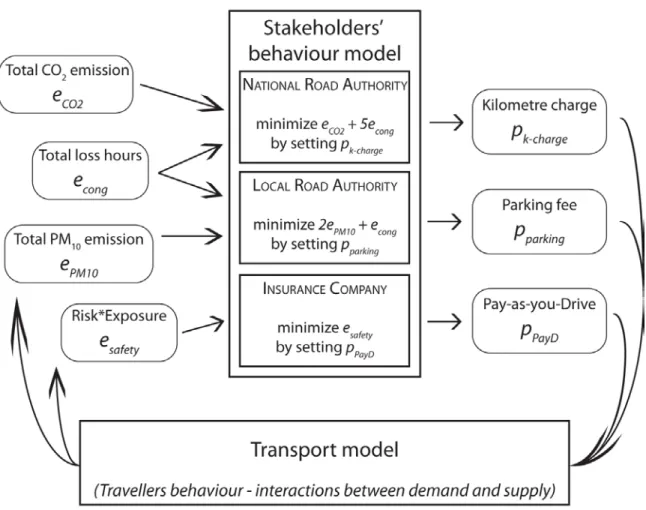
To illustrate the two paradigms, a case study in which stakeholders have conflicting interests is presented. The case considers behaviour of the national road authority, a local road authority and an insurance company. The national road authority minimizes
congestion (econg) and climate affecting CO2-emissions (eCO2); the mechanism to achieve this is a kilometre charge on highways (pk-charge). The local road authority cannot enforce a kilometre charge, but is able to levy parking fees (ppark); these fees are used to mitigate smog causing PM10-emissions (ePM10) and congestion (econg). Insurance companies try to enforce costumers onto safer road types to minimize exposure to risk (esafety). Pay-as-you-Drive (pPayD) is the used mechanism in which you pay the insurance-fee per kilometre based on used road types.
The externalities of the transport system (e) and can be quantified from equilibrium in the transport model. Emissions (eCO2 and ePM10) are based on the number of driven kilometres on certain road types and give total amount of emitted matter. Congestion (econg) is
quantified as the total loss hours for all travellers. Safety of travellers (esafety) depends on many factors, but can roughly be quantified by risk (level per road type) ×exposure. Figure 1 shows how this case study can be simulated with the presented framework. For each stakeholder an objective function is specified with weighting factors between effects. Conflicts are expected since (1) the insurance company and the local road authority will be advantageous if travellers use the (safe) highways outside cities (with low PM10
-emissions) and (2) the highways are affected by the kilometre charge of the national road authority driving away travellers. The non-cooperative approach converges, if exists, to a Nash equilibrium in which the resulting effects might be adverse. Safety indicator esafety can for example be high because both road authorities do not take it into account.
Exploring solutions with the cooperative approach, might lead to a coalition between the national road authority and the insurance company. They can agree on a certain bounded level of esafety while the insurance company uses pPayD to remove vehicles from congested roads. To settle the coalition the national road authority can financially compensate the insurance company.