Chapter 11
Snow Shelters
This chapter explains how to build different snow shelters in the Antarctic, as well as the relative merits of each type of shelter and the time required to build each type of shelter. The choice of which shelter to build will be dictated by the local snow conditions.
If a camp is occupied for several days, it’s a good idea to build a snow shelter for an emergency shelter (just in case). A snow shelter can be used also as a toilet shelter.
11.1 Snow Quarry and Block
Cutting
Before you build a snow shelter, identify an area you can use as a quarry to cut snow blocks. The quarry site and the method of cutting blocks are important for the success of most shelters.
In many areas of Antarctica, the snow conditions are perfect for cutting out snow blocks. However, some areas such as the Siple Coast may have sugar snow or powder snow. In these areas, your quarry will have to be stomped out and packed down (ski and boot packing works well), and the snow will have to be allowed to sinter (freeze solid). This can take up to an hour before the snow is solid enough for block cutting. Snow drifts that contain good block-cutting snow can sometimes be
found on sea ice or on hard frozen glaciers.
The snow conditions may change in just a few feet in your quarry. You may run into an ice layer or a sugar layer that will affect the quality of your blocks. If this happens, try cutting the blocks at a different orientation (horizontally versus vertically) or try cutting deeper in the quarry or simply moving over a few feet. Probe with your saw or axe for the right consistency. Don’t panic if you don’t have a snow saw. You can produce good blocks with a shovel - even an ice axe will work. Keep the quarry close to your shelter; don’t double the effort. If cutting blocks for a tent wall, the quarry excavation makes a great spot for your tent site. Blocks can be cut out of the snow shelter site (i.e., the snow trench can be the quarry).
Try to cut your blocks the same size. Put one aside for a model. Rock-box size blocks are preferable for most projects except roofs.
11.2 Snow Walls
Snow walls provide wind-free areas for cooking and for community “lounging.” A snow wall should be built around mountaineering tents. This will keep the tent from blowing away in gale force winds, decrease wind chill, and reduce tent flapping noise. (Note: Snow walls are not necessary when using Scott tents.)
Snow-wall blocks should all be the same size, and each block should overlap the gaps in the course below it. Rock-box size blocks are preferable.
11.3 Snow Trenches (1/2 to 2
Hours)
A snow trench is a good, quick, simple shelter. The snow must be deep and soft enough to shovel to an adequate depth. If an ice layer stops shoveling progress, snow blocks can be stacked to increase the effective depth of the shelter. A trench can be a quick or “hasty” shelter in an emergency, or a cavernous, comfortable abode complete with sleeping benches and snow-block A-frame roof.
11.3a Trench with Snow-Block Roof
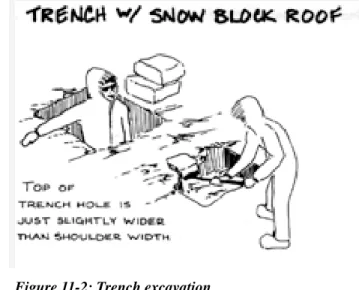
1. Choose a site with soft enough snow for dig-ging. Mark an outline in the surface just slightly wider than your shoulders and 6 to 7 feet long.
Figure 11-2: Trench excavation
2. Excavate the trench by cutting out blocks with a snow saw and/or by shoveling. (Blocks for the roof can come out of a separate quarry area.) It’s critical that the top of the trench “hole” be slightly wider than shoulder width - just wide enough to work in. If you make the trench too wide, you’ll have a difficult time roofing it with snow blocks. The trench should be waist deep to armpit deep, depending on snow conditions and the desired comfort for the inhabitants. If hard snow or an ice layer prevents you from digging to an adequate depth, build up the depth by making a wall around the excavation with large, stout snow blocks. (See figure 11-2).
3. When the trench is deep enough, sleeping benches can be carved out of the sides. Be careful not to dig too close to the surface or the
snow will be too weak to support roof blocks. 4. Roof blocks can be either laid flat across the
trench or set up as an A-frame, which gives more head room. Roof blocks leaned A-frame style can be staggered to support each succes-sive block. Don’t worry about gaps or holes, as these can be filled in later with snow chunks. Good dimensions for roof blocks are approxi-mately 18" x 5" x 30", but let common sense and snow conditions dictate what size blocks to cut. (See figure 11-3).
5. Finish the shelter by “chinking” the gaps with snow chunks and shoveling loose snow over the roof.
11.3b Trench with Tarpaulin Roof
A trench with a tarpaulin roof is the quickest shelter you can build. This is very important in an emergency. 1. The size of the trench you dig is dependent on
the size of the covering and on the support items used to span the trench. Support items could include skis, ski poles, bamboo flags, rope(s) stretched tight, etc.
2. Span the trench with support items, cover with a tarp, and anchor the edges of the tarp with snow blocks or heavy equipment.
Improvise with trench coverings. A trench can be covered with a tent fly, skidoo cowlings and covers, Nansen sleds, sled tanks, plywood, pallets, cardboard, plastic, etc. (See figure 11-4). 3. Shovel a light skiff of snow over the tarp to add
extra insulation; too much snow will collapse the tarp.
Trenches make good frozen-food coolers. They also make good toilet sites (preferably not in the same trench).
11.4 Snowmounds/Quinzhees
(2 to 4 Hours)
Snowmounds (also known as quinzhees) are among the easiest snow shelters to build. All you need is enough surface snow to shovel into a big pile over packs or equipment. The tunnel entrance is then dug in, the gear removed, and the shelter hollowed out and enlarged. 1. Pile equipment in the deepest patch of snow
available. Avoid unnecessarily flattening the site. (See figure 11-5).
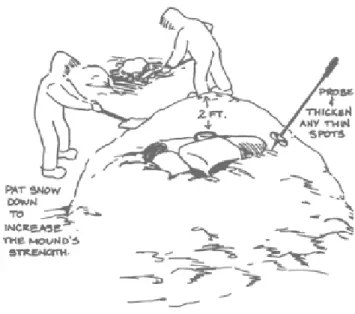
2. Standing well away from the equipment pile, shovel snow onto the center, burying the equip-ment. To increase the mound’s strength, pat the snow down as you proceed. The buried equip-ment must have a minimum of 2 feet of consoli-dated snow covering it. Probe all around the mound with an ice axe or ski pole and shovel snow on any thin spots. (See figure 11-6).
Figure 11-6: Buried equipment pile.
3. Dig into the mound on the downhill side or away from the wind to form an entrance. Dig down first and then back up into the shelter to create a cold air sump. The entrance should come up right near the wall. Be careful not to
tunnel into the central sleeping area as this will waste space.
4. Another temporary entrance dug opposite the main entrance and dug in at ground level will speed up the hollowing-out process by as much as an hour. This hole should then be blocked up after hollowing out is completed.
5. The equipment in the pile should be pulled out of the entrance(s), the inside of the shelter should be hollowed out carefully, and the floor dropped to increase the inside area. When you begin to see blue light, the walls are the correct thickness (about 12 inches thick.)
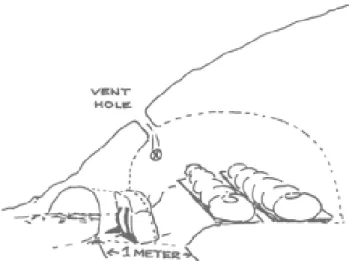
6. A vent hole the diameter of a tennis ball should be poked through the ceiling before operating a stove inside the shelter. (See figure 11-7).
Figure 11-8: Vent hole in snow cave.
11.5 Snow Caves (3 to 4 Hours)
A snow cave requires a sloping snow surface and snow that is well-compacted but soft enough to shovel. Wet or unconsolidated snow is liable to collapse. Given good conditions, a snow cave will provide roomy and comfortable shelter.
1. Dig an entrance tunnel, about the diameter of a car tire, that extends at least 3 feet into a drift. 2. Scoop out a platform at a level above the
en-trance tunnel to form a cold-air sump. The platform should be centered on the entrance tunnel and should be long enough and wide enough for all occupants. Remove excavated snow through the entrance. After scooping out the platform, hollow out a ceiling of a reason-able height.
3. A vent hole the diameter of a tennis ball should be poked through the ceiling before operating a stove inside the shelter. (See figure 11-8).
11.6 Igloos (3 to 5 Hours)
Although igloos are by far the hardest shelters to build and should not be attempted in an emergency, they are warm, roomy, and aesthetically pleasing.
1. Choose a quarry site for your snow blocks. Snow should cut with an even consistency. • Avoid blocks with a “curd-like” texture. • Avoid blocks with a shear layer.
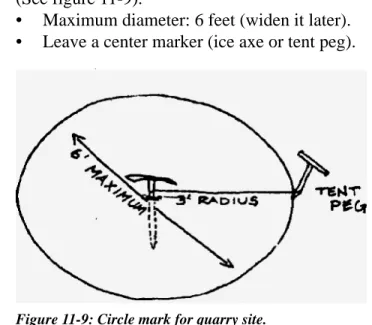
• In loose snow, the quarry area may have to be stomped out and allowed to set up. 2. Scribe a circle in the snow near the quarry site.
(See figure 11-9).
• Maximum diameter: 6 feet (widen it later). • Leave a center marker (ice axe or tent peg).
Figure 11-10: Snow block sizing.
Figure 11-11
3. Cut out the snow blocks.
• You’ll need 50 to 80 blocks.
• Calculate the ideal block size as shown below in figure 11-10.
Use SMC saw as a ruler: Total saw (length)
x 1/2 saw (width)
x
blade length (height)
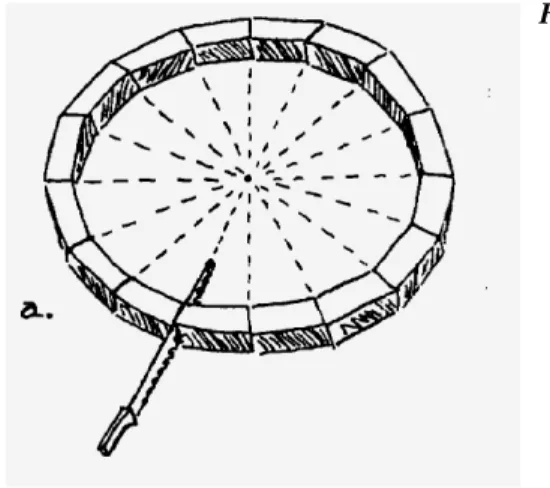
4. Lay out the first flight of blocks.
• Cut the sides of each block so they point to the center as shown in figure 11-11).
• Cut a spiral from ground level of the first block until the last 4 or 5 blocks are full size as shown in figure 11-12.
• The top spiral cut must point toward the center marker (at ground level). Use your saw as a “sight/straightedge” as shown in figure 11-13.
Figure 11-12
Figure 11-13
5. Continue laying blocks over the first flight. (All the blocks are now full size.)
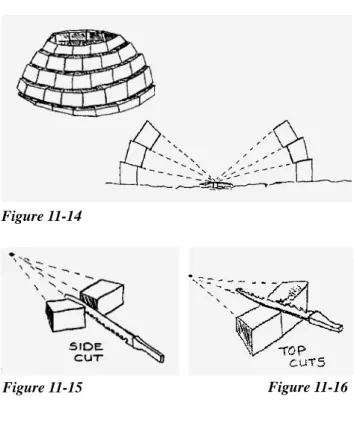
• Each flight of blocks is stacked slightly closer to the center as shown in figure 11-14. • Remember that side cuts are toward the
center as in figure 11-15.
• Level off the top layer, using your saw as a straight edge to sight toward the center at ground level as in figure 11-16. This brings the igloo progressively toward the center, which eventually closes it.
6. One person needs to stay inside the igloo with a saw and a small shovel, helping place each block.
• Don’t chink the blocks to make them fit. • Only the block you’re working on needs to
be held in place.
• As you build up, gently tamp the previously laid blocks in toward the center. This locks the blocks together.
• Never push out on the blocks; this unlocks them.
Figure 11-14
Figure 11-15 Figure 11-16
• The top edge of each flight should be smooth, with no bumps or steps.
Figure 11-17
Figure 11-18
7. The last block should be cut as a tapered “cork.” It is lowered to the person inside the igloo, who can cut the sides until it drops in snugly as shown in figure 11-17.
8. The inside person should next dig down into the snow at the base of a wall and tunnel over to meet the entrance tunnel being dug by a person outside, as shown in figure 11-18.
• Keep the entrance close to the wall to avoid using up sleeping area in the igloo.
• The entrance should be lower than the sleeping area to create a cold sink. 9. Hollow out the floor space in the igloo to
in-crease the sleeping area. Chink and shovel snow over any gaps in the blocks.
11.7 Crevasses and Bergshrunds
Crevasses and bergshrunds, in emergency bivouac situations, can provide shelter which can be augmented by chopping out ledges. The utmost care must be
taken to ensure the safety of you and your compan-ions in such a dangerous bivouac. Although these
shelters are very cold, you will be out of the wind if you choose a suitable site.