CEC Theses and Dissertations College of Engineering and Computing
2017
Individualized Instruction as a Faculty Training
Strategy for Technology Integration
Jennifer Merritt
Nova Southeastern University,[email protected]
This document is a product of extensive research conducted at the Nova Southeastern UniversityCollege of Engineering and Computing. For more information on research and degree programs at the NSU College of Engineering and Computing, please clickhere.
Follow this and additional works at:https://nsuworks.nova.edu/gscis_etd
Part of theComputer Sciences Commons
Share Feedback About This Item
This Dissertation is brought to you by the College of Engineering and Computing at NSUWorks. It has been accepted for inclusion in CEC Theses and Dissertations by an authorized administrator of NSUWorks. For more information, please [email protected].
NSUWorks Citation
Jennifer Merritt. 2017.Individualized Instruction as a Faculty Training Strategy for Technology Integration.Doctoral dissertation. Nova Southeastern University. Retrieved from NSUWorks, College of Engineering and Computing. (1013)
Individualized Instruction as a Faculty Training Strategy
for Technology Integration
by
Jennifer L. Merritt
A dissertation submitted in partial fulfillment of the requirements for the degree of Doctor of Philosophy
in
Computing Technology in Education
College of Engineering and Computing Nova Southeastern University
Abstract
An Abstract of a Dissertation Submitted to Nova Southeastern University in Partial Fulfillment of the Requirements for the Degree of Doctor of Philosophy
Individualized Instruction as a Faculty Training Strategy
for Technology Integration
by
Jennifer L. Merritt July 2017
It is inevitable that campus-based higher education will adopt some form of a hybrid learning approach. For schools and their faculty members, this means the acknowledgment and acceptance of these changes are required. Campus-based higher education faculty members wish to change how they teach courses due to societal demands to better suit the next generation of students. Initially, schools began offering new technology to faculty that wished to use the technology; however, over the years, due to the demands of competition with other schools and next generation, tech-savvy students entering academia, schools are starting to require the use of technology that was once only an option for faculty members.
This implementation of incorporating technology into the classroom has faced several roadblocks because what was once considered a simple transition has become more complex due to faculty resistance to new technology, which stems from various limitations, barriers, and perceptions, such as low computer self-efficacy, high computer anxiety, and time to learn new technology. The purpose of this study was to understand how in-service faculty experience individualized training as a method of teaching faculty how to use the technology and integrate it into their courses. The lived experiences and perceptions of in-service faculty regarding individualized training were specifically focused on to determine how individualized instruction was perceived to help or hinder integrating technology into their courses. The focus was the experience Harper College and McLennan Community College’s in-service faculty, who experienced training through the group training currently offered by the schools, as well as the proposed individualized training. Higher education faculty from general study areas, such as English, math, and science were invited to participate.
The study consisted of a 6-week individualized training program for 12 in-service faculty members (seven completed the study) who previously participated in a group training program about Blackboard. The study was a phenomenological approach in that used interviews to gather information regarding the lived experiences as the basis of analysis. The data for this study were gathered, horizonalized, and analyzed through a 7-step data processing method for phenomenology studies.
After the data were analyzed, the findings show how developing a good
individualized training program can help in-service faculty members not only integrate technology into their course designs but address any of the limitations or barriers the faculty faced. These findings coincide with the recommendations that training programs need to be developed into a phased approach in which the existing group training should continue but a secondary training program should be developed that incorporates
andragogy-based principles and the technological pedagogical content knowledge (TPACK) framework.
Acknowledgements
This has been an extremely long haul to complete the dissertation as many of life’s obstacles kept cropping up but in the end, a very rewarding journey. The massive amount of support from colleagues, family and friends helped me get through all of this.
My family has been my biggest support system during this process as they have been there every step of the way helping to overcome obstacles that cropped up and gave me the encouragement to complete this journey. My biggest supporter through this journey was my better half, as I could not have done this without her support and being at my side every step of the way.
I want to also extend thanks to faculty that participated in the study and the schools that supported this study. I thoroughly enjoyed working with them and that experience has helped to develop long lasting friendships as well. It was a good learning experience for all and look forward to a continued working relationship with the faculty and schools.
Lastly, thank you to my advisor Dr. Wang for not giving up on me and realizing that life’s obstacles were there at every turn. I cannot express enough appreciation for everything Dr. Wang has done for me over the years. Thank you goes out to Dr. Snyder and Dr. Lane for joining the committee and sticking with me as I know this was a long haul for all you!!
Table of Contents
Abstract ii
Acknowledgements iv List of Tables viii List of Figures ix
Chapters
1. Introduction 1
Technological, Pedagogical, Content Knowledge 5 Problem Statement 8
Dissertation Goal 12 Research Questions 14
Relevance and Significance 14 Barriers and Issues 16
Assumptions, Limitations, and Delimitations 18 Definition of Key Terms 19
2. Review of the Literature 23
Benefits of Technology Integration 26 Examples of Technology Integration 29
Limitations and Barriers to Integrating Technology in the Classroom 32 Faculty Perceptions 40
Andragogy 46
Technological Pedagogical Content Knowledge 49 Integration and Training Example 52
Training 56 Summary 60
3. Methodology 61
Introduction 61 Research Design 61
Research Design Appropriateness 62 Epoché and Subjectivity Statement 63
Population and Sample 64 Participant Selection 65 Instrumentation 66
Data Collection Procedures 67 Data Analysis 73
Format for Presenting Results 75 Validity and Reliability 76 Ethical Considerations 77 Summary 78
4. Results 80
Overview 80 Data Analysis 80
Horizonalization of the Data 81 Example of Data Horizonalization 82 Textual and Structural Descriptions 87
Textual Description of Pam’s Experiences 88 Structural Description of Pam’s Experiences 90 Textual Description of Sally’s Experiences 91 Structural Description of Sally’s Experiences 93 Findings 94
5. Conclusion, Implications, Recommendations, and Summary 102
Conclusions 102 Implications 112 Recommendations 115 Summary 116 Appendices A. Epoché 118
B. Institutional Review Board Approval 124
C. Email Call to Participate in the Study 132
D. Cover Letter and Adult Consent Form 134
E. Initial Interview – Training Program Design 136
F. First Interview Question Guide 140
G. Second Interview Question Guide 143
H. Third Interview Questions Guide 145
I. Thank you Email to Participants 146
J. Textual and Structural Descriptions for Hannah 148
K. Textual and Structural Descriptions for Ann 159
L. Textual and Structural Descriptions for Lynn 167
M. Textual and Structural Descriptions for Greg 176
N. Textual and Structural Descriptions for Kim 184
O. Composite Descriptions and Synthesis 191
P. Synthesis 201
List of Tables
Tables
List of Figures
Figures
1. TPACK Framework Illustration 6
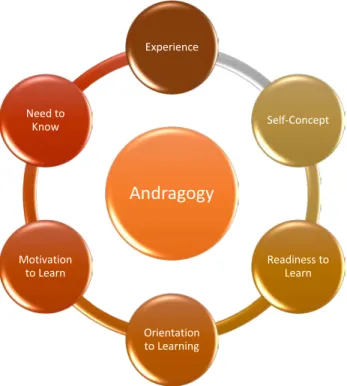
2. Six Principles of Andragogy 47
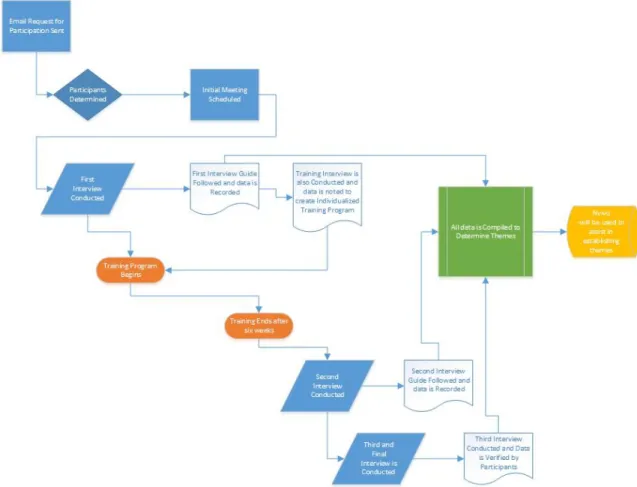
3. Data Collection Process 68
4. Gradebook Example 70
5. Calendar Selection 71
6. Course Module Example 72
Chapter 1
Introduction
As technology continues to advance and become more integrated into the daily
lives of individuals, it is also being integrated into classrooms, spanning from preschool
through higher education. At present, many higher education institution leaders have
expressed feeling the pressure of having to implement some form of technology in
classrooms so they can keep pace with the technologically informed students (Courts &
Tucker, 2012; Means, 2010). One institution this applies to is Harper College, located in
Palatine, Illinois: “In 2004, Harper College served a total of 37,338 credit and noncredit
students during the summer, fall, and spring terms, making Harper one of the largest
community colleges in the country” (Harper College, 2013, para. 17). A second
institution is McLennan Community College out of Waco, Texas, which has been around
since 1965 and the school has only been using Blackboard for the past three years
(McLennan, 2016).
Currently, most higher education faculty members are familiar with using a
computer for PowerPoint presentations, but colleges should offer a larger array of
technology that can be utilized in the classroom. Members of Harper College and
McLennan Community College’s leadership have responded to the needs of the current
student population by offering an online supplement for face-to-face courses, using
from various devices, such as computers, iPads, and smartphones. This technology’s use
may be largely beneficial to the faculty and students when utilized effectively. Such
utilization could include extensive use, such as asynchronous discussions using online
forums, and low-level use, such as emailing and grade posting (Courts & Tucker, 2012;
Ertmer & Ottenbreit-Leftwich, 2010). To educate faculty on Blackboard and its
functionality, both colleges offer group training for faculty members throughout each
semester, with one course being an introduction to Blackboard and the second being an
advanced course on the use of Blackboard. It is not mandatory for faculty partake in
Blackboard training; however, faculty members are highly encouraged to attend.
Regardless of such encouragement, the turnout for sessions has traditionally been low.
Some of the current trends in research suggest technology training is best offered when
coupled with the specific needs and goals of a particular faculty member, thus suggesting
an individualized training program for teaching technology among faculty.
Individualized training has the high potential to promote professional
development and long-term changes in teachers’ attitudes toward and practices with
technology in the classroom by providing individualized training and support in the
context of a real classroom (Kopcha, 2012). Moreover, in Kopcha’s (2012) study, a
training mentor uses individualized training to improve technology integration in the
classroom. To begin the individualized training, the mentor starts with a needs analysis
through initial or pretraining information gathering of the current situation. The results
from the needs analysis—especially the barriers or hindrances—were used in the
individualized training development. The training results showed improved knowledge
Individualized training has been specifically established to be effective in
improving teaching skills for Kindergarten through 12th(K-12) grade students
(Archambault, 2011; Archambault & Crippen, 2009). Archambault and Crippen (2009)
claim there is a need to focus on K–12 students and teachers because there is a major
push for K–12 schools to offer online courses, thus requiring the use of technology in the
classroom. Hence, there is a need to explore how to improve teacher skills and
knowledge in technology use in their classes, given this push for online courses in K–12
schools. Archambault (2011) focuses on a national survey of K–12 online teachers to
determine their preparedness for using technology inside the classroom. K–12 online
teachers indicate they feel the most prepared in the areas of pedagogy, content, and
pedagogical content; however, they are not prepared for the aspects of teaching related to
technology (e.g., technological pedagogical knowledge [PK], technological content
knowledge [CK], and technological pedagogical content knowledge [TPACK]). TPACK
examines the relationship and the interactions between content, pedagogy, and
technological knowledge and will be explained in greater detail later.
Offering individualized training can help with the issues of faculty not
understanding how to relate the technology to their personal teaching and learning
philosophies and their pedagogy, which can help achieve maximized results for the
integration of pedagogy into technology training (Georgina & Olson, 2008). Considine,
Horton and Moorman (2009) suggest that because faculty members today are considered
digital immigrants, connecting their knowledge of technology to the common teaching
methods (pedagogy) proves challenging. This is exasperated considering the numerous
teaching career (Kao, Chin-Chung & Shih, 2014). This thought is also supported by
Lapp, Moss, and Rowsell (2012), who argue that faculty members struggle with ways to
incorporate new models of learning with integrating technology in the classroom. Kurt
(2013) noted that society also plays a big role in determining what kinds of technology
are implemented in the classroom which may benefit society but the faculty feel not
equipped to integrate the ever changing technology into their curriculum. This is where
focused, individualized training can assist faculty in effectively integrating technology
into the classroom, and it can help them relate the content to their personal teaching and
learning philosophies.
Through this study, the researcher examined the faculty experiences with
individualized training. The focus of this study was how faculty members perceive how
the training helped them become confident in using the current technology provided by
Harper College and McLennan Community College, how it assisted with effectively
integrating the technology in to the classroom, and how the technology aligns with their
personal teaching and learning philosophies. Psychological barriers for faculty were
recognized while conducting the training, such as low computer self-efficacy and high
computer anxiety, as they could hinder the learning process, along with pedagogy
reasoning. The negative effect on self-efficacy and the increased effect of anxiety
highlight the need to aid teachers in the use of technology through individualized
training. Nevertheless, self-efficacy and anxiety are not the focus of the study. By gaining
a more in-depth understanding of these barriers and determining the best training plan for
the faculty that aligns with their personal teaching and learning philosophy (pedagogy), it
comfortable with integrating technology in the classroom with relating it to their
pedagogy. In turn, this confidence will help foster a student-centered, outcomes-based
learning environment.
Technological, Pedagogical, Content Knowledge
Faculty were offered opportunities to receive professional development, but this
could be problematic when not delivered to meet the faculty members’ needs. Most
professional development is often quite generalized and not driven by the faculty
members’ needs. The training sessions were quick and focused on just showing the
features instead of explaining how they could be applied in the classroom or to the course
design. This is why faculty needed a “collection of competencies and knowledge of how
to use . . . disciplinary knowledge, pedagogical techniques, and technological tools” in
their classrooms (Kereluik, Mishara, & Koehler, 2011, p. 15). Faculty required a different
level of literacy and competency with technology, which is why the TPACK model is
utilized for this study.
Shulman (1987) identified a framework for describing various domains of
knowledge that he felt were needed for effective teaching. Shulman believed that no
single domain was sufficient to create instruction that would create an effective learning
environment. Shulman felt that by reviewing all the domains and the intersection of
these domains creates the best instructional material for a faculty’s discipline that not
only benefits the instructor but also the students. Mishra and Koehler (2006) took
Shulman’s framework and expanded upon it to create knowledge domains of technology.
Mishra and Koehler added the domain of technology knowledge to address the
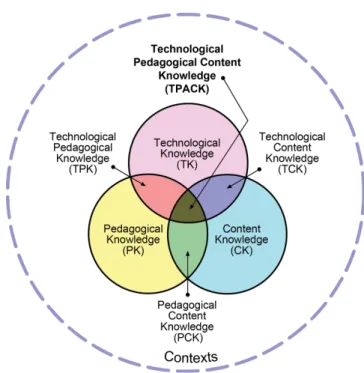
TPACK examines the relationship and the interactions between content,
pedagogy, and technological knowledge as seen in Figure 1 (Kereluik et al., 2011; Shin,
Koehler, Mishra, Schmidt, Bara, & Thompson, 2009). Looking at these relationships
encourages faculty to develop new strategies regarding how to integrate technology while
aligning with the faculty members’ pedagogical strategies. This new knowledge also
creates a new role for the faculty: They become the course designer instead of just being
a standard technology user (Kereluik et al., 2011).
Figure 1. TPACK Framework Illustration from http://tpack.org.
Technologies are constantly changing and emerging, which may be a great asset
for education when proper integration is researched and understood. Technological
content knowledge (TCK) is crucial, as faculty need to know how to utilize the
technology to successfully integrate it, but this knowledge needs to be “flexible, creative
manage, direct, and employ the technology to meet their pedagogical needs. The training
provided should also be aligned with the faculty members’ specific pedagogical content
knowledge (PCK) so the faculty members can understand how to integrate the technology
into their course designs.
Technology by itself is not inherently an educational tool but a tool that needs to
be repurposed for education. As Spires, Lee and Turner (2008) note, this is why it is
important to connect the 21st-century tools for classroom purposes, and without this
connection, it is understandable why faculty are hesitant in integrating the technology
into their course designs. Understanding that technology is a product that has a way to
reshape the course content that can create an open environment for faculty and students to
freely dialog, experiment and collaborate is an important tool to learn. Utilizing a
TPACK framework that integrates technology, pedagogy, and CK has been established to
help faculty better integrate the different aspects of knowledge to technology use in the
classroom (Koehler & Mishra, 2009). TPACK will be used as the framework for the
individualized training because it has been established to be a promising approach to
facilitate the use of technology in education, specifically in the classroom (Alsofyani,
Aris, Eynon, & Majid, 2012).
The individualized training using a TPACK framework will be composed of three
phases: learning, enacting, and transferring (Graham, Burgoyne, Cantrell, Smith, St.
Clair, & Harris, 2009). The learning phase involves interactive classroom instruction
about content topics, process skills, and inquiry for Blackboard (Graham et al., 2009).
The enacting phase has six sessions of an in-depth study about selected topics related to
knowledge is then applied to the learning management system (Blackboard) for each
participant in the training session.
Utilizing a TPACK framework will allow faculty to effectively and confidently
integrate technology, which begins with proper training. By providing a change in
knowledge, you can create a change in practice, which will result in greater technology
integration (Shin et al., 2009).
Problem Statement
Online technology is becoming prevalent in today’s higher education system, as it
becomes an integral component of most schools and universities. As the popularity of
online technology grows, so does the need for faculty members who can use online
technologies effectively in their classrooms. Students today who are technology driven
need faculty who can teach them online technologies so the students can remain focused
and engaged. Faculty who are adept with the use of online technologies can also increase
student communication, as students comfortable with online communication find it to be
more engaging (Kurt, 2013; Smith, 2007).
Lowerison, Sclater, Schmid, and Abrami (2006) claim that online technology is
growing at a tremendous rate; one significant effect of this is on the way instruction is
delivered in schools across the United States. Moreover, this tremendous growth in online
technology requires classroom faculty to become adept with using technologies—if not
expert technology users overnight—to become effective contemporary faculty and to
meet their technologically-driven students’ needs (Allen & Seaman, 2007). This change
is important to address the national dependency on technology as businesses today
the workforce with a solid foundation as to how to use it or at least be computer literate
(Kinshuk, Hui-Wen, Sampson & Chen, 2013). Most classroom faculty cannot maintain
this new demand from students and resist using online technologies in the classrooms for
various reasons, from psychological barriers to the time needed to learn the new
technology (Li, 2007). Due to the lack of knowledge pertaining to technology, many
faculty members perceive the integration of online technology in the teaching and
learning the process as a time consuming and unnecessary task (Kopcha, 2010; Kotrlik &
Redmann, 2009).
Allen and Seaman (2007) claim that the majority of faculty members found the
use of online technology in how they teach their classes an unreasonable request and that
the demand to catch up with the ever-changing pace of online technology is not possible.
Many studies also show the majority of educators cannot remain current with new
technologies that keep coming out and are less comfortable with using those technologies
in their courses (Carnevale, 2007; Columbaro & Monaghan, 2009; Weshah, 2013). Such
discomfort and resistance to keeping up with new technology makes faculty unable to
meet the needs of their students. As a result, faculty struggling to integrate an increasing
number of technology tools into their classroom instruction are also struggling to be
effective instructors to these students. Curran (2008) suggests that educational institutions
that require their faculty to incorporate online technologies and tools to facilitate teaching
strategies should be diligent in understanding what factors could support faculty
members’ abilities to do so and what barriers they experience through effectively using
Despite technology being utilized in classrooms for some time at this point,
certain faculty members still choose not to incorporate technology into their classrooms
or teaching methods (Davidson, Richardson & Jones, 2014; Means, 2010). Technology
training programs can be tailored to fulfill faculty members’ needs so they can be
comfortable with implementing technology in the classroom that will help foster a
student-centered, outcomes-based learning environment. It is important to note that, as
technology continuously changes, faculty members have learned how to use various
programs and equipment on a continual basis, which adds to the time faculty spend on
learning the technology, but only from the technical point of view.
Individualized training programs and professional development programs, which
can help alleviate stress, can be utilized by faculty to develop a stronger foundation on
which to operate such technology. Researchers have argued that faculty “need exposure
to and practice with technology which directly relates to existing pedagogical content
knowledge” (Ertmer & Ottenbreit-Leftwich, 2010, p. 266). Individualized or small-group
training has been found to aid in the success of technology training among educators (de
Vry, 2003; Georgina & Olson, 2008). Training can be enhanced when the training is
limited to a specific tool that the faculty member wants to learn but learn in a safe
environment where they can make mistakes without messing up their courses. This safe
environment can help to increase faculty confidence and potential increase in usage of the
tools learned (Hartsell, Herron, Fang, & Rathod, 2010). By eliminating some of the
stressors—such as low computer self-efficacy, high computer anxiety, and the amount of
time required for learning the new technology—faculty members may demonstrate an
without addressing these stressors, faculty members may continue to reject the utilization
of the latest technology in the classroom (Shu, Tu, & Wang, 2011).
One of the barriers to effective technology integration is computer self-efficacy.
Self-efficacy is derived from the social cognitive theory, which accounts for the different
roles learners utilize in their everyday learning and human behavioral adaptation
(Bandura, 1987). According to this theoretical framework, learners are self-regulating
when it comes to their learning methods (Moos & Azevedo, 2009). This framework may
help explain how individuals acquire knowledge and what other items may influence this
learning effort, such as personal factors and learning environments. Bandura (1987)
stated that self-efficacy is one’s self-perception of one’s capabilities to meet situational
demands based upon current states of motivation, the course of action needed, and
cognitive resources. If a faculty member has a current low level of computer self-efficacy
or a high level of computer anxiety, then that member will be less motivated to utilize
new forms of technology in teaching methods.
The significance of this problem is that these faculty members allow stressors and
barriers to stop them from learning and using current technology in the classroom. As
noted by Ertmer and Ottenbreit-Leftwich (2010), most individuals expect certain
professionals to be up-to-date with technology, such as professionals in the fields of
medicine and law enforcement; however, this expectation is rarely applied to educators.
In looking at what faculty members currently utilize in the classrooms, faculty members
utilize the same tools—such as PowerPoint, Scantron cards, slide shows, and videos—
like instructors who came before them. As with other professions, faculty members are
(Courts & Tucker, 2012; Ertmer & Ottenbreit-Lefwich, 2010). To achieve these skills, it
is necessary for schools to assist educators in understanding how to use new forms of
technology, which in turn can be used to facilitate meaningful learning (Eastmen, Iyer, &
Eastman, 2009; Lai, 2008).
Conducted research has focused on working with and training adult learners,
which has shown that these types of learners are more comfortable and willing to adapt to
new technology as long as the training takes into consideration their current levels of
computer use and experience (Ertmer & Ottenbreit-Lefwich, 2010; Mitzner et al., 2008).
Moreover, with individualized training, adult learners can be encouraged to learn more
clearly explained concepts (Chang, Shieh, Liu, & Yu, 2012). This individualized
instruction can benefit faculty in a positive way when undergoing technology training,
thus addressing barriers that have hindered the learning process in the past, such as
lacking computer self-efficacy and decreasing levels of computer anxiety. Because adults
need additional time to attain the basic skills and additional assistance when undergoing
technology training, individualized training is a more appropriate concept (Mitzner et al.,
2008). Currently, group training is being used by most schools, including Harper College
and McLennan Community College. Through the exploration of how faculty members
experience individualized training for technology integration, trainers for academic
institutions can learn how this strategy can be used most effectively for faculty
development.
Dissertation Goal
The purpose of this study is to understand how in-service faculty experience
integrate it into their courses. The lived experiences and perceptions of in-service faculty
regarding the individualized training are specifically focused to determine how
individualized instruction is perceived to help or hinder integrating technology into the
faculty members’ courses. In relation, the researcher explores the unique elements of
individualized training. In addition, the researcher also has the opportunity to
demonstrate how in-service faculty members’ lived experiences of individual training add
to the body of knowledge. The focus is the experience of Harper College and McLennan
Community College’s in-service faculty, who had experienced training through current
group training and individualized training. Higher education faculty from general study
areas, like English, math, and science, were invited to participate.
This qualitative study includes the collection of data using phenomenological
interviews. Phenomenology is a qualitative approach that seeks to investigate individuals’
perceptions, feelings, and opinions based on their lived experiences in relation to a
particular phenomenon. The approach deals with comprehensive descriptions and
supports a reflective structural analysis portraying the essences of the experience
(Moustakas, 1994). In the case of this study, the phenomena studied were the lived
experiences and perceptions of faculty regarding the individualized training.
The researcher chooses the phenomenological approach to understanding the
experiences of individualized training among faculty members and determines how the
individualized training assists in technology integration. This is the best method for
understanding the experiences of individuals and for gathering comprehensive
understanding of an experience or phenomenon (Rubin & Rubin, 2004). This method is
phenomenological research design allows the researcher to completely capture and
characterize a phenomenon based on how participants perceive, describe, feel, remember,
and make sense of this phenomenon (Patton, 2001). According to Patton (2001), “to
gather such data, the researcher must undertake in-depth interviews with people that have
directly experienced the phenomenon of interest; that is, they have ‘lived experience’ as
opposed to secondhand experience” (p. 104).
Research Questions
The research questions follow:
RQ1. How do in-service faculty members describe their experiences with
individualized instruction? What themes emerge from these experiences? What is the
overall essence of the experience?
RQ2. How do in-service faculty members perceive the effectiveness of
individualized training in helping them integrate technology into their classrooms?
RQ3. From the in-service faculty members’ perceptions, what are the barriers of
individualized training in helping faculty to integrate technology into their classrooms?
Relevance and Significance
The significance of this problem is that higher education institutions need to
address faculty barriers to create an effective training program that increases technology
use in the classroom. As noted by Ertmer and Ottenbreit-Leftwich (2010), most
individuals expect professionals to be up-to-date with technology; however, when it
comes to educators, this expectation is rarely applied. Ertmer and Ottenbreit-Leftwich
(2010) state that faculty members use the same tools used in the past. Faculty members
needs (Courts & Tucker, 2012; Ertmer & Ottenbreit-Lefwich, 2010; Kurt, 2013; Means,
2010). Students today use technology in their everyday lives, and they expect to use the
same pieces of technology to the same degree in classroom and academic settings (Kurt,
2013; Means, 2010). In not utilizing technology in the classroom, students could become
uninterested in the course material and learning methods of that institution and transfer to
other institutions that offer the technology they are accustomed to utilizing. For faculty
members to gain the skills necessary to integrate technology in the classroom, institutions
should first assist educators in understanding how to use the technology and how it can
relate to their pedagogy. This will help foster a meaningful learning environment and
satisfy present-day learners’ needs (Eastmen et al., 2009; Kopcha, 2012; Lai, 2008).
Most of the research conducted in faculty development and technology integration
in the classroom focuses on the learner’s perspective or teachers in the K–12 programs
(Courts & Tucker, 2012; Ertmer & Ottenbreit-Lefwich, 2010; Means, 2010). Previous
literature focusing on the learners focuses on how technology assists learners in achieving
a better learning experience instead of focusing on how it can be related to the faculty
members’ pedagogy (Abbitt, 2011; Edmunds, Thorpe, & Conole, 2012). Few studies
focus on faculty in higher education, which is why this study addressed the topic of
providing effective training programs for higher education faculty to increase technology
integration by in-service faculty. During this study, the researcher looked at utilizing
individualized training sessions to help increase educators’ knowledge of Blackboard,
how to use the technology in the classroom, and how educators’ can relate to the usage of
greater understanding of how individualized instruction can be used as a faculty
development strategy would help technology integration.
Though the focus was on Harper College and McLennan Community College,
where members of the colleges’ leadership have responded to students’ needs by offering
Blackboard as an online supplement for face-to-face courses, the findings of this study
could be used to generate an understanding for other educational technologies or systems
used in the classroom. Blackboard is a learning management system (LMS) which
students can access from various devices, such as computers, iPads, and smartphones.
This technology’s use may be largely beneficial to the faculty and students when utilized
effectively.
Barriers and Issues
In exploring the issue of creating an effective training program, certain barriers
and issues needed to be addressed. Some of the barriers included gathering a group of
faculty members willing to gain a better understanding of Blackboard and how to
implement Blackboard into their classroom. As noted in the review of the literature, if an
individual has a low level of computer self-efficacy or a high level of computer anxiety, it
is possible that individual may not wish to participate in the study. This could potentially
cause the pool of participants from which to choose from a sample to be smaller than
ideal. This could also create a pool of participants with various levels of existing
technology utilization backgrounds, different levels of computer self-efficacy, and
different levels of computer anxiety. This was evident in the participants in this study, as
participants quickly withdrew from the study, citing issues of time and comfort levels
with the technology.
Various studies in the past have addressed the issues of teaching faculty using
new technology, but this study went beyond the typical group training and provided
customized, individualized training for the faculty members. This caused some additional
issues, as there was a considerable amount of time required from both the trainer and the
study participants involved.
The following list describes the various issues present for this study:
• A very low turnout for participants from Harper College resulted in expanding the study to a second site, McLennan Community College.
• The panel of faculty members gathered who were willing to participate in the study for the entire length of the study totaled 12. Of the 12
participants who volunteered, two quickly withdrew due to time
constraints and self-efficacy issues.
• Time coordination with the participating faculty members for the initial interview and the weekly individualized training sessions became
increasingly difficult with the addition of the second site, as McLennan’s
faculty training was conducted via videoconferencing, as well as balancing
the schedules with Harper College’s faculty.
• Coordination with the faculty development department at Harper College ensured a classroom with technology access was available for
• Coordination with the faculty development department at McLennan Community College ensured the participants had access to a computer for
the videoconference training sessions.
• Coordination with the faculty members for interviews after the training had been completed.
• Coordination with the faculty members for data validation to ensure their interviews were correctly transcribed.
The study had certain barriers and issues to resolve, but because the participant
group had a diverse background and varying types of barriers, the study provides
information about how academic institutions can adjust their training methods to enable
integrating technology and its utilization by faculty members.
Assumptions, Limitations, and Delimitations
The researcher assumed the phenomenological methodology is the most
appropriate for the research purpose because it enables the researcher to explore lived
experiences within a natural setting. Conclusions were generated from the participants’
responses regarding the issue of interest. Phenomenology enables the researcher to assess
how participants perceive, think, and feel for an issue of interest (Creswell, 2009; Vogt,
2007). According to van Manen (1997), phenomenology reveals the meanings that
participants ascribe to a specific issue of interest. Van Manen (1997) states the “lived
experience is the starting point and end point of phenomenological research” (p. 36).
Moreover, these experiences and their meanings can only be understood and captured if
the participants will engage in in-depth conservations (Polit & Beck, 2004; Van Manen,
However, there are inherent limitations to a phenomenological methodology
design. Given the methodology design and the use of phenomenological interviews as the
major source of data collection, the potential for interview bias exists and the reliability
of the results may be questioned. However, the researcher reflected upon her stance
toward the research problem and maintained an awareness of any bias throughout the
interview process. Regarding the reliability of the results, the researcher employed
methods—such as member checking—as a way to improve the trustworthiness of the
results.
This study was delimited to the employees of Harper College and McLennan
Community College, who experienced training through the individualized training and
taught the various subject areas: business application, healthcare administration, biology,
animal science, business math and college readiness. A sample of 20 participants was
proposed but the study was only able to solicit 12 participates for individualized training
and various interviews. Using interviews as an approach to data gathering was more
appropriate for the current study because the purpose and research questions required the
input of participants regarding their lived experiences concerning the training they
encountered. Though the study was limited to the use of semi-structured interviews, this
was sufficient to reveal more information and explanations from the participants
compared to what could be gathered through surveys (Moretti et al., 2011).
Definition of Key Terms
By explaining or clarifying the meaning of the following terms, readers will have
Barriers refer to elements that obstruct the effective use or learning of an
innovation. These are issues related to the adopter of the innovation and the innovation
itself. Issues are often related to how the innovation is communicated (Funk, Tornquist,
& Champagne, 1995).
Computer anxiety isa psychological construct that is a “fear of computers when
using the computer, or when considering the possibility of computer use” (Hasan &
Ahmed, 2010, p. 84).
Computer self-efficacy is a judgment of one’s capability to use a computer in the
future when faced with a new or unfamiliar situation (Compeau & Higgins, 1995).
Content knowledge is described as “knowledge about the actual subject matter
that is to be learned or taught” (Mishra & Koehler, 2007, p. 5).
Digital divide is the gap between students’ knowledge of technology and the
faculty members’ knowledge of technology in the classroom and in the everyday world
(Project Tomorrow, 2011).
Educational technologies are technological options that can alter faculty
members’ delivery methods and lead to enhanced learning outcomes, fewer costs, and
improved communication between faculty and students (Heirdsfield, Walker, Tambyah,
& Beutel, 2011).
In-service training is training provided to faculty that are currently employed in
higher education classrooms.
Information and communication technology (ICT) is technology that provides
access to information through telecommunication methods, such as the Internet, wireless
The International Society for Technology in Education is an association that
advocates for the utilization of innovative and effective technology use to promote
excellence in learning. Advocacy includes providing professional development and
developing the standards for technology use for students, faculty, and administrators that
are internationally used in education (International Society for Technology in Education,
2008).
Online technology refers to devices, machines, and techniques used to facilitate
productive processes from a computer network (Anderson, 2003).
Pedagogical knowledge (PK) refers to knowledge about various teaching methods
that align with educational purposes, goals, and values, which allows for the
incorporation of such materials and methods in the classroom (Mishra & Koehler, 2007).
PCK is the knowledge about content that can promote learning the classroom
through curriculum, assessment, and reporting (Mishra & Koehler, 2007).
Phenomenological research is research that includes a systematic method to
examine and describe the “lived experience” (Creswell, 2007) of participants to
understand the meaning and nature of a phenomenon (Cilesiz, 2011).
Professional development comprises activities that improve a faculty member’s
instructional knowledge. Activities could consist of group training, research, conferences,
or learning something new about technology.
TCK is a faculty member’s understanding of how technology and content can
TPACK is the understanding of how content, pedagogy, and technology
knowledge interact with one another. All components need to be assessed simultaneously
(Mishra & Koehler, 2007).
Technological (TPK) is an understanding of the relationship between technology
and learning with a focus on how technology can impact on the learning process. TPK
also addresses the constraints of technology in learning, along with constraints to
pedagogical strategies (Mishra & Koehler, 2007).
Technological knowledge (TK) is the understanding of technology and having
sufficient knowledge to achieve implementation goals and technological changes (Mishra
Chapter 2
Review of the Literature
U.S. Education Secretary Arne Duncan noted that the nation’s school systems,
whether higher education or school/district levels, have yet to utilize technologies’ full
potentials in the classrooms. Leadership at these institutions needs to adopt better training
techniques so educators can integrate the technology into the classroom that will enrich
the learning experience (United States Department of Education, 2010). Many educators
have acknowledged the importance of having technology in the classroom and its impact
on the learning process but need a better commitment from leadership to not only allow
access to the technology but to also training the faculty in how to effectively use it.
Research has shown that an increase in usage of technology in education also provides an
economic benefit to the country as well (Cervera & Johnson, 2015; Stine, 2011).
The goal of the research was to understand how in-service faculty experience
individualized training as a method of teaching faculty how to use the technology and
integrate it into their courses. This section presents a review of literature related to this
topic. The review covers studies on the benefits and examples of technology integration,
limitations to integration, and barriers to technology integration, faculty perceptions,
Despite the abundance of studies on ICT’s effects, most of the research that has
been conducted in this field has focused on the learner’s perspective. Previous literature
is too focused on how technology will help students achieve a better learning experience
through technology use. Limited studies have focused on higher education faculty, which
is why this study researched how individualized training increased technology utilization
in the classroom for in-service higher education faculty. Current models of training today
are completed by training the faculty on the features of functions of the learning
management system instead of how those features can be incorporated into the faculty’s
curriculum (Keengwe & Georgina, 2012). The individualized training needed to go
beyond the basic concepts of the computing technology, as it needed to be relevant to the
curriculum being taught and aligned with the faculty member’s personal teaching and
learning philosophies. This is why individualized training could be such a benefit to
teaching faculty how to integrate technology, as long as the training is individualized and
curriculum-based (Baylor & Ritchie, 2002; Beckers, 2000; Roberts, 2003).
Observations in the classroom—ranging from K–12 academic settings and higher
education—have noted the modest educational technology utilization (Means, 2010).
Despite decades of promotion at all levels, classroom practices in most schools have
changed very little from those of the mid-20th century (Means, 2010). Recent large-scale
survey results revealed an increase in faculty technology use between 2005 and 2007;
however, since this time, there has been no increase in technology-based learning
activities (Bakia, Means, Gallagher, Chen, & Jones, 2009). Gray, Thomas and Lewis
(2010) conducted a nationwide survey about educational technology implementation and
during class time even though they reported that 93% of the schools were Internet
accessible. Ehrlich, Sporte and Sebring (2013) conducted a study of Chicago schools and
found that nearly 30% of students rarely used technology for instructional purposes.
Faculty and student use of technology seems to occur more often outside the classroom
than within the classroom which is creating a student population that has a higher level of
computer literacy than the faculty (Lahti, Hätönen & Välimäki, 2014). According to the
United States Department of Education Office of Technology (2015), more than 90% of
children under the age of 17 are using computers which also demonstrates the importance
of integrating technology in the classroom.
Many forms of technology can be used in educational settings or for learning
purposes. A typical modern college student is likely to know more about Wikipedia than
World Book and would likely know more about how to locate bibliographic material
online than in a library (Courts & Tucker, 2012). Faculty can utilize this knowledge to
help promote learning for present-day technology-savvy students (Ertmer &
Ottenbreit-Leftwich, 2010). Technological methods like online videos, social networking, blogs,
virtual office hours, and learning management systems can be utilized in the classroom
(Courts & Tucker, 2012). For veteran faculty members, these methods may seem foreign,
but to the youth entering college today, these newer technologies are common and
familiar ground (Green & Hannon, 2007). The technology to support learning, consumer
demands, implementation into the classroom, and the knowledge to support currently
exists. The challenges are to find ways to integrate this technology into the classroom
with the faculty members’ full support which means the faculty need to have the
students and align with the course objectives (Ballou & Springer, 2015). Though studies
have established the importance of faculty members to integrating technologies in the
classroom due to modern students’ needs, limited studies have focused on how faculty
members should go about it and what skills they should have to effectively do so.
Benefits of Technology Integration
Technology has come a long way and has changed how we do things not only in
society but in the classroom today. These advancements are noted to not only help the
student advance in their career but also a benefit for the country economically as well
(Gerver, 2014). Matthews and Walton (2013) note that in today’s digital world,
technology is a major contributing factor to not only creating a level of computer literacy
but to also assist in the process of learning how to think critically. Because of these
changes in society, faculty need to make the necessary changes in the classroom to
incorporate technology to help students gain the necessary skills that society is looking
for. This does require that faculty make changes to how they present the material in the
classroom. Aaronsohn (2003) explains that traditional teaching methods include teaching
that focus on the content, with the faculty member considered an expert. Curriculum
content is expected to be “covered” so students can reveal their acquisition of a particular
body of knowledge. Student activity consists of paying attention to and listening to the
faculty. The primary focus consists of the product, not processes, for that traditional type
of instruction. These traditional teaching methods and the way students learn, according
to Aaronsohn (2003), pleases faculty. Most people were not taught to think for
In seeing how technology can change the classroom and the learning
environment, ICT was introduced and began the integration process. ICTs give students
the experience of obtaining immediate feedback on their work. ICTs also give them
adequate privacy and a more time reinforcement for their work, which all lead to a
supportive learning environment (Sang, Valcke, Braak, & Tondeur, 2010). These features
are generated by technology use in the classroom, which helps students become engaged,
even though the content being learned could be tedious and challenging. Using ICTs also
allows immediate notifications for the learners, which can assist in an increase in
performance, as the learner will immediately be notified of any negative performance;
this can reduce learners’ frustration and the time devoted to learning and relearning the
correct information, as well as the procedures being taught in class (Graesser, 2011).
Graesser also notes that ICTs allow students to receive corrections on their work without
the students feeling judged. Students will not feel insecure or embarrassed, even though
they engage in trial and error behaviors, which will lead them to make mistakes. Students
can be exposed to different ICTs in classrooms, such as games, applications, and
multimedia presentations, which usually help the students better understand specific
concepts. ICTs in the classroom, therefore, can lead to a higher sense of satisfaction so
students are more willing and engaged in learning and exploring the taught academic
concepts. Studies established that ICT programs, overall, can enable students to have
more flexibility in how they learn. As a result, ICT programs empower the students.
Technology use in the classroom has been found to have a positive effect on
student learning and faculty performance (DiVall et al., 2013; Drijvers, Doorman, Boon,
researchers gather perceptions of students, faculty members, and school administrators
regarding the frequency and appropriateness of classroom technology use in their classes.
A total of 466,124 faculty members and 12 school administrators participated in the
study. The results indicate that the most frequently used ICTs are course management
systems, audience response systems, and systems that capture lecture content.
Furthermore, faculty members and students expressed that the faculty members used
course management systems and audience response systems in the appropriate instance
and manner. However, the more technology-literate respondents reported a significantly
greater preference for increased use of classroom technology, despite the data indicating
that 86% of faculty members reported that they changed their teaching methodologies to
meet student needs. Ninety-one percent of the students agreed that the use of technology
satisfied their needs (DiVall et al., 2013). Properly training faculty to deliver the content
using the appropriate technological tools can have a big influence on the overall teaching
and learning experience (DiVall et al., 2013; Lubin & Ge, 2012).
In an additional study conducted by Drijvers et al. (2010), which dealt with
technology use in the classroom, the researchers explore the availability of technology in
the mathematics classroom and the manner in which the faculty members facilitate
student learning with the use of technology. Drijvers et al. (2010) used the theory of
instrumental orchestration to guide their research in investigating and determining the
types of orchestrations faculty members develop when using technology and the extent to
which it affects faculty members’ views on mathematics education and technology’s role.
Videotapes of 38 lessons were taught by three faculty members and were used for the
completing questionnaires and interviews. Through a qualitative analysis, the researchers
identified the orchestration types and faculty profiles. Results revealed that the
orchestration preferences of the three faculty members were significantly related to their
views of technology use.
Examples of Technology Integration
According to Hinson, Laprairie, and Cundiff (2005), even though 99% of
full-time public school faculty members could access computers and the Internet in their
schools, only 39% integrated technology into their lessons. Thirty-three percent of public
school faculty members considered themselves capable of using computers and Internet
teaching; however, 66% felt somewhat or not at all prepared to use this technology in the
classroom. According to the researchers, to implement positive technological changes,
faculty members need skills first to use technology and then to apply the techniques in
their teaching. Realistically, the researchers claimed a successful technology integration
plan should span 3–5 years. In addition, several stages make up a model of strategies
proven successful when integrating technology into the classroom. The first thing to do is
to develop a professional development team and include not only faculty members,
administrators, school staff, community members, and parents, but students and parents,
who should develop a plan and guide all aspects of the initiate. The second stage involves
preparation. The professional development team will determine training and
implementation, as well as the project’s aspects, including individuals who will
participate, which strategies and delivery participants will utilize, and evaluation
components. The next stage involves instruction, which works best on-site, with faculty
to test techniques and acquired training. The next stage involves refinement. This is
where faculty members must be given all needed necessary resources (e.g., hardware,
software, and peripherals, such as digital cameras), along with qualified support. The next
stage involves evaluation. To determine the merits of the project and impact on learning
and teaching, formative and summative evaluations need to be implemented. Accessing
outcomes can help determine whether to continue the program (Hinson, Laprairie, and
Cundiff, 2005).
Deubel (2006) contends that faculty members can transform the students’ love of
video games into a useful and valuable learning tool. According to Deubel, lessons
currently being learned in school are becoming more fun due to their resemblance to
video games. It was only a matter of time, Deubel stresses, for the technology behind a
computer and online gaming technology to penetrate the educational system. Marc
Prensky, in Digital Game-Based Learning (McGraw-Hill, 2000, as cited by Deubel
2006), states that schoolchildren today—from the elementary level through college—
travel with a varied array of technology, such as MP3 players, smartphones, and laptops,
which have access to the Internet. Digital game-based learning links educational content
with a computer or online games and is effective in the learning process if managed
properly, as it can present positive potential opportunities for a wealth of educational
application. Digital game-based learning motivates students to learn by making the
learning fun. Deubel purports that the use of new technological tactics in teaching is a
method that can be effective in teaching almost any subject matter or skillset when
promotes active engagement and experiential learning, supports this learning style (video
game use in the classroom).
Though research supports these and additional benefits of gaming, which could
include therapeutic benefits and increased motivation, a number of faculty members are
still resistant to students using video games in the classroom. Their reasons include the
following:
1. A game is inconsistent with learning objectives.
2. A game distracts students from learning.
3. A game’s components (flickering, sounds, etc.) trigger negative and/or
cognitive and physiological responses.
4. A game presents unacceptable violence.
5. A game does not fit into the current standards-driven accountability
movement in the educational realm (Deubel, 2006).
A number of case studies have countered these faculty members’ concerns. Video
games have been found to contribute to the development of a child’s spatial abilities.
They also assist children with special needs improve their basic skills in language, math,
and reading. Video games are reportedly even linked with social benefits, even though
they are frequently played in isolation, as they constitute a common communicative
interest (Deubel, 2006).
Henry Jenkins, the former principal investigator for the MIT-Microsoft
Games-to-Teach Project, examined the educational potential of computer and video games. He
contends that when video games are utilized in learning experiences, students experience
children learn to link goals and roles (Deubel, 2006). With successful studies of
technology utilization at all education levels and how studies show the students’ benefits,
training higher education faculty to utilize and integrate technology is an important asset
to the learning process for college students. This is equally important when incoming
students are accustomed to learning through technology.
Delgado, Wardlow, McKnight and O’Malley (2015) conducted a study that did a
review of the integration, resources and effectiveness of technology in K-12 classrooms.
Some of the conclusions derived from the study showed that over the past few years,
student-to-device ratios have reduced from 11:1 to 1.7:1. The ratio also showed how the
school’s resources dictated the amount of resources allocated to technology since many
did not achieve a 1:1 ratio but a few schools were able to achieve this goal. The overall
investment in terms of funding technology for the classroom have shown a decline but
there has been an increase of 97% of teachers having more than one computer in their
classroom. That number reflects the growing changes in the K-12 system with adding in
more technology for the students to work from and increasing the overall percentage of
the classrooms that have access to the Internet to 93% (based upon the literature used for
this study). In showing the increase in technology integration in the K-12 education
system, it increases the need to ensure that higher education institutions keep pace and
offer technology to incoming college level students.
Limitations and Barriers to Integrating Technology in the Classroom
There are many benefits to technology utilization in the classroom, but some
limitations exist in making this integration a reality. The work of Seamon and Levitt
for technology use in classroom instruction, are at the same time, “somewhat limited in
their skills and desperately search for ways to implement technology to assist them in
their lesson planning with the students’ best interests in mind” (Cole & Styron, 2005, p.
27).
As mentioned in Cole & Styron (2005), the work of Poole and Moran (1998) has
identified several factors known to contribute to the ineffectiveness of staff development
in technology. Those factors are the following:
1. lack of support from school administration,
2. lack of awareness of what is needed in the schools,
3. one-shot workshops that are inadequate and that have no follow-up,
4. training expense, and
5. a lack of continued support (Cole & Styron, 2005).
The study conducted by Cole and Styron (2005) is quantitative in nature and
involves gathering data through the use of a causal–comparative design involving the
responses of 90 faculty members who participated in online training modules through
FacultyLine, a free professional development program sponsored by PBS. The analysis
was conducted through the use of a survey that focused on the determination of a
difference in attitudes concerning online professional development. A factor in the
analysis was the level of computer experience possessed by individual faculty members
prior to their participation in an online professional development session.
The factors noted by Cole and Styron (2005) are important factors to address even
in the current age. Weshah (2013) addressed the importance of getting leadership on
help faculty to have a better awareness of the technology available and how to use that
technology because if faculty do not understand how to integrate the technology, they
will not use it. In addition of the support from leadership, faculty need to have the
support of technical support for any and all issues as a lack of service creates additional
technology and learning problems for both the faculty and students.
In addition to technology integration limitations, barriers also prevent faculty
from utilizing technology in the classroom or learning processes. Stevens (2014)
designed a study to assess the impact of training on the time needed for faculty members
to effectively use technology in the classroom. Many faculty members utilize technology
in the classroom to enhance student achievement; however, only a few have observed an
increase in student achievement levels. The researcher designed a quantitative study to
determine the length of time faculty spend using technology in classrooms and the length
of time faculty need to maximize the effectiveness of technology integration and training
on the time needed to integrate technology into teaching practices. The researcher
acknowledges that even though previous studies show training can lessen the time needed
for faculty to use technology in their classrooms, those studies fail to show the length of
time faculty spend integrating technology and the length of time faculty uses reducing
technology integration because they have undergone training. The researcher focused on
the barrier of time. The researcher found that time spent on integrating technology does
not generate the maximum effect. The number of minutes devoted to integrating
technology into the classroom is not similar to the number of minutes believed are needed
to get the maximum effectiveness from teachers’ technology use. The faculty members
to get the maximum effect. This means the faculty members were not devoting sufficient
time to integrating technology. Zhang (2015) found that more time was needed to learn
the new technology as gaining technology proficiency is something that requires lots of
time, practice and patience on the faculty’s part.
Computer self-efficacy and computer anxiety are two additional barriers that need
to be addressed when trying to get more faculty to integrate technology in the classroom.
It is also necessary to address faculty members’ perceptions of what this additional
technology adds to their workload. These concerns were addressed beforehand, as it is
important that faculty members recognize the positive aspects of using information and
communication technologies in the classroom, which results in successful technology–
classroom integration (Bitner & Bitner, 2002; Hartsell et al., 2010; Means, 2010).
Self-efficacy is derived from the social cognitive theory created by Bandura
(1987; as cited in Moos & Azevedo, 2009). Social cognitive theory addresses the areas of
“self-regulatory, self-reflective, cognitive and vicarious processes in human behavioral
adaptation” (Moos & Azevedo, 2009, p. 577). Research has demonstrated that learners
with higher self-efficacy will take on the challenges of learning something new, and
learners with low self-efficacy will resist taking on new challenges. In relation to
computers, computer self-efficacy is one’s beliefs in one’s capacity to work effectively
with technology, and if one’s computer self-efficacy levels are low, it can cause one to
not work with or implement technology (Moos & Azevedo, 2009; Wang, Ertmer, &
Newby, 2004).
Bandura (1987) addresses the issue of computer self-efficacy by defining it as an