© 2019, IRJET | Impact Factor value: 7.211 | ISO 9001:2008 Certified Journal
| Page 2644
Seismic Analysis of Multi-Storey Steel Structure with Steel Bracing at
Different Location
Aniket Katte
1, D.B. Kulkarni
21
M. Tech. student, Dept. of Civil-structural Engineering, RIT, Maharashtra, India
2
Associate Professor, Dept. of Civil-structural Engineering¸ RIT, Maharashtra, India
---***---Abstract -
Buildings that are situated seismic zones havehigher risk of buildings receiving damage and causes terrible loss of assets along with life. The bracing system is the most effective systems used to control the lateral movement because of earthquake load, so that, during seismic load due to earthquake the danger of structural and non-structural harm can be reduced to a large extent. The study is carried out by arranging bracings at different places in the structure in direction to recommend the appropriate location of bracing by comparing different seismic parameters like displacement, storey drift. X-type bracing system is used and loads are considered as per IS: 1893(Part1)-2016. The modelling and analysis is performed using software ETABS.
Key Words: lateral displacement, storey drift, response spectrum analysis, ETAB.
1. INTRODUCTION
The terrible effects of past seismic activity on life and assets have increased the necessity for a close evaluation of the conventional lateral load resisting systems and to use lateral load resisting systems which are effective in reducing earthquake forces. Buildings are planned as per code standards at the time of their erection to avoid the damage of building even at large scale earthquake. Buildings have inadequate lateral strength as well as ductility even if they are planned as per code standards. Seismic strengthening is mostly dependent upon the economic status and life protection.
In general, ground motion due to earthquake can happen any place in the world and the danger related with the buildings, particularly under severe seismic forces wants to be given special care. While providing bracing in structural system in structure construction the location of bracing should be at effective location to make building stiffer. Mostly steel bracings used are X, V, inverted V etc. This paper deals with the study of X type bracing system on steel building.
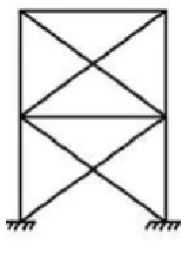
1.1 X Bracing
Now a days X bracing is a system used to reinforce structures in which corner of the support in diagonal direction intersect. Bracing is important in quake resistant buildings since it helps keep a building safe. Depending upon
force, one brace in tension while the other is in compression. Cross bracing can be connected to any four-sided building.
Fig -1: Cross Bracing
2.
MODELLING
To study the response spectrum analysis of structure, G+15 multi-storied building is considered. The modelling and analysis of work is done by using ETABS software. Storey shears, story drifts and storey Displacement is compared for Braced and unbraced structural system.
2.1 Material Properties:
The basic material properties used are as follows:
• Modulus of Elasticity of steel, Es = 20,0000 MPa
• Modulus of Elasticity of concrete, Ec = 27386.12 MPa
• Grade of concrete = M30
2.2 Details of models:
The various parameters considered for analysis of building which is modelled in ETABS. Seismic parameters are taken from IS 1893 (Part 1) 2016. Parameters considered are as per tabulation.
[image:1.595.384.475.249.376.2]© 2019, IRJET | Impact Factor value: 7.211 | ISO 9001:2008 Certified Journal
| Page 2645
Table -1:
Parameters considered for modelling
Type of Building Steel
No. of story G+ 15
Plan area(m2) 16*16
Grade of steel Fe345 and Fe415
Column ISHB 200-250/16 & ISHB 300-400/16
Beam ISWB 300 and ISLB 150
Slab thickness 150mm
Steel Bracing ISA 110*110*10
Bracing type X type
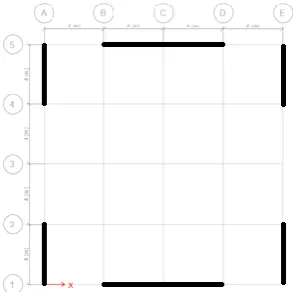
2.3 Plan View of Building with location of Bracing
Fig -2: Conventional frame model without bracing (Model 1)
Fig -3: Model with bracing at corner of structure (Model 2)
Fig -4:
Model with bracing at second and third
bay in both direction
(Model 3)Fig -5: Model with bracing at first and fourth bay in X-direction and second and third bay in Y-X-direction (Model 4)
[image:2.595.51.274.123.388.2] [image:2.595.353.512.299.445.2] [image:2.595.94.229.432.566.2] [image:2.595.356.503.495.641.2] [image:2.595.96.224.606.736.2]© 2019, IRJET | Impact Factor value: 7.211 | ISO 9001:2008 Certified Journal
| Page 2646
Fig -7: Model with bracing at second and third bay in X-direction and second and third bay in Y-X-direction at core
(Model 6)
3. ANALYSIS:
To make the building structure more ductile and to provide sufficient stiffness X type bracing system is used in this study, the analysis of G+15 storey steel building with X type bracing structural system subjected to seismic forces is proposed to be carried out. The modelling is done by using ETABS software and analysis is carried out by response spectrum method which is also known as linear dynamic method.
3.1 Response Spectrum Method
There are computational benefits in using the response spectrum method of seismic evaluation for prediction of displacements and member forces in structural method. The technique includes the calculation of big values of the displacements and member forces in every mode of vibration.
Response spectra are curves plotted among max response of single degree of freedom (SDOF) system subjected to certain earthquake ground movement and its time period.
3.2 Loads Considered in the Analysis
The following loads were considered for the analysis of various buildings:
a. Gravity loads –
The intensity of dead load and live load at various floor levels considered in the study are listed below.
i. Dead load –
Weight of Slab = 3.75 kN/m2
Weight of Floor Finish = 1.5 kN/m2
ii. Live Load –
Live Load at all floor levels has been taken as 3 kN/m2.
b. Seismic Load –
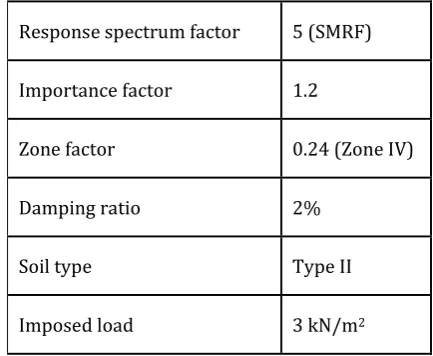
IS 1893(part I) is used for seismic load calculations. The mass of the building is supposed to be lumped at the floor levels. The weight of columns beams and walls have been equally distributed to the floors above and below. The floor load includes the self-weight of the floor load as per the codal provisions. For the purpose of analysis, the following seismic factors were considered.
Response spectrum factor 5 (SMRF)
Importance factor 1.2
Zone factor 0.24 (Zone IV)
Damping ratio 2%
Soil type Type II
Imposed load 3 kN/m2
4. RESULTS AND DISCUSSION
4.1 Lateral displacements:
[image:3.595.91.277.87.233.2]Maximum displacement of building by response spectrum analysis in X direction:
Table -2: Maximum lateral displacement in X direction and percentage reduction
Model No. displacement at top Maximum storey (mm)
Percentage reduction in displacement
with respect to model 1
(%)
Model 1 66.682 -
Model 2 51.31 23.05
Model 3 43.716 34.44 Model 4 51.862 22.22
Model 5 44.207 33.7
[image:3.595.324.541.268.446.2]© 2019, IRJET | Impact Factor value: 7.211 | ISO 9001:2008 Certified Journal
| Page 2647
Chart -1: Graphical representation of lateral displacement in X direction
The graphical illustration of storey displacement found for steel structure with & without bracing shown in chart-1 and table 2. The maximum reduction of displacement in model 6 which is 34.45%.
[image:4.595.34.288.89.240.2]Maximum displacement of building by response spectrum analysis in Y direction:
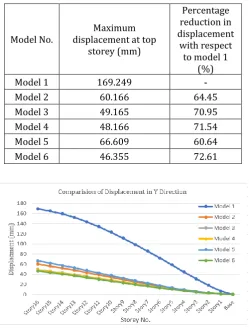
Table -3: Maximum lateral displacement in Y direction and percentage reduction
Model No. displacement at top Maximum storey (mm)
Percentage reduction in displacement
with respect to model 1
(%)
Model 1 169.249
-
Model 2 60.166 64.45
Model 3 49.165 70.95
Model 4 48.166 71.54
Model 5 66.609 60.64
Model 6 46.355 72.61
Chart -2: Graphical representation of lateral displacement in Y direction
The graphical illustration of storey displacement found for steel structure with & without bracing shown in chart-2 and table 3. The maximum reduction of displacement in model 6 which is 72.61%.
4.2 Storey Drift
[image:4.595.306.563.243.573.2]Maximum drift of building by response spectrum analysis in X direction:
Table -4: Maximum drift in X direction and percentage reduction
Model No. Maximum drift
Percentage reduction in drift with respect to model 1 (%)
Model 1 0.001766 -
Model 2 0.001296 26.61 Model 3 0.001096 37.93 Model 4 0.001314 25.59 Model 5 0.001105 37.42 Model 6 0.001094 38.05
[image:4.595.38.288.404.733.2]© 2019, IRJET | Impact Factor value: 7.211 | ISO 9001:2008 Certified Journal
| Page 2648
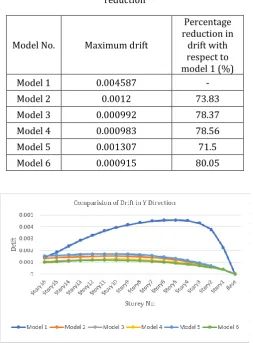
[image:5.595.36.290.151.495.2]Maximum drift of building by response spectrum analysis in Y direction:
Table -5: Maximum drift in Y direction and percentage reduction
Model No. Maximum drift
Percentage reduction in
drift with respect to model 1 (%)
Model 1 0.004587
-
Model 2 0.0012 73.83
Model 3 0.000992 78.37 Model 4 0.000983 78.56 Model 5 0.001307 71.5 Model 6 0.000915 80.05
Chart -4: Graphical representation of drift in Y direction From the above Chart-4 and table 5, It is found that, with bracing systems structure will have better control over story drifts. The maximum reduction of storey drift in Y direction is 80.05%.
5. CONCLUSIONS
From analysis of 16 storied Steel structure with provision of Bracing for different types, following conclusions are drawn.
1. The lateral load resisting capacity of building increases with increase in stiffness with the use of bracing in structural system than conventional structure.
2. Model with bracing at second and third bay in X-direction and second and third bay in Y-X-direction at core(Model 6) performing well in terms of reduction in displacement and storey drift.
3. The displacement of the structure is reduced by 34.45% in X direction and 72.61% in Y direction with the use of X-bracing.
4. The drift of the structure is reduced by 38.05% in X direction and 80.05% in Y direction with the use of X-bracing. The values of storey drift for all the stories are found to be within the limits i.e. 0.004 times to storey height according to IS 1893:2016 (Part I).
ACKNOWLEDGEMENT
I extend my sincerest gratitude to my parents, my Guides, head of program, head of dept., and my well-wishers who helped me in all situations whenever needed during this project completion.
REFERENCES
[1] Balkanlou V. Sadeghi, Karimi M. Reza Bagerzadeh,
Azar B. Bagheri, and Alaeddin Behravesh (2013) "Evaluating effects of viscous dampers on optimizing seismic behavior of structures" International Journal of Current Engineering and Technology (Research Gate), Vol.3, No. 4, pp.1150-1157.
[2] Chang Kuo-Chun, Yu-Yuan Lin, and Chang-Yu Chen.
(2008) "Shaking table study on displacement-based design for seismic retrofit of existing buildings using nonlinear viscous dampers" Journal of Structural Engineering (ASCE), Vol.134, no. 4, pp.671-681.
[3] Dhananjay. S. Pawar, S. Abdulla U. Phadnis, Raju. S.
Shinde, Yugandhar. N. Jinde (2015) “Analysis of multistoried braced frame subjected to seismic and gravity loading.” International Journal of Engineering Research and Applications, Vol.5, no.3, pp.46-50.
[4] Guo Tong, Jia Xu, Weijie Xu, and Zhiqiang Di. (2014)
"Seismic upgrade of existing buildings with fluid viscous dampers: design methodologies and case study" Journal of Performance of Constructed Facilities (ASCE), vol.29, no.6. pp. (04014175)1-11.
[5] Narkhede D. I., and R. Sinha (2012) "Shock vibration
control of structures using fluid viscous dampers" 15 WCEE LISBOA.
[6] Narkhede Dilip I., and Ravi Sinha (2014) "Behavior
© 2019, IRJET | Impact Factor value: 7.211 | ISO 9001:2008 Certified Journal
| Page 2649
BIOGRAPHIES
Mr. Aniket J. Katte, PG Student, M.Tech, Structural Engineering, at Rajarambapu Institute of Technology, Rajaramnagar. Graduated from Savitribai Phule Pune University, Pune.