Accepted Manuscript
Robust sparse representation based multi-focus image fusion with
dictionary construction and local spatial consistency
Qiang Zhang , Tao Shi , Fan Wang , Rick S. Blum , Jungong Han
PII:
S0031-3203(18)30213-9
DOI:
10.1016/j.patcog.2018.06.003
Reference:
PR 6577
To appear in:
Pattern Recognition
Received date:
31 October 2017
Revised date:
8 May 2018
Accepted date:
1 June 2018
Please cite this article as: Qiang Zhang , Tao Shi , Fan Wang , Rick S. Blum , Jungong Han , Robust
sparse representation based multi-focus image fusion with dictionary construction and local spatial
consistency,
Pattern Recognition
(2018), doi:
10.1016/j.patcog.2018.06.003
ACCEPTED MANUSCRIPT
Highlight
A RSR model is introduced for multi-focus image fusion.
ACCEPTED MANUSCRIPT
Robust sparse representation based multi-focus image fusion
with dictionary construction and local spatial consistency
Qiang Zhanga,b, Tao Shib, Fan Wangb, Rick S. Blumc, Jungong Hand
aKey Laboratory of Electronic Equipment Structure Design, Ministry of Education, Xidian University, Xi'an, Shaanxi 710071,
China
b
Center for Complex Systems, School of Mechano-electronic Engineering, Xidian University, Xi'an Shaanxi 710071,China
cElectrical and Computer Engineering Department, Lehigh University, Bethlehem, PA 18015, United States
dSchool of Comping and Communications, Lancaster University, Lancaster, LA1 4YW, U.K.
Abstract: Recently, sparse representation-based (SR) methods have been presented for the fusion of multi-focus images.
However, most of them independently consider the local information from each image patch during sparse coding and fusion, giving rise to the spatial artifacts on the fused image. In order to overcome this issue, we present a novel multi-focus image fusion method by jointly considering information from each local image patch as well as its spatial contextual information during the sparse coding and fusion in this paper. Specifically, we employ a robust sparse representation (LR_RSR, for short) model with a Laplacian regularization term on the sparse error matrix in the sparse coding phase, ensuring the local consistency among the spatially-adjacent image patches. In the subsequent fusion process, we define a focus measure to determine the focused and de-focused regions in the multi-focus images by collaboratively employing information from each local image patch as well as those from its 8-connected spatial neighbors. As a result of that, the proposed method is likely to introduce fewer spatial artifacts to the fused image. Moreover, an over-complete dictionary with small atoms that maintains good representation capability, rather than using the input data themselves, is constructed for the LR_RSR model during sparse coding. By doing that, the computational complexity of the proposed fusion method is greatly reduced, while the fusion performance is not degraded and can be even slightly improved. Experimental results demonstrate the validity of the proposed method, and more importantly, it turns out that our LR-RSR algorithm is more computationally efficient than most of the traditional SR-based fusion methods.
Key words: multi-focus image fusion, robust sparse representation, dictionary construction, spatial contextual information, spatial consistency.
1. Introduction
Due to the limited depth of field of optical lenses in conventional cameras, it is not often possible
to obtain an image that contains all of the relevant objects in focus [1, 2]. As shown in Fig. 1, this issue
can be effectively addressed by multi-focus image fusion, in which several images with different focus
points (e.g., Fig. 1 (a) and Fig. 1(b)) are combined into a composite image (e.g., Fig. 1(c)) with
full-focus.
Suppose at least one of the input images provides a focused version of the scene, the focused
regions can be extracted from the given multi-focus input images and then preserved in the fused image,
while all of the defocused regions should be discarded [1]. In addition, the fusion algorithm should not
introduce any spatial artifacts or inconsistencies into the fused image. Finally, the fusion algorithm
ACCEPTED MANUSCRIPT
should have high computational efficiency, thereby facilitating real-world applications. In this paper,
we will address the fusion of multi-focus images by using a robust sparse representation (RSR) model
with dictionary construction and local spatial consistency, specifically designed to have high spatial
consistency and computational efficiency.
Fig. 1. Illustration of multi-focus image fusion. (a) Source image with focus on the flower; (b) Source image with focus on the
clock; (c) Fused image with full-focus.
So far, many sparse representation-based (SR) methods have been presented for the fusion of
multi-focus images [1, 2, 3, 4, 5, 6, 7, 8, 9]. A thorough review of these methods can be found in [10].
Rather than being fixed in advance as those in the traditional multi-scale transforms (MSTs), most of
the over-complete dictionaries in SR are learned from a set of training images using some learning
methods, such as K-SVD [11]. Compared with the fixed basis functions, these over-complete
dictionaries contain richer basis atoms and are able to achieve more meaningful and stable
representations of the source images. For this reason, SR-based image fusion methods generally
outperform the traditional MST-based image fusion methods from both subjective and objective aspects
[3, 4].
However, most of the existing SR-based fusion methods advocate the patch-based implementation.
More specifically, each image patch is individually taken into account during sparse coding and fusion,
giving rise to the spatial artifacts on the fused image. In order to reduce the spatial artifacts, a sliding
window technology [3] is often employed in these methods, where the input images are divided into a
larger number of patches overlapped with a fixed number of pixels (usually one pixel) along the
horizontal and vertical directions, respectively. Owing to the overlap among image patches, the number
of input patches to be fused is greatly large, which results in a huge requirement of memory storage and
increase of computational complexity. In addition, some detailed information will be unavoidably lost
in the fused image because of the overlap [1, 5].
In fact, images have strong local correlations among spatially adjacent patches. More precisely,
ACCEPTED MANUSCRIPT
these patches are either all in-focus or are all out-focus in most cases. Motivated by the observation, the
contextual information among spatially adjacent patches, instead of the sliding window approach, is
employed to reduce the spatial artifacts of the fused image in this paper. In addition, we pay special
attention to reducing the computational complexity of the proposed method in order to improve its
utility for real world applications.
To this end, we employ a robust sparse representation (LR_RSR, for short) model with a
Laplacian regularization term on the sparse error matrix during the sparse coding phase, which
adequately considers the local consistency among the spatially-adjacent image patches. In the
subsequent fusion process, we collaboratively employ information from each local image patch as well
as those from its spatial neighbors to determine the focused and de-focused regions in the multi-focus
images. By doing that, the spatial artifacts in the fused image may be obviously suppressed. Moreover,
owing to the joint use of sparse errors from multiple spatially adjacent patches, a non-overlapping
division of input images, rather than an overlapping division way as in most of SR-based fusion
methods, may be adopted during the fusion process. This greatly reduces the requirement of memory
storage and computational complexity of the proposed fusion method.
In addition, we will employ a learned dictionary with only a fixed small number of atoms but
maintaining good representation capability, rather than the input data themselves as in [1], for the
LR_RSR model during sparse coding. This will further greatly reduce the computational complexity of
the proposed method, while the fusion performance is not degraded and even slightly improved.
Experimental results demonstrate that the proposed method introduces fewer spatial artifacts to the
fused images than most state-of-the-art methods. Especially, it is also shown to have higher
computational efficiency than some traditional SR-based fusion methods.
In summary, the main contributions of this paper are as follows.
(1) We present a multi-focus image fusion algorithm based on a robust sparse representation (RSR)
model, in which the spatial consistency among image patches is adequately considered during
sparse coding and fusion. This is clearly different from most of the existing SR-based fusion
methods, which usually treat each image patch independently.
(2) We employ a robust sparse representation (LR_RSR) model with a Laplacian regularization on the
sparse error matrix during sparse coding. To the best of our knowledge, it is the first time that the
ACCEPTED MANUSCRIPT
over-complete dictionary with small atoms while maintaining good representation capability for
the LR_RSR model.
(3) We jointly employ local information (i.e., sparse reconstruction errors obtained by LR_RSR) of
each image patch along with those from its spatially adjacent neighbors to determine the focused
and defocused regions within an input multi-focus image during the fusion process.
The rest of the paper is organized as follows. Section 2 briefly reviews the SR-based fusion
methods. Section 3 details the dictionary construction for RSR model. Section 4 describes the proposed
fusion method in detail. Experimental results and conclusions are given in Section 5 and Section 6,
respectively.
Notations
Throughout the paper, a vector is denoted by a lower-case letter, and a matrix is denoted by a
capital letter. All elements of vectors and matrices are real-valued. Given a vector x and a matrix X,
some notations used in this paper are listed in Table 1.
Table 1. List of vector and matrix related notations.
Symbols Definition
( )
x i the i-th entry of the vector x
( , )
X i j the
i j, -th entry of the matrix X( ,:)
X i the i-th row of the matrix X
(:, )
X j the j-th column of the matrix X
2
x l
2-norm of the vector x, i.e., x2
ix i2( )0,2
X l0,2-norm of the matrix X, i.e., the number of the non-zero rows in the matrix X
1,2
X l1,2-norm of the matrix X, i.e., 2 1,2 i j ( , )
X
X i j2,0
X l2,0-norm of the matrix X, i.e., the number of the non-zero columns in the matrix X
2,1
X l
2,1-norm of the matrix X, i.e., X2,1
j iX i j2( , ) FX Frobenius-norm of the matrix X, i.e., 2 , ( , )
F i j
X
X i jX l-norm of the matrix X, i.e., the maximum absolute value of the entries in the matrix X
T transpose of a vector or a matrix
2. Related work
To date, numerous fusion algorithms have been presented for multi-focus images [12, 13, 14],
wherein multi-scale transform-based (MST-based) image fusion algorithms are one of the most popular
choices [15]. Various MST-based fusion methods have been discussed over the years, ranging from the
early wavelet [16] and pyramid [17] transforms to the recently developed multi-scale geometric
analysis approaches, such as curvelet [18], contourlet [19], and shearlet [20].
ACCEPTED MANUSCRIPT
representation (SR) has also attracted more attention in multi-sensor image fusion, including
multi-focus image fusion, in recent years [1-9, 21-24]. For example, in [3], Yang and Li first introduced
SR [25] into image fusion, where the l1-norm of the SR coefficient vector (i.e., the sum of the absolute
values of SR coefficients) was employed as the activity level for each local image patch and the fused
image was constructed using a maximum selection fusion rule. A SR model with dictionary learning
was presented for multi-focus image fusion in [2], where the correlation between the sparse
representation coefficients of input image patch and the pooled features obtained in the dictionary
learning phase, instead of the simple l1- orl2-norm of the representation coefficient vector, was used
as the activity level. In [4], a general image fusion framework was presented by combing MST and SR
to simultaneously overcome the drawbacks of the MSR-based and SR-based fusion methods. They also
presented an adaptive SR (ASR) model for simultaneous image fusion and denoising [21]. In [6], a
group sparse presentation (GSR) model was presented to exploit the intrinsic structure among the
atoms in different groups and applied to medical image fusion, where the non-zeros elements are forced
to occur in clusters (i.e., group-sparsity) rather than appear randomly. Almost all these SR-based fusion
methods are performed in a patch-based way. Alternatively, a newly merged convolutional SR (CSR)
model was introduced to image fusion [5], which aims to achieve the SR of an entire image rather than
a local image patch.
In [1], a robust SR (RSR) model was first presented to extract the detailed information in a set of
multi-focus images by using a so-called sparse reconstruction error, instead of the conventional
least-squared reconstruction error. Then a multi-task RSR (MRSR) model was presented for
multi-focus image fusion by imposing a joint constraint on the reconstruction errors across all tasks. In
the MRSR-based fusion method, information from each local image patch and those from its spatial
neighbors (referred to as its spatial contextual information) were collaboratively employed to
determine the focused and de-focused regions. Owing to the use of spatial context, block artifacts in the
fusion results are greatly reduced and sometimes can even be eliminated.
Despite its great advances in terms of the performance, MRSR is computationally expensive,
especially when the number of spatially adjacent patches of each image patch gets increased. In
addition, the data is directly employed as the dictionary in the MRSR model. With an incremental size
of each input image, the computational complexity of MRSR increases again, eventually leading the
ACCEPTED MANUSCRIPT
Similar to that in [1], we also consider the spatial context among image patches during the fusion
process in this paper. But differently, we pay special attention to reducing the computational
complexity of the proposed fusion method.
3. Dictionary construction for RSR model
Owing to the obvious superiority of RSR over the traditional SR [25], we also employ the RSR
model [1] to achieve the sparse coding of each image patch. In addition to the RSR model, the
employed over-complete dictionary also plays an important role for the fusion performance and
computation efficiency of a multi-focus fusion method. In [1], the data themselves were simply
employed as the dictionary during the sparse coding. Despite its excellent performance, the downside
of such an approach is that the computational burden can be excessive for larger images if the number
of dictionary atoms is propositional to the image size.
Alternatively, we will present a simple but efficient dictionary construction method for RSR. For
that, we will first construct a set of data samples (or image patches), denoted by a matrix
1 2
[ , ,..., N] n N
Y y y y R of size n N , which are randomly selected from a set of training images.
Here, n denotes the dimension of each data sample and N denotes the total number of image
patches. Each column yiRn of the matrix Y represents a data vector (i.e., a training image patch).
Then we will find an optimal subset of the data samples set Y , rather than the whole set Y , to form
the dictionary
1 2
[ , ,..., ]
M
n M i i i
D y y y R where i i1, ,...,2 iM
1, 2,...,N
, such that any column fromY can be well reconstructed by the subset D.
We will achieve this goal by first formulating the problem as the following robust "row-sparsity"
optimization problem, similar to that in [26].
0,2 2,0
,
min . .
X E X E s t YYXE. (1)
Here, [ ,1 2,..., ] N N N
X x x x R is the representation coefficient matrix to be sought, and each of its
columns xiRN denotes the representation coefficients for the data yi. Note that YX denotes the
authentic information contained in the data samples Y.
E
R
n N is the sparse error matrix anddenotes the corruptions or outliers within the data samples Y. The parameter 0 is to balance the
effects of the two components in (1) and is experimentally set to 30 in this paper.
ACCEPTED MANUSCRIPT
dictionary in (1). However, the goal of [27] is to achieve the sparse coding for the input data using a l0 -
or l1 -norm minimization constraint, while our goal is to construct a dictionary for the RSR model by
selecting only a small number of image patches with sufficient representation capability from the input
training patches. Therefore, a "row-sparsity" (i.e., l0,2-norm minimization) constraint is employed in
(1).
When solving (1), the optimal solution of the representation coefficient matrix
X
* may beincentivized to have some “zeros” rows because of the “row-sparsity” (i.e., l0,2-norm minimization)
constraint, which means that the corresponding data samples in the matrix Y are not used to reconstruct
any data samples during the coding and thus cannot be selected as the dictionary atoms. In contrast, the
data samples corresponding to the “non-zeros” rows in the matrix *
X
have been used to reconstructthe other data samples. In fact, those data samples corresponding to the rows with larger energies (i.e.,
those row vectors with larger l2-norm values) get higher weights during the coding phase, and can thus
be deemed to be more important. Therefore, we will select those data samples corresponding to the row
vectors of the optimal matrix
X
* with the M largest l2-norm values as the dictionary atoms, i.e.,1 2
[ , ,..., ]
M
i i i
D y y y with * * * *
1 2 1 2
2 2 2 2
(:, ) (:, ) (:,M) (:, ) , , ,...,M
X i X i X i X j ji i i . Here, we
experimentally set M to 128 or 256, which is far smaller than the total number of data samples N.
Next, we discuss the details of solving (1), which is a non-convex optimization problem and can
be relaxed to the following convex one
1,2 2,1
,
min . .
X E X E s t YYXE. (2)
The optimization problem in (2) is convex and can be solved by various methods. Here, we adopt the
linearized alternating direction method with an adaptive penalty (LADMAP) [28, 29] considering that
LADMAP has high computational efficiency and a convergence guarantee for such convex
optimization problems as in (2). In addition, LADMAP can also ensure each sub-problem mentioned in
(2) to have a closed-form solution. In LADMAP, an augmented Lagrangian function is first constructed
by introducing a Lagrange multiplier to remove the equality constraint as
2
1,2 2,1
,
2
1,2 2,1
,
min + , +
2
min +
2
F X E
X E
F
J X E V Y YX E Y YX E
V
X E Y YX E
, (3)
ACCEPTED MANUSCRIPT
product of the matrices A and B. Then the objective function in (3) is alternately minimized with
respect to X and E, respectively, by fixing one or the other. Algorithm 1 gives the optimization
algorithm for dictionary construction.
Algorithm 1: Optimization of RSR with “row-sparsity” constraint
Input: Sampling data Y and parameter
Output: Representation coefficient and error matrices X and E
Initialize1: 0
X 0, 0
E 0,1.1,106, 10
max 10
, 4
10
while not converged do
(1) Fix X and update E:
2 2 1 2,1 2,1 1 min min 2 2
j j j
j j j
j j j
E E
F F
V V
E E Y YX E E Y YX E
. (4)
This sub-optimization problem has the following closed-form solution [30]:
2
1 2
2
(:, ) /
(:, ), if (:, ) / (:, ) (:, ) 0, otherwise j j j G i
G i G i
E i G i
, (5)
where
j j
j V G Y YX . (2) Fix E and update X:
2
1 1
1,2 1,2
min min ( )
2
j j
j j j
j
X X
F
V
X X Y YX E X f X
, (6)
where 2 1 ( ) 2 j j j j j F V
f X Y YX E
. To solve (6), the quadratic termf X( )can be replaced by its first order
approximation at the previous iteration by adding a proximal term [31], i.e.,
2
2 1
1,2 1,2
min , min
2 2
j
j j
X
j j j j j
X j
F
X X
F f X
X X X X f X X X X X X
, (7)
where is set to Y 22 as in [31].
j Xf X is the partial differential of f X
with respect to X, and iscomputed by
1j
j j T j j
X j
V
f X Y YX Y E
. Then (6) has the following close-form solution [30]:
2 1 2 2 1 ( ,:) 1 ( ,:), if ( ,:)) ( ,:) ( ,:) 0, otherwise j j j H i
H i H i X i H i
, (8)
where 1 1
j
j T j j
j
V
H X Y YX Y E
.
(3) Update the multiplier V: Vj1Vjj
YYXj1Ej1
(4) Update : 1 min
, max
j j
(5) Check the convergence conditions: 1 1 1 1
, ,
j j j j j j
F F
Y YX E Y X X E E
end while
4. RSR-based multi-focus image fusion with local spatial consistency
In this section, we will first present a RSR model with Laplacian regularization (LR_RSR, for
short) considering the local spatial consistency among image patches and then discuss how we apply it
to the fusion of multi-focus images.
4.1 RSR with Laplacian regularization (LR_RSR)
ACCEPTED MANUSCRIPT
Given the over-complete dictionary
D
R
n M constructed in the previous section, the existingRSR model in [1] can be computed by
0 2,0
,
min . .
X E X E s t YDXE
, (9)
where [ ,1 2,..., ] n N N
Y y y y R is the observed data matrix (e.g., a multi-focus image in this paper),
and each of its columns is a data vector (e.g., an image patch) yiRn.
X
R
M N andE
n N denotethe representation matrix and error matrix, respectively.
Fig. 2. Illustration of the decomposition of RSR on a multi-focus image (Credit to [1]). Y denotes an image focused on the flowerpot. DX denotes a fully defocused version of the original and E contains the details of the flowerpot.
The RSR model in (9) can be directly applied to the fusion of multi-focus images similar to many
of the traditional SR-based fusion methods. Especially, as shown in Fig. 2, a multi-focus image can be
decomposed into a blurred or fully-defocused entity plus a detailed entity, denoted by the reconstructed
matrix DX and the error matrix E, respectively, by using the RSR model. In other words, the error
matrix E, rather than the representation coefficients, contains the high frequency details in the
multi-focus image and can thus be used to determine the focus measure of each multi-focus input
image [1].
However, as shown in (9), the traditional RSR model considers each local image patch
independently with no consideration of the local spatial consistency among image patches. As a result
of that, some spatial artifacts will be easily introduced to the fused image in the subsequent fusion
processing. In fact, images have strong local correlations among spatially adjacent patches. More
exactly, for a multi-focus image, the spatially adjacent image patches have similar focus information,
i.e., these patches are all in-focus or are all out-focus in most cases. Accordingly, they will also have
similar sparse errors in the RSR model.
ACCEPTED MANUSCRIPT
short) by integrating a Laplacian regularization with respect to the sparse error matrix with the
traditional RSR model in this paper as
1 2
0 2,0
,
min + ( T) . .
X E X E tr ELE s t YDXE
, (10)
where
1 and
2 are two positive trade-off parameters to balance the three components. TheLaplacian regularization term ( T)
tr ELE is defined by
2
2 ,
1
( ) (:, ) (:, )
2
T
ij i j
tr ELE
E i E j . (11)The weight
ij implies the similarity between the i-th and j-th image patch and is computed by2
2 2
exp , if and are spatially adjacent 2
0, otherwise
i j
i j
ij
y y
y y
. (12)
is a scalar parameter and is experimentally set to 0.5 in this paper. Based on these weights, anaffinity matrix WRN N with ( , ) ij
W i j
and a diagonal degree matrix N N with( , ) ( , )
j
i i W i j
are constructed. Then the Laplacian matrix L in (11) is computed byL
W
.In general, the spatially adjacent patches with similar appearances will have similar representation
coefficients as well as sparse errors in the RSR model. Accordingly, it might be more reasonable to
introduce two Laplacian regularization terms with respect to the representation coefficient matrix and
the sparse error matrix in (10), respectively. However, in this paper, the focus information of each local
patch in a multi-focus image is determined by its sparse errors rather than its representation coefficients.
Therefore, in (10), only one Laplacian regularization term with respect to the sparse error matrix is
introduced for simplicity.
The Laplacian regularization with respect to sparse error matrix in the proposed LR-RSR model
ensures the local consistency among the spatially-adjacent image patches. More specifically, each
column yi in the observed matrix Y in (10) denotes an image patch to be considered when LR-RSR
is applied to multi-focus image fusion in our revised manuscript. The corresponding column E(:, )i in
the error matrix E denotes the sparse error for the i-th image patch. As shown in (12), if two spatially
adjacent image patches yi and yj have similar appearances, the weight
i j, will be assigned to ahigh value. Then the difference between E(:, )i and E(:, )j will be forced to be a small value by
ACCEPTED MANUSCRIPT
two image patches will thus be seen as both in-focus or both out-focus. As a result of that, the spatial
artifacts introduced into the fused image will be reduced to some extent.
Algorithm 2: Optimization of LR_RSR using LADMAP
Input: Observed data Y, over-complete dictionary D, and parameters 1,2
Output: Representation coefficient and error matrices X and E
Initialize: 0
X 0, 0
E 0,1.1,106,max1010, 3 10
while not converged do
(1) Fix E and update X:
2 1
1 1
min min ( )
2 j j j j j X X F V
X X Y DX E X g X
, (15)
where 2 ( ) 2 j j j j F V
g X Y DX E
. Similar to that in solving (6), this sup-optimization problem can be solved by
replacing the quadratic termg X( ) with its first order approximation at previous iteration and a proximal term, i.e.,
2
2
1 1 1
1 1
1
min , = min
2 2
j
j j
X
j j j j j
X j
F
X X
F g X
X X XX g X XX X XX , (16)
where 1 is set to 2
1 Y 2
and Xg X
j is computed by
1
j
j j T j j
X j
V
g X D DX Y E
. Thus it has the following closed-form solution [32]:
1 1 1 1 1 1 j j
j j T j j
j
V
X S X D DX Y E
, (17) where the threshold function S x( ) is defined as
, if ( ) , if
0, otherwise
x x
S x x x
. (18)
(2) Fix X and update E:
2
1 1
1 2,1 2 2,1
min ( ) min ( )
2
j j
j T j
j
E E
F
V
E E tr ELE Y DX E E h E
, (19)
where 2 1 2 ( ) ( ) 2 j j T j j F V
h E tr ELE Y DX E
. Similarly, this sub-optimization problem can be solved by
2 2
1 2 1
1 2,1 2,1
2 2
1
min , min
2 2
j E
j j j j j
E F
E E
F
h E
E E E E h E E E E E E
, (20)
where 2 is set to
2 2 1.02 2 2
j F
L
as suggested in [33]. Eh E
j is computed by1 2
( ) 2
j
j j j j j
E j
V h E E L Y DX E
. Thus it has the following closed-form solution [30]:
2
1 2 1 2
2
(:, ) /
(:, ), if (:, ) / (:, ) (:, )
0, otherwise
j j
Q i
Q i Q i
E i Q i
, (21)
where
2
j E j h E
Q E
.
(3) Update the multiplier V: Vj1Vjj
YDXj1Ej1
(4) Update : 1 min
, max
j j
(5) Check the convergence conditions: 1 1 1 1
, ,
j j j j j j
F F
Y DX E Y X X E E
end while
Similar to the case in the previous section, the non-convex optimization problem in (10) can be
ACCEPTED MANUSCRIPT
1 2
1 2,1
,
min + ( T) . .
X E X E tr ELE s t YDXE. (13).
Then an augmented Lagrangian function is constructed by introducing a Lagrange multiplier to remove
the equality constraint as
2
1 2
1 2,1
,
2
1 2
1 2,1
,
min + ( ) ,
2
min + ( )
2
T
F X E
T
X E
F
J X E tr ELE V Y DX E Y DX E
V
X E tr ELE Y DX E
. (14)
Finally, the optimization problem can be solved by using the LADMAP method [28, 29]. Algorithm 2
provides the optimization of LR_RSR in detail.
Fig. 3. Illustration of the validity of the Laplacian regularization term in the LR_RSR model. (a) An image with focus on the flower; (b) Sparse errors obtained using the traditional RSR model; (c) Sparse errors obtained using the LR-RSR model.
Fig.3 illustrates the validity of the Laplacian regularization term in the LR_RSR model. As shown
in Fig. 3(b), parts of the clock regions also have higher sparse errors by using the traditional RSR
model in addition to the flower regions. As a result of that, parts of the clock regions in Fig. 3(a) will be
mistakenly determined to be in-focus in the subsequent fusion process by using the RSR model, thus
introducing some spatial artifacts to the fused image. In contrast, as shown in Fig. 3(c), only the
focused flower regions are forced to have high sparse errors and will be determined to be in-focus by
using the LR-RSR model.
Furthermore, the introduction of the Laplacian regularization does not increase the computational
complexity of the LR_RSR model. Similar to the traditional RSR, the major computational complexity
ACCEPTED MANUSCRIPT
matrices. As a result, LR_RSR has the same computational complexity as RSR. MRSR may also
ensure the spatial consistency among image patches to some extent by imposing a joint sparsity
constraint (i.e. l2,1-norm minimization) on the reconstruction errors across all tasks. However, the joint
sparsity constraint increases the computational complexity of MRSR.
More specifically, suppose the data matrix Y and dictionary D have sizes of n N and
n M , respectively. Then the coefficient matrix X has size MN . Thus, the computational
complexities of RSR and LR_RSR are both O rnNM( 2) by further considering the number of
iterations r needed for convergence. While, the computational complexity of MRSR is about
2
( )
O rnKNM , where K denotes the number of spatially adjacent patches for each image patch to be
considered. Here, the number of dictionary atoms Mk for all types of features in the MRSR model are
assumed to be the same, i.e., M0M1 MK1M. For this reason, we will apply LR_RSR to
multi-focus image fusion in the following subsection.
4.2 Multi-focus image fusion based on LR_RSR
In this subsection, we will discuss the proposed multi-focus image fusion method in detail. In
addition to LR_RSR, we will define a new focus measure by jointly employing information (i.e., the
sparse errors obtained by LR_RSR) from each image patch along with information from the
spatially-adjacent neighbors in the proposed fusion method to further reduce the introduction of spatial
artifacts in the fused image.
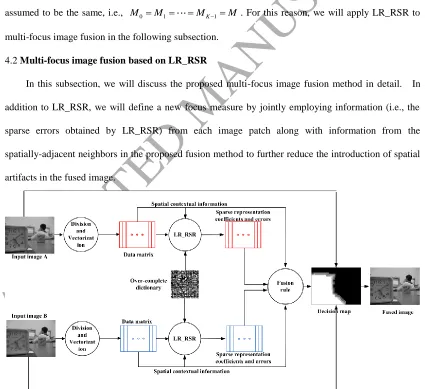
Fig. 4. Diagram of the proposed fusion method.
[image:15.595.73.498.322.711.2]ACCEPTED MANUSCRIPT
registered, the diagram of the proposed multi-focus image fusion algorithm based on LR_RSR is
shown in Fig. 4 and described as follows.
(1) Divide the input images IA and IB into N non-overlapping image patches of the same
size pxpy pixels. Then two sets of image patches
IiA|i0,1,...,N1
and
IiB|i0,1,...,N1
are obtained from images IA and IB, respectively.(2) Re-order each image patch as a vector of dimension d pxpy and construct the data
matrices 0A, 1A,..., A1
A N
Y y y y and 0B, 1B,..., B1
B N
Y y y y for images IA and IB , respectively.
A i
y and yiB are vectors corresponding to the i-th image patches IiA and IiB of images IA and
B
I , respectively.
(3) Perform LR_RSR on YA and YB, respectively, using Algorithm 2 and then obtain their
corresponding representation coefficient matrices XA, XB and error matrices EA, EB. In this step,
a globally-trained dictionary D is employed, which is constructed from a set of training image patches
by using Algorithm 1. As well, each image patch and one of its 8-connencted neighbors are seen as a
pair of spatially-adjacent image patches during the computation of Laplacian regularization in (10).
(4) Define a decision map (i.e., a matrix)
C
with the same size of source images by using thesparse errors EA and EB. The values of the entries in the matrix
C
are in the range of [0,1] . “1”indicates that the fused pixels are directly selected from the source image IA, while “0” means that
the fused pixels are directly selected from the source image IB. Otherwise, the fused pixels are the
weighted average of the source images IA and IB . This step is one of the most important
components in the proposed fusion method and will be further discussed soon in detail.
(5) Construct the finally fused image IF by using the decision map
C
as
,
,
,
,
1
,
F A B
I m n I m n C m n I m n C m n , (22)
where IF
m n,
, IA
m n,
and IB
m n,
denote the pixel values of the fused image IF , inputACCEPTED MANUSCRIPT
the ( , )m n -th entry of the matrix (or the decision map)
C
.In the following content, we will discuss the determination of the decision map
C
in detail.First, define an initial decision map
C
of the same size IA or IB, and divide the decisionmap
C
into N patches of size pxpy by using the same way as that in the division of source imageA
I or IB. Then obtain a set of decision map patches or sub-matrices
C ii | 0,1,...,N1
.Secondly, assign each of its entries C m ni( , ) in the i-th decision map patch Ci to “1” or “0” by
comparing the focus measure value
iA of image patch IiA with the focus measure value
iB ofimage patch IiB as
1, if ( , )
0, otherwise
A B
i i
i
C m n
. (23)
Here, the focus measure value
iA is patch-based and is jointly determined by the sparse errors ofimage patch IiA as well as its 8-connencted spatial-adjacent neighbors, denoted by ( A)
i
I
, as follows
2 2
(:, ) A A (:, )
j i
A
i EA i I I EA j
. (24)Accordingly, the focus measure value
iB is determined by using the same way, i.e.,
2 2
(:, ) B B (:, )
j i
B
i EB i I I EB j
. (25)It should be noted that the sparse errors of current image patch and its spatially-adjacent neighbors,
instead of the only sparse error of current image patch, are jointly employed to define the focus
measure in (24) and (25). This will reduce spatial artifacts, as shown in Fig. 5(e).
Thirdly, reconstruct the decision map
C
by adding the patches
C ii | 0,1,...,N1
toC
attheir original spatial positions in
C
. This can be seen as the reverse process of the division ofC
.Fourthly, refine the decision map
C
by removing some "holes" with small areas to obtain a newdecision map
C
. Although the introduction of local consistency can reduce the artifacts to greatextent, some isolated regions in-focus are still inevitably mistaken as de-focused ones. Similarly, some
isolated regions out-focus are also mistakenly labeled as the focused ones. As a result of that, there will
ACCEPTED MANUSCRIPT
numbers of entries are less than 5% of the total number of pixels in the input image are seen as isolated
regions and are thus removed. This is simply achieved by re-assigning the entry values within these
isolated regions as 1 minus their original values. The new decision map
C
is thus computed by
1 ( , ), if
,
,( , ), otherwise
C
C m n m n
C m n
C m n
, (26)
where C denotes the isolated regions in the decision map
C
.Finally, define some transitional regions between the focused regions and the defocused regions,
and then construct the final decision map
C
. According to the decision mapC
, each input imagecan be simply divided into two types of regions, i.e., focused regions and de-focused regions. For
example, “1” means focused regions while “0” means de-focused regions for imageIA. In contrast, “1”
and “0” mean de-focused regions and focused regions, respectively, for imageIB. However, as
discussed in [34], the de-focused imaging system can be characterized by a low-pass filtering system.
This indicates that it is a gradual process, rather than an abrupt process, from the focused (or
de-focused) regions to the de-focused (or focused) regions. In other words, it is reasonable to define a
transitional region between a focused region and a defocused region.
Therefore, in this paper, we will divide each multi-focus input image into three types of regions
(i.e., focused, de-focused and transitional regions), instead of two types of regions. We simply take
those patches in the decision map
C
as transitional regions, denoted by C, whose entries valuesare different from those of one of its 8-connected spatial neighbors. For these transitional regions, the
fused image is computed as the weighted average of source images, instead of being simply selected
from one of the source images. Here, the weights are also computed by using the focus measure values
of these source image patches. Then the final decision map
C
is determined by
1, if & ,
, , ,
0, if & ,
A B
i i C
A i C A B i i A B
i i C
m n
C m n m n
m n
, (27)
where the index i in iA or iB is determined by the index of image patch IiA or IiB that the
location ( , )m n belongs to. By using the final decision map
C
, the fused image can be obtained byACCEPTED MANUSCRIPT
Fig. 5. Illustration of decision maps obtained by different methods. (a) Source image with focus on the ‘clock’; (b) Source image
with focus on the ‘student’; (c) ‘Ideal’ decision map; (d) Decision map obtained by using the sparse error of each single image patch; (e) Decision map C obtained by using the joint sparse errors of each image patch and its neighbors, i.e., (23); (f) Decision map C obtained by performing ‘removing holes’ on (e), i.e., (26); (g) Final decision map C by using (27), in which the gray regions denote the transitional regions.
Fig. 5 illustrates the decision maps obtained by different methods. As shown in Fig. 5(d), there are
many isolated patches or “holes” in the decision map obtained by using the sparse error of each single
image patch. In contrast, as shown in Fig. 5(e), these “holes” are greatly reduced by using the joint
sparse errors of each image patch and its spatially-adjacent neighbors. This demonstrates the
effectiveness of the proposed focus measures defined by (24) and (25). By further removing the
remaining “holes” or isolated patches, the decision map can be closer to the ‘ideal’ decision map.
4.3 Computational Complexity of the proposed fusion method
The computational complexity of the proposed fusion method is fully dependent on that of the
LR_RSR model. As discussed in Subsection 4.1, the computational complexity of LR_RSR is
2
( )
O rnNM , where M and N denote the numbers of the dictionary atoms and input image patches,
respectively. n denotes the dimension of the dictionary atoms or input data. r is the number of iterations
needed for convergence. Accordingly, the computational complexity of the proposed fusion method is
also O rnNM( 2), which demonstrates that the number of dictionary atoms M has a greater impact
on the computational complexity of the proposed fusion method than other parameters.
When RSR and MRSR are applied to multi-focus image fusion, the input data themselves are
simply employed as the dictionary in [1]. That is to say, the number of dictionary atoms M equals that
of the data (or the input image patches) N in the RSR-based and MRSR-based fusion methods. As a
ACCEPTED MANUSCRIPT
about O rnN( 3) and O rnKN( 3), respectively. Here K denotes the number of spatially adjacent
patches for each image patch to be considered. In addition, the number of dictionary atoms M (e.g.,
256 in this paper) is usually smaller than the number of image patches N (e.g., 1200 for an image of
size 320 240 ) in the proposed fusion method. Therefore, the proposed fusion method has greatly
higher computation efficiency than the RSR-based and MRSR-based fusion method.
More importantly, due to the non-overlapping division of input images, the number of image
patches N in the proposed fusion method is also much smaller than those (e.g., about 76800 for an
image of size 320 240 ) in the traditional SR-based fusion methods, including the RSR-based one in
[1], where an overlapping division way is usually adopted. Therefore, the proposed fusion method also
has higher computational efficiency than those traditional SR-based fusion methods. This will be
verified in the experimental part.
5. Experimental results and analysis
In this section, several sets of experiments are performed to verify the feasibility of the proposed
multi-focus image fusion algorithm based on the LR_RSR. First, we discuss the validity of the
constructed dictionary by using Algorithm 1. Then we discuss the impacts of some parameters on the
fusion performance. Finally, several pairs of multi-focus images from two public databases are fused
by using the proposed method and some state-of-the-art methods to demonstrate the validity of the
proposed method.
5.1 Validity of the constructed dictionary
Here, we will discuss the impacts of different dictionaries on the fusion performance to show the
validity of the proposed dictionary construction method. For that, 20,000 patches of size 8 8 are
first randomly selected from a set of images with high resolution to construct the training data. These
images are downloaded from http://r0k.us/graphics/kodak. Afterward, two sets of dictionaries with
different parameters are constructed by using Algorithm 1. One set of dictionaries (D1,D10,D20,
30
D ,D40,D50,D70and D100, for short, respectively) are constructed by using the same
number of atoms (i.e., M=256) but different values of the parameter (i.e., =1, 10, 20, 30, 40, 50, 70, 100, respectively). The other set of dictionaries (DM128,DM256, DM512, DM1024 and DM2048,
ACCEPTED MANUSCRIPT
the previous Fig. 5(a) and Fig. 5(b) are fused using the proposed fusion method but with different
dictionaries constructed above. In addition, the dictionary with 256 atoms learned by using the K-SVD
method for the traditional SR model (DKSVD, for short) and the normalized data themselves (Ddata, for
short) are also compared with our constructed dictionaries.
In order to subjectively evaluate the fusion performance by using different dictionaries, a fully
focused ('ideal') imageIRis first created by visually extracting the focused regions from input images
Fig. 5(a) and Fig. 5(b). Then the fused images are compared with the 'ideal' image by using the mean
square error (Emse) and the difference coefficients (dDC). Smaller Emse and dDC values indicate
higher fusion performance.
Table 2 and Table 3 present the fusion results obtained by using our proposed fusion method but
with different dictionaries. Table 2 shows that the fusion performance varies with the parameter and achieves the best when is set to 30. Table 3 shows that better fusion performance can be
obtained when using our constructed dictionaries (i.e., the first 5 dictionaries in Table 3) than the
dictionaries Ddata and DKSVD. Further, the dictionary DM256 achieves the best fusion performance
among the mentioned dictionaries. This demonstrates that dictionaries with only a few atoms (e.g., 256),
carefully selected from among the 20,000 training data samples, have better representation capability
than dictionaries with more atoms. By imposing the "row-sparsity" constraint on the representation
coefficients, the data samples with the best representation capability can be selected from the training
data. In particular, the constructed dictionary DM256 performs much better than the dictionary DKSVD,
although both of them have 256 dictionary atoms. This further demonstrates the effectiveness of our
proposed dictionary construction method.
Table 2. Fusion results using the dictionaries with different values of .
Dictionary D1 D10 D20 D30 D40 D50 D70 D100
Emse 2.4449 2.1839 2.1940 2.1929 2.2126 2.2205 2.2320 2.2344
dDC 0.0137 0.0128 0.0127 0.0127 0.0127 0.0128 0.0128 0.0129
Table 3. Fusion results using the dictionaries with different numbers of atoms M.
Dictionary DM128 DM256 DM512 DM1024 DM2048 Ddata DKSVD
Emse 2.1945 2.1929 2.2582 2.2966 2.5222 2.6676 3.0549
dDC 0.0128 0.0127 0.0129 0.0131 0.0138 0.0146 0.0150
5.2 Fusion parameter impacts
In this subsection, we still employ the input multi-focus images in Fig. 5(a) and Fig. 5(b) to test
ACCEPTED MANUSCRIPT
x y
p p , on the fusion performance.
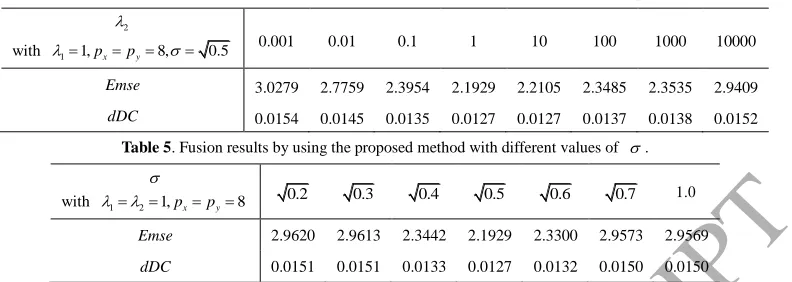
Table 4. Fusion results by using the proposed method with different values of 2.
2
with 11,pxpy8, 0.5
0.001 0.01 0.1 1 10 100 1000 10000
Emse 3.0279 2.7759 2.3954 2.1929 2.2105 2.3485 2.3535 2.9409
[image:22.595.93.489.109.250.2]dDC 0.0154 0.0145 0.0135 0.0127 0.0127 0.0137 0.0138 0.0152
Table 5. Fusion results by using the proposed method with different values of .
with 1 21,pxpy8
0.2 0.3 0.4 0.5 0.6 0.7 1.0
Emse 2.9620 2.9613 2.3442 2.1929 2.3300 2.9573 2.9569
dDC 0.0151 0.0151 0.0133 0.0127 0.0132 0.0150 0.0150
Experimental results demonstrate that the fusion performance remains nearly unchanged when the
parameter 1 is within the range of [0.001, 300]. When 1 is larger than 300, the fusion performance
will be greatly degraded. In contrast, the fusion performance varies continuously with the parameter
2
and is best when 2 is set to 1, which is shown in the Table 4. As shown in Table 5, the fusion
performance also varies with the parameter and achieves the best when is set to 0.5 . Similar to those in the traditional SR and RSR fusion methods, better fusion results can be obtained
when the sizes of image patches are set to 8 8 . Therefore, we will set px py 8, 121 and
0.5
in the following experiments.
5.3 Validity of the proposed fusion method
Several pairs of multi-focus images from two public databases are employed to thoroughly
demonstrate the validity of the proposed fusion method LR_RSR. Fig. 6 provides the ten pairs of
multi-focus images from the first database, which are downloaded from
http://home.ustc.edu.cn/~liuyu1. Fig. 7 illustrates the twenty pairs of multi-focus images from the
second database, which are downloaded from
https://www.researchgate.net/publication/291522937_Lytro_Multi-focus_Image_Dataset.
We will compare our proposed method LR_RSR with some state-of-the-art methods, including
SR [3], adaptive SR (ASR) [21], NSCT_SR [4], convolutional SR (CSR) [5], RSR [1], MRSR [1],
neighbor distance (ND) [12], NSCT [4], homogeneity similarity (HS) [35], image matting (IM) [36]
and deep convolutional neural network (DCNN) [37]. It should be noted that DCNN is a
deep-learning-based fusion method. The mutual information (MI) quality metric [38], gradient
ACCEPTED MANUSCRIPT
and the QPC metric [41] are employed to subjectively evaluate the different fusion methods. The
former two metrics MI and QG are used to evaluate the different fusion methods based on information
extraction, while the latter two metrics ZN_CC and QPC are used to evaluate different fusion methods
based on spatial consistency. Larger values of these metrics mean better fusion performance.
Fig. 6. Ten pairs of multi-focus images in the first database. The top row contains 10 input images with the focus on the left part,
and the bottom row contains the corresponding input images with the focus on the right part.
Fig. 7. Twenty pairs of multi-focus images in the second database. The first top row contains the first 10 input images with the
focus on the front part, and the second row contains the corresponding input images with the focus on the back part. The third row contains the remaining 10 input images with the focus on the front part, and the bottom row contains the corresponding input images with the focus on the back part.
Fig. 8 illustrates some fusion results on the first pair of multi-focus images in Fig. 6(a1) and Fig.
6(b1) (i.e., Fig. 5(a) and Fig. 5(b)) obtained by using different fusion methods. In order to better
compare different fusion methods visually, in Fig. 9, we also provide the normalized difference images
[1] between each of the fused images in Fig. 8 and one of the input images in Fig. 6(b1).
As shown in Fig. 8, all of the fusion methods mentioned here seem to perform well for Fig. 6(a1)
and Fig. 6(b1). However, a more careful comparison in Fig. 9 indicates that LR_RSR, DCNN and
MRSR perform better than others. As shown in Fig. 9(a) ~ Fig. 9(i), there are many residual errors
between each of the fused images and the input image Fig. 6(b1). This indicates that the fused images
obtained by these methods do not completely come from the focused regions of the input images and
thus introduce serious spatial artifacts, especially on the borders of the head of the student. In contrast,
ACCEPTED MANUSCRIPT
reduced. This demonstrates that MRSR, DCNN and our proposed LR_RSR method can more
accurately determine the focused and defocused regions of the input images. As shown in circle regions
of Fig. 9(j) ~ Fig. 9(l), few residual errors exist on the borders of head regions. This also indicates that
MRSR, DCNN and LR_RSR, especially the latter two methods, introduce fewer spatial artifacts to the
fused images.
Fig. 8. Fusion results for Fig. 6(a1) and (b1). (a) ND; (b) NSCT; (c) HS; (d) MF; (e) SR; (f) NSCT_SR; (g) ASR; (h) CSR; (i)
RSR; (j) MRSR; (k) DCNN; (l) LR_RSR.
Fig. 9. Normalized difference images between Fig. 6(b1) and each of the fused images in Fig. 8. (a) ND; (b) NSCT; (c) HS; (d)
MF; (e) SR; (f) NSCT_SR; (g) ASR; (h) CSR; (i) RSR; (j) MRSR; (k) DCNN; (l) LR_RSR.
Table 6. Performance of different SR-based fusion methods on the first database. Scores for the 10 image pairs in this database
are averaged.
Method MI QG ZNCC_PC QPC Tavg(s)
ND 3.9255 0.7438 0.9403 0.6541 2.0 NSCT 3.8461 0.7420 0.9458 0.6673 0.7 HS 4.8726 0.7629 0.9433 0.6858 0.8 MF 4.7915 0.7638 0.9597 0.6828 37.8
SR 4.5100 0.7583 0.9508 0.6793 15.9 NSCT_SR 4.0559 0.7496 0.9507 0.6735 12.6 ASR 3.7429 0.7244 0.8879 0.6321 42.0 CSR 4.0694 0.7396 0.9131 0.6656 43.1 RSR 4.7241 0.7707 0.9670 0.6977 880.1 MRSR 4.8530 0.7737 0.9686 0.7009 39.6 DCNN 4.8150 0.7681 0.9721 0.7005 43.8 LR_RSR 4.8127 0.7687 0.9752 0.6993 4.6
This visual comparison among different fusion methods is consistent with the quantitative results
in Table 6, which also demonstrates that MRSR, DCNN and LR_RSR perform better than other