£!1~6
VJ
3sor
NVS
1921N*
oaNVN~3~NVS
+
13~~VW.,0
1
0
I
I.,
L
.,
£
921
J
3S
SlVJlaOI~3dCD
Testament to
C
omput
e
r
Age
:
A
utomat
e
d Bibl
e
Di
s
tribution
February, 1967
COpy
SAN
JOSE
More than 1000 hours
from d-c to 1.5 MHz
Now try to get that through your head
You can ... with a CEC Magnetic Recording Head.
In fact, consid~,ring that these recording heads last up to five times longer than any others, the 1000 hour guarantee seems rather conservative. In virtually every case, a CEC head will surpass a thousand hours with little or no indication of wear.
The reason: CE C recording heads are of a unique material and solid metal pole-tip design which completely eliminates the weakness of conventional lamination and rotary head designs.
This has resulted in superior
per-formance at frequencies to 2 MHz and a minimum of wear and cleaning.
There is a CEC head for every analog and digital recorder.
Whatever make or model recorder you may now be using, CEC has the head to make the most of it, irrespec-tive of the interface parameters. The "family" consists of more than 1 00 diff~r
ent recording heads, all with the same design advantages. Consequently, it is now possible to obtain state-of-the-art recording without replacing the basic instrument.
How were we able to achieve this
breakthrough in head design? Through experience. CEC has not only been making magnetic recording heads longer than anyone else, but was the first to produce them on a quantity basis. And - because CEC uses precision machine construction where others rely on hand assembly.
For complete specifications and all the facts about this complete line of re-cording heads, call or write your nearest CEC field office.
CEC/DATATAPE PRODUCTS
Pasadena, California 91109"Can I
ma"';
,~,~,;,
When buying a computer, the most i i')Or:
a scientist asks is: "C?n I get it to do thE; j':') .
In physics, in chemistry, in life and 83dh scienc;',,:, there have been more than 500 yesses for th? :)[-_":
More yesses than for any other real-time, on-lin eral purpose computer for science.
That should give you 'confidence. More than; ,(her scientIsts have written programs that wor: .0 po-tential ities (and limitations) of the PDP-8 hE::(; been exhaustively explored. There is an acti\le and ir:ter-ested community of investigators ready to ex,,,hange
:er do
the
lob?"
'}I'I , techniques, even programs.
.eS
PDP-8 the most immediately approacha-nputer you can buy.r'iC:!I"e are some other important questions - and
cilS'!,:efS: Q: How much 7 A: $18,000 complete. Q: W:lsn available 7 A: 30 to 90 days. Q: How much
SpS8u
?
A: 1.5 /-Lsec.Q:
How much memory? A: 4096 12 bit words.Q:
Do I get a bear for added security? A: Only if requested.Send for your copy of our 540 page Small Computer Handbook and Primer. Free.
COMPUTERS' MODULES
DIGITAL EQUIPMENT CORPORATION, Maynard, Massachusetts Ol'lb4, Telephone: (617) 897--8821 • Cambridge, Mass, • New Haven. Washington, D. C .• ParSippany, N, J .• Rochester, N. Y,' Philadelphia. Huntsville. PittsblJrO h • Ch'cdgo • Denver· Ann Arbor. Houston. Los Angeles. Palo Alto. Seattle. Carleton Place and Toronto, ant. • Reading, England • Paris, Fran~e • Munich "nu Cologne, Germany • (;ydney and West Perth" Australia • Modules distributed also through Allied Radio
You get more work out of
a Burroughs 500 system because
more of the computer gets
into the work.
That, in a nutshell, is how
Burroughs 500 Systems solve
two major problems of
com-puter operation: throughput
and system utilization.
Their solution means a much
higher ratio of performance to
price-and a better return on
your computer investment.
1. Throughput. In the past,
the only way to increase
throughput (the amount of
work a computer system
delivers in a given period of
time) was to get a
bigger,
faster computer-at
a sizeable
increase in cost.
The Burroughs way is to
provide a better organized
computer that can do more
Designate No. 5 on Readers Service Card
than one job at a time. This
pacesetting computer
capabil-ity, called
multiprocessing,
has
been enjoyed by Burroughs
customers for nearly three
years. Thousand-job-a-day
installations are not unusual.
2.
System utilization. You
pay for the whole computer
system; but chances are you
use only a portion of it most of
the time. Your computer has
to be big enough to handle
your biggest job. Whenever a
smaller job is running, much
of the system is idle because
the typical computer can do
only one job at a time.
The Burroughs method of
multiprocessing
combines
these smaller jobs
automati-cally, and runs as many of them
together as the
full
size of your
Burroughs computer
will
allow.
No special programing or
tricky operating procedures
are required. It's all done by
the computer itself, through
its Master Control Program.
There are now five Burroughs
500 Systems, ranging from the
small B 2500 to the
super-scale B 8500. Perhaps one of
them can improve your firm's
computer operations and
prof-itability. See your Burroughs
representative, or write us at
Detroit, Michigan 48232.
FEBRUARY, 1967 Vol. 16, No.2
editor and publisher
EDMUND C. BERKELEY
associate publisher
PATRICK J. MCGOVERN
assistant editors
MOSES M. BERLIN CHARLENE J. HOFER LINDA LADD LOVETT NEIL D. MACDONALD
contributing editors
JOHN BENNETT ANDREW D. BOOTH DICK H. BRANDON JOHN W. CARR, III NED CHAPIN ALSTON S. HOUSEHOLDER PETER KUGEL ROD E. PACKER
advisory committee
T. E. CHEATHAM, JR. JAMES J. CRYAN RICHARD W. HAMMING ALSTON S. HOUSEHOLDER HERBERT F. MITCHELL, JR. VICTOR PASCHKIS
art director
RAY W. HASS
fulfilment manager
WILLIAM J. MCMILLAN, 815 Washington St. Newtonville, Mass. 02160, 617-DEcatur 2-5453
advertising representatives
New York 10018, BERNARD LANE 31 West 39 St., 212-BRyant 9-1281 Chicago 60611, COLE, MASON AND DEMING 737 N. Michigan Ave., 312-SU 7-6558 Los Angeles 90005, WENTWORTH F. GREEN 300 S. Kenmore Ave., 213-DUnkirk 7-8135 San Francisco 94105, A. S. BABCOCK 60S Market St., 415-YUkon 2-3954 Elsewhere, THE PUBLISHER 815 Washington St., 617-DEcatur 2-5453 Newtonville, Mass. 02160
The front cover shows the American Bible Society using a computer to handle the problems of distributing each week more than one million copies of its publications. For more information, see page 45.
Special Feature.'
Software, Programming, and Future Developments
18 SOFTWARE DEVELOPMENT AND ITS COSTSby Carl H. Reynolds
A "veteran's" understanding of programming development, inherent prob-lems of third generation software, and prospects for the future. 24 AN INTRODUCTION TO SORT TECHNIQUES
by Edward Opengart
A survey of internal sort and merge techniques representing the more common procedures of current generalized sorts.
30 FUNDAMENTAL CONCEPTS OF PROGRAMMING LANGUAGES
by Jean E. Sammet
Programming languages are characterized, classified for definition, con-trasted with machine language, and discussed in terms of technical and nontechnical aspects.
36 MULTI·PROGRAMMING: WHO NEEDS IT?
by Brooke W. Boering
An examination of the fundamentals of systems design and of return on costs, in the light of the advent of multi'programming and current changes in equipment, prices and capacities.
40 THE CASE FOR COBOL
by
s.
M. BernardA realistic evaluation of the language as a whole a·nd an analysis of those elements which are built into it for its. effective use.
111, Every Issue
43
7
6
22
54
10
11
11 12 12
13 13 13 13
14 14 14
15
15
15
42
29 58 60
62
62
across the editor's desk
COMPUTING AND DATA PROCESSING NEWSLETTER
editorial
Computer-Assisted Explanation in Programming
capital report
by Senfer
w.
stuartmarket report
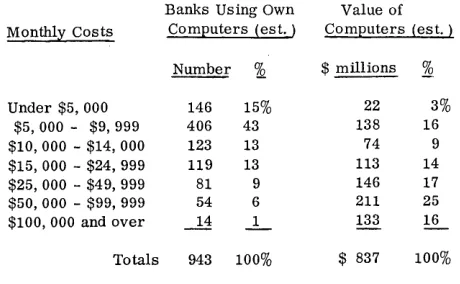
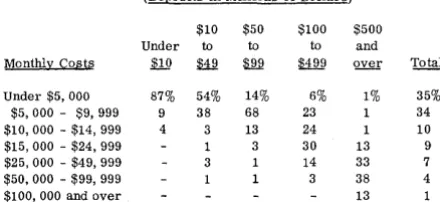
u. S. Banks Have $837 Million Worth of Computers in Use: Market Expanding at 20% Per Year
world report -
Great Britail1,
by Ted Schoeters
multi-access forum
All-Out Pursuit of Economic Growth to Create Jobs, by Thomas J. Watson, Jr. Software Gap - A Growing Crisis for Computers
How Small Can We Make a Book? Project Hindsight, by Philip H. Abelson C&A Problem Corner
Honey from Numbers - Comments Subscription Fulfillment - Comments IEEE Computer Conference - Call for Papers C of P = City of Prescott, by Donald E. Wilson lost Subscriber Search Operation, by Roger H. Geeslin 765 and 567, by William E. Roberts
Correction
Time-Shared Computer Access - C&A Contest Winner Zero-Un Informatique, by Pierre-Jean Refregier
IMPORTA1'-JT NOTICE TO SUBSCRIBERS IN THE UNITED STATES: Please look at your address label on this copy. IF YOUR ZIP CODE IS MISSING OR IS INCORRECT, please (l) attach your label to a reply card from this magazine, (2) write on the card your correct zip code, and (3) mail the postage paid reply card to us at once. Please note that your zip code must be for your street address or your post office box, whichever appears on your label.
Mas de 1000 Areas de Utilizacion de Los Computadores Electronicos, by G. L.
Forgnani
The Second Industrial Revolution
reference information
Calendar cif Coming Events Computer Census
New Patents, by Raymond R. Skolnick
index of notices
Advertising Index Classified Advertising
.~.'_ CdMPUTERS AND AUTOMATION IS PUBLISHED MONTHLY AT B15 WASHINGTON ST., NEWTONVILLE, MASS. 02160, BY BERKELEY ENTERPRISES, INC. PRINTED IN U.S.A. SUBSCRIPTION RATES: UNITED
:~): STATES, $15.00 FOR 1 YEAR, $29.00 FOR 2 YEARS, INCLUDING THE JUNE DIRECTORY ISSUE; CANADA, ADD SOc A YEAR FOR POSTAGE; FOREIGN, ADD $3.50 A YEAR FOR POSTAGE. ADDRESS ALL -.",-;". EDITORIAL AND SUBSCRIPTION MAIL TO BERKELEY ENTERPRISES, INC., 815 WASHINGTON ST., NEWTONVILLE, MASS., 02160. SECOND CLASS POSTAGE PAID AT BOSTON, MASS.
POSTMASTER: PLEASE SEND ALL FORMS 3579 TO BERKELEY ENTERPRISES, INC., 815 WASHINGTON ST., NEWTONVILLE, MASS. 02160. © COPYRIGHT, 1967, BY BERKELEY ENTERPRISES, INC. CHANGE OF ADDRESS: IF YOUR ADDRESS CHANG~S, PLEASE SEND US BOTH YOUR NEW ADDRESS AND YOUR OLD ADDRESS (AS IT APPEARS ON THE MAGAZINE ADDRESS IMPRINT), AND ALLOW THREE WEEKS FOR THE CHANGE TO BE MADE.
c&a
CAPITAL
REPORT
The first section of the Post Office Department's source-data collection system, originally announced as a $22 million project and now estimated at $33.5 million, will start operat-ing this month, accordoperat-ing to Lawrence F. O'Brien, the Postmaster General. The Eastern seaboard section of the system is scheduled to go on the air as the first operational phase, and includes New York and the New England states.
The system will be used to collect data on post office opera-tions and management funcopera-tions, and should measurably speed mail service by .. freezing manpower which can be used clse-whe·re. Four cities are in the first trial-run network, and four more are three-quarters along the way to tie-in. O'Brien es-timates that the system will pay for itself in approximately
three years by saving man-hours now required for employee time reporting, part-time hiring, and reports on mail flow through the postal system.
Manual preparation of thousands of reporting forms will also be eliminated when the new system is fully operational, said O'Brien; he considers the main valuable aspect to be in irnproved management by one of th,~ government's largest employers. The pre-Christmas pile-up and delay of tons of third and fourth class mail in the Northeast has speeded up P.O.'s ADP effort. St. Louis and Paramus, N.J., each with a CDC 3300, will eventually be linked with' batteries of 1205's. Paramus, Rochester, Syracuse, Albany (N.Y.), and Spring-field (Mass.), are scheduled to go on the air first.
The U.S. Army Combat Developments Command has let a contract to Technical Operations Research, Inc., for a $2.3 million project involving war gaming, weapons evaluation, material requirements, cost/ effectiveness, field testing, and logistics. The work will be carried out at Fort Belvoir, Va., by their Systems Sciences Division headquartered in Arling-ton, Va. The initial contract funds 1967 effort on the work, scheduled to take 5 years to complete, by their Combat Opera-tions Research Group.
The Federal Bureau of Investigation, long a user of punch
card equipment, is putting two IBM 360/40's on the air this month in a year's pilot operation of a National Crime Infor-mation Center. It is scheduled to begin operations with 15 cooperating law enforcement agencies feeding information into, and getting replies out of, the central tandem 360's in their Washington headquarters. One 360/40 processes ad-ministrative work and serves as a back-up.
Currently, teletypes linked directly into the central processor and random-access files, will carry coded requests for inter-rogation, update, and purge of data for stolen cars and guns, wanted criminals, etc. Uniform codes have been developed with common formats to aid inexperienced remote users. The agency, in step with industry public relations practices, has announced that it is considering the use of satellites when that becomes practical.
First trials will use standard teletypes operating at 100 \\'ords per minute. Future plans call for transmitting and receiving video images of faces, fingerprints, and other visual data, with perhaps video receivers mounted in patrol cars. The trial network and operating system have been designed by the Institute for Telecommunication Sciences and Aeron-omy in the Department of Commerce under a grant from the Office of Law Enforcement Assistance.
J.
Edgar Hoover, still head of the FBI though now over 70, states that, " . . . the FBI has made certain that its com-puters are able to interface, or be compatible with,' equip--ment produced by any major manufacturers . . . and that local police agencies can select any equipment they desire ... " The FBI is also funding research on automatic classification and translation into machine language, of fingerprint data, using scanning devices.To allay fears of invasion of privacy, which have been the subject of considerable recent controversy between Hoover and Robert Kennedy, he states that the system, " . . . means many things, all of them good . . . with no intrusion whatso-ever upon the right to privacy . . . with a guarantee of the security of information in its files against access or removai by unauthorized persons."
How these guarantees can be met and accuracy maintained with input and output from, " . . . local officers . . . within ... even the smallest police departments ... " is open to some
question. The ultimate effect in deterring crime is however likely to be beneficial.
The government's ban on shipment of large scientific com-puters to France has been lifted, and two CDC 6600's have been ordered, with one already shipped to the French Power Bureau, and another on order for S.I.A., a French service bureau.
The Department of Commerce, which controls exports of certain material to foreign countries, had previously banned shipment of the large-scale scientific hardware by U.S. firms. Although reasons for denial are rarely given, it was widely believed that the ban centered around France's possible use of the scientific machines to develop atomic weapons, which the U.S. hoped to slow.
In a related move, Bull-General Electric, G. E.'s French affiliate, discontinued the Gamma 140 and 145, eliminated about 200 jobs connected with their production, and cut back work weeks from 45 to 420 hours.
IBM, American Telephone and Telegraph, ITT World Communications, Xerox, Honeywell, Business Equipment Manufacturers' Association, Informatics, Bunker-Ramo, and Western Union were among more than 20 organizations who responded to the call by the Federal Communications Com-mission for comments and opinions on rate structures and quality of service, connected with data communications as-sociated with computing facilities. The FCC restated its promise, made last month, that it will proceed swiftly with the investigation. It hopes to identify items for the inquiry agenda within a short time so that it can determine if regulation of computing/ communication links is necessary.
c&a
EDITORIAL
Computer-Assisted
Explanation
•
In
Programming
The special feature of this issue of "Computers and Auto-mation" is "Programming, Software, and Future Develop-ments." In this area, we can notice a great change happen-ing in the computer field:
The barrier to progress nowadays is not so much the limited capacity of the equipment as it is the limited capacity of the programming.
In other words, to make powerful computers is now much easier than to make full use of the powers of computers. We have acquired a sorcerer's machine: how are we as
appren-tices to use it well?
This problem is reflected in several facts:
• Often a third and sometimes half or more of the money spent for a computer installation is spent on programming and programmers.
• Persons to understand problems and systems and to program them for computers are far fewer than needed.
What is the way out? One important avenue for progress in understanding of programming is better explanation than exists nowadays of programming and related information. This is explanation that would enable a person to learn and understand in, say, half the time that he previously would have needed. Even though problem-oriented languages like FORTRAN or COBOL are available, still much of the time we have to use assembly language to achieve essential speed and versatility. We can't for long tolerate an inef-ficiency factor of 10, or 5, or even 3, for many classes of problems. We greatly need good explanation and much more understanding of the principles of programming in as-sembly language and many related subjects.
What is good explanation of programming?
According to the dictionary, to explain is to make plain or clear, to render intelligible. In other words, to explain an idea means to express that idea in terms of other ideas; it means expressing a strange idea in familiar relations to fa-miliar ideas.
For example, what is LISP?
J:xplanation 1:
LISP is a problem-oriented machine-independent com-puter-programming language particularly adapted to handling symbolic expressions.
But for you, the reader, to be satisfied with this, you need to understand already: problem-oriented; machine-indepen-dent; computer-programming language; symbolic expression.
If you do not know the meaning of even one of these terms, you are thwarted. Also, you have to be satisfied with not understanding why the word "LISP" was chosen. (In fact, the mystique of "LISP" stimulates people at one time-shared computer system to put into their time-shared supervisor when you call LISP: "LITHP IS LITHTENING.")
Let's try again.
Explanation 2:
LISP is a language in which you can quite easily write programs for computers; it is well adapted to expressing
COMPUTERS and AUTOMATION for February, 1967
the conditions that occur in many kinds of problems; it is independent of any particular computing machine; it is able to handle letters, digits, numbers, words, state-ments, commands, tables, lists, and many other items, i.e. expressions composed of symbols of almost any kind. The name "LISP" comes from the first three letters of "LIST" and the first le.tter of "PROCESSING." As a programming language, it was worked out in 1958-60 at Massachusetts Institute of Technology by John McCar-thy and several other computer scientists.
Which of these two explanations is more satisfactory? The second one. Why? Essentially, because it fulfils more of the needs of a broader audience. I t conforms better with the maxim:
Never underestimate a man's intelligence; never overes-timate his information.
In fact, I often refer to a list of 35 common properties and relations which an explanation should be checked against.
If you would like a copy of this list, designate 1 on the Readers Service Card.
When an explanation is successful, the explainee fully un-derstands. What is understanding?
Most of the definitions given In the dictionary for "un-derstanding" do not convey an operational meaning: they are synonyms like "grasping," "comprehending," etc. But among the definitions, we do find one which has an operational meaning: understanding is "the power to distinguish truth from falsehood and to adapt means to ends."
N ow the understanding of programming can be demon-strated on a computer. To demonstrate that a program-ming explanation is good, has produced understanding, we can look to see if the person trying to understand it can do something that he was not able to do before. If you "un-derstand," then your program runs; if you don't "under-stand," your program does not run.
In producing the understanding of programming and re-lated subjects, (1) really good explanation of programming step by step, plus (2) direct access to a computer for ex-perimenting and learning, can become seven league boots. The computer as a teacher has many powers and virtues. The computer can act as a device which gives explanations, offers examples, presents problems, suggests hints, and veri-fies understanding. The computer is infinitely patient, yet completely intolerant of errors; and it can be programmed to be courteous and friendly!
Once in a while a human being will be needed of COUlse in order to answer the questions that the computer is deaf to or stupid about. But most of the time the computer, properly programmed to explain well, can be your explainer, your instructor, your solution-checker, and your expert in making clear how to program and produce software - and perhaps even, eventually, your guide, philosopher, and friend.
~
EDITOR
The Bryant
Series
XLO-1000
Controller
This is a plug for our new
Imagine. A Bryant memory system that plugs into almost any computer made.
Just like that.
What's more, you can specify a software package consisting of both handler and
maintenance routines. We'll even code the routines in your own machine language.
The controller can work in several different modes-serial or parallel-with
word transfer rates from 50 microseconds per word to 900 nanoseconds per word.
It can also tr'ansfer information to and from two computers.
Capacity is from one to 500 million characters with up to eight new Bryant
Auto-Lift Drums. Or, if you prefer, disc files can be used.
These new plug-in memory systems are already in
use in military, commercial and industrial applications.
Call your local Bryant Representative or write Bryant
Computer Products, 850 Ladd Rd., Walled Lake,
Michi-gan 48088.
We'll make a Bryant Believer out of you, too.
BRYANT
COMPUTER PRODUCTS
~:~~:-- ~l
tl<LQj
EX-CELL-O CORPORATION
universal memory system.
c&a
MULTI-ACCESS FORUM
ALL-OUT PURSUIT OF ECONOMIC GROWTH TO CREATE JOBS
Excerpts from a speech by Thomas J. Watson, Jr., which appeared in:
"Information Forum on Technology & Nation" Newark, Del. 19711
For a decade or more, many people have feared, with some justification, that technological change in our time is going so fast that it threatens a great many jobs while it C'ases the work burden of the vast majority. Every year fe\ver and fewer people produce more and more goods.
In fact, all through the peacetime years of the 1950s, de-spite the economy's continuing growth, unemployment climbed higher with every peak of the business cycle. Then starting with the recession of 1957-58, it climbed to a plateau and stayed there. For seven years, despite increases In
ev-erything else - production sales, profits, wages -- unem-ployment never averaged less·than 5 percent.
These were some of the facts and fears that led to the C'stablishment of the Automation Commission by the Con-gress in August of 1964. Underlying all its subjects of in-quiry was this basic question: do automation and technolog-ical advance represent a major threat to employment in the decade ahead and therefore require inhibiting controls or other action by the Federal Government or by someone else?
Despite a frank recognition of the problems of technologi-cal ch~nge, the answer to the q~esti?,n of controlling tech-nology In one way or another was No.
Having reached this conclusion, the Commission made a number of recommendations. Four major ones follow:
• Economic Growth: The Commission recommended an all-out pursuit of economic growth to heighten living standards for everyone and to create jobs - for the to-tal of 93 million workers who will be our work force in 1975.
• Education: The Commission recommended, among other things, universal education for everybody in a trade school or community college; and "realistic ac-cess" to university education for "all qualified stu-dents."
• Employer of Last Resort: The Commission agreed that for the physically and mentally handicapped, the unskilled and uneducated, the victims of prejudice -the last people whom employers would hire - the Government should gradually and experimentally offer them jobs in hospitals, schools, urban renewal projects, etc.
• Negative Income Tax: The Commission suggested that the time has come to take a tough-minded look at the hodge-podge of payments to the poor and non-poor alike, and possibly revise it in order to make sure that the money will go where it will do the most good. The Commission did not recommend enact-ment of a negative income tax, but did urge Congress to study it as a possible solution.
Studies by the Commission have consistently reached two main conclusions:
• We should and must drive forward the thrust of tech-nology as a great good for the United States and a great hope for the whole world;
SOFTWARE GAP - A GROWING CRISIS
FOR COMPUTERS
Based on
a report
in Business Week for November 5, 1966, p. 127, published by: McGraw Hill, I'nc.330 W. 42nd St.
New York, N. Y. 10036
A shortage of programmers - and the fruits of their solitary art - is stunting the growth of computer use and costing industry hard cash. The supply of skilled com-puter personnel is far short of the demand. There are only about 120,000 programmers in the United States - and right now there's an estimated need for 175,000 or more. And the gap is widening. The number, power, and wide-spread application of computers has far outstripped the sup-ply of programmers.
The computer has gotten so complex it is demanding ever more intricate instructions. Programs written for old machines must be rewritten for third-generation computers with integrated circuits. Businessmen fail to grasp the sig-nificance of programming or anticipate its cost. And even the computer makers have failed to anticipate the cost and time needed to develop complicated systems programs that control the computer's memory and peripheral equipment.
Programming is expensive and is likely to become more so. In 1964 the government spent 42% of its computer bud-get on software; in 1966 it will spend 51 %. On a national basis, in 1960 software and hardware were equal in cost at
HOW SMALL CAN WE MAKE A BOOK?
Based on an editorial in the December, 1966 issue of: Current
905 Madison Ave'. New York, N.Y. 10021
John R. Platt, a biophysicist at the University of Michi-gan, asks a deceptively simple question: How small can we make a book, and still read it?
One thing seems clear: at the rate new books are being published (there are 2,000-odd pages of print being pro-duced each minute!), they cannot remain their conventional size. Library shelves are already bursting. One hundred years ago the Harvard library contained 212,050 volumes; the Yale library, 95,200. Today these two libraries have al-most 8 and 5 million volumes respectively. As recently as 1940, only 9 university libraries in the United States had more than a million volumes; today that number has risen to 36.
One solution to the problem of the amount of space re-quired for books lies in improved storage and retrieval sys-tems: computerized catalogues, microfilms, electronic in-dices. It is already practical to reduce a page's area by 500 to 1,000 times so that an entire book can be printed on an ordinary catalogue card.
In the near future, using an electron microscope and tiny
COMPUTERS and AUTOMATION for February, 1967
about $1-billion. By 1970, it is predicted that software and programming services will reach an annual cost of $7-bil-lion compared to $5-bil$7-bil-lion for hardware.
Over the years, the biggest share of the software tab has been paid by the computer' customer, not the manufacturer. But the programming bottleneck has pinched the computer makers too. Users bla,me manufacturers for their unrealis-tic promises and delivery dates for software. Some users simply don't pay their bills until the new machine is' run-ning; others invoke a penalty clause in contracts.
The software shortage has given birth to a new group of companies. Their aim is to help business with program-ming, but there's a twist: software consultants are rapidly acquiring so much expertise in specific program skills that computer makers are their largest customer group. The field is burgeoning; new software companies are formed every day. But recruiting and training an adequate staff needed to get sizable contracts takes capital, and so does the service needed to keep customers happy. And the service provided is dependent upon the key element in the software gap - the new breed of intellectual artist - the pro-grammer.
dots of metal-film, we will be able to store 1,000 books of 500 pages each on an area no larger than the proverbial head of a pin. At that point, microlibraries will become feas-ible. All the world's books could then be put on a desk top, and the living room archive will become commonplace.
But the problem doesn't end there. On the contrary, that's exactly where it begins. For once we have instant access to all knowledge, we will, more than ever, have to decide which knowledge is important:
Philip H. Abelson, the editor of "Science," stated it pre-cisely in an editorial last November: "There is increasingly wide distribution of unevaluated material. The bottleneck in utilization of knowledge is not . . . inadequate informa-tion retrieval. The lag occurs in the step between the pile of books on a man's desk and the transfer of that information to his mind. We need to devote much more energy to determining what is significant and then conveying it in concentrated form."
To which we can only add, from beneath our piles of books and magazines, Amen.
PROJECT HINDSIGHT*
I. Based on a report by Philip H. Abelson, Editor, in Science, December 2, 1966, Vol. 154, No. 3753,
Published by American Assoc. for the Advancement of Science
1515 Mass. Ave. N.W. Washington, D.C.
In an effort to understand factors contributing to suc-cessful management of its research and development pro-grams, the United States Department of Defense is conduct-ing a retrospective study of the science and technology used in weapons systems. This effort, known as Project Hind-sight, has been underway for 2~ ye.ars. About 20 proven weapons systems have been analyzed. Typically a team of five to ten expert scientists and engineers dissects the sys-tem into its subsyssys-tems and components, and identifies con-tributions from recent science and technology important to improved cost or effectiveness. Such a contribution is called an Event.
Once the Event has been recognized, its history is traced. I t has been possible to identify the individuals who were principal contributors, their organizations, and the dates and circumstances under which the work was done. Eight per-cent of the Events are categorized as science, 92 perper-cent as technology.
Of the science Events, the majority were applied research clearly oriented toward a DOD need. Most of the remainder were applied research with a commercial objective. Only two science Events were identified as arising 'from basic academic research. Nine per cent of all the Events, mostly in applied research and technology, were performed by univer-sities.
About 90 percent of the federal funds for university re-search is furnished by mission-oriented agencies including the Department of Defense. Some of the conclusions from
Proj ect Hindsight reached to date are of relevance to such agencies and university scientists:
1) Contributions from recent (post-1945) undirected science to the systems studied appear to have been small.
2) The length of time to utilization of scientific findings is decreased when the scientist is working in areas related to the problems of his spoJ).sor.
3) The efficient production of timely knowledge useful to a mission-oriented agency is most readily achieved when that agency funds and manages its own research pro-grams.
Because of its unprecedehted nature and impressive scope Project Hindsight is likely to be influential. The report implicitly raises questions concerning government support of academic research which university scientists will do well to consider.
*A re~ort "Project Hindsight" is available from the Clearinghouse for Federal Scientific and Technical Information, 5285 Port Royal Road, Springfield, Virginia 22151.
II. From the Editor
Computer persons pursuing certain research projects for the Department of Defense, take note: The green light is changing to yellow and red.
C&A
PROBLEM CORNER
Readers are invited to submit problems (and their solu-tions) for this column to: Problem Editor, Computers and Automation, 815 Washington St., Newtonville, Mass. 02160.
The following problem is submitted by Walter Penney of Greenbelt, Maryland. The solution will appear next month.
Problem 672: Coffee-Time Analysis
As soon as Hank Rivers and John Lawthorne had ordered their coffee, Hank began, "Things were hectic today! The big brass were in a huddle all day trying to decide what computer to buy. The choice had narrowed down to a BIVAC, RENN, DIGS 170 :md M.C.P's new Y 219 ma-chine."
John took a sip, and said, "I suppose there's always some trade-off in connection with these choices."
"Trade-off?· That just isn't the word! The BIVAC was fastest, the RENN the most compact, and the DIGS 170 the cheapest. And to make things worse, no machine oc-cupied the same rank in any two categories."
John took a pencil out of his pocket and began to write on the back of the check. "I assume the Y 219 was rejected since it wasn't best in anything."
"Far from it! Next to the RENN it was fastest, and, what seemed 1'0 carry a lot of weight with the non-scientific members of the panel, it was considerably cheaper than the BIV AC." Hank's expression left little doubt what he thought of non-scientists and their evaluations of computers.
Hank thought his companion had been doodling on the back of the check, but now he saw that a 3 by 4 array was beginning to take shape. John looked up from his scribbling. "I'll bet I can tell you how the various machines rank in speed, size and price."
"Don't see how you can do that; I haven't given you any figures. You must know these machines!"
"Not at all. I'll give you the relative standings of the machines in each category, and if I'm wrong, I'll pay for the coffee."
John showed the back of the check to Hank, who looked it over a few moments, then dug in his pocket, and sum-moned the waiter.
IIHONEY FROM NUMBERSII-COMMENTS
I. From Miss Georgia Nagle Computation Center
Mass. Inst. of Technology Cambridge, Mass. 02139
Congratulations on your delightful essay in the December "Computers and Automation" on numbers - from one who has never been able to cope with them in any way. I know
the honey is there, but I've never been able to find it!
II. From the Editor, enclosing the December 1966 editorial, to
Monsieur Andre Maurois Academie Francaise Paris, France
J e prends du plaisir en vous envoyant quelque chose que j'ai ecrite et que parle de vous et de vos idees - avec mes salutations distinguees.
III. From Andre Maurois
Je vous remercie de m'avoir envoye cet article ou vous me citez et ou vous commentez mes propos de maniere si intelli-gente et si neuve.
Bien cordialement
a
vous.P.S. J'ai essaye 142857. It's amusing and easy to explain.
SUBSCRIPTION FULFILLMENT
I. From Margaret Milligan, Publisher Data Processing Digest, Inc.
Los Angeles, Calif ~ 90035
We laughed ourselves sick (with sympathy) over your ed-itorial about the subscription fulfillment problems in your November issue. No one who has never been in the situa-tion could appreciate it as we do. How companies, and even government agencies, can send checks with no identification or accompanying documents is beyond me. And the agencies can get their clients' orders mixed up with amazing rt:gular-ity. I guess we could exchange exasperating experiences for hours.
We still have less than 5000 subscribers, so we are not in the difficult position you are in, since ours is still managed entirely manually, and we can maintain cross files to help us locate people. But it is getting worse, and it is impossible to find good people to handle the problems (which we call bags of worms) .
I would like to know something about your computer op-eration. We have been investigating the possibility of going on computer because the addressing plates available to us are so limited in character length. If you have the time, I hope you can give me a" little information about your system.
II. From the Editor
Your letter delighted me.
By now you should have a letter from our computer ful-fillment manager, and I hope he has answered your present questions.
COMPUTERS and AUTOMATION for February, 1967
IEEE COMPUTER
CONFERENCE-CALL FOR PAPERS
Professor S. S. Yau
Dept. of Electrical Engineering The Technological Institute Northwestern University Evanston, III. 60201
The First Annual Computer Conference of the Institute of Electrical and Electronics Engineers will be held in Chi-cago, Ill., Sept. 6-8, 1967. Papers describing results of original research in the following areas (or related topics) are invited.
1. Design Automation:
This area includes automated design of electronics circuits, filters, logic circuits, large integrated arrays, computer systems, etc.
2. New Computer Elements and New Computer System Organizations:
This area includes use of microelectronics, inte-grated electronics, optical devices, and other new elements in computer design, and future computer system organizations, etc.
3. Reliability:
This area includes design of reliable computer sys-tems from unreliable elements, organizations of re-liable automata, self-fault-detection, self-diagnosis, self-repair, etc.
4. Patte~n Recognition:
This area includes new techniques for pattern recog-nition, pattern visualization, and description of their implementation, etc.
5. On-Line Computer Systems and Their Applications: This area includes on-line control of experimental equipment, industrial process control, inventory con-trol, large message switching and circuit switching systems, etc.
Authors are requested to submit seven copies of a 75-word abstract and a 2000-word synopsis with any important illus-trations, and a list of references to me by April 10, 1967. The author should arrange for any necessary company or security clearances before submission of his manuscript. Authors will be notified of acceptance or rejection of their papers by May 31, 1967. The deadline for submitting the completed manu-scripts is September 6, 1967.
C OF P
=
CITY OF PRESCOTT
I. From the editorial uSubscription Fulfi!lment", Computers and Automation for November, 1966
As I write this editorial, I have in front of me a voucher which came off a check. The date is typed "JUN 20, 66." The "account number" is typed "103986," a number which does not agree with any invoice number we have. The "in-voice amount" is typed $4.00. The "remarks" are typed [sic]: subscription to computers & automation, Nevember, 1966 At the bottom of the voucher, printed, is "C of P 14." On the voucher there is no name of a bank, nor name of an organization, nor name of a subscriber, nor any address. What do you do? We have no way of crediting this $4 to anybody. We have no way of inquiring of anybody whose $4 this is. (It is beyond my understanding how any modern organization could use printed vouchers for its checks that do not bear any name or address!)
II. From Donald E. Wilson, CPA City Treasurer
P. O. Box 2059
City of Prescott, Arizona 86301
As I write this letter, I have in front of me your editorial in the November, 1966 issue of "Computers & Automation." As a matter of fact, I have enclosed a marked copy of that page, outlining this embarrassing subject in red. I am also enclosing copies of the voucher to which you refer, plus a copy of the duplicate payment which resulted from all this.
Had we issued a purchase order for this, as is our cus-tomary practice, we would not have had the duplicate pay-ment. Had we had the City name and address printed on the voucher, this wouldn't have happened. Had we re-corded your invoice number on the original check, this would have been avoided.
We now have on order a NCR500 system, the planning for which made your magazine desirable. I read each copy thoroughly, and have gotten much from it. As a matter of fact, I even read the editorial, as you can see.
Oh, by the way, the account number is that of our own accounting system. The checks are prepared on our present equipment, a NCR class 33 accounting machine. Perhaps our new computer will help to eliminate these deficiencies.
I will appreciate your returning the duplicate payment of $4.00 at your earliest convenience.
III. From the Editor
Thank you for your letter. It gives me much satisfaction to return to you as City Treasurer the $4 we owe you. I can see from your letter that this sort of problem, which has given us both such difficulty, is on its way out for the City of Prescott, Arizona.
LOST SUBSCRIBER SEARCH OPERATION
I. From Roger H. Geeslin Assoc. Prof. of Mathematics University of Louisville Louisville, Kentucky 40208
My copy of the November issue of Computers and Au-tomation had a second label affixed, addressed to the Li-brary, Belknap Campus, University of Louisville. I assume this means that the Library did not receive their copy. Please send them one.
Also, re your subscription fulfillment editorial, is it too much to expect you to have a cross reference list by name of your subscribers?
II. From the Editor
Thank you for your letter, and for noticing and returning the second label pasted in error on your copy. Thanks to you, we can correct this error, and have done so by sending a copy of the issue to your library.
As a result of your suggestion and some analysis of possi-bilities with our magnetic tape file of subscribers, we are installing a "Lost Subscriber" search operation to look for "lost" subscribers. Although our file of subscribers is se-quenced according to their geographic location, at a reason-able cost we can run an alphabetic search every second month for names not found geographically.
We shall begin this soon experimentally and hope in this way to reunite certain lost subscribers and the subscrip-tion record to "Computers and Automasubscrip-tion."
Just the same, we still request that all correspondence about subscriptions should include complete name and ad-dress, present and previous.
765 AND 567
I. From William E. Roberts Fort Worth, Texas 76112
This is a fast world we live in. Everything seems to be accelerating - even the rate of acceleration. I know that our newest jets flying west can beat the sun and thus arrive at their destination before they le.ave (timewise) from the point of departure. This doesn't upset me, probably be-cause I haven't done any of that kind of jet flying yet. But, what does upset me is when my subscription to "Com-puters and Automation" expires before it starts.
In July of this year I subscribed to your magazine for a period of one year. I made a special request, however, and this is probably how things got fouled up. I asked that, if possible, my subscription should start with the June Directory issue. I preferred to have the Directory then in-stead of waiting for the 1967 Directory issue.
I didn't get the June 1966 Directory issue nor the July 1966 issue but did get the August 1966 issue. This was un-derstandable as I figured it was too late and too troublesome
to back the thing up as much as I had requested. But, the August 1966 is the only copy I have ever received.
I took a look at the subscription sticker on that one lonely issue I received and, sure enough, it appears to be coded to expire before the subscription was to start. The code is *DO 765. Usually these things are set up to give the actual expiration date. If that is the way your system is programmed, my subscription was set up to expire before I decided to subscribe.
In any event I really would like to receive your magazine and sincerely hope that someone around your shop can straighten it out.
Don't feel too badly, though. I have had similar trouble with other publications and have about reached the con-clusion that one of two situations must exist; either I am "snake-bit" when it comes to magazine subscriptions or mag-azine subscription automation is a poorly developed art that is fraught with errors.
II. From the Editor
Thank you for your nice letter. From our office we are shipping you the missing issues right now.
Weare sending your letter to our fulfillment office to have them correct your subscription record, and send you Febru-ary through May 1967 in due course. May 1967 should be the right expiry. The code on your sub apparently changed from 567 to 765, due to Murphy's First Law, "If something can go wrong, it will." If there is any discrepancy, we shall get in touch with you again.
Thank you again for your friendliness towards us, in spite of the poor functioning of our subscription fulfillment art in your case.
CORRECTION
On page 9 of the January, 1967 issue of "Computers and Automation," the credit line for the article entitled "BOOK" should be amended to include: "Reprinted by permission of
TIME-SHARED COMPUTER ACCESS -
C&A CONTEST WINNER
"Computers and Automation" is pleased to announce the winner of the Readers Service Card drawing in the contest for a chance to use a time-shared computer free. This contest was announced on page 55 of the October, 1966, issue of "Computers and Automation". The winner is Mr. Francis
J.
Bartram of the Shell Oil Company, New York, N.Y. Mr. Bartram has won $100 worth (approxima tel y 7 hours) of time-shared computer console time plus a free installation for the period of use. The winner has the right to delegate his prize if he is not in a position to use it.ZERO-UN INFORMATIQUE
I.
From Pierre-Jean Refregier EditorZero-Un Informatique Paris 10e, France
To read practically every publication dealing with EDP is a professional obligation for myself as well as for my staff. I have been wanting to tell you for some time that although we are "blase", each number of "Computers and Automation" is eagerly awaited by us, because we believe that in its own style, it is the best journal in the EDP field. I should even say that "Computers and Automation" is, in some respects, a model for our own publications: "Zero-Un-Informatique" (monthly) and "Zero-Un-Actualites" (fortnightly). Both are the only French EDP journals which are completely independent from any outside influence. Like you we think not only in terms of machines, but also in terms of men.
I should welcome any form of cooperation with you which you may think suitable.
It is my belief that it would be particularly interesting to acquaint French EDP circles with your ideas as regards the
The contest was sponsored jointly by "Computers and Automation" and the "Information Processing Centers Busi-ness" of General Electric, Computer Department, Phoenix, Arizona. C&A is providing the quantum of computer time; General Electric is providing the teletypewriter installation charge and rental, the telephone line charge, and the time for instruction to the winner.
We hope to publish soon a first-hand account of the lucky user's experiences and reactions with the time-shared computer.
social and human repercussions of progress in the EDP field. As you certainly know, France is at present actively - I should even say, enthusiastically - interested in computers, but action in this field is somewhat chaotic for the time being.
II. From the Editor
We are glad that you like "Computers and Automation." Your proposal of cooperation is interesting to us, and we shall be glad to be of help to you if we can. It is quite possible that we have many common interests and purposes, particularly in producing understanding of the social impli-cations of computers and automation and the social respon-sibilities of computer people.
MAS DE 1000 AREAS DE UTILIZACION DE LOS COMPUTADORES ELECTRONICOS
G. L. Forgnoni Univac de Mexico Mexico 1, D.F. Mexico
We are enclosing some copies of "Over 1000 Applications of Computers" translated into Spanish, in accordance with the permission you gave us in your recent letter.
COMPUTERS and AUTOMATION for February, 1967
The distribution to computer users in Mexico and to Uni-versities started in December.
Please accept again our thanks for your authorization.
Introducing a
·
$90,000
computer '
that can end up
costing you
$500,000.
There are three things to remember about Sigma 5.
First, it is multi-use, like its big brother Sigma 7.
It does foreground real-time control, background
general-purpose computation, and high-speed
input/ output. Simultaneously.
Second, Sigma 5's central processor is so
power-ful and sophisticated that it works even more
efficiently with $500,000 worth of memory,
periph-erals and options than it does in its basic $90,000
configuration.
Third, Sigma 5 grows without fuss. Everything
is modular - memory, input/output processors,
peripherals, central processor options, software.
Each upward transition is simple and logical until
you reach Sigma 5's limit. Then if you want to keep
on growing, just substitute a Sigma 7 CPU and
behold! You have a Sigma 7 time-sharing system.
Two computers aren't better than one.
It no longer makes economic sense to have
dif-ferent computers for difdif-ferent kinds of jobs.
Sigma 5 will control your plant, do your
scien-tific and engineering computation, and look after
your accounting and inventory. All at once.
Nobody will have to stand in line. Everyone will
be protected against loss or interference. Sigma 5
can deal with foreground real-time interrupts in
6 microseconds without losing control of any of its
other jobs, yet every background user will get his
answers faster than he needs them.
Nobody loves a lazy computer.
If
your Sigma 5 ever has an idle microsecond it
will be your fault.
Sigma 5 doesn't stop computing to wait for input/
output. It doesn't reserve idle capacity to take care
of on-line peaks.
Instead it dynamically and very rapidly shifts
from one task to another in order to keep all its
power working all the time. Input/output is
man-aged independently by one built-in and five optional
I/O processors, with up to 160 automatic I/O
channels.
The bigger the better.
One reason why Sigma 5 gets more efficient as
it grows larger is that when memory modules are
added interleave and overlap occur. This not only
COMPUTERS and AUTOMATION for February, 1967
increases the effective speed of the central
proces-sor but raises input/output capability too.
Sigma 5 won't wait for software.
Sigma 5 is program-compatible with Sigma 7.
The software for both has already been developed
and is being delivered now with Sigma 7's.
So you'won't have problems with new and untried
software. And you won't have to wait either.
Sigma 5 software is modular like the hardware.
As your Sigma 5 grows the software grows too, in
natural, simple, logical steps.
Software for Sigma 5 includes Basic Control
Monitor, Batch Processing Monitor, three
ASA-compatible FORTRAN IV compilers including a
high-efficiency version, Symbol Assembler,
Meta-Symbol Extended Assembler, SDS COBOL 65,
Sort/Merge, and a library of mathematical,
busi-ness and utility routines.
All Sigma 5 software is multi-use.
Here are some numbers.
Basic memory cycle time of 850 nanoseconds is
reduced as overlapping of memory occurs.
32 memory sizes, from 4,096 to 131,072 words.
Memory uses 32-bit words, is addressable and
alterable by 8-bit bytes, halfwords, words, and
doublewords.
16 general purpose registers, expandable to 256.
All memory is directly addressable without base
registers.
8 automatic I/O channels in CPU, plus 5
optional I/O processors, either mUltiplexor lOP's
(500,000 bytes/sec.) or selector lOP's (37 million
bits/ sec.) in any desired combination.
224 levels of priority interrupt. Priorities
auto-matically recognized without program intervention.
How soon?
Order now and you'll get your Sigma 5 (with
software) in August.
You can order the exact configuration that fits
your needs. Or if you have budget problems, order
what you can afford now and
plan to add modules as more
i
,\1 )
Iii
funds become available.
Growing with Sigma 5 is
almost painless. All you feel is a
Scientific Data Systems,slight twinge in the pocketbook.
Santa Monica, CaliforniaDesignate No. 12 on Readers Service Card
SOFTWARE DEVELOPMENT AND ITS COSTS
Carl H. Reynolds~ President
Computer Usage Compan)'~ Inc.
Mt. Kisco~ N.Y. 10549
"It is
im~possiblefor us to see anything which we are unable to do with
cOlnputers. Therefore, something of the hUl1Ian being inside of us takes
over and says we l1Iust try to do at least part of what we can see as the
possibilities."
In the past three or four years I have done a lot of work in development of software. I have met a lot of
pro-grammers; worked with a lot of programmers under both good and bad conditions; and have now decided to devote my life fully to the development of software. These past four or five years have started to synthesize in my mind some true statements about programming development and that lead to the so-called "software crisis." In this article I shall go over some of these points and, hopefully, this battle-scarred veteran will be able to give you a picture of the overall war which will be useful in developing the strate-gies you need for your own ends.
My subject is the costs of programming, development, and maintenance, and the payoff from software development. After looking quite deeply into the cut and dried figures of the matter, I have come to the conclusion that they were really beside the point; that understanding and controlling costs and pay-off of software development required an un-derstanding in a direction different from accounting for or measuring the physical process of writing specifications, coding, and debugging.
Three Ideas to Understand Programming Development
The software area is in confusion today because there are very few fundamental concepts on which to base any assess-ment of the situation. It takes at least three ideas to under-stand the programming development process.
First of all one must have some method of evaluating the program. Generally ·it seems to me that we are talking about the software problems in the same way that we would tell the designers of the Volkswagen that they have a poor product because it doesn't go fast enough, it isn't big enough, and it costs a little too much. All of this without letting the VW designer know how fast is fast, how big is big, and how little is little. This is a problem of great magnitude, but which I will leave for others to discuss.
The second thing that we need to understand is that pro-gramming has a technological base just as hardware does. The technology that is used in particular programming can be in various stages of development. For example, it can be in research; it can be in the state-of-the-art~ or it can be in available technology. It is diffie-nIt to be very specific about these definitions, but let's try.
Defining "Research"
In hardware technology, to define research is easy. It is work done in the laboratory by one or two people. It may be advertised widely in the newspapers as being the savior of everythi'ng in mankind, but nobody in his right mind will take an order for that device nor will a responsible man-ufacturing man say he can build them in quantIty.
Defining "State of the Art"
The second stage we could call State-of-the-art. That is, a lot of people and a lot of laboratories can do this and they have made pilot production attempts and have gotten some data on what it costs to produce this item.
Defining "Available Technology"
Finally, it is Available Technology which means lots of people understand the process, many people are, in fact, producing this item, and almost anybody can go into the business with a fair understanding of what his costs and profits will be.
The Same States in Programming
contend that in programming the same states exist, but
they have never been differentiated or understood by per-haps even the programmers themselves - certainly not by their management, and certainly not by the customers. We