© 2019, IRJET | Impact Factor value: 7.211 | ISO 9001:2008 Certified Journal
| Page 1332
Design & Investigate the Performance Characteristics of RLS Algorithm
in Halfband FIR Filter Structure for WiMAX / WLAN Applications
K. Prathiba
1, B. Senthil Murugan
21
PG Scholar, Department of ECE, Thanthai Periyar Government Institute of Technology, Vellore, Tamilnadu, India
2
Assistant Professor, Department of ECE, Thanthai Periyar Government Institute of Technology, Vellore,
Tamilnadu, India
---***---Abstract - The purpose of this paper is to study the performance characteristics of RLS algorithm in halfband FIR filter structure for WiMAX & WLAN applications. Firstly, the paper presents the theory behind the adaptive filter. Secondly, it describes the most commonly adaptive filter which were used in RLS algorithm. From the parameter, the order of filter for WiMAX & WLAN is applied in RLS algorithm techniques. Furthermore it explains some of the techniques of adaptive filter, the system identification, the prediction & the noise cancellation. Finally the simulation results of these techniques are obtained.
Keywords - FIR, Halfband, RLS, WiMAX & WLAN.
1. Introduction
Adaptive filters are filters with the ability of adaptation to an unknown environment. This family of filters has been widely applied because of its versatility and low cost. The ability of operating in an unknown environment added to the capability of tracking time variations of input statistics makes the adaptive filter a powerful device for signal- processing and control applications.
Applications are separated in basic classes: identification, prediction and interference cancelling. It have a common characteristic: an input signal is received for the adaptive filter and compared with a desired response, generating an error. That error is then used to modify the adjustable coefficients of the filter, generally called weight, in order to minimize the error and, in some optimal sense, to make that error being optimized, in some cases tending to zero, and in another tending to a desired signal.
The proposed algorithm will be performed according to the factors are rate of convergence, computational cost and tracking characteristics.
This paper [1] describes new strategies to improve the transient response time of harmonic detection using adaptive filters applied to shunt active power filters. Two cases are presented and discussed, both using an adaptive notch filter, but one uses the least mean square algorithm to adjust the coefficients and the other uses the recursive least squares algorithm.
This paper [2] presents advanced digital signal algo- rithms for adaptive filtering applied for noise cancellation and signal analysis in real-time. Correlated and not-correlated signal parts are distinguished by such methods based on the statistical characteristics of the received signals.
Due to the high flexibility and the high integrated of FPGA technology, this paper [3] propose a LMS algorithm using FPGA technology to achieve it, and well used in adaptive filter, not only meet the needs of flexibility and real-time for systems, but also easy to implement , compared with other algorithms it is more simple and more reliable. It has good prospects in the field of signal processing.
This brief proposes [4] a novel normalized least mean square algorithm that is characterized by robustness against noisy input signals. To compensate for the bias caused by the input noise that is added at the filter input, a derivation method based on rea- sonable assumptions finds a bias-compensating vector.
© 2019, IRJET | Impact Factor value: 7.211 | ISO 9001:2008 Certified Journal
| Page 1333
TABLE1. FILTER DESIGN PARAMETERS FOR WiMAX / WLAN APPLICATIONS
In this paper we are designing the RLS algorithm for WiMAX & WLAN standard as per the specification mentioned in the table 1. The sampling rate reduction required for WiMAX is 8 and WLAN is 12, which is realized with multistage FIR, which reduces the computational complexity compared to single- stage realization and other structures considered for analysis.
2. Adaptive filters techniques
The adaptive filters are efficient when compared to multirate filters because it gives the accurate response and analyse the perfomance metrics such as order of the filter or length of the filter, convergence rate, minimum mean square error [MSE], computational complexity, stability and robustness. There are major types of adaptive filtering techniques: System identification, Prediction and Noise cancellation.
[image:2.595.190.406.406.491.2]2.1 System Identification
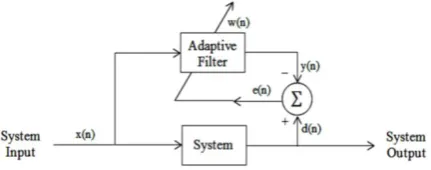
Fig.2.1 System Identification
Above fig 2.1 In that application, the adaptive filter receives the same input x(n) as the system. The output of the adaptive filter y(n) is then compared with the desired response and output of the system d(n) generating an error. That error e(n) is used to adjust the weight w(n) in order to minimise the error, identifying the system. The adaptive system identification is an important tool that is widely used in the fields of communications, control systems and signal processing. The characteristic of good tracking of time variations is a powerful instrument to the identification of unknown time-varying systems.
[image:2.595.191.407.642.721.2]2.2 Prediction
Fig 2.2 Prediction
From fig 2.2 Having the aim to give the best prediction of a random signal, the adaptive predictor filter relies on applying the past values of the random signal x(n), obtained by applying a delay to that signal provided to the adaptive filter input and
Parameters WiMAX WLAN
Sampling Rate 8 12
Input sampling frequency Fs (MHz) 133.632 132
Pass band Edge (MHz) 8 0.45
Stop band Edge (MHz) 10 12.5
© 2019, IRJET | Impact Factor value: 7.211 | ISO 9001:2008 Certified Journal
| Page 1334
comparing its output y(n), with the desired response d(n), that is nothing but, the actual random signal x(n). When the filter output is used to adjust the filter weights, the adaptive filter is called a predictor filter; when the result of the comparison between y(n) and d(n), called e(n), is used to adjust the weights of the filter, it operates as a prediction error filter.
[image:3.595.189.407.156.233.2]2.3 Noise Cancellation
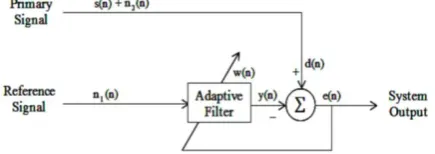
Fig 2.3 Noise Cancellation
Above fig 2.3 A desired response d(n), which is nothing but, a primary noisy signal (corrupted by a noise n2(n)),primary signal = s(n) + n2(n). It is compared with the output of the adaptive filter y(n), that has as input a reference signal n1(n) which is the noise source that creates the noise which corrupts the primary signal (noise n2(n)). The system output e(n) in this case, is the difference between the filter output y(n) and the desired response d(n). In an optimum situation, this e(n) will be equal to the original signal without the interference (s(n)).
3. DESIGN rls algorithm
Contrary to the LMS algorithm, whose aim is to reduce the mean square error, the recursive least-squares algorithms (RLS) objective is to find, recursively, the filter coefficients that minimize the least square cost function. The RLS algorithm has as an advantage a fast convergence, but on the other hand, it has the problem of a high computational complexity. The cost function of this algorithm is the weighted least-squares (WLS), given by:
where range 0> λ >1 is called “forgetting factor’’, which gives exponentially less weight to older error samples and e(n) is the error, defined by the difference between the desired response d(n) and the output y(n) produced by a transversal filter whose tap inputs at time n is equal x(n),x(n-1),…,x(n-M+1). The e(n) is defined by:
where x(n) is the tap-input vector, defined by:
w(n) is the tap-weight vector, defined by:
The minimum value of the cost function J(n), reached when the tap-weights have they optimum value is defined by the normal equations written in matrix form:
The M-by-M correlation matrix Φ(n), is defined by:
© 2019, IRJET | Impact Factor value: 7.211 | ISO 9001:2008 Certified Journal
| Page 1335
where * denotes de complex conjugation. To compute the RLS we need to apply the matrix inversion Lemma. After applying this method, we have:
where is the inverse correlation matrix, λ-1 is the inverse forgetting factor and k(n) is the gain.
The M-by-1 gain vector k(n) is defined by:
The tap-weight vector w(n) is then calculated using the following expression:
where the * represents the complex conjugation.
4. GRAPHICAL ANALYSIS
Fig 4.1 a) Desired signal, filter output and the error of the RLS algorithm for the system identification
In the above Fig 4.1 a) shows that the desired signal, filter output and the error of the RLS algorithm for the system identification
[image:4.595.194.395.385.544.2] [image:4.595.194.402.614.748.2]© 2019, IRJET | Impact Factor value: 7.211 | ISO 9001:2008 Certified Journal
| Page 1336
In the above Fig 4.2 b) shows that Weighted least-squares of the RLS algorithm for system identification
Fig 4.3 c) Desired signal, filter output and error of the RLS algorithm for the signal prediction
In the above Fig 4.3 c) shows that the desired signal, filter output and error of the RLS algorithm for the signal prediction
Fig 4.4 d) Least-squares of the RLS algorithm for prediction
In the above Fig 4.4 d) shows that the least-squares of the RLS algorithm for prediction
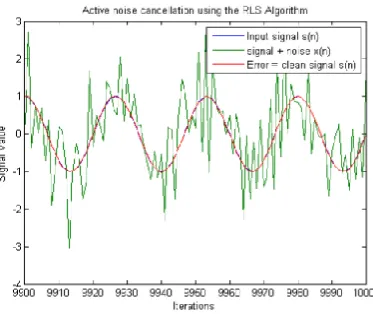
Fig 4.5 e) Results of application of the RLS algorithm for the Noise cancellation
[image:5.595.196.396.103.283.2] [image:5.595.195.400.344.503.2] [image:5.595.203.390.565.722.2]© 2019, IRJET | Impact Factor value: 7.211 | ISO 9001:2008 Certified Journal
| Page 1337
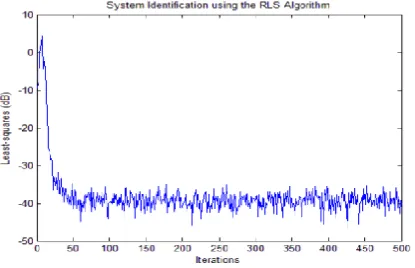
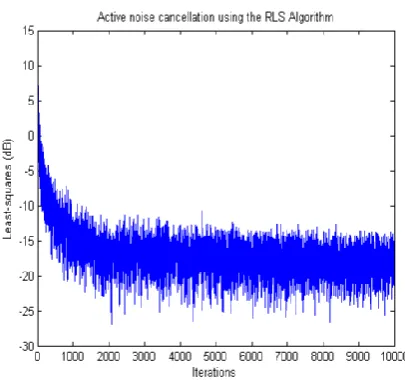
Fig 4.6 f)Least-squares error of the Noise cancellation using the RLS algorithm
In the above Fig 4.6 f) shows that the least-squares error of the Noise cancellation using the RLS algorithm
5. Conclusion
Therefore, the order of filter for WiMAX & WLAN is applied in RLS algorithm through the techniques of adaptive filter. Then the simulation results are obtained using matlab. Thus the performance characteristics of RLS algorithm in halfband FIR filter structure for WiMAX & WLAN applications are designed.
6. Future work
It is possible to design the filter structure in MATLAB - Simulink model and finally it is realize in Virtex-V FPGA using Xilinx system generator will be done in future. So far we analysed the different Adaptive filter methods and the results show that the complexity can be reduced and to found the different performance metrics using WiMAX & WLAN applications.
References
[1] Rondineli Rodrigues Pereira, Carlos Henrique da Silva, Luiz Eduardo Borges da Silva, Germano Lambert-Torres and João O. P. Pinto (2011) “ New Strategies for Application of Adaptive Filters in Active Power Filters ”, IEEE Transactions On Industry Applications, Vol. 47.
[2] Arnd Frech , Markus Klugel , Peter Russer (2013)“ Adaptive Filtering for Noise Cancellation and Signal Analysis in Real-time”, Proceedings of the 43rd European Microwave Conference.
[3] Guanghui Cai, Chuan Liang, Jun Yang (2013) “Design and Implementation of LMS Adaptive Filter Algorithm Based on FPGA”, 2nd International Symposium on Instrumentation and Measurement, Sensor Network and Automation (SIMSNA).
[4] JinWoo Yoo, JaeWook Shin, and PooGyeon Park(2015) “An Improved NLMS Algorithm in Sparse Systems Against Noisy Input Signals”, IEEE Transactions on circuits and systems—ii: express briefs, vol. 62.
[image:6.595.195.398.77.267.2]