43
PostAc
®: A Visual Interactive Search, Exploration,
and Analysis Platform for PhD Intensive Job Postings
Chenchen Xu1,2 Inger Mewburn1 Will J Grant1 Hanna Suominen1−4
1. The Australian National University (ANU) / Canberra, ACT, Australia 2. Data61, Commonwealth Scientific and Industrial Research Organization (CSIRO) /
Canberra, ACT, Australia
3. University of Canberra / Canberra, ACT, Australia 4. University of Turku / Turku, Finland [email protected]
Abstract
Over 60% of Australian PhD graduates land their first job after graduation outside academia, but this job market remains largely hidden to these job seekers. Employers’ low awareness and interest in attracting PhD grad-uates means that the term ”PhD” is rarely used as a keyword in job advertisements; 80% of companies looking to employ similar re-searchers do not specifically ask for a PhD qualification. As a result, typing in PhD to a job search engine tends to return mostly aca-demic jobs. We set out to make the market for advanced research skills more visible to job seekers. In this paper, we present PostAc®, an online platform of authentic job postings that helps PhD graduates sharpen their career thinking. The platform is underpinned by re-search on the key factors that identify what an employer is looking for when they want to hire a highly skilled researcher. Its ranking model leverages the free-form text embedded in the job description to quantify the most sought-after PhD skills and educate information seek-ers about the Australian job-market appetite for PhD skills. The platform makes visible the geographic location, industry sector, job ti-tle, working hours, continuity, and wage of the research intensive jobs. This is the first data-driven exploration in this field. Both empirical results and online platform will be presented in this paper.
1 Introduction
The PhD was originally conceived - and is usu-ally understood - to mark the commencement of an academic career. Yet the degree has never been entirely fit for purpose: as early as 90 years ago,
Dale (1930) questioned the role of academic de-gree. But since then, both academic and industry needs have changed dramatically.
On the academic side, changing workforce structures over the last few decades have meant
PhD graduates have faced ever greater difficul-ties landing academic employment (Bazeley et al.,
1996). In Australia, recent research has revealed that up to 60% of students end up working out-side of academia, making us ask whether their aca-demic training is really fit for their final purpose
(McGagh et al.,2016).
Outside academia, governments are starting to recognize the importance of highly trained grad-uates to innovation, and are thus putting pressure on universities to re-think PhD curricula so as to target both academic and wider industry needs
(Mewburn et al., 2016). Yet limited data-driven
research exists to explain how having a PhD ac-tually impacts job seeking in non-academic sec-tors. Meanwhile, about 80% of the companies looking to employ highly skilled researchers do not specifically ask for PhD qualifications (
Mew-burn et al., 2018). In this paper, we demonstrate
an online platform — PostAc® (short video) — that allows users to explore non-academic career options at scale and is able to accommodate a dy-namic industry environment as the model evolves. This educational technology artefact builds on an exploratory study developed through multiple iter-ations of expert annotation, modelling, and empir-ical evaluation. The final fine-tuned model is able to correctly categorise jobs requiring PhD level skills at an accuracy of 88%.
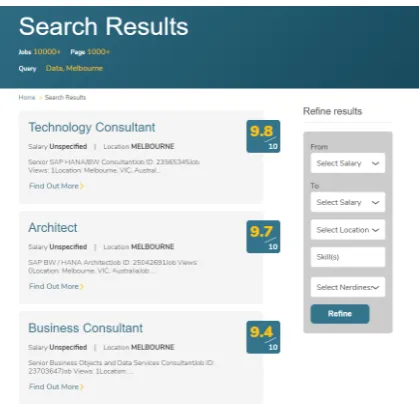
Figure 1: Search Results in the Exploration View
in increasing the understanding of different indus-tries’ absorption of PhD graduates.
Since its launch in late 2018, PostAc®has been sharpening the research career thinking of over
1,300 participating PhD students. Its analysis scales out for over 1.2 million job advertisements to quantify the most sought-after PhD skills and educates information seekers about the Australian job-market appetite for PhD skills in terms of geo-graphic location, industry sector, job title, working hours, continuity, and wage. Its 2017 pilot (
Mew-burn et al.,2018) revealed the hidden job market
for research talents to the government.
2 Data Set
To the best of our knowledge, no empirical stud-ies on big data have previously been conducted in this field, so we commenced the work by prepar-ing our own data set. Over 1.2 million jobs post-ings published during 2015 were collected from
Burning Glass International Inc. as the seeding
data set. Each posting came with the original job title and job description, as well as 41 unique at-tributes, including the employer, salary, and disci-pline codes. As in this study we sought to under-stand and support PhD graduates finding careers outside academic institutions, academic jobs (uni-versity lecturers, fellows, professors, etc.) were removed (approximately 1%).
To facilitate the study of PhD-shaped jobs and the training of our ranking model, human experts manually annotated 1,315job postings based on an agreed schema (details can be found in (
Mew-Proprocess Proprocess
Database
Train Ranking Model Fine-tune
Linguistic Models Linguistic Models
Ranking Model
Prediction
shared
Exploration View
Analytics View Processed
Job
Postings Predicted Ranking
PhD student users
HDR administration
users Labelled Data
Raw Job Postings
Similarity System
Pruning System
Modelling Component
[image:2.595.307.524.61.335.2]Online Component
Figure 2: System Architecture
burn et al., 2018)) so that each job is associated
with a ‘PhDness score (Figure 1) that took val-ues from 1 (least shaped) to 10 (most PhD-shaped). As expected (not that many jobs require PhD skills), the highly ranked jobs comprised only a small proportion of the entire set. We alleviated this imbalance in the generation of the annotated data set by adding a simple rule-based filter af-ter the random sampling process, resulting in jobs fairly unlikely to require a PhD (e.g., a job paid by the hour) being removed.
3 System Overview
the construction of the database (e.g., tokenization for full-text searching and semantic embedding for similarity measurement) and fine-tuning of word embeddings. The online component leverages the models from the modelling component to digest the incoming job data set, which is mostly unla-belled. Along with the ranking results, the jobs are enriched with the aforementioned linguistic at-tributes before finally being saved to the database. Regarded as important principles in the design of any system, the scalability and modularity are ex-amined upon each component to be integrated.
The modelling component is built with
Ten-sorflow, where a scheduling system arranges the
fine-tuning work in a distributed manner. Mean-while, the storage engine is built on top of
Elas-ticSearch, making it possible to handle the
diges-tion of approximately100,000job postings com-ing monthly, as well as to support future extension. Since the database is prepared in the back-end engine, PostAc®provides two dedicated view flows for the needs of both PhD students and staff members (e.g., careers advisors and curriculum designers). PhD students can use the Exploration view flow to search, compare, and investigate the millions of jobs available on the system. Their behaviors can be analyzed as implicit feedback to further enhance the training data set, and thus contribute to optimization of the modelling com-ponent. Staff members from universities and aca-demic institutions will be given access to the Ana-lytics view, allowing them to improve their under-standing of the potential job market for PhD grad-uates, and high degree education policy making.
4 System Features
In addition to our major objective of revealing those jobs most likely to require PhD skills, in practice we needed to provide users with similar job postings to assist them in comparing how the recommended ones can fit better. These two tar-gets lead to the two main modules in our system, namely PhDnessranking modeland job similar-ity system. Acknowledging the nature that jobs of high requirements are hard to satisfy and likely to be reposted, we also elaborate in building a prun-ing system to cope with it.
4.1 Ranking Model
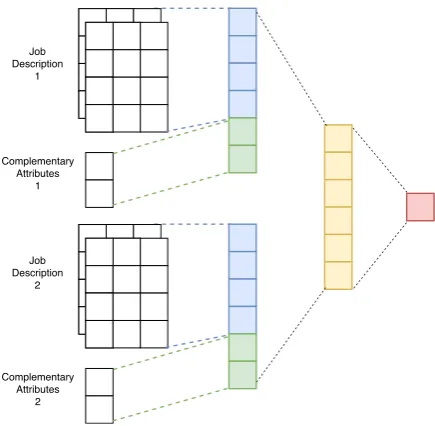
The ranking model predicts the PhDness for given job postings (Figure 3). This problem can be
Job Description
1
Complementary Attributes
1
Job Description
2
Complementary Attributes
[image:3.595.307.525.59.272.2]2
Figure 3: Ranking Model Architecture
treated as a regression task, where each job is eval-uated with a numeric PhDness score. Instead, as one of targets in this project is to study what re-quirements make a job more PhD related, we com-pose the problem as a ranking task. That is, given any two job postings, the model will learn to judge the one with higher PhDness.
The backbone network for learning the repre-sentation of a job posting is modified from the FastText model (Joulin et al.,2017). We incorpo-rate the following input features:
The job description provides key knowledge to PhDness, and we process it the same as the Fast-Text model. Given the input description text of
W words, w = [w1, w2, . . . , wW], a weight
matrix A is a lookup table over the whole vo-cabulary that maps the individual word tokens to their latent space representation (seeMikolov et al.
(2013)). During the seeding phase, we use a pre-trained word embedding fine-tuned from Glove
(Pennington et al.,2014) to populate Aand then
do not change it during the training of the rank-ing model.1
The word representations are then averaged to form the text-level representation:
Ew(xi) =
Axi
W (1)
where xi refers to the job posting xi, i ∈ {1,2, . . . , I}.
1The job description can contain many rare or
We also add the bag of N-grams as additional features to capture some single word-group level knowledge, as this aspect might be blurred in the text-level representation. First, let the bag of
N-grams be Nk = {wk, wk+1, . . . , wk+N−1}.
Then, similar to word representations (1), theN -gram representations are also averaged:
ENk =
P
A{Nk} N .
The job posting comes with other complemen-tary job attributes, denoted as a1, a2, . . . , aA,
also providing useful knowledge to the job’s PhD-ness (e.g., MinimumSalary or Employer), al-though they are not always presented as the job description. The one-hot encoding fe is applied
and the transformed attributes are normalized and appended to the text representation to form the fi-nal input feature, using the concatenation function
fc:
E(x) =fc(Ew,{ENk}, fe(a1, a2, . . . , aA)).
(2) Now with the input features, the ranking task is defined similarly to the ordinal regression set-ting (Joachims, 2006). Given any two input job postings xi and xj that are comparable, i 6= j, iandj ∈ {1,2, . . . , I},yi 6=yj, the target value
(i.e., PhDness ranking) isyi = sign(yi−yj). We
apply the hinge loss here as our focus is to learn the comparative rank, and the model then is to minimize, using the final input feature (2):
`= X
i,j,yi6=yj
max(0,1−yif2(E(xi)−E(xj) +b))
wherebis the bias term andf2is a two-layer
neu-ral network. The second layer has a linear acti-vation function as the sign is for the hinge loss to learn.
We evaluate the ranking model by using the K-fold cross validation (K = 5 specifically) on the human annotated training data. Two evalua-tion measures are used to justify the performance from different perspectives: First, the normalized discounted cumulative gain (NDCG) att(J¨arvelin
and Kek¨al¨ainen,2002) is a widely used
measure-ment for ranking quality in information retrieval measures the usefulness of the top trated items. We adopt it with t to be 15% of the total num-ber of testing examples. Second, the normalized
Kendall’sτ distance (Kendall,1938) is calculated to measure the overall ranking quality by looking at the number of discordant pairs.
Our fine-tuned model is able to achieve 0.89
for the NDCG attscore and0.13for the normal-ized Kendall’s τ distance, showing evidence that the model can both find the most PhD intensive job postings overall and also perform well enough in comparing the PhDness among any randomly chosen pair of job postings.
As for the inference stage, first the model is used to predict a grid of comparative scores for all pairs of candidate job postings. The final predic-tion of the PhDness score for a given posting is the average of its relative scores against the other post-ings.
4.2 Similarity System
In addition to the PhDness score prediction from the ranking model, the platform also recognizes similar job postings to help users to perform comparisons. Analogously to the ranking model discussed above, we also incorporate both the text features and complementary attribute fea-tures here. However, an unsupervised approach is adopted due to the following considerations: first, the similarity system should not be bounded by the annotation set and thus generalize easily to all job postings; and second, the speed.
Specifically, the term frequency×inverse doc-ument frequency (TF×IDF) features are extracted from the job description text and other textual attributes (e.g., Employer). Numerical attributes (e.g., Salary) are categorized and attached to the feature list with a small normalization factor. The final similarity scoring is calculated using the Eu-clidean distance.
4.3 Pruning System
The preliminary research reveals a problem that some jobs are re-posted for a few times during the period until being fulfilled. One of the key mod-ules in PostAc®is its pruning system that removes those duplicated postings. The module adopts a heuristic approach to avoid laborious annotation by hand.
Xia et al. (2010), the duplication score d0 is de-fined as
d0 = s
αd.
The publish date difference in the denominator (with the normalizer α) acts as a factor that pe-nalizes when two job postings are too far away from each other. Later, the postings whose dupli-cation score is larger than a given threshold are filtered out.
5 Implementation
The PostAc® platform is implemented as a web tool, with the back-end natural language process-ing systems responsible for rankprocess-ing, similarity measurement, and pruning built on Python. The front-end website for storing and managing data and users is built using the PHP programming lan-guage. This separation enables the interface to be usable from lightweight environment and also sup-port large amount of users. At the back-end side, two major optimizations are applied:
Ranking Model: Although by the nature of a pairwise ranking model the prediction takesO(I2)
time complexity, it is worth noting that the predic-tion of each individual posting is performed inde-pendently of other postings. The fine-tuned rank-ing model is serialized and replicated for a few copies. The platform now runs a few prediction process in parallel and this can also easily scale up to future extensions.
Similarity System: The output TF×IDF fea-ture matrix can still have a fair number of di-mensions even with a pruned vocabulary. Finding the nearest neighbors in this big set can be time-consuming. We saved the extracted feature matrix on a KD-tree data structure (Bentley, 1975) and this is progressively maintained as new data comes into the system. Once the KD-tree is up to date, the nearest neighbor search is performed right af-ter with the results being saved. This incurs a rea-sonably large cost up front but once made avail-able, it greatly reduces the processing time for the front-end service. The separation of two compo-nents makes it possible to perform the process at the back-end side and push the results to the front-end, without interfering it in most of the time.
With regard to the front-end side, as aforemen-tioned, the PostAc® platform contains two major usage ows: Exploration View for PhD graduates to look at individual job advertisements and Ana-lytics View for policy makers and supervisors who
are interested in demand for graduates in different industry sectors.
5.1 Exploration View
Individual users seeking PhD-shaped jobs can ac-cess the exploration view flow via a search box. The users can enter a few keywords related to the fields of research they are interested in, or words that relate to their existing skill set. The system ranks all jobs based on the combined score from both the keyword matching and the PhDness score predicted by the ranking model.
The search results (Figure 1) are displayed as a list of job titles that can be further refined by adding more filters. A user can click on a job posting to navigate to the page with more detailed information. In this page, complementary job at-tributes are provided along with top-ranked similar jobs from the similarity system. Users’ navigation and click-through behaviors are recorded as feed-back to complement the seeding training data and fine-tune the ranking system in the future.
5.2 Analytics View
One of the main aims of the PostAc® platform is to improve PhD graduate awareness of the demand for their research skills. Aggregated data can also help universities and policy makers to target policy interventions and education efforts appropriately. The Analytics View is designed to help users by showing a range of visualisations of the data set characteristics as well as the key factors our rank-ing system has been able to discover from the data. TheTime Series Graphvisualizes the seasonal changes in the demand for jobs in various in-dustries, reflecting the industry and market level changes, month by month, over a year.
The Distribution Graph (Figure 4) visualizes how the PhD-shaped jobs are distributed among different areas. Users from government agen-cies can use these graphs to support regional pol-icy making.
The Skill Set Graphvisualizes the commonly requested skill sets and abilities for jobs requiring PhD level skills.
6 Conclusion
Figure 4: Distribution of PhD Jobs in the Healthcare Sector by a Region: urban Australian areas tend to call for more PhD graduates for healthcare jobs.
hand-annotated data set and its results give em-pirical evidence of the underlying ranking model being scalable and effective. Currently, the on-line platform enables a visual-interactive search, exploration, and visualisation of the findings from our machine learning model. This platform will help boost the awareness of the value of PhD level skills and better match PhD graduates to great jobs outside academia.
Acknowledgments
This research partnership of the ANU and Data61/CSIRO was supported by the ANU Dis-covery Translation Fund 2.0, Australian Govern-ment DepartGovern-ment of Industry, Innovation and Sci-ence (DIIS), On Prime program, and data provided by Burning Glass International Inc. We gratefully acknowledge the funding from the Data61/CSIRO for the first author’s PhD studies.
References
Pat Bazeley, Lynn Kemp, Kate Stevens, Christine As-mar, Carol Grbich, Herb Marsh, and Ragbir Bhathal. 1996.Waiting in the Wings: A Study of Early Career
Academic Researchers in Australia. Canberra,
Aus-tralia: Australian Government Publishing Service.
Jon Louis Bentley. 1975. Multidimensional binary search trees used for associative searching. Com-munications of the ACM, 18(9):509–517.
Edgar Dale. 1930. The training of Ph.D.’s. The Jour-nal of Higher Education, 1(4):198–202.
Kalervo J¨arvelin and Jaana Kek¨al¨ainen. 2002. Cumu-lated gain-based evaluation of IR techniques. ACM Transactions on Information Systems, 20(4):422– 446.
Thorsten Joachims. 2006.Training linear SVMs in lin-ear time. InProceedings of the 12th ACM SIGKDD International Conference on Knowledge Discovery and Data Mining, KDD ’06, pages 217–226. New York, NY, USA: Association for Computing Ma-chinery.
Armand Joulin, Edouard Grave, Piotr Bojanowski, and Tomas Mikolov. 2017. Bag of tricks for efficient text classification. InProceedings of the 15th Con-ference of the European Chapter of the Association for Computational Linguistics: Volume 2, Short Pa-pers, pages 427–431. Valencia, Spain: Association for Computational Linguistics.
Maurice G. Kendall. 1938. A new measure of rank cor-relation.Biometrika, 30(1/2):81–93.
John McGagh, Helene Marsh, Mark Western, Pe-ter Thomas, Andrew Hastings, Milla Mihailova, and Matt Wenham. 2016. Securing Australias Fu-ture: Review of Australia’s Research Training Sys-tem. Melbourne, Australia: Australian Council of Learned Academies.
Inger Mewburn, Will J. Grant, Hanna Suominen, and Stephanie Kizimchuk. 2018. A machine learning analysis of the non-academic employment opportu-nities for Ph.D. graduates in Australia.Higher Edu-cation Policy, pages 1–15.
Inger Mewburn, William Grant, Hanna Suominen, and Stephanie Kizimchuk. 2016. What do non academic employers want? A critical examination of ’PhD shaped’ job advertisements for doctoral employa-bility. Society for Research into Higher Educa-tion (SRHE) Annual InternaEduca-tional Conference 2016, pages 1–3.
Tomas Mikolov, Ilya Sutskever, Kai Chen, Greg Cor-rado, and Jeffrey Dean. 2013. Distributed repre-sentations of words and phrases and their compo-sitionality. InProceedings of the 26th International Conference on Neural Information Processing Sys-tems — Volume 2, NIPS’13, pages 3111–3119. Lake Tahoe, NV, USA: Curran Associates Inc.
Jeffrey Pennington, Richard Socher, and Christopher Manning. 2014. Glove: Global vectors for word representation. In Proceedings of the 2014 Con-ference on Empirical Methods in Natural Language Processing (EMNLP), pages 1532–1543. Doha, Qatar: Association for Computational Linguistics.