1224
Unsupervised Parallel Sentence Extraction with Parallel Segment
Detection Helps Machine Translation
Viktor Hangya and Alexander Fraser Center for Information and Language Processing
LMU Munich, Germany
{hangyav, fraser}@cis.lmu.de
Abstract
Mining parallel sentences from comparable corpora is important. Most previous work re-lies on supervised systems, which are trained on parallel data, thus their applicability is problematic in low-resource scenarios. Re-cent developments in building unsupervised bilingual word embeddings made it possible to mine parallel sentences based on cosine simi-larities of source and target language words. We show that relying only on this informa-tion is not enough, since sentences often have similar words but different meanings. We de-tect continuous parallel segments in sentence pair candidates and rely on them when min-ing parallel sentences. We show better minmin-ing accuracy on three language pairs in a standard shared task on artificial data. We also provide the first experiments showing that parallel sen-tences mined from real life sources improve unsupervised MT. Our code is available, we hope it will be used to support low-resource MT research.
1 Introduction
The performance of machine translation has im-proved significantly recently, with some claims of even being close to human parity (Hassan et al.,
2018), but a large amount of parallel data is re-quired for high quality systems. For many lan-guage pairs the size of the available training data is not adequate. Recently, developments in the field of unsupervised bilingual word embeddings (BWEs) made it possible to build MT systems without any parallel data. Both statistical ( Lam-ple et al., 2018b;Artetxe et al., 2018b) and neu-ral (Artetxe et al., 2018c; Lample et al., 2018a) MT approaches were proposed which are promis-ing directions to overcome the data sparsity prob-lem. However, various issues of the approaches still have to be solved, e.g., better word reorder-ing durreorder-ing translation or tunreorder-ing system
parame-ters. For many interesting low resource language pairs, we do not have enough parallel data, but we do have access to sources of comparable mono-lingual text. In this paper we propose a strong unsupervised system for parallel sentence mining and show that the mined data improves the perfor-mance of unsupervised MT systems.
Previously many approaches tackled the prob-lem of parallel sentence extraction but they were relying on different levels of bilingual signals ei-ther to build dictionaries (Grover and Mitra,2017), parallel sentence classifiers (Bouamor and Saj-jad, 2018) or bilingual sentence representations (Schwenk, 2018). An unsupervised system was also proposed which only relied on unsupervised BWEs, thus no additional resources are needed (Hangya et al.,2018). We use this approach as our baseline and show that relying only on word sim-ilarity information leads to false positive sentence pairs, such as in this example:
• The US dollar has a considerable role in the international monetary system.
• Die Rolle des US Dollar im internationalen Geldsystem sollte neu ¨uberdacht werden.
(The role of the US dollar in the international monetary system should be reconsidered.)
sides that are aligned with each other. In order to increase the precision of our system we only mine similar sentence pairs where the detected paral-lel segments form a large part of the full sentence pairs thus overcoming the problem of only nearly parallel sentence pairs mentioned above.
We conduct two sets of experiments to show that our system mines more useful parallel sen-tences and that they are beneficial for MT sys-tems. First, we evaluate the accuracy of the min-ing approach on the BUCC 2017 shared task data (Zweigenbaum et al., 2017). We show that by looking for continuous parallel segments we can increase the performance significantly compared to (Hangya et al., 2018), especially the precision of the system, on German-, French- and Russian-English language pairs.1 Second, since the data used in previous work was artificially assembled, we use real life German and English monolin-gual news crawl data to mine parallel sentences, and use them to improve an unsupervised neural MT system by using the extracted data as silver-standard parallel training data. We show for the first time that exploiting comparable monolingual text sources with an unsupervised parallel sen-tence mining system helps unsupervised MT. Fur-thermore, we achieve increased performance com-pared with the previous unsupervised mining sys-tem.
2 Related Work
Most previous systems addressing parallel sen-tence extraction depend on bilingual resources which makes their applicability problematic in low-resource scenarios. Munteanu et al. (2004) used a bilingual dictionary and a small number of parallel sentences to train a maximum entropy classifier for mining Arabic and English parallel sentences. Similarly, parallel data was used to train IBM Model 1 and a maximum entropy clas-sifier (Smith et al., 2010). Munteanu and Marcu
(2006) extracted parallel sub-sentential segments from partly parallel sentences and used them to improve a statistical MT system. We follow this idea in our work and detect continuous parallel segments in order to weight the similarity values of candidate sentence pairs. To further promote the task, the BUCC 2017 shared task – Identi-fying parallel sentences in comparable corpora
1Chinese-English is left for future work, as a study of un-supervised Chinese word segmentation approaches is needed.
– was organized, where parallel sentences were automatically inserted into two monolingual cor-pora to produce gold standard train and test data in order to measure the performance of participat-ing systems (Zweigenbaum et al., 2017). Since then, various neural architectures were proposed. Bilingual word embeddings were used in (Grover and Mitra, 2017), neural sentence pair classifiers were used in (Bouamor and Sajjad, 2018) and bilingual sentence representations were trained in (Schwenk, 2018). The disadvantage of the men-tioned methods is that they need a bilingual sig-nal to be trained, in contrast with our approach which only uses monolingual data. A fully un-supervised system was proposed in (Hangya et al.,
2018) but the system introduced too much noise by mining sentence pairs with similar words but different meaning. Also, the usefulness of the sys-tem in downstream tasks was not tested.
Our approach is based on BWEs where repre-sentations of source and target language words are in the same bilingual space. Previous approaches building BWEs were using bilingual signals of various granularity. Following Mikolov et al.
(2013), many authors map monolingual word em-beddings into the same bilingual space (Faruqui and Dyer, 2014; Xing et al., 2015), others lever-age parallel texts (Gouws et al., 2015) or create artificial cross-lingual corpora using seed lexicons or document alignments (Vuli´c and Moens,2015;
Duong et al.,2016) to train BWEs. Several authors have shown that good quality BWEs can be trained by mapping monolingual spaces without any bilin-gual signal.Conneau et al.(2018) used adversarial training to rotate the source space to match the tar-get and extracted an initial lexicon to fine tune the mapping. Others used word neighborhood infor-mation to create an initial mapping (Artetxe et al.,
2018a; Alvarez-Melis and Jaakkola, 2018). We use the work of Conneau et al. (2018) to build BWEs for parallel sentence extraction.
The development of unsupervised BWEs
same back-translation techniques (Lample et al.,
2018b;Artetxe et al.,2018b). Although the initial results are promising, there are many issues still to be solved. In our experiments we use the NMT system of (Artetxe et al., 2018c). We show that the addition of our mined parallel data improves performance over baseline results.
3 Approach
Our approach for mining parallel sentences is based on calculating the similarity of sentence pair candidates. To avoid mining pairs having similar words but different meaning we look for continu-ous parallel segments in the candidates based on word alignments. We use the length of the seg-ments to either filter the candidate out or to weight the averaged similarity scores of words to get the final score of a given candidate.
3.1 Word Similarity
The first step of our method is to define the similar-ity of words. For this we use BWEs, where source and target language words are embedded in the same vector space. First, we build monolingual word embeddings and map the source words into the target space. Initially, a seed lexicon of source and target language words was needed to learn a mapping between the two spaces (Mikolov et al.,
2013). Conneau et al. (2018) showed that good quality BWEs can be produced without any bilin-gual signal, by using an adversarial system to learn an initial mapping of the two spaces and mine fre-quent source words and their most similar pairs from the target language to form an initial seed lexicon. Using this initial lexicon the mapping can be further tuned using orthogonal mapping (Xing et al.,2015). We use the system ofConneau et al.
(2018) to build unsupervised BWEs.
To measure similarity of words we use the co-sine similarity basedCross-Domain Similarity Lo-cal SLo-caling(CSLS) metric (Conneau et al.,2018) which aims to overcome the hubness problem of high dimensional spaces (Dinu et al., 2015). In short, this metric adjusts the similarity values of a word based on the density of the area where it lies, i.e., it increases similarity values for a word lying in a sparse area and decreases values for a word in a dense area. We create a dictionary of the 100nearest target words for each source language word with their similarities using CSLS.
Even though good quality dictionaries can be
built based on BWEs, the translations of some words, such as named entities and rare words, can be improved using orthographic information (Braune et al.,2018;Riley and Gildea,2018). We follow the approach of Braune et al. (2018) and create a dictionary similar to the dictionary in the previous paragraph but using orthographic similar-ity of words, i.e., one minus normalized Leven-shtein distance, instead of CSLS. We then merge the two dictionaries to get the final set of similar word pairs by taking all target words from both dictionaries for each source language word2.
To build monolingual embeddings we use fast-Text’s skipgram model (Bojanowski et al., 2017) with dimension size300and keeping all other pa-rameters default3. We use MUSE as the imple-mentation of (Conneau et al., 2018) with default parameters4for building unsupervised BWEs.
3.2 Parallel Segment Detection
The next step of our approach is to calculate the similarities of sentence pair candidates using the dictionaries created above. Various algorithms were proposed to measure sentence similarities, such as the Hungarian alignment (Kuhn, 1955;
Varga et al., 2007) and the Word Mover’s Dis-tance (Kusner et al., 2015). On the other hand, these methods are computationally expensive for parallel sentence extraction where the number of sentence pair candidates is huge. Due to perfor-mance considerations Hangya et al. (2018) pro-posed a fast word similarity based method to cal-culate sentence similarity by averaging the scores of the most similar words. The disadvantage of relying only on similar words is that non-parallel candidates having similar words are often wrongly mined, as already discussed. To overcome this problem, we align words in the candidate sentence pairs in order to detect parallel segments similarly toMunteanu and Marcu (2006). Our hypothesis is that such continuous segments are more related, thus candidates having long enough segments are parallel.
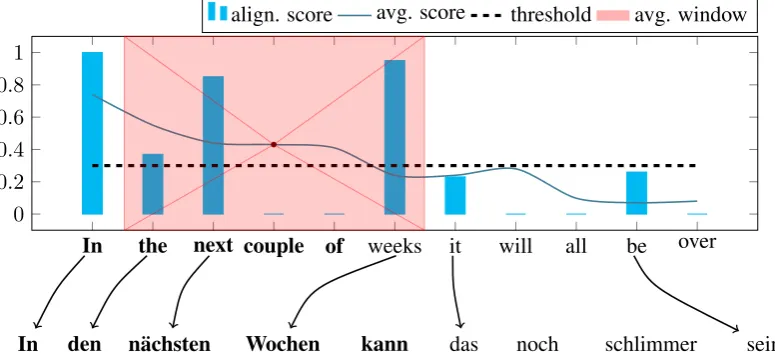
Our algorithm is illustrated in Figure 1. We it-erate over the source sentences from left to right and greedily align each source word to the most similar target word that was not already aligned. We note that source words can be left unaligned if
2
If a translation is in both dictionaries we take the max of the values.
3
In the next couple of weeks it will all be over 0
0.2 0.4 0.6 0.8 1
align. score avg. score threshold avg. window
[image:4.595.104.492.64.244.2]In den n¨achsten Wochen kann das noch schlimmer sein
Figure 1: The figure depicts our algorithm for parallel segment detection on a non-parallel sentence pair. The aligned words and their scores are shown together with the smoothed values using average filtering of window size 5. Detected segments with respect to0.3 threshold value are bolded on both source (En) and target (De) sides. Averaged scores on the target side are calculated based on target sentence word order which is used for target segment detection (we omit this part of the diagram). To decide if the pair is parallel we average word alignment scores of the full source sentence, weight it using the length of the detected segment and check if it reaches a given threshold. Translation of the target sentence:In the next weeks this can be even worse.
none of the possible target words are in the used dictionary entry for that word. Similarly, target words could be unaligned as well. We assign an alignment score for each position of the source and target sentences respectively. The alignment score for a word at positioniis its similarity score to its aligned word (taken from the dictionary used) or 0if the word is unaligned. We then look for con-tinuous segments on both source and target sides by looking for sequences of indices where the alignment scores are higher then a given thresh-old value. Since the use of mostly function words could vary across languages, e.g., En: in the in-ternationalvs. De: im (in+dem) internationalen, these words often remain unaligned resulting in gaps in the sequences, and so fragmented paral-lel segments are formed. To allow a small num-ber of unaligned words in the extracted segments we apply an average filter on the alignment score sequences with a predefined window size at each position giving a smoothed alignment value. After extracting segments from both sides of a candidate pair, we align source and target side segments by matching those which have the most word align-ments between each other. The number of seg-ments could be unbalanced on the two sides thus we ignore segments which are not aligned with segments on the other side. Furthermore, we filter segments by dropping all segment pairs if i) either side is shorter than a given threshold and if ii) the
length difference of the pair is larger than 5 to-kens. We note that our algorithm at this point can be used to mine parallel segments from sentence pairs. However, our focus in this paper is to mine complete sentence pairs which we describe in the following.
3.3 Parallel Sentence Mining
used parameters for each experiment in the follow-ing sections.
We applied pre-filtering of candidates due to the large number of possible sentence pairs. Follow-ing Gr´egoire and Langlais (2017), we only con-sider the100most similar target sentences for each source sentence as candidates. We calculate sen-tence similarity by embedding them using aver-aged word vectors and measuring their cosine dis-tance which can be run efficiently using GPUs even on large datasets (Johnson et al.,2017).
4 Evaluation on BUCC 2017
We conduct our first set of experiments on the BUCC 2017 shared task data (Zweigenbaum et al.,
2017). The aim of this shared task is to quan-titatively evaluate methods for extracting parallel sentences from comparable monolingual corpora. Train, development and test datasets were built for 4 language pairs German-, French-, Russian-and Chinese-English language pairs. The data was built automatically by inserting parallel news com-mentary sentences into monolingual wikipedia dumps. To make sure that the insertions are not easy to detect parallel sentences were only inserted if other strongly related sentences in terms of their topic are present in the monolingual corpus. We use the system of (Hangya et al., 2018) as our baseline and run experiments on the first three lan-guage pairs (as we already mentioned, we would need to study Chinese unsupervised word segmen-tation to run Zh-En experiments). We consider En-glish as the target language in all cases.
4.1 Evaluation Setup
Following the data selection and preprocessing steps of the baseline we use monolingual news crawls, downloaded between2011and2014taken from the WMT 2014 shared task (Bojar et al.,
2014), for building the initial monolingual word embeddings. We tuned our system parameters us-ing the development data on all language pairs. We performed tuning in the following intervals: threshold value for segment detection0.2−0.4; window size of average filter 5− 20; threshold value for deciding parallelism 0.1 − 0.6; mini-mum segment length20%−50%of the original sentence. We note that for the experiments in this section we kept the minimum segment length low in order not to filter out candidates aggressively but to decrease their scores instead. This way
can-P (%) R(%) F1(%)
De-En
avg 23.71 44.57 30.96
align-static 44.63 41.13 42.81
align-dyn 48.53 39.18 43.35
Fr
-En
avg 39.02 52.61 44.81
align-static 43.20 41.27 42.21
align-dyn 50.51 38.11 43.44
Ru-En
avg 16.75 24.20 19.80
align-static 25.85 23.33 24.53
[image:5.595.314.519.61.200.2]align-dyn 37.44 18.73 24.97
Table 1: Precision, recall andF1 scores for our
pro-posed system and the baseline (avg) on the BUCC 2017 dataset.
didates with short segments could still be mined. In Section 5 we will use a higher value to favor precision over recall. Besides using a static value for deciding parallelism we also used the dynamic thresholding proposed in (Hangya et al.,2018):
th= ¯S+λ∗std(S) (1)
where S is a set containing the similarity values of each source sentence in the test set and its most similar target candidate,S¯andstd(S)are its mean and standard deviation. We performed a less in-tensive tuning of λas suggested. As in previous work, we evaluate our system on the training set of the shared task since the official test set is undis-closed. We do not use the train set to either train or tune our system.
4.2 Results
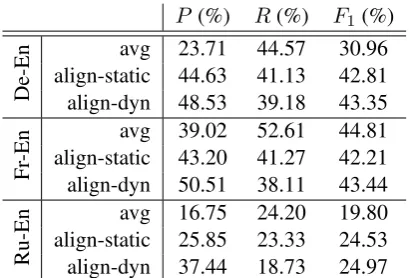
We show precision, recall and F1 scores in
Ta-ble 1 for the three language pairs. In addition to the baseline (avg) system, which only relies on averaged word similarity scores, we show the performance of our proposed system with static and dynamic thresholding. Our system achieved a significant increase of F1 for German- and
Russian-English language pairs. For both pairs we achieved a large increase of precision, especially in the case of German-English where the improve-ment is over 20%. On the other hand, we expe-rienced a slight drop of recall due to our stricter approach for the mining process. For the French-English language pair theF1 score has decreased
1. Benchmarking-Ergebnisse werden u.a. im Global Competitiveness Report des World Economic Forum ver¨offentlicht. Benchmarking results are published among others in the World Economic Forum’s Global Competitiveness Report. These ratios are compiled and published by the World Economic Forum.
2. Ende 1994 gelang es dem afghanischen Verteidigungsminister Ahmad Schah Massoud, Hekmatyr und die verschiede-nen Milizen milit¨arisch in Kabul zu besiegen.
At the end of 1994, Afghan defense minister Ahmad Shah Massoud succeeded in defeating Hekmatyr and the various militias in Kabul.
In late 1994, Rabbani’s defense minister, Ahmad Shah Massoud defeated Hekmatyr in Kabul and ended ongoing bombardment of the capital.
[image:6.595.75.523.62.211.2]3. Die 20 gr¨oßten St¨adte der Welt sind, bis auf drei Ausnahmen, in Schwellenl¨andern zu finden. The 20 largest cities in the world, with three exceptions, can be found in emerging markets. Indeed, all but three of the worlds 20 largest cities are in emerging markets.
Table 2: German-English examples with translations of German sentences shown in italic. Examples 1 and 2 are false positives of the baseline but not our proposed system while example 3 is a false negative of our approach.
our conservative approach also misses true parallel pairs resulting in a significant drop in recall. How-ever, we argue that precision is more important for downstream tasks, since noise in the data often hurts performance. Based on non-mined parallel examples we found that French segments tend to be more fragmented compared to other languages which leads to a stronger decrease in the sentence pair similarity scores. One solution to the problem could be to use a larger window size when detect-ing parallel segments.
Using static and dynamically calculated thresh-old values performs comparably. It can be seen that dynamic thresholding achieved higher pre-cision but lower recall when compared with the static value. Furthermore, the increase of precision is higher than the decrease of recall, resulting in betterF1 scores as well. In the baseline dynamic
thresholding was needed due to the system’s sen-sitiveness to the threshold value. In contrast, for our system there is a bigger gap between similarity scores of parallel and non-parallel sentence pairs due to segment length based weighting, so for this reason the tuned static value worked well on the test set.
We manually analyzed German-English exam-ples to highlight the differences of our system and the baseline. We show samples in Table2where 1and2are falsely mined by the baseline while3 is missed by our proposed system. Although ex-ample 1 seems parallel, there is some additional information on the source side. Since the words are similar, the baseline system incorrectly mines this pair. On the other hand, our approach ig-nores it because the detected segment is only Com-petitiveness Report des World Economic Forum
ver¨offentlicht, while the words in the beginning do not form a continuous segment thus decreasing its overall score aggressively. Similarly, example 2has different content at the end of the sentence pair which makes the detected segment short even though there are similar words in the pair. Exam-ple3is a parallel sentence pair which was missed by our system but not by the baseline. The reason lies in the wording of a short segment in the sen-tences. The source side phrase bis auf drei Aus-nahmen (with three exceptions)is expressed asall but threeon the target side. This difference results in two shorter segments (die 20 gr¨oßten St¨adte der Weltandin Schwellenl¨andern zu finden) in the sen-tence which decreases the similarity score below the threshold. Such false negatives occurred when a short non-parallel segment divides a longer par-allel segment which could be solved by either us-ing larger window size for the average filter or by merging segments if they are a few tokens away from each other. On the other hand, this could also introduce false positives.
In general, we can conclude that we improved
F1 score significantly, except for French-English
where the baseline performed only a couple of per-centage points better. Furthermore, our method achieved the highest precision, out-performing the baseline in all three language pairs, which is more important when mining from the web (Xu and Koehn,2017).
5 Improving Unsupervised MT
shown before. In this section we mine parallel data from real life data sources and use the ex-tracted sentences to improve the performance of unsupervised MT. For this we simulate a low-resource setup for the German-English language pair similarly to previous work on unsupervised MT (Artetxe et al.,2018c;Lample et al.,2018b).
5.1 Evaluation Setup
To mine parallel sentence pairs we use compara-ble monolingual data for both German and En-glish. For this we use the news crawl data between 2007 and 2015 released by the WMT 2016 trans-lation shared task (Bojar et al.,2016) containing about140M and114M German and English sen-tences respectively after length based filtering (see below).
As a first step, we build unsupervised BWEs on the same data as (Artetxe et al., 2018c), i.e., newscrawl between 2007 and 2013, using the same procedure mentioned earlier. The built BWEs are used to create the dictionary of word similarities for the mining and to initialize the NMT system. We consider German as the source language during the mining process. Before run-ning our system on the full data to extract sen-tences we batch the data to decrease the number of sentence pair candidates. Assuming that differ-ent news portals cover a given evdiffer-ent in the same year we only look for parallel sentences within the same year. We note that further use of batching could be possible if more fine grained date infor-mation is available. Furthermore, we also batch texts based on their length assuming that sentences with very different number of tokens are not paral-lel. We use sentences with length between 10 and 50 tokens and make batches with step size 5. We also apply pre-filtering within the batches. This method drastically decreased the runtime of the mining procedure which took around 1 week us-ing 40 threads on a2.27GHzCPU.
Since tuning would have been time consuming, we based our hyperparameters on the experiments in the previous section and on preliminary experi-ments. In order to increase the precision of mined sentences we chose an aggressive setup for win-dow size and minimum segment length, requiring long continuous segments in the sentences. We made the following choices: threshold value for segment detection0.3; window size of average fil-ter5; threshold value for deciding parallelism0.3;
minimum segment length70%. At the end we ex-tracted around220K parallel sentence pairs from the full dataset.
5.2 Machine Translation System
As the unsupervised MT system we use the neu-ral approach proposed by Artetxe et al.(2018c). The system is based on unsupervised BWEs as the initial bilingual signal connecting the source and target languages. The system mostly follows the standard encoder-decoder architecture using RNN layers and attention mechanism (Bahdanau et al., 2014). One difference compared to the standard architecture is its dual structure. In con-trast to general NMT systems which are usually built for a specific translation direction, the sys-tem is capable of performing both source→target and target→source translation. This is achieved by having a shared encoder for both languages which encodes source and target sentences simi-larly. The encoders of the system are initialized with the pretrained BWEs which are kept fixed during training. On top of the shared encoders sep-arate decoders generate the translation of the input for each language using the encoder’s output.
Training is performed in an iterative manner where each iteration consists of a denoising and an on-the-fly backtranslation step. The goal of the denoising step is to learn good quality represen-tations of both source and target sentences in the encoder and to learn how to decode these repre-sentations. Since parallel data is not available, this process is done monolingually, i.e., encoding the input and decoding to the original language, simi-larly to auto encoding. In order to prevent simple copying of words, a random noise is applied on the input sentences and the task is to denoise the in-put. To tie source and target representations more strongly backtranslation is also performed at each iteration (Sennrich et al.,2016), and synthetic par-allel data is generated, by translating sentences to the other language using the system’s current pa-rameters, and then running a training step using the backtranslation as input to predict the original sentence.
pa-unsup 07-13 all 07-13 long 07-15 all 07-15 long europarl - avg align avg align avg align avg align
-WMT14 de-en 10.35 10.47 11.26 10.77 11.56 10.59 11.79 11.05 11.20 14.14 en-de 6.30 6.23 6.91 5.14 6.82 6.55 7.26 6.16 6.78 8.96
[image:8.595.72.526.62.146.2]WMT16 de-en 13.07 13.35 14.35 14.09 14.95 12.99 15.39 14.16 14.29 18.06 en-de 8.59 8.72 9.69 7.10 10.01 8.92 10.23 8.62 9.79 12.66
Table 3: NMT experiments using mined parallel sentences. We compare results using mined sentence pairs from
Hangya et al.(2018) and our approach. Texts before 2014 is used in07-13while all data is used in07-15. We also restrict the minimum sentence length to 16 tokens in case oflong. We show a fully unsupervised system using no parallel sentences, and an oracle using europarl parallel sentences.
all long
avg
mined from 07-13 3,945,931 2,626,599 mined from 07-15 10,651,736 6,858,384
align
mined from 07-13 90,707 8,358 mined from 07-15 218,126 16,677
europarl 218,126 —
Table 4: Number of parallel sentence pairs in the datasets.
rameters. We use words as tokens in our exper-iments (but we note that byte-pair encoding was slightly better in (Artetxe et al.,2018c)).
5.3 Results
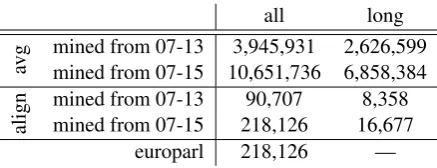
We evaluate MT experiments on the WMT14 and WMT16 test sets and present BLEU scores with the neural MT system in Table3. We compare our approach (using dynamic thresholding) with two baseline systems. We rerun5 the setup presented in (Artetxe et al.,2018c) without any mined paral-lel data (unsup). In addition, we use the system of (Hangya et al., 2018) with dynamic thresholding to mine parallel sentences (avg). We ran multi-ple sets of experiments by splitting the mined data along two dimensions. We used sentences before 2014 only in lines07-13in order to use data that are from the past when evaluating on the WMT14 test set. All the data was used in07-15. Further-more, looking at the mined data we noticed that shorter sentences tend to be more noisy. For this reason, we only used sentences that are at least 16 tokens long inlong. As an oracle experiment, we used true parallel sentences from europarl by randomly sampling the same amount as the over-all mined pairs to give a theoretic upper bound of the results with the used NMT system. The exact number of sentence pairs in each dataset used is
5Original results were shown only on WMT14 which are comparable to our BLEU scores.
shown in Table4.
Based on the scores in Table 3 it can be seen that by using mined sentences we achieved a sig-nificant performance increase compared to the un-supervised baseline. Our system outperformed the avg baseline as well in all setups. Furthermore, our approach achieved improvements compared to the unsupervised system in all cases while the avg baseline approach achieved negative results as well. Based on Table 4 avg mines significantly more sentence pairs compared to our proposed ap-proach, which contains noise leading to perfor-mance degradation. This result supports the claim of our work, i.e., relying only on word similari-ties can lead to the mining of sentence pairs which have similar meanings but are not exactly parallel. For all test sets best results were achieved using all mined data by our system. Looking at the ef-fect of length filtering it can be seen that this step helped when mining from07-13but not when us-ing data from all years. From this we conclude, that if there are only a smaller number of parallel sentences better quality is important but quantity suppresses a small amount of noise in the 07-15
setup. Comparing scores on WMT14 with and without data from the same year and the future no clear difference can be seen. Furthermore, the BLEU score differences between the time inter-vals on WMT14 strongly follows that on WMT16 where all of the sentences are from the past. From this we conclude that the unsupervised MT system generalizes well using older data.
[image:8.595.72.291.221.305.2]source Wenn Justin Bieber einen Kaffee trinkt, staunt man an der Fensterscheibe. reference When Justin Bieber drinks coffee people goggle through the window. unsup If Justin Timberlake ate a coffee, you buzzing to the window. 07-15 all If Justin Bieber drank a coffee, you wonder at the window.
source Etwa die H¨alfte der demokratischen W¨ahler der Vorwahlen landesweit sagen, dass sie mit Begeisterung Clinton unterst¨utzen w¨urden, wenn sie von der Partei nominiert w¨urde.
reference About half of Democratic primary voters nationwide say they would enthusiastically support Clinton if she became the party’s nominee.
unsup Roughly half of the pro-election voters nationwide voters say they would support Obama’s support with Clinton if they would be nominated by the party.
07-15 all About half of the Democratic primary voters nationwide say that they would support Clinton with enthusiasm if they would be nominated by the party.
source und sagte, er habe auf jemand geschossen und jemand get¨otet reference and said he had shot and killed someone
[image:9.595.76.522.62.261.2]unsup and he said he had been shot on someone and killed 07-15 all and he said he had shot and killed someone
Table 5: Example translations comparing the unsupervised baseline with adding mined parallel sentences on WMT16.
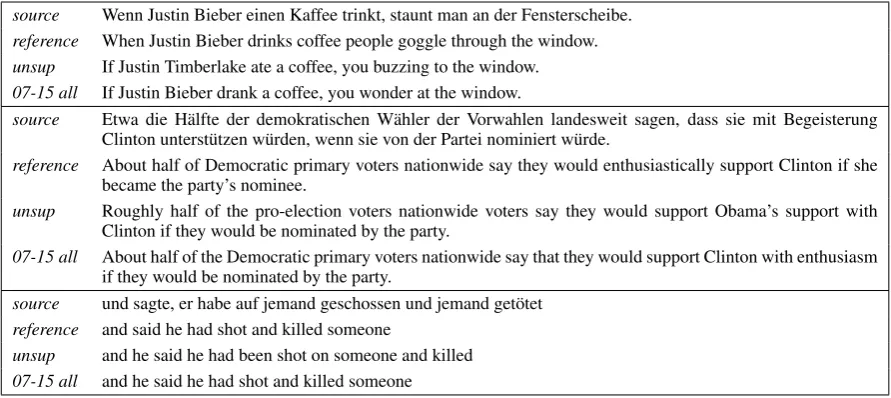
We manually analyzed the translations given by the unsupervised baseline system and the setup when we used all the sentence pairs mined by our approach on WMT16. We show examples depict-ing differences in Table5. One aspect where the added parallel sentences clearly helped is the han-dling of named entities. As the first and second examples show, the baseline system often mixes up names which is due to their similar representa-tions in BWE space. By adding parallel data the system could learn to match the source and target side representations of a given entity, i.e., copy the correct word to the translation. We also found that the fluency of translations is also improved which is demonstrated by the second and third examples. The second example shows an important weakness of the baseline, which is that it tends to be redun-dant, e.g., by mentioningvotersandsupporttwice. In addition, it mentions US presidency related en-tities twice, once asClintonand once confusing it withObama. On the other hand, by using parallel sentences the results are more fluent and accurate. While the meaning of the third example was cor-rectly translated, the wording used by the baseline is unnatural in contrast to the07-15 allsetup.
6 Conclusions
Parallel sentence extraction is important for pro-viding an additional bilingual signal for many downstream tasks in low resource setups. Most previous work tackled this problem using super-vised techniques which made their applicability problematic. In this work, we proposed a fully
unsupervised system for parallel sentence extrac-tion. We showed that a previous unsupervised sys-tem, which only relies on word similarity in source and target language sentences, often mines false positives because not all sentences having simi-lar words are parallel. To overcome this problem we introduced the detection of continuous paral-lel segments based on word alignments. We filter candidates having too short segments and weight the similarity score of the rest based on segment lengths. We showed that using our method bet-ter performance could be achieved on the BUCC 2017 parallel sentence extraction task compared to previous work. In contrast to previous unsu-pervised work, we also extracted sentences from real world comparable corpora and showed bet-ter translation performance when using these sen-tence pairs, opening up new possibilities for using small amounts of parallel data in purely unsuper-vised MT approaches. Our analysis showed that both handling of named entities and the fluency of sentences improved. We publicly release our system6to support MT communities especially for low-resource setups.
Acknowledgments
We would like to thank the anonymous review-ers for their valuable input. This project has re-ceived funding from the European Research Coun-cil (ERC) under the European Union’s Horizon 2020 research and innovation programme (grant agreement№640550).
References
David Alvarez-Melis and Tommi Jaakkola. 2018. Gromov-Wasserstein Alignment of Word Embed-ding Spaces. InProc. EMNLP.
Mikel Artetxe, Gorka Labaka, and Eneko Agirre. 2018a. A robust self-learning method for fully un-supervised cross-lingual mappings of word embed-dings. InProc. ACL.
Mikel Artetxe, Gorka Labaka, and Eneko Agirre. 2018b. Unsupervised Statistical Machine Transla-tion. InProc. EMNLP.
Mikel Artetxe, Gorka Labaka, Eneko Agirre, and Kyunghyun Cho. 2018c. Unsupervised Neural Ma-chine Translation. InProc. ICLR.
Dzmitry Bahdanau, Kyunghyun Cho, and Yoshua Ben-gio. 2014. Neural machine translation by jointly learning to align and translate. InProc. ICLR.
Piotr Bojanowski, Edouard Grave, Armand Joulin, and Tomas Mikolov. 2017. Enriching word vectors with subword information. Transactions of the Associa-tion for ComputaAssocia-tional Linguistics, 5.
Ondrej Bojar, Christian Buck, Christian Federmann, Barry Haddow, Philipp Koehn, Johannes Leveling, Christof Monz, Pavel Pecina, Matt Post, Herve Saint-Amand, Radu Soricut, Lucia Specia, and Aleˇs Tamchyna. 2014. Findings of the 2014 Workshop on Statistical Machine Translation. InProc. 9th Work-shop on Statistical Machine Translation.
Ondrej Bojar, Rajen Chatterjee, Christian Federmann, Yvette Graham, Barry Haddow, Matthias Huck, An-tonio Jimeno Yepes, Philipp Koehn, Varvara Lo-gacheva, Christof Monz, et al. 2016. Findings of the 2016 conference on machine translation. In Proc. Conference on Machine Translation.
Houda Bouamor and Hassan Sajjad. 2018. H2@ BUCC18: Parallel Sentence Extraction from Com-parable Corpora Using Multilingual Sentence Em-beddings. InProc. BUCC.
Fabienne Braune, Viktor Hangya, Tobias Eder, and Alexander Fraser. 2018. Evaluating bilingual word embeddings on the long tail. InProc. NAACL-HLT.
Alexis Conneau, Guillaume Lample, Marc’Aurelio Ranzato, Ludovic Denoyer, and Herv´e J´egou. 2018. Word Translation Without Parallel Data. In Proc. ICLR.
Georgiana Dinu, Angeliki Lazaridou, and Marco Ba-roni. 2015. Improving Zero-Shot Learning by Mit-igating the Hubness Problem. In Proc. workshop track at ICLR.
Long Duong, Hiroshi Kanayama, Tengfei Ma, Steven Bird, and Trevor Cohn. 2016. Learning crosslin-gual word embeddings without bilincrosslin-gual corpora. In
Proc. EMNLP.
Manaal Faruqui and Chris Dyer. 2014. Improving vec-tor space word representations using multilingual correlation. InProc. EACL.
Stephan Gouws, Yoshua Bengio, and Greg Corrado. 2015. Bilbowa: Fast bilingual distributed represen-tations without word alignments. InProc. ICML.
Francis Gr´egoire and Philippe Langlais. 2017. BUCC 2017 Shared Task: a First Attempt Toward a Deep Learning Framework for Identifying Parallel Sen-tences in Comparable Corpora. InProc. BUCC.
Jeenu Grover and Pabitra Mitra. 2017. Bilingual Word Embeddings with Bucketed CNN for Parallel Sen-tence Extraction. InProc. ACL, Student Research Workshop.
Viktor Hangya, Fabienne Braune, Yuliya Kala-souskaya, and Alexander Fraser. 2018. Unsuper-vised Parallel Sentence Extraction from Comparable Corpora. InProc. IWSLT.
Hany Hassan, Anthony Aue, Chang Chen, Vishal Chowdhary, Jonathan Clark, Christian Feder-mann, Xuedong Huang, Marcin Junczys-dowmunt, William Lewis, Mu Li, Shujie Liu, Tie-yan Liu, Renqian Luo, Arul Menezes, Tao Qin, and Mi-crosoft Ai. 2018. Achieving Human Parity on Automatic Chinese to English News Translation.
arXiv:1803.05567.
Jeff Johnson, Matthijs Douze, and Herv´e J´egou. 2017. Billion-scale similarity search with GPUs. CoRR, abs/1702.08734.
Harold W Kuhn. 1955. The hungarian method for the assignment problem. Naval research logistics quar-terly, 2(1-2).
Matt Kusner, Yu Sun, Nicholas Kolkin, and Kilian Weinberger. 2015. From Word Embeddings to Doc-ument Distances. InProc. ICML.
Guillaume Lample, Ludovic Denoyer, and Marc’Aurelio Ranzato. 2018a. Unsupervised Machine Translation Using Monolingual Corpora Only. InProc. ICLR.
Guillaume Lample, Myle Ott, Alexis Conneau, Lu-dovic Denoyer, and Marc’Aurelio Ranzato. 2018b. Phrase-Based & Neural Unsupervised Machine Translation. InProc. EMNLP.
Tomas Mikolov, Quoc V. Le, and Ilya Sutskever. 2013. Exploiting similarities among languages for ma-chine translation. CoRR, abs/1309.4168.
Dragos Stefan Munteanu, Alexander Fraser, and Daniel Marcu. 2004. Improved machine translation perfor-mance via parallel sentence extraction from compa-rable corpora. InProc. NAACL-HLT.
Parker Riley and Daniel Gildea. 2018. Orthographic Features for Bilingual Lexicon Induction. InProc. ACL.
Holger Schwenk. 2018. Filtering and Mining Parallel Data in a Joint Multilingual Space. InProc. ACL.
Rico Sennrich, Barry Haddow, and Alexandra Birch. 2016. Improving neural machine translation models with monolingual data. InProc. ACL.
Jason R. Smith, Chris Quirk, and Kristina Toutanova. 2010. Extracting Parallel Sentences from Compara-ble Corpora using Document Level Alignment. In
Proc. NAACL-HLT.
D´aniel Varga, P´eter Hal´acsy, Andr´as Kornai, Viktor Nagy, L´aszl´o N´emeth, and Viktor Tr´on. 2007. Par-allel corpora for medium density languages. Ams-terdam Studies In The Theory And History Of Lin-guistic Science Series 4.
Ivan Vuli´c and Marie-Francine Moens. 2015. Bilin-gual word embeddings from non-parallel document-aligned data applied to bilingual lexicon induction. InProc. ACL.
Chao Xing, Dong Wang, Chao Liu, and Yiye Lin. 2015. Normalized Word Embedding and Orthogo-nal Transform for Bilingual Word Translation. In
Proc. NAACL-HLT.
Hainan Xu and Philipp Koehn. 2017. Zipporah: a fast and scalable data cleaning system for noisy web-crawled parallel corpora. InProc. EMNLP.
Zhen Yang, Wei Chen, Feng Wang, and Bo Xu. 2018. Unsupervised Neural Machine Translation with Weight Sharing. InProc. ACL.