177
Towards Assessing Argumentation Annotation – A First Step
Anna Lindahl
Språkbanken Text University of Gothenburg
Sweden
Lars Borin
Språkbanken Text University of Gothenburg
Sweden
(anna.lindahl|lars.borin|jacobo.rouces)@svenska.gu.se
Jacobo Rouces Gonzalez
Språkbanken Text University of Gothenburg
Sweden
Abstract
This paper presents a first attempt at using Walton’s argumentation schemes for annotat-ing arguments in Swedish political text and as-sessing the feasibility of using this particular set of schemes with two linguistically trained annotators. The texts are not pre-annotated with argumentation structure beforehand. The results show that the annotators differ both in number of annotated arguments and selection of the conclusion and premises which make up the arguments. They also differ in their label-ing of the schemes, but grouplabel-ing the schemes increases their agreement. The outcome from this will be used to develop guidelines for fu-ture annotations.
1 Introduction
Argumentation mining – the automatic recogni-tion and classificarecogni-tion of arguments and their com-ponents in text – is a useful technology for a num-ber of practical text-processing applications, both commercial and academic, and in the latter case not least as a component of research tools in the digital humanities and social sciences.
Many different annotation schemes for argu-ment analysis have been proposed in the litera-ture (Lippi and Torroni, 2016; Macagno et al., 2017;Visser et al., 2018;Song et al.,2014), and a central concern in the context of argumentation mining is to arrive at a scheme which is both ex-pressive enough for the intended tasks and explic-itly defined in a way which makes it amenable to high-accuracy automatic processing.
Automatic linguistic annotation often requires the use of a ground-truth data set – a gold stan-dard – for evaluating – and often training – dif-ferent kinds of algorithms and software. Since the gold standard annotations will invariably need to be introduced by humans, we require an annota-tion scheme which human annotators can learn (in a reasonable amount of time) to apply with high accuracy and high inter-annotator agreement.
One of the most elaborate and extensive efforts to devise a comprehensive set of argumentation schemes is that by Walton et al. (2008), which builds on a long line of works in philosophy and law studies. Walton et al. (2008) further explic-itly intend their schemes to be usable “in AI”. The 60 schemes (with additional sub-schemes in many cases) presented in the book are given detailed, formalized descriptions, and in the present paper we describe and discuss the initial stage in an ef-fort intended to evaluate the suitability and use-fulness of this set of schemes for argumentation mining.
As indicated above, a prerequisite for this is that a sufficient amount of suitable text can be man-ually annotated with high inter-annotator agree-ment. Consequently, we have initiated an annota-tion effort (the first of several), where a small set of Swedish political texts (newspaper editorials) have been annotated using the schemes ofWalton et al. (2008). To the best of our knowledge, this is the first annotation study which applies Wal-ton’s schemes directly to text, without any pre-annotated structure step beforehand. In the present paper, we present and discuss the results of this ex-ercise, and outline what the next steps of this effort should be, based on these results.
Related Work
pre-segmented text, identified as containing argumen-tation.
Visser et al. (2018) use Walton’s original schemes for annotating nodes in an argumentation structure. They reach an inter-annotator agreement ofκ= 0.723(Cohen’s Kappa), but note that there are some schemes that are difficult for the anno-tators to distinguish, despite the use of a decision tree based on Walton et al. (2008). The issue of distinguishing schemes and the need for a taxon-omy or classification of the schemes have been also been discussed in Walton (2012), and there have been many suggestions for this (Walton et al., 2008;Walton and Macagno,2015;Macagno et al., 2017). Because of this, in addition to using the original schemes, we also use groups suggested in the classification system mentioned in Walton et al.(2008).
2 Data Set Creation and Annotation
The Data Set
The data for this study were originally compiled byHedquist(1978), who investigated emotive lan-guage1 in Swedish newspaper editorials. He se-lected a total of 30 editorials from 6 newspapers, all published in the period May–September 1973, shortly before the Swedish national parliament elections at the end of September 1973. The news-papers were selected so as to reflect the five politi-cal parties then represented in the Swedish parlia-ment, and the editorials were selected on the basis of topic, with two general and three specific topics per newspaper. The total number of words in this data set is about 19,000, for an average word count per editorial of about 640.
For his investigation Hedquist annotated all texts manually for emotive language, using a scheme which he developed specifically for this work. Together with the existing and planned ar-gumentation annotation described in this paper, this data set comprises a small but rich founda-tion for future work on argumentafounda-tion mining in Swedish in particular, but also in more general terms on the relationship between argument struc-tures and sentiment.
Annotation Procedure
The editorials were annotated by two annotators with solid training in linguistic analysis, master students of linguistics at Uppsala University.
The instructions given to the annotators were minimal. In preparation for the annotation task, they were initially given three editorials, asked to identify and classify all arguments in them manu-ally according to Walton et al.(2008). After this they met with the project leader, for a discussion of differences and difficulties. Other than that, they were expected to be able to understand the de-scription of the argumentation schemes as given by Walton et al. (2008), as it was believed that somebody with their extensive training in linguis-tics should be well equipped to understand and ap-ply these descriptions, which are couched in terms quite familiar to somebody who has been exposed to linguistic semantics and pragmatics.
The annotation was done with the Araucaria tool for argument analysis (Reed and Rowe, 2004) which has support for Walton’s argument schemes. For the annotation, the 30 most common schemes were used, as originally presented in Wal-ton(2013). In Araucaria, for a given text, the an-notator selects any consecutive passage of text, la-bels it and possibly connects it to any other labeled passage of text. From here on, these passages are referred to as units. The available labels are ‘premise’ and ‘conclusion’. A premise can only have one conclusion, but a unit can be annotated multiple times. This is suitable for chained ar-gumentation. After labeling, an argument scheme is connected to a conclusion and one or more premises, and these parts together make up the argument. Araucaria also allows adding so-called ‘missing’ units if an annotator feels a conclusion or premises are left unstated/implied.
3 Results
The results from the two annotators differ signifi-cantly, both regarding what is annotated and how it has been annotated. More specifically, they differ both in numbers of arguments annotated and the distributions of units, and they even differ in how they use the annotation tool, which results in dif-ferent structure of the file containing the argument
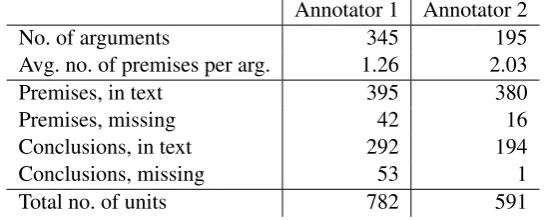
Annotator 1 Annotator 2
No. of arguments 345 195
Avg. no. of premises per arg. 1.26 2.03
Premises, in text 395 380
Premises, missing 42 16
Conclusions, in text 292 194
Conclusions, missing 53 1
[image:3.595.162.435.64.174.2]Total no. of units 782 591
Table 1: Annotation statistics
information, although the retrieved information is the same.
The number of annotated argument instances and units is shown in Table 1. Annotator 1 (A1) has annotated about 150 more argument instances than annotator 2 (A2), although the latter has an-notated more premises on average. By inspection it was observed that A1 often pairs a conclusion with each of its premises into individual arguments with one conclusion and one premise each, but as-signs all of these arguments the same scheme. A2 usually includes all premises attached to a conclu-sion as a single argument. This could be either a difference in interpretation or usage of the tool, but this may be the reason for the difference in the av-erage number of premises.
The annotators have used the option of adding missing units differently, with A1 having added about 100 missing units and A2 17 as shown in Table1. The identification of implied conclusions or premises is a well-known problem, and might be the reason for this discrepancy. In Table 2 the statistics of multiple occurrences are shown. A1 has both more units repeating as conclusions, and occurring as both premise and conclusion. On the other hand, A2 has 26 repeating premises while A1 has none. Most of A2’s occurrences are only repeating once, but A1 has many conclusions which occur many times. This is related to the dif-ference in how the annotators divide the premises between arguments. If a conclusion has 6 premises and A1 turns each conclusion-premise pair into a separate argument, then the conclusion will occur 6 times.
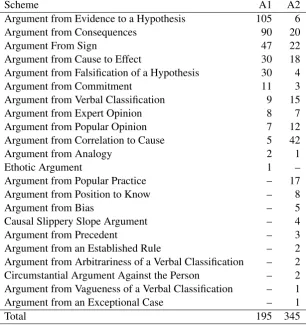
Of the 30 schemes described byWalton(2013), A1 uses 12 and A2 uses 21. Together they use 22 different schemes.2 Both annotators use 4–5 schemes for the majority of identified arguments,
223 of the annotated units of A1 are not marked with an argument scheme and are thus not included.
with the rest of the schemes having only a few oc-currences each. Even though A1 annotates more argument instances, fewer schemes are used. Ta-ble3shows the the used schemes and their occur-rences for A1 and A2. The schemes ARGUMENT FROM CONSEQUENCES and ARGUMENT FROM SIGN are both heavily used by both annotators. The description of these schemes are seen below.
ARGUMENTFROMSIGN:
Premise: A is true in this situation.
Premise: Event B is generally indicated as true when its sign, A, is true in this kind of situation.
Conclusion: B is true in this situation.
ARGUMENT FROMCONSEQUENCES:
Premise: If A is brought about, then good (bad) conse-quences will (may plausibly) occur
Conclusion: A should (not) be brought about.
Annotator 1 Annotator 2
[image:4.595.91.504.60.119.2]Units as both conclusion and premise 72 Units as both conclusion and premise 12 Units as repeating conclusion 80 Units as repeating conclusion 7 Units as repeating premises 0 Units as repeating premises 26
Table 2: Occurrences of units
Scheme A1 A2
Argument from Evidence to a Hypothesis 105 6
Argument from Consequences 90 20
Argument From Sign 47 22
Argument from Cause to Effect 30 18 Argument from Falsification of a Hypothesis 30 4
Argument from Commitment 11 3
Argument from Verbal Classification 9 15
Argument from Expert Opinion 8 7
Argument from Popular Opinion 7 12 Argument from Correlation to Cause 5 42
Argument from Analogy 2 1
Ethotic Argument 1 –
Argument from Popular Practice – 17 Argument from Position to Know – 8
Argument from Bias – 5
Causal Slippery Slope Argument – 4
Argument from Precedent – 3
Argument from an Established Rule – 2 Argument from Arbitrariness of a Verbal Classification – 2 Circumstantial Argument Against the Person – 2 Argument from Vagueness of a Verbal Classification – 1 Argument from an Exceptional Case – 1
Total 195 345
Table 3: Usage of schemes for Annotator 1 and 2
ARGUMENT FROMEVIDENCE TO AHYPOTHESIS:
Premise: If hypothesis A is true, then a proposition B,
reporting an event, will be observed to be true.
Premise: B has been observed to be true in a given instance .
Conclusion: A is true.
ARGUMENT FROMCORRELATION TOCAUSE:
Premise: There is a positive correlation between A and B.
Conclusion: A causes B.
4 Evaluation
In order to measure inter-annotator agreement (IA) we use the measure in Equation 1 based on the Sørensen–Dice coefficient, where a1 and a2 are
the sets of annotations from each annotator, and mis the set of pairs of annotations froma1anda2
that are matching (i.e. they are considered
equiv-alent). Annotations can be either units (spans of text representing premises or conclusions) or ar-guments (a conclusion with one or more spans).
c= 2∗ |m|/(|a1|+|a2|) (1)
[image:4.595.146.453.153.480.2]To determine if two units are matching, the amount of overlap between the strings represent-ing the units is compared to a given threshold α. The strings are defined as ranges of charac-ter indices within the text. The amount of over-lap is measured as the ratio between the length of the longest common continuous substring to both strings and the length of the longest of both strings. For example, the units below have an over-lap of 0.68.
Unit 1.7:48 Utgången kan leda till regeringsbyte, men den kommer inte att leda till någon förändring av
trygghetspoli-tiken i det svenska välfärdssamhälllet.3
‘The result might lead to a change of government, but it will not lead to any change in the Swedish welfare state.’
Unit 2. den kommer inte att leda till någon förändring av trygghetspolitiken i det svenska välfärdssamhälllet.
‘it won’t lead to any change in the Swedish welfare state.’
Two values of α are used in the experiments. A strict one of 0.9, which can still account for small differences in whitespace, and a more le-nient threshold of 0.5. In order to compare how well the annotators agree, the arguments are com-pared unit by unit. First, the conclusions of the arguments are compared, and if the conclusion matches, the premises are compared. Given both a matching conclusion and premise, the schemes of the two matching arguments are compared. If a unit occurs more than once, it will belong to dif-ferent arguments. Each occurrence is thus treated as a unique occurrence.
Conclusions
In Table4the number of matching conclusions is shown. The IA is calculated as per Equation 1, and is 0.26 for anα of 0.9. The average number of matching conclusions per editorial is 2.37, with two editorials having no matches and one having seven matches.
α
Conclusions 0.9 0.5
m 71 92
[image:5.595.309.523.272.407.2]IA 0.26 0.34
Table 4: IA andmfor conclusions.
3The number at the beginning of the sentence is sentence numbering present in the source of the texts.
Premises
Given a matching conclusion between two argu-ments, the premises of the same arguments are compared. Since the number of premises in an argument can vary between the annotators, both matches with all premises matching and at least one is displayed in Table5. With the full overlap α, used for both premises and conclusions, the IA is 0.56 for at least one matching premise. With the sameα, only 6 of the matching conclusions have all premises matching. Using the 0.5α, the IA is 0.71 for at least one matching premise, and 0.20 all premises matching. The IA within all arguments is low for bothα.
α
At least one matching premise 0.9 0.5
m 20 33
IA, within matching conclusions 0.56 0.71 IA, within all arguments 0.07 0.12
All premises match
m 6 9
[image:5.595.115.245.635.689.2]IA, within matching conclusions 0.17 0.20 IA, within all arguments 0.02 0.03
Table 5: IA andmfor premises, given a matching con-clusion.
It is important to note that even if two argu-ments have a matching conclusion this does not necessarily mean that they should have the same premises, a conclusion can be reached through dif-ferent premises and argumentation. This could ex-plain why there are 71 matching conclusions, but only 20 of them share at least one premise. An ex-ample of this can be seen below:
Premise A1:den visar sig redan i form av kraftiga höjningar
av olje- och bensinpriserna.‘It is already showing in the form of increasing oil and gas prices.’
Premise A2:Vi är i det här landet inte särskilt vana att spara
på något.‘We are not especially used to saving anything in this country.’
Conclusion:Men nu är energikrisen inte långt borta
‘But now the energy crisis is not far away’
Scheme A1: ARGUMENT FROMSIGN
Scheme A2: ARGUMENT FROMCAUSE TOEFFECT
α
At least one premise match 0.9 0.5
m 74 99
IA, within all arguments 0.27 0.37
All premises match
m 14 20
[image:6.595.72.264.62.172.2]IA, within all arguments 0.05 0.07
Table 6: IA andmfor only premises.
where all premises match. Of these 14 matches, three have also a matching argumentation scheme. This means that even if the premises match, there is disagreement about which scheme they partic-ipate in. The two following examples show this. The first example is a match in both conclusion and premises, but the schemes differ. The next ex-ample has the same premise but different conclu-sion and scheme. This indicates that a premise can be used for different schemes, and result in differ-ent conclusions.
Premise:Den är inte obegränsad ‘It is not unlimited.’
Conclusion:Allmänt sett är det nödvändigt att hushålla med energin
‘It is widely considered necessary to economize energy.’
Scheme A1: ARGUMENT FROMCONSEQUENCES
Scheme A2: ARGUMENTFROMSIGN
Premise: En växling vid makten medför att vi inte
riskerar några socialistiska experiment under valperioden utan kan bygga vidare på välfärdssamhällets grund.
‘A shift of power will result in us not risking any socialistic experiment during the elected term and instead we can further build on the foundations of the welfare society.’
Conclusion A1:Väljare bör rösta på oppositionen
‘Voters should vote for the opposition’
Conclusion A2:Rösta inte bort samverkan!
‘Do not vote away collaboration!’
Scheme A1: ARGUMENT FROMCONSEQUENCES
Scheme A2: CAUSALSLIPPERYSLOPEARGUMENT
Argument schemes
After finding which arguments match in conclu-sion and premise, the argumentation schemes are compared. Using 0.9 as theα, only 2 arguments have a match in scheme, conclusion and premises. The schemes in these two arguments are AR -GUMENT FROM SIGN and ARGUMENT FROM CAUSE TO EFFECT. Using 0.5 asαinstead, there
are 4 matches. Three of them have only 1 premise and they all overlap fully. The last one has half of the premises matching.
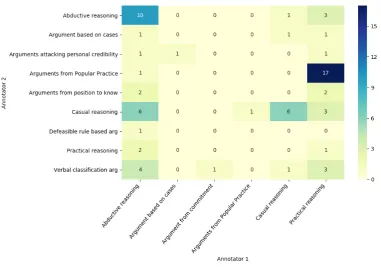
Based on the low numbers of matching schemes in the case where both conclusion and premise match, conclusions and premises were compared separately. Of all the matching conclusions, 9 have the same scheme, see Table7. Figure1shows how the schemes co-occur when the conclusion is the same. The schemes that match are the schemes which are most commonly used by both annota-tors.
α
Scheme matches 0.9 0.5
m 9 10
IA, within matching conclusion 0.25 0.22 IA, within all arguments 0.02 0.02
Table 7: IA andmfor schemes, given a matching con-clusion.
In Figure 1 we can see that ARGUMENT FROM CONSEQUENCES and ARGUMENT FROM POPULAR PRACTICEhave a high co-occurrence, compared to the others. This could be because the annotators have have chosen different premises, for the same conclusion and thus chosen different schemes. The descriptions of these schemes are shown below.
ARGUMENT FROMCONSEQUENCES:
Premise: If A is brought about, then good (bad) conse-quences will (may plausibly) occur.
Conclusion: A should (not) be brought about.
ARGUMENT FROMPOPULARPRACTICE:
Premise: If a large majority (everyone, nearly everyone, etc.)
does A, or acts as though A is the right (or an acceptable) thing to do, then A is a prudent course of action.
Premise: A large majority acts as though A is the right thing
to do.
Conclusion: A is a prudent course of action.
[image:6.595.313.521.238.303.2]Figure 1: Co-occurrence matrix for the schemes with the same conclusion (α0.9)
Premise:Den höga arbetslösheten i Sverige är inte
accept-abel ur några synpunkter, detta måste slås fast med skärpa. ‘The high unemployment rate in Sweden is not acceptable from any angle, this must be firmly established.’
Conclusion:Att skaffa fram nya jobb, måste vara den
vikti-gaste uppgiften för närvarande.‘To create new jobs must be the most important task for now.’
Scheme A1: ARGUMENT FROMCONSEQUENCES
Scheme A2: ARGUMENT FROMPOPULARPRACTICE
As mentioned above, matching premises were also compared, regardless of conclusions. One could expect this to generate more scheme matches, as similar premises would possibly be used in similar kinds of argumentation. However, as noted in the previous section, of all the 540 ar-guments, only 14 have all premises matching. Out of these, only 3 have the same scheme, as com-pared to 9 scheme matches for the conclusions.
Because of the noted difficulty of distinguishing the schemes, both here and in previous research, and the low number of matches, the schemes were divided into groups and these groups were com-pared instead. This division is suggested by
Wal-ton et al.(2008) as a classification system for the schemes.
α Matching schemes 0.9 0.5
m 3 7
[image:7.595.313.486.463.569.2]IA, within matching 0.08 0.15 IA, within all arguments 0.01 0.03 Abductive reasoning 2 5 Casual reasoning 1 1 Practical reasoning 0 1
Table 8: Matching schemes with the new groups of schemes, given a matching conclusion and at least one premise.
-Figure 2: Co-occurrence matrix for the schemes in new groups, with the same conclusion (α0.9)
α Matching schemes 0.9 0.5
m 17 20
IA, within matching conclusions 0.48 0.43 IA, within all arguments 0.06 0.07 Abductive reasoning 10 12
Casual reasoning 6 6
[image:8.595.99.481.67.336.2]Practical reasoning 1 2
Table 9: Matching schemes with the new groups of schemes, only conclusions.
TICAL REASONING. This mismatch in groups is due to the previously discussed co-occurrence of the schemes ARGUMENT FROMCONSEQUENCES and ARGUMENT FROM POPULAR PRACTICE. The former scheme is in the group PRACTICAL REASONINGand the latter scheme is in the ARGU -MENTS FROM POPULAR PRACTICE group, thus transferring the co-occurrences to the new groups. Again, a comparison of the schemes in the new groups but for only matching premises was done. This however only led to 4 scheme matches and no pattern in the co-occurrences.
5 Conclusions and Future Work
In this first annotation exercise, we wanted to in-vestigate whether annotators with a strong
back-ground in linguistics but who were given lit-tle explicit instruction for this specific annota-tion task would be able to recover the argumen-tation schemes described byWalton et al.(2008). This turned out not to be the case, with the an-notators agreeing neither on whole arguments nor on the units and schemes which make them up.4 This could be for at least three reasons: (1) that the annotators would have needed more detailed and precise instructions; (2) that the argumenta-tion schemes themselves are too difficult to re-cover from free natural text (despite their seeming formal characterization); or (3) that the annotation task should be structured differently, in a first step where spans representing argument instances are identified followed by a second step where the in-stances and their components are labeled.5
Some of the differences between the annotators would have been avoided if they had more
spe-4
The use of only two annotators possibly influenced the result, making it difficult to conclude when we are dealing with ‘normal’ disagreement or not.
5
[image:8.595.75.288.386.492.2]cific instructions for the tool. More strict and de-tailed instructions for the annotation itself could probably improve the inter-annotator agreement, but might come with a loss of information. For ex-ample, a rule such as marking sentences instead of spans would result in some loss of informa-tion, since an argument might not be restricted to sentences. However, most of the disagreements come from differences in the interpretation of ar-gument components and schemes, as shown in the examples in the previous section. For example, the same premises and conclusions are used in differ-ent schemes, and a single premise is used more than one scheme. In order to minimize informa-tion loss but achieve high inter-annotator agree-ment a necessary next step in annotating argumen-tation needs to be a discussion of what should be marked as premises and conclusions and why the annotators have made the choices they did.
Interpretation seems also to be the reason for the difference in the annotation of the argumen-tation schemes, although the low inter-annotator agreement in the argument components evaluated before the schemes might influence this. If the an-notators were given already annotated units they would possibly agree more. The results of Visser et al.(2018) indicate this, where they use already predefined nodes and reach a high inter-annotator agreement.
As previously shown, and also observed by oth-ers (Walton and Macagno,2015;Macagno et al., 2017), the original schemes can be difficult to dis-tinguish from each other. If they are to be used by annotators, then they need better instructions on when to use which scheme. As the post-annotation grouping of schemes improved agreement, per-haps it would be effective to collapse them already in advance, instructing annotators to use coarser groupings in cases of doubt.
For the immediate future we plan to design two annotation exercises to follow up on the experi-ment described in this paper and to address some of the questions raised above. Further, the exer-cises will be carried out using two different anno-tation workflows. In the first exercise, the annota-tors will be instructed to use the schemes of Wal-ton et al.(2008), but this time according to an ex-plicit annotation manual. In the second exercise the annotators will be asked to annotate the same texts according to some other proposed scheme, possibly a less fine-grained version of the original
schemes as this was shown to have a positive ef-fect on the inter-annotator agreement, but the ex-act scheme to be used remains to be determined. We will also organize two versions of each exer-cise, one corresponding to the previous annotation round, where annotatoras are asked to identify ar-gumentation spans and classify them in one opera-tion, and another where argumentation span iden-tification is separated from labeling of schemes and components.
In all cases we plan to employ more than two annotators and there will be a different set of an-notators for each of the four annotation setups. The texts to be annotated will include the edito-rials used for the work described in this paper, but we may also decide to extend the data set. Hope-fully, the planned experiments will allow us to gain a better understanding of the advantages and dis-advantages of different schemes for argumentation annotation, as well as for alternative organizations of the annotation workflow.
Acknowledgments
The work presented here has been partly sup-ported by an infrastructure grant to Språkbanken Text, University of Gothenburg, for contributing to building and operating a national e-infrastructure funded jointly by the Swedish Research Council (under contract no. 2017-00626) and the partici-pating institutions.
We would also like to thank the anonymous re-viewers for their detailed and constructive com-ments.
References
Vanessa Wei Feng and Graeme Hirst. 2011.
Classi-fying arguments by scheme. InProceedings of the
49th annual meeting of the association for compu-tational linguistics: Human language technologies, pages 987–996.
Nancy Green. 2015. Identifying argumentation schemes in genetics research articles. In Proceed-ings of the 2nd Workshop on Argumentation Mining, pages 12–21. Association for Computational Lin-guistics.
Rolf Hedquist. 1978. Emotivt språk: En studie i dagstidningars ledare [Emotive language: A study in newspaper editorials]. Umeå University, Dept. of Nordic Languages, Umeå.
Marco Lippi and Paolo Torroni. 2016. Argumenta-tion mining: State of the art and emerging trends. ACM Transactions on Internet Technology (TOIT), 16(2):10.1–10.25.
Fabrizio Macagno, Douglas Walton, and Chris Reed. 2017. Argumentation schemes. history, classi-fications, and computational applications. His-tory, Classifications, and Computational Applica-tions (December 23, 2017). Macagno, F., Walton, D. & Reed, C, pages 2493–2556.
Chris Reed and Glenn Rowe. 2004. Araucaria: Soft-ware for argument analysis, diagramming and repre-sentation.International Journal on Artificial Intelli-gence Tools, 13(04):961–979.
Yi Song, Michael Heilman, Beata Beigman Klebanov, and Paul Deane. 2014. Applying argumentation
schemes for essay scoring. In Proceedings of the
First Workshop on Argumentation Mining, pages 69–78.
Christian Stab and Iryna Gurevych. 2017. Parsing
ar-gumentation structures in persuasive essays.
Com-putational Linguistics, 43(3):619–659.
Jacky Visser, Lawrence John, Wagemans Jean, and Reed Chris. 2018. Revisiting computational mod-els of argument schemes: Classification, annotation, comparison. InProceedings of the 7th International Conference on Computational Models of Argument (COMMA 2018).
Douglas Walton. 2012. Using argumentation schemes for argument extraction: A bottom-up method. IJCINI, 6:33–61.
Douglas Walton. 2013. Argumentation schemes for presumptive reasoning. Routledge.
Douglas Walton and Fabrizio Macagno. 2015. A clas-sification system for argumentation schemes. Argu-ment & Computation, 6(3):219–245.