436 Ind. Eng. Chem. Prod. Res. Dev. 1985, 2 4 , 436-440
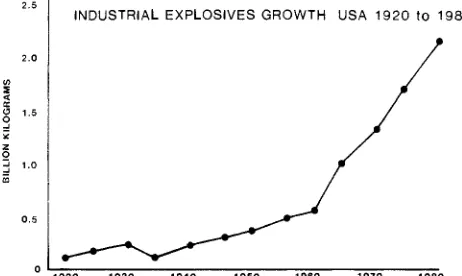
INDUSTRIAL EXPLOSIVES GROWTH USA 1920 to 1980
2.0
w
a
s
c1 1.5'1920 1930 1940 1950 1960 1970 1980 Figure 8. Consumption of industrial explosives in the U S . from 1920 t o 1980.
dustry Surveys, 1961-1981). Figure 8 shows this large increase in comparison with the previous 40 years. The recent economic conditions have hit the mining and con- struction industries very hard, resulting in a leveling off, or even a slight decrease, in explosives consumption the last few years. However, continued growth is expected to resume as the economy picks up. Since coal mines con- sume the majority (58%) of all explosives in the United
States and are the largest (33%) single market for slurries, a stable production volume base seems assured given the country's insatiable appetite for energy.
The improvements in slurry formulations and the de- velopment of emulsion explosives have made these prod- ucts safer, easier, and cheaper to manufacture.
Recent developments have broadened the range of ap- plication of these products and improved their end-use characteristics so they are now being considered for a number of military applications as well as the more tra- ditional civilian work. Successful use has already been demonstrated in certain bomb and missile fills, tank traps and trenching devices, and nuclear simulation charges. New and varied applications in government areas besides military, such as space and forest service, can also be ex- pected under the influence of economic and technical competition.
Literature Cited
Hansen, 8. L. IRECO Inc., Salt Lake City, UT, Technical Data Sheets, 1983. Mineral Industiy Surveys, "Apparent Consumption of Industrial Explosives and Blasting Agents in the Unked States" U.S. Department of the Interior, Bureau of Mines: Washington, DC, 1961-1981 (annual).
Received for review November 1, 1984
Accepted March 11, 1985
Chemistry of (5-Cyanotetrazolato-N*)pentaamminecobalt
( I
I
I )
Perchlorate and Similar Explosive Coordination Compounds
Morton L. Lieberman
Sandla National Laboratories, Albuquerque. New Mexico 87 185
The coordination compound (5-cyanotetrazolato-N2)pentaamminecobalt( I I I ) perchlorate has been developed for explosive applications. Chemical studies applying to this development are reviewed. These include establishment of a commercial synthetic procedure, determination of structure, characterization of impurities, and development of analytical techniques for chemical analysis. Chemical reaction paths leading to impurity formation and associated with thermal decomposition are examined. The status of an ongoing effort to define relationships between chemical structure and explosive properties is presented.
Introduction
An extensive research and development program was undertaken to develop a safe explosive material that could be initiated by a thermal source and would exhibit rapid deflagration-to-detonation transition (DDT). The result was the synthesis and characterization of the high-energy coordination compound (5-cyanotetrazolato-N2)penta- a"inecobalt(II1) perchlorate (CP). This paper reviews a variety of chemical studies that have been part of the program. While the emphasis is on CP, studies that have involved related compounds are included.
The application of interest was low-voltage detonators that can be thermally initiated by an electrical current passed through a resistive bridgewire. A generalized CP detonator is shown schematically in Figure 1. The igniter charge is initiated by the hot bridgewire, and growth to detonation occurs in the transfer column. The explosive charge is loaded in a series of increments under different conditions in order to maximize the desired functional characteristics in each of the column regions (Lieberman
Scheme I'
LIGAND X
- QNO,
ACRONYM HTZ PCP CH3TZPCP CF3TzPCP ClTzPCP CNTzPCP NOzTZPCP DNPhTZH PCP
'
Tz, tetrazolato; DNPh, 3,5-dinitrophenyl. *Generated in situ from sodium salts a n d HCIO,.et al., 1981). The development of CP for this application represents a safety improvement over the prior use of primary explosives, such as lead azide. As shown in the generalized Table I (Lieberman and Fronabarger, 1979), CP has sensitivity characteristics that are different from those of common primary and secondary explosives. Clearly, a material that uniquely fulfills the requirements
[image:1.616.58.289.44.182.2]Ind. Eng. Chem. Prod. Res. Dev., Vol. 24, No. 3, 1985 437
Table I. Qualitative Comparison of CP with the Primary and Secondary Classes of Explosives
sensitivity of unconfined materials to various stimuli explosive
tvDe shock electrostatic discharge hot wire examples
primary sensitive sensitive sustains rapid reaction, often proceeds to lead azide detonation
secondary insensitive insensitive does not TNT"
sustain reaction RDX"
or burns in a slow manner PETN" C P insensitive in bulk form, insensitive in bulk form, does not sustain in bulk form, sustains
sensitive in unconfined
pressed state pressed state
Increasing sensitivity in the order T N T < RDX < PETN. of specific explosive applications has resulted from coor- dination chemistry.
Synthesis and Characterization of CP
The synthesis of CP is performed via a batch process described by Fleming et al. (1979). The four steps are summarized below:
sensitive in confined
"20 2Co(NO3),
+
8NH3(aq)+
2(NH4)2C03+
1/202-
2 Co(NH,),CO NO,
+
2NH4N0,+
H203 1
CPCN
c
CPCN
+
3HC104 2c
Co(NH,),H20](CI04),+
CO,N-C-CN N\ N /N
+
NaCl(CIO,),
CP
The bonding position of the tetrazole ring to the cobalt atom was determined by NMR analysis of labeled com- pounds (Balahura et al., 1983). A single-crystal structure determination by Graeber and Morosin (1983) also verified that the compound was N-2 bonded and established bond lengths. Analytical studies indicated that two other co- ordination compounds were present in the product as contaminants. They were subsequently identified as an amide and an amidine chelate of CP, as shown. The
amide amidine chelate
former was identified by infrared spectroscopy and the latter by a single-crystal structure determination (Graeber and Morosin, 1983). Because the amide is highly insoluble, it was not possible to grow a crystal suitable for a single- crystal structure determination. For that reason the identification of the N-2 bonding position is assumed,
detonation in confined pressed state
DETONATOR HOUSYG
BRIDGEWIRE I
w
LEADS
Figure 1. Generalized CP detonator design.
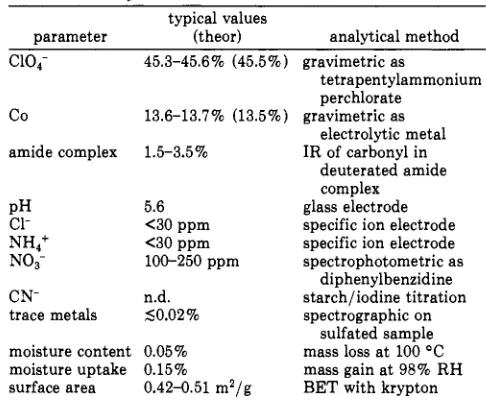
Table 11. Analytical Results
typical values
Darameter (theor) analvtical method
c10;
c o
amide complex
PH c1- NHIC NO<
CN- trace metals
moisture content moisture uptake surface area
45.3-45.6% (45.5%)
13.6-13.7% (13.5%)
1.5-3.5 %
5.6 <30 ppm
<30 ppm
100-250 ppm
n.d. 50.02%
0.05% 0.15%
0.42-0.51 m2/g
gravimetric as
tetrapentylammonium perchlorate
gravimetric as electrolytic metal IR of carbonyl in
deuterated amide c o m p 1 ex glass electrode specific ion electrode specific ion electrode spectrophotometric as
diphenylbenzidine starch/iodine titration spectrographic on
sulfated sample mass loss at 100 "C mass gain at 98% RH BET with krypton
rather than proven, for this compound.
[image:2.616.69.289.234.481.2] [image:2.616.317.560.340.542.2] [image:2.616.56.298.595.698.2]438 Ind. Eng. Chem. Prod. Res. Dev., Vol. 24, No. 3, 1985
Another species of concern is the Co2+ ion. Thermal decomposition studies by Searcy and Shanahan (1978) have shown that this ion forms early in the decomposition process.
As
a result, it is a sensitive measure of the stability or compatibility of CP in various environments. Merrill (1980) developed a spectrophotometric procedure for Co2+ based on the analysis of the CoC142- ion. Schumacher et al. (1985) developed a more sensitive spectrophotometric technique based on Co2+ complex formation with 2,2’-di- pyridyL2’-pyridylhydrazone.Chemical Reactions
Mechanisms associated with the formation of impurities of CP have been of interest. The formation of the amide is assumed to be a simple hydrolysis reaction. For that reason it is believed that the ligand remains bonded in the N-2 position. The amidine chelate, however, has been shown to be N-1 bonded, which implies that the cyano- tetrazole ligand may be at least partially N-1 bonded in solution. This has led to the following proposed sequence of reactions to account for the observed products:
2 +
N-N
rN
2+
N-C
0 2 + //
NH3
The formation of the amidine chelate through this reaction sequence implies the existence of an N-1 bonded isomer of CP. None has been isolated or observed. Ellis and Purcell (1982), however, have shown that azide attack of [(substituted-nitrile)pentaa”inecobalt(III)] complexes yield N-1 bonded [(substituted-tetrazo1ato)penta-
amminecobalt(III)] complexes that are thermodynamically less stable than their N-2 bonded isomers. They have shown that increasing temperature and acidity accelerates the conversion of the N-1 to the N-2 form in solution. Since the process for the synthesis of CP involves both elevated temperature and acidic conditions, the formation of the N-2 isomer is consistent with the findings of Ellis and Purcell(l982). Most importantly, their work provides a basis for assuming that an N-1 isomer of CP can exist, which is the cornerstone of the reaction sequence leading to the formation of the amidine chelate.
Using the analytical techniques developed for the analysis of impurities in CP and mass spectrometry, Searcy and Shanahan (1978) characterized the thermal decom- position process as consisting of three general stages. The first stage is endothermic and involves the dissociation of ammonia. I t appears to include the reduction of Co(II1) by ammonia to yield Co(I1) and gaseous nitrogen. Cleavage of the tetrazole ring occurs with the evolution of nitrogen. The second stage is exothermic and involves reaction of the perchlorate anion with ammonia and partial oxidation of cyanotetrazole. It occurs in parallel with the first stage.
The final stage includes additional consecutive redox re- actions and occurs in parallel with the prior stages. The overall reaction sequence is very complex and includes many individual reactions occurring both in series and in parallel. Yelton et al. (1984) utilized a variety of mass spectrometric and ancillary techniques to more closely examine the early-stage thermal decomposition processes. They showed that ammonia is definitely the first gaseous product evolved. The identification of cyanogen and ni- trogen indicated that ring opening was occurring. On the basis of bond lengths determined by Graeber and Morosin (1983), it was proposed that the ring bonds between N-1 and N-2, and N-3, and N-4 and C-5 were cleaved to yield the observed gases. Attempts to identify the parent molecule by mass spectrometry were unsuccessful.
The identification of ammonia as the initial gaseous product of thermal decomposition raises the question as to whether evolution occurs preferentially from the equatorial or axial ammines. One approach to answering this question is via mass spectrometry of isotopically la- beled compounds. The axial ammine could be distin- guished from those in the equatorial positions by having the former either fully deuterated or I5N labeled. This approach is under current investigation. In a related study Lieberman et al. (1984) showed by proton and deuterium NMR spectroscopy of partially deuterated CP samples that deuteration occurs preferentially in the axial position, but deuteration of equatorial ammines precedes complete deuteration of the axial ammine. As a result, complete deuteration of the axial ammine without deuteration of equatorial ammines requires an alternative synthetic route rather than controlled partial deuteration of CP.
Chemical Tailoring
Lieberman and Fronabarger (1980) reviewed the status of the development of CP in 1980. Whereas as a loose powder CP is insensitive to a human-body-equivalent electrostatic discharge, it is not insensitive to such a stimulus when loaded and pressed in detonator hardware. Therefore, the safety improvement that exists with regard to the handling of loose powders does not exist with regard to the handling of detonators; i.e., a spark can ignite the compressed powder and yield a detonation. As a result, spark protection devices are incorporated in such deto- nators. The ultimate goal is to develop a material that provides electrostatic safety whether as a loose powder or as a compressed material in a detonator. This has lead to ongoing studies that attempt to determine the factors that affect spark sensitivity. Clearly, this parameter is affected by both chemical and physical variables. One approach that has been taken is based on chemical “tailoring” of CP. It involves selectively replacing chemical moieties of the molecule and evaluating the resultant electrostatic and detonator properties.
In one study Fleming et al. (1980) synthesized and characterized a series of CP analogues in which the cyano group was replaced by groups of various physical sizes and electron-withdrawing character. The syntheses are sum- marized in Scheme I.
Ind. Eng. Chem. Prod. Res. Dev., Vol. 24, No. 3, 1985 439 For 3-N02-1,2,4-TrzH, the solvent used was l-methyl-2- pyrrolidinone, whereas water was used for the others. Fronabarger et al. (1981) evaluated all except the pyra-
zolato complex. The loose powders were insensitive to the
human-body-equivalent electrostatic discharge. For the detonator-loaded condition, electrostatic sensitivity in- creased in the order 3-N02-1,2,4-TrzPCP
<
4-N02-1,2,3- TrzPCP<
5-N02TzPCP, and ease of growth to detonation followed the same order, with the tetrazolato complex exhibiting greatest spark sensitivity and ease of achieving detonation.Additional studies are in progress. Johnson et al. (1984) have attempted to synthesize and characterize analogues of CP in which the cobalt atom has been replaced by chromium, rhodium, ruthenium, and iridium. The chro- mium and rhodium compounds have been satisfactorily prepared and characterized, whereas the others have been shown to consist of product mixtures. Such compounds provide variations in thermal stability, metal-to-ammine bond strength, and possible oxidation states. Replacement of the perchlorate anion by other oxidizing anions and replacement of the cyanotetrazolato ligand by additional trigger groups are being examined. The utilization of tetraammines or polymeric coordination compounds are under consideration. At this stage correlations appear to exist between the electron-withdrawing character of var- ious moieties and the resultant functional properties. Much remains to be done to determine whether chemical "tailoring" can yield materials with tailored explosive performance characteristics.
W.0 1 1 1 i r
NOi
-0.21 " " ' "
I
*CN 9 . 79 . 6
9 . 5
ji;-
0.0-0.1
7
-
-
-
-
-
-
EQUATORIAL NH3 'H NMR SHIFTS
VERSUS HAMMETT Opara CONSTANTS opma-5.696 -20.24
r-0.957
EOUATORIAL NH3 'H NMR SHIFTS VERSUS HAMMETT D m t a CONSTANTS ~ m t r - 4 . 3 6 6 - 1 5 . 4 3
-:::pa,
Q.o::r , ,1
-0.23.5 3.6 3.7 3.8
[image:4.616.63.267.37.501.2]6 EOUATORIAL (PPM)
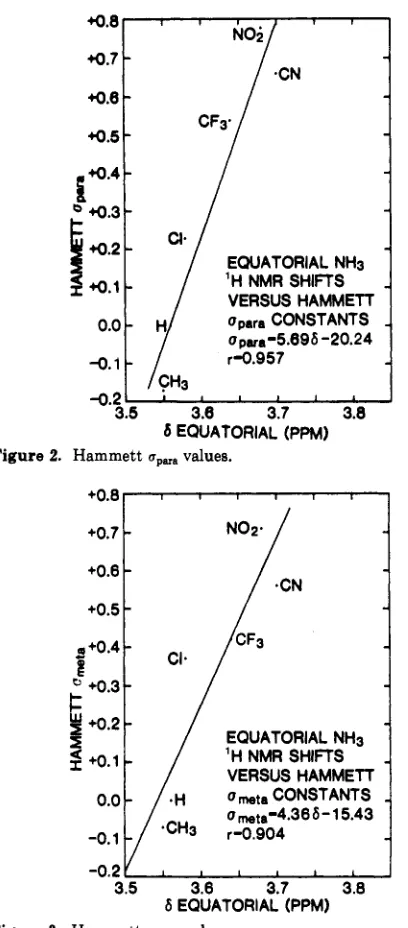
Figure 3. Hammett umetr values.
u constants, as shown in Figures 2 and 3. Subsequent performance testing by Fronabarger et al. (1981) indicated that increasing electrostatic sensitivity and increasing ease of growth to detonation correlated with increasing elec- tron-withdrawing ability of the moiety.
In another study Fleming et al. (1982) synthesized and characterized nitroheterocyclic pentaa"inecobalt(II1) perchlorates. The heterocyclic groups were the tetrazolato (Tz), both triazolato (Trz), and the pyrazolato (Pyz) moieties. The purpose of this investigation was
to
obtain materials with which to evaluate the effect of ring com- position on resultant performance properties. The syntheses are summarized below.ligand, X 5
-
N02TzH3-N02-1,2.4-TrzH + APCP solvent
4 - N02-1,2,3- TrzH 90 OC 4-NOp-PyzH
acronym 3-NO2-1,2.4-TrrPCP (c104)2 4-N02-1.2,3-TrzPCP
5-NOzTzPCP
4-NO2-PyzPCP
Acknowledgment
This work was supported by the
U.S.
Department of Energy under Contract DE-AC04-76DP00789.Registry No. CP, 68147-80-8.
Literature Cited
Balahura, R. J.; Purcell, W. L.; Vlctwlano, M. E.; Lleberman, M. L.; Loyola, V. M.; Fleming, W.; Fronabarger, J. W. Inorg. Chem. 1085, 22. 3802. Eills, W. R., Jr.; Purcell, W. L. Inorg. Chem. 1082, 21, 834.
Fleming, W.; Fronabarger, J. W.; Searcy, J. a. presented at the American Defense Preparedness Assoclatlon W t l n g , Materials and Processing DC vlslon, Joint Symposium, CompatlbilRy/Processing Exploshres, Propellants and Ingredients, Albuquerque, NM, May 1979.
Fleming, W.; Fronabarger, J. W.; Lieberman, M. L.; Loyola, V. M. presented at the Second Chemical Congress of the North American Contlnent, Las Vegas, NV, Au 1980.
Fleming, W.; Fronabarger, J. W.; Lieberman, M. L.; Loyola, V. M. "Abstracts of Papers", 183rd National Meetlng of the American Chemical Soclety, Las Vegas, NV, March 1982; American Chemical Soclety: Washington. DC, 1978.
Fronabarger, J. W.; Fleming, W.; Lleberman, M. L. presented at the 11th Symposium on Explosives and Pyrotechnics, Philadelphia, PA, 1981. Graeber, E. J.; Morosln, B. Acta Crystallogr. Sect. C.: Cryst. Struct. Com-
mun. 1083, 39. 587.
Johnson, R.; Fronabarger, J.; Flemlng, W.; Lleberman, M.; Loyola, V. pres- ented at the 1984 International Chemical Congress of Pacific Basin Socl- etles, Honolulu, HI, Dec 1984.
Jungst, R. G.; Peterson, P. K. Sandla Laboratories Report SAND78-1395, 1978, Albuquerque, NM.
Lieberman, M. L.; Fronabarger, J. W. "Abstracts of Papers", American Chemical Soclety/Chemicai Society of Japan Chemlcai Congress, Honoiu- Iu, HI, April 1979; Amerlcan Chemical Soclety: Washington. DC. 1979. Lieberman, M. L.; Fronabarger, J. W. presented at the 7th International Pyrc-
technics Seminar, Vail, CO, July 1980.
Lleberman, M. L.; Vllla, F. J.; Marchi, D. L.; Lause, A. L.; Yates, D.; Frona- barger, J. W. presented at the 11th Symposium on Explosives and Pyro- technics, Philadelphla, PA, Sept 1981.
Lieberman, M. L.; Earl, W. L.; Flemlng, W. presented at the 1984 Interna- tional Chemlcai Congress of Paclflc Basin Societies, Honolulu, HI, Dec 1984.
Loyola, V. M.; Womeiduff, J. Sandla Laboratorles Report SAND80-2390, Feb 1981. Albuquerque, NM.
440 Ind. Eng. Chem. Prod. Res. Dev. 1985, 24, 440-442
Merrill, R. M. Sandia Laboratories Report SAND79-0653, Dec 1980, Albu- Schumacher, R. J.; Bullock, K. Mound Facllity Report MLM-3121, November Schumacher, R. J.; Brown, N. E.; Deutsch. E. Mound Facility Report to be Searcy, J. Q.: Shanahan, K. L. Sandia Laboratories Report SAND78-0466,
Yelton, R. 0.; Lieberman, M. L.; Andrzejewski. W. J. presented at the XXIII
International Conference on Coordinatlon Chemistry, Boulder, CO, 1984.
Received for review February 1, 1985 Revised manuscript received April 2, 1985 Accepted May 10, 1985
querque, NM. 1983.
published in 1985. Aug 1978, Albuquerque, NM.
Fundamental Research on Explosives Program
Thomas Rivera
Explosives Technology, MS C920, Los Alamos National Laboratory, Los Alamos, New Mexico 87545
The Fundamental Research on Explosives (FRE) program is a multidisciplinary, Laboratory-wide fundamental research effort whose aim is to gain a detailed molecular-level understanding of the energetics of liquid nitric oxide de- composition that supports the phenomenon of detonation in that system. In the FRE program we are interested in the details of the acquisition and maintenance of steady detonation in liquid nitric oxide and in how this steady condition compares to the existing (Chapman-Jouguet) theory of steady detonation.
Introduction
The Fundamental Research on Explosives (FRE) pro- gram was initiated as a 5-year program beginning in fiscal year 1982. It was established as a Laboratory-wide, co- ordinated theoretical and experimental effort aimed at gaining a fundamental understanding of detonation be- havior using state-of-the-art techniques not previously applied to explosives. The program represents a new ap- proach in our efforts to understand the fundamental processes of detonation. Initial tasks included choosing a prototype explosive molecule simple enough to allow study of the details of the detonation process both ex- perimentally and theoretically. Liquid nitric oxide (NO) was selected.
Subsequently, a plan of attack evolved that established the following goals: (1) determine the equation-of-state (EOS) properties of liquid NO, (2) explore the chemistry of initiating and detonating liquid NO, and (3) measure detonation properties of liquid NO with sufficient precision to enable a test of current Chapman-Jouguet (CJ) theory.
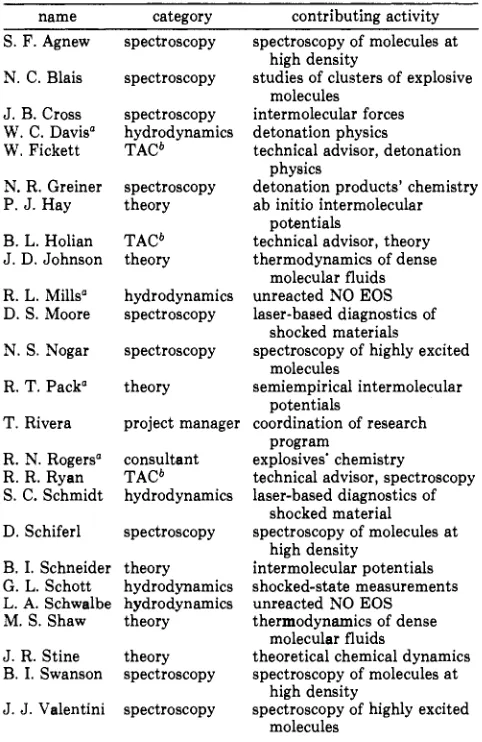
A list of fiscal year 1984-participating FRE team members is presented in Table I.
Overview
A. Detonation Products EOS. The experimental portion of the work on the EOS of the detonation products of liquid NO has been successfully completed (Schott et al., 1985). The experimental data, which was obtained in the pressure range of 10-30 GPa, are compared with the- oretical Hugoniot curves in Figure 1. Our newly developed method (Johnson et al., 1984; Shaw et al., 1983) for treating nonspherical potentials of molecular fluids using effective spherical potentials coupled with existing mixing rules was utilized in modeling the EOS. Intermolecular potentials were calculated by using ab initio (Hay et al., 1984) and semiempirical methods (Pack, 1984). The agreement be- tween experimental data and theoretical calculations is excellent. The resulting EOS is adequate for our planned test of CJ theory, but the question of what forms of oxi- dized nitrogen are actually present as products of deto- nating NO remains to be answered.
B. Shock Wave Measurements. We have experi- mentally verified the attainment of chemical equilibrium
Table I. FRE Team Members, Fiscal Year 1984
name cat ego r y contributing activity S. F. Agnew
N. C. Blais
J. B. Cross W. C. Davis" W. Fickett
N. R. Greiner P. J. Hay
B. L. Holian J. D. Johnson
R. L. Mills" D. S. Moore
N. S. Nogar
R. T. Pack"
T. Rivera
R. N. Rogers0 R. R. Ryan S. C. Schmidt
D. Schiferl
B. I. Schneider
G. L. Schott L. A. Schwalbe M. S. Shaw
J. R. Stine B. I. Swanson
J. J. Valentini
spectroscopy
spectroscopy
spectroscopy hydrodynamics TACb
spectroscopy theory
TACb theory
hydrodynamics spectroscopy
spectroscopy
theory
project manager
consultant TACb hydrodynamics
spectroscopy
theory hydrodynamics hydrodynamics theory
theory spectroscopy
spectroscopy
spectroscopy of molecules at
studies of clusters of explosive
intermolecular forces detonation physics
technical advisor, detonation
detonation products' chemistry ab initio intermolecular
technical advisor, theory thermodynamics of dense
molecular fluids unreacted NO EOS
laser-based diagnostics of
spectroscopy of highly excited
semiempirical intermolecular
coordination of research
explosives' chemistry
technical advisor, spectroscopy laser-based diagnostics of
spectroscopy of molecules at
intermolecular potentials shocked-state measurements unreactsd NO EOS
thermodynamics of dense molecular fluids
theoretical chemical dynamics spectroscopy of molecules at
spectroscopy of highly excited high density
molecules
physics
potentials
shocked materials
molecules
potentials
program
shocked material
high density
high density
molecules
Los Alamos Fellow. Technical Advisory Committee.
in detonating liquid NO. We were able to do this because the same thermodynamic state is reached by shocking either liquid NO or liquid N2