Overview of the Infectious Diseases (ID) task of
BioNLP Shared Task 2011
Sampo Pyysalo∗ Tomoko Ohta∗ Rafal Rak‡§ Dan Sullivan† Chunhong Mao† Chunxia Wang† Bruno Sobral† Jun’ichi Tsujii¶ Sophia Ananiadou‡§
∗Department of Computer Science, University of Tokyo, Tokyo, Japan †Virginia Bioinformatics Institute, Virginia Tech, Blacksburg, Virginia, USA
‡School of Computer Science, University of Manchester, Manchester, UK §National Centre for Text Mining, University of Manchester, Manchester, UK
¶Microsoft Research Asia, Beijing, China
{smp,okap}@is.s.u-tokyo.ac.jp [email protected]
{dsulliva,cmao,cwang,sobral}@vbi.vt.edu
{rafal.rak,sophia.ananiadou}@manchester.ac.uk
Abstract
This paper presents the preparation, resources, results and analysis of the Infectious Diseases (ID) information extraction task, a main task of the BioNLP Shared Task 2011. The ID task represents an application and extension of the BioNLP’09 shared task event extrac-tion approach to full papers on infectious dis-eases. Seven teams submitted final results to the task, with the highest-performing system achieving 56% F-score in the full task, com-parable to state-of-the-art performance in the established BioNLP’09 task. The results in-dicate that event extraction methods general-ize well to new domains and full-text publi-cations and are applicable to the extraction of events relevant to the molecular mechanisms of infectious diseases.
1 Introduction
The Infectious Diseases (ID) task of the BioNLP Shared Task 2011 (Kim et al., 2011a) is an infor-mation extraction task focusing on the biomolecu-lar mechanisms of infectious diseases. The primary target of the task is event extraction (Ananiadou et al., 2010), broadly following the task setup of the BioNLP’09 Shared Task (BioNLP ST’09) (Kim et al., 2009).
The task concentrates on the specific domain of two-component systems (TCSs, or two-component regulatory systems), a mechanism widely used by bacteria to sense and respond to the environment (Thomason and Kay, 2000). Typical TCSs con-sist of two proteins, a membrane-associated sensor
kinase and a cytoplasmic response regulator. The sensor kinase monitors changes in the environment while the response regulator mediates an adaptive response, usually through differential expression of target genes (Mascher et al., 2006). TCSs have many functions, but those of particular interest for infec-tious disease researchers include virulence, response to antibiotics, quorum sensing, and bacterial cell at-tachment (Krell et al., 2010). Not all TCS functions are well known: in some cases, TCSs are involved in metabolic processes that are difficult to precisely characterize (Wang et al., 2010). TCSs are of in-terest also as drugs designed to disrupt TCSs may reduce the virulence of bacteria without killing it, thus avoiding the potential selective pressure of an-tibiotics lethal to some pathogenic bacteria (Gotoh et al., 2010). Information extraction techniques may support better understanding of these fundamental systems by identifying and structuring the molecu-lar processes underlying two component signaling.
The ID task seeks to address these opportuni-ties by adapting the BioNLP ST’09 event extraction model to domain scientific publications. This model was originally introduced to represent biomolecu-lar events relating to transcription factors in human blood cells, and its adaptation to a domain that cen-trally concerns both bacteria and their hosts involves a variety of novel aspects, such as events concerning whole organisms, the chemical environment of bac-teria, prokaryote-specific concepts (e.g. regulons as elements of gene expression), as well as the effects of biomolecules on larger-scale processes involving hosts such as virulence.
2 Task Setting
The ID task broadly follows the task definition and event types of the BioNLP ST’09, extending it with new entity categories, correspondingly broadening the scope of events, and introducing a new class of events, high-level biological processes.
2.1 Entities
The ID task defines five core types of entities: genes/gene products, two-component systems, reg-ulons/operons, chemicals, and organisms. Follow-ing the general policy of the BioNLP Shared Task, the recognition of the core entities is not part of the ID task. As named entity recognition (NER) is considered in other prominent domain evaluations (Krallinger et al., 2008), we have chosen to isolate aspects of extraction performance relating to NER from the main task of interest, event extraction, by providing participants with humcreated gold an-notations for core entities. These anan-notations are briefly presented in the following.
Mentions of names of genes and their products (RNA and proteins) are annotated with a single type, without differentiating between subtypes, fol-lowing the guidelines of the GENIA GGP corpus (Ohta et al., 2009). This type is named PRO -TEIN to maintain consistency with related tasks (e.g. BioNLP ST’09), despite slight inaccuracy for cases specifically referencing RNA or DNA forms. Two-component systems, consisting of two proteins, frequently have names derived from the names of the proteins involved (e.g. PhoP-PhoR or SsrA/SsrB). Mentions of TCSs are annotated as TWO-COMPONENT-SYSTEM, nesting PROTEIN an-notations if present. Regulons and operons are col-lections of genes whose expression is jointly regu-lated. Like the names of TCSs, their names may de-rive from the names of the involved genes and pro-teins, and are annotated as embedding PROTEIN an-notations when they do. The annotation does not differentiate between the two, marking both with a single type REGULON-OPERON.
In addition to these three classes relating to genes and proteins, the core entity annotation recognizes the classes CHEMICAL and ORGANISM. All men-tions of formal and informal names of atoms, inor-ganic compounds, carbohydrates and lipids as well
as organic compounds other than amino acid and nu-cleic acid compounds (i.e. gene/protein-related com-pounds) are annotated as CHEMICAL. Mentions of names of families, genera, species and strains as well as non-name references with comparable speci-ficity are annotated as ORGANISM.
Finally, the non-specific type ENTITY1 is defined for marking entities that specify additional details of events such as the binding site in a BINDINGevent or the location an entity moves to in a LOCALIZATION event. Unlike the core entities, annotations of the generic ENTITY type are not provided for test data and must be detected by participants addressing the full task.
2.2 Relations
The ID task involves one relation, EQUIV, defin-ing entities (of any of the core types) to be equiv-alent. This relation is used to annotate abbreviations and local aliases and it is not a target of extraction, but provided for reference and applied in evaluation, where references to any of a set of equivalent entities are treated identically.
2.3 Events
The primary extraction targets of the ID task are the event types summarized in Table 1. These are a su-perset of those targeted in the BioNLP ST’09 and its repeat, the 2011 GE task (Kim et al., 2011b). This design makes it possible to study aspects of domain adaptation by having the same extraction targets in two subdomains of biomedicine, that of transcrip-tion factors in human blood cells (GE) and infectious diseases. The events in the ID task extend on those of GE in the inclusion of additional entity types as participants in previously considered event types and the introduction of a new type, PROCESS. We next briefly discuss the semantics of these events, defined (as in GE) with reference to the community-standard Gene Ontology (Ashburner et al., 2000). We refer to (Kim et al., 2008; Kim et al., 2009) for the ST’09/GE definitions.
1
Type Core arguments Additional arguments GENE EXPRESSION Theme(PROTEINor REGULON-OPERON)
TRANSCRIPTION Theme(PROTEINor REGULON-OPERON) PROTEIN CATABOLISM Theme(PROTEIN)
PHOSPHORYLATION Theme(PROTEIN) Site(ENTITY)
LOCALIZATION Theme(Core entity) AtLoc(ENTITY),ToLoc(ENTITY)
BINDING Theme(Core entity)+ Site(ENTITY)+
PROCESS Participant(Core entity)?
REGULATION Theme(Core entity / Event),Cause(Core entity / Event)? Site(ENTITY),CSite(ENTITY) POSITIVEREGULATION Theme(Core entity / Event),Cause(Core entity / Event)? Site(ENTITY),CSite(ENTITY) NEGATIVEREGULATION Theme(Core entity / Event),Cause(Core entity / Event)? Site(ENTITY),CSite(ENTITY)
Table 1: Event types and their arguments. The type of entity allowed as argument is specified in parenthesis. “Core en-tity” is any of PROTEIN, TWO-COMPONENT-SYSTEM, REGULON-OPERON, CHEMICAL, or ORGANISM. Arguments that can be filled multiple times marked with “+”, non-mandatory core arguments with “?” (all additional arguments are non-mandatory).
The definitions of the first four types in Table 1 are otherwise unchanged from the ST’09 definitions except that GENE EXPRESSION and TRANSCRIP -TION extend on the former definition in recogniz-ing REGULON-OPERONas an alternative unit of ex-pression. LOCALIZATION, taking only PROTEIN type arguments in the ST’09 definition, is allowed to take any core entity argument. This expanded definition remains consistent with the scope of the corresponding GO term (GO:0051179). BINDING is similarly extended, giving it a scope largely con-sistent with GO:0005488 (binding) but also encom-passing GO:0007155 (cell adhesion) (e.g. a bac-terium binding another) and protein-organism bind-ing. The three regulation types (REGULATION, POSITIVEREGULATION, and NEGATIVEREGULA -TION) likewise allow the new core entity types as arguments, but their definitions are otherwise un-changed from those in ST’09, that is, the GENIA on-tology definitions. As in these resources, regulation types are used not only for the biological sense but also to capture statements of general causality (Kim et al., 2008). As in ST’09, all events of types dis-cussed above require aThemeargument: only events involving an explicitly stated theme (of an appropri-ate type) should be extracted. All other arguments are optional.
The PROCESStype, new to ID, is used to annotate high-level processes such as virulence, infection and resistance that involve infectious organisms. This type differs from the others in that it has no manda-tory arguments: the targeted processes should be
ex-tracted even if they have no explicitly stated partici-pants, reflecting that they are of interest even without the further specification. When stated, the involved participants are captured using the generic role type Participant. Figure 1 shows an illustration of some of the the ID task extraction targets.
We term the first five event types in Table 1 taking exactly oneThemeargument as their core argument simple events. In analysis we further differentiate non-regulation events(the first seven) andregulation (the last three), which is known to represent partic-ular challenges for extraction in involving events as arguments, thus creating nested event structures.
2.4 Event modifications
The ID task defines two event modification ex-traction targets, NEGATION and SPECULATION. These modifications mark events as being explic-itly negated (e.g.virB is not expressed) or stated in a speculative context (e.g.virB may be expressed). Both may apply simultaneously. The modification definitions are identical to the ST’09 ones, includ-ing the representation in which modifications (un-like events) are not assigned text bindings.
3 Data
Figure 1: Example event annotation. The association of a TCS with an organism is captured through an event structure involving a PROCESS(“virulence”) and POSITIVE REGULATION. Regulation types are used to capture also statements of general causality such as “is essential for” here. (Simplified from PMC ID 2358977)
Journal # Published
PLoS Pathogens 9 2006–2010
PLoS One 7 2008–2010
BMC Genomics 3 2008–2010 PLoS Genetics 2 2007–2010 Open Microbiology J. 2 2008–2010 BMC Microbiology 2 2008–2009
Other 5 2007–2008
Table 2: Corpus composition. Journals in which selected articles were published with number of articles (#) and publication years.
design was guided by previous studies on NER and event extraction in a closely related domain (Pyysalo et al., 2010; Ananiadou et al., 2011).
3.1 Document selection
The training and test data were drawn from the pri-mary text content of recent full-text PMC open ac-cess documents selected by infectious diseases do-main experts (Virginia Tech team) as representative publications on two-component regulatory systems. Table 2 presents some characteristics of the corpus composition. To focus efforts on natural language text likely to express novel information, we excluded tables, figures and their captions, as well as methods sections, acknowledgments, authors’ contributions, and similar meta-content.
3.2 Annotation
Annotation was performed in two primary stages, one for marking core entities and the other for events and secondary entities. As a preliminary processing step, initial sentence segmentation was performed with the GENIA Sentence Splitter2. Segmentation errors were corrected during core entity annotation.
Core entity annotation was performed from the basis of an automatic annotation created using se-lected existing taggers for the target entities. The
2http://www-tsujii.is.s.u-tokyo.ac.jp/
˜y-matsu/geniass/
Entity type prec. rec. F
PROTEIN 54.64 39.64 45.95
CHEMICAL 32.24 19.05 23.95
ORGANISM 90.38 47.70 62.44
[image:4.612.107.266.148.239.2]TWO-COMPONENT-SYSTEM 87.69 47.24 61.40
Table 3: Automatic core entity tagging performance.
following tools and settings were adopted, with pa-rameters tuned on initial annotation for two docu-ments:
PROTEIN: NeMine (Sasaki et al., 2008) trained on the JNLPBA data (Kim et al., 2004) with threshold 0.05, filtered to only GENE and PROTEIN types.
ORGANISM: Linnaeus (Gerner et al., 2010) with “variant matching” for species names variants.
CHEMICAL: OSCAR3 (Corbett and Murray-Rust, 2006) with confidence 90%.
TWO-COMPONENT-SYSTEM: Custom regular ex-pressions.
Initial automatic tagging was not applied for en-tities of the REGULON-OPERONtype or the generic ENTITY type (for additional event arguments). All automatically generated annotations were at least confirmed through manual inspection, and the ma-jority of the automatic annotations were revised in manual annotation. Table 3 summarizes the tag-ging performance of the automatic tools as measured against the final human-annotated training and de-velopment datasets.3
Annotation for the task extraction targets – events and event modifications – was created entirely man-ually without automatic annotation support to avoid any possible bias toward specific extraction meth-ods or approaches. The Tsujii laboratory team
orga-3
Item Train Devel Test Total
Articles 15 5 10 30
Sentences 2,484 709 1,925 5118 Words 74,439 21,225 57,489 153,153 Core entities 6,525 1,976 4,239 12,740
Events 2,088 691 1,371 4150
[image:5.612.77.295.56.142.2]Modifications 95 45 74 214
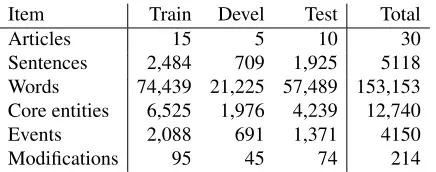
Table 4: Statistics of the ID corpus.
nized the annotation effort, with a coordinating an-notator with extensive experience in event annota-tion (TO) leading annotator training and annotaannota-tion scheme development. Detailed annotation guide-lines (Pyysalo et al., 2011) extending on the GE-NIA annotation guidelines were developed jointly with all annotators and refined throughout the an-notation effort. Based on measurements of inter-annotator consistency between annotations indepen-dently created by the two teams, made throughout annotator training and primary annotation (exclud-ing final corpus cleanup), we estimate the consis-tency of the final entity annotation to be no lower than 90% F-score and that of the event annotation to be no lower than 75% F-score for the primary eval-uation criteria (see Section 4).
3.3 Datasets and statistics
Initial annotation was produced for the selected sec-tions (see Section 3.1) in 33 full-text articles, of which 30 were selected for the final dataset as repre-sentative of the extraction targets. These documents were split into training, development and test sets of 15, 5 and 10 documents, respectively. Participants were provided with all training and development set annotations and test set core entity annotations. The overall statistics of the datasets are given in Table 4. As the corpus consists of full-text articles, it con-tains a somewhat limited number of articles, but in other terms it is of broadly comparable size to the largest of the BioNLP ST corpora: the corpus word count, for example, corresponds to that of a cor-pus of approximately 800 PubMed abstracts, and the core entity count is comparable to that in the ST’09 data. However, for reasons that may relate in part to the domain, the event count is approximately a third of that for the ST’09 data. In addition to having less training data, the entity/event ratio is thus consider-ably higher (i.e. there are more candidates for each
true target), suggesting that the ID data could be ex-pected to provide a more challenging extraction task.
4 Evaluation
The performance of participating systems was evaluated in terms of events using the standard precision/recall/F-score metrics. For the primary evaluation, we adopted the standard criteria defined in the BioNLP’09 shared task. In brief, for deter-mining whether a reference annotation and a pre-dicted annotation match, these criteria relax exact matching for event triggers and arguments in two ways: matching of text-bound annotation (event triggers and ENTITY type entities) allows limited boundary variation, and only core arguments need to match in nested event arguments for events to match. For details of the matching criteria, please refer to Kim et al. (2009).
The primary evaluation for the task requires the extraction of all event arguments (both core and ad-ditional; see Table 1) as well as event modifications (NEGATION and SPECULATION). This is termed the full task. We additionally report extraction re-sults for evaluation where both the gold standard ref-erence data and the submission events are reduced to only core arguments, event modifications are re-moved, and resulting duplicate events removed. We term this thecore task. In terms of the subtask divi-sion applied in the BioNLP’09 Shared Task and the GE task of 2011, the core task is analogous to sub-task 1 and the full sub-task analogous to the combination of subtasks 1–3.
5 Results
5.1 Participation
NLP Events Other resources Rank Team Org Word Parse Trig. Arg. Group. Modif. Corpora Other
1 FAUST 3NLP CoreNLP,
SnowBall McCCJ + SD (UMass+Stanford as features) GE word clusters
2 UMass 1NLP CoreNLP,
SnowBall McCCJ + SD Joint, dual dec.+MIRA 1-best - GE
-3 Stanford 3NLP CoreNLP McCCJ + SD MaxEnt Joint, MSTParser - GE word clusters 4 ConcordU 2NLP - McCCJ + SD dict rules rules rules - triggers and
hedge words
5 UTurku 1BI Porter McCCJ + SD SVM SVM SVM SVM - hedge words
6 PNNL 1CS, 1NLP,
2BI Porter Stanford SVM SVM rules - GE UMLS, triggers
[image:6.612.79.536.56.203.2]7 PredX 1CS, 1NLP LGP LGP dict rules rules - - UMLS, triggers
Table 5: Participants and summary of system descriptions. Abbreviations: Trig./Arg./Group./Modif.=event trigger detection/argument detection/argument grouping/modification detection, BI=Bioinformatician, NLP=Natural Lan-guage Processing researcher, CS=Computer scientist, CoreNLP=Stanford CoreNLP, Porter=Porter stemmer, Snow-ball=Snowball stemmer McCCJ=McClosky-Charniak-Johnson parser, LGP=Link Grammar Parser, SD=Stanford De-pendency conversion, UMLS=UMLS resources (e.g. lexicon, metamap)
ST’09 participation. In system design choices, we note an indication of increased use of joint models as opposed to pure pipeline designs, with the three highest-ranking systems involving a joint model.
Several participants compiled dictionaries of event trigger words and two dictionaries of hedge words from the data. Four teams, including the three top-ranking, used the GE task corpus as supplemen-tary material, indicating that the GE annotations are largely compatible with ID ones (see detailed results below). This is encouraging for future applications of the event extraction approach: as manual annota-tion requires considerable effort and time, the ability to use existing annotations is important for the feasi-bility of adaptation of the approach to new domains. While several participants made use of support-ing syntactic analyses provided by the organizers (Stenetorp et al., 2011), none applied the analyses for supporting tasks, such as coreference or entity relation extraction results – at least in cases due to time constraints (Kilicoglu and Bergler, 2011).
5.2 Evaluation results
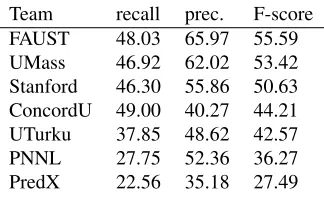
Table 6 presents the primary results by event type, and Table 7 summarizes these results. The full task requires the extraction of additional arguments and event modifications and involves multiple novel challenges from previously addressed domain tasks including a new subdomain, full-text documents, several new entity types and a new event category.
[image:6.612.346.508.298.397.2]Team recall prec. F-score FAUST 48.03 65.97 55.59 UMass 46.92 62.02 53.42 Stanford 46.30 55.86 50.63 ConcordU 49.00 40.27 44.21 UTurku 37.85 48.62 42.57 PNNL 27.75 52.36 36.27 PredX 22.56 35.18 27.49
Table 7: Primary evaluation results.
Nevertheless, extraction performance for the top systems is comparable to the state-of-the-art results for the established BioNLP ST’09 task (Miwa et al., 2010) as well as its repetition as the 2011 GE task (Kim et al., 2011b), where the highest overall result for the primary evaluation criteria was also 56% F-score for the FAUST system (Riedel et al., 2011). This result is encouraging regarding the ability of the extraction approach and methods to generalize to new domains as well as their applicability specifi-cally to texts on the molecular mechanisms of infec-tious diseases.
FAUST UMass Stanford ConcordU UTurku PNNL PredX Size
GENE EXPRESSION 70.68 66.43 54.00 56.57 64.88 53.33 0.00 512
TRANSCRIPTION 69.66 68.24 60.00 70.89 57.14 0.00 53.85 77
PROTEIN CATABOLISM 75.00 72.73 20.00 66.67 33.33 11.76 0.00 33
PHOSPHORYLATION 64.00 66.67 40.00 54.55 60.61 64.29 40.00 69
LOCALIZATION 33.33 14.29 31.58 20.00 66.67 20.69 0.00 49
Simple event total 68.47 63.55 52.72 56.78 62.67 43.87 18.18 740
BINDING 31.30 34.62 23.44 40.00 22.22 20.00 28.28 156
PROCESS 65.69 62.26 73.57 67.17 41.57 51.04 53.27 901
Non-regulation total 63.78 60.68 63.59 62.43 46.39 47.34 43.65 1797
REGULATION 35.44 30.49 17.67 19.43 22.96 0.00 2.16 267
POSITIVE REGULATION 47.50 49.49 34.78 23.41 41.28 24.60 21.02 455
NEGATIVE REGULATION 58.86 60.45 44.44 47.96 52.11 25.70 9.49 260
Regulation total 47.07 46.65 33.02 28.87 39.49 18.45 9.71 982
Subtotal 57.28 55.03 52.09 46.60 43.33 37.53 28.38 2779
NEGATION 0.00 0.00 0.00 22.92 32.91 0.00 0.00 96
SPECULATION 0.00 0.00 0.00 3.23 15.00 0.00 0.00 44
Modification total 0.00 0.00 0.00 11.82 26.89 0.00 0.00 140
[image:7.612.91.528.57.288.2]Total 55.59 53.42 50.63 44.21 42.57 36.27 27.49 2919
Table 6: Primary evaluation F-scores by event type. The “size” column gives the number of annotations of each type in the given data (training+development). Best result for each type shown in bold.
The best performance for simple events and for PROCESS approaches or exceeds 70% F-score, ar-guably approaching a sufficient level for user-facing applications of the extraction technology. By con-trast, BINDING and regulation events, found chal-lenging in ST’09 and GE, remain problematic also in the ID task, with best overall performance below 50% F-score. Only two teams, UTurku and Con-cordU (Kilicoglu and Bergler, 2011), attempted to extract event modifications, with somewhat limited performance. The difficulty of correct extraction of event modifications is related in part to the recursive nature of the problem (similarly as for nested reg-ulation events): to extract a modification correctly, the modified event must also be extracted correctly. Further, only UTurku predicted any instances of sec-ondary arguments. Thus, teams other than UTurku and ConcordU addressed only the core task extrac-tion targets. With the excepextrac-tion of ConcordU, all systems clearly favor precision over recall (Table 7), in many cases having over 15% point higher preci-sion than recall. This a a somewhat unexpected in-version, as the ConcordU system is one of the two rule-based in the task, an approach typically associ-ated with high precision.
The five top-ranking systems participated also in the GE task (Kim et al., 2011b), which involves a
Team recall prec. F-score ∆ FAUST 50.62 66.06 57.32 1.73 UMass 49.45 62.11 55.06 1.64 Stanford 48.87 56.03 52.20 1.57 ConcordU 50.77 43.25 46.71 2.50 UTurku 38.79 49.35 43.44 0.87 PNNL 29.36 52.62 37.69 1.42 PredX 23.67 35.18 28.30 0.81
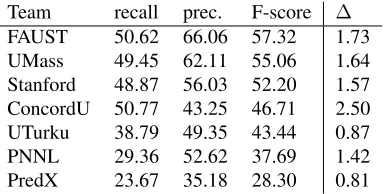
Table 8: Core task evaluation results. The ∆ column gives the F-score difference to the corresponding full task (primary) result.
could potentially be applied also with other systems, an experiment that could further clarify the relative strengths of the various systems. The top-ranking five systems all participated also in the EPI task (Ohta et al., 2011), for which UTurku ranked first with FAUST having comparable performance for the core task. While this supports the conclusion that ID performance differences do not reflect a simple universal ranking of the systems, due to many sub-stantial differences between the ID and EPI setups it is not straightforward to identify specific reasons for relative differences to performance at EPI.
Table 8 summarizes the core task results. There are only modest and largely consistent differences to the corresponding full task results, reflecting in part the relative sparseness of additional arguments: in the training data, for example, only approximately 3% of instances of event types that can potentially take additional arguments had at least one additional argument. While event modifications represent a further 4% of full task extraction targets not required for the core task, the overall low extraction perfor-mance for additional arguments and modifications limits the practical effect of these annotation cate-gories on the performance difference between sys-tems addressing only the core targets and those ad-dressing the full task.
6 Discussion and Conclusions
We have presented the preparation, resources, re-sults and analysis of the Infectious Diseases (ID) task of the BioNLP Shared Task 2011. A corpus of 30 full-text publications on the two-component systems subdomain of infectious diseases was cre-ated for the task in a collaboration of event annota-tion and domain experts, adapting and extending the
BioNLP’09 Shared Task (ST’09) event representa-tion to the domain.
Seven teams submitted final results to the ID task. Despite the novel challenges of full papers, four new entity types, extension of event scopes and the intro-duction of a new event category for high-level pro-cesses, the highest results for the full ID task were comparable to the state-of-the-art performance on the established ST’09 data, showing that the event extraction approach and present systems generalize well and demonstrating the feasibility of event ex-traction for the infectious diseases domain. Analy-sis of results suggested further opportunities for im-proving extraction performance by combining the strengths of various systems and the use of other event resources.
The task design takes into account the needs of supporting practical applications, and its results and findings will be adopted in future development of the Pathosystems Resource Integration Center4 (PATRIC). Specifically, PATRIC will combine do-main named entity recognition and event extraction to mine the virulence factor literature and integrate the results with literature search and retrieval ser-vices, protein feature analysis, and systems such as Disease View.5 Present and future advances at the ID event extraction task can thus assist biologists in efforts of substantial public health interest.
The ID task will be continued as an open shared task challenge with data, supporting re-sources, and evaluation tools freely available from the shared task site, http://sites.google.
com/site/bionlpst/.
Acknowledgments
This work was supported by Grant-in-Aid for Spe-cially Promoted Research (MEXT, Japan). This project has been funded in whole or in part with Fed-eral funds from the National Institute of Allergy and Infectious Diseases, National Institutes of Health, Department of Health and Human Services, under Contract No. HHSN272200900040C, awarded to BWS Sobral.
4
http://patricbrc.org
5
References
Sophia Ananiadou, Sampo Pyysalo, Jun’ichi Tsujii, and Douglas B. Kell. 2010. Event extraction for sys-tems biology by text mining the literature. Trends in Biotechnology, 28(7):381–390.
Sophia Ananiadou, Dan Sullivan, William Black, Gina-Anne Levow, Joseph J. Gillespie, Chunhong Mao, Sampo Pyysalo, BalaKrishna Kolluru, Junichi Tsujii, and Bruno Sobral. 2011. Named entity recognition for bacterial type IV secretion systems. PLoS ONE, 6(3):e14780.
M Ashburner, CA Ball, JA Blake, D Botstein, H Butler, JM Cherry, AP Davis, K Dolinski, SS Dwight, JT Ep-pig, MA Harris, DP Hill, L Issel-Tarver, A Kasarskis, S Lewis, JC Matese, JE Richardson, M Ringwald, GM Rubin, and G Sherlock. 2000. Gene ontology: tool for the unification of biology. Nature genetics, 25:25–29.
Jari Bj¨orne and Tapio Salakoski. 2011. Generaliz-ing biomedical event extraction. In Proceedings of the BioNLP 2011 Workshop Companion Volume for Shared Task, Portland, Oregon, June. Association for Computational Linguistics.
Eugene Charniak and Mark Johnson. 2005. Coarse-to-Fine n-Best Parsing and MaxEnt Discriminative Reranking. InProceedings of the 43rd Annual Meet-ing of the Association for Computational LMeet-inguistics (ACL’05), pages 173–180.
Peter Corbett and Peter Murray-Rust. 2006. High-throughput identification of chemistry in life science texts.Computational Life Sciences II, pages 107–118. Marie-Catherine de Marneffe, Bill MacCartney, and Christopher D. Manning. 2006. Generating Typed Dependency Parses from Phrase Structure Parses. In Proceedings of the Fifth International Conference on Language Resources and Evaluation (LREC’06), pages 449–454.
Martin Gerner, Goran Nenadic, and Casey M. Bergman. 2010. LINNAEUS: a species name identification sys-tem for biomedical literature. BMC bioinformatics, 11(1):85+, February.
Yasuhiro Gotoh, Yoko Eguchi, Takafumi Watanabe, Sho Okamoto, Akihiro Doi, and Ryutaro Utsumi. 2010. Two-component signal transduction as potential drug targets in pathogenic bacteria.Current Opinion in Mi-crobiology, 13(2):232–239. Cell regulation.
Halil Kilicoglu and Sabine Bergler. 2011. Adapting a general semantic interpretation approach to biological event extraction. InProceedings of the BioNLP 2011 Workshop Companion Volume for Shared Task, Port-land, Oregon, June. Association for Computational Linguistics.
Jin-Dong Kim, Tomoko Ohta, Yoshimasa Tsuruoka, Yuka Tateisi, and Nigel Collier, editors. 2004. Intro-duction to the bio-entity recognition task at JNLPBA, Geneva, Switzerland.
Jin-Dong Kim, Tomoko Ohta, and Jun’ichi Tsujii. 2008. Corpus annotation for mining biomedical events from lterature.BMC Bioinformatics, 9(1):10.
Jin-Dong Kim, Tomoko Ohta, Sampo Pyysalo, Yoshi-nobu Kano, and Jun’ichi Tsujii. 2009. Overview of BioNLP’09 Shared Task on Event Extraction. In Proceedings of Natural Language Processing in Biomedicine (BioNLP) NAACL 2009 Workshop, pages 1–9.
Jin-Dong Kim, Sampo Pyysalo, Tomoko Ohta, Robert Bossy, and Jun’ichi Tsujii. 2011a. Overview of BioNLP Shared Task 2011. In Proceedings of the BioNLP 2011 Workshop Companion Volume for Shared Task, Portland, Oregon, June. Association for Computational Linguistics.
Jin-Dong Kim, Yue Wang, Toshihisa Takagi, and Aki-nori Yonezawa. 2011b. Overview of the Genia Event task in BioNLP Shared Task 2011. In Proceedings of the BioNLP 2011 Workshop Companion Volume for Shared Task, Portland, Oregon, June. Association for Computational Linguistics.
M. Krallinger, A. Morgan, L. Smith, F. Leitner, L. Tan-abe, J. Wilbur, L. Hirschman, and A. Valencia. 2008. Evaluation of text-mining systems for biology: overview of the Second BioCreative community chal-lenge. Genome biology, 9(Suppl 2):S1.
Tino Krell, Jess Lacal, Andreas Busch, Hortencia Silva-Jimnez, Mara-Eugenia Guazzaroni, and Juan Luis Ramos. 2010. Bacterial sensor kinases: Diversity in the recognition of environmental signals. Annual Re-view of Microbiology, 64(1):539–559.
Thorsten Mascher, John D. Helmann, and Gottfried Un-den. 2006. Stimulus perception in bacterial signal-transducing histidine kinases. Microbiol. Mol. Biol. Rev., 70(4):910–938.
David McClosky, Mihai Surdeanu, and Christopher Man-ning. 2011. Event extraction as dependency parsing for bionlp 2011. InProceedings of the BioNLP 2011 Workshop Companion Volume for Shared Task, Port-land, Oregon, June. Association for Computational Linguistics.
David McClosky. 2009. Any Domain Parsing: Auto-matic Domain Adaptation for Natural Language Pars-ing. Ph.D. thesis, Department of Computer Science, Brown University.
the BioNLP 2011 Workshop Companion Volume for Shared Task, Portland, Oregon, June. Association for Computational Linguistics.
Makoto Miwa, Sampo Pyysalo, Tadayoshi Hara, and Jun’ichi Tsujii. 2010. Evaluating dependency repre-sentation for event extraction. InProceedings of COL-ING’10, pages 779–787.
Tomoko Ohta, Jin-Dong Kim, Sampo Pyysalo, Yue Wang, and Jun’ichi Tsujii. 2009. Incorporating GENETAG-style annotation to GENIA corpus. In Proceedings of BioNLP’09, pages 106–107.
Tomoko Ohta, Sampo Pyysalo, and Jun’ichi Tsujii. 2011. Overview of the Epigenetics and Post-translational Modifications (EPI) task of BioNLP Shared Task 2011. InProceedings of the BioNLP 2011 Workshop Companion Volume for Shared Task, Portland, Oregon, June. Association for Computational Linguistics. Sampo Pyysalo, Tomoko Ohta, Han-Cheol Cho, Dan
Sul-livan, Chunhong Mao, Bruno Sobral, Jun’ichi Tsujii, and Sophia Ananiadou. 2010. Towards event extrac-tion from full texts on infectious diseases. In Proceed-ings of BioNLP’10, pages 132–140.
Sampo Pyysalo, Tomoko Ohta, Rafal Rak, Dan Sulli-van, Chunhong Mao, Chunxia Wang, Bruno Sobral, Jun’ichi Tsujii, and Sophia Ananiadou. 2011. An-notation guidelines for infectious diseases event cor-pus. Technical report, Tsujii Laboratory, University of Tokyo. To appear.
Sebastian Riedel and Andrew McCallum. 2011. Ro-bust biomedical event extraction with dual decompo-sition and minimal domain adaptation. InProceedings of the BioNLP 2011 Workshop Companion Volume for Shared Task, Portland, Oregon, June. Association for Computational Linguistics.
Sebastian Riedel, David McClosky, Mihai Surdeanu, An-drew McCallum, and Chris Manning. 2011. Model combination for event extraction in bionlp 2011. In Proceedings of the BioNLP 2011 Workshop Compan-ion Volume for Shared Task, Portland, Oregon, June. Association for Computational Linguistics.
Yutaka Sasaki, Yoshimasa Tsuruoka, John McNaught, and Sophia Ananiadou. 2008. How to make the most of NE dictionaries in statistical NER. BMC bioinfor-matics, 9 Suppl 11.
Pontus Stenetorp, Goran Topi´c, Sampo Pyysalo, Tomoko Ohta, Jin-Dong Kim, and Jun’ichi Tsujii. 2011. BioNLP Shared Task 2011: Supporting Resources. In Proceedings of the BioNLP 2011 Workshop Compan-ion Volume for Shared Task, Portland, Oregon, June. Association for Computational Linguistics.
Peter Thomason and Rob Kay. 2000. Eukaryotic sig-nal transduction via histidine-aspartate phosphorelay. J Cell Sci, 113(18):3141–3150.
Yue Wang, Jin-Dong Kim, Rune Sætre, Sampo Pyysalo, and Jun’ichi Tsujii. 2009. Investigating heteroge-neous protein annotations toward cross-corpora uti-lization.BMC Bioinformatics, 10(403).