The UPV-PRHLT combination system for WMT 2011
Jes ´us Gonz´alez-Rubio and Francisco Casacuberta Instituto Tecnol´ogico de Inform´atica
Departamento de Sistemas Inform´aticos y Computaci´on Universitat Polit`ecnica de Val`encia
{jegonzalez|fcn}@dsic.upv.es
Abstract
This paper presents the submissions of the pat-tern recognition and human language technol-ogy (PRHLT) group to the system combina-tion task of the sixth workshop on statistical machine translation (WMT 2011). Each sub-missions is generated by a multi-system mini-mum Bayes risk (MBR) technique. Our tech-nique uses the MBR decision rule and a linear combination of the component systems’ prob-ability distributions to search for the minimum risk translation among all the sentences in the target language.
1 Introduction
The UPV-PHRLT approach to machine translation (MT) system combination is based on the mini-mum Bayes risk system combination (MBRSC) al-gorithm (Gonzlez-Rubio et al., 2011). A multi-system MBR technique that computes consensus translations over multiple component systems.
MBRSC operates directly on the outputs of the component models. We perform an MBR decod-ing usdecod-ing a linear combination of the component models’ probability distributions. Instead of re-ranking the translations provided by the component systems, we search for the hypothesis with the min-imum expected translation error among all the pos-sible finite-length strings in the target language. By using a loss function based on BLEU (Papineni et al., 2002), we avoid the hypothesis alignment prob-lem that is central to standard system combination approaches (Rosti et al., 2007). MBRSC assumes only that each translation model can produce expec-tations ofn-gram counts; the latent derivation struc-tures of the component systems can differ arbitrary. This flexibility allows us to combine a great variety of MT systems.
2 Minimum Bayes risk Decoding
SMT can be described as a mapping of a word se-quence f in a source language to a word sequence
ein a target language; this mapping is produced by the MT decoder D(f). If the reference translation
eis known, the decoder performance can be mea-sured by the loss functionL(e,D(f)). Given such a loss functionL(e,e0)between an automatic transla-tione0 and a referencee, and an underlying proba-bility modelP(e|f), MBR decoding has the follow-ing form (Goel and Byrne, 2000; Kumar and Byrne, 2004):
ˆ
e= arg min e0∈E
R(e0) (1)
= arg min e0∈E
X
e∈E
P(e|f)· L(e,e0), (2)
where R(e0) denotes the Bayes risk of candidate translation e0 under loss function L, and E repre-sents the space of translations.
If the loss function between any two hypotheses can be bounded: L(e,e0) ≤ Lmax, the MBR de-coder can be rewritten in term of a similarity func-tion S(e,e0) = Lmax− L(e,e0). In this case, in-stead of minimizing the Bayes risk, we maximize the Bayes gainG(e0):
ˆ
e= arg max e0∈E
G(e0) (3)
= arg max e0∈E
X
e∈E
P(e|f)· S(e,e0). (4)
MBR decoding can use different spaces for hy-pothesis selection and gain computation (arg max and sum in Eq. (4)). Therefore, the MBR decoder can be more generally written as follows:
ˆ
e= arg max e0∈E
h X
e∈Ee
P(e|f)· S(e,e0), (5)
whereEhrefers to the hypotheses space form where the translations are chosen andEerefers to the evi-dences space that is used to compute the Bayes gain. We will investigate the expansion of the hypotheses space while keeping the evidences space as provided by the decoder.
3 MBR System Combination
MBRSC is a multi-system generalization of MBR decoding. It uses the MBR decision rule on a linear combination of the probability distributions of the component systems. Unlike existing MBR decoding methods that re-rank translation outputs, MBRSC search for the minimum risk hypotheses on the com-plete set of finite-length hypotheses over the out-put vocabulary. We assume the component systems to be statistically independent and define the Bayes gain as a linear combination of the Bayes gains of the components. Each system provides its own space of evidencesDn(f)and its posterior distribu-tion over transladistribu-tionsPn(e|f). Given a sentencefin the source language, MBRSC is written as follows:
ˆ
e= arg max e0∈E
h
G(e0) (6)
≈arg max e0∈E
h
N
X
n=1
αn· Gn(e0) (7)
= arg max e0∈E
h
N
X
n=1 αn·
X
e∈Dn(f)
Pn(e|f)· S(e,e0), (8)
whereN is the total number of component systems,
Ehrepresents the hypotheses space where the search is performed, Gn(e0) is the Bayes gain of hypothe-sise0 given by thenthcomponent system andαnis a scaling factor introduced to take into account the differences in quality of the component models. It is worth mentioning that by using a linear combination instead of a mixture model, we avoid the problem of component systems not sharing the same search space (Duan et al., 2010).
3.1 Computing BLEU-based Gain
We are interested in performing MBRSC under BLEU. Therefore, we rewrite the gain functionG(·) using single evidence (or reference) BLEU
(Pap-ineni et al., 2002) as the similarity function:
Gn(e0) =
X
e∈Dn(f)
Pn(e|f)·BLEU(e,e0) (9)
BLEU=
4
Y
k=1
mk
ck
14
·mine1−rc,1.0
, (10)
whereris the length of the evidence,cthe length of the hypothesis, mk the number of n-gram matches of sizek, and ck the count ofn-grams of sizekin the hypothesis.
The evidences space Dn(f) may contain a huge number of hypotheses1which often make impracti-cal to compute Eq. (9) directly. To avoid this prob-lem, Tromble et al. (2008) proposelinear BLEU, an approximation to the BLEU score to efficiently per-form MBR decoding on the lattices provided by the component systems. However, we want to explore a hypotheses space not restricted to the evidences pro-vided by the systems.
In Eq. (9), we have one hypothesise0that is to be compared to a set of evidences e ∈ Dn(f) which follow a probability distribution Pn(e|f). Instead of computing the expected BLEU score by calcu-lating the BLEU score with respect to each of the evidences, our approach will be to use the expected
n-gram counts and sentence length of the evidences to compute a single-reference BLEU score. We re-place the reference statistics (r andmnin Eq. (10)) by the expected statistics (r0andm0n) given the pos-terior distributionPn(e|f)over the evidences:
Gn(e0) =
4
Y
k=1
m0k ck
14
·min
e1−r 0
c,1.0
(11)
r0 = X e∈Dn(f)
|e| ·Pn(e|f) (12)
m0k= X ng∈Nk(e0)
min(Ce0(ng), C0(ng)) (13)
C0(ng) = X e∈Dn(f)
Ce(ng)·Pn(e|f), (14)
whereNk(e0)is the set ofn-grams of sizekin the hypothesis,Ce0(ng)is the count of then-gramngin
1
the hypothesis andC0(ng)is the expected count of
ngin the evidences. To compute then-gram match-ings m0k, the count of each n-gram is truncated, if necessary, to not exceed the expected count for that
n-gram in the evidences.
We have replaced a summation over a possibly ex-ponential number of items (e0 ∈ Dn(f)in Eq. (9)) with a summation over a polynomial number ofn -grams that occur in the evidences2. Both, the ex-pected length of the evidencesr0 and their expected
n-gram countsm0kcan be pre-computed efficiently fromN-best lists and translation lattices (Kumar et al., 2009; DeNero et al., 2010).
3.2 Model Training
The scaling factors in Eq. (8) denote the “quality” of each system with respect to the rest of them, i.e. the relative importance of each system in the Bayes gain computation. This scaling factors must be carefully tuned to obtain good translations.
We compute the scaling factor of each system as the number of times the hypothesis of the system is the best TER-scoring translation in the tuning cor-pora. Previous works show that this measure ob-tains the best translation results among other heuris-tic measures (Gonz´alez-Rubio et al., 2010) and even as good results as more complex methods such as MERT (Och, 2003). A normalization is performed to transform these counts into the range [0.0,1.0]. After the normalization, a weight value of0.0is as-signed to the scoring system, i.e. the lowest-scoring system is discarded and not taken into ac-count in the computation of the Bayes gain.
3.3 Model Decoding
In most MBR algorithms, the hypotheses space is equal to the evidences space. However, we are inter-ested in extend the hypotheses space by including new sentences created using fragments of the hy-potheses in the evidences spaces of the component models. We perform the search (argmax opera-tion in Eq. (8)) using the approximate median string (AMS) algorithm (Mart´ınez et al., 2000). AMS algorithm perform a hill-climbing search on a hy-potheses space equal to the free monoidΣ∗ of the vocabulary of the evidencesΣ =V oc(Ee).
2IfD
n(f)is represented by a lattice, the number ofn-grams
Algorithm 1MBRSC decoding algorithm.
Require: Initial hypothesise
Require: Vocabulary the evidencesΣ 1: ˆe←e
2: repeat
3: ecur←ˆe
4: forj= 1to|ecur|do
5: eˆs←ecur
6: fora∈Σdo
7: e0s ←Substitute(ecur, a, j)
8: ifG(e0s)>G(ˆes)then
9: ˆes←e0s
10: eˆd←Delete(ecur, j)
11: eˆi ←ecur
12: fora∈Σdo
13: e0i ←Insert(ecur, a, j)
14: ifG(e0i)>G(ˆei)then
15: ˆei←e0i
16: eˆ←arg maxe0∈{e
cur,ˆes,eˆd,ˆei}G(e
0)
17: untilG(ˆe)6>G(ecur)
18: return ecur
Ensure: G(ecur)≥ G(e)
The AMS algorithm is shown in Algorithm 1. AMS starts with an initial hypothesise3that is mod-ified using edit operations until there is no improve-ment in the Bayes gain (Lines3–16). On each posi-tionj of the current solutionecur, we apply all the possible single edit operations: substitution of the
jth word of ecur by each wordain the vocabulary (Lines5–9), deletion of thejth word ofe
cur (Line 10) and insertion of each wordain the vocabulary in thejthposition ofecur(Lines11–15). If the Bayes gain of any of the new edited hypotheses is higher than the Bayes gain of the current hypothesis (Line 17), we repeat the loop with this new hypotheseseˆ, in other case, we return the current hypothesis.
AMS algorithm takes as input an initial hypothe-siseand the combined vocabulary of the evidences spaces Σ. Its output is a possibly new hypothesis whose Bayes gain is assured to be higher or equal than the Bayes gain of the initial hypothesis.
The complexity of the main loop (lines 2-17) is
O(|ecur| · |Σ| ·CG), whereCG is the cost of
com-is polynomial in the number of edges in the lattice.
3
cz→en en→cz de→en en→de es→en en→es fr→en en→fr
#systems 12 14 25 34 15 22 23 21
de
v Worst 15.6 8.8 12.8 4.5 15.1 20.3 15.8 13.9
Best 25.9 16.9 22.2 16.3 27.8 32.7 28.6 35.5
MBRSC 26.7 15.9 22.2 17.1 30.5 33.3 30.2 34.7
test
Worst 13.3 9.1 12.9 5.1 14.7 20.7 16.1 13.0
Best 27.2 18.6 21.9 16.7 27.4 32.5 28.1 33.5
[image:4.612.101.512.51.182.2]MBRSC 27.9 17.7 22.1 16.5 30.4 32.9 29.6 32.7
Table 1: BLEU scores (case-sensitive) on the shared translation task development and test corpora of the best and worst single systems and MBRSC. For each translation direction, we show the number of systems being combined. Best translation results are in bold.
puting the gain of a hypothesis, and usually only a moderate number of iterations (< 10) is needed to converge (Mart´ınez et al., 2000).
4 Results
Experiments were conducted on all the8translation directions of the shared translation task Czech– English (cz↔en), German–English (de↔en), Spanish–English (es↔en) and French–English (fr↔en) and also on the raw and clean versions of the Haitian creole–English featured translation task (ht→en). All the experiments were carried out with the true-cased, detokenized version of the tuning and test corpora, following the WMT 2011 submission guidelines.
4.1 Shared translation task
Table 1 shows the BLEU scores of MBRSC on the development and test corpora in comparison with the score of the best and worst individual systems. In most of the translation directions, MBRSC im-proved the results of the best individual system, e.g. +2.7/+3.0 BLEU point in es→en. However, in en→cz and en→fr, MBRSC performs worse than the best individual system. One thing we noticed is that for these translation directions, the translations from one provided single system (online-B) were much better in terms of BLEU than those of all other systems (in the former case by more than14% rel-ative in development). In our experience, MBRSC requires “comparably good” systems to be able to achieve significant improvements (particularly if us-ing heuristic scalus-ing factors). On the other hand, we would have achieved improvements over all
remain-ing systems leavremain-ing out online-B.
4.2 Featured translation task
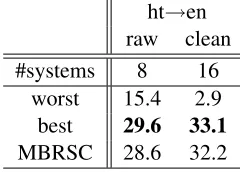
Regarding the ht→en featured translation task, MBRSC is not able to improve the results of the best individual system in any case. As in the en→cz and en→fr translation directions, one of the systems (bm-i2r) perform much much better than all other systems. We can notice the surprisingly low score of one of the systems (umd-hu) in the clean task. The translations of this system are all equal (“N / A”) so we suppose that some error occurred during the translation or submission processes.
ht→en raw clean
#systems 8 16
worst 15.4 2.9 best 29.6 33.1
[image:4.612.365.485.418.504.2]MBRSC 28.6 32.2
Table 2: BLEU scores (case-sensitive) on the featured translation task development corpora of the best and worst single systems and MBRSC. Best translation re-sults are in bold.
5 summary
an approximation to the BLEU score that allows to efficiently apply MBR in these conditions. In most of the translation directions we were able to obtain BLEU gains over the best individual systems.
Acknowledgements
This paper is based upon work supported by the EC (FEDER/FSE) and the Spanish MEC/MICINN un-der the MIPRCV “Consoliun-der Ingenio 2010” pro-gram (CSD2007-00018), the iTrans2 (TIN2009-14511) project and the UPV under grant 20091027. Also supported by the Spanish MITyC under the erudito.com (TSI-020110-2009-439) project and by the Generalitat Valenciana under grant Prome-teo/2009/014.
References
John DeNero, Shankar Kumar, Ciprian Chelba, and Franz Och. 2010. Model combination for machine trans-lation. InHuman Language Technologies: The 2010 Annual Conference of the North American Chapter of the Association for Computational Linguistics, pages 975–983, Morristown, NJ, USA. Association for Com-putational Linguistics.
Nan Duan, Mu Li, Dongdong Zhang, and Ming Zhou. 2010. Mixture model-based minimum bayes risk de-coding using multiple machine translation systems. In
Proceedings of the 23rd International Conference on Computational Linguistics (Coling 2010), pages 313– 321, Beijing, China, August. Coling 2010 Organizing Committee.
Vaibhava Goel and William J. Byrne. 2000. Minimum bayes-risk automatic speech recognition. Computer Speech & Language, 14(2):115–135.
Jes´us Gonz´alez-Rubio, Germ´an Sanchis-Trilles, Joan-Andreu S´anchez, Jes´us Andr´es-Ferrer, Guillem Gasc´o, Pascual Mart´ınez-G´omez, Martha-Alicia Rocha, and Francisco Casacuberta. 2010. The upv-prhlt combi-nation system for wmt 2010. In Proceedings of the Joint Fifth Workshop on Statistical Machine Trans-lation and MetricsMATR, pages 296–300, Uppsala, Sweden, July. Association for Computational Linguis-tics.
Jess Gonzlez-Rubio, Alfons Juan, and Francisco Casacu-berta. 2011. Minimum bayes-risk system combina-tion. In Proceedings of the 49th Annual Meeting of the Association for Computational Linguistics: Hu-man Language Technologies, pages 1268–1277, Port-land, Oregon, USA, June. Association for Computa-tional Linguistics.
Shankar Kumar and William J. Byrne. 2004. Minimum bayes-risk decoding for statistical machine translation. InHLT-NAACL, pages 169–176.
Shankar Kumar, Wolfgang Macherey, Chris Dyer, and Franz Och. 2009. Efficient minimum error rate train-ing and minimum bayes-risk decodtrain-ing for translation hypergraphs and lattices. InProceedings of the Joint Conference of the 47th Annual Meeting of the ACL and the 4th International Joint Conference on Natural Lan-guage Processing of the AFNLP: Volume 1 - Volume 1, pages 163–171, Morristown, NJ, USA. Association for Computational Linguistics.
C. D. Mart´ınez, A. Juan, and F. Casacuberta. 2000. Use of Median String for Classification. InProceedings of the 15th International Conference on Pattern Recog-nition, volume 2, pages 907–910, Barcelona (Spain), September.
Franz J. Och. 2003. Minimum error rate training in statistical machine translation. InProceedings of the 41st Annual Meeting on Association for Computa-tional Linguistics - Volume 1, pages 160–167, Morris-town, NJ, USA. Association for Computational Lin-guistics.
Kishore Papineni, Salim Roukos, Todd Ward, and Wei-Jing Zhu. 2002. BLEU: a method for automatic evaluation of machine translation. InProceedings of the 40th Annual Meeting on Association for Compu-tational Linguistics, pages 311–318, Morristown, NJ, USA. Association for Computational Linguistics. Antti-Veikko Rosti, Necip Fazil Ayan, Bing Xiang,
Spy-ros Matsoukas, Richard Schwartz, and Bonnie Dorr. 2007. Combining outputs from multiple machine translation systems. In Human Language Technolo-gies 2007: The Conference of the North American Chapter of the Association for Computational Lin-guistics; Proceedings of the Main Conference, pages 228–235, Rochester, New York, April. Association for Computational Linguistics.