Edinburgh’s Syntax-Based Machine Translation Systems
Maria Nadejde, Philip Williams, and Philipp KoehnSchool of Informatics, University of Edinburgh, Scotland, United Kingdom
[email protected], [email protected], [email protected]
Abstract
We present the syntax-based string-to-tree statistical machine translation systems built for the WMT 2013 shared transla-tion task. Systems were developed for four language pairs. We report on adapting parameters, targeted reduction of the tun-ing set, and post-evaluation experiments on rule binarization and preventing drop-ping of verbs.
1 Overview
Syntax-based machine translation models hold the promise to overcome some of the fundamen-tal problems of the currently dominating phrase-based approach, most importantly handling re-ordering for syntactically divergent language pairs and grammatical coherence of the output.
We are especially interested in string-to-tree models that focus syntactic annotation on the tar-get side, especially for morphologically rich tartar-get languages (Williams and Koehn, 2011).
We have trained syntax-based systems for the language pairs
• English-German,
• German-English, • Czech-English, and
• Russian-English.
We have also tried building systems for French-English and Spanish-French-English but the data size proved to be problematic given the time con-straints. We give a brief description of the syntax-based model and its implementation within the Moses system. Some of the available features are described as well as some of the pre-processing steps. Several experiments are described and final results are presented for each language pair.
2 System Description
The syntax-based system used in all experiments is the Moses string-to-tree toolkit implementing GHKM rule extraction and Scope-3 parsing previ-ously described in by Williams and Koehn (2012)
2.1 Grammar
Our translation grammar is a synchronous context-free grammar (SCFG) with phrase-structure labels on the target side and the generic non-terminal la-belX on the source side. In this paper, we write these rules in the form
LHS→ RHSs|RHSt
whereLHS is a target-side non-terminal label and RHSs and RHSt are strings of terminals and
non-terminals for the source and target sides, respec-tively. We use subscripted indices to indicate the correspondences between source and target non-terminals.
For example, a translation rule to translate the GermanHausinto the Englishhouseis
NN→Haus|house
If our grammar also contains the translation rule
S→das ist ein X1 |this is aNN1
then we can apply the two rules to an inputdas ist ein Hausto produce the outputthis is a house.
2.2 Rule Extraction
The GHKM rule extractor (Galley et al., 2004, 2006) learns translation rules from a word-aligned parallel corpora for which the target sentences are syntactically annotated. Given a string-tree pair, the set of minimally-sized translation rules is ex-tracted that can explain the example and is consis-tent with the alignment. The resulting rules can be composed in a non-overlapping fashion in order to cover the string-tree pair.
Two or more minimal rules that are in a parent-child relationship can be composed together to ob-tain larger rules with more syntactic context. To avoid generating an exponential number of com-posed rules, several limitation have to be imcom-posed. One such limitation is on the size of the com-posed rules, which is defined as the number of non-part-of-speech, non-leaf constituent labels in the target tree (DeNeefe et al., 2007). The corre-sponding parameter in the Moses implementation isMaxRuleSizeand its default value is 3.
Another limitation is on the depth of the rules’ target subtree. The rule depth is computed as the maximum distance from its root node to any of its children, not counting pre-terminal nodes (param-eterMaxRuleDepth, default 3).
The third limitation considered is the number of nodes in the composed rule, not counting target words (parameterMaxNodes, default 15).
These parameters are language-dependent and should be set to values that best represent the char-acteristics of the target trees on which the rule ex-tractor is trained on. Therefore the style of the treebanks used for training the syntactic parsers will also influence these numbers. The default values have been set based on experiments on the English-German language pair (Williams and Koehn, 2012). It is worth noting that the Ger-man parse trees (Skut et al., 1997) tend to be broader and shallower than those for English. In Section 3 we present some experiments where we choose different settings of these parameters for the German-English language pair. We use those settings for all language pairs where the target lan-guage is English.
2.3 Tree Restructuring
The coverage of the extracted grammar depends partly on the structure of the target trees. If the target trees have flat constructions such as long noun phrases with many sibling nodes, the rules extracted will not generalize well to unseen data since there will be many constraints given by the types of different sibling nodes.
In order to improve the grammar coverage to generalize over such cases, the target tree can be restructured. One restructuring strategy is tree binarization. Wang et al. (2010) give an exten-sive overview of different tree binarization strate-gies applied for the Chinese-English language pair. Moses currently supports left binarization
andright binarization.
By left binarization all the left-most children of a parent node n except the right most child are grouped under a new node. This node is in-serted as the left child of n and receives the la-beln.¯ Left binarizationis then applied recursively on all newly inserted nodes until the leaves are reached. Right binarizationimplies a similar pro-cedure but in this case the right-most children of the parent node are grouped together except the left most child.
Another binarization strategy that is not cur-rently integrated in Moses, but is worth investigat-ing for different language pairs, is parallel head binarization.
The result of parallel binarization of a parse tree is a binarization forest. To generate a bina-rization forest node, both right binabina-rization and left binarization are applied recursively to a parent node with more than two children. Parallel head binarizationis a case ofparallel binarizationwith the additional constraint that the head constituent is part of all the new nodes inserted by either left or right binarization steps.
In Section 3 we give example of some initial ex-periments carried out for the German-English lan-guage pair.
2.4 Pruning The Grammar
Decoding for syntax-based model relies on a bottom-up chart parsing algorithm. Therefore de-coding efficiency is influenced by the following combinatorial problem: given an input sentence of lengthnand a context-free grammar rule with
sconsecutive non-terminals, there are n+1
s
ways to choose subspans, orapplication contexts (Hop-kins and Langmead, 2010), that the rule can ap-plied to. The asymptotic running time of chart parsing is linear in this numberO(ns).
Hopkins and Langmead (2010) maintain cubic decoding time by pruning the grammar to remove rules for which the number of potential applica-tion contexts is too large. Their key observaapplica-tion is that a rule can have any number of non-terminals and terminals as long as the number of consecutive non-terminal pairs is bounded. Terminals act to anchor the rule, restricting the number of potential application contexts. An example is the ruleX→
W yY Zzfor which there are at mostO(n2) appli-cation contexts, given that the terminals will have a fixed position and will play the role of anchors in the sentence for the non-terminal spans. The number of consecutive non-terminal pairs plus the number of non-terminals at the edge of a rule is referred to as thescopeof the rule. The scope of a grammar is the maximum scope of any of its rules. Moses implementsscope-3 pruningand therefore the resulting grammar can be parsed in cubic time.
2.5 Feature Functions
count, and various scores for the synchronous derivation. Our grammar rules are scored accord-ing to the followaccord-ing functions:
• p(RHSs|RHSt,LHS), the noisy-channel
translation probability.
• p(LHS,RHSt|RHSs), the direct translation
probability.
• plex(RHSt|RHSs) and plex(RHSs|RHSt),
the direct and indirect lexical weights (Koehn et al., 2003).
• ppcfg(FRAGt), the monolingual PCFG
prob-ability of the tree fragment from which the rule was extracted. This is defined as Qn
i=1p(ri), where r1. . . rn are the con-stituent CFG rules of the fragment. The PCFG parameters are estimated from the parse of the target-side training data. All lex-ical CFG rules are given the probability 1. This is similar to the pcfg feature proposed by Marcu et al. (2006) and is intended to en-courage the production of syntactically well-formed derivations.
• exp(−1/count(r)), a rule rareness penalty.
• exp(1), a rule penalty. The main grammar and glue grammars have distinct penalty fea-tures.
3 Experiments
This section describes details for the syntax-based systems submitted by the University of Edinburgh. Additional post-evaluation experiments were car-ried out for the German-English language pair.
3.1 Data
We made use of all available data for each lan-guage pair except for the Russian-English where the Commoncrawlcorpus was not used. Table 1 shows the size of the parallel corpus used for each language pair. The English side of the paral-lel corpus was parsed using the Berkeley parser (Petrov et al., 2006) and the German side of the parallel corpus was parsed using the BitPar parser (Schmid, 2004). For German-English, German compounds were split using the script provided with Moses. The parallel corpus was word-aligned using MGIZA++ (Gao and Vogel, 2008).
All available monolingual data was used for training the language models for each language
Lang. pair Sentences Grammar Size
en-de 4,411,792 31,568,480
de-en 4,434,060 55,310,162
cs-en 14,425,564 209,841,388
[image:3.595.320.516.62.132.2]ru-en 1,140,359 7,946,502
Table 1: Corpus statistics for parallel data.
pair. 5-gram language models were trained us-ing SRILM toolkit (Stolcke, 2002) with modi-fied Kneser-Ney smoothing (Chen and Goodman, 1998) and then interpolated using weights tuned on the newstest2011 development set.
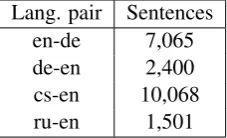
The feature weights for each system were tuned on development sets using the Moses implementa-tion of minimum error rate training (Och, 2003). The size of the tuning data varied for different lan-guages depending on the amount of available data. In the case of the the German-English pair a filter-ing criteria based on sentence level BLEU score was applied which is briefly described in Section 3.5. Table 2 shows the size of the tuning set for each language pair.
Lang. pair Sentences
en-de 7,065
de-en 2,400
cs-en 10,068
ru-en 1,501
Table 2: Corpus statistics for tuning data.
3.2 Pre-processing
Some attention was given to pre-processing of the English side of the corpus prior to parsing. This was done to avoid propagating parser errors to the rule-extraction step. These particular errors arise from a mismatch in punctuation and tokenization between the corpus used to train the parser, the PennTree bank, and the corpus which is being parsed and passed on to the rule extractor. There-fore we changed the quotation marks, which ap-pear quite often in the parallel corpora, to opening and closing quotation marks. We also added some PennTree bank style tokenization rules1. These
rules split contractions such as I’ll, It’s, Don’t,
Gonna,Commissioner’sin order to correctly sep-arate the verbs, negation and possessives that are
[image:3.595.360.474.379.448.2]Grammar Size BLEU
Parameters Full Filtered 2009-40 2010-40 2011-40 Average
Depth=3, Nodes=15, Size=3 2,572,222 751,355 18.57 20.43 18.51 19.17
Depth=4, Nodes=20, Size=4 3,188,970 901,710 18.88 20.38 18.63 19.30
Depth=5, Nodes=20, Size=5 3,668,205 980,057 19.04 20.47 18.75 19.42
Depth=5, Nodes=30, Size=5 3,776,961 980,061 18.90 20.59 18.77 19.42
[image:4.595.74.527.61.159.2]Depth=5, Nodes=30, Size=6 4,340,716 1,006,174 18.98 20.52 18.80 19.43
Table 3: CasedBLEUscores for various rule extraction parameter settings for German-English language
pair. The parameters considered areMaxRuleDepth,MaxRuleSize,MaxNodes. Grammar sizes are given for the full extracted grammar and after filtering for the newstest2008 dev set.
newstest2012 newstest2013
System Sentences BLEU Glue Rule Tree Depth BLEU Glue Rule Tree Depth
Baseline 5,771 23.21 5.42 4.03 26.27 4.23 3.80
Big tuning set 10,068 23.52 3.41 4.34 26.33 2.49 4.03
Filtered tuning set 2,400 23.54 3.21 4.37 26.30 2.37 4.05
Table 4: CasedBLEUscores for German-English systems tuned on different data. Scores are emphasized
for the system submitted to the shared translation task.
parsed as separate constituents.
For German–English, we carried out the usual compound splitting (Koehn and Knight, 2003), but not pre-reordering (Collins et al., 2005).
3.3 Rule Extraction
Some preliminary experiments were carried out for the German-English language pair to deter-mine the parameters for the rule extraction step:
MaxRuleDepth,MaxRuleSize,MaxNodes. Table 3 shows the BLEU score on different test sets for
various parameter settings. For efficiency rea-sons less training data was used, therefore the grammar sizes, measured as the total number of extracted rules, are smaller than the final sys-tems (Table 1). The parameters on the third line
Depth=5, Nodes=20, Size=4were chosen as the averageBLEUscore did not increase although the
size of the extracted grammar kept growing. Com-paring the rate of growth of the full grammar and the grammar after filtering for the dev set (the columns headed “Full” and “Filtered”) suggests that beyond this point not many more usable rules are extracted, even while the total number of rules stills increases.
3.4 Decoder Settings
We used the following non-default decoder param-eters:
max-chart-span=25: This limits sub deriva-tions to a maximum span of 25 source words. Glue rules are used to combine sub derivations allowing the full sentence to be covered.
ttable-limit=200: Moses prunes the translation grammar on loading, removing low scoring rules. This option increases the number of translation rules that are retained for any given source side
RHSs.
cube-pruning-pop-limit=1000: Number of hy-potheses created for each chart span.
3.5 Tuning sets
One major limitation for the syntax-based systems is that decoding becomes inefficient for long sen-tences. Therefore using large tuning sets will slow down considerably the development cycle. We carried out some preliminary experiments to de-termine how the size of the tuning set affects the quality and speed of the system.
[image:4.595.74.538.224.294.2]se-lected examples with high sentence-BLEUscore in
a way that penalizes excessively short examples2.
Results of these experiments are shown in Table 4. Results show that there is some gain in BLEU
score when providing longer sentences during tun-ing. Further experiments should consider tuning the baseline with the newstest2008-2011 data, to eliminate variance caused by having different data sources. Although the size of the third tuning set is much smaller than that of the other tuning sets, the
BLEU score remains the same as when using the
largest tuning set. The glue rule number, which shows how many times the glue rule was applied, is lowest when tuning with the third data set. The
tree depth number, which shows the depth of the resulting target parse tree, is higher for the third tuning set as compared to the baseline and similar to that resulted from using the largest tuning set. These numbers are all indicators of better utilisa-tion of the syntactic structure.
Regarding efficiency, the baseline tuning set and the filtered tuning set took about a third of the time needed to decode the larger tuning set.
Therefore we could draw some initial conclu-sions that providing longer sentences is useful, but sentences for which some baseline system per-forms very poorly in terms of BLEUscore can be
eliminated from the tuning set.
3.6 Results
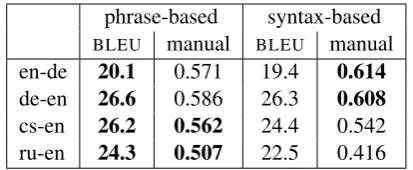
Table 5 summarizes the results for the systems submitted to the shared task. TheBLEUscores for
the phrase-based system submitted by the Univer-sity of Edinburgh are also shown for comparison. The syntax-based system hadBLEUscores similar
to those of the phrase-based system for German-English and German-English-German language pairs. For the Czech-English and Russian-English language pairs the syntax-based system was 2 BLEUpoints
behind the phrase-based system.
However, in the manual evaluation, the German–English and English–German syntax based systems were ranked higher than the phrase-based systems. For Czech–English, the syntax systems also came much closer than the BLEU
score would have indicated.
The Russian-English system performed worse because we used much less of the available data for training (leaving outCommoncrawl) and
there-2Ongoing work by Eva Hasler. Filtered data set was pro-vided in order to speed up experiment cycles.
phrase-based syntax-based
BLEU manual BLEU manual
en-de 20.1 0.571 19.4 0.614
de-en 26.6 0.586 26.3 0.608
cs-en 26.2 0.562 24.4 0.542
[image:5.595.313.520.61.146.2]ru-en 24.3 0.507 22.5 0.416
Table 5: Cased BLEU scores and manual
evalua-tion scores (”expected wins”) on the newstest2013 evaluation set for the phrase-based and syntax-based systems submitted by the University of Ed-inburgh.
fore the extracted grammar is less reliable. An-other reason was the mismatch in data format-ting for the Russian-English parallel corpus. All the training data was lowercased which resulted in more parsing errors.
3.7 Post-Submission Experiments
Table 6 shows results for some preliminary ex-periments carried out for the German-English lan-guage pair that were not included in the final sub-mission. The baseline system is trained on all available parallel data and tuned on data from newstest2008-2010 filtered for sentences up to 30 words.
Tree restructuring — In one experiment the parse trees were restructured before training by
left binarization. Tree restructuring is need to im-prove generalization power of rules extracted from flat structures such as base noun phrases with sev-eral children. The second raw in Table 6 shows that the BLEU score did not improve and more
glue rules were applied when usingleft binariza-tion. One reason for this result is that the rule ex-traction parametersMaxRuleDepth,MaxRuleSize,
MaxNodeshad the same values as in the baseline. Increasing this parameters should improve the ex-tracted grammar since binarizing the trees will in-crease these three dimensions.
lan-newstest2012 newstest2013
System Grammar size BLEU glue rule tree depth BLEU glue rule tree depth
Baseline 55,310,162 23.21 5.42 4.03 26.27 4.23 3.80
Left binarized 57,151,032 23.17 7.79 4.09 26.13 6.57 3.85
[image:6.595.79.520.61.134.2]Realigned vb 53,894,112 23.26 4.88 4.19 26.26 3.73 3.96
Table 6: CasedBLEUscores for various German-English systems.
System Vb droprules Vb Countnt2012 Vb Countnt2013 Baseline 1,038,597 9,216 8,418 Realigned
verbs 391,231 9,471 8,614 Reference
translation - 9,992 9,207
Table 7: Statistics about verb dropping.
guage model scores and BLEU scores. However
the syntax models handle the reordering of verbs better than phrase-based models.
In an experiment we investigated how the num-ber of verbs dropped by the translation rules can be reduced. In order to reduce the number of verb dropping rules we looked at unaligned verbs and realigned them before rule extraction. An un-aligned verb in the source sentence was un-aligned to the verb in the target sentence for which IBM model 1 predicted the highest translation probabil-ity. The third row in Table 6 shows the results of this experiment. While there is no change inBLEU
score the number of glue rules applied is lower. Further analysis shows in Table 7 that the number of verb dropping rules in the grammar is almost three times lower and that there are more trans-lated verbs in the output when realigning verbs.
4 Conclusion
We describe in detail the syntax-based machine translation systems that we developed for four Eu-ropean language pairs. We achieved competitive results, especially for the language pairs involving German.
Acknowledgments
The research leading to these results has re-ceived funding from the European Union Sev-enth Framework Programme (FP7/2007-2013) un-der grant agreement 287658 (EU BRIDGE) and grant agreement 288487 (MosesCore).
References
Chen, S. F. and Goodman, J. (1998). An empiri-cal study of smoothing techniques for language modeling. Technical report, Harvard University. Collins, M., Koehn, P., and Kucerova, I. (2005). Clause restructuring for statistical machine translation. InProceedings of the 43rd Annual Meeting of the Association for Computational Linguistics (ACL’05), pages 531–540, Ann Ar-bor, Michigan. Association for Computational Linguistics.
DeNeefe, S., Knight, K., Wang, W., and Marcu, D. (2007). What can syntax-based MT learn from phrase-based MT? InProceedings of the 2007 Joint Conference on Empirical Methods in Natural Language Processing and Compu-tational Natural Language Learning (EMNLP-CoNLL 2007). June 28-30, 2007. Prague, Czech Republic.
Galley, M., Graehl, J., Knight, K., Marcu, D., De-Neefe, S., Wang, W., and Thayer, I. (2006). Scalable inference and training of context-rich syntactic translation models. In ACL-44: Pro-ceedings of the 21st International Conference on Computational Linguistics and the 44th an-nual meeting of the Association for Computa-tional Linguistics, pages 961–968, Morristown, NJ, USA. Association for Computational Lin-guistics.
Galley, M., Hopkins, M., Knight, K., and Marcu, D. (2004). What’s in a translation rule? In HLT-NAACL ’04.
Gao, Q. and Vogel, S. (2008). Parallel implemen-tations of word alignment tool. InSoftware En-gineering, Testing, and Quality Assurance for Natural Language Processing, SETQA-NLP ’08, pages 49–57, Stroudsburg, PA, USA. As-sociation for Computational Linguistics. Hopkins, M. and Langmead, G. (2010). SCFG
[image:6.595.72.297.177.254.2]in Natural Language Processing, pages 646– 655, Cambridge, MA. Association for Compu-tational Linguistics.
Koehn, P. and Knight, K. (2003). Empirical meth-ods for compound splitting. InProceedings of Meeting of the European Chapter of the Associ-ation of ComputAssoci-ational Linguistics (EACL). Koehn, P., Och, F. J., and Marcu, D. (2003).
Sta-tistical phrase-based translation. In NAACL ’03: Proceedings of the 2003 Conference of the North American Chapter of the Association for Computational Linguistics on Human Lan-guage Technology, pages 48–54, Morristown, NJ, USA. Association for Computational Lin-guistics.
Marcu, D., Wang, W., Echihabi, A., and Knight, K. (2006). SPMT: statistical machine transla-tion with syntactified target language phrases. InEMNLP ’06: Proceedings of the 2006 Con-ference on Empirical Methods in Natural Lan-guage Processing, pages 44–52, Morristown, NJ, USA. Association for Computational Lin-guistics.
Och, F. J. (2003). Minimum error rate training in statistical machine translation. In Proceed-ings of the 41st Annual Meeting on Association for Computational Linguistics - Volume 1, ACL ’03, pages 160–167, Morristown, NJ, USA. As-sociation for Computational Linguistics. Petrov, S., Barrett, L., Thibaux, R., and Klein, D.
(2006). Learning accurate, compact, and in-terpretable tree annotation. In Proceedings of the 21st International Conference on Computa-tional Linguistics and the 44th annual meeting of the Association for Computational Linguis-tics, ACL-44, pages 433–440, Stroudsburg, PA, USA. Association for Computational Linguis-tics.
Schmid, H. (2004). Efficient parsing of highly am-biguous context-free grammars with bit vectors. In Proceedings of the 20th international con-ference on Computational Linguistics, COL-ING ’04, Stroudsburg, PA, USA. Association for Computational Linguistics.
Skut, W., Krenn, B., Brants, T., and Uszkoreit, H. (1997). An annotation scheme for free word or-der languages. InProceedings of the Fifth Con-ference on Applied Natural Language Process-ing (ANLP-97).
Stolcke, A. (2002). SRILM - an extensible lan-guage modeling toolkit. In Intl. Conf. Spo-ken Language Processing, Denver, Colorado, September 2002.
Wang, W., May, J., Knight, K., and Marcu, D. (2010). Re-structuring, labeling, and re-aligning for syntax-based machine translation.
Comput. Linguist., 36(2):247–277.
Williams, P. and Koehn, P. (2011). Agreement constraints for statistical machine translation into german. InProceedings of the Sixth Work-shop on Statistical Machine Translation, pages 217–226, Edinburgh, Scotland. Association for Computational Linguistics.
Williams, P. and Koehn, P. (2012). Ghkm rule extraction and scope-3 parsing in moses. In