Normalized Compression Distance Based Measures for
MetricsMATR 2010
Marcus Dobrinkat and Jaakko V¨ayrynen and Tero Tapiovaara Adaptive Informatics Research Centre
Aalto University School of Science and Technology P.O. Box 15400, FI-00076 Aalto, Finland
{marcus.dobrinkat,jaakko.j.vayrynen,tero.tapiovaara}@tkk.fi
Kimmo Kettunen
Kymenlaakso University of Applied Sciences P.O. Box 9, FI-48401 Kotka, Finland
Abstract
We present the MT-NCD and MT-mNCD machine translation evaluation metrics as submission to the machine transla-tion evaluatransla-tion shared task (MetricsMATR 2010). The metrics are based on nor-malized compression distance (NCD), a general information theoretic measure of string similarity, and evaluated against hu-man judgments from the WMT08 shared task. The experiments show that 1) our metric improves correlation to hu-man judgments by using flexible match-ing, 2) segment replication is effective, and 3) our NCD-inspired method for mul-tiple references indicates improved results. Generally, the proposed MT-NCD and MT-mNCD methods correlate competi-tively with human judgments compared to commonly used machine translations eval-uation metrics, for instance, BLEU.
1 Introduction
The quality of automatic machine translation (MT) evaluation metrics plays an important role in the development of MT systems. Human eval-uation would no longer be necessary if automatic MT metrics correlated perfectly with manual ments. Besides high correlation with human judg-ments of translation quality, a good metric should be language independent, fast to compute and sen-sitive enough to reliably detect small improve-ments in MT systems.
Recently there have been some experiments with normalized compression distance (NCD) as a method for automatic evaluation of machine trans-lation. NCD is a general string similarity measure
that has been useful for clustering in various tasks (Cilibrasi and Vitanyi, 2005).
Parker (2008) introduced BADGER, a machine translation evaluation metric that uses NCD to-gether with a language independent word normal-ization method. Kettunen (2009) independently applied NCD to the direct evaluation of transla-tions. He showed with a small corpus of three lan-guage pairs that the scores of NCD and METEOR (v0.6) from translations of 10–12 MT systems were highly correlated.
V¨ayrynen et al. (2010) have extended the work by showing that NCD can be used to rank transla-tions of different MT systems so that the ranking order correlates with human rankings at the same level as BLEU (Papineni et al., 2001). For trans-lations into English, NCD had an overall system-level correlation of0.66whereas the best method, ULC had an overall correlation of0.76, and BLEU had an overall correlation of0.65. NCD presents a viable alternative to the de facto standard BLEU. Both metrics are language independent, simple and efficient to compute. However, NCD is a general measure of similarity that has been ap-plied in many domains. More advanced meth-ods achieve better correlation with human judg-ments, but typically use additional language spe-cific linguistic resources. Dobrinkat et al. (2010) experimented with relaxed word matching, adding language specific resources to NCD. The metric called mNCD, which works similarly to mBLEU (Agarwal and Lavie, 2008), showed improved cor-relation to human judgments in English, the only language where a METEOR synonym module was used.
The motivation for this challenge submission is to evaluate the MT-NCD and MT-mNCD metric performance in an open competition with
the-art MT evaluation metrics. Our experiments and submission build on NCD and mNCD. We ex-pand NCD to handle multiple references and re-port experimental results for replicating segments as a preprocessing step that improves the NCD as an MT evaluation metric.
2 NCD-based MT evaluation metrics
NCD-based MT evaluation metrics build on the idea that a string xis similar to another string y, when both share common substrings. When de-scribingy, common substrings do not have to be repeated, but can be referenced tox. This is done when compressing the concatenation of xand y, which results in smaller output when more infor-mation ofyis already included inx.
2.1 Normalized Compression Distance
The normalized compression distance, as defined by Cilibrasi and Vitanyi (2005) is given in Equa-tion 1, in whichC(x)is the length of the compres-sion ofxandC(x, y)is the length of the compres-sion of the concatenation ofxandy.
NCD(x, y) = C(x, y)−min{C(x), C(y)}
max{C(x), C(y)} (1)
NCD computes the distance as a score closer to one for very different strings and closer to zero for more similar strings. Most MT evaluation met-rics are defined as similarity measures in contrast to NCD, which is a distance measure. For eas-ier comparison with other MT evaluation metrics, we define the NCD based MT evaluation similar-ity metric MT-NCD as1−NCD.
NCD is a practically usable form of the uncom-putable normalized information distance (NID), a general metric for the similarity of two objects. NID is based on the notion of Kolmogorov com-plexity K(x), a theoretical measure for the algo-rithmic information content of a stringx. It is de-fined as the shortest universal Turing machine that printsxand stops (Solomonoff, 1964). NCD ap-proximates NID by the use of a compressorC(x)
that presents a computable approximation of the Kolmogorov complexityK(x).
2.2 NCD with multiple references
Most ideas can be described with in different ways, therefore using only one reference transla-tion for the evaluatransla-tion of a candidate sentence is
not ideal and the exploitation of knowledge in sev-eral different reference translations is helpful for automatic MT evaluation.
One simple way for handling multiple refer-ences is to evaluate against each reference indi-vidually and select the maximum score. Although this works, it is clearly not optimal. We developed the NCDm metric, which is inspired by NCD. It
considers all references simultaneously and the quality of a translation t against multiple refer-encesR={r1, . . . , rm}is assessed as
NCDm(t, R) =
max{C(t|R),min
r∈RC(r|t}
max{C(t),min
r∈RC(r)}
(2)
where C(x|y) = C(x, y) −C(y) approximates conditional algorithmic information with the com-pressor C. The NCDm similarity metric with a
single reference (m= 1) is equal to NCD in Equa-tion 1. Again, we define MT-NCDmas1−NCDm.
Figure 1 shows how both, the MT-NCDm and
the BLEU metric change with a different num-ber of references when the translation is varied from correct to a random sequence of words. The scores are computed with 249 sentences from the LDC2010E28Dev data set using the first reference as the correct translation. A higher score with mul-tiple references against the correct translation indi-cates that the measure is able to take into account information from multiple references at the same time.
The words in the candidate translation are re-placed with probability p with a word randomly selected with uniform probability from a lexicon created from all reference translations. This simu-lates partially correct translations. The words are changed in a simple way without deletions, inser-tions or word order permutainser-tions. The MT-NCDm
score increases with more than one reference translation and random changes to the sentence re-duce the score roughly proportional to the number of changed words. With BLEU, the score is af-fected more by a small number of changes.
2.3 mNCD
One enhancement to the basic NCD as auto-matic evaluation metric is mNCD (Dobrinkat et al., 2010), which provides relaxed word matching based on the flexible matching modules of ME-TEOR (Agarwal and Lavie, 2008).
candi-0.0 0.2 0.4 0.6 0.8 1.0
0.0
0.1
0.2
0.3
0.4
0.5
0.6
word change probability (p)
MT e
v
aluation metr
ic score
MT−NCDm with 3 references
MT−NCDm with 2 references
MT−NCDm with 1 reference
BLEU with 3 references BLEU with 2 references BLEU with 1 reference
MT−NCDm
[image:3.595.73.287.60.354.2]BLEU
Figure 1: The MT-NCDm and BLEU scores with
a different number of multiple references against correct translation with random word change probability (p).
date, given that some of the words are synonyms or share the same stem. Subsequent analysis using any n-gram based automatic analysis should result in a larger similarity score in the hope that this re-flects more than just the surface similarity between the candidate and the reference.
Given suitable Wordnet resources, mNCD should alleviate the problem of translation vari-ability especially in absence of multiple refer-ence translations. Our submission uses the de-fault METEOR exact stem synonym mod-ules, which provide synonyms only for English. We base our submission metric on the MT-NCD metric and therefore define MT-mNCD as 1 − mNCD.
3 MT Evaluation System Description
3.1 System Parameters
The system parameters for the submission metrics include how candidates and references are prepro-cessed, the choice of compressor for the NCD it-self, as well as the granularity of how large seg-ments are evaluated by NCD and how they are
combined into a final score.
Partly due to time constraints we decided not to introduce language specific parameters, therefore we chose those parameter values that perform well in overall and are simple to compute.
3.1.1 Preprocessing
Character casing For MT-NCD, we did ex-periments without preprocessing and with lower-casing candidates and references. On average over all tasks for language pairs into English, lower-casing consistently decreased the RANK correla-tion scores but increased the CONST correlation scores. No consistent effect could be found for the language pairs from English. In our submission metrics we use no preprocessing.
For MT-mNCD the used METEOR matching module lower-cases the adapted words by default. After adapting a synonym in a reference, we tried to keep the casing as it was in the candidate, which we called real-casing. We use no real-casing for our submitted MT-mNCD metric as this did not improve results consistently over all task into En-glish.
Segment Replication Compression algorithms may not work optimally with short strings, which would deteriorate the approximation of Kol-mogorov complexity. Our hypothesis was that a replication of a string (”abc”) multiple times
(3×”abc” = ”abcabcabc”) could help the
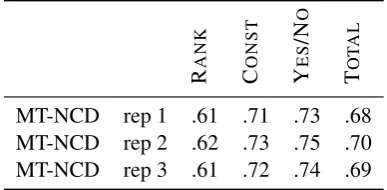
com-pression algorithm to produce a better estimate of the algorithmic information. This was tested in the MT evaluation framework, and correlation be-tween MT-NCD and human judgments improved when the segments were replicated two times. Further replication did not produce improvements. Results for the MT-NCD metric with replica-tions one, two and three times are shown in Ta-ble 1. The results are averages over all used lan-guages. With two compared to one replication, the details for each language show that RANK corre-lation is improved for the target languages English and French, but degrades for German and Spanish. CONST andYES/NO correlation improve for all languages except German. We did not use repli-cation in our submissions.
3.1.2 Block size
R
A
N
K
C
O
N
S
T
Y
E
S
/N
O
T
O
T
A
L
[image:4.595.84.278.63.158.2]MT-NCD rep 1 .61 .71 .73 .68 MT-NCD rep 2 .62 .73 .75 .70 MT-NCD rep 3 .61 .72 .74 .69
Table 1: Effect of the replication factor on MT-NCD correlation scores for the bz2 compres-sor with block size one as average over all lan-guages.
each segment is evaluated separately and the seg-ment scores are aggregated to a docuseg-ment score. This is similar to how other MT metrics, for ex-ample, BLEU, work. The other extreme is to join all segments together, with block size equal to the number of segments, and evaluate it as a single string, which is similar to document comparison. For block aggregation we experimented with arith-metic and geometric mean and obtained very sim-ilar results. We selected arithmetic mean for the submission metrics.
Figure 2 shows the block size effect on the cor-relation between MT-NCD and human judgments for different target languages. Except for Spanish, our experiments indicate that the block size value has little effect. Therefore, and given how other evaluation metrics work, we chose a block size of one for our submission metrics. We noticed incon-sistencies with Spanish in other settings as well and will investigate these issues further.
3.1.3 Compressor
There are several universal compressors that can be utilized with NCD, for instance, zlib/gzip, bz2 and PPMZ, which represent different approaches to compression. In terms of compression rate, PPMZ is the best of the mentioned methods, but it is considerably slower to compute compared to the other methods. In terms of correlation with hu-man judgments, NCD using bz2 performs slightly worse than using PPMZ. Given much shorter com-pression times for bz2 with very little correlation performance degradation, our choice for the sub-mission is the more standard bz2 compressor.
3.1.4 Segment Interleaving
Computation of NCD between longer texts (e.g. documents) may exceed the internal compressor window size that is present in some compression
2 5 10 20 50 100 500 2000 5000
0.0
0.2
0.4
0.6
0.8
1.0
block size in lines
system le
v
el
correlation with human judgements
into fr into en into es into de
fr
en
es de
Figure 2: Effect of the block size on the correlation of MT-NCD to human judgments for the system level evaluation.
algorithms (Cebrian et al., 2005). In this case, only a part of the texts to be compared are visible at any time to the compressor and similarities to the text outside the window will be missed. One solution for the MT evaluation task is to use uti-lize the known parallel segments of candidate and reference translations. The two segment lists can be interleaved so that the corresponding segments are always adjacent and the compression window size is not exceeded for matching segments.
For our submission, we chose a block size of one, therefore every segment is evaluated individ-ually. As a result, segment interleaving does not have any effect. Segment interleaving is affective in the block size evaluation and results shown in Figure 2.
3.2 Evaluation Experiments
[image:4.595.308.525.85.271.2]reference sentences (segments) plus their aligned translations for 12 to 17 different translation sys-tems, depending on the language pair.
The human judgments include three categories which contain evaluations for at most one segment at a time, not whole documents. In the RANK category, humans had to rank the output of five MT systems according to quality. The CONST category contains rankings for short phrases (con-stituents), and the YES/NO category contains bi-nary answers to judge if a short phrase is an ac-ceptable translation or not.
We report RANK, CONSTand YES/NO system level correlations to human judgments as results of our metrics for French, Spanish and German both from and to English. The English–Spanish news task was left out as most metrics had negative cor-relation with human judgments.
The evaluation methodology used in Callison-Burch et al. (2008) allows us to measure how each MT evaluation metric correlates with human judg-ments on the system level, in which all translations from each MT system are aggregated into a single score. The system rankings based on the scores are compared to human judgments.
Spearman’s rank correlation coefficient ρ was calculated between each MT metric and human judgment category using the simplified equation:
ρ= 1− 6
P
idi
n(n2−1) (3)
where for each systemi, di is the difference
be-tween the rank derived from annotators’ input and the rank obtained from the metric. From the anno-tators’ input, thenMT systems were ranked based on the number of times each system’s output was selected as the best translation divided by the num-ber of times each system was part of a judgment.
3.3 Results
The results for WMT08 data for our submitted metrics are shown in Table 2 and are sorted by the RANKcategory separately for language pairs from English and into English.
For tasks into English, the correlations show that MT-mNCD improves over the MT-NCD met-ric in all categories. Also the flexible match-ing seems to work better for NCD-based metrics than for BLEU, where mBLEU only improves the CONST correlation scores. For tasks from English, MT-mNCD shows slightly higher cor-relation compared to MT-NCD, except for the
YES/NO category. The standard BLEU correla-tion score is best of the shown evaluacorrela-tion met-rics. Relaxed matching using mBLEU does not improve BLEU’s RANK correlation scores here either, but CONST and YES/NO correlation per-forms better relative to BLEU than MT-mNCD compared to MT-NCD.
R
A
N
K
C
O
N
S
T
Y
E
S
/N
O
T
O
T
A
L
IN
T
O
E
N MT-mNCD .61 .74 .75 .70 MT-NCD .57 .69 .71 .66 mBLEU .50 .76 .70 .65 BLEU .50 .72 .74 .65
F
R
O
M
E
N BLEU .68 .79 .79 .75
[image:5.595.321.508.169.340.2]MT-mNCD .67 .76 .74 .72 MT-NCD .65 .73 .75 .71 mBLEU .63 .81 .81 .75
Table 2: Average system-level correlations for the WMT08 data sorted by RANK into English and from English for our submitted metrics MT-NCD and MT-mNCD and for BLEU and mBLEU
4 Conclusions
In our submissions, we applied MT-NCD and MT-mNCD metrics and extended the NCD MT evaluation metric to handle multiple references. The reported experiment indicate a possible im-provement for the multiple references.
We showed that a replication of segments as a preprocessing step improves the correlation to hu-man judgments. The string replication might alle-viate problems in the compressor for short strings and thus could provide better estimates of the al-gorithmic information.
References
Abhaya Agarwal and Alon Lavie. 2008. METEOR, M-BLEU and M-TER: evaluation metrics for high-correlation with human rankings of machine trans-lation output. In StatMT ’08: Proceedings of the Third Workshop on Statistical Machine Translation, pages 115–118, Morristown, NJ, USA. Association for Computational Linguistics.
Chris Callison-Burch, Cameron Fordyce, Philipp Koehn, Christof Monz, and Josh Schroeder. 2008. Further meta-evaluation of machine translation. In
StatMT ’08: Proceedings of the Third Workshop on Statistical Machine Translation, pages 70–106, Morristown, NJ, USA. Association for Computa-tional Linguistics.
Manuel Cebrian, Manuel Alfonseca, and Alfonso Or-tega. 2005. Common pitfalls using the normalized compression distance: What to watch out for in a compressor. Communications in Information and Systems, 5(4):367–384.
Rudi Cilibrasi and Paul Vitanyi. 2005. Clustering by compression. IEEE Transactions on Information Theory, 51:1523–1545.
Marcus Dobrinkat, Tero Tapiovaara, Jaakko J. V¨ayrynen, and Kimmo Kettunen. 2010. Evaluating machine translations using mNCD. InProceedings of the ACL-2010 (to appear), Uppsala, Sweden.
Kimmo Kettunen. 2009. Packing it all up in search for a language independent MT quality measure tool. In
Proceedings of LTC-09, 4th Language and Technol-ogy Conference, pages 280–284, Poznan.
K. Papineni, S. Roukos, T. Ward, and W. Zhu. 2001. BLEU: a method for automatic evaluation of machine translation. Technical Report RC22176 (W0109-022), IBM Research Division, Thomas J. Watson Research Center.
Steven Parker. 2008. BADGER: A new machine trans-lation metric. In Metrics for Machine Translation Challenge 2008, Waikiki, Hawai’i, October. AMTA.
Ray Solomonoff. 1964. Formal theory of inductive inference. Part I. Information and Control, 7(1):1– 22.