Proceedings of the NAACL HLT 2010 Sixth Web as Corpus Workshop, pages 8–16,
Building a Korean Web Corpus for Analyzing Learner Language
Markus Dickinson Indiana University [email protected]
Ross Israel Indiana University [email protected]
Sun-Hee Lee Wellesley College [email protected]
Abstract
Post-positional particles are a significant source of errors for learners of Korean. Fol-lowing methodology that has proven effective in handling English preposition errors, we are beginning the process of building a machine learner for particle error detection in L2 Ko-rean writing. As a first step, however, we must acquire data, and thus we present a method-ology for constructing large-scale corpora of Korean from the Web, exploring the feasibil-ity of building corpora appropriate for a given topic and grammatical construction.
1 Introduction
Applications for assisting second language learners can be extremely useful when they make learners more aware of the non-native characteristics in their writing (Amaral and Meurers, 2006). Certain con-structions, such as English prepositions, are difficult to characterize by grammar rules and thus are well-suited for machine learning approaches (Tetreault and Chodorow, 2008; De Felice and Pulman, 2008). Machine learning techniques are relatively portable to new languages, but new languages bring issues in terms of defining the language learning problem and in terms of acquiring appropriate data for training a machine learner.
We focus in this paper mainly on acquiring data for training a machine learning system. In partic-ular, we are interested in situations where the task is constant—e.g., detecting grammatical errors in particles—but the domain might fluctuate. This is the case when a learner is asked to write an essay on
a prompt (e.g., “What do you hope to do in life?”), and the prompts may vary by student, by semester, by instructor, etc. By isolating a particular domain, we can hope for greater degrees of accuracy; see, for example, the high accuracies for domain-specific grammar correction in Lee and Seneff (2006).
In this situation, we face the challenge of obtain-ing data which is appropriate both for: a) the topic the learners are writing about, and b) the linguistic construction of interest, i.e., containing enough rel-evant instances. In the ideal case, one could build a corpus directly for the types of learner data to analyze. Luckily, using the web as a data source can provide such specialized corpora (Baroni and Bernardini, 2004), in addition to larger, more gen-eral corpora (Sharoff, 2006). A crucial question, though, is how one goes about designing the right web corpus for analyzing learner language (see, e.g., Sharoff, 2006, for other contexts)
The area of difficulty for language learners which we focus on is that of Korean post-positional parti-cles, akin to English prepositions (Lee et al., 2009; Ko et al., 2004). Korean is an important language to develop NLP techniques for (see, e.g., discussion in Dickinson et al., 2008), presenting a variety of features which are less prevalent in many Western languages, such as agglutinative morphology, a rich system of case marking, and relatively free word or-der. Obtaining data is important in the general case, as non-English languages tend to lack resources.
The correct usage of Korean particles relies on knowing lexical, syntactic, semantic, and discourse information (Lee et al., 2005), which makes this challenging for both learners and machines (cf.
glish determiners in Han et al., 2006). The only other approach we know of, a parser-based one, had very low precision (Dickinson and Lee, 2009). A secondary contribution of this work is thus defin-ing the particle error detection problem for a ma-chine learner. It is important that the data represent the relationships between specific lexical items: in the comparable English case, for example, interest
is usually found within:interestin/*with learning.
The basic framework we employ is to train a ma-chine learner on correct Korean data and then apply this system to learner text, to predict correct parti-cle usage, which may differ from the learner’s (cf. Tetreault and Chodorow, 2008). After describing the grammatical properties of particles in section 2, we turn to the general approach for obtaining relevant web data in section 3, reporting basic statistics for our corpora in section 4. We outline the machine learing set-up in section 5 and present initial results in section 6. These results help evaluate the best way to build specialized corpora for learner language.
2 Korean particles
Similar to English prepositions, Korean postposi-tional particles add specific meanings or grammat-ical functions to nominals. However, a particle can-not stand alone in Korean and needs to be attached to the preceding nominal. More importantly, par-ticles indicate a wide range of linguistic functions, specifying grammatical functions, e.g., subject and object; semantic roles; and discourse functions. In (1), for instance, ka marks both the subject (func-tion) and agent (semantic role),eykeythe dative and beneficiary; and so forth.1
(1) Sumi-ka
Sumi-SBJ
John-eykey
John-to
chayk-ul
book-OBJ
ilhke-yo read-polite
‘Sumi reads a book to John.’
Particles can also combine with nominals to form modifiers, adding meanings of time, location, instru-ment, possession, and so forth, as shown in (2). Note in this case that the markerul/lulhas multiple uses.2
1
We use the Yale Romanization scheme for writing Korean. 2
Ul/lul,un/nun, etc. only differ phonologically.
(2) Sumi-ka Sumi-SBJ
John-uy
John-GEN
cip-eyse
house-LOC ku-lul he-OBJ twu
two
sikan-ul
hours-OBJ
kitaly-ess-ta. wait-PAST-END
‘Sumi waited for John for (the whole) two hours in his house.’
There are also particles associated with discourse meanings. For example, in (3) the topic markernun
is used to indicate old information or a discourse-salient entity, while the delimiter to implies that there is someone else Sumi likes. In this paper, we focus on syntactic/semantic particle usage for nom-inals, planning to extend to other cases in the future.
(3) Sumi-nun
Sumi-TOP
John-to
John-also
cohahay. like
‘Sumi likes John also.’
Due to these complex linguistic properties, parti-cles are one of the most difficult topics for Korean language learners. In (4b), for instance, a learner might replace a subject particle (as in (4a)) with an object (Dickinson et al., 2008). Ko et al. (2004) re-port that particle errors were the second most fre-quent error in a study across different levels of Ko-rean learners, and errors persist across levels (see also Lee et al., 2009).
(4) a. Sumi-nun
Sumi-TOP
chayk-i
book-SBJ
philyohay-yo need-polite
‘Sumi needs a book.’
b. *Sumi-nun Sumi-TOP
chayk-ul
book-OBJ
philyohay-yo need-polite
‘Sumi needs a book.’
3 Approach
3.1 Acquiring training data
is a dearth of data. It seems like a large data set is essential for moving forward.
For Korean, there are at least two corpora pub-licly available right now, the Penn Korean Treebank (Han et al., 2002), with hundreds of thousands of words, and the Sejong Corpus (a.k.a., The Korean National Corpus, The National Institute of Korean Language, 2007), with tens of millions of words. While we plan to include the Sejong corpus in fu-ture data, there are several reasons we pursue a dif-ferent tack here. First, not every language has such resources, and we want to work towards a language-independent platform of data acquisition. Secondly, these corpora may not be a good model for the kinds of topics learners write about. For example, news texts are typically written more formally than learner writing. We want to explore ways to quickly build topic-specific corpora, and Web as Corpus (WaC) technology gives us tools to do this.3
3.2 Web as Corpus
To build web corpora, we use BootCat (Baroni and Bernardini, 2004). The process is an iterative algo-rithm to bootstrap corpora, starting with various seed terms. The procedure is as follows:
1. Select initial seeds (terms). 2. Combine seeds randomly. 3. Run Google/Yahoo queries. 4. Retrieve corpus.
5. Extract new seeds via corpus comparison. 6. Repeat steps #2-#5.
For non-ASCII languages, one needs to check the encoding of webpages in order to convert the text into UTF-8 for output, as has been done for, e.g., Japanese (e.g., Erjavec et al., 2008; Baroni and Ueyama, 2004). Using a UTF-8 version of Boot-Cat, we modified the system by using a simple Perl module (Encode::Guess) to look for the EUC-KR encoding of most Korean webpages and switch it to UTF-8. The pages already in UTF-8 do not need to be changed.
3.3 Obtaining data
A crucial first step in constructing a web corpus is the selection of appropriate seed terms for construct-ing the corpus (e.g., Sharoff, 2006; Ueyama, 2006).
3
Tetreault and Chodorow (2009) use the web to derive learner errors; our work, however, tries to obtain correct data.
In our particular case, this begins the question of how one builds a corpus which models native Ko-rean and which provides appropriate data for the task of particle error detection. The data should be genre-appropriate and contain enough instances of the par-ticles learners know and used in ways they are ex-pected to use them (e.g., as temporal modifiers). A large corpus will likely satisfy these criteria, but has the potential to contain distracting information. In Korean, for example, less formal writing often omits particles, thereby biasing a machine learner towards under-guessing particles. Likewise, a topic with dif-ferent typical arguments than the one in question may mislead the machine. We compare the effec-tiveness of corpora built in different ways in training a machine learner.
3.3.1 A general corpus
To construct a general corpus, we identify words likely to be in a learner’s lexicon, using a list of 50 nouns for beginning Korean students for seeds. This includes basic vocabulary entries like the words for
mother, father, cat, dog, student, teacher, etc.
3.3.2 A focused corpus
Since we often know what domain4 learner es-says are written about, we experiment with building a more topic-appropriate corpus. Accordingly, we select a smaller set of 10 seed terms based on the range of topics covered in our test corpus (see sec-tion 6.1), shown in figure 1. As a first trial, we select terms that are, like the aforementioned general cor-pus seeds, level-appropriate for learners of Korean.
han-kwuk ‘Korea’ sa-lam‘person(s)’
han-kwuk-e‘Korean (lg.)’ chin-kwu ‘friend’
kyey-cel ‘season’ ga-jok ‘family’
hayng-pok ‘happiness’ wun-tong ‘exercise’
ye-hayng‘travel’ mo-im‘gathering’
Figure 1: Seed terms for the focused corpus
3.3.3 A second focused corpus
There are several issues with the quality of data we obtain from our focused terms. From an ini-tial observation (see section 4.1), the difficulty stems in part from the simplicity of the seed terms above,
4By
leading to, for example, actual Korean learner data. To avoid some of this noise, we use a second set of seed terms, representing relevant words in the same domains, but of a more advanced nature, i.e., topic-appropriate words that may be outside of a typical learner’s lexicon. Our hypothesis is that this is more likely to lead to native, quality Korean. For each one of the simple words above, we posit two more advanced words, as given in figure 2.
kyo-sa‘teacher’ in-kan‘human’
phyung-ka‘evaluation’ cik-cang‘workplace’
pen-yuk‘translation’ wu-ceng‘friendship’
mwun-hak‘literature’ sin-loy‘trust’
ci-kwu‘earth’ cwu-min‘resident’
swun-hwan‘circulation’ kwan-kye‘relation’
myeng-sang‘meditation’ co-cik‘organization’
phyeng-hwa‘peace’ sik-i-yo-pep‘diet’
tham-hem‘exploration’ yen-mal‘end of a year’
cwun-pi‘preparation’ hayng-sa‘event’
Figure 2: Seed terms for the second focused corpus
3.4 Web corpus parameters
One can create corpora of varying size and general-ity, by varying the parameters given to BootCaT. We examine three parameters here.
Number of seeds The first way to vary the type and size of corpus obtained is by varying the number of seed terms. The exact words given to BootCaT af-fect the domain of the resulting corpus, and utilizintg a larger set of seeds leads to more potential to create a bigger corpus. With 50 seed terms, for example, there are 19,600 possible 3-tuples, while there are only 120 possible 3-tuples for 10 seed terms, limit-ing the relevant pages that can be returned.
For the general (G) corpus, we use: G1) all 50 seed terms, G2) 5 sets of 10 seeds, the result of split-ting the 50 seeds randomly into 5 buckets, and G3) 5 sets of 20 seeds, which expand the 10-seed sets in G2 by randomly selecting 10 other terms from the remaining 40 seeds. This breakdown into 11 sets (1 G1, 5 G2, 5 G3) allows us to examine the effect of using different amounts of general terms and facili-tates easy comparison with the first focused corpus, which has only 10 seed terms.
For the first focused (F1) corpus, we use: F11) the
10 seed terms, and F12) 5 sets of 20 seeds, obtained
by combining F11 with each seed set from G2. This
second group provides an opportunity to examine what happens when augmenting the focused seeds with more general terms; as such, this is a first step towards larger corpora which retain some focus. For the second focused corpus (F2), we simply use the
set of 20 seeds. We have 7 sets here (1 F11, 5 F12, 1
F2), giving us a total of 18 seed term sets at this step.
Tuple length One can also experiment with tuple length in BootCat. The shorter the tuple, the more webpages that can potentially be returned, as short tuples are likely to occur in several pages (e.g., com-pare the number of pages that all ofperson happi-ness seasonoccur in vs. person happiness season exercise travel). On the other hand, longer tuples are more likely truly relevant to the type of data of inter-est, more likely to lead to well-formed language. We experiment with tuples of different lengths, namely 3 and 5. With 2 different tuple lengths and 18 seed sets, we now have 36 sets.
Number of queries We still need to specify how many queries to send to the search engine. The max-imum number is determined by the number of seeds and the tuple size. For 3-word tuples with 10 seed terms, for instance, there are 10 items to choose 3 objects from: 103
= 3!(1010!
−3)!
= 120possibilities.
Using all combinations is feasible for small seed sets, but becomes infeasible for larger seed sets, e.g.,
50 5
= 2
,118,760possibilities. To reduce this, we
opt for the following: for 3-word tuples, we generate 120 queries for all cases and 240 queries for the con-ditions with 20 and 50 seeds. Similarly, for 5-word tuples, we generate the maximum 252 queries with 10 seeds, and both 252 and 504 for the other condi-tions. With the previous 36 sets (12 of which have 10 seed terms), evenly split between 3 and 5-word tuples, we now have 60 total corpora, as in table 1.
# of seeds
tuple # of General F1 F2
len. queries 10 20 50 10 20 20
3 120 5 5 1 1 5 1
240 n/a 5 1 n/a 5 1
5 252 5 5 1 1 5 1
[image:4.612.321.531.604.692.2]504 n/a 5 1 n/a 5 1
Other possibilities There are other ways to in-crease the size of a web corpus using BootCaT. First, one can increase the number of returned pages for a particular query. We set the limit at 20, as anything higher will more likely result in non-relevant data for the focused corpora and/or duplicate documents. Secondly, one can perform iterations of search-ing, extracting new seed terms with every iteration. Again, the concern is that by iterating away from the initial seeds, a corpus could begin to lose focus. We are considering both extensions for the future.
Language check One other constraint we use is to specify the particular language of interest, namely that we want Korean pages. This parameter is set using the language option when collecting URLs. We note that a fair amount of English, Chinese, and Japanese appears in these pages, and we are cur-rently developing our own Korean filter.
4 Corpus statistics
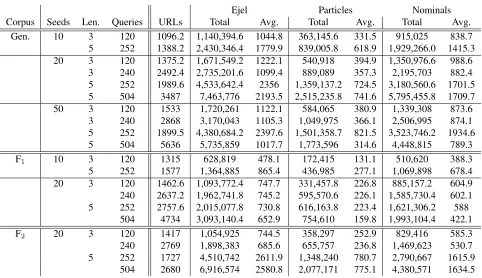
To gauge the properties of size, genre, and degree of particle usage in the corpora, independent of appli-cation, basic statistics of the different web corpora are given in table 2, where we average over multiple corpora for conditions with 5 corpora.5
There are a few points to understand in the table. First, it is hard to count true words in Korean, as compounds are frequent, and particles have a de-batable status. From a theory-neutral perspective, we countejels, which are tokens occurring between white spaces. Secondly, we need to know about the number of particles and number of nominals, i.e., words which could potentially bear particles, as our machine learning paradigm considers any nominal a test case for possible particle attachment. We use a POS tagger (Han and Palmer, 2004) for this.
Some significant trends emerge when comparing the corpora in the table. First of all, longer queries (length 5) result in not only more returned unique webpages, but also longer webpages on average than shorter queries (length 3). This effect is most dra-matic for the F2corpora. The F2corpora also exhibit
a higher ratio of particles to nominals than the other web corpora, which means there will be more
pos-5
For the 252 5-tuple 20 seed General corpora, we average over four corpora, due to POS tagging failure on the fifth corpus.
itive examples in the training data for the machine learner based on the F2corpora.
4.1 Qualitative evaluation
In tandem with the basic statistics, it is also impor-tant to gauge the quality of the Korean data from a more qualitative perspective. Thus, we examined the 120 3-tuple F1 corpus and discovered a number
of problems with the data.
First, there are issues concerning collecting data which is not pure Korean. We find data extracted from Chinese travel sites, where there is a mixture of non-standard foreign words and unnatural-sounding translated words in Korean. Ironically, we also find learner data of Korean in our search for correct Ko-rean data. Secondly, there are topics which, while exhibiting valid forms of Korean, are too far afield from what we expect learners to know, including re-ligious sites with rare expressions; poems, which commonly drop particles; gambling sites; and so forth. Finally, there are cases of ungrammatical uses of Korean, which are used in specific contexts not appropriate for our purposes. These include newspa-per titles, lists of newspa-personal names and addresses, and incomplete phrases from advertisements and chats. In these cases, we tend to find less particles.
Based on these properties, we developed the aforementioned second focused corpus with more advanced Korean words and examined the 240 3-tuple F2 corpus. The F2 seeds allow us to capture a
greater percentage of well-formed data, namely data from news articles, encyclopedic texts, and blogs about more serious topics such as politics, literature, and economics. While some of this data might be above learners’ heads, it is, for the most part, well-formed native-like Korean. Also, the inclusion of learner data has been dramatically reduced. How-ever, some of the same problems from the F1corpus
persist, namely the inclusion of poetry, newspaper titles, religious text, and non-Korean data.
Ejel Particles Nominals
Corpus Seeds Len. Queries URLs Total Avg. Total Avg. Total Avg.
Gen. 10 3 120 1096.2 1,140,394.6 1044.8 363,145.6 331.5 915,025 838.7
5 252 1388.2 2,430,346.4 1779.9 839,005.8 618.9 1,929,266.0 1415.3
20 3 120 1375.2 1,671,549.2 1222.1 540,918 394.9 1,350,976.6 988.6
3 240 2492.4 2,735,201.6 1099.4 889,089 357.3 2,195,703 882.4
5 252 1989.6 4,533,642.4 2356 1,359,137.2 724.5 3,180,560.6 1701.5 5 504 3487 7,463,776 2193.5 2,515,235.8 741.6 5,795,455.8 1709.7
50 3 120 1533 1,720,261 1122.1 584,065 380.9 1,339,308 873.6
3 240 2868 3,170,043 1105.3 1,049,975 366.1 2,506,995 874.1
5 252 1899.5 4,380,684.2 2397.6 1,501,358.7 821.5 3,523,746.2 1934.6
5 504 5636 5,735,859 1017.7 1,773,596 314.6 4,448,815 789.3
F1 10 3 120 1315 628,819 478.1 172,415 131.1 510,620 388.3
5 252 1577 1,364,885 865.4 436,985 277.1 1,069,898 678.4
20 3 120 1462.6 1,093,772.4 747.7 331,457.8 226.8 885,157.2 604.9
240 2637.2 1,962,741.8 745.2 595,570.6 226.1 1,585,730.4 602.1 5 252 2757.6 2,015,077.8 730.8 616,163.8 223.4 1,621,306.2 588
504 4734 3,093,140.4 652.9 754,610 159.8 1,993,104.4 422.1
F2 20 3 120 1417 1,054,925 744.5 358,297 252.9 829,416 585.3
240 2769 1,898,383 685.6 655,757 236.8 1,469,623 530.7
5 252 1727 4,510,742 2611.9 1,348,240 780.7 2,790,667 1615.9
[image:6.612.72.554.54.332.2]504 2680 6,916,574 2580.8 2,077,171 775.1 4,380,571 1634.5
Table 2: Basic statistics of different web corpora
Note that one might consider building even larger corpora from the start and using the filtering step to winnow down the corpus for a particular application, such as particle error detection. However, while moving ungrammatical Korean is a process of re-moving noise, identifying whether a corpus is about traveling, for example, is a content-based decision. Given that this is what a search engine is designed to do, we prefer filtering based only on grammatical and genre properties.
5 Classification
We describe the classification paradigm used to de-termine how effective each corpus is for detecting correct particle usage; evaluation is in section 6.
5.1 Machine learning paradigm
Based on the parallel between Korean particles and English prepositions, we use preposition error de-tection as a starting point for developing a classifier. For prepositions, Tetreault and Chodorow (2008) ex-tract 25 features to guess the correct preposition (out of 34 selected prepositions), including features cap-turing the lexical and grammatical context (e.g., the
words and POS tags in a two-word window around the preposition) and features capturing various rel-evant selectional properties (e.g., the head verb and noun of the preceding VP and NP).
We are currently using TiMBL (Daelemans et al., 2007) for development purposes, as it provides a range of options for testing. Given that learner data needs to be processed instantaneously and that memory-based learning can take a long time to clas-sify, we will revisit this choice in the future.
5.2 Defining features
5.2.1 Relevant properties of Korean
As discussed in section 2, Korean has major dif-ferences from English, leading to different features. First, the base word order of Korean is SOV, which means that the following verb and following noun could determine how the current word functions. However, since Korean allows for freer word order than English, we do not want to completely disre-gard the previous noun or verb, either.
mor-phemes as well as particles, meaning that we must consider sub-word features, i.e., segment words into their component morphemes.
Finally, particles have more functions than prepo-sitions, requiring a potentially richer space of fea-tures. Case marking, for example, is even more de-pendent upon the word’s grammatical function in a sentence. In order to ensure that our system can correctly handle all of the typical relations between words without failing on less frequent constructions, we need (large amounts of) appropriate data.
5.2.2 Feature set
To begin with, we segment and POS tag the text, using a hybrid (trigram + rule-based) morphological tagger for Korean (Han and Palmer, 2004). This seg-mentation phase means that we can define subword features and isolate the particles in question. For our features, we break each word into: a) its stem and b) its combined affixes (excluding particles), and each of these components has its own POS, possibly a combined tag (e.g., EPF+EFN), with tags from the Penn Korean Treebank (Han et al., 2002).
The feature vector uses a five word window that includes the target word and two words on either side for context. Each word is broken down into four features: stem, affixes, stem POS, and affixes POS. Given the importance of surrounding noun and verbs for attachment in Korean, we have features for the preceding as well as the following noun and verb. For the noun/verb features, only the stem is used, as this is largely a semantically-based property.
In terms of defining a class, if the target word’s affixes contain a particle, it is removed and used as the basis for the class; otherwise the class is NONE. We also remove particles in the context affixes, as we cannot rely on surrounding learner particles.
As an example, consider predicting the particle for the word Yenge (‘English’) in (5a). We gener-ate the instance in (5b). The first five lines refer to the previous two words, the target word, and the following two words, each split into stem and suf-fixes along with their POS tags, and with particles removed. The sixth line contains the stems of the preceding and following noun and verb, and finally, there is the class (YES/NO).
(5) a. Mikwuk-eyse
America-in
sal-myense
live-while
Yenge-man-ul
English-only-OBJ
cip-eyse
home-at
ss-ess-eyo. use-Past-Decl
‘While living in America, (I/she/he) used only English at home.’
b. Mikwuk NPR NONE NONE sal VV myense ECS
Yenge NPR NONE NONE cip NNC NONE NONE ss VV ess+eyo EPF+EFN sal Mikwuk ss cip
YES
For the purposes of evaluating the different cor-pora, we keep the task simple and only guess YES or NO for the existence of a particle. We envision this as a first pass, where the specific particle can be guessed later. This is also a practical task, in that learners can benefit from accurate feedback on knowing whether or not a particle is needed.
6 Evaluation
We evaluate the web corpora for the task of predict-ing particle usage, after describpredict-ing the test corpus.
6.1 Learner Corpus
To evaluate, we use a corpus of learner Korean made up of essays from college students (Lee et al., 2009). The corpus is divided according to student level (be-ginner, intermediate) and student background (her-itage, non-heritage),6and is hand-annotated for par-ticle errors. We expect beginners to be less accurate than intermediates and non-heritage less accurate than heritage learners. To pick a middle ground, the current research has been conducted on non-heritage intermediate learners. The test corpus covers a range of common language classroom topics such as Ko-rean language, Korea, friends, family, and traveling. We run our system on raw learner data, i.e, un-segmented and with spelling and spacing errors in-cluded. As mentioned in section 5.2.2, we use a POS tagger to segment the words into morphemes, a cru-cial step for particle error detection.7
6
Heritage learners have had exposure to Korean at a young age, such as growing up with Korean spoken at home.
7
Seeds Len. Quer. P R F Gen. 10 3 120 81.54% 76.21% 78.77%
[image:8.612.77.293.57.306.2]5 252 82.98% 77.77% 80.28% 20 3 120 81.56% 77.26% 79.33% 3 240 82.89% 78.37% 80.55% 5 252 83.79% 78.17% 80.87% 5 504 84.30% 79.44% 81.79% 50 3 120 82.97% 77.97% 80.39% 3 240 83.62% 80.46% 82.00% 5 252 82.57% 78.45% 80.44% 5 504 84.25% 78.69% 81.36% F1 10 3 120 81.41% 74.67% 77.88% 5 252 83.82% 77.09% 80.30% 20 3 120 82.23% 76.40% 79.20% 240 82.57% 77.19% 79.78% 5 252 83.62% 77.97% 80.68% 504 81.86% 75.88% 78.73% F2 20 3 120 81.63% 76.44% 78.93% 240 82.57% 78.45% 80.44% 5 252 84.21% 80.62% 82.37% 504 83.87% 81.51% 82.67%
Table 3: Results of guessing particle existence, training with different corpora
The non-heritage intermediate (NHI) corpus gives us 3198 words, with 1288 particles and 1836 nom-inals. That is, about 70% of the nominals in the learner corpus are followed by a particle. This is a much higher average than in the 252 5-tuple F2
cor-pus, which exhibits the highest average of all of the web corpora at about 48% (1616781; see table 2).
6.2 Results
We use the default settings for TiMBL for all the re-sults we report here. Though we have obtained 4-5% higher F-scores using different settings, the compar-isons between corpora are the important measure for the current task. The results are given in table 3.
The best results were achieved when training on the 5-tuple F2 corpora, leading to F-scores of
82.37% and 82.67% for the 252 tuple and 504 tu-ple corpora, respectively. This finding reinforces our hypothesis that more advanced seed terms result in more reliable Korean data, while staying within the domain of the test corpus. Both longer tuple lengths and greater amounts of queries have an effect on the reliability of the resulting corpora. Specificaly, 5-tuple corpora produce better results than similar 3-tuple corpora, and corpora with double the amount
of queries of n-length perform better than smaller
comparable corpora. Although larger corpora tend to do better, it is important to note that there is not a clear relationship. The general 50/5/252 corpus, for instance, is similarly-sized to the F2 focused
20/5/252 corpus, with over 4 million ejels (see ta-ble 2). The focused corpus—based on fewer yet more relevant seed terms—has 2% better F-score.
7 Summary and Outlook
In this paper, we have examined different ways to build web corpora for analyzing learner language to support the detection of errors in Korean parti-cles. This type of investigation is most useful for lesser-resourced languages, where the error detec-tion task stays constant, but the topic changes fre-quently. In order to develop a framework for testing web corpora, we have also begun developing a ma-chine learning system for detecting particle errors.
The current web data, as we have demonstrated, is not perfect, and thus we need to continue improving that. One approach will be to filter out clearly non-Korean data, as suggested in section 4.1. We may also explore instance sampling (e.g., Wunsch et al., 2009) to remove many of the non-particle nominal (negative) instances, which will reduce the differ-ence between the ratios of negative-to-positive in-stances of the web and learner corpora. We still feel that there is room for improvement in our seed term selection, and plan on constructing specific web cor-pora for each topic covered in the learner corpus. We will also consider adding currently available cor-pora, such as the Sejong Corpus (The National Insti-tute of Korean Language, 2007), to our web data.
With better data, we can work on improving the machine learning system. This includes optimizing the set of features, the parameter settings, and the choice of machine learning algorithm. Once the sys-tem has been optimized, we will need to test the re-sults on a wider range of learner data.
Acknowledgments
References
Amaral, Luiz and Detmar Meurers (2006). Where does ICALL Fit into Foreign Language Teach-ing? Talk given at CALICO Conference. May 19, 2006. University of Hawaii.
Baroni, Marco and Silvia Bernardini (2004). Boot-CaT: Bootstrapping Corpora and Terms from the Web. In Proceedings of LREC 2004. pp. 1313– 1316.
Baroni, Marco and Motoko Ueyama (2004). Re-trieving Japanese specialized terms and corpora from the World Wide Web. In Proceedings of KONVENS 2004.
Daelemans, Walter, Jakub Zavrel, Ko van der Sloot, Antal van den Bosch, Timbl Tilburg and Memory based Learner (2007). TiMBL: Tilburg Memory-Based Learner - version 6.1 - Reference Guide.
De Felice, Rachele and Stephen Pulman (2008). A classifier-baed approach to preposition and deter-miner error correction in L2 English. In Proceed-ings of COLING-08. Manchester.
Dickinson, Markus, Soojeong Eom, Yunkyoung Kang, Chong Min Lee and Rebecca Sachs (2008). A Balancing Act: How can intelligent computer-generated feedback be provided in learner-to-learner interactions.Computer Assisted Language Learning21(5), 369–382.
Dickinson, Markus and Chong Min Lee (2009). Modifying Corpus Annotation to Support the Analysis of Learner Language. CALICO Journal
26(3).
Erjavec, Irena Srdanovi`c, Tomaz Erjavec and Adam Kilgarriff (2008). A Web Corpus and Word Sketches for Japanese. Information and Media Technologies3(3), 529–551.
Han, Chung-Hye, Na-Rare Han, Eon-Suk Ko and Martha Palmer (2002). Development and Eval-uation of a Korean Treebank and its Application to NLP. InProceedings of LREC-02.
Han, Chung-Hye and Martha Palmer (2004). A Mor-phological Tagger for Korean: Statistical Tag-ging Combined with Corpus-Based Morphologi-cal Rule Application. Machine Translation18(4), 275–297.
Han, Na-Rae, Martin Chodorow and Claudia Lea-cock (2006). Detecting Errors in English Arti-cle Usage by Non-Native Speakers. Natural Lan-guage Engineering12(2).
Ko, S., M. Kim, J. Kim, S. Seo, H. Chung and S. Han (2004). An analysis of Korean learner corpora and errors. Hanguk Publishing Co.
Lee, John and Ola Knutsson (2008). The Role of PP Attachment in Preposition Generation. In Pro-ceedings of CICLing 2008. Haifa, Israel.
Lee, John and Stephanie Seneff (2006). Auto-matic Grammar Correction for Second-Language Learners. In INTERSPEECH 2006. Pittsburgh, pp. 1978–1981.
Lee, Sun-Hee, Donna K. Byron and Seok Bae Jang (2005). Why is Zero Marking Important in Ko-rean? InProceedings of IJCNLP-05. Jeju Island, Korea.
Lee, Sun-Hee, Seok Bae Jang and Sang kyu Seo (2009). Annotation of Korean Learner Corpora for Particle Error Detection. CALICO Journal
26(3).
Sharoff, Serge (2006). Creating General-Purpose Corpora Using Automated Search Engine Queries. InWaCky! Working papers on the Web as Corpus. Gedit.
Tetreault, Joel and Martin Chodorow (2008). The Ups and Downs of Preposition Error Detection in ESL Writing. InProceedings of COLING-08. Manchester.
Tetreault, Joel and Martin Chodorow (2009). Exam-ining the Use of Region Web Counts for ESL Er-ror Detection. InWeb as Corpus Workshop (WAC-5). San Sebastian, Spain.
The National Institute of Korean Language (2007). The Sejong Corpus.
Ueyama, Motoko (2006). Evaluation of Japanese Web-based Reference Corpora: Effects of Seed Selection and Time Interval. InWaCky! Working papers on the Web as Corpus. Gedit.