Journal of Modern Physics,2011, 2, 1455-1469
doi:10.4236/jmp.2011.212180 Published Online December 2011 (http://www.SciRP.org/journal/jmp)
Analysis of Physical Systems with Paraconsistent
Annotated Logic: Introducing the Paraquantum
Gamma Factor
γ
ψ
João Inácio Da Silva Filho1,2
1Santa Cecília University, Group of Applied Paraconsistent Logic, Santos, Brazil 2Institute for Advanced Studies of the University of São Paulo, Térreo,
Cidade Universitária, São Paulo, Brazil E-mail: [email protected]
Received August 30, 2011; revised October 9, 2011; accepted October 28, 2011
Abstract
In this paper we use a non-classical logic called ParaQuantum Logic (PQL) which is based on the founda-tions of the Paraconsistent Annotated logic with annotation of two values (PAL2v). The formalizafounda-tions of the
PQL concepts, which is represented by a lattice with four vertices, leads us to consider Paraquantum logical states ψwhich are propagated by means of variations of the evidence Degrees extracted from measurements performed on the Observable Variables of the physical world. In this work we introduce the Paraquantum Gamma Factor γPψ which is an expansion factor on the PQL lattice that act in the physical world and is
cor-related with the Paraquantum Factor of quantization hψ whose value is associated with a special logical state
on the lattice which is identified with the Planck constant h. Our studies show that the behavior of the Paraquantum Gamma Factor γPψ, at the time of reading the evidence Degrees through measurements of the
Observable Variables in the physical world, is identical to that one of the Lorentz Factor γ used in the relativ-ity theory. In the final part of this paper we present results about studies of expansion and contraction of the Paraquantum Logical Model which correlate the factors γPψ and γ. By applying these correlation factors, the
lattice of the PQL suitable for the universe understudy can be contracted or expanded, allowing the quantiza-tion model to cover the several study fields of physics.
Keywords:Paraconsistent Logic, Paraquantum Logic, Classical Physic, Relativity Theory, Quantum Mechanics
1. Introduction
We present in this paper an alternative of modeling physical systems through a non-Classical logic namely the Paraconsistent Logic (PL) whose main feature is the revocation of the principle of non-contradiction [1]. In other words, in its foundation this logic is capable of dealing with contradictory signals [2-3]. Important re-search has been made in the projects of expert systems based on algorithms based on a non-Classical logic, namely Paraconsistent Annotated logic with annotation of two values (PAL2v) [4]. The applications of PAL2v have been successful in the development of expert sys-tems that have to make decisions based on uncertain or contradictory information [5-7]. In these applications of the PAL2v there was the need of some restrictions on the
algorithms because in certain conditions the model pre-sented values which were generated through jumps or unexpected variations [5,7]. Results of more recent re-search show that the restrictions were imposed on the PAL2v because it has features in its basic structure such that the results obtained can be identified with phenom-ena watched in the study of quantum mechanics [8]. Ac-cording to [4] we can obtain through the PAL2v a repre-sentation of how the annotations or evidences express the knowledge about a certain proposition P. This is done through a lattice on the real plane with pairs (, λ) which are the annotations as seen in Figure 1(a). With the val-ues of x and y that vary between 0 and 1 and being con-sidered in an Unitary Square on the Cartesian Plane (USCP) [4] we obtain the following final transformation
[image:2.595.84.514.78.335.2](a) (b)
Figure 1. Lattice of four vertexes and representation Certainty Degree (DC) and Contradiction Degree (Dct).
( , ) , 1
T X Y x y x y
(1) According to the language of the PAL2v we have:x = is the Favorable evidence Degree.
y = λ is the Unfavorable evidence Degree.
As seen in Figure 1(b) the first coordinate of the transformation (1) is called Certainty DegreeDC.
C
D (2) The second coordinate of the transformation (1) is called Contradiction DegreeDct.
1
ct
D (3) The second coordinate is a real number in the closed interval [−1,+1].
The y-axis is called “axis of the contradiction de-grees”.
Since the linear transformation T(X,Y)shown in (1) is expressed with evidence degrees μ and λ, from (2), (3) and (1) we can represent a Paraconsistent logical state τ into Lattice τ of the PAL2v, such that:
,
, 1
(4)
or
,
DC, Dct
(5)
where: τ is the Paraconsistent logical state.
DC is the Certainty Degree obtained from the evidence
degrees μ and λ.
Dctis the Contradiction Degree obtained from the
evi-dence degrees μ and λ.
2. The Paraquantum Logic—
PQL
Based on the previous considerations about the PAL2v [4,9-10], we present the foundations of the Paraquantum Logics PQL as follows.
2.1. The Paraquantum Function ψ(PQ) and the
Paraquantum Logical State ψ
A paraquantum logical state ψ is created on the lattice of the PQL as the tuple formed by the certainty degree DC
and the contradiction degree Dct. Both values depend on
the measurements perfomed on the Observable Variables in the physical environment which are represented by μ
and λ. Equations (2) and (3) can be expressed in terms of μ and λ as follows:
( , ) C
D (6)
( , ) ct
D 1 (7)
A Paraquantum function (P) is defined as the Paraq-uantum logical state :
(PQ) , DC( , ) Dct ( , )
(8)
For each measurement performed in the physical world of μ and λ, we obtain a unique duple
DC( , ) , Dct ( , )
which represents a uniqueJ. I. DA SILVA FILHO 1457
0)
the PQL, where on the vertical axis of contradiction de-grees:
(1,1), (0,1) (1,1)
T DC Dct
is the contradictory
ex-treme Paraquantum logical state of InconsistencyT.
DC(0,0), (0, 1)Dct (0,0)
is the contradictory
extreme Paraquantum logical state of Undetermination .
On the horizontal axis of certainty degrees, the two extreme real Paraquantum logical states are:
(1,0), (1,0) (1,0)
t DC Dct
is the real extreme Pa-
raquantum logical state which represents Veracityt. (0,1) (0,1)
( , ) ( 1,
F DC Dct
is the real extreme
Paraquantum logical state which represents FalsityF.
2.3. The Vector of State P(ψ)
A Vector of State P(ψ) will have origin in one of the two vertexes that compose the horizontal axis of the certainty degrees and its extremity will be in the point formed for the pair indicated by the Paraquantum function
.
(PQ) DC( , ) , Dct ( , )
If the Certainty Degree is negative (DC < 0), then the
Vector of State P(ψ) will be on the lattice vertex which is the extreme Paraquantum logical state False: ψF = (−1,0).
If the Certainty Degree is positive (DC > 0), then the
Vector of State P(ψ) will be on the lattice vertex which is the extreme Paraquantum logical state True: ψt = (1,0).
If the certainty degree is nil (DC = 0), then there is an
[image:3.595.129.505.346.689.2]undefined Paraquantum logical state ψI = (0.5;0.5). Figure 2 shows a point (DC,Dct) where DC = f(μ,λ) and Dct= f (μ,λ) which represents a Paraquantum logical state
ψ on the lattice of states of the PQL.
Given a current Paraquantum logical state ψcur defined
by the duple (DC, Dct), the Vector of State P(ψ) is
com-puted by:
2 21 C ct
MP D D
a) For DC>0 the real Certainty Degree is computed by:
1
C R
D MP
Therefore:
2 21 1
C R C ct
D D D (9)
Figure 2. Vector of State P(ψ) representing a Paraquantum logical state ψ on the Paraquantum lattice of states on the point DC, Dct).
where:
DCψR = real Certainty Degree.
DC = Certainty Degree computed by (6). Dct= Contradiction Degree computed by (7).
b) For DC < 0, the real Certainty Degree is computed
by: DC R MP
1 Therefore:
2 21
C R C ct
D D D 1 (10)
where:
DCψR = real Certainty Degree.
DC = Certainty Degree computed by (6). Dct = Contradiction Degree computed by (7).
c) For DC= 0, then the real Certainty Degree is nil:
0
C R
D .
The intensity of the real Paraquantum logical state is computed by:
1 2
C R R
D
(11)
The inclination angle of the Vector of State which
is the angle formed by the Vector of State P() and the x-axis of the certainty degrees is computed by:
arctg 1
ct
C D
D (12)
The degree of intensity of the contradictory Paraquan-tum logical state ψctrψ is computed by:
1 2
ct ctr
D
(13)
where: μctrψ = intensity degree of the contradictory
Paraquantum logical state.
Dct = Contradiction Degree computed by (7).
Since the Paraquantum analysis deals with Favorable and Unfavorable evidence Degrees and of the meas-urements performed on the physical world, these varia-tions affect the behavior and propagation of the super-posed Paraquantum logical states sup on the lattice of the PQL.
The Paraquantum logical state of quantization h
which is located in the equilibrium points of the lattice can be obtained through trigonometric analysis.
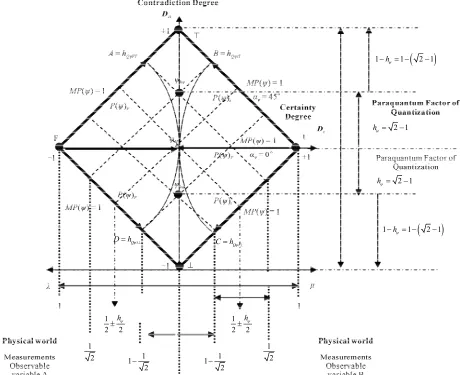
2.4. The Paraquantum Factor of Quantizationh
When the superposed Paraquantum logical state sup propagates on the lattice of the PQL a value of quantiza-tion for each equilibrium point is established. This point is the value of the contradiction degree of the Paraquan-tum logical state of quantization h such that:
2 1
h (14) where:
h is the Paraquantum Factor of quantization.
The factor h quantifies the levels of energy through
the equilibrium points where the Paraquantum logical state of quantization h, defined by the limits of
propa-gation throughout the uncertainty of the PQL, is located. Figure 3 shows the interconnections between the factors and its characteristics, in which they delimit the Region of Uncertainty in the Lattice of PQL.
In a process of propagation of Paraquantum logical state , it happens that in the instant that the superposed Paraquantum logical state sup reaches the representative points of the limiting factors of the uncertainty region of the PQL, the Certainty Degree (DC) remains zero but the
real Certainty Degree (DCR)will be increased or
de-creased from zero and this difference corresponds to the effect of the Paraquantum Leap. At the instant that the superposed Paraquantum logical states sup visit the Paraquantum logical state of quantization h, the real
Certainty Degree will have variations of the form:
1 2 1
C Rt C R
D D h (15)
We observed that when the Paraquantum logical states sup visit the Paraquantum state of quantization h
es-tablished by the Paraquantum Factor of quantization h,
the Paraquantum Leap happens. In the study of the PQL, when the propagation happens only in this point, the lat-tice is called fundamental lattice of transition frequency level N = 1.
Since that for the fundamental lattice of the PQL, the number of times of application of the Paraquantum Fac-tor of quantization h is N = 1, then, for a contraction or
expansion, the number of times will be greater than 1. Generalizing, we have that the Paraquantum Factor of quantization h expands or contracts the lattice of the
PQLN times such that:
2 1
N NN
h h (16) where:
N is an integer greater than 1.
The Paraquantum Factor of quantization hψ can be
used to correlate the values of quantities between the physical environment and the Paraquantum universe represented by the lattice of the PQL. The successive applications of hψ leads to a formula of expansion of the
initial lattice which, keeping its referential on the hori-zontal axis can be expressed for level N as follows:
exp 1
N anN
h h h h
h
(17)
exp 1
N
C anN C
J. I. DA SILVA FILHO 1459
Q t
D h C h Q t
1h 1 2 1
2 1
h
2 1
h
1h 1 2 1
1 2 2
h
1
2 2
h
1 2
1 2 1
1 2
1 1
2
[image:5.595.68.529.82.457.2]
Figure 3. The paraquantum factor of quantization h related to the degrees of evidence obtained in the measurements of the observable variables in the physical world.
Figure 4 shows the expansion of the fundamental lat-tice of the PQL with expansion order h2
. The largest
expansion will feel with N = 1 and the expansions in reference to the initial Lattice will be smaller as N in-creases. It is verified that the increase due to expansion is symmetrical, therefore the value that expands for the vertex T of Inconsistency logical state with, hψT→h2T
→··· N T
h it is equal value to the that expands for the
vertex of the Undetermination logical state with, hψ →h2
→···h N .
In that way, the contraction equation can be presented for a level N, such that:
N 1
contractN
h h h h
h
(19)
N 1
CcontractN C
D D h (20)
with N 1 positive and belonging to the integer number set.
where: DCcontractN = contracted Certainty Degree.
DC = Certainty Degree computed by (9). h = the Paraquantum Factor of quantization.
N = level of contraction frequency, or number of times of application of hψ.
In the figure the Paraquantum logical states indicates that the Uncertainty Region of PQL is dependent of the level of transition frequency N that acts in the Paraquan-tum Factor of quantization hψ, such that:
1
2 2
N
IP
h
(21)
N = integer positive ≥1
where: ΔψIP is the variation around the Paraquantum
logical state of Indefinition pure.
N is the level of contraction frequency, or number of times of application of hψ.
[image:6.595.103.488.73.468.2]
Figure 4. Expansion of the fundamental lattice of the PQL with expansion order h2
.
Fundamental lattice, that it happens starting from the Paraquantum logical state of Indefinition pure ψIP, have
their values obtained through:
Favorable evidence Degree: 1
2 2
N
N
h
and
Unfavorable evidence Degree: 1
2 2
N
N
h
where N is integer positive ≥1, what indicates the level of frequency of transition of the PQL lattice.
3. Paraquantum Analysis in Physical
Systems
Based on the above equations we present the Paraquan-tum Logic (PQL) as a logical solution for resolution of phenomena modeled by the laws of Physics [2,4,9,11]. In order to develop this study, we start its application base
on assumptions made from experimental observations of the Newton laws [12-15]. Doing this the PQL will allow, through the Paraquantum Logical Model, the mathe-matical applications to be extended to all fields of the physical science.
3.1. The Newton’s Second Law
The idea of the second Newton law is that when a resul-tant of forces acts on a body, this body will receive an acceleration which is proportional to Force (F) and in-versely proportional to its mass (m) [13,15]. When the law is expressed as a mathematical equation, this state-ment depends on a value that adjusts or defines this pro-portionality between the largenesses such that:
1 .F or .
a k F m a
m k
(22)
J. I. DA SILVA FILHO 1461
a is the acceleration or the ratio through which the velocity of the body changes along time.
F is the resultant of all forces acting on the body.
m is the mass of the body.
k is a factor of adjustment of proportionality.
When mathematically considered the second Newton law expressed the relation between the largenesses force,
mass and acceleration. It is well known that the adjusts of measure units with respect to the Newton laws were performed in a way that the proportionality constant k, from the second law and represented in (22), became 1 in the International System of Units (SI) largely used nowadays [8,16]. The International System of Units (SI) uses three fundamental largenesses of the Metric Sys-tems: mass, length and time.
3.2. Correlation between the Units of the British and the International Systems
In order to apply the Paraquantum Logics PQL on physical systems it is important to study Newton’s laws that relate the involved physical largenesses (force, mass
and acceleration) with the British System of units as well as the implications with respect to their transformations to the International System of Units (SI) [16]. In the British System of units those largenesses considered fundamental are defined as: force, length and time. Be-cause of that there is no freedom to choose units for force
and acceleration that must be used, however, to define the unit for mass so large or so small as desired. Doing so, the value of the proportionality constant k in (22), which represents the second Newton law, depends on the value of the unit chosen for mass.
For the unit of force when the proportionality factor k
acts on the mass, where the force and the acceleration
are 1 in the International System of units (SI), the equa-tion that expresses the poundal of the British System of units [16,17]is expressed by:
21 pdl 32.174049 1 lbm. 1 ft
s
(23) Comparing (22) which represents Newton’s second law with (23) which represents (22) expressed in the form of Newton’s second law in units of the British Sys-tem, we have the inverse value of the proportionality constant k:
1 32,174049
k .
The slug is compatible with the British System of units where the unit of force (and weight) is the pound. If 1 slug
is 14.5939 kg, then the corresponding to 1/32.174049 of the slug in the British System of units such as force will be obtained in the International System of units (SI) by
the following equality:
1
14.5939 kg = 0.453592272 kg 32.174049
x slug
We repeat the above again but now using the corre-sponding values from the International System of units (SI) where the unit for force is the Newton (N). In this case, (23) can be expressed by:
21 N 4.448221615 1 Kg 1 m
s
(24) We obtain from (22), which represents the second Newton law, comparing with (24), which represents second Newton law in the International System of units (SI), the inverse value of the proportionality factor k such
that: 1 4.448221615
k .
Equating (23) and (24), force and acceleration become 1. In this case:
2
1 pdl 32.174049 1 lbm. 1 ft 1 N
s
2
1 N 4.448221615 1 Kg 1 m 1 pdl
s
We observe in the equality that for the International System of units (SI) to present the value of force F in an unit of Newton, an adjustment of the value of mass of the International System of units (SI) was needed. An ad-justment was also necessary in the British System of units when the transformation from feet to meters was done. So, in order to obtain 1N (Newton) of force, with
mass and acceleration 1 in the British System we write:
2
32.174049
1 . 1 1
4.448221615
ft lbm
s
N
7.233013951 1
. 1
2 1 N
ft lbm
s
Comparing with (22), which represents the second Newton law, the factor of proportionality adjustment is:
1
7.233013951 br
k which is a factor of proportionality
adjustment of the British System of units: 0.138254952
br
k
In the same way in order to obtain 1 poundal (pdl) of
force, with mass and acceleration 1 in the International System of units (SI) we write:
24.448221615 m
1 1 K
32.174049 s
pdl g 1
2m
1 0.138254952 1 Kg 1
s
Comparing with (22), which represents the second Newton law, we have that:
1
0.138254952 IS
k
which gives us a factor of proportionality adjustment in the International System of units: kSI 7.233013951
Comparisons and analogies between the Systems of units lead us to relations and values that made the pro-portionality factor k of (22), which represents the second Newton law, to be 1 in the International System of units (SI). The analysis of physical systems through the Paraquantum Logics PQL is started with the receiving of information from the physical environment through the Evidence Degrees µ and λ obtained from measurements of observable variables [18]. The values of the Evidence Degrees extracted from the information sources are nor-malized [4][19], therefore, they are in the closed real interval between 0 and 1. In order to build a Paraquan-tum Logical Model it is necessary to impose these nor-malization conditions to the values of the factors of pro-portionality adjustment kIS that appear in the equations
related to the second Newton law as seen in (22). The adjustments needs the factor of proportionality adjust-ment kbr of the British System of units to be multiplied
by 10 and the factor of proportionality kSI of the
Interna-tional System of units (IS) to be divided by 10. There-fore:
1.38254952 br
k and kIS 0.7233013951. The fundamental theory of the PQL formalizes the Paraquantum logical states ψ which propagate through the fundamental Lattice always in diagonal form, build-ing internal propagation lattices. Dobuild-ing so, the values of the factors of proportionality adjustment k obtained from the experimental physics related to the Newton second law, which were treated in this paper, are very close to the ones expected in the theory and formalization of the
PQL.
This allows the characterization of identifying proper-ties among the natural processes of results obtained from experiments with the theory that is foundational to the
PQL.
The theoretical and experimental values show that the
PQL is a logic capable of creating models that can rep-resent the physical phenomena with a good approxima-tion of the values obtained through the equaapproxima-tions repre-senting the second law of Newton. So, it is possible to adapt the factors of proportionality adjustment k obtained for the Paraquantum Logical Model as follows:
1.38254952 2
br
k and 0.7233013951 1
2
IS
k
Considering that the values of k were obtained from arbitrary measurements, whose values were adapted along the years with practical applications, the differ-ences are low.
3.3. Newton Gamma Factor
We consider that applying the PQL in the analysis of physical quantities will produce through its Paraquantum Logical Model results identified with the International System of Units (SI). The proportionality factor which will affect the analysis when we want to express values in the British System will be: kbr 2.
Considering that the values read from the observable variables, which are related to the evidence degrees of the fundamental quantities of physics, are obtained from measurement devices which are graduated in units from the International System of Units (SI), we have to multi-
ply the obtained values by 1 2 .
These considerations show that the application of the
PQL for the analysis of physical systems provides us with a Paraquantum logical model which produces quan-
tization of 1
2 on the fundamental quantities of phys- ics, when these are used as Observable Variables in the physical world, from where the evidence degrees are
extracted. We observe that the quantization of 1 2 on the evidence Degrees µ and λ produces a quantization of
2 1
on the axis of contradiction degrees on the lattice of the PQL.This corresponds to the Paraquantum Factor of quan-tization h obtained on the equilibrium point where the
Paraquantum logical state of quantization h is
lo-cated. In the application of the Paraquantum Logical Model in broad areas of physics, the factor 2 as well as its inverse will be largely used to perform adjustments needed to the natural proportionality that exists between physical quantities and adjustment of unitary values be-tween unit systems. Due to its importance, well call this value Newton Gamma Factor and represent it by N.
Therefore, for the classical logic applied in the Paraq-uantum Logical Model, we have Newton Gamma Factor
2
N
.
3.4. Newton Gamma Factor γN and Lorentz
Factor γ
When we compare the Lorentz factor Relativity Theory to the Newton Gamma Factor applied in the N, the
J. I. DA SILVA FILHO 1463
not change with the variations of velocity related to the light speed c in the vacuum. If we consider the equality
N
, we have:
2
2 1
2
1 v
c
v is the velocity of the body in relation to the light speed
c in the vacuum.
The equality can be rewritten removing the square root of both sides and isolating 1:
2
2
1 2 1 v
c
Manipulating the equation we have:
2
2
1 1
2
v c
or
2 1 1
2
v c
.
The velocity of the body is expressed as a fraction of the light speed c in the vacuum so:
eloc
v v c
where: eloc is the value of constant velocity of the body
in comparison with the light speed in the vacuum such
that .
v
eloc v
0 1
According the Relativity Theory, eloc is expressed as
a constant smaller or equal the light speed in the vacuum. We observe that the equation relating Newton and Lor-
v
entz factors can be written as follows:
2 1
1 2
velocc c
or 1 1
2
eloc
v c resulting: 1 2
eloc
v c which is iden- tified in the interval as being a constant value smaller or equal the light speed c in the vacuum. Therefore, this is the quantitative value of the velocity v of the body in relation to the light speed c in the vacuum for which the Newton and Lorentz factors coincide.
4. The Paraquantum Gamma Factor
γ
PψThe equality condition between Newton Gamma Factor
N
from classical mechanics and the Lorentz factor from the Relativity Theory which resulted in the equa-
tion 1
2
eloc
v c. This shows that that equality expres- ses a strong bond between values of fundamental quanti-ties of two important areas of physics. Classical physics and Relativity Theory can be represented jointly in the Paraquantum logical model through only one factor. This factor which links Newton’s theories to the restricted relativity theory is called Paraquantum Gamma Factor
P
which we study in the following.
4.1. Application of Newton Gamma Factor
Equation (21) expresses the variation of the value of the Favorable evidence Degree µ extracted from measure-ments performed on Observable Variables in the physical environment, correlating to the Paraquantum Factor of quantization hψ on the lattice of the PQL. Equation (21)
is as follows: 1
2 2
N
IP
h
Since h 2 1 , this equation can be written just considering the extraction of the Favorable evidence De-gree such that:
1 2 11 1
2 2 2 2 2
2 1 N
or 1 1 1
2 2 2
N
If we express it using the Newton Gamma Factor, we
have: 1 1 1
2 2
N
N
.
We can express the increased value of each quantiza-tion in an expansion as being:
acresc
1 1
2 N 2
h
(25)
The expression (21) of the value of variation of the Favorable evidence Degree µ extracted from measure-ments performed on Observable Variables in the physical world, correlating the Paraquantum Factor of quantiza-
tion hψ on the lattice of the PQL, shows that 1
2 for
a situation before the application N = 1, this is, before the condition was analyzed.
The equation that results this value informs the present condition that there was an evidence degree µ such that
when multiplied by the previous value, the result 1 2
was obtained. This condition previous to analysis this value can be mathematically expressed through multi-plications of inverse values of the Newton Gamma Fac-tor.
An initial application before the fundamental lattice
resulted the previous value 1 2 .
We have that the previous condition was produced by:
1 1
N N
→
1 1
2 2
→ 1
In a process of expansion where we consider quantiza-tions in successive applicaquantiza-tions of inverted values of the Newton Gamma Factor and where the evidence degree in the beginning represents Indefinition, we can do the fol-lowing: for the first application of the inverted value of the Newton Gamma Factor we can write its present value with increase with condition N = 1 such that:
We consider that in the expansion of the lattice, there
will always be an increase proportional to 1
N
to
the value of each analyzed situation.
This means that, in an expansion process, at each quantization there will be an increase to the present value of the evidence degree corresponding to the inverse value of the Newton Gamma Factor. So, in the previous equation we can obtain results where the application of the inverse value of Newton Gamma Factor is restricted only to the increased value of the fundamental lattice such that:
1
1 1 1
2 2 2
N
which represented by the Newton
Gamma Factor is: 1
1 1 1 2 2 N
N
.
According to the same procedure of expansion of the lattice, keeping the inverted value of the Newton Gamma Factor in the successive applications, we obtain:
acresc
1 1 1 2 2
N
N
For N = 2
2
1 1 1 1 1
2 2 2 2 2
N
2
1 1 1
2 2 2 4
N
→ 2
1 1 1 1
2 2 2 4
N
→
which represented by the Newton Gamma Factor is:
2
1 1 1 1
2 2 4
N
N
For N = 3
3
1 1 1 1 1 1 1
2 2 2 2 2 2 2
N
3
1 1 1 1 1 1
2 2 2 2 4 2
N
3
1 1 1 1
2 2 2 4 4 2
N
→ 3
1 1 1 1 1 1
2 2 2 4 4 2
N
→
which repre-sented by the Newton Gamma Factor is:
3
1 1 1 1 1 1
2 2 4 4
N
N N
.
For N = 4
4
1 1 1 1 1 1 1 1 1
2 2 2 2 2 2 2 2 2
N
→ 4
1 1 1 1 1 1 1 1
2 2 2 2 4 4 2
N
2
→
4
1 1 1 1 1
2 2 2 4 4 2 8
N
→ 4
1 1 1 1 1 1 1
2 2 2 4 4 2 8
N
→
which represented by the Newton Gamma Factor is:
4
1 1 1 1 1 1 1
2 2 4 4 8
N
N N
.
J. I. DA SILVA FILHO 1465
5
1 1 1 1 1 1 1 1 1
2 2 2 2 4 4 2 8
N
2
→ 5
1 1 1 1 1 1
2 2 2 4 4 2 8 8 2
N
→
5
1 1 1 1 1 1 1 1 1
2 2 2 4 4 2 8 8
N
2 →
which represented by the Newton Gamma Factor is:
5
1 1 1 1 1 1 1 1 1
2 2 4 4 8 8
N
N N
N
.
For N = 6
6
1 1 1 1 1 1 1 1 1 1
2 2 2 4 4 2 8 8 2 16
N
→
which represented by the Newton Gamma Factor is:
6
1 1 1 1 1 1 1 1 1 1
2 2 4 4 8 8 16
N
N N N
.
For N = 7
7
1 1 1 1 1 1 1 1
2 2 2 4 4 2 8 8 2 16 16 2
N
→
which represented by the Newton Gamma Factor is:
7
1 1 1 1 1 1 1 1 1 1 1 1
2 2 4 4 8 8 16 16
N
N N N
N
For N = 8
8
1 1 1 1 1 1 1 1 1 1 1 1 1
2 2 2 4 4 2 8 8 2 16 16 2 32
N
which represented by the Newton Gamma Factor is:
8
1 1 1 1 1 1 1 1 1 1 1 1 1
2 2 4 4 8 8 16 16 32
N
N N N N
We observe that the process of application of the in-verted value of the Newton Gamma Factor is the follow-ing geometric progression:
2 3 n1,
a ar ar ar ar
with values: 1
1
1 1 1 1
, . 2 4 8 16
n
a a1r
and
2
1 1
1 1 1 1 1 1 1 1
2 4 8 16
1
,
N N N
n
N
a
a r
N
We observe that the following sum:
2 2
3 1 1
1 1 1
1 1
,
a
N N N
n n
N N
a a ar ar ar ar ar
ar ar ar
3
is the infinite series. If we substract 1 from it, it will be-come the binomial expansion of the Lorentz Factor used in the Relativity Theory such that:
2 1
1 v
c
↔
1
2 2 2
1
1 1
2
v v
c c
We can identify the Lorentz Factor in the infinite series of the binomial expansion correlated to the series obtained from successive applications of the Newton Gamma Factor N such that:
1 1
1 1
1
,
N a
N N
N n n
N
r r r
r r r
1
N
only for odd integer numbers.
We identify a correlation value of the Paraquantum logics which we call Paraquantum Gamma Factor P such that:
1 P
N
(26)
where:
N
is the Newton Gamma Factor such that: 1 2
N
is the Lorentz Factor, such that :
2 1
1 v
c
.
If the speed v of the body is correlated to the light speed c in the vacuum, which is the maximum value of velocity in the Relativity Theory [8][20-22] and a limit to the construction of a lattice of the PQL, then the Paraq-uantum Gamma Factor P is applied to the
computa-tion of the evidence degrees extracted from the Observ-able VariObserv-ables in the physical environment.
4.2. Variations of the Paraquantum Gamma Factor
As it was done for the Newton Gamma Factor, the value of the Paraquantum Gamma Factor P is applied from
the condition of Indefinition in the Paraquantum analysis, where the analyzed situation is identified by the Favor-
able evidence Degree 1 2
and by the Unfavorable
evidence Degree 1 2 .
We observe that with the analysis of (26) the Paraq-uantum Gamma Factor P depends only on the value
contained in the Lorentz Factor and therefore on the velocity v of the body in relation to the speed light c in the vacuum. When we use the Paraquantum Gamma Factor P, the velocity v of the body is always
corre-lated to the speed light c in the vacuum, so its value de-pends on the Lorentz Factor which, according to the Relativity Theory, changes with the increase or decrease
of the velocity v [8,15].
The Equation (26) for a quantitative paraquantum analysis of the time and velocity can be compared to the Time dilation equation of the special relativity theory [8,15].
t t
(27)
where: t is the variation value of the time measured in the referential point.
t
is the variation value of the time measured in the body point in movement when is measured in the refer-ential point.
= Lorentz Factor, such that:
2 1
1 v
c
4.3. Selected Examples of Application of the Paraquantum Gamma Factor
Some selected examples that deal with the application of the Paraquantum Gamma Factor in Equation (26) and involving the time dilation Equation (27) of the theory of relativity are presented to follow:
Example of Application
Calculate the value of the velocity that a body must be in relation to the speed of the light in the vacuum, in the following conditions:
a) So that the time observed in the referential point is the double when calculated by the Time dilation equation of the special relativity theory.
Resolution: ?
v so that t 2 t
From the equation (27) of the special relativity theory, then: t 2 t
→
2 2
1
t t
v c
→
2 1 2
1 v
c
2
→
1 1
2
v c
2 2
1 1
2
v c
→
2
1 1
2
v c
→
the value of the velocity is:
0.866025403
v c
Applying the Paraquantum Logical Model by equation (26): t Pt then:
t
2
t
→2 t Pt→2 P t
t → 2P
Therefore the measured t will be the double when the Paraquantum Gamma Factor will be equal the 2.
J. I. DA SILVA FILHO 1467
As: P 1
N
then:
2 1 N →
2 2 1
1 3 2 v c →
22 2 1
1 3 2 v c →
22 1 1 3 2 v c →
22 1 1 3 2 v c
the value of the velocity is: v0.822312892c
b) So that the time observed in the referential point is 2 larger when calculated by the Time dilation equa-tio
R
n of the special relativity theory. esolution:
?
v so that t 2t
From the equation (27) of the special relativity theory, then:
2
t t
→ 2 1 1 2
v c
→
the value of the velocity is: 1 2
v c
Applying the Paraquantum Logical Model by equation (26):
P
t t
Then: t 2t → 2 t Pt → 2 P
Therefore, the measured time will be 2 when th Paraquantum Gamma Factor will be equal
e 2.
As: P 1
N
then:
2 1 N →
2 2 1
1
2 2
v c → 2 2 2 1 1 2 2 v c 2 2 1 1 2 2 v c → 2 2 1 1 2 2
v
c
the value of the velocity is: 1 2
v
Resolution: ?
v so that t t
From the Equation (27) of the special relativity theory, then:
c
c) So that the time observed in the referential point is equal when calculated by the Time dilation equation of the special relativity theory.
t t
→ 2 1 1 1 c v → 2 2 1 v → 1 1 c 2 2 1 1 1 v c
→ 0
v c
the value of the velocity is:
Applying the Paraquantum Logical Model by equation (26):
0
v c.
P
t t
Then: t t → t Pt → 1P
Therefore the measured time will be equal when the Paraquantum Gamma Factor will be equal 1.
As: P 1
N
then: 1 1 N →
2
2 1 1 2 2 v c 2 2 2 1 1 2 2 v c 2 2 1 1 2 2 v c → 2 2 1 1 2 2v c
the value of the velocity is:
0.521005383
v c
4.4. Limits of the Paraquantum Gamma Factor Factor
Select examples show that the independence condition to et a unitary Lorentz Factor happens only when the
ve-T nd its
and Dependence of the Lorentz
g
locity v is too low in compared to the light speed c in the vacuum.
he limits of the Paraquantum Gamma Factor a dependence with the variation of the Lorentz Factor are presented. It was verified in example c) that the unitary Paraquantum Gamma Factor (P 1) happens when the speed value v of the body, in relation at the speed c of the light in the vacuum, to reach the value of:
0.52803503
v c
2 2
1 1 1.177547573
1 0.52803503
vc
1
c
tum Gamma Factor is:
Through the Equation (26) the value of the Paraquan-
1 P
N
1.177547573
1.177547573 1
2
P
that results in its unitary value: P 1
From this condition if the s e of the body to diminish, then the Paraquantum Gamma Factor will be minor who the unit until reaching the boundary-value, which is the inverse value of the Factor Gamm
ton. However, the Lorentz Factor is who limits the peed valu
a of
New-Paraquantum Gamma Factor P. This condition be-comes the Paraquantum Gamma Factor P a relativis-tic factor.
4.5. Discussion
We observe that with this condition the result is a value of Paraquantum Gamma Factor P very close to the inverted value of the Newton Gamma Factor N such
hat, when: t
1
→ 1 1
2 P
N
The inverted value of the Paraq tum Gamma Factor
uan
P
in the Newtonian universe has practically the same effect as the Newton Gamma Factor N. On the other
careful analysis of the phenomenon shows that the effect of the P antum Gam actor hand, a
araqu ma F P is
initiated from the instant we consider an object lo
with ve-city v related to the light speed c in the vacuum.
When the Lorentz Factor increases in such way that its value becomes the Newton Gamma Factor N,
then the value of the Paraquantum Gamma Factor P
will be the value of the Newton Gamma Factor N.
Under these conditions, the velocity v of the body com-pared to the light speed c in the vacuum will be the in-verted value of the Newton Gamma Factor N.
There-fore, for:
2
N
→ P N 2 and 1 2
v c.
When the velocity v of the body compared to the light speed c in the vacuum has a value greater t the in-verted value
han
of the Newton Gamma Factor N, then the
value of the Lorentz Factor and also the of the
Paraquantum Ga Factor
value
mma P are above 1
2 .
Under these conditions the Lorentz Factor and the Paraquantum Gamma Factor P will have values varying in a way which is approximate to the results ob-tained by the Relativity Theory and computations done with (27).
In the Newtonian world the choice of using the Paraquantum Gamma Factor P or the inverted value of the Newton Gamma Factor N is irreleva t because they are very close values. Howe we observe that as the velocity v f the body (considered in relation to the light speed c in the vacuum) increases, there is a signifi-cant increa
n r,
se of the Paraqua Gamma Factor ve
ntum P.
After a certain value of v, the Paraquantum Gamma Fac-tor P becomes important in computation of quan-tities, while the inverse value the Newton Gamma Facto
the of
N
remains the same. The use of the Paraquan-tum Gamma Factor P allows computations, which correlate values of the Observable Variables to the val-ues related to quantization through the Paraquan Factor of quantization hψ, to be performed in any area of
stud physical science. Therefore the applications of tum
y of
P
go from the Theory of Relativity to the studies of Quantu Mechanics. This means that variations in the values of the evidence rees are due to relativistic-type phenomena which are expressed by the Paraquantum Gamma Factor
m
deg
P
. So, the Paraquantum Gamma Fac-tor P will have influence on the computation of states and on the intensity of measures of physical quantities lyzed in the Paraquantum world represented in the lattice such as velocity, acceleration, energy and power.
5. Conclusions
Bas n the concepts of the Paraquantum logics PQL
we did in this work a detailed study about the existing correlations between the physical world represented by the values of the evidence degrees and the Paraquantum ana
ed o
the lattice of the PQL. The equa-g with representative values of hysical systems considered on the lattice of the PQL
world, represented by tions and forms of dealin p
allowed to obtain behavioral characteristics of Paraq-uantum logical states ψ which produce quantitative re-sults affected by the measurements performed on the Observable Variables in the physical environment.
Rela-J. I. DA SILVA FILHO 1469
tiv [7] J. I. Da Silva Filho, A. Rocco, M. C. Mario and L. F. P.
Ferrara, “Annotated Paraconsistent Logic Applied to an Expert System Dedicated for Supporting in an Electric Power Transmission Systems Re-Establishment,” 2006
IEEE PES on Power Systems Conference and Exposition, Atlanta, October 29 2
ity Theory.
The correlation between the Paraquantum Gamma Factor P, which acts on the measurements performed
at the extraction of evidence degrees in the physical world, with the Paraquantum Factor of quantization hψ, allows that the Paraquantum logical model to be capable of analyzing physical quantities in a quantitative fashion.
The model
006-November 1 2006, pp. 2212-
t Systems, Vol. 3, 1998, pp. 191-197. 2220.
[8] P. A. Tipler and A. Llewellyn, “Modern Physics,” 5th Edition, W. H. Freeman and Company, New York, 2007. [9] J. M. Abe and J. I. Da Silva Filho, “Inconsistency and
Electronic Circuits,” In: E. Alpaydin, Ed., Proceedings of EIS’98 International ICSC Symposium on Engineering of Intelligen
standardizes analysis and interpretations an
eas
m
his research.
, Bueno, “Scientific Theories, Models, ,” Principia, NEL—Episte-gic Research Group, Federal University (UFSC), Santa Catarina, 2007, pp. d allows that these applications to be extended to all study ar of physics which are considered incompatible because of existing contradictions in computations. The direct applications in the solution of problems applying the Paraquantum Logical Model in the Newtonian phys-ics and in the physphys-ics that covers the theories of quantum
[10] N. C. A. Da Costa, “On the Theory of Inconsistent For-mal Systems,” Notre Dame Journal of Formal Logic, Vol. 15, No. 4, 1974, pp. 497-510.
doi:10.1305/ndjfl/1093891487
[11] J. I. Da Silva Filho and A. Rocco, “Power Systems Out-age Possibilities Analysis by Paraconsistent Log echanics and relativity will be presented in future
pa-pers.
6. Acknowledgements
The author thanks INESC—Institute of Engineering of Systems and Computers of Porto, Portugal, in particular researcher Prof. Jorge Correia Pereira for the support during t
ic,” 2008
2008, pp. 1-6.
: “An Introduction to
Me-retical Computer Science,
gics and Paraconsistency,” In: D. Jacquette, D. M.
Foundations of Quantum
IEEE Power and Energy Society General Meeting: Con-version and Delivery of Electrical Energy in the 21st Century, Pittsburgh, 20-24 July
[12] D. Kleppner and R. K. Binding
chanics” Mcgraw-Hill, Columbus, 1973, p. 600.
[13] P. A. Tipler, “Physics,” Worth Publishers, Inc., New York, 1976.
[14] P. A Tipler and G. M. Tosca, “Physics for Scientists,” 6th
7. References
Edition, W. H. Freeman and Company, 2007.
[15] J. Bernstein, P. M. Fishbane and S. G. Gasiorowicz “Mod-[1] N. C. A. Da Costa and D. Marconi, “An Overview of Para-
consistent Logic in the 80’s,” The Journal of Non- Clas-sical Logic, Vol. 6, No. 1, 1989, pp. 5-32.
[2] D. Krause and O
and the Semantic Approach
ern Physics,” Prentice-Hall, New York, 2000, p. 624. [16] J. P. Mckelvey and H. Grotch “Physics for Science and
Engineering,” Harper and Row Publisher Inc., New York, 1978, p. 426.
of mology and Lo
Santa Catarina [17] M. Ference Jr., H. B. Lemon and R. J. Stephenson “Ana-lytical Experimental Physics,” 2nd Editon, University of Chicago Press, Chicago, 1956.
187- 201.
[3] N. C. A. Da Costa, V. S. Subrahmanian and C. Vago, “The Paraconsistent Logic PJ,” Mathematical Logic Quar-
terly, Vol. 37, No. 9-12, 1991, pp. 139-148. [18] J. A. Wheeler and H. Z. Wojciech (eds), “Quantum Theory and Measurement,” Princeton University Press, Princeton, 1983.
doi:10.1002/malq.19910370903
[4] J. I. Da Silva Fiho, G. Lambert-Torres and J. M. Abe, “Uncertainty Treatment Using Paraconsistent Logic: In-troducing Paraconsistent Artificial Neural Networks,” IOS P
[19] H. A. Blair and V. S. Subrahmanian, “Paraconsistent Lo- gic Programming,” 7th Conference on Foundations of Software Technology and Theo
Pune, 17-19 December 1987.
[20] N. C. A. da Costa, D. Krause and O. Bueno, “Paraconsis-tent Lo
ress, Amsterdam, 2010, p. 328.
[5] J. I. Da Silva Filho, A. Rocco, A. S. Onuki, L. F. P. Fer- rara and J. M.Camargo, “Electric Power Systems Con- tingencies Analysis by Paraconsistent Log
tion,” International Conference
Gabbay, P. Thagard and J. Woods, Eds., Philosophy of Logic, Elsevier, Series Handbook of the Philosophy of Science, Vol. 5, 2006, pp. 655-781.
[21] H. Reichenbach, “Philosophic ic Applica-
on Intelligent Systems Applications to Power Systems, Toki Messe, 5-8 No-vember 2007, pp. 1-6. doi:10.1109/ISAP.2007.4441603 [6] J. I. Da Silva Filho, A. Rocco, M. C. Mario and L. F. P.
Ferrara, “PES-Paraconsistent Expert Sy
Mechanics,” University of California Press, Berkeley, 1944.
[22] F. Gross, “Relativistic Quantum Mechanics and Field Theory,” John Wiley & Sons, Inc., Hoboken, 1993, p. 97. stem: A