Journal of Cosmetics, Dermatological Sciences and Applications, 2011, 1, 50-58
doi:10.4236/jcdsa.2011.13009 Published Online September 2011 (http://www.SciRP.org/journal/jcdsa)
Treatment of Aged Skin with a pH 4 Skin Care
Product Normalizes Increased Skin Surface pH
and Improves Barrier Function: Results of a Pilot
Study
Jürgen Blaak1, Rainer Wohlfart2, Nanna Y. Schürer1
1Department of Dermatology, Environmental Medicine and Health Theory, University of Osnabrück, Osnabrück, Germany; 2Research
and Development, Kneipp-Werke, Würzburg, Germany. Email: [email protected]
Received May 27th, 2011; revised June 10th, 2011; accepted June 22nd, 2011.
ABSTRACT
The physiological skin surface pH is just below 5. With age the skin surface pH increases up to 6. An increased pH correlates with reduced barrier integrity/cohesion. The present pilot study assesses possible normalization of an in-creased skin surface pH of the elderly and improvement of barrier function via application of ≈pH 4.0 skin care prod-ucts. Baseline skin surface pH was determined in elderly (80+ years old; n = 15) compared to middle aged adults (31 - 50 years old; n = 15). The effect of o/w emulsions at pH-values of 3.5,4.0,4.5 and 5.5 on the skin surface pH was de-termined in both groups. Further, the effect of a 4-week treatment with a pH 4.0 skin care product on the skin surface pH, skin hydration and barrier integrity was assessed. Thirteen elderly females were involved in this home-in-use test. Increased baseline skin surface pH of the elderlynormalizes to the physiological pH of 4.5 - 5.0 over 7 hours after sin-gle application of o/w-emulsions with a given pH of 3.5 or 4.0. A 4-week treatment employing the pH 4.0 skin care product improves the epidermal barrier integrity of the elderly significantly (p = 0.005).Reduction of the increased baseline skin surface pH of the elderly is accompanied by improved epidermal barrier integrity. Skin care products for the elderly have to be adjusted in the pH range of 3.5 to 4.0.
Keywords: Skin Aging, Skin Care, Skin Surface pH, Epidermal Barrier Function
1. Introduction
The physiological skin surface pH has been evaluated repeatedly. Even though the skin surface pH is still de-fined to be 5.4 - 5.9 [1], recent multicenter studies postu-late a skin surface pH just below 5.0 appeared in 330 or 222 subjects [2-3]. The acid pH of the skin surface, known as the “acid mantle” [4], and the pH gradient [5] of the stratum corneum (SC), regulates at least three epi-dermal functions: antimicrobial barrier, permeability barrier and barrier integrity/cohesion [6]. The relevance of an acid skin surface pH as an antimicrobial barrier has been demonstrated repeatedly [2,7-10]. At a pH of 5.0 growth of pathogenic bacteria, like S. aureus, is inhibited in vitro and in vivo. Species of the normal resident flora are positively affected by the physiological, acidic milieu [7-10]. Further, the dissociation of endogenous bacteria from skin surface is enhanced at alkaline conditions [2].
More recent studies provide insight into the skin surface pH performing a key role in SC functions as permeability barrier homeostasis and SC integrity/cohesion (the con-verse of desquamation) [6]. Permeability barrier homeo-stasis depends on the pH gradient throughout the SC. When acute perturbed skin sites are exposed to a neutral pH buffer [11] or to “superbases” [12], barrier recovery is delayed. These pH-induced barrier abnormalities are associated with an inhibition of two lipid processing en-zymes, β-glucocerebrosidase (β-GlcCer’ase) and acid sphingomyelinase (aSMase), which exhibit low pH op-tima and transfer polar lipids as, glucosylceramide and sphingomyelin, to the non-polar barrier organization [13-16].
en-zyme, SCCE) and kallikrein-8 (KLK8, neuropsin) [17]. KLK5 and KLK7 play a key role in integrity/cohesion in desquamation, which exhibit neutral pH optima [18-19]. Desmoglein 1 (DSG1), desmocollin 1 (DSC1) and cor-neodesmosin (CDSN) are extracellular protein structures of corneodesmosomes. Desquamation is linked to the degradation of DSG1, DSC1 and CDSN by kallikreins [20]. The acidic SC pH regulates KLK5 and KLK7 by reducing, but not completely inhibiting, their activities and by maintaining physiological desquamation. Because of the pH-gradient from 7 (Stratum granulosum (SG)/SC interface) to below 5 (skin surface) the activities of KLK5 and KLK7 change accordingly [6,17].
An increased skin surface pH has been described re-peatedly in the elderly: Zlotogorski et al. [21] showed significant higher skin ph values in the over-80 group in comparison to the younger groups. Thune et al. [22] demonstrated a higher pH (5.7 ± 0.15) in the elderly (67 - 95 years, mean age 81) and revealed a positive cor-relation between age and pH. These results are in line with those of Wilhelm et al. [23], who found higher val-ues on the ankles of elderly subjects (70.5 ± 13.8 years). Man et al. [24] retrieved pH values of approx 6.0 on the forearms and foreheads of male and female subjects in the age group over-70. Moreover, in aged mice an ele-vated pH was demonstrated at all levels throughout the SC by Choi et al. [25].
While an elevated pH inhibits the activity of the lipid-processing enzymes β-GlcCer’ase and aSMase, which results in inadequate formation of lamellar lipid bilayers, the activity of KLK5 and KLK7 is increased, which results in premature degradation of corneodesmo-somes. The functional consequences are 1) delayed bar-rier recovery [11-12]; 2) reduced barbar-rier integrity/cohe- sion [12,26] and 3) negative effects on the skin microbi-ota [2]. In the context of aged skin, delayed barrier re-covery [25,27] and an impaired barrier integrity [25, 27-28] has been demonstrated in the elderly.
The aim of our pilot study was to investigate possible normalization of an increased skin pH of the elderly and improvement of barrier function by application of skin care products with a pH 3.5 - 4.0.
2. Materials and Methods
2.1. Volunteers
Primarily, the effect of a single application of a given o/w emulsion on the skin surface pH was assessed in ten elderly females (range 81 - 95, mean 85.3 ± 4.8) and ten young females (31 - 48, 39.1 ± 6.4). A time course of 7 hours after single application of the given o/w emulsion was performed on five elderly females (81 - 87, 82.6 ± 2.5) compared to five young females (31 - 49, 38.2 ± 8.2).
Secondly, the effect of a 4-week treatment with a pH 4.0 skin care product on the skin surface pH, skin hydration and barrier integrity was assessed. Thirteen elderly fe-males (80 - 90, 84.5 ± 3.9) were involved in this home- in-use test.
The study was approved by the local ethics committee of the University of Osnabrück (Germany) which gave it unanimous approval. Written, informed consent was ob-tained from all volunteers. The volunteers were healthy without any skin diseases or lesions on the test sites.
2.2. Material
Skin surface pH was measured with a flat glass electrode (Mettler-Toledo, Giessen, Germany) attached to a pH meter (Skin-pH-Meter® PH905, Courage & Khazaka, Cologne, Germany) and SC hydration was determined by a capacitate-based corneometer (Corneometer® CM825, Courage & Khazaka, Cologne, Germany). Furthermore, barrier function was determined by measuring transepi-dermal water loss (TEWL). TEWL was measured using an open chamber device (Tewameter® TM300, Courage & Khazaka, Cologne, Germany). For the evaluation of barrier integrity strippings on the volar forearm were necessary, for which we used a commercially available adhesive tape (3M Blenderm surgical tape, 3M Deutsch-land, Neuss, Germany).
2.3. Test Products
The different pH values of the tested o/w emulsions were adjusted with citric acid (<0.5%). The test products were A (pH 3.5), B (pH 4.0), C (pH 4.5) and D (pH 5.5). Ac-cording to INCI ingredients were aqua, arachis hypogaea oil, prunus amygdalus dulcis oil, simmondsia chinensis seed oil, pentylene glycol, cetearyl alcohol, glyceryl stea- rate, glycerin, oenothera biennis oil, persea gratissima oil, persea gratissima oil unsaponifiables, prunus domestica seed oil, potassium palmitoyl hydrolyzed wheat protein, rosmarinus officinalis leaf extract, panthenol, xanthan gum, citric acid, tocopherol.
2.4. Experimental Design
Treatment of Aged Skin with a pH 4 Skin Care Product Normalizes Increased Skin Surface pH and 52
Improves Barrier Function: Results of a Pilot Study
room temperature (21.7˚C ± 1.4˚C; relative humidity 46.2% ± 3.8%) and the functional assessment at the vol-unteer home (temperature 20.2˚C ± 2.6˚C; relative hu-midity 49.4% ± 6.5%).
2.5. Skin pH Time Curves
There was a 12-hour pre-trial period, during which vol-unteers were requested to refrain from applying any skin care products and tap water to the test sites. The control and treated sites (50 × 60 mm) were attributed at random to each volunteer on the midvolar aspect of each forearm with a 4-cm distance to the cubital fossa. To get skin pH time curves we first measured the basal pH on the test sites on the volar forearm. We next applied 0.09 g (= 3 mg/cm2) of the test products to the respective test site
with a plastic syringe (Omnifix®-F, B. Braun Melsungen AG, Melsungen, Germany). The cream was spread with a gloved finger in a standardized way. For the 2-hour pe-riod, the skin surface pH was measured every twenty minutes after application. For the 7-hour period, the skin surface pH was measured after twenty minutes and thereafter every 2 hours. The point of measuring of every test area was changed to avoid a wash-out effect from the water drop from the skin pH meter.
2.6. Functional Assessment
To evaluate the functional effects (functional assessment) of an acid cream on aged skin, i.e. aged permeability barrier, a 4-week home-in-use-test was performed. The volunteers were instructed to use the test product (o/w cream, pH 4.0) twice daily on the test sites. In this study the volar aspect of the forearm was used to determine barrier integrity before and after application of the test product. To assess changes in skin surface pH and skin hydration the forehead (photoaged skin, pa) and the me-dial upper arm (chronological aged skin, ca) were in-volved and compared. Before any product treatment the basal skin surface pH and skin hydration was measured (Basis). On the forearm the barrier integrity, i.e. number of strippings to disturb the barrier, was evaluated ac-cording to Gunathilake et al. [29]. TEWL values were measured after every five tape strippings and the strip-pings were repeated until TEWL increased by three fold. The practical procedure of the stripping itself was per-formed according to Dickel et al. [30]. Tape strips were gently pressed downward by fingertips for about 2 sec-onds and tape was removed on one quick movement at an angle of 45˚ in the direction of adherence. For each single strip a new tape cut was used and positioned on exactly the same skin area. The basal barrier integrity was assessed on randomized change of left or right fore-arm. The barrier integrity after the 4-week treatment (day
28) was assessed on both forearms.
2.7. Statistical Analysis
Statistical analysis was performed using SPSS software version 18.0 (SPSS, Chicago, IL, USA). Differences be-tween the test sites were tested for their statistical sig-nificance using the Mann-Whitney U-test for not nor-mally distributed non-paired data. To compare the non- parametric paired values of each test site the Wilcoxon signed-rank test was used. The significance level was set at p≤ 0.05. All measured and calculated parameters are reported as arithmetic mean and standard deviation (mean ± SD). The Skin surface pH of each volunteer was converted to the hydrogen ion concentration. The arith-metic mean of the hydrogen ionic concentration was calculated for the respective group and this in turn con-verted to a pH [31].
3. Results
3.1. Skin pH Time Curves
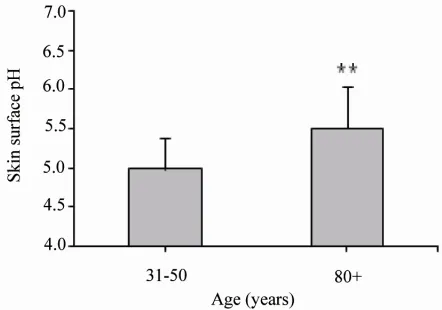
Baseline skin pH values, which are significantly (p < 0.006) higher in the elderly compared to middle aged adults, are presented in Figure 1. In the context of a 2-hour measurement ten very old females were compared with ten middle aged adults and in the context of the 7-hour measurement five very old were compared with five middle aged females. The baseline skin surface pH of the volar forearm was 5.50 ± 0.54 in the fifteen elderly and 4.98 ± 0.39 in the fifteen younger volunteers (Figure 1).
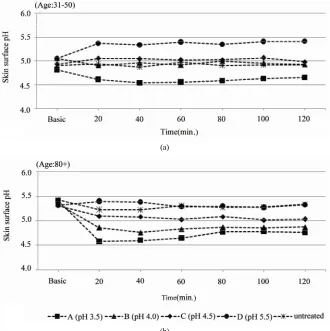
Figure 2(a) reveals skin surface pH values over the duration of 2 hours after single application of an o/w emulsion with a pH of 3.5, 4.0, 4.5 and 5.5 on the volar
[image:3.595.312.533.517.672.2]forearm in ten middle aged adults.
The skin surface pH decreased after application of the test product A (pH 3.5). The skin surface pH remained stable around 5 after application of test product B (pH 4.0) and C (pH 4.5). Applying a pH5.5 o/w emulsion (product D) leads to an increase of the skin surface pH up to 5.4. The skin surface pH of the aged volunteers shows a de- crease of 0.8 units after application of the pH 3.5 cream (5.40 > 4.58) and a decrease of approximately 0.5 units after application of the pH 4.0 cream (5.33 > 4.86). The application of these creams leads to a skin surface pH of 4.5 to 5.0 over at least 2 hours. Application of the pH 4.5 and pH 5.5 creams is reflected by a decrease of the skin pH, but not below pH 5.0 (Figure 2(b)).
Next we assessed the influence of two different test products on the skin pH over a 7-hour period in five eld- erly (Figure 3) and five middle aged adults.
For this measurement we select the pH 3.5 and pH 4.0 cream, which leads to stabilization of the skin surface pH
between 4.5 and 5.0 (Figure 2(b)). Figure 3 shows a de- creased skin pH 20 minutes after application of both test products of 1.0 unit (pH 3.5 cream) and 0.6 units (pH 4.0 cream). The skin surface pH of the elderly reveals values between 4.5 and 5.0 over at least 7 hours.
3.2. Functional Assessment
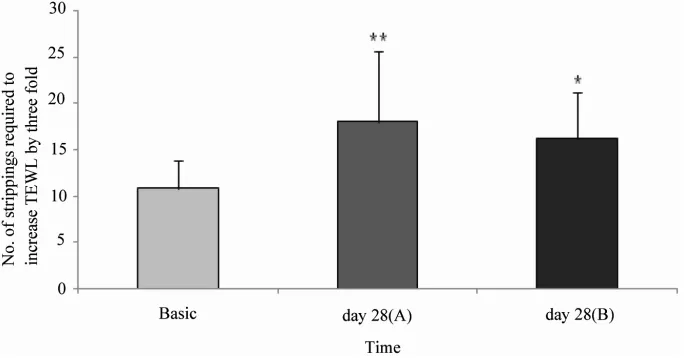
We next evaluated the long-term effects after treat- ment with a pH 4.0 o/w emulsion on permeability barrier function. The focus was on the assessment of the barrier integrity (numbers of stripping required to increase TEWL by three fold) before and after 4-week treatment with the pH 4.0 cream. To disturb the barrier, i.e. in- creased TEWL by three fold, 10.85 ± 2.9 strippings were required. After a 28 day treatment period employing the pH 4.0 test product, we assessed the barrier integrity of both forearms, i.e. of the pre-irritated (A) as well as of a non-irritated control site (B). To increase the TEWL by three fold on the pre-irritated skin, 18.00 ± 7.62 strip-
(a)
[image:4.595.133.463.338.669.2](b)
Treatment of Aged Skin with a pH 4 Skin Care Product Normalizes Increased Skin Surface pH and 54
[image:5.595.113.488.96.231.2]Improves Barrier Function: Results of a Pilot Study
Figure 3. Mean values of the skin surface pH over the duration of 7 hours after single application of test product A (pH 3.5) or B (pH 4.0) on the volar forearm of elderly (80+ years old, n = 5).
Figure 4. Mean values ± SD of the numbers of tape strippings required to increase the TEWL by three fold. TEWL meas-urements were taken prior to tape strippings (Basis) and after a 28 day treatment with a pH4.0 o/w emulsion on the pre-irritated (pre-stripped) location (A) and non-irritated (non-stripped) location (B). *p≤ 0.05, **p≤ 0.01: significantly dif-ferent from day 0 (Basis).
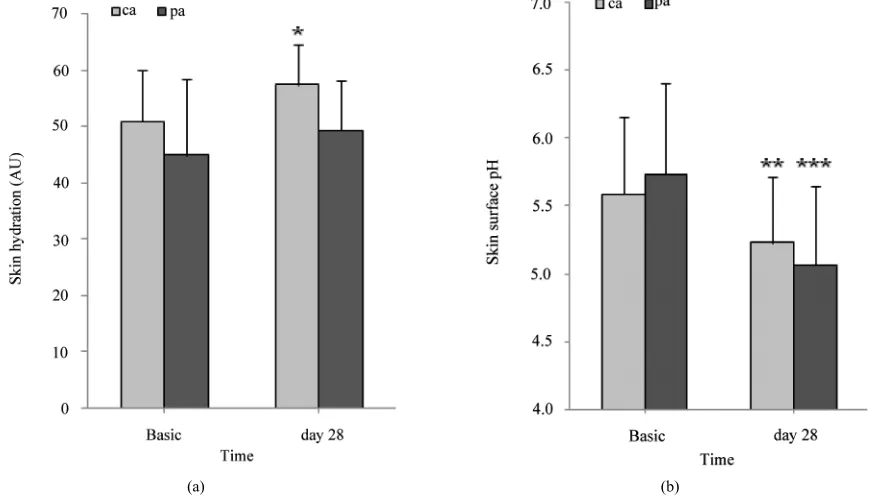
pings were employed. 16.15 ± 5.26 strippings were re- quired for the non-irritated site. Barrier integrity signifi-cantly improved after the 4-week treatment period with the pH 4.0 test product (pre-irritated site: p ≤ 0.01, and non-irritated site: p≤ 0.05) (Figure 4). Furthermore, the skin surface pH and hydration before, during and after the 4-week treatment period was assessed. Skin surface pH and “skin” hydration were measured on chronological aged (ca, medial upper arm) and photoaged (pa, forehead) skin. The skins surface pH decreased significantly by 0.3 units on the upper arm (p≤ 0.01) and by 0.6 units on the forehead (p≤ 0.01) after a 7 day treatment period with a pH 4.0 test product (Table1). Figure 5 shows skin sur-face pH and skin hydration values at day 0 (Basis) and after a 4-week treatment period (day 28). On day 28 a significant decrease in skin pH of approximately 0.4 units on ca (p≤ 0.01) and 0.7 units on pa (p≤ 0.001) was noticed (Figure 5(a)). A significant increase in skin
hy-dration was assessed already on day 7, 14 and 21 in ca (p
≤ 0.01) and pa (p≤ 0.05). Skin hydration continued to increase up to day 21 on both skin sites (Table 1). On day 28 skin hydration was increased only on the upper arm compared to the baseline value (p≤ 0.05) (Figure 5(b))
4. Discussion
An increased skin surface pH of 5.5 to 6.0 has been pre-viously described in aged skin [21-25]. In agreement with these findings, baseline skin surface pH values ranged from 5.5 to 6.0 in this study. The observed baseline pH values were significantly higher (p≤ 0.01) in the elderly (5.50 ± 0.54) compared to the young (4.98 ± 0.39) group.
[image:5.595.128.470.271.450.2]Table 1. Comparison of chronological aged (ca) with photoaged skin (pa) under 4-week treatment with a pH 4.0 cream (n = 13).
Skin hydration (AU) Skin surface pH
Time ca pa ca pa
Basis Day 7 Day 14 Day 21 Day 28
50.91 ± 9.12 59.12 ± 6.96** 60.31 ± 10.51** 58.33 ± 10.37** 57.45 ± 7.91*
45.00 ± 13.34 54.16 ± 8.84**
53.12 ± 9.28* 52.19 ± 10.56* 49.36 ± 11.27ns
5.59 ± 0.58 5.30 ± 0.49** 4.98 ± 0.76** 5.11 ± 0.47** 5.23 ± 0.42**
5.73 ± 0.68 5.18 ± 0.59** 4.88 ± 0.80** 4.96 ± 0.53*** 5.06 ± 0.53***
Values are shown as arithmetic mean ± standard deviation (SD); ns: no significance, *p≤ 0.05, *p≤ 0.01, **p≤ 0.001; Statistical significance was calculated for each time point in comparison to the related baseline with Mann-Whitney-U test; AU: arbitrary unit; ca: chronological aged skin; pa: photoaged skin.
[image:6.595.81.520.219.468.2]
(a) (b)
Figure 5. Skin surface pH and skin hydration (AU). (a) gives the mean values ± SD of skin surface pH on the untreated side as well as 28 days thereafter; (b) gives the mean values ± SD of skin hydration on the untreated side as well as 28 days thereafter. AU: arbitrary unit. *p≤ 0.05, **p≤ 0.01, ***p≤ 0.001: significantly different from day 0 (Basis).
topical products [36-38]. Today it is well known, that already a single application with tap water [2] or washing emulsions [39] leads to an increased skin surface pH up to 6 for up to 8 hours. Moreover, a long-term treatment with rinse-off [33] or leave-on [36] products can decrease the skin surface pH over weeks.
Taking these findings into account, we first assessed if the increased skin surface pH of elderly can be normalized by topical application of an acidic o/w emulsion: The skin surface pH in the elderly (5.5 to 6.0) decreases by single topical application of a pH 3.5 or pH 4.0 o/w cream to the physiological pH range of 4.5 to 5.0 over a 7-hour time period.
An important SC function is barrier integrity/cohesion (the converse of desquamation). This SC function is re-lated to the activity of the pH dependent enzymes KLK5 and KLK7, which exhibit neutral pH optima [18,19]. The
extracellular protein structures DSC1, DSG1, and CDSN are part of the corneodesmosomes. Desquamation is linked to the degradation of these protein structures by KLK5 and KLK7. The activity of KLK5 and KLK7 is regulated by the physiological SC pH of 4.5 to 5.0 by reducing, but not completely inhibiting their activities. Therefore, controlled desquamation is ensured at phy- siological SC pH [6,17]. Conversely, an increased SC pH raises the activity of KLK5 and KLK7, which leads to premature degradation of corneodesmosomes, i.e. re-duced barrier integrity/cohesion [12,26]. In the context of aged skin impaired barrier integrity is described [25, 27-28].
bar-Treatment of Aged Skin with a pH 4 Skin Care Product Normalizes Increased Skin Surface pH and 56
Improves Barrier Function: Results of a Pilot Study
rier integrity on the volar forearm of thirteen elderly (80+ years old) was significantly (p≤ 0.05 and p≤ 0.01) im-proved in comparison to the baseline barrier integrity. Our findings are in line with Fluhr et al. [40], who showed improved barrier integrity after exogenous acidification in neonatal skin, Choi et al. [25], who described an enhanced barrier integrity after acidification of moderately aged human and rodent skin and Hachem et al. [12] who showed “supernormal” barrier integrity/cohesion after SC acidification in hairless mice. In another context, Gu- nathilake et al. [29] demonstrated a correlation between low skin surface pH (between 4.5 and 5.0) and enhanced barrier functions like recovery and integrity/cohesion. Kim et al. [36] observed in young skin (20 - 35 years old) a significantly decreased TEWL after 2-week application of an acidic (pH 3) skin care product in comparison to the other products (pH 8 and pH 5). Moreover, a significantly increased TEWL after SLS-irritation on the pH 8-applied skin site was observed when compared to the pH 3- and pH 5-applied skin sites. In contrast, Buraczewska and Lodén [41] found no superiority of a pH 4.0 cream over a pH 7.5 cream. They assessed no significant differences in barrier recovery after treatment with creams of pH 4.0 and 7.5 in volunteers aged 21 to 54 years.
Between 70% and 85% [42-45] of the elderly suffer from skin problems (xerosis, pruritus) and skin diseases (contact dermatitis, other eczema, candidiasis). Barland
et al. [46] assumed a strong correlation between the ab-normal aged barrier function and the abab-normal skin con-ditions in the elderly. Because of this the development of a specific skin care for the very old (80+ years old) is required. This pilot study demonstrates that skin care for the elderly need to be adjusted in the pH range of 3.5 to 4.0. We postulate that long-term acidic skin care (pH 3.5 to pH 4.0) normalizes the increased skin pH of the eld-erly, improves the integrity of the epidermal barrier and therefore reduces skin problems in the elderly. Finally in the future it needs to be demonstrated which changes can be achieved under long-term pH 4.0 skin care treatment referring to clinical, patient relevant and physiological respective biochemical skin barrier parameters.
REFERENCES
[1] O. B. Falco and H. C. Korting, “Der Normale pH-Wert der Menschlichen Haut,” Der Hautarzt, Vol. 37, No. 3, 1986, pp. 126-129.
[2] H. Lambers, S. Piessens, A. Bloem, H. Pronk and P. Finkel, “Natural Skin Surface pH is on Average below 5, which is Beneficial for Its Resident Flora,” International Journal of Cosmetic Science, Vol. 28, No. 5, 2006, pp. 359-370. doi:10.1111/j.1467-2494.2006.00344.x
[3] D. Segger, U. Aßmus, M. Brock, J. Erasmy, P. Finkel, A.
Fitzner, H. Heuss, U. Kortemeier, S. Munke, T. Rhein- länder, H. Schmidt-Lewerkühne, W. Schneider and G. Weser, “Multicenter Study on Measurement of the Natu-ral pH of the Skin Surface,” IFSCC Magazine, Vol. 10, No. 2, 2007, pp. 107-110.
[4] H. Schade and A. Marchionini, “Der Säuremantel der Haut (Nach Gaskettenmessung),” Klinische Wochenschrift, Vol. 7, No. 1, 1928, pp. 12-14. doi:10.1007/BF01711684
[5] H. Öhman and A. Vahlquist, “In Vivo Studies Concerning a pH Gradient in Human Stratum Corneum and Upper Epidermis,” Acta Dermato-Venereologica, Vol. 74, No. 5, 1994, pp. 375-379.
[6] P. M. Elias, “Stratum Corneum Defensive Functions: An Integrated View,” Journal of Investigative Dermatology, Vol. 125, No. 2, 2005, pp. 183-200.
[7] K. T. Holland, W. J. Cunliffe and C. D. Roberts, “The Role of Bacteria in Acne Vulgaris: A New Approach,”
Clinical and Experimental Dermatology, Vol. 3, No. 3, 1978, pp. 253-257.
[8] H. C. Korting, “Das Säuremantelkonzept von Marchioni und die Beeinflussung der Resident-Flora der Haut durch Waschungen in Abhängigkeit vom pH-Wert,” In: O. Braun-Falco and H. C. Korting, Ed., Hautreinigung mit Syndets, Springer Verlag, Berlin, 1990, pp. 93-103. [9] H. Kurabayashi, K. Tamura, I. Machida and K. Kubota,
“Inhibiting Bacteria and Skin pH in Hemiplegia: Effects of Washing Hands with Acidic Mineral Water,” American Journal of Physical Medicine and Rehabilitation, Vol. 81, No. 1, 2002, pp. 40-46.
doi:10.1097/00002060-200201000-00007
[10] H. C. Korting, A. Lukacs, N. Vogt, J. Urban, W. Ehret and G. Ruckdeschel, “Influence of the pH-Value on the Growth of Staphylococcus epidermidis, Staphylococcus aureus and Propionibacterium acnes in Continuous Cul-ture,” Zentrallblatt für Hygiene und Umweltmedizin, Vol. 193, No. 1, 1992, pp. 78-90.
[11] T. Mauro, W. M. Holleran, S. Grayson, W. N. Gao, M. Q. Man, E. Kriehuber, M. Behne, K. R. Feingold and P. M. Elias, “Barrier Recovery is Impeded at Neutral pH, Inde-pendent of Ionic Effects: Implications for Extracellular Lipid Processing,” Archives of Dermatological Research, Vol. 290, No. 4, 1998, pp. 215-222.
doi:10.1007/s004030050293
[12] J. P. Hachem, D. Cumrine, J. Fluhr, B. E. Brown, K. R. Feingold and P. M. Elias, “pH Directly Regulates Epi-dermal Permeability Homeostasis, and Stratum Corneum Integrity/Cohesion,” Journal of Investigative Dermatol-ogy, Vol. 121, No. 2, 2003, pp. 345-353.
doi:10.1046/j.1523-1747.2003.12365.x
[13] W. M. Holleran, Y. Takagi, G. Imokawa, S. Jackson, J. M. Lee and P. M. Elias, “Beta-Glucocerebrosidase Activity in Murine Epidermis: Characterization and Localization in Relation to Differentiation,” Journal of Lipid Research, Vol. 33, No. 8, 1992, pp. 1201-1209.
Per-meability Barrier,” Journal of Clinical Investigation, Vol. 104, No. 12, 1999, pp. 1761-1770. doi:10.1172/JCI5307
[15] M. Schmuth, M. Q. Man, F. Weber, W. Gao, K. R. Fein-gold, P. Fritsch, P. M. Elias and W. M. Holleran, “Per-meability Barrier Disorder in Niemann-Pick Disease: Sphingomyelin-Ceramide Processing Required for Nor-mal Barrier Homeostasis,” Journal of Investigative Der-matology, Vol. 115, No. 3, 2000, pp. 459-466.
doi:10.1046/j.1523-1747.2000.00081.x
[16] Y. Takagi, E. Kriehuber, G. Imokawa, P. M. Elias and W. M. Holleran, “Beta-Glucocerebrosidase Activity in Mam- malian Stratum Corneum,” Journal of Lipid Research, Vol. 40, No. 5, 1999, pp. 861-869.
[17] P. Ovaere, S. Lippens, P. Vandenabeele and W. Declercq, “The Emerging Roles of Serine Protease Cascades in the Epidermis,” Trends in Biochemical Science, Vol. 34, No. 9, 2009, pp. 453-463. doi:10.1016/j.tibs.2009.08.001
[18] M. Brattsand and T. Egelrud, “Purification, Molecular Cloning, and Expression of a Human Stratum Corneum Trypsin-Like Serine Protease with Possible Function in Desquamation,” The Journal of Biological Chemistry, Vol. 274, No. 42, 1999, pp. 30033-30040.
doi:10.1074/jbc.274.42.30033
[19] E. Ekholm and T. Egelrud, “Expression of Stratum Cor- neum Chymotryptic Enzyme in Relation to Other Mark-ers of Epidermal Differentiation in a Skin Explant Model,” Experimental Dermatology, Vol. 9, No. 1, 2000, pp. 65-70. doi:10.1034/j.1600-0625.2000.009001065.x
[20] C. Caubet, N. Jonca, M. Brattsand, M. Guerrin, D. Ber-nard, R. Schmidt, T. Egelrud, M. Simon and G. Serre, “Degradation of Corneodesmosome Proteins by Two Serine Proteases of the Kallikrein Family, SCTE/KLK5/ hK5 and SCCE/KLK7/hK7,” Journal of Investigative Dermatology, Vol. 122, No. 5, 2004, pp. 1235-1244.
doi:10.1111/j.0022-202X.2004.22512.x
[21] A. Zlotogorski, “Distribution of Skin Surface pH on the Forehead and Cheek of Adults,” Archives of Derma-tological Research, Vol. 279, No. 6, 1987, pp. 398-401.
doi:10.1007/BF00412626
[22] P. Thune, T. Nilsen, I. K. Hanstad, T. Gustavsen and H. Lovig Dahl, “The Water Barrier Function of the Skin in Relation to the Water Content of Stratum Corneum, pH and Skin Lipids. The Effect of Alkaline Soap and Syndet on Dry Skin in Elderly, Non-Atopic Patients,” Acta Der-mato-Venereologica, Vol. 68, No. 4, 1988, pp. 277-283. [23] K. P. Wilhelm, A. B. Cua and H. I. Maibach, “Skin Aging.
Effect on Transepidermal Water Loss, Stratum Corneum Hydration, Skin Surface pH, and Casual Sebum Content,”
Archives of Dermatology, Vol. 127, No. 12, 1991, pp. 1806-1809.
[24] M. Q. Man, S. J. Xin, S. P. Song, S. Y. Cho, X. J. Zhang, C. X. Tu, K. R. Feingold and P. M. Elias, “Variation of Skin Surface pH, Sebum Content and Stratum Corneum Hydration with Age and Gender in a Large Chinese Population,” Skin Pharmacology and Physiology, Vol. 22, No. 4, 2009, pp. 190-199. doi:10.1159/000231524
[25] E. H. Choi, M. Q. Man, P. Xu, S. Xin, Z. Liu, D. A. Crumrine, Y. J. Jiang, J. W. Fluhr, K. R. Feingold, P. M. Elias and T. M. Mauro, “Stratum Corneum Acidification Is Impaired in Moderately Aged Human and Murine Skin,” Journal of Investigative Dermatology, Vol. 127, No. 12, 2007, pp. 2847-2856. doi:10.1038/sj.jid.5700913
[26] J. W. Fluhr, J. Kao, M. Jain, S. K. Ahn, K. R. Feingold, and P. M. Elias, “Generation of Free Fatty Acids from Phospholipids Regulates Stratum Corneum Acidification and Integrity,” Journal of Investigative Dermatology, Vol. 117, No. 1, 2001, pp. 44-51.
doi:10.1046/j.0022-202x.2001.01399.x
[27] R. Ghadially, B. E. Brown, S. M. Sequeira-Martin, K. R. Feingold and P. M. Elias, “The Aged Epidermal Perme-ability Barrier. Structural, Functional, and Lipid Bio-chemical Abnormalities in Humans and a Senescent Murine Model,” Journal of Clinical Investigation, Vol. 95, No. 5, 1995, pp. 2281-2290. doi:10.1172/JCI117919
[28] J. Blaak, D. Lüttje, S. M. John and N. Y. Schürer, “Irrita-bility of the Skin Barrier: A Comparison of Chronologi-cally Aged and Photoaged Skin in Elderly and Young Adults,” European Geriatric Medicine, Vol. 2, No. 4, 2011, pp. 208-211. doi:10.1016/j.eurger.2011.05.011
[29] R. Gunathilake, N. Y. Schurer, B. A. Shoo, A. Celli, J. P. Hachem, D. Crumrine, G. Sirimanna, K. R. Feingold, T. M. Mauro and P. M. Elias, “pH-Regulated Mechanisms Account for Pigment-Type Differences in Epidermal Bar-rier Function,” Journal of Investigative Dermatology, Vol. 129, No. 7, 2009, pp. 1719-1729.
doi:10.1038/jid.2008.442
[30] H. Dickel, T. M. Bruckner, S. M. Erdmann, J. W. Fluhr, P. J. Frosch, J. Grabbe, H. Loffler, H. F. Merk, C. Pirker, H. J. Schwanitz, E. Weisshaar and J. Brasch, “The ‘Strip’ Patch Test: Results of a Multicentre Study towards a Standardization,” Archives of Dermatological Research, Vol. 296, No. 5, 2004, pp. 212-219.
doi:10.1007/s00403-004-0496-x
[31] M. Kober, “Bestimmung des Hautoberflächen-pH bei Probanden: Methodik und Ergebnisse im Rahmen Klini- scher Studien,” In: O. Braun-Falco and H. C. Korting, Ed.,
Hautreinigung mit Syndets, Springer Verlag, Berlin, 1990, pp. 57-66.
[32] R. Gfatter, P. Hackl and F. Braun, “Effects of Soap and Detergents on Skin Surface pH, Stratum Corneum Hydra-tion and Fat Content in Infants,” Dermatology, Vol. 195, No. 3, 1997, pp. 258-262.
[33] A. O. Barel, R. Lambrecht, P. Clarys, B. M. Morrison Jr. and M. Paye, “A Comparative Study of the Effects on the Skin of a Classical Bar Soap and a Syndet Cleansing Bar in Normal Use Conditions and in the Soap Chamber Test,” Skin Research and Technology, Vol. 7, No. 2, 2001, pp. 98-104. doi:10.1034/j.1600-0846.2001.70208.x
[34] H. M. Gunathilake, G. M. Sirimanna, and N. Y. Schurer, “The pH of Commercially Available Rinse-off Products in Sri Lanka and Their Effect on Skin pH,” Ceylon Me- dical Journal, Vol. 52, No. 4, 2007, pp. 125-129.
Treatment of Aged Skin with a pH 4 Skin Care Product Normalizes Increased Skin Surface pH and Improves Barrier Function: Results of a Pilot Study
58
Braun-Falco, “Differences in the Skin Surface pH and Bacterial Microflora Due to the Long-Term Application of Synthetic Detergent Preparations of pH 5.5 and pH 7.0. Results of a Crossover Trial in Healthy Volunteers,” Acta Dermato-Venereologica, Vol. 70, No. 5, 1990, pp. 429- 431.
[36] E. Kim, S. Kim, G. W. Nam, H. Lee, S. Moon and I. Chang, “The Alkaline pH-Adapted Skin Barrier Is Dis-rupted Severely by SLS-Induced Irritation,” International Journal of Cosmetic Science, Vol. 31, No. 4, 2009, pp. 263-269. doi:10.1111/j.1468-2494.2009.00491.x
[37] S. Stenzaly-Achtert, A. Schölermann, J. Schreiber, K. H. Diec, R. Rippke and S. Bielefeldt, “Axillary pH and In-fluence of Deodorants,” Skin Research and Technology, Vol. 6, No. 2, 2000, pp. 87-91.
doi:10.1034/j.1600-0846.2000.006002087.x
[38] R. R. Wickett and C. M. Trobaugh, “Personal Care Prod-ucts,” Cosmetics & Toiletries, Vol. 105, No. 7, 1990, pp. 41-46.
[39] A. Post, M. Gloor and W. Gehring, “Über den Einfluss der Hautwaschung auf den Haut-pH-Wert,” Dermatologische Monatsschrift, Vol. 178, No. 5, 1992, pp. 216-222. [40] J. W. Fluhr, M. Mao-Qiang, B. E. Brown, J. P. Hachem,
D. G. Moskowitz, M. Demerijan, M. Haftek, G. Serre, D. Crumrine, T. M. Mauro, P. M. Elias and K. R. Feingold, “Functional Consequences of a Neutral pH in Neonatal
Rat Stratum Corneum,” Journal of Investigative Derma-tology, Vol. 123, No. 1, 2004, pp. 140-151.
doi:10.1111/j.0022-202X.2004.22726.x
[41] I. Buraczewska and M. Lodén, “Treatment of Surfac-tant-Damaged Skin in Humans with Creams of Different pH Values,” Pharmacology, Vol. 73, No. 1, 2005, pp. 1-7.
[42] S. Beauregard and B. A. Gilchrest, “A Survey of Skin Problems and Skin Care Regimens in the Elderly,” Ar-chives of Dermatology, Vol. 123, No. 12, 1987, pp. 1638- 1643. doi:10.1001/archderm.123.12.1638
[43] S. Ward, “Eczema and Dry Skin in Older People: Identi-fication and Management,” British Journal of Community Nursing, Vol. 10, No. 10, 2005, pp. 453-456.
[44] K. Weismann, R. Krakauer and B. Wanscher, “Prevalence of Skin Diseases in Old Age,” Acta Dermato-Venere- ologica, Vol. 60, No. 4, 1980, pp. 352-353.
[45] R. A. Norman, “Geriatric Dermatology,” Dermatologic The- rapy, Vol. 16, No. 3, 2003, pp. 260-268.
doi:10.1046/j.1529-8019.2003.01636.x
[46] C. O. Barland, P. M. Elias and R. Ghadially, “The Aged Epidermal Permeability Barrier: Basis for Functional Abnormalities,” In: P. M. Elias and K. R. Feingold, Ed.,