Journal of the Statistical and Social Inquiry Society of Ireland Vol. XXVII, Part I
ACCESS AND ADMISSION CHARGES TO MUSEUMS: A CASE STUDY OF THE NATIONAL MUSEUM*
JOHN O'HAGAN and CHRISTOPHER DUFFY Trinity College, Dublin
(read before the Society, 20 January 1994)
1. INTRODUCTION
With some notable exceptions, museums have received little attention in the economics literature1. The paper by Peacock and Godfrey (1974) looked at the economics of museums and galleries, with the later work by Frey and Pommerehne (1989) doing likewise but from the perspective of institutional economics. The work of Hendon (1979) was managerial in focus and was concerned with the issue of efficiency in the allocation of museum resources.
In recent years the research emphasis appears to have been more on the description and analysis of the audiences for museums. The National Bureau for Economic Research in the United States, though, commissioned work on the economics of museums (see Feldstein, 1991) with the focus mainly on tax policy and its impact on museum funding. In the burgeoning literature on non-profit organisations, museums have also received some attention (see Di Maggio, 1986). Two polemical pieces, with an economics slant, on the role of museums are the books by Banfield (1984) and Grampp (1989).
The Banfield and Grampp books raised issues concerning the funding of museums, something that has received considerable attention in recent years in the UK and that is likely to surface in Ireland in the coming year or so as the national cultural institutions consider the issue of whether or not to introduce charges. The principle of free admission to national cultural institutions, especially museums, has prevailed in Britain and Ireland for over two centuries2. Charges to the British Museum were
proposed as far back as 1784, and again in 1929. Charges were actually introduced there in 1974, but abandoned three months later after a change of government. The pressure to introduce charges has resumed, especially now that charges have been introduced in the National History Museum in London and in many branches of other national museums in Britain as well as in several national museums in Continental Europe3.
Some fundamental questions concerning the nature and role of a national museum need addressing before the issue of admission charges can properly be addressed. With this in mind, Sections 2 and 3 of this paper will link back to the earlier work cited above and look again at some of the important questions raised therein. These relate to the functions of museums in general and what the raison d'etre of a national museum is and how it relates to these functions4. It will be seen in that discussion that a key objective of a national historical museum (which is what the National Museum in Ireland, the National Museum in Denmark and the British Museum in London are), and indeed of similar national institutions, is the achievement of a satisfactory level of access to the collections of the museum and a consideration of this issue forms the subject matter of the next two sections of the paper. In Section 4 it will be asked what is meant by a satisfactory level of access, while Section 5 will examine the available evidence in relation to access to the National Museum of Ireland. The question of charging for entry to the Museum is then fully discussed in Section 6, both in terms of the experience with charging for entry to similar institutions in Ireland to date and in terms of how, if at all, it would impact on the goal of access. Section 7 concludes the paper.
2. FUNCTIONS OF A MUSEUM5 Definition
Museums may be viewed as part of a group of institutions which constitute the heritage sector, a sector which also includes for example historic houses and libraries. In many cases the borderline between the various types of institution in the sector is less than clear-cut. Moreover, within the museum subsector itself there are many different types of museum covering a wide variety of subjects such as history, art, science, crafts etc, which leads one to question what, if anything, they have in common.
with professional staff, which owns and utilises tangible objects, cares for them, and exhibits them to the public on some regular schedule". He cites the International Council of Museums as defining a museum as an establishment in which objects are the main means of communication. This implies an interaction between the objects and museum visitors and indeed it could be argued that the functions of a museum originate in the distinctive nature of this interaction. Hendon (ibid, p28) also quotes the Council as defining a museum as "a permanent establishment administered in the public interest with a view to conserve, study, exploit by various means and, basically, to exhibit, for the pleasure and education of the public, objects of cultural value".
Functions
The definitions above are useful in that they implicitly define the main functions of a museum, which is the subject of more explicit discussion in a number of papers. In these discussions there appears to be considerable agreement on the main functions of a museum, although various authors present these functions differently, or emphasise different aspects of the operation of a museum.
Parkhurst (1975) identifies four purposes of a museum, namely collecting, preserving, presenting and elucidating. Hendon (1979) states that museum outputs are so diverse that services cannot be satisfactorily defined, yet he identifies six potentially-satisfying experiences which museums provide: education, in the sense of both formal classes and education through exhibition; scholarship, meaning the use of collections for study; recreation; a moral experience; an aesthetic experience; and satisfaction for what he calls status-conscious people. A report on museum services in Ireland (see Institute of Professional Civil Servants, 1973) identified three categories of activities undertaken by a national museum: services for the public, research and publication, and preservation. By services for the public was meant general services such as display and exhibition and more specific services such as information to schools. Preservation relates to both acquisition and conservation.
Arising out of the above, six quite separate functions of a museum can be identified, on the following lines.
(i) Acquisition. This refers to the acquisition of materials for the museum's collections. These may be acquired through fieldwork, donations or purchase.
(iii) Research. This refers to research on the collections of the museum, either by museum staff or scholars given access to the museum's collections. It includes the uncovering of the information which is relevant to an understanding of the objects, the recording of information relevant to the collections, and the making of catalogues of the collections.
(iv) Exhibition/Display. This means providing the material which is conserved or preserved with a public space and using this space to mount either temporary or permanent displays/exhibitions.
(v) Access. This entails allowing the general public access to view the displays/exhibitions.
(vi) Education. This involves a lot more than access, in that there is also some effort to educate and inform people (a) when in attendance by way either of formal classes or more informal exhibition-related activity and (b) when not in attendance by way of information, especially for schools, communicated through slides, booklets, videos and so on. The museum may also contribute through its collections to the development of art and design in a country6. Moreover, the major museums may also have a further educational function in terms of an international liaison role and the training/educating of curators of other institutions.
Interrelationship of functions
The above functions are closely interrelated. The first function, acquisition, is basic in that it provides the core material for a museum, namely its contents. All other functions are dependent on it, since there can be no preservation, research, exhibition, access or education, without collections. Preservation/conservation, in turn, is essential if the material acquired is to be kept intact for present and future generations. Research is an integral part of the functions of preservation and conservation. It is also a necessary component of the exhibition/display and educational functions, in that it provides the information and understanding necessary for these functions to be carried out effectively.
national museums which are publicly funded on the basis of being primarily educational in nature (see later). Education, as mentioned, may be aimed either at a general or a specialised audience. Formal education in the sense of lectures, classes, special access to the collections for scholars, and schools-related activity is generally aimed at a smaller audience than informal education. Included in the latter are guided tours, video cassettes, and exhibition-related information, intended mainly to enhance the experience of those in attendance.
In viewing a museum as a firm, therefore, it is clear that it does not simply perform a single function but is best viewed as a complex institution which performs many separate but closely-interrelated functions. While the functions above are interrelated, this does not mean, as shall be seen, that every museum necessarily performs them all. Also, while many of these functions complement one another, in practice conflicts do arise between the pursuit of these various functions.
3. PURPOSE OF A NATIONAL MUSEUM National Identity and Origins
The primary purpose, in our opinion, of the different functions of a museum outlined earlier as they apply to a national historical museum such as the National Museum in Ireland is to enhance and inform people's understanding and awareness of a nation's historical origins and 'roots', in all its dimensions, and thereby to contribute to the formation of a sense of national identity and belonging among its people. This is the raison d'etre of a national historical museum, which implies that its output, as experienced through the different functions it performs in this regard, is almost wholly public (in the economist's sense of the term) and thereby that it should be almost totally, if not entirely, funded by the state. Its output is in many ways a classic example of a public good, that ranks with the much-used textbook examples of national defence and lighthouses.
These items sometimes may have a very large sale value but no use value. It is unlikely, though, that most individuals would discard interesting artefacts relating to the earlier part of their own or their childrens5 lives, or the lives of their forebears, even though they might only look at these objects a few times in their lifetime, if at all, and for the remaining period keep some of them locked away. Moreover, the value of these items, in relation to household/individual income, may be much greater than that of the collections of a national museum when related to the country's national income. The difficulty is that different people have greatly varying preferences regarding what and how much should be retained and preserved, in relation to artefacts both of a personal and national nature. This implies that people's willingness to pay for a national museum will vary greatly, something of course that applies to all public goods and not just a national museum. Other Purposes
An often-stated purpose of a national museum is to enhance the international standing and therefore prestige of the nation. This argument, however, is simply an extension of that listed above. Using the analogy of the individual again, if someone sold, or worse still discarded, artefacts of major family interest they would suffer the obloquy of other family members and probably the strong disapproval of those friends who get to know about it. The reason, as stated above, is that most individuals appear to value the collection and retention of interesting personal and historical artefacts and frown on those who do not share these values. Some people or nations, therefore, may retain artefacts simply because others whose opinions they value do so. This, of course, is not a separate argument for retaining artefacts of personal or national significance, but derives from the prior fact that the majority of people/nations appear to derive utility from so doing.
Implications for Functions of a National Museum
The above implies that the key role of a national museum is contributing to the formation of a sense of national identity and belonging. Does this throw light on the weightings that might be attached to the different functions of a national museum? The functions of a museum differ depending on the type of museum in question8. The reason for this may be sought in the weightings of functions in different types of museums. Many commercial museums (e.g. wax museums) focus primarily on exhibition and display, but do not engage to any great extent in research and education. The latter functions are emphasised to varying degrees by different museums, but where there is large public funding involved, as there is with national museums, these functions usually are very prominent and indeed should be, given the primary purpose of a national museum.
Museums which provide the full range of functions may be considered to provide an array of outputs/services, many of the benefits from which, such as those from the research and education services, may be public in nature. For museums with a large emphasis on these aspects of their activities, and this includes all national museums, then clearly their output could be, as mentioned, wholly 'public' in nature. Some museums do not supply this array of services and may be viewed essentially as providing a recreational experience, the benefits from which are largely private in nature. It is clear then that a national museum, including the National Museum of Ireland must provide the full range of functions outlined earlier, but that does not tell us how these functions are to be weighted.
The functions of acquisition, preservation and research are central to a national museum and, indeed, in relation to acquisition in many countries artefacts of national significance are de jure deemed to be the property of the national museum regardless of who found them or on what property they were found. These items often require extensive research before they can be properly identified and authenticated by museum staff. There are limits, obviously, to a policy of acquiring, preserving and researching artefacts of national significance. To use the analogy of the individual again, no one is going to keep every bus ticket or gas bill they or their ancestors ever purchased, or every piece of furniture they ever used. The reason is obvious, suitable storage space is limited and costs money, as does a system to keep track of these objects. Besides, there is no point in storing these artefacts if there is little prospect that you or your progeny will ever want to look at them again. So it is with a national museum, the selection of items to keep and discard often being one of the most difficult tasks for a nation in this regard.
the services and collections of the museum then it cannot meet its primary purpose of contributing to the formation of a sense of national identity and belonging9.
4. ACCESS: MEASUREMENT
The interesting point resulting from the above, especially in relation to the educational function, is that many people could have access to the services of a national museum, without actually attending and physically seeing the collections. Is it possible, then, for a national museum to inform and educate the public with regard to its collections without having physical access to these collections? It is certainly the case that a national museum can meet its primary purpose through communication other than providing physical access to its collections, but if the latter was not provided the question of whether or not it is then a museum arises10. Related to this is the issue of why preserve the artefacts at all, once the relevant research and documentation has been completed, if they are never going to be on display for the public. A high level of physical access for the public to the museum's collections, therefore, is often seen as the ultimate measure of the effectiveness of a national museum's operation. In many ways it is the only measure of the effectiveness of a museum that is available. Therein, however, lies the danger, as a national museum performs the many other functions listed earlier, and, even in the area of access, as mentioned, there is the wider concept of access to its services as opposed to its collections, a concept that is not at all captured in attendance figures.
Notwithstanding the above, participation rates are frequently used as a surrogate or indirect measure of access to a museum, of which there are two types, aggregated and disaggregated11. In the aggregate they refer to the percentage of the population which visited the national museum in a given time period. In other words they refer to the level of attendance at the national museum in the country as a whole. This measure does not, as mentioned, take any account of the fact that many people may have access to the services of the museum, even though they may not physically visit the museum. It also takes no account of the 'quality' of the visit, as measured perhaps by length of visit or some other similar indicator. Last, even accepting the measure, there is no objective way of knowing what level of participation is 'satisfactory'.
In most studies it is the disaggregated figures which are considered to be most relevant to the issue of access (see Di Maggio et al, 1978), thereby emphasising the importance of the distribution of participation (e.g. by socio-economic or geographical composition) within an aggregate percentage rather than the aggregate itself. This is puzzling, as the disaggregated figures are of secondary concern if the aggregate figures are at an unacceptably low level. For example, if only one per cent of the population have attended the museum in the last year, say, then surely the disaggregated figures are almost irrelevant? In this sense museum surveys which show the disaggregated figures for museum attendance in a particular time period (the most common type of survey undertaken) are less important than national surveys which discover the aggregate level of attendance at museums.
In terms of disaggregated participation figures, there are two main types of equality which are relevant to the present study, equality between different socio-economic groups and equality between different geographical areas. Lack of equality in either of these respects is often cited as proof of elitism within the museum industry, which would be deemed all the more unacceptable in the light of their public funding. The importance of disaggregated participation rates, however, depends on which definition of equal access is being used.
The term equality is used in a variety of ways to convey a number of different things. Equality of opportunity implies the absence of discrimination in the economic system, which in the context of this discussion suggests that all individuals should have an equal and unbiased possibility of attending the national museum. This is an ex ante concept, concerned with equal access given present preference structures and thereby is compatible with a highly unequal pattern of participation. Equality of outcome on the other hand is an ex post concept and is concerned with equality in the final distribution of resources, i.e. in this context equality in participation rates. If the government is concerned with equality of opportunity then the disaggregated participation figures are of little relevance, whereas clearly if equality of outcome is the objective then they are a critical indicator of success or otherwise in meeting this objective.
The above leaves a number of questions unresolved. First, what variation in the level of participation would constitute an unacceptable level of inequality? Second, what is an acceptable level for the aggregate rate of participation? In relation to both of these questions the position pertaining in other similar countries may be a guideline. Other factors with regard to participation rates are the time horizon, as there may be strong life-cycle effects in museum attendance, and the frequency of attendance. Third, how should the aggregate figures be disaggregated? Last, while it was indicated above that equality of outcome may be the objective in relation to museum attendance, there is still the possibility that equality of opportunity is the relevant criterion, which as mentioned implies that the participation measures to be looked at in the next section have little if any relevance.
5. ACCESS: THE EVIDENCE
In this section extensive use is made of a survey which was carried out in 1986 and which has not been analysed to date. The survey was of museum-visiting patterns among Irish adults, and it was conducted by a market research company for the Department of the Taoiseach. Although information was sought on attendance at other museums and galleries, the focus of the survey was on attendance at two branches of the National Museum, 'the' National Museum (NM) (the Kildare Street branch) and the Natural History Museum (NHM) (the Merrion Square branch). The survey involved participation in the market research company's Barometer survey, which is based on a nationally representative sample of 1,200 adults with fieldwork distributed across 60 separate sampling locations throughout the country. All interviewing took place in the home and eligibility for interview was established on the basis of quota controls relating to sex, age and social class within area, matching known demographic characteristics of the total adult population. Standard quality controls were applied at all levels of the survey and these included a postal check, manual editing of all questionnaires and logic checks at the analysis stage. The results of the survey, then, are likely to be very accurate, although dated perhaps. The latter should not, however, be a serious problem as the level and pattern of museum attendance is unlikely to have varied significantly since then.
Aggregate Figures
one-third of adults had attended, compared to less than a quarter of those interviewed in the case of the NHM.
Table 1 Percentage of Total Population who had Visited Museums or Galleries in Ireland
Venue
National Museum Natural History Museum Both
Neither
Base =1,202
Percent 35 24 21 62
Venue
National Gallery A Folklife Museum Hugh Lane Gallery Royal Hospital Castletown House
Percent 22
16 10 9 7
Source: Behaviour and Attitudes Marketing Research (1986).
These results may be compared with the level of attendance at museums or galleries other than these two museums. The National Gallery proved to be the most popular of the other institutions, with 22 per cent of those interviewed having visited it. The category with the next highest attendance, 16 per cent, was a folklife museum, a composite category and not a single institution. No other museum registered more than ten per cent attendance. Most remarkable of all is the finding that almost two-thirds of those interviewed had never visited any major museum or gallery. It is also of interest that no other museum in Ireland had recorded as high a level of attendance as either branch of the National Museum.
14 15 38 28 5 423 17 14 37 25 6 286
Table 2 Percentage of those Attending the National Museum (NM) and the Natural History Museum (NHM) by Recency of Visit
Time period NM NHM Within the past year
Between one and two years Between two and ten years Over ten years
Cannot remember / do not know Base =
Source: As for Table 1.
[image:12.415.36.383.375.507.2]The final issue discussed in relation to the level of attendance is the frequency of attendance, the main results on which are summarised in Table 3. This shows that on average those who had attended the museum did so on 3.5 occasions. The average number of visits, however, is not a useful summary statistic since it gives no indication of the overall distribution of attendance. Thus, it may be seen that for one-third of visitors, visiting the NM is a once-off event. At the other end of the scale 21 per cent of visitors at the NM had visited more than four times (excluding do not know responses), and 10 per cent had visited more than ten times. Relating the figures to the total number interviewed, only seven per cent had visited the NM more than four times, the corresponding figure for ten or more times being 3.4 per cent.
Table 3 Percentage of Visitors to the NM and the NHM According to the Number of Visits
Number of visits NM NHM One
Two Three Four Five to nine Ten or more
Do not know / cannot recall Average number of visits
Base= _ _ _ — Source: As for Table I.
It is clear that the museum does not appear to achieve a high level of participation, which in turn raises two issues. The first is that since there is no stated target level of attendance it is impossible to ascertain whether or not the participation level recorded is 'sufficient' or 'adequate'. The fact that almost twice as many people had
never attended the Museum as had attended, though, must raise some doubt concerning the adequacy of access to the NM. The second issue concerns the reasons for this? To answer this question the non-attendees would need to be interviewed and not just the Museum audience, a major drawback of the survey being used here.
Socio-economic and Geographical Composition
[image:13.417.27.373.374.495.2]Table 4 shows that there were marked differences in the incidence of visiting between socio-economic groups. As may be seen, there was a sharp and steady decline in the incidence of visiting as one moves from the A/B group to the F50-group. Those in the A/B group had an incidence of visiting which was six to seven times greater than that for the F50- group. In the A/B group in fact seven out of ten had at some time visited the NM, whereas only little over one in ten of the F50- had ever visited. The pattern of participation by socio-economic group is even more evident when one considers those who had never visited either branch of the Museum or who had visited both. A similar pattern emerges in each case, with 52 per cent of the A/B group having visited both and only five per cent of the F group having done so. This means that somebody from the A/B group is approximately ten times more likely to have visited both branches of the Museum than somebody from a farming background. Putting it differently, almost three-quarters of those in the A/B group had visited one or other of the NM and NHM, whereas less than a third of the D/E group and only one in five of the F50 groups had done so.
Table 4 Percentage of those from Different Social Groups who had Visited the NM and NHM
Social group NM NHM Neither Both All visitors
A/B Cl C2 D/E F50+
F50- 11 7 80 5 B a s e - 423 286 745 252 Source: As for Table I.
There was little difference in visiting patterns between social groups when recency of visiting was considered, though differences did emerge when frequency of visiting was considered. Those from farming who had visited the Museum had substantially lower frequency of attendance than any of the other groups, but between these groups there was no marked difference.
35 70 50 36 28 18
24 55 34 27 16 7
62 27 46 60 70 80
Table 5 shows the attendance levels for visitors from different regions of the country who had visited the NM and the NHM. It is clear that the attendance pattern for Dublin is considerably different to the rest of the country. As much as 65 per cent of those from Dublin had visited the NM, whereas the next highest percentage was only 33 per cent and the figure for rural ConnaughtAJlster was as low as 13 per cent. In fact the table shows that 84 per cent of those from rural areas had never visited either branch of the Museum and the vast majority of those who had visited from this area had done so more than a year previously. There appears to be an almost inverse relationship between distance from Dublin and attendance at the Museum. Moreover, those from Dublin who did attend did so much more frequently, reinforcing the case that there appears to be substantial geographical inequality of access to the Museum.
Table 5 Percentage from Different Regions who had Visited the NM and the NHM
Region Base= NM NHM Neither Both All visitors
Dublin
Rest of Leinster
Urban Connaught/Ulster Urban Munster
Rural Munster
Rural Connaught/Ulster Source: As for Table 1.
6. ADMISSION CHARGES
The Case for Admission Charges
Given that access for the public is such an important function of a national museum, the question arises as to whether or not this access must be provided at a zero admission charge? In the past the answer to this question would have been quite definitely in the affirmative, but charges to national museums, at least for adults, are now quite commonplace. Several countries including Ireland have not introduced such charges, but the pressure from some quarters to do so has not abated.
If the output of a national museum is, as suggested above, a public good, then standard economic analysis would suggest that it should be paid for out of general taxation and not, even partly, by admission charges. The benefits of a public good, though, such as the output of a national museum are not evenly spread and in principle, if a Lindahl type tax option were feasible, people would pay different amounts towards its provision. In particular, it may be argued that the benefits of
attending the museum are extra to the benefits that arise from the other functions of a museum and that people should pay for these extra benefits. This is especially true given (a) that providing access to the public involves significant extra cost for a museum in terms of security/supervisory staff and other non-wage costs such as heating and lighting and (b) that the level of attendance at national museums tends to be both low and uneven across different socio-economic groups. The latter, as seen, is certainly borne out in the Irish case. There are other advantages to charges. Their imposition could make museum staff much more accountable and responsive to the wishes of the public than is the case with zero charges (complaints from attendees are much more likely to be voiced and heeded when they are paying directly for the cost of entry), and their imposition could lead to a reduction in the number of people who, because there is a zero cost to entry, use a visit to the museum to 'shelter from the elements' or 'pass the time' (activities that have nothing to do with the functions of a museum), visitors who can on occasion greatly reduce the enjoyment of the museum for others.
Pricing Options
Discussions on whether or not to introduce admission charges are often conducted as though it were a straight choice between free admission and compulsory fixed charges. The reality is that there is a variety of pricing options between these two extremes. The range of charging options is broader for museums, since they are non-profit, than for private firms and they are able to utilise methods of payment that would not usually be considered acceptable for a commercial organisation. Under a system of free admission there is no entrance fee and no donations box where the individual may make contributions. This system applies in very few museums as almost all museums today have at the very minimum a donations box. With the latter, two main variations are possible, either no stipulated level of voluntary donation or a suggested level or range of donations. The former operates in the National Gallery in Ireland, whereas the latter applies in for example St Patrick's Cathedral. An extension of this system is to insist on some payment, but to leave the level of payment up to the individual. A desired level may or may not be indicated. The main attraction of these systems of charging is that they attempt to exact payment according to willingness and ability to pay, allowing those who can least afford it to enter free of charge if necessary. The benefit may be more prosaic, though, in that it could be argued that it allows a museum director opposed to charges to placate those pressing for charges without actually introducing any!
weeks of the year; frequent user and/or family/group tickets; a basic entrance charge, with extra charges for specific exhibitions; and special membership schemes, such as 'friends of the museum'.
The above implies that there is a number of different ways in which admission charges can be introduced, a fact that can be used, as will be seen later, to overcome many of the objections to the introduction of such charges.
Admission Charges in Ireland
Table 6: Percentage of Visitors According to Reaction to Different Admission Charges in the National Museum
Reaction
Extremely good value Very good value Fairly good value Fairly poor value Very poor value Don't know 50p 49 30 3 1 8 4 75p 39 29 13 4 12 4 lOOp 15 35 19 6 21 4 150p 4 14 13 8 52 4 200p 2 5 14 5 71 4 250p 0 2 5 7 81 4 300p 0 2 4 3 87 4 Source: Behaviour and Attitudes Marketing Research (1986a).
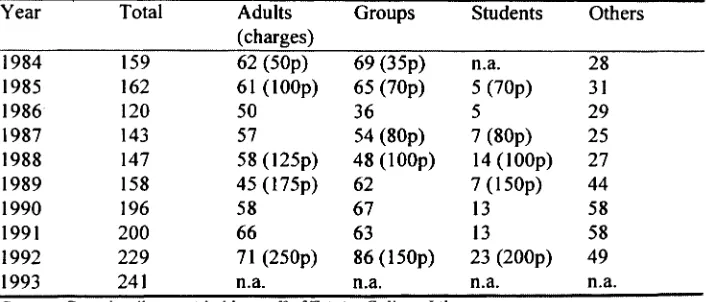
Surveys on willingness to pay are inevitably hypothetical. For this reason it may be useful to look at two case studies where charges have been actually introduced. The first of these is the Long Room at Trinity College in Dublin, where after a policy of free admission for many years charges were introduced. In 1981 a voluntary stipulated donation of 50p was introduced. The rationale behind this move was to provide additional sources of revenue to fiind the activities of the manuscripts, early printed books, and conservation sections of the Library. The response to this voluntary contribution was considered inadequate, and in April 1983 a fixed mandatory charge, with exemptions for certain categories of attendees, was introduced, to run for the tourist season only, i.e. from April to October inclusive. The Library authorities were already aware that the Library attracted a large number of visitors, as evidenced by the large number of free explanatory leaflets taken by visitors, and it was felt that a modest fee would not deter attendance and yet bring significant extra income for the Library.
Table 7 Attendance (000s) and Prices at Long Room, 1984-1993 (May to September inclusive)
Year 1984 1985 1986 1987 1988 1989 1990 1991 1992 1993 Total 159 162 120 143 147 158 196 200 229 241 Adults (charges) 62 (50p) 61 (lOOp) 50 57 58 (125p) 45(175p) 58 66 71 (250p) n.a. Groups 69(35p) 65(70p) 36 54 (80p) 48 (lOOp) 62 67 63 86(150p) n.a. Students n.a. 5(70p) 5 7 (80p) 14(100p) 7(150p) 13 13 23 (200p) n.a. Others 28 31 29 25 27 44 58 58 49 n.a. Source: Data kindly provided by staff of Trinity College Library.
Estimate for 1993 based on data for April to August inclusive.
Why should the above be the case? The first reason is that in response to introducing charges the Library made a significant number of improvements to the services it offered visitors, most notably in 1992 when major refurbishment took place and an exhibition room was added. Thus, the 'product' improved over the period, partly because the introduction of charges made it possible, and in response to this the number of attendees increased adding further to revenues.
Second, one of the main categories of visitor to the Long Room is overseas tourists, especially in the summer months to which the data above apply. Over the period in question, the number of such visitors to Dublin increased significantly, from around 0.76 million in 1984 to 0.89 million in 1988. There was a classification change in 1989 and as such the figures for the later years may not be comparable with earlier years: the number of overseas visitors to Dublin, using the new classification, was 1.15 million in 1989 and this had risen to just under 1.4 million in 1992. This large increase in overseas visitors to Dublin certainly explains some of the increase, in the face of large price increases, in numbers attending the Long Room. This is especially so given that the admission charge as a proportion of the total vacation expenditure of overseas visitors is very small, a situation where the customer is traditionally less sensitive to price (see Blatterberg and Broderick, 1991).
Charges to the Treasury were introduced in September 1986 and operated throughout the year from 1987 to 1990 inclusive. Admission on a Tuesday, however, was free and was observed by Museum staff as being the busiest day for visitors. The charges introduced were as follows: adults lOOp, students 50p, children 30p, family ticket 200p, and OAPs free, with group rates applying at 75p for adults and 25p for children.
[image:19.424.25.380.366.434.2]Table 8 outlines the level of attendance by paying adult visitors, students, children and families. (The number of people, just over 1,000 in 1990, paying a group rate was almost insignificant and contrasts with the experience of the Long Room in this regard.) Overall, it is clear that significant numbers were prepared to pay a charge into the Treasury and that over time the number increased considerably. May to September were the peak months for visits to the Treasury, with more than two-thirds of adult and student visits occurring in these months. It is likely that many of these were domestic visitors since in the case of the Long Room many foreign tourists pay as part of a group, a category that was notable in its absence in the case of the Treasury. It is clear that the Long Room, though, is a much greater visitor attraction than the Treasury with almost 500 thousand paying visitors over the course of a year to the Long Room compared to only 55 thousand in the case of the Treasury. This may be partly explained by the location of the Long Room, set as it is in the heart of the historic campus of Trinity College, but it would be difficult to argue that the Long Room contains more important or significant historical artefacts than the Treasury and the surrounding areas of the National Museum13.
Table 8 Attendance (000s) at the Treasury, 1987 to 1990
Year 1987 1988 1989 1990
Adults 13.2 21.7 19.0 31.3
Families 4.3 10.0
9.1 12.0
Students 3.6 2.9 6.3 9.7
Children 1.4 1.7 1.8 1.8 Source: Data kindly provided by National Museum.
The number for families is got by multiplying the number of tickets sold by four.
Conclusion
What effects would museum charges have on the finances of the National Museum? Clearly, they are intended only to cover the variable costs of providing the access and, as such, would constitute a small proportion of the total income of the museum. One indirect effect of charges on the museum's income is that they may affect other income sources, such as private donations or public subsidy. These effects are a source of real concern to those managing national museums but they may arise from poor information/management rather than charges per se, as the museum must make it clear that part of the revenue from the charges is to cover extra services for the attendees that would not exist in the absence of charges, the experience at the Long Room being a good example in this regard. Indeed, if new services are not introduced then one would expect the public subsidy to be reduced to match the increase in income from admission charges. In the case of the NM, sources of income and bequests other than from the state are not significant.
The possible effects of charges on the level and pattern of attendance have received most attention in this debate. It was seen above that in the case of the two pricing experiments in Ireland for which data were presented there has not been any adverse reaction on attendance as a result of the introduction of charges, quite the contrary in fact. It could be argued that these were special cases, especially the Long Room where most of the attendees are overseas visitors, and that it is not a national museum in the sense defined earlier. There is patchy and rather inconclusive evidence on the effects of charges on the level of attendance at national museums in other countries. Besides, much of the work that this evidence is based on does not take account of the fact that attendance consists of two dimensions, number of visits and duration of visits. Thus, while, for example, the number of visits may have fallen in some UK museums as a result of the introduction of charges this may be more than compensated by an increase in the duration of these visits14. A related factor is that even with zero admission charges, the level of attendance at many national museums in a given time period, such as a year, tends to be low, as seen in the case of Ireland five per cent of the adult population. A variation of this theme is that charges may lead to a disproportionate fall in attendance by the lower-income groups. It is a myth, however, to suggest that zero admission charges bring about an even distribution in attendance across income classes, as all of the available evidence, including that for Ireland as seen, suggests that museum attendance is predominantly undertaken by the higher-income groups. The reasons for the high non-attendance among the lower-higher-income groups have to be found somewhere other than cost of entry. Besides, even if cost was a factor, there is nothing to stop a national museum having, as many do, reduced entry charges for certain groups such as children and senior citizens or zero charges for all on certain days of the week.
not get to the real causes of the low and uneven attendance that is prevalent in many national museums with zero admission charges.
7. CONCLUDING COMMENTS
This paper has made a number of contributions to the economic analysis of museums, both in terms of developing existing literature and in presenting new statistical data on museums in Ireland. The paper also sought to provide a coherent framework within which the issue of admission charges to national museums might be discussed.
Section 2 of the paper showed the importance of analysing the interrelationship of functions which a museum performs. The implications of this are best seen in Section 3 which discussed the purpose of a national museum. Here it was argued that the plethora of purposes often ascribed to museums can be misleading, and that a national historical museum has a well-defined purpose, namely that of contributing to a sense of national identity. This in turn has implications for the functions which a museum performs, and in particular for the question of access to museums, the topic of discussion in Section 4.
It was argued that attendance figures are imperfect surrogate measures of access, since it is possible to have access to the services of a museum without necessarily physically attending. While disaggregated participation rates are frequently the focus of most museum surveys, it was suggested that aggregate figures are arguably more important. The usual distinction between geographical and socio-economic equality was supplemented by analysing participation rates in terms of equality of opportunity and equality of outcome.
Section 5 presented the first-ever museum survey data for Ireland. These data showed that just over one in three Irish adults had ever visited either branch of the National Museum, although less than one in twenty had done so in the previous twelve months15. For one-third of visitors the visit was a once-off event, with only one-fifth visiting more than four times. As might be expected attendance is unevenly distributed in socio-economic terms. Almost three-quarters of those in the A/B group had visited either branch of the Museum, whereas just over a quarter of those in D/E group had done so. Likewise geographical attendance is uneven, with an inverse relationship between distance from Dublin and attendance at the Museum.
Footnotes
1. This is in marked contrast to the performing arts, where the pioneering work by Baumol and Bowen (1966) led to a spate of work on this topic, including that by O'Hagan and Duffy (1987) in relation to Ireland.
2. This viewpoint was underlined by Sir Hans Sloane when he left his collection to the British nation in order that it might "be kept for the use and benefit of the public who may have free access to view and peruse the same." (Quoted in Rankine, 1987.) As a result of this generous gesture the British Museum was founded in 1753.
3. The National Museum in Copenhagen is a shining example of what is possible in relation to standards of presentation and service, something which some believe is not unrelated to the introduction of charges there some years ago. 4. These sections draw extensively on a forthcoming paper by the authors. See
O'Hagan and Duffy (1994).
5. This section draws extensively on Duffy (1991).
6. This certainly applies to the National Museum in Ireland.
7. The same applies to the role of shops and restaurants in museums, i.e. while they may generate useful additional revenue they have nothing to do with the primary purpose of a museum.
8. In this regard it might be useful to identify four types of museum, as done by one of the referees. These are (i) comprehensive/national, (ii) regional, (iii) specific/activity-related (e.g. agriculture, automobiles) and (iv) commercial display. The bulk of this paper refers only to the first of these. We do not examine the relationship between national and regional/municipal museums in Ireland, something that might usefully be the subject of further research.
9. It is important to note that the presence in one space of a range of artefacts imparts a significance to the collection which individually they would not have if they were situated in different sites. This applies with particular force if they are so scattered in various countries that the evolution of the sense of national identity and belonging is lost entirely. We are indebted to one of the referees for this point.
10. Computer documentation and mechanised retrieval will deliver vast improvements in quality of service and access. However, "all the evidence indicates that the public demand for the real thing, with all its power and veracity, is increasing and is insatiable". (See Neil Cossons, 'What Should We Preserve', The London Independent, 16 October 1993.)
11. For a fuller discussion of this issue, see O'Hagan and Duffy (1989).
13. A factor here may be that the Long Room is more prominently advertised in tourism literature. School visits do not appear to have occurred on any significant scale to the Treasury, although these may have taken place on Tuesdays when no entry charge applied.
14. According to a survey in the UK a sizeable majority consider it reasonable for museums to charge for admission, and most would be prepared to pay adult entrance fees of between £1 and £2. At the same time, concessions and exemptions for certain categories of visitors are widely accepted. See Touche Ross (1989).
References
Arts Council, 1983. Audiences, Acquisitions and Amateurs: Participation in the Arts in Ireland, Dublin Lansdowne Market Research.
Ban field, Edward C , 1984. The Democratic Muse: Visual Arts and the Public Interest, New York, Basic Books.
Baumol, William J. and William C. Bowen, 1966. Performing Arts: The Economic Dilemma, New York, Twentieth Century Fund.
Blatterberg, Robert C. and Broderick, Cynthia J., 1991. "Marketing of Art Museums", in Feldstein (1991), pps. 327-346.
Clarke, Rosemary, 1991. "Government Policy and Art Museums in the United Kingdom", in Feldstein (1991), pps. 271-326.
Di Maggio, Paul, 1986. "Non-profit Organisations in the Production and Distribution of Culture", in Walter W. Powell (ed.), The Non-profit Sector: A Research Handbook, New Haven, Yale University Press, pps. 195-220.
Duffy, Christopher, 1991. "The Public Funding of Museum: A Case Study of the National Museum of Ireland". (PhD thesis, University of Dublin, Trinity College.) Feldstein, Martin (ed.), 1991. The Economics of Art Museums, Chicago, University of Chicago Press.
Frey, Bruno S. and Pommerehne, Werner W., 1989. Muses and Markets: Explorations in the Economics of the Arts, Oxford, Basil BlackwelL
Grampp, William D., 1989. Pricing the Priceless: Art, Artists, and Economics, New York, Basic Books.
Hendon, William S., 1979. Analyzing an Art Museum, New York, Praeger.
Institute of Professional Civil Servants, 1973. Museum Service for Ireland, Dublin, Irish Museum Association.
Meyer, Karl E., 1979. The Art Museum: Power, Money, Ethics, New York, William Morrow.
O'Hagan, John and Christopher Duffy, 1989. "Equal Access to the Performing Arts: An Ill-Defined Goal", in C. Richard Waits et al. (eds.), Cultural Economics: A European Perspective, Ottawa, Association of Cultural Economics.
O'Hagan, John and Christopher Duffy, 1994. "National Museums: Functions, Costs and Admission Charges", European Journal of Cultural Policy (forthcoming).
Parkhurst, Charles, 1975. "Art Museums: Kinds, Organisations, Procedures and Financing", in S. Lee (ed.), On Understanding Art Museums, Englewood Cliffs, NJ, Prentice Hall, pps. 68-97.
Peacock, Alan and Godfrey, Christine, 1976. "The Economics of Museums and Galleries", in Mark Blaug (ed.), The Economics of the Arts, London, Martin Robertson, pps. 189-204.
Rankine, Jean, 1987. "Museum Charges", National Art Collection Fund Magazine, Christmas, p. 23.
DISCUSSION
Andrew Burke: This paper presents a case for introducing charges to museums. The argument is built on the results of the 1986 Behaviour and Attitudes Marketing Research Survey relating to attendance at museums. The authors base their analysis on the data relating to museum visitors' willingness to pay entrance fees. The paper is concise and well presented, but the paucity of data to which the authors have access greatly constrains the depth of analysis that is possible. In the light of this constraint the authors do a commendable and revealing analysis of the economics of museums.
However, it remains to be considered whether the conclusions of the paper should be regarded as sufficient for policy action. Since the data is inadequate it implies that other information needs to be examined. It is on this basis that the analysis needs to be extended, (even on a qualitative basis), in order to fully consider the ramifications of a policy move to introduce charges to museums. The authors consider the option of charges to museums solely on the basis of visitors' willingness to pay, but do not take into consideration how such a policy move may affect other sources of revenue to museums. In particular, it is becoming increasingly popular for museums to raise revenue through corporate sponsorship. The gains to the sponsor is the goodwill and prestige of being associated with the museum and hence the scale of this benefit is positively related to the volume of visitors the museum receives over the sponsorship period. If museum charges were to be introduced, it is likely that the number of visitors to museums may decline and hence, the gains to the sponsor may be eroded. If this turns out to be the case then it is quite likely that an introduction of museum charges would reduce sponsorship revenue. It is paramount that such a trade-off is taken into consideration when assessing the merits of museum charges. Similar trade-offs also exist which are likely to show a negative relationship between the level of museum charges and revenues received from museum gift shops and restaurants. It is true that the authors argue that attendances at Trinity College Long Room did not decline when charges were introduced, but this is an observation across time when other influences did not remain constant, such as the level of tourism, growth of Irish National Income, change in price of other leisure activities and therefore, it is impossible to claim that there is no negative relationship between museum charges and museum attendances on the basis of this observation.