FORMULATION AND EVALUATION OF SUSTAINED RELEASE
FLOATING TABLETS OF VALSARTAN
*Amrit Khanal, Mina Bhatta, Sajan Maharjan, T. Suguna and C. Sowmya
Department of Pharmaceutics, Raghavendra Institute of Pharmaceutical Education and
Research, Anantapur, A.P, India.
*Raghavendra Institute of Pharmaceutical Education and Research, K.R. Palli cross,
Chiyyedu (PO), Anantapur.
ABSTRACT
Objective: The objective of the study was to develop and evaluate the
gastro retentive floating drug delivery system (GFDDS) of Valsartan to
achieve prolonged release in the treatment of hypertension and
myocardial infections. Methods: The sustained release floating
formulations were prepared by direct compression method using
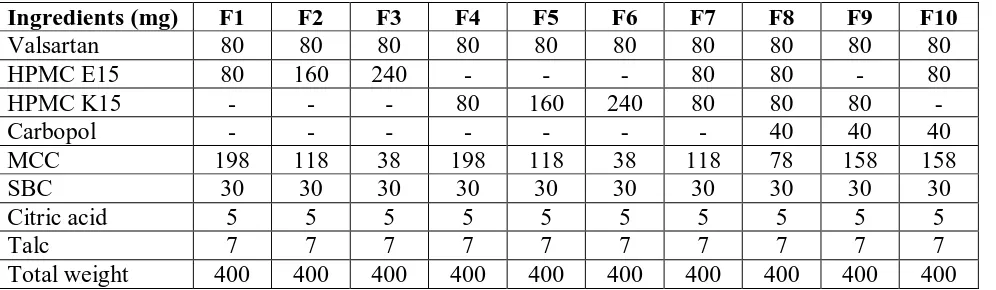
HPMCE15, HPMCK15 and Carbopol polymers in various ratios and
gas generating agents (Sodium bicarbonate and Citric acid) MCC.
FT-IR and DSC studies indicates absence of any interaction between
Valsartan, polymers and excipients. Results: The tablets were also
evaluated for its hardness, friability and other in vitro evaluation tests. All parameter complied with IP limits. The invitro drug release profiles obtained for F8 prepared by combination of HPMCE15, HPMCK15, Carbopol showed lesser
floating time(FLT) 3minutes and prolong floating duration and was a controlled release
characteristic(98.87%) for 20 hours. The drug release data were analyzed as per zero order
(0.951) and first order (0.997) models. Drug release was diffusion controlled and followed
first order kinetics. Non-Fickian diffusion was the drug release mechanism from all the
tablets formulated. Conclusion: It can be concluded that the gastro retentive floating tablets
of valsartan were prepared and evaluated for once daily administration.
KEYWORDS: Floating drug delivery system, Valsartan, HPMC, Carbopol, Floating time,
Floating lag time.
Volume 6, Issue 2, 579-593. Research Article ISSN 2277– 7105
*Corresponding Author
Amrit Khanal
Raghavendra Institute of
Pharmaceutical Education
and Research, K.R. Palli
Cross, Chiyyedu (PO),
Anantapur. Article Received on 12 Dec. 2016,
Revised on 02 Jan. 2017, Accepted on 23 Jan. 2017
INTRODUCTION
Oral drug delivery is considered most natural, uncomplicated, convenient and safe due to its
ease of administration, patient acceptance and cost–effective manufacturing process.[1] The
oral conventional drug delivery system are designed for immediate release of drug for rapid
absorption even though this system has limitations[2,3] as requirement of frequent
administration of drugs which has short half-life may leads to poor patient compliance due to
chance of missing dose, difficulty to attain steady state concentration, chance of
overmedication and under medication as the as the fluctuation of steady state concentration,
precipitation of adverse drug reaction of drugs which have narrow therapeutic index
whenever overmedication occurs. In order to overcome the drawbacks of conventional drug
delivery systems, several technical advancements have led to the development have led to the
development of controlled drug delivery system that could revolutionize method of
medication and provide a number of therapeutic benefits.[4]
It is evident from the recent scientific and patient literature that an increased interest in novel
dosage forms that are retained in stomach for a prolonged and predictable period of time
exists today in academic and industrial research groups. One of the most feasible approaches
for achieving a prolonged and predictable drug delivery in the GI tract is to control the gastric
residence time (GRT), i.e. gastro retentive dosage form (GRDFs or GRDS). GRDFs extend
significantly the period of time over which the drugs may be released. They not only prolong
dosing intervals, but also increase patient compliance beyond the level of existing controlled
release dosage form.[7,8]
Various approaches have been pursued to increase the retention of an oral dosage form in the
stomach. These systems include: floating systems, bio adhesive systems, swellable and
expandable systems, high density systems.[9,10]
Floating dosage systems[11] form important technological drug delivery systems with gastric
retentive behavior and offer several advantages in drug delivery. These advantages include:
improved drug absorption because of increased GRT and more time spent by the dosage form
at its absorption site, controlled delivery of drugs, delivery of drugs for local action in the
stomach, minimizing the mucosal irritation duo to drugs, by drug releasing slowly at
controlled rate, treatment of gastrointestinal disorders such as gastro-esophageal reflux,
simple and conventional equipment for manufacture, ease of administration and better patient
Valsartan is an angiotensin-receptor blocker that is used for variety of cardiac conditions
including hypertension, diabetic nephropathy, heart failure, myocardial infraction and
coronary artery disease. It acts by angiotensin II receptor. Valsartan has specific absorption
window at upper gastro intestinal tract so that drug in dissolved form must be available
before this region therefore there is a need for developing delivery system that release the
drug at the right time, at the specific site. Therefore a gastro retentive extended release drug
delivery system was developed in order to retain the drug product in stomach for extended
period of time. Development of such dosage form involves a combination of high viscosity
polymer and a rate controlling polymers to design floating drug delivery system.[14,15,16]
METHODOLOGY
Materials: Valsartan was obtained as a gift sample from Dr. Reddy’s laboratories,
Hyderabad, HPMC (K15 & E15), Carbopol, MCC citric acid sodiumbicarbonate talc
Hydrochloric acid and Aerosil were procured from were procured from microlabs Bangalore.
Used were of analytical reagent grade.
Methods
I) Preformulation studies
The overall objective of preformulation testing is to generate information useful to the
formulation in developing stable and bioavailable dosage forms.
Characterization of Drug: The drug is characterized for Physical appearance, Melting point,
water content by KF, hygroscopicity, density and the results were shown in table.1.
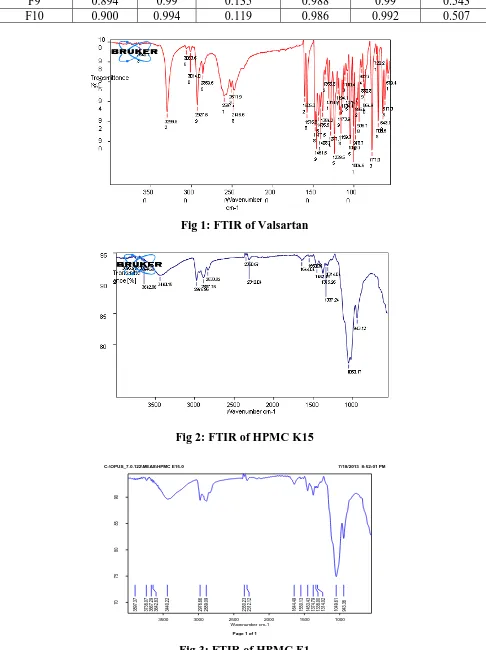
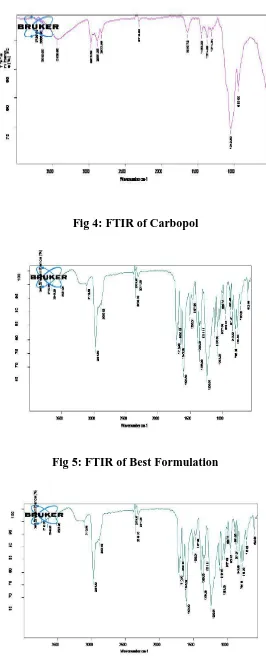
Drug excipients interaction studies: By FTIR and DSC Studies the Spectras and
thermograms were shown in fig 1-5. and fig 6 respectively.
Formulation of floating tablets
Tablets were fabricated by direct compression technique. Valsartan and all other ingredients
were individually passed through sieve #60 and mixed thoroughly by triturating up to
15minute. The powder mixture was lubricated with talc and tablet were prepared by direct
Pre compression characteristics
Pre compression characteristics studies including Bulk density, Tapped density, Carr’s index,
Hausner’s ratio and Angle of repose were performed for the crude drug, Valsartan resulted as
table no 2.
Carr’s index
Carr’s index was calculated by using following formula and result was shown in table no.2 Carr’s Index= (Tapped density-Bulk density) × 100/ Tapped density.
Hausner’s Ratio
It is measurement of frictional resistance of the drug. The ideal range should be 1.2 –1.5. It
was calculated by using following formula and result was shown in table no 2.
Hausner’s Ratio=Tapped density/Bulk density
Angle of repose (θ)
Angle that can be obtained between the free surface of a powder heap and horizontal plane.
The angle of repose was measured by funnel method and result was shown in table no.2.
The angle of repose is given as,
θ=tan-1
(h/r)
Where
θ= angle of repose
h= height of the heap
r=radius of the base of the heap
Post compression characteristics
Determination of physicochemical parameters
Hardness test
Hardness test was performed by using the procedure given in USP Monsanto hardness tester
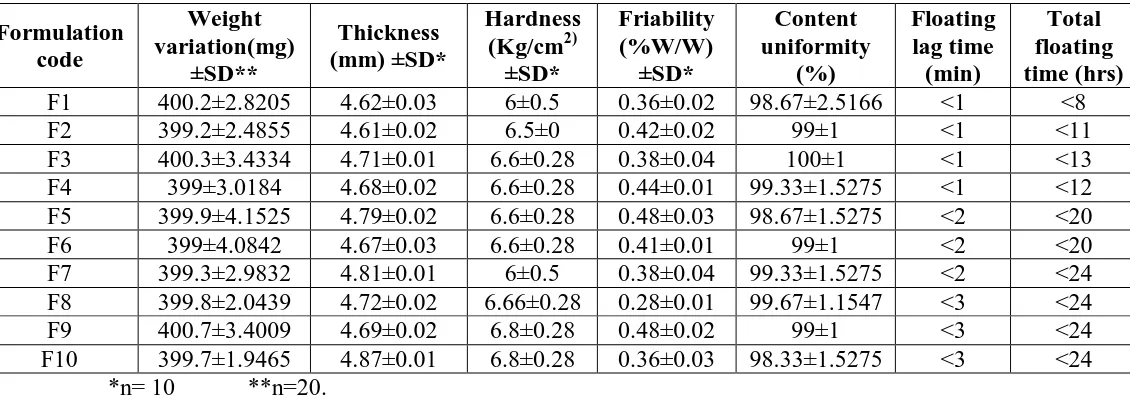
was used for the determination of hardness of 6 tablets and result was given in table no.3.
Friability
Twenty tablets were accurately weighed and placed in the friabilator (Roche’s Friabilator)
Weight variation
20 tablets were selected randomly from the lot and weighed individually to check for weight
variation as per USP and result was given in table no.3.
Disintegration test
Tablets were taken and one tablet was introduced in each tube disintegration apparatus
and placed in 1litre beaker containing water at 370±20C and the time of disintegration
was recorded according USP and result was shown in table no.3.
Drug content
20 tablets were randomly selected from the batch, weighed and powdered. Powder equivalent
to100 mg of valsartan was weighed and transferred in to a 10ml volumetric flask and volume
made up with 0.1N HCl. Further 1 ml of the above solution was diluted to 10ml with
0.1NHCl and absorbance of resultant solution was observed at 270nm as per USP and result
was shown in table no.3.
Thickness
10 tablets were measured for their thickness and diameter with vernier calipers and result was
given in table no.3.
In-vitro dissolution study
Dissolution was done for each of sustained release floating tablets of valsartan in 0.1N HCl
for 24 hours. Invitro release studies were carried out by using United States Pharmacopoeia (USP) Dissolution Testing Apparatus II (Paddle method). The dissolution test was performed
using 900 ml of 0.1N HCl (pH 1.2) at 37±0.5oC. 50 rpm was maintained, 5 ml of sample was
withdrawn at predetermined time intervals for 24 hours and the same volume of the fresh
medium was replaced. The absorbance of the withdrawn sample was measured
spectrophotometrically at a wavelength at 270nm and cumulative percentage drug release
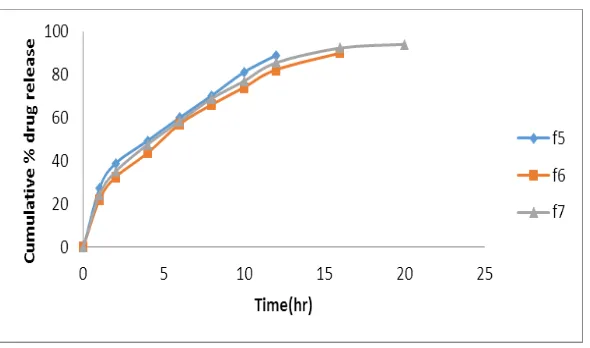
was calculated using an equation obtained from a standard curve and graph were shown in
figure 6 to 9.
Determination of floating parameters
a) In-vitro buoyancy test
time required for the tablet to rise to the surface and float was considered as the floating lag
time.
b) Swelling index
Swelling of hydrophilic polymer such as Hydroxy Propyl Methyl Cellulose greatly depends
upon the contents of the stomach and the osmolarity of the medium. These eventually
influence the release, slowing action and the residence time. For each formulation, one tablet
was weighed and placed in a beaker containing 200 ml of distilled water. After each hour the
tablet was removed from beaker and weighed again up to 8 hours. The percentage weight
gain by the tablet was calculated by using the formula and result was given in table no.4.
Swelling index (S.I) = {(Wt‐Wo)/Wo} x 100.
Where, S.I. = swelling index
Wt = Weight of tablet at time t
Wo = Weight of tablet before immersion.
RESULTS AND DISCUSSION
In the Preformulation studies, Characteristic of drug compatibility studies were performed
using FTIR spectrophotometer. The FTIR spectrum of pure drug and physical mixture of
drug and polymer were studied. The peaks obtained in the spectra’s of each formulation
correlated with the peaks of pure drug spectrum. So it was concluded that no significant
difference in peak pattern in IR spectrum of drug, polymer and the excipients exists. The
values obtained for the preformulation parameters for the formulations
F1,F2,F3,F4,F5,F6,F7,F8,F9 and F10 are tabulated in Table 5. The values for the angle of
repose were found to be in the range of 24.25 to 29.36. This indicates good flow property of
the powder blend as the concentration of HPMC E15, HPMC K15 decreases. Compressibility
index ranges between 10.1891% and 12.6161% indicating that the powder blend has the
required flow property for direct compression. Microscopic examinations of tablets from each
formulation batches have showed round shape (oval) with no cracks.
Hydrodynamically balanced tablets of Valsartan (intra‐gastric buoyant tablets) were prepared
and evaluated to increase its local action and bioavailability. In the present study ten
formulations with variable concentration of polymer (HPMC) were prepared by direct
compression and evaluated for physicochemical properties, buoyancy lag time, total floating
0.1N HCl solution at pH 1.2 at 37±0.5oC tablets float immediately and remain buoyant up
to8‐12 hours without disintegration. Floating property of the tablet is governed by both the
swelling (hydration) of the polymer when it contacts with the gastric fluid, which in turn
results in increase in the bulk volume and the presence of internal voids in the dry centre of
the tablet (porosity). These two factors are essential for the tablet to acquire bulk density < 1,
so that it remains buoyant on the gastric fluid. Hardness of the tablets was in the range of 6.5
to 6.8 ±0.28 kg/cm2. This ensures good handling characteristics of all the batches. % weight
loss in the friability test was less than 1% in all the cases, ensuring that the tablets were
mechanically stable.
All the floating tablets prepared contained the drug within 102±5% of the label claim. All the
formulated tablets (F1 to F10) passed the weight variation test as the % weight variation was
within the Pharmacopoeial limits of ±5% of the average weight. Table 4 shows the results of
physicochemical characters of Valsartan tablets. In the present study, the higher degree of
swelling and slow drug release was found for tablets of F8 containing 20% HPMC K15 and
HPMC E15. Thus, the concentration of polymer and ratio of lactose had major influence on
swelling process, matrix integrity, as well as on floating capability. Hence from the above
results it can be proved that linear relationship exists between swelling process and
concentration ratio as shown in Table 5 and Fig. 1. From the in-vitro drug profiles, it was found that drug release rate decreased as the concentration of polymers HPMC K15 and
HPMC E15 increases as shown in and Fig 7-9.
Stability studies were performed for the all formulation as per ICH guidelines for 2 months.
Dissolution testing was performed during and after study. Results showed no significant
difference after testing indicating that these formulations were stable. The percentage of drug
release and total floating time was comparatively good in Formulation F8 compared with that
of other formulations.
The analysis of drug release mechanism from a pharmaceutical dosage form is an important
but complicated process and is practically evident in the case of matrix systems. As a
model-dependent approach, the dissolution data was fitted to five popular release models such as
zero-order, first-order, diffusion and Hixson Crowell and Korsmeyer Peppas equations,
which have been described in the literature. The order of drug release from matrix systems
release from matrix systems was studied by using Higuchi equation, erosion equation and
Peppa’s-Korsemeyer equation. The results are given in Table no.7.
Table 1: Physical characterization of valsartan
Physical Properties Valsartan
Physical appearance White to partially white in color
Melting Point 116-117ºC
Water content by KF NMT 2%W/W
Hygroscopicity Hygroscopic powder
Partition Coefficient 5.8
Density (gm/cm²) 1.212
Table 2: Physical properties of blend
Angle Of repose ±SD*
Bulk Density (gm/ml) ± SD*
Tapped Density(gm/ml) ±SD* Carr’s Index(%)±SD* Hausner’s Ratio±SD*
F1 24.25±0.23 0.487±0.0202 0.5424±0.0252 10.1891±1.9083 1.1137±0.0234
F2 26.96±0.15 0.5103±0.0055 0.5704±0.0012 10.5366±0.7895 1.1211±0.0123
F3 25.58±0.34 0.4958±0.0069 0.5459±0.0051 10.2693±1.0665 1.1011±0.011
F4 28.65±0.12 0.4784±0.0068 0.544±0.0093 12.1114±0.3176 1.2041±0.1119
F5 29.36±0.15 0.5018±0.0056 0.5706±0.0009 12.0564±0.9247 1.1195±0.0418
F6 25.93±0.64 0.4983±0.0019 0.5702±0.0011 12.6161±0.3054 1.1443±0.004
F7 26.15±0.15 0.5107±0.005 0.5807±0.0014 12.0596±0.6848 1.1371±0.0088
F8 25.45±0.43 0.5203±0.0007 0.5918±0.0008 12.0914±0.2266 1.1375±0.0029
F9 26.69±0.21 0.5379±0.0031 0.6002±0.0017 10.3683±0.3794 1.1158±0.0049
F10 28.63±0.11 0.5393±0.0005 0.6011±0.0016 10.2697±0.1994 1.1144±0.0025
[image:8.595.18.583.508.707.2]*n=3.
Table 3: Physicochemical evaluation data parameters of Valsartan tablets formulations
Formulation code Weight variation(mg) ±SD** Thickness (mm) ±SD* Hardness (Kg/cm2) ±SD* Friability (%W/W) ±SD* Content uniformity (%) Floating lag time (min) Total floating time (hrs)
F1 400.2±2.8205 4.62±0.03 6±0.5 0.36±0.02 98.67±2.5166 <1 <8
F2 399.2±2.4855 4.61±0.02 6.5±0 0.42±0.02 99±1 <1 <11
F3 400.3±3.4334 4.71±0.01 6.6±0.28 0.38±0.04 100±1 <1 <13
F4 399±3.0184 4.68±0.02 6.6±0.28 0.44±0.01 99.33±1.5275 <1 <12
F5 399.9±4.1525 4.79±0.02 6.6±0.28 0.48±0.03 98.67±1.5275 <2 <20
F6 399±4.0842 4.67±0.03 6.6±0.28 0.41±0.01 99±1 <2 <20
F7 399.3±2.9832 4.81±0.01 6±0.5 0.38±0.04 99.33±1.5275 <2 <24
F8 399.8±2.0439 4.72±0.02 6.66±0.28 0.28±0.01 99.67±1.1547 <3 <24
F9 400.7±3.4009 4.69±0.02 6.8±0.28 0.48±0.02 99±1 <3 <24
F10 399.7±1.9465 4.87±0.01 6.8±0.28 0.36±0.03 98.33±1.5275 <3 <24
Table 4: Swelling index % of formulation F1 to F10 of Valsartan
Time (hrs.)
Swelling index (%)
F1 F2 F3 F4 F5 F6 F7 F8 F9 F10
1 24.55 30.45 36.56 45.83 50.83 56.32 60.49 66.56 72.5 81.21 2 31.65 37.47 48.74 56.44 62.44 66.89 69.84 75.43 80.75 94.5 4 39.33 46.12 61.85 69.12 71.84 75.12 79.45 88.24 92.82 111.4 6 44.29 57.9 75.2 77.03 84.12 89.12 91.73 101.3 121.5 128.5
8 - - - 89.12 99.03 104 107.4 119.6 130.4 155.9
[image:9.595.54.552.241.386.2]12 - - - - 109.11 - - 127.9 144.4 169.4
Table 5: Formulation trials for sustained release floating tablet of valsartan
Ingredients (mg) F1 F2 F3 F4 F5 F6 F7 F8 F9 F10
Valsartan 80 80 80 80 80 80 80 80 80 80
HPMC E15 80 160 240 - - - 80 80 - 80
HPMC K15 - - - 80 160 240 80 80 80 -
Carbopol - - - 40 40 40
MCC 198 118 38 198 118 38 118 78 158 158
SBC 30 30 30 30 30 30 30 30 30 30
Citric acid 5 5 5 5 5 5 5 5 5 5
Talc 7 7 7 7 7 7 7 7 7 7
[image:9.595.69.529.423.567.2]Total weight 400 400 400 400 400 400 400 400 400 400
Table 6: Results analyzed after 2 months of accelerated stability studies
Table 7: Release Kinetics Studies for all formulations
Formulation
R² Values n-values
Zero order
First order
Rate constant (k)in hr -1
Hixson
Crowell Higuchi Peppas
F1 0.802 0.917 0.177 0.883 0.973 0.455
F2 0.877 0.955 0.156 0.941 0.982 0.446
F3 0.917 0.988 0.145 0.934 0.992 0.448
F4 0.903 0.988 0.177 0.977 0.996 0.453
F5 0.922 0.954 0.165 0.981 0.996 0.463
F6 0.914 0.993 0.135 0.989 0.997 0.52
F7 0.856 0.992 0.142 0.970 0.984 0.474
F8 0.951 0.997 0.116 0.981 0.993 0.655
S.No Test Initial After 1 month After 2 months
1 Description Complies Complies Complies
2
Post compression parameters
a. Weight variation b.Hardness
c.Floating lag time d.Total floating time
Complies Complies Complies
3 Dissolution (In 0.1N HCl) 98.87% 98.13% 97.6%
F9 0.894 0.99 0.135 0.988 0.99 0.543
[image:10.595.53.539.78.728.2]F10 0.900 0.994 0.119 0.986 0.992 0.507
Fig 1: FTIR of Valsartan
Fig 2: FTIR of HPMC K15
38 97 .3 7 37 38 .0 7 36 67 .2 9 36 42 .8 3 34 40 .2 2 29 76 .6 6 28 89 .0 9 23 50 .2 3 23 12 .1 2 16 44 .4 9 15 50 .1 3 14 53 .4 3 13 74 .7 9 13 38 .0 0 13 14 .0 2 10 49 .6 1 94 3. 38 1000 1500 2000 2500 3000 3500 Wavenumber cm-1 70 75 80 85 90 T ra ns m itt an ce [ % ]
C:\OPUS_7.0.122\MEAS\HPMC E15.0 7/18/2013 8:52:01 PM
Page 1 of 1
Fig 4: FTIR of Carbopol
[image:11.595.160.433.77.251.2]Fig 6: DSC of best formulation
Fig 7: In vitro Drug Release Profile of formulations F1 –F4
[image:12.595.152.447.511.685.2]Fig 9: In vitro Drug Release Profile of formulations F8 – F10
CONCLUSION
The gastro retentive floating drug delivery system (GFDDS) of Valsartan to achieve
prolonged release could be prepared and the drug showed compatibility with all the
excipients. Physical parameters and in-vitro drug release studies were found to be within the
limits. Drugs release kinetics like zero-order, first order, diffusion and Hixson Crowell plots
of optimized formulation was plotted and the drug release found to be following the first
order kinetics and the area to volume of the dosage form changes with time. Stability studies
of the final formulations were performed according to ICH guidelines for 2 months and no
major changes were observed indicated that the optimized formulation was stable. It can be
concluded that the gastro retentive floating tablets of valsartan were prepared and evaluated
for once daily administration.
ACKNOWLEDGEMENTS
The authors would like to express the gratitude to Dr. Reddy’s laboratories for sending the
simvastatin as gift sample.
REFERENCES
1. Leon lachman, Herbert A. Liberman, the Theory and practice of Industrial pharmacy:
P.293-302.
2. Robinson Jr, lee V.H.L, controlled drug delivery: Fundamentals and Appilications, 2nd
edn. Marcel Dekker, New York: 1978; 24-36.
3. Brahmankar D.M, Jaiswal S.B, biopharmaceutics and pharmacokinetics a treatise, 1st ed.
4. Chein Y.W, Novel Drug Delivery Systems, 2nd ed. Marcel Dekker; New York: 1992;
4-56.
5. Banker G.S, Rhodes C.T, Modern pharmaceutics. 3rd ed. Marcel Dekker, New York:
1996; 678-721.
6. Vyas S.P, Khar R.K and Controlled Drug Delivery: Concepts and Advances, 1st ed.
Vallabh Prakashan, New Delhi: 2002; 345-376.
7. P.G. Yeole, Floating Drug Delivery System: Need and Development, Ind. J. Pharm Sci.,
2005; 67(3): 265-272.
8. Shweta Arora, Floating Drug Delivery: A Review, AAPS Pharmscitech. 2005; 47(11):
268-272.
9. Libo Yang, A New Intragastric Delivery system for the Treatment of H.Pylori associated
with gastric ulcers, Elsevier J. of controlled release., Apr 1999; 34(5): 215-222.
10.Ross and Wilson, Anatomy Physiology and Health Education. 9th ed. Churchil
Livingston, P. 295-311.
11.Wilson K.R.W, Waugh A. Anatomu and Physiology in Health and Illiness, 9th ed.
Churchill Livingstone: London: 1996; 342-345.
12.Garima Chawla, Gupta, Pharmaceutical technology, July 2003; 23(9): 39-48.
13.Desai S, Bolton S. A Floating controlled Release System: in-vitro and in-vivo evaluation,
J. Pharma. Res., 1993; 10: 1321-1325.
14.Garg S, Sharma S. Gastroretentive Drug Delivery Syatems, pharmatech, 2003; 160-164.
15.Dr.Jose, Khalid Shah, Gastroretentive Drug Delivery System, Business brief,
pharmatech., 2003; 165-173.
16.Deshpande A.A, Shah N.H, Rhodes C.T, Development of a Novel Controlled Release
System for Gastric Retention, J. Pharma. Res., 1997; 14(6): 815-819.
17.Garima Chawla A means to address regional variability in intestinal drug absorption:
Pharmtech. 2003; 234-238.
18.David S.S. The effect of density on the gastric emptying on single and multiple unit
dosage forms. J. Pharma Res., 1986; 3: 208-213.
19.H.G. Sivakumar, Floating Drug Delivery System for prolonged Gastric Residence time: A
review, Ind. J. Pharm. Edu., oct dec-2004; 311-316.
20.Timmermans J, Moes A.J. The cut off size for gastric emptying of dosage forms, J.
21.Bhavana V, Khopade A.J, Jain W.D, Shelly and Jain N.K, Targeted Oral Drug Delivery,
Indian B.Y. Choi, H.J. Park, Preparation of alginate beads for floating drug delivery
system: effect of co2 gas forming agent. J. Controlled Release, 2000; 25(6): 488-491.
22.Timmermans J, Moes A.J. The cut off size for gastric emptying of dosage forms, J.
Pharm. Sci., 1993; (82): 854.
23.Bhavana V, Khopade A.J, Jain W.D, Shelly and Jain N.K, Targeted Oral Drug Delivery,
Indian drugs., 1996; (33): 365-373.
24.Roop K. Khar, Controlled Drug Delivery, Gastroretentive system 4th edn. P. 202-203.
25.Ichikawa M, Watanabe S, Miyake Y, A new multiple-unit oral floating dosage system:
Preparation and in-vitro evaluation of floating and sustained-release characteristics, J.
Pharm. Sci., 1991; (80): 1062-1066.
26.Abubakr O. Nur S. Zhang, Captopril Floating and/or Bioadhesive Tablets: Design and
Release Kinetics, Taylor & Francis: 2000; 26(9): 965 – 969.
27.Menon A, Wolfgang A.R, Saks A. Development and evaluation of a monolithic floating
dosage form for Furosemide, J. Pharm. Sci., 1994; (83): 239-245.
28.Ozdemir N, Ordu S, Ozkan Y. Studies of floating dosage forms of Furosemide: in-vitro
and in vivo evaluations of bilayer tablet formulations, Drug. Dev. Ind. Pharm., 2000;
857-866.
29.Xux, Sun M, Floating matrix dosage form for phenaporlamine HCl based on gas forming
agent, Int. J. Pharm, 2006; 25(4): 324-332.
30.Srivastava A.K, Wadwa S. Oral sustain delivery of Atenolol from floating matrix tablets
and in vitro evaluation, Drug. Dev. Ind. Pharm., 2005; 31(45): 367-374.