FORMULATION AND EVALUATION OF CONTROLLED RELEASE
TABLETS OF BOSENTAN
Y. Vishnu Vandana*1, T. Manasa2 and G. Nookarathnam3
1
*Department of Pharmaceutical Technology, Avanthi Institute of Pharmaceutical Sciences,
Vijayanagaram, A.P: 531162.
2
Professor, Department of Pharmaceutical Technology, Avanthi Institute of Pharmaceutical
Sciences, Vijayanagaram, A.P: 531162.
3
Professor, Department of Pharmaceutical Analysis, Avanthi Institute of Pharmaceutical
Sciences, Vijayanagaram, A.P: 531162.
ABSTRACT
In the present research, an attempt has been made to formulate
controlled release matrix tablets of Bosentan. Bosentan is used to treat
pulmonary arterial hypertension (PAH). It improves your ability to
exercise and prevents your condition from getting worse. Different
formulations were prepared by using different polymers like HPMC 50
CPS, HPMC E-5, karaya gum; Avicel PH102, PVP K30, Hydroxy
Ethyl Cellulose and Talc etc. with different ratios were used in the
development of formulations. HPMC 50 CPS, HPMC E-5 and karaya
gum are used as rate controlling polymer, PVP K30 used as binder,
microcrystalline cellulose as filler. The prepared tablets were evaluated
for pre compression and post compression parameters with different
ratios. All the evaluated parameters of the formulations showed
compliance with pharmacopoeial standards. The selected formulations were subjected to
stability studies as per ICH guidelines at different temperature and humidity conditions. It
can be concluded that among all the formulations and the combinations of HPMC 50CPS,
HPMC E-5, Avicel PH102 considered as the optimized formulations in the present research
work. The optimized formulations show non-fickian diffusion mechanism of release and
other all evaluation.
KEYWORDS: Bosentan, HPMC 50 CPS, HPMC E-5, Karaya gum, Avicel PH102, PVP
Volume 6, Issue 7, 1350-1360. Research Article ISSN 2277– 7105
*Corresponding Author Y. Vishnu Vandana
Department of
Pharmaceutical Technology,
Avanthi Institute of
Pharmaceutical Sciences,
Vijayanagaram, A.P:
531162.
Article Received on 15 May 2017,
Revised on 05 June 2017, Accepted on 25 June 2017
K30 and Magnesium stearate etc.
INTRODUCTION
The controlled release system is to deliver a constant supply of the active ingredient, usually
at a zero-order rate, by continuously releasing, for a certain period of time, an amount of the
drug equivalent to the eliminated by the body. An ideal controlled drug delivery system
is the one, which delivers the drugs at a predetermined rate, locally or systemically,
for a specific period of time.
The aim of this present work is to formulate a controlled release matrix tablet of Bosentan
preparation and evaluation using various polymers such as HPMC 50 CPS, HPMC E-5 and
Karaya gum.Bosentan is a dual endothelin receptor antagonist important in the treatment of
pulmonary artery hypertension (PAH). It is licensed in the United States, the European
Union and other countries by Actelion Pharmaceuticals for the management of PAH under
the trade name Tracleer®. Bosentan is used to treat pulmonary hypertension by blocking
the action of endothelin molecules that would otherwise promote narrowing of the blood
vessels and lead to high blood pressure.
MATERIALS AND METHODS
Bosentan obtained as a gift sample from Spectrum Pharma Labs, Hyderabad, Karaya Gum
was obtained from Himedia Laboratory, Mumbai. HPMC 50 CPS, HPMC E5, PVP K30 was
obtained from Nice Chemicals Laboratory, Mumbai. Magnesium Stearate, Micro Crystalline
Cellulose and all other chemicals and solvents used are from Spectrum Pharma Labs,
Hyderabad.
Evaluation Parameters
Pre Compression Parameters
Precompression parameters include bulk density, tapped density, compressibility index and
Hausner’s ratio, angle of repose, total porosity and flow rate.
Post Compression Parameters
A. Thickness and diameter
Control of physical dimension of the tablet such as thickness and diameter is essential for
consumer acceptance and tablet uniformity. The thickness and diameter of the tablet was
B. Hardness
The Monsanto hardness tester was used to determine the tablet hardness. The tablet was held
between a fixed and moving jaw. Scale was adjusted to zero; load was gradually increased
until the tablet fractured. The value of the load at that point gives a measure of hardness of
the tablet. Hardness was expressed in Kg/cm2.
C. Friability (F)
Tablet strength was tested by Friabilator USP EF-2. Pre weighed tablets were allowed for
100 revolutions (4min), taken out and were dedusted. The percentage weight loss was
calculated by rewriting the tablets. The % friability was then calculated by,
D. Weight variation test
The weight of the tablet being made in routinely measured to ensure that a tablet
contains the proper amount of drug. The USP weight variation test was done by weighing 20
tablets individually, calculating the average weight and comparing the individual weights to
the average. The tablet meet the USP test if not more than 2 tablets are outside the
percentage limits and if no tablets differs by more than 2 times the percentage limit. USP
official limits of percentage deviation of tablet are presented in the following table,
Where, PD = Percentage deviation, W aBosentan = Average weight of tablet,
Winitial = individual weight of tablet.
E. Uniformity of drug content.
Five tablets of various formulations were weighed individually and powdered. The powder
equivalent to average weight of tablets was weighed and drug was extracted in Phosphate
buffer pH 6.8, the drug content was determined measuring the absorbance at 274nm after
suitable dilution using a UV/Visible Spectrophotometer (UV-1800).
In-vitro release study
(Paddle method)
Dissolution medium : Phosphate buffer pH- 6.8
Temperature : 37± 0.50C RPM : 50 Vol. withdrawn and replaced : 5ml every 1 hour
λ max : 274
Blank solution : Phosphate buffer pH- 6.8
Duration of study : 12 hours
Volume of dissolution media : 900ml
Procedure
The release rate of Bosentan from tablets was determined using The United States
Pharmacopoeia (USP) XXIV dissolution testing apparatus II (paddle type). The dissolution
test was performed using 900 ml of pH 1.2, for first 2 hours then in phosphate buffer pH 6.8
for rest of the hours at 37±0.50C and 50 rpm. A sample (5 ml) of the solution was withdrawn from the dissolution apparatus hourly for 12 hours and the samples were replaced with fresh
dissolution medium. Cumulative percentage of drug release was calculated.
Kinetic Analysis of In-Vitro Release Rates of Controlled Release Tablets
The results of in vitro release profile obtained for all the formulations were plotted in modes
of data treatment as follows:-
1. Zero – order kinetic model – Cumulative % drug released versus time.
2. First – order kinetic model – Log cumulative percent drug remaining versus time.
3. Higuchi’s model – Cumulative percent drug released versus square root of time.
4. Korsmeyer equation / Peppa’s model – Log cumulative percent drug released versus log
time.
Table-1: Tablet composition of different formulations of Bosentan matrix tablets
containing HPMC 50 CPS as controlled release polymer
Ingredients (mg)
Formulation Code
F1 F2 F3 F4 F5 F6
Bosentan 16 16 16 16 16 16
HPMC 50 CPS 61 56 51 46 41 36
PVP K30 10 10 10 10 10 10
Micro crystalline cellulose 35 35 35 35 35 35
Hydroxy ethyl cellulose 15 15 15 15 15 15
Metolose SR - 5 10 15 20 25
talc 5 5 5 5 5 5
Total weight(mg) 150 150 150 150 150 150
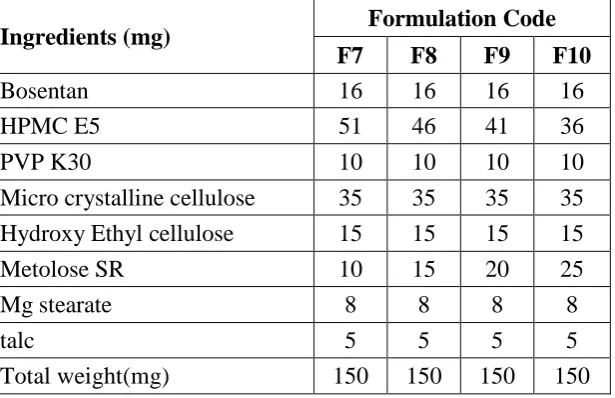
Table-2: Tablet composition of different formulations of Bosentan matrix tablets
containing HPMC E5 as controlled release polymer
Ingredients (mg) Formulation Code
F7 F8 F9 F10
Bosentan 16 16 16 16
HPMC E5 51 46 41 36
PVP K30 10 10 10 10
Micro crystalline cellulose 35 35 35 35
Hydroxy Ethyl cellulose 15 15 15 15
Metolose SR 10 15 20 25
Mg stearate 8 8 8 8
talc 5 5 5 5
Total weight(mg) 150 150 150 150
Table 3: Tablet composition of different formulations of Bosentan matrix tablets
containing karaya gum as controlled release polymer
Ingredients (mg)
Formulation Code
F11 F12 F13
Bosentan 16 16 16
Karaya gum 15 20 35
PVP K30 10 10 10
Microcrystalline cellulose 25 25 25
Hydroxy Ethyl cellulose 20 25 20
Metolose SR 51 41 31
Mg stearate 8 8 8
Talc 5 5 5
[image:5.595.145.453.163.362.2]RESULTS AND DISCUSSION
Standard curve of Bosentan
Melting Point Determination
Melting point of Bosentan was determined by capillary method. The melting point of
Bosentan was found to be in the range 198° which compiled with BP standards, indicating
purity of the drug sample.
Solubility
Bosentan was found to be more soluble in pH 6.8 phosphate buffer as compare to pH1.2
and pH 7.4 phosphate buffer, i.e. it has optimum solubility at pH 6.8 (4.87 mg/ml). The
solubility decrease to about (2.57mg/ml) at pH 1.2 and it was equal to (3.36 mg/ml) at pH
7.4.
Compatibility Study
Compatibility study is important to understand the interaction between the drug and
polymers. It saves costs and it makes easier to choose a few excipients from the long list of
excipients for a better formula.
Drug- excipient interactions play a vital role with respect to release of drug from the
formulation amongst others. FTIR techniques have been used here to study the physical
and chemical interaction between drug and excipients used. In the present study, it has been
observed that there is no chemical interaction between drug and the polymers used.
spectrum. This indicates that the drug was compatible with the formulation components.
Flow Properties
A flow property plays an important role in pharmaceuticals especially in tablet formulation
because improper flow may cause more weight variation. Values of Carr’s Index
(Compressibility) below 15% usually give rise to good flow properties but readings above
25% indicate poor flow properties. It was found that the compressibility values of the
powders were below 15% and hence they exhibit good flow characteristics.
Values of angle of repose are rarely 200 and values up to 400 indicate reasonable flow properties. Above 500however the powder flows only with great difficulties. Dynamic angle of repose measurements can be replicated with relative standard deviations of approximately
2%. They are particularly sensitive to changes in particle size distribution and to the
moisture content and they provide a rapid means of monitoring significant batch to batch
differences in these respects.
The Carr’s Index (Compressibility) of the powders was in the range of 6.68 to 12 .60.
The angles of repose of the powders were in the range of 25.390 to 28.760, which indicate a good flow property of the powders. Here the angle of repose was found to be below 400 this shows that the reasonable flow property of powders.
Evaluation of Tablets
Physical Parameters (Shape, Size, Hardness & Friability)
The punches used to compress the tablets were 9mm, spherical shaped. The shape and size of
the tablets were found to be within the limit. The hardness of the tablets was found to be in
the range of 4.10 to 4.46 Kg/cm2. Thicknesses of the tablets were found to be in the range of 3.98 to 4.24 mm. The friability of the tablets was found to be less than 1% and it was
within the range of standard specification.
Weight Variation and Drug Content
Weight variation test helps to check whether the tablet contain proper quantity of the drug.
From each of the formulations ten tablets were randomly selected and weighed. The results
are given in detail. The average weights of the tablets were found to be within the prescribed
official limits (IP).
batches were found to be in the range of 97.12 to 99.78%.
In-Vitro Release Study
All the 13 formulation of prepared tablets of Bosentan were subjected to in vitro release
studies, these studies were carried out using dissolution medium, (pH 1.2 and Phosphate
buffer pH 6.8).by using USP-2 (paddle type) dissolution apparatus. The results were
evaluated for 12 hours. As per the results of dissolution study formulations 1, 2, 3,
F-4, F-5, F-6, F-7, F-8, F-9, F-10, F-11, F-12 and F-13, showed 92.36%,82.93 %, 85.36%,
89.22%, 93.26%, 92.53%, 94.53%, 90.16%, 94.31%, 92.51%, 83.66%, 81.03%, release
respectively over a period of 12 hours.
Among all the formulation, F-5, showed 93.26%, release respectively at the end of 12
[image:8.595.93.504.355.705.2]hours.
Table 4: Percentage drug release of formulations F1-F6
Sr. No. Time
(hrs)
FORMULATION CODE
F1 F2 F3 F4 F5 F6
In acidic buffer pH 1.2
1 0 0.0 0.0 0.0 0.0 0.0 0.0
2 1 9.13 8.04 7.51 6.12 5.55 5.06
3 2 15.17 13.21 10.9 9.65 8.66 7.52
In phosphate buffer pH 6.8
4 3 19.35 18.44 17.87 16.33 15.55 14.11
5 4 23.18 22.13 21.32 20.69 19.32 18.25
6 5 32.13 31.25 29.24 28.63 27.17 25.64
7 6 42.21 40.09 37.85 35.23 33.23 30.08
8 7 56.53 55.32 49.44 47.52 44.39 41.36
9 8 72.5 69.25 59.32 58.65 43.32 54.25
10 9 81.36 75.25 70.02 69.31 67.04 63.27
11 10 92.36 89.23 85.36 78.32 72.02 71.3
12 11 89.22 84.11 80.05
13 12 93.26 89.63
Table 5: Percentage drug release of formulations F7-F13
SN. No.
Time (hrs)
FORMULATION CODE
F7 F8 F9 F10 F11 F12 F13
1 0 0.0 0.0 0.0 0.0 0.0 0.0 0.0
2 1 13.66 12.28 10.2 9.23 7.67 6.65 5.40
3 2 21.65 19.58 18.55 17.57 12.52 8.56 9.52
In phosphate buffer pH 6.8
4 3 30.98 27.56 25.23 24.31 21.55 18.23 15.28 5 4 42.50 36.88 32.63 30.63 27.32 24.56 20.33 6 5 54.58 48.26 42.53 40.58 32.23 30.67 28.07
7 6 69.37 61.33 52.47 49.5 43.92 38.57 36.01
8 7 81.56 78.23 73.14 60.27 51.27 44.01 40.54
9 8 92.53 87.41 83.12 74.28 66.5 52.21 49.23
10 9 94.53 90.16 85.23 74.22 59.59 55.44
11 10 94.31 82.51 66.54 63.61
12 11 88.26 74.14 69.02
13 12 92.51 83.66 81.03
Kinetics
Different models like Zero order, First order, Higuchi’s and Krosmeyers-peppas plots were
drawn. The regression coefficient (R2) value for Zero order, First order, Higuchi’s and Krosmeyers-peppas plots for formulation F5 were found to be 0.977, 0.813, 0.967, 0.583,
0.718(n value). The optimized formulations F-5 follow Zero order and higuchi release
mechanism
CONCLUSION
In this study matrix tablet of Bosentan were prepared by including analytic control of the
production process and preparation and isolation mixture of 1-haloacetyl-2(S)-pyrrolidine
carboxamide, using HPMC 50CPS, HPMC E-5 and karaya gum, PVP K30 polymers as
retardant. The drug-polymer ratio was found to influence the release of drug from the
formulations. It was found that increase in the concentration of HPMC 50CPS in polymeric
ratio decreases the drug release. The formulations F-5 showed good drug release with good
matrix integrity release of 93.26% at the end of 12hr so the formulation F-5 selected as the
optimized formula. The enteric coated polymer was used to avoid the drug release in stomach
because the drug is quiet unstable in stomach and the aim of the work is to release the drug
in intestine. The formulation F-5 showed good drug release with good matrix integrity.
Different parameters like hardness, friability, weight variation, drug content uniformity,
in-vitro drug release were evaluated. Based on these results formulation F-5was found to be
slope (n) value of peppas plot confirms that non-Fickian diffusion (anomalous transport) was
the main mechanism. The regression coefficient (R2) values of zero order of the optimized formulation F-5 was greater than the R2 values of first order. Thus, the drug release follows zero order release kinetics.
The results suggest that the developed controlled-release matrix tablets of B o s e n t a n
could perform better than conventional dosage forms, leading to improve efficacy and better
patient compliance. Thus the aim of this study was achieved. Further preclinical and clinical
studies are required to evaluate the efficacy of these formulations of Bosentan in the
management of hypertensive.
ACKNOWLEDGEMENT
We are thankful to the Management and Principal of Avanthi institute of pharmaceutical
sciences for continuous support for completion of my project research and also Spectrum
Pharma Research Solutions, Hyderabad for guiding me to do this entire work.
BIBILIOGRAGHY
1. Chein YW. Oral Drug delivery and delivery systems. In: Novel drug delivery systems.
Marcel Dekker, Inc., New York, 2002; 50: 3rd edition: 139-96.
2. Lachman Leon, Lieberman Herbert A. Compression coated and layer tablets.
3. In: Pharmaceutical Dosage Forms: Tablets. Marcel Dekker, Inc., New York, 2002; 1:
2nd edition: 247-84.
4. Anroop B. Nair, Hiral vyas and Ashok Kumar. Controlled release matrix uncoated tablets
of enalapril maleate using HPMC alone, Journal of Basic and Clinical Pharmacy Vol-001
Issue-002 March 2010 – May 2010.
5. Shantveer V. Salger, Lingaraj S. Danki, Abdul Sayeed, Shivanand Hiremath. Formulation
and invitro evaluation of sustained release matrixtablets of anti-hypertensive drug
propranolol hydrochloride, Scholars Research Library, Der Pharmacia Lettre, 2010; 2(5):
12-22.
6. Amit. S.Yadav, Ashok Kumar P, Vinod R, Someshwara Rao B, Suresh V Kulkarni.
Design and Evaluation of Guar Gum Based Controlled Release Matrix Tablets of
Zidovudine, Journal of Pharmaceutical Science and Technology, 2010; 2(3): 156-162.
7. Raj Kumar. Marikanti, Kiran Joshi. P, Vidya Sagar. CH, Venkateswara reddy. B, Kiran
kumar. A, Nagaraju. I, Srinivasa Rao. P1and J. Ravi kiran. Formulation and evaluation of
2010; 2(3): 746-753. ISSN No: 0975-7384.
8. Raju Manda, K Sundaramoorthy and T Vetrichelvan. Research Journal of
Pharmaceutical, Biological and Chemical Sciences Formulation and In-Vitro Evaluation
of sustained release Matrix Tabelts of Aceclofenac by using different natural polymars,
ISSN: 0975-8585 October – December 2010. RJPBCS, Page No. 279-91.
9. Santanu Ghosh and B. B. Barik. Preparation and evaluation of aceclofenac sustained
release formulation and comparison of formulated and marketed product, International
Journal of Medicine and Medical Sciences, September, 2009; 1(9): 375-382.
10.R.K.Kar, S.Mohapatra, B.B. Barik Design and characterization of controlled release
matrix tablets of zidovudine, Asian Journal of Pharmaceutical and Clinical Research,
April- June, 2009; 2: 2.
11.Ganesan V, Jayachandran DL Design and Evaluation of Matrix Tablets of Ambroxol
Hydrochloride using Guargum Research J. Pharm. and Tech. 2008; 1(4): 507-12.
12.Abdelbary GA, Tadros MI. Design and in vitro/in vivo evaluation of novel nicorandil
extended release matrix tablets based on hydrophilic interpolymer complexes and a
hydrophobic waxy polymer. Eur J Pharm Biopharm. 2008; 69(3): 1019-28.
13.Kulkarni R V, Shah A, Boppana R. Development and evaluation of xyloglucan matrix
tablets containing naproxen. Asian J of pharmaceutics, 2008; 2(2): 102-5.
14.Punna Rao Ravi, Sindura Ganga, Ranendra Narayan Saha. Design and in vitro evaluation
of Zidovudine oral controlled release tablets prepared using Hydroxy propyl methy
cellulose. Chem. Pharm. Bull. 2008; 56(4): 518-24.
15.Kyeo- re lee, Eun- jung kim, Sang- wan seo, Hoo- kyun choi. Effect of poloxamer
on the dissolution of Felodipine and preparation of controlled release matrix tablets
containing Felodipine. Arch Pharm Res. 2008; 31(8): 1023-28.
16.Amelia avachat, Vikram kotwal. Design and evaluation of matrix based controlled release
tablets of Diclofenac Sodium and chondrotin Sulphate. AAPS Pharm Sci Tech. 2007;