ISSN Online: 2333-9721 ISSN Print: 2333-9705
DOI: 10.4236/oalib.1105681 Aug. 29, 2019 1 Open Access Library Journal
Construction Quality Residential Project Based
on Artificial Neural Network
Yue Yue1, Jiaye Wu2*, Shuyang Liu1, Yingqian Zhang3
1School of Management of Sichuan University of Science & Engineering, Zigong, China
2Sichuan Shengtuo Testing Technology Co., LTD., Zigong, China
3School of Civil Engineering of Sichuan University of Science & Engineering, Zigong, China
Abstract
Engineering quality evaluation is an important part of engineering quality management. However, China has not yet formed a systematic engineering quality evaluation system. Aiming at such problems, a comprehensive evalua-tion method based on artificial neural network for residential project con-struction quality is proposed. Based on the analysis of the quality influencing factors in the construction process of residential projects, a construction quality grade index system was established. Based on the index system, the Analytic Hierarchy Process (AHP) was used to qualitatively and quantitative-ly anaquantitative-lyze various factors, combined with expert scoring. The method obtains quantitative decision-making results; the multi-index comprehensive evalua-tion method using artificial neural network and AHP method simulates the expert to evaluate the construction quality of residential buildings and com-pares the model evaluation results of construction quality with the evaluation results of experts, and analyzes artificial nerves. The case analysis of a resi-dential project was carried out to verify the effectiveness and feasibility of the method, and the superiority of the artificial neural network in comprehensive evaluation is demonstrated.
Subject Areas
Engineering Management
Keywords
Artificial Neural Network, Quality Evaluation, Analytic Hierarchy Process
1. Introduction
In recent years, China’s construction industry has experienced rapid
develop-How to cite this paper: Yue, Y., Wu, J.Y., Liu, S.Y. and Zhang, Y.Q. (2019) Construction Quality Residential Project
Based on Artificial Neural Network. Open
Access Library Journal, 6: e5681.
https://doi.org/10.4236/oalib.1105681
Received: August 8, 2019 Accepted: August 26, 2019 Published: August 29, 2019
Copyright © 2019 by author(s) and Open Access Library Inc.
This work is licensed under the Creative Commons Attribution International License (CC BY 4.0).
http://creativecommons.org/licenses/by/4.0/
DOI: 10.4236/oalib.1105681 2 Open Access Library Journal
ment, and the overall level of residential project quality has been greatly im-proved. The quality of residential projects was related to the sustained and healthy development of the country’s social economy. It is particularly impor-tant to strengthen the quality management of residential projects and overcome the common problems of residential quality. Engineering quality evaluation is an important part of project quality management. How to use scientific and rea-sonable methods to control and evaluate the quality of residential construction, to improve the overall quality level of residential projects, has become a major issue of common concern at the present stage.
Pim Polesie conducts an in-depth analysis of the status quo of engineering quality and the quality of engineering construction through the evaluation re-sults of the evaluation system, and proposes reasonable quality improvement measures [1]. At present, China has not yet formed a systematic and compre-hensive construction project quality evaluation system and model. This leads to the lack of relevant data for the personnel engaged in the quality management of construction engineering to support the evaluation and analysis of engineering quality, so that the specific measures formulated by the quality management personnel are out of touch with the actual situation, resulting in waste of re-sources and even hidden quality hazards [2]. Zhao Lingyan and Zhao Qun sys-tematically analyzed the insufficiency of AHP in construction engineering, ex-plained the process of establishing model and calculation in AHP, expounded the concept of index weight, and determined the method of determining weight coefficient by using AHP. From the consistency test results, a satisfactory result was obtained [3].
Based on the above research, this paper conducts further research on the comprehensive evaluation method of residential construction quality, optimizes the factors of residential construction quality, establishes the construction quali-ty index system of residential construction and combines AHP method and ex-pert scoring method. After obtaining the quantitative decision results, the mul-ti-index comprehensive evaluation method based on the artificial neural net-work and AHP method is used to comprehensively judge the construction quality of the residential project, and the network prediction results are obtained and the quality of the construction is judged. Finally, model evaluation results of resi-dential construction quality and the evaluation results of experts are compared and analyzed, and an example analysis of a residential project is carried out.
2. Establishment of the Quality Index System for Residential
Construction
DOI: 10.4236/oalib.1105681 3 Open Access Library Journal
reliability and accuracy. The key to solving the problem of quality control and evaluation of residential construction is to establish a feasible, comprehensive and scientific evaluation method.
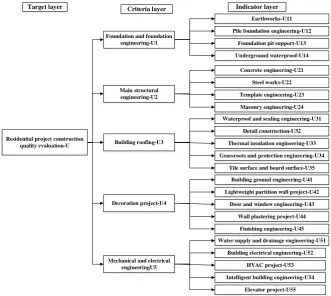
The factors influencing the construction quality of residential projects are complex and diverse, and a large number of them are proposed. Based on the comprehensive analysis and analysis, the evaluation index system of residential engineering construction quality grade is proposed, as shown in Figure 1.
[image:3.595.208.540.409.705.2]The evaluation index system for the quality of residential construction shown in Figure 1 is a hierarchical analysis system established after considering the construction process and results of the residential project from many aspects, multiple angles and multiple levels. The establishment process fully follows the concise and relevant, Accurate assembly and hierarchical principles. The system is divided into three levels: the target layer, the criterion layer, and the indicator layer; the highest level is also the target layer to represent the ultimate goal of solving the problem: to judge the quality of the residential construction; the middle layer is also the criterion layer. It represents the intermediate link through which the predetermined goal is achieved. The bottom layer, the indi-cator layer, represents the specific solution to the problem. It is the key factor for the detailed description of the middle layer after analyzing the middle layer fac-tors. At the same time, the criterion layer and the index layer also constitute a two-level evaluation comprehensive system of the residential engineering con-struction quality level evaluation index system, that is, the first-level evaluation
Figure 1. Residential project construction quality evaluation (figure caption). Target layer Criteria layer Indicator layer
Foundation and foundation engineering-U1
Earthworks-U11
Pile foundation engineering-U12
Foundation pit support-U13
Underground waterproof-U14
Main structural engineering-U2
Concrete engineering-U21
Steel works-U22
Template engineering-U23
Masonry engineering-U24
Decoration project-U4
Building ground engineering-U41
Lightweight partition wall project-U42
Door and window engineering-U43
Wall plastering project-U44
Finishing engineering-U45 Building roofing-U3
Waterproof and sealing engineering-U31
Detail construction-U32
Thermal insulation engineering-U33
Grassroots and protection engineering-U34
Tile surface and board surface-U35
Mechanical and electrical engineeringU5
Water supply and drainage engineering-U51
Building electrical engineering-U52
HVAC project-U53
Intelligent building engineering-U54
Elevator project-U55 Residential project construction
DOI: 10.4236/oalib.1105681 4 Open Access Library Journal
factor set and the second-level evaluation factor set. After naming and quantify-ing the index numbers in the two-level evaluation factor level, the evaluation value of each index is the data source of the evaluation index system of the entire residential construction quality level.
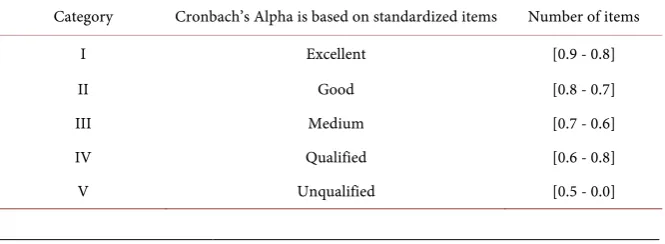
Before quantifying the influencing factors of the quality assessment of resi-dential construction, it is first necessary to establish a grade evaluation criterion for the comprehensive quantitative results of various indicators. After compre-hensively considering the indicators in the secondary evaluation factor set that affects the construction quality of the residential project, the quality evaluation criteria for the construction of the residential building as shown in Table 1 are established. The analytic hierarchy process and the expert scoring method de-termine the scores of the grades of the grades of the quality grades of residential construction. The five quality grade standards for residential construction quali-ty evaluation are {excellent, good, medium, qualified, unqualified}, and the rep-resentative score interval is the comprehensive score interval after quantification of each index factor in the residential construction quality assessment. Compar-ing the comprehensive result value of the residential construction quality of the project to be evaluated with the quality evaluation standard of Table 1, the level of the quality of the residential project to be evaluated can be further deter-mined.
3. AHP Decision Result
The difficulty in evaluating the evaluation index system of residential construc-tion quality grade is: 1) the multi-objective evaluaconstruc-tion object, the comprehensive evaluation is difficult; 2) the qualitative and quantitative indicators coexist, for the subjective with the user or the appraiser only Feeling qualitative indicators related to experience, due to the lack of a clear quantitative representation, it is difficult to judge; 3) the more indicators, the more complicated the problem.
[image:4.595.207.540.618.740.2]Analytic Hierarchy Process (AHP) is a multi-criteria decision-making method combining qualitative and quantitative analysis. After using (AHP) method to decompose related elements of decision-making problems of residential con-struction quality into target layer, criterion layer and index layer, The subjective judgment of human beings is objectively quantified with a certain scale; on this basis, qualitative analysis and quantitative analysis are carried out, and finally
Table 1. Construction quality rating standard.
Category Cronbach’s Alpha is based on standardized items Number of items
I Excellent [0.9 - 0.8]
II Good [0.8 - 0.7]
III Medium [0.7 - 0.6]
IV Qualified [0.6 - 0.8]
DOI: 10.4236/oalib.1105681 5 Open Access Library Journal
the problem is reduced to the problem of determining the relative importance weight of the lowest level relative to the highest level [4]. The steps of analyzing the various factors of cable laying quality evaluation by AHP method, and ob-taining the decision results of various factors and indicators are as follows:
Step one constructs a judgment matrix.
The elements of each layer in the evaluation index system of the construction quality of the residential project are compared with each other, and the judg-ment matrix of the two elejudg-ments can be obtained. The 1 - 9 scale method is used to quantify the decision judgment, and the experts analyze and determine two kinds of numerical judgment matrices: 1) the judgment matrix of the criterion layer for the target layer U; 2) the judgment matrix of the index layer for the
criterion layer U−Ui, among them i=
{
1, 2, 3, 4, 5}
.Step two Consistency test.
In order to prevent the determination of the relative importance of each indi-cator, there will be uncoordinated or even contradictory results, and a consis-tency check is required. According to the relationship between the matrix and the corresponding eigenvalues in the matrix theory, the characteristics of the ei-genvalue can largely reflect the characteristics of the matrix to which it belongs. Therefore, the indicator that the measurement matrix deviates from the consis-tency is represented by the eigenvalue (n = matrix order)
max
1
n CI
n
λ − =
− (1)
The larger the value of CI , the worse the consistency test result of the matrix
is, and the more uncoordinated between the indicators; on the contrary, the bet-ter the consistency test and the coordination of the indicators.
CI CR
RI
= (2)
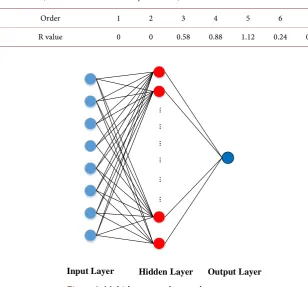
As shown in Equation (2), in order to characterize the matrix random consis-tency ratio, the ratio of CI to RI (mean random consistency index) is
se-lected to determine and denoted as CR. Wherein, the value of RI is obtained
from Table 2 according to the order of the matrix.
With 0.1 as the limit, the meaning of the CR value can be divided into two
cases:
( )
( )
0.1, The matrix has satisfactory consistency
Make adjustments until satisfactio
0.1, n
CR CR<
≥
Ⅰ
Ⅱ (3)
4. BP Artificial Neural Network Evaluation Method
Neural Network (NN) is the abbreviation of Artificial Neural Network (ANN), which is a mathematical model or computational model simulating the structure and function of biological neural network [5].
DOI: 10.4236/oalib.1105681 6 Open Access Library Journal Table 2. RI (mean random consistency indicator) value table.
Order 1 2 3 4 5 6 7
R value 0 0 0.58 0.88 1.12 0.24 0.32
Figure 2. Multi-layer neural network.
1) Since the output result of NN has an error with the actual result, the error between the estimated value and the actual value is calculated, and the error is propagated back from the output layer to the hidden layer until it is propagated to the input layer;
2) In the process of BP, the value of various parameters is adjusted according to errors;
3) Continuously iterate the above process until convergence occurs.
Multi-layer neural networks can also be implemented by least square method Learning:
( )
(
)
21
N
i i
i
E ω y o
=
=
∑
− (4)where,
( )
1
1 e i
i x
o = − ⋅ω
+ (5)
Gradient Descent Method is adopted, there is
(
) (
)
2 i i i i
j j
y o
E
y o
ω ω
∂ −
∂ = −
∂
∑
∂ (6)(
) (
)
2 i i i i
j j
y o
E
y o
ω ω
∂ −
∂
= −
∂
∑
∂ (7)where,
Input Layer
··
· ··
· ··
· ··
· ··
· ··
·
[image:6.595.209.518.81.368.2]DOI: 10.4236/oalib.1105681 7 Open Access Library Journal 0 i j y ω ∂ =
∂ (8)
(
1)
i i i
i i j
j i j
o o h
o o a
h
ω ω
∂ =∂ ∂ = −
∂ ∂ ∂ (9)
(
1)
i i i
i i j
j i j
o o h
o o a
h
ω ω
∂ ∂ ∂
= = −
∂ ∂ ∂ (10)
where, aj is the output of Unit J in previous layer.
Multiply the obtained gradient by the penalty term η, and correct the weight
sequence to prevent over-fitting of the model, i.e.:
j j
j
E
ω η ω
ω ∂
− →
∂ (6)
j j
j
E
ω η ω
ω ∂
− →
∂ (6)
Repeat iterating the above process until the error meets the requirement.
5. Case Analysis
The above method is applied to test the construction quality of a residential project and verify the feasibility (Tables 3-8).
Each expert multiplies the weight value of each sub-item, and finally the com-prehensive value of the evaluation of the quality of the residential construction by 20 experts is obtained. The results are shown in Table 9.
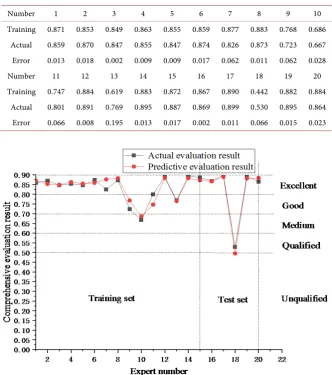
Fi Finally, samples with numbers 1 - 15 are used as training sets and 15 - 20 are used as test sets. As shown in Table 10. The training set data (sample num-ber 1 - 15) shows that the relative error of the output result of the network is very small, and the output result is almost consistent with the expected result, which proves that the network has reached the accuracy requirement training; the serial number is 16 - 20. The output of the simulation evaluation of the five sets of test set data and the expected output are shown in Table 10.
As can b As can be seen from Table 10, the relative error between the output value and the expected value obtained by the neural network is controlled at a fraction of a few percents to a few percent, which is almost identical to the eval-uation result of the desired output. Figure e shows a comparison of the results.
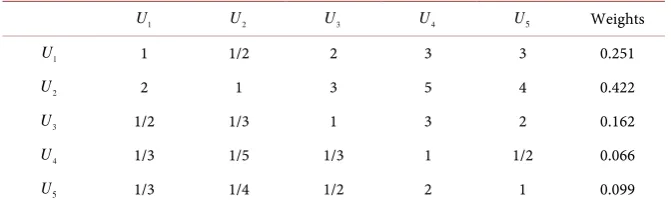
Table 3. Judgment matrix U.
1
U U2 U3 U4 U5 Weights
1
U 1 1/2 2 3 3 0.251
2
U 2 1 3 5 4 0.422
3
U 1/2 1/3 1 3 2 0.162
4
U 1/3 1/5 1/3 1 1/2 0.066
5
U 1/3 1/4 1/2 2 1 0.099
[image:7.595.206.542.609.711.2]DOI: 10.4236/oalib.1105681 8 Open Access Library Journal Table 4. Judgment matrix U1.
11
U U12 U13 U14 Weights
11
U 1 1/4 1/3 1/2 0.095
12
U 4 1 2 3 0.467
13
U 3 1/2 1 2 0.278
14
U 2 1/3 1/2 1 0.160
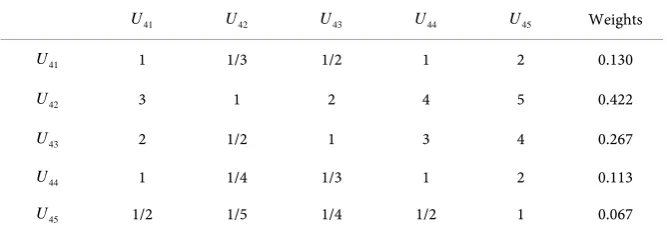
[image:8.595.206.540.231.322.2]λmax = 4.0310, CI = 0.0103, RI = 0.88, CR = 0.0117.
Table 5. Judgment matrix U2.
21
U U22 U23 U24 Weights
21
U 1 1/3 2 3 0.233
22
U 3 1 4 5 0.545
23
U 1/2 1/4 1 2 0.138
24
U 1/3 1/5 1/2 1 0.084
λmax = 4.0511, CI = 0.0170, RI = 0.88, CR = 0.0193.
Table 6. Judgment matrix U3.
31
U U32 U33 U34 U35 Weights
31
U 1 3 2 3 4 0.396
32
U 1/3 1 1/2 1 2 0.135
33
U 1/2 2 1 3 4 0.277
34
U 1/3 1 1/3 1 1 0.108
35
U 1/4 1/2 1/4 1 1 0.084
λmax = 5.0811, CI = 0.0203, RI = 1.12, CR = 0.0181.
Table 7. Judgment matrix U4.
41
U U42 U43 U44 U45 Weights
41
U 1 1/3 1/2 1 2 0.130
42
U 3 1 2 4 5 0.422
43
U 2 1/2 1 3 4 0.267
44
U 1 1/4 1/3 1 2 0.113
45
U 1/2 1/5 1/4 1/2 1 0.067
λmax = 5.1833, CI = 0.0458, RI = 1.12, CR = 0.0409.
[image:8.595.207.541.371.483.2] [image:8.595.207.541.531.647.2]DOI: 10.4236/oalib.1105681 9 Open Access Library Journal Table 8. Judgment matrix U5.
51
U U52 U53 U54 U55 Weights
51
U 1 1/2 2 4 3 0.274
52
U 2 1 3 4 3 0.392
53
U 1/2 1/3 1 2 2 0.154
54
U 1/4 1/4 1/2 1 1/2 0.073
55
U 1/3 1/3 1/2 2 1 0.107
λmax = 5.1044, CI = 0.0261, RI = 1.12, CR = 0.0233.
Table 9. Comprehensive value of construction project quality evaluation.
Number 1 2 3 4 5 6 7 8 9 10
Value 0.859 0.870 0.847 0.855 0.847 0.874 0.826 0.873 0.723 0.667
Number 11 12 13 14 15 16 17 18 19 20
[image:9.595.209.540.238.300.2]Value 0.801 0.891 0.769 0.895 0.887 0.869 0.899 0.530 0.895 0.864
Table 10. Simulation results and relative error.
Number 1 2 3 4 5 6 7 8 9 10
Training 0.871 0.853 0.849 0.863 0.855 0.859 0.877 0.883 0.768 0.686
Actual 0.859 0.870 0.847 0.855 0.847 0.874 0.826 0.873 0.723 0.667
Error 0.013 0.018 0.002 0.009 0.009 0.017 0.062 0.011 0.062 0.028
Number 11 12 13 14 15 16 17 18 19 20
Training 0.747 0.884 0.619 0.883 0.872 0.867 0.890 0.442 0.882 0.884
Actual 0.801 0.891 0.769 0.895 0.887 0.869 0.899 0.530 0.895 0.864
Error 0.066 0.008 0.195 0.013 0.017 0.002 0.011 0.066 0.015 0.023
[image:9.595.206.539.326.702.2]DOI: 10.4236/oalib.1105681 10 Open Access Library Journal
6. Conclusion
Aiming at the evaluation of construction quality of residential projects, this pa-per establishes a more comprehensive construction quality index system for res-idential projects, and uses artificial neural network algorithms to learn the knowledge and “experience” of experts, and the simulation experts evaluate the construction quality of residential projects. The artificial neural network auto-matically calculates and outputs the evaluation results according to the index data of the input network, and does not need to manually determine the weight of each part of the data, which reduces the possibility of being affected by non-objective factors in the evaluation process, and improve the reliability, ob-jectivity and accuracy of the evaluation results. For some obvious errors in the sample, the artificial neural network can be automatically eliminated, and the fault tolerance of the network ensures the accuracy of the whole system, so that the overall fitting degree is very high and the evaluation effect is excellent [6]. The artificial neural network has shown excellent superiority and very broad ap-plication prospects in the apap-plication of construction project quality assessment. Compared with other evaluation methods, this paper uses artificial neural net-work to evaluate the construction quality of residential projects with higher effi-ciency and accuracy, real-time evaluation and control of the construction quality of residential projects, and provides workers for residential project construction. When learning and analyzing databases with large data volumes, the network has obvious advantages over other evaluation methods in terms of accuracy, ef-ficiency and relative error.
Conflicts of Interest
The authors declare no conflicts of interest regarding the publication of this paper.
References
[1] Pun, P. (2013) The View of Freedom and Standardization among Managers in Swe-dish Construction Contractor Projects. International Journal of Project Manage-ment, 42, 299-306.https://doi.org/10.1016/j.ijproman.2012.09.010
[2] Gao, H. and Li, H.M. (2002) Application of Fuzzy Comprehensive Evaluation Me-thod in Engineering Quality Risk Analysis. Journal of Xi’an University of Science and Technology, 22, 21-23.
[3] Wu, Z.J. and Wang, W.W. (2010) Application of BP Neural Network in Sales Fore-cast of Stocking Enterprises. Industrial Engineering,1, 105-107.
[4] Zhai, X. (2015) Slope Deformation Monitoring Method Based on 3D Laser Scan-ning Technology.China University of Geosciences, Beijing.
[5] Fan, H., Wang, F. and Wang, G.W. (2017) Research Progress in the Laying Method of Hot Water Hot Pipe Gallery. Journal of Huaqiao University (Natural Science), 38, 747-752.