ON REGULARITY AND THE WORD PROBLEM FOR FREE IDEMPOTENT GENERATED SEMIGROUPS
IGOR DOLINKA, ROBERT D. GRAY, AND NIK RUˇSKUC
Abstract. The category of all idempotent generated semigroups with a pre-scribed structureE of their idempotentsE (called the biordered set) has an
initial object called the free idempotent generated semigroup overE, defined
by a presentation over alphabet E, and denoted byIG(E ). Recently, much
effort has been put into investigating the structure of semigroups of the form IG(E ), especially regarding their maximal subgroups. In this paper we take
these investigations in a new direction by considering the word problem for IG(E ). We prove two principal results, one positive and one negative. We
show that, for a finite biordered setE, it is decidable whether a given word w∈E∗represents a regular element; if in addition one assumes that all
maxi-mal subgroups ofIG(E )have decidable word problems, then the word problem
inIG(E )restricted to regular words is decidable. On the other hand, we exhibit
a biorderEarising from a finite idempotent semigroupS, such that the word
problem forIG(E )is undecidable, even though all the maximal subgroups have
decidable word problems. This is achieved by relating the word problem of IG(E )to the subgroup membership problem in finitely presented groups.
1. Introduction
In his foundational paper [28] Nambooripad made the fundamental observation that the set of idempotentsE(S)of an arbitrary semigroupS carries the abstract structure of a so-called biordered set (or regular biordered set in the case of regular semigroups). He provided an axiomatic characterisation of regular biordered sets in his paper. This was later extended by Easdown to arbitrary (non-regular) semi-groups [10] who showed that each abstract biordered set is in fact the biordered set of idempotents of a suitable semigroup. Not only are biordered sets important for the study of abstract semigroups but, in addition, for many naturally occurring semigroups their biordered sets of idempotents carry deep algebraic and geometric information. For example, Putcha’s theory of monoids of Lie type [32] shows that one can view the biordered set of idempotents of a reductive algebraic monoid as a generalised building, in the sense of Tits.
The study of biordered sets of idempotents of semigroups is closely related to the study of idempotent generated semigroups. Idempotent-generated semigroups are of interest for a variety of reasons. Firstly, they have the universal property that every semigroup embeds into an idempotent generated semigroup [20], and if the
2010Mathematics Subject Classification. Primary 20M05; Secondary 20F05, 20F10.
The research of the first author was supported by the Ministry of Education, Science, and Tech-nological Development of the Republic of Serbia through the grant No.174019, and by the grant No.0851/2015 of the Secretariat of Science and Technological Development of the Autonomous Province of Vojvodina. The research of the second author was partially supported by the EPSRC-funded project EP/N033353/1 ‘Special inverse monoids: subgroups, structure, geometry, rewriting systems and the word problem’. The research of the third author was supported by the EPSRC-funded project EP/H011978/1 ‘Automata, Languages, Decidability in Algebra’.
semigroup is (finite) countable it can be embedded in a (finite) semigroup generated by 3 idempotents [3]. Secondly, many naturally occurring semigroups have the property that they are idempotent generated. Examples of idempotent generated semigroups include semigroups of transformations [20], matrix semigroups [12, 23], endomorphism monoids of independence algebras [15, 14], and certain reductive linear algebraic monoids [33, 34].
Let us suppose that E is the biordered set arising from the set of idempotents E of a semigroup S. Thefree idempotent generated semigroup IG(E )is then the
free-est semigroup in which the idempotents possess the same structure (for formal definitions see below). In fact, if S is a regular semigroup, two such free struc-tures are defined, namely IG(E ) and its homomorphic image RIG(E ), the regular free idempotent generated semigroup onE. Clearly an important step towards
un-derstanding the class of semigroups with a fixed biordered set of idempotents E is
to study these free objects. The natural question that arises is to which extent and in which ways the structure and the properties of these free objects are determined by those ofS andE.
There has been a recent resurgence of interest in the study of free idempotent generated semigroups, see [1, 2, 5, 6, 7, 8, 11, 16, 17, 18, 25, 38]. Most of these recent articles concentrate on maximal subgroups, following in the footsteps of the pioneering work [1] of Brittenham, Margolis and Meakin, where the first non-free such subgroup is exhibited. One exception is the article [11] by Easdown, Sapir and Volkov, in which the authors investigate the behaviour of elementsnot belonging to maximal subgroups, and show they cannot have finite order. The purpose of this paper is to begin the process of broadening this study to what is arguablythe
key question, namely their word problem and, ultimately, the structure. Until now the word problem for free idempotent generated semigroups has remained poorly understood, with just a handful of known results which deal only with certain very special classes of biordered sets; see for instance [31, Section 6]. (Note added in revision: Gould and Yang in their recent work [39] on free idempotent generated semigroups over bands briefly touch on the word problem and prove it is solvable when the underlying band satisfies certain additional conditions.)
Now, for an arbitrary regular biorder E, the semigroup RIG(E ) is structurally
very similar toS, in terms of their Green’s relations, the only difference being in the maximal subgroups. This difference, on the other hand, can be huge, as recent work shows; for example, Dolinka and Ruˇskuc [8] show thatany finitely presented group arises as a maximal subgroup ofRIG(E )from a finite semigroup of idempotents (a
band). But, due to the tight structural links otherwise, this is the only thing ‘that can go wrong’: the word problem forRIG(E ), withE finite, is soluble if and only if
all the maximal subgroups have soluble word problems (this follows directly from [35, Theorem 4.1]).
The structure ofIG(E )is much more complicated than that ofRIG(E ), as already
observed in [1, Section 3], where an initial comparison between the two is carried out. Its regular elements do form a part that in a way ‘looks like’ the regular semigroup RIG(E ), in the sense that the natural epimorphism IG(E ) → RIG(E )
IG(E )will typically contain non-regular elements as well, and the structure of this
part of the semigroup is not well understood at present.
The aim of this paper is to shift the focus of attention from maximal subgroups to the word problem and the structure of the non-regular part ofIG(E ), by means
of establishing the following main results:
(1) a characterisation for when a word w ∈ E∗ represents a regular element
in IG(E )(Theorem 3.6); in the case whereE is finite this characterisation
turns into an effective decision procedure (Theorem 3.7);
(2) a characterisation for when two words u, v ∈ E∗ representing regular
ele-ments actually represent the same element ofIG(E ); whenEis finite and all
maximal subgroups have soluble word problems, this turns into a solution for the word problem for the regular part ofIG(E )(Theorem 3.10);
(3) an explicit construction of a finite bandEsuch that all maximal subgroups ofIG(E )have soluble word problems but the word problem forIG(E )itself
is not soluble (Theorem 5.3).
Our explicit construction is designed so as to relate the word problem inIG(E )
with the subgroup membership problem in an arbitrary finitely presented group. As part of (2) we give an algorithm which takes an arbitrary finite biordered set E and computes Rees matrix representations for each of the regular principal
factors of IG(E ); see Theorem 4.2 and Lemma 4.3. These results are important
tools which are needed to analyse the explicit construction in (3) and establish our results on the word problem.
Perhaps also worth noting is the immediate corollary from the discussion above and our main results that there exists a finite regular biordered setE such that the
word problem forRIG(E )is decidable, while that forIG(E )is not.
The paper is organised as follows. In Section 2 we present some results about the action of idempotents on the H-classes in a fixed D-class of a semigroup, and show how this action is encoded in the biorder of an idempotent generated semigroup. These ideas are then applied in Section 3 where our results on the word problem for regular elements of IG(E )are given. Section 4 contains results which
show how to compute Rees matrix representations of regular D-classes of IG(E ).
In Section 5 we outline the main ideas behind, and state our main results for, our explicit construction of a finite band E such that all maximal subgroups ofIG(E )
have soluble word problems but the word problem for IG(E )itself is not soluble.
The details of our construction are given in Section 6, and the proofs of our main results about this construction are then obtained in Sections 7 and 8. Finally in Section 9 we make some concluding remarks, and discuss possible future research directions that arise from this work.
2. Actions of idempotents on H-classes
Substantial information about a semigroup may be gained by studying its ideal structure. One of the most fundamental tools in this regard are the five equivalence relations calledGreen’s relations. Given a semigroupS, we define fora, b∈S:
aRb⇔aS1=bS1, aL b⇔S1a=S1b, aJ b⇔S1aS1=S1bS1,
whereS1 denotesS with an identity element adjoined (unlessS already has one); hence, these three relations record when two elements ofS generate the same prin-cipal right, left, and two-sided ideals, respectively. Furthermore, we letH =R∩L
andD=R○L, and remark thatDis the join of the equivalencesRandL because
R○L =L ○R. As is well known, for finite semigroups we always have D=J,
while in general the inclusions H ⊆ R,L ⊆ D ⊆ J hold. The R-class of a is
denoted byRa, and in a similar fashion we use the notationLa, Ja, Ha andDa.
Recall that an element a of a semigroup S is (von Neumann) regular if there exists a′∈S such thataa′a=a. Ifa is an element of a semigroupS we saya′ is
aninverse of aifaa′a=aand a′aa′=a′. Note that an element with an inverse is
necessarily regular. In fact, the converse is also true: every regular element has an inverse. It is well known that a singleD-class consists either entirely of regular or non-regular elements; see [21, Proposition 2.3.1]. Therefore, regular D-classes are precisely those containing idempotents, and for each idempotente, theH-classHe
is a group with identity e. In fact, this is a maximal subgroup of the semigroup under consideration and all maximal subgroups arise in this way.
The following result is due to Howie and Lallement [22, Lemma 1.1].
Lemma 2.1(Howie–Lallement Lemma). LetS be a semigroup and lete, f∈E(S). Ifef∈Sis regular thenef has an idempotent inversegsuch thatge=gandf g=g.
Proof. We outline the proof here for completeness. Since ef is regular it has an inversexinSsatisfyingef xef=ef, andxef x=x. Then(f xe)2=f(xef x)e=f xe,
sof xeis an idempotent. Now routine calculations show the result holds by taking
g=f xe∈E(S).
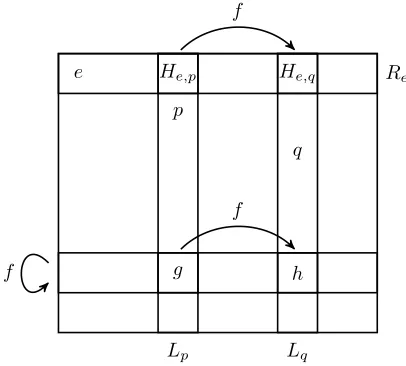
Applying the Howie–Lallement Lemma we obtain the following crucial general result which describes the way that idempotents can act on the H-classes in a given fixedR-class of a semigroup. This is illustrated in Figure 1.
Proposition 2.2. LetS be a semigroup, lete, p, q∈E(S)beD-related idempotents inS, and letf ∈E(S). Set
He,p=Re∩Lp, and He,q=Re∩Lq.
Then
He,pf =He,q
if and only if there exist idempotentsg, h∈E(S)such that
pLgRhLq, f g=g, and gf=h.
Remark 2.3. The reader should note the complication of similar looking, but fun-damentally different, notations forH-classes: the single-indexedHa stands for the H-class of the elementa, while the double-indexedHe,p is the intersection of the R-class ofewith theL-class ofp.
Proof of Proposition 2.2. (⇒) Suppose thatHe,pf =He,qinS. By Green’s Lemma
[21, Lemma 2.2.1] the map x ↦ xf is an R-class preserving bijection from Lp
g h f
f
f e He,p
Lp
p
He,q
Lq
q
[image:5.612.203.406.120.303.2]Re
Figure 1. The action of an idempotent on theH-classes within a fixedR-class in an arbitrary semigroup, as described by Propo-sition 2.2.
element of S. By the Howie–Lallement Lemma pf has an idempotent inverse g
such thatgp=g andf g=g. Sincepf andg are inverses it follows thatpg= (pf)g
is an idempotent with pfRpf g =pgLg. Consider the idempotent pg∈E. From
abovegLpgRpfRp, and sincepgis an idempotent it follows by the Miller–Clifford Theorem [21, Proposition 2.3.7] that g = gp ∈ Rg∩Lp. Set h = gf which is an
idempotentR-related tog, becausef g=g. Since g∈Lp andx↦xf is anR-class
preserving bijection from Lp to Lq, it follows that h= gfLpfLq. Therefore we
have found idempotentsg, h∈S such thatpLgRh=gfLq,f g=gandgf =h.
(⇐) Now suppose that there exist g, h ∈ E(S) such that pLgRhLq, f g = g
andgf =h. By Green’s Lemma the mapping x↦xf is anR-preserving bijection
betweenLgandLh SinceHe,p=Re∩Lp=Re∩LgandHe,q=Re∩Lq=Re∩Lh, it
follows thatHe,pf =He,q, as required.
Definition 2.4. Let S be a semigroup with set E = E(S) of idempotents. The biordered set E = (E,∗)is the partial algebra where
e∗f=ef if{e, f} ∩ {ef, f e} ≠ ∅, (2.1)
and the product e∗f in E is undefined otherwise. A pair of idempotents (e, f)
satisfying the condition{e, f} ∩ {ef, f e} ≠ ∅is called abasic pair.
It is easy to show that for such a pair their product ef is indeed again an idempotent, and that it is eitherR-related toeorL-related tof. Throughout we shall abuse notation writingef instead ofe∗f. The reader should remember that
if the productef is indicated to take place inE = E (S)then Condition (2.1) must hold.
We now turn our attention to idempotent generated semigroups. In what follows
Swill denote an idempotent generated semigroup with set of idempotentsE=E(S)
Lemma 2.5. For alle, f∈E we have
eRf in S⇔ef=f andf e=einE, (2.2)
eLf in S⇔ef=eandf e=f inE, (2.3)
and
eDf inS⇔ ∃ e1, e2, . . . , en∈E∶e=e1Re2Le3R. . .Len−1Ren=f inS. (2.4)
Proof. This first two claims are immediate from the definition of E. The third
clause can be recovered by appealing to the theory of E-chains [28], but for the sake of completeness we show how it can be proved by applying Proposition 2.2. SupposeeDf, and lett∈S be such thateRtLf. AsS is idempotent generated we
can write t as a product of idempotents t=e1e2. . . ek. From eRf it follows that et=t, and hence
eRee1Ree1e2R. . .Ree1e2. . . ek.
Therefore for each 1≤i≤k,
Hee1e2...ei−1ei=Hee1e2...ei,
and, applying Proposition 2.2, there are idempotentsgi, hi with
ee1e2. . . ei−1LgiRhiLee1e2. . . ei.
But then
eLg1Rh1Lg2Rh2. . .LgkRhkLf,
as required. The converse implication is obvious.
The following lemma is another application of Proposition 2.2 and will show how inS the action of the elements fromEon theH-classes in a given regularR-class is completely determined by (and is computable from) the biorderE. Even though
not explicitly referred to here, the ideas in the following lemmas intimately relate to the notion of sandwich set (and generalised sandwich sets) and their connection to the theory of biordered sets, as explored by Pastijn in [31].
Lemma 2.6. Let e, p, q∈E be D-related idempotents inS, and letf∈E. Set He,p=Re∩Lp, and He,q=Re∩Lq.
Then
He,pf =He,q inS
if and only if there exist g, h∈E such that the following equations all hold in the biorder E:
pg=p, gp=g, gh=h, hg=g,
hq=h, qh=q, f g=g, gf=h.
Proof. (⇒) Suppose thatHe,pf=He,qinS. By Proposition 2.2 there exist
idempo-tentsg, h∈E such that inS we have pLgRhLq,f g=g andgf=h. In particular (f, g)is a basic pair of idempotents, yielding f g=g, gf =hin E. The remaining
six equalities expresspLgRhLq, as in Lemma 2.5.
(⇐) Now suppose that there exist g, h∈E such that the eight listed equations
hold in E. It follows that the equations also hold in S, and thus in S we have pLgRhLq,f g=gandgf=h. Now the result follows by the converse implication
Remark 2.7. Lemma 2.6 is general, and in particular no finiteness assumption is imposed on the setE. It is important to stress that the action we are considering ofS on theH-classes in a given fixedR-class is different from the closely related action ofSon theL-classes inD (even though the two coincide in the finite case). To see this consider the bicyclic monoid B = ⟨b, c∣bc =1⟩. In the action on the
H-classes ofR1, the productH1,1cis undefined, while in the action onL-classes we haveL1c=L1.
The following result formalises the statement that the action of E on the H -classes in a givenR-class ofS is completely determined by the biorderE (S).
Lemma 2.8. LetS andT be semigroups with the same biordered set of idempotents E (S) = E (T) = E. Lete∈E andw∈E∗. Then
ewRe inS ⇔ ewReinT.
Additionally, if both are true, then for anyq∈E we have
ewLq inS ⇔ ewLq inT.
Proof. Both claims are proved simultaneously by induction on the length of the word w, using Lemma 2.6, which implies that the validity of each of the four constituent clauses (namely,ewRein S,ewRein T,ewLqin S andewLqinT)
depends only onE, and not onS orT themselves.
3. The word problem for regular elements ofIG(E )
Given an arbitrary biordered set E = E (S), we will define thefree idempotent generated semigroup IG(E ) associated to E by means of a presentation. The set
of generating symbols in this presentation will be preciselyE, which opens up the danger of ambiguity in what follows: products of elements ofE can be interpreted both as words over E (i.e. elements of E∗) or as the specific elements of E (or indeed of S) to which they evaluate. With this in mind, IG(E ) is the semigroup
defined by the presentation
IG(E ) = ⟨E∣ ef =e∗f ({e, f} ∩ {ef, f e} ≠ ∅) ⟩, (3.1)
where ef is the word of length 2 with letters e and f, while e∗f denotes the
partial multiplication inE considered as a partial algebra; see Definition 2.4. When
working with this presentation, given two words u, w∈E∗ we shall write u≡v to
meanuandvare identical as words inE∗, and writeu=v to mean they represent
the same element of the semigroupIG(E ).
Clearly, IG(E ) is an idempotent generated semigroup, and it follows from [10]
that E (IG(E )) = E, that is, the biordered set of idempotents ofIG(E )is precisely
E. In particular, Lemmas 2.5, 2.6, and 2.8 all apply to this semigroup. In the
special case thatE is finite, we can deduce the following decidability results for the
semigroupIG(E ).
Lemma 3.1. There is an algorithm which takes a finite biordered setE ande, f∈E and decides each ofeRf,eLf, andeDf inIG(E ).
Proof. This is an immediate consequence of Lemma 2.5: for the relationsR and
L the criteria in (2.2), (2.3) can be read off directly fromE, and forD one has to
note that the sequencee1, . . . , en in (2.4) can be taken not to contain any repeats,
Remark 3.2. Let us point out the subtle difference between a finite biorder and a biorder arising from a finite semigroup. Clearly, the biorder arising from a finite semigroup is finite. However the converse is not true, as demonstrated by Easdown; see [9, Theorem 13]. All our decidability results are predicated on finiteness, and we couch them in the more general setting of finite biordered sets.
Lemma 3.3. There exist algorithms which for any given finite biordered set E decide the following:
(i) for givenD-related idempotents e, p, q∈E, and another idempotent f ∈E, whether
He,pf=He,q inIG(E ), where
He,p=Re∩Lp and He,q=Re∩Lq;
(ii) for elements e∈E and w∈E∗ whether ewRe in IG(E ), and if so returns q∈E such that ewLq.
Proof. (i) This is an immediate consequence of Lemma 2.6.
(ii) If w≡ the algorithm gives an affirmative answer, and returns q=e.
Oth-erwise writew≡w′f. From the definition of Green’s relationR, and the fact that
in a regularD-class everyL-class contains an idempotent, it follows that inIG(E )
we have
ewRe⇔ew′ReandHe,q′f =He,q,
for some idempotentsq′, q∈E withq′Lew′andqLew. Recursively check whether ew′Reand, if so, compute all q′∈E with q′Lew′. Then use Lemma 3.3 to check
if there existsq∈E such thatHe,q′f =He,q, and if so return an affirmative answer
andq.
We now turn our attention to the word problem for regular elements ofIG(E ).
First we prove a lemma which describes the form that words representing regular elements ofIG(E )can take.
Lemma 3.4. Suppose that u, v ∈E∗, e∈E satisfy ueLe, evRe in IG(E ). Then applying a single relation from the presentation for IG(E )to the worduev yields a wordu′e′v′ such that
u′e′Le′Re′v′ holds in IG(E ). In particular,e′De inIG(E ).
Proof. If a relation is applied to u, yielding a word u′, set e′=e, v′≡v, and the
assertion is obvious. The case of applying a relation tov is analogous.
Suppose now we apply a relation of the form e=f g toe. Then we know that
either eRf or eLg. Without loss of generality, suppose eRf. In this case set
u′≡u,e′=f andv′≡gv. Firstly, we have
e′v′≡f gv=evReRf =e′,
Secondly, fromueLeand Green’s Lemma [21, Lemma 2.2.1] we have thatx↦ux
is anL-class preserving bijectionRe→Rue. But f∈Re, and so
u′e′≡ufLf=e′,
as required.
For the next case, suppose that v ≡ f v1, that (e, f) is a basic pair, and the
be seen to hold by settingu′≡u,e′=gandv′≡v1. Finally, the case whereu≡u1f and the relation applied isf e=g is dual to this one.
This covers all possible applications of relations, and the proof is complete.
An immediate corollary of this lemma is the following result.
Lemma 3.5. Suppose that u, v ∈E∗, e∈E satisfy ueLe, evRe in IG(E ). Then every word over the alphabet E which is equal in IG(E ) to the word uev has the formu′e′v′ where
u′e′Le′Re′v′,
andeDe′.
Theorem 3.6. Let E be an arbitrary biordered set. A word w∈ E∗ represents a regular element ofIG(E )if and only ifw≡uevwheree∈EandueLeRevinIG(E ), in which caseeDw inIG(E ).
Proof. (⇐) Since R is a left congruence, we deduce uevRueLe, and hence uev
represents a regular element.
(⇒) Suppose thatw∈E∗ represents a regular element of IG(E ). Then there is
an idempotente∈EwitheRw. Thenw=ewinIG(E ). Nowewhas the form given
in the statement of Lemma 3.5, with u≡ andv ≡w. Therefore, by Lemma 3.5,
the wordwalso has this form.
The last clause follows easily since, by the Miller–Clifford Theorem,ueLeRev
implieseD(ue)(ev) =uevin IG(E ).
In the special case of finite biordered sets E, combining this theorem with the
decidability results already obtained above yields the following result, which is the first main result of this section.
Theorem 3.7. There is an algorithm which takes a finite biordered set E and a word w∈ E∗ and decides whetherw represents a regular element of IG(E ), and if so, returnse, f∈E such thateRwLf inIG(E ).
Proof. For every decomposition w = uev (e ∈ E, u, v ∈ E∗) check whether evRe
and ueLe using Lemma 3.1. By Theorem 3.6, the element represented by w is regular if and only if the answer is affirmative for some decomposition. In this case, the requisite idempotents eand f can be computed by repeatedly, letter by letter, running the algorithms from Lemma 3.3 (i) and (ii) on words ev and ue
respectively.
Theorem 3.7 can be interpreted as saying that there is an algorithm which takes an arbitrary finite biordered set, tests regularity of words, and for any given regular word can identify the ‘position’ of theH-class of that element inIG(E ). We would
like to extend this to a solution to the word problem for regular elements but this will only be possible under the assumption that the word problem can be solved for the maximal subgroups ofIG(E ), so we now turn our attention to them. We pass
fromIG(E )to its maximal subgroups using a Reidemeister–Schreier type rewriting
process as first described in [17]. We shall recall the details of this process here. In the special case of finite biordered sets, we shall explain how this process turns into an algorithm for writing down presentations for maximal subgroups ofIG(E ), and
In what follows,Swill continue to stand for an idempotent generated semigroup, with the set of idempotentsE=E(S)and the corresponding biorderE = E (S), and
let us fix an arbitrary e∈E. Let D be the D-class of e in IG(E ). Let Ri (i∈ I)
and Lj (j ∈ J) be the sets of R- and L-classes respectively in D. We denote
theH-classes in D byHi,j=Ri∩Lj. Unfortunately, this is yet another indexing
of H-classes that the reader will have to contend with – on the plus side, it is compatible with the earlier He,p notation, provided the indexing setsI and J are
taken to consist of representatives. Let
K= {(i, j) ∶ Hi,j is a group},
and denote byeij the unique idempotent in Hi,j ((i, j) ∈K). For notational
con-venience assume that the symbol 1 belongs to both index sets I and J, and that
e= e11. Consider the R-class R= R1 and its H-classesH1,j (j ∈ J). We have
seen that the generatorsEact on this set ofH-classes, and we now translate this action to an action (j, w) ↦ jw of the free monoid E∗ on the index set J∪ {0}.
Specifically, for each letterg∈E, we set
(j, g) ↦ ⎧ ⎪ ⎪ ⎨ ⎪ ⎪ ⎩
l ifH1,jg=H1,l inIG(E ),
0 otherwise,
and extend by freeness. By Lemma 2.8 theH-classes in theR-class ofeinIG(E )
are in natural bijective correspondence with the H-classes in the R-class of e in
S. If we index the latter asH1S,j (j∈J)in the natural way we have
H1S,jg=H1S,jg if and only ifjg≠0.
This reflects the fact that the action of E on theH-classes inside an R-class is entirely determined by the biorderE and does not depend on the actual semigroup.
Arguing as in [17], there exist words rj ∈ (E∩D)∗ for j∈J, satisfying 1rj =j
and every prefix of everyrjis equal to somerl. We call this set of words aSchreier
system. Furthermore, for eachj ∈J, there exists a word rj′ ∈ (E∩D)∗ such that jr′j=1 and
xrjr′j=x in IG(E )for allx∈H1,1, and
xr′jrj=x in IG(E )for allx∈H1,j.
In fact, such words rj, r′j (j∈ J) can be determined solely from the biorder E in
the following inductive way. To begin with setr1≡r′1≡,J1= {1}. Suppose that
at stepka setJk⊆J is computed, and for everyj∈Jk wordsrj,rj′ satisfying the
required properties are also computed. Suppose Jk ≠ J. For everyj ∈ Jk∖Jk−1
and everyf ∈ E with 0≠ jf ∈J∖Jk by Proposition 2.2 there exist idempotents
g, h∈E such that g ∈ Lj, h∈ Ljf, gRh, f g =g, and gf =h. Now let rjf ≡rjh,
r′jf ≡grj′, and add jf to Jk+1. That every j ∈J will be reached in the course of
this procedure follows from the definition ofR and the fact thatE is a generating set. Hence, whenE is finite this becomes an actual algorithm to compute the rj,
r′j (j∈J)from the biorderE.
Using these definitions we shall now work towards a presentation for the group
H=H1,1. By results from [35], the elements ofIG(E )represented by wordserjf r′jf ∈
E∗ with j ∈ J, f ∈ E, jf ≠ 0, form a generating set of H. Motivated by this,
introduce a new alphabet
Furthermore, letψ∶B∗→E∗ be the unique homomorphism extending
[j, f] ↦erjf r′jf.
Now define
φ∶ {(j, w) ∶ j∈J, w∈E∗, jw≠0} →B∗
byφ(j,1) ≡1 and, forw≡e1⋯etwitht≥1,
φ(j, e1⋯et) ≡ [j, e1][je1, e2][je1e2, e3]⋯[je1e2⋯et−1, et] ∈B∗.
As a straightforward consequence of this definition we have
φ(j, w1w2) ≡φ(j, w1)φ(jw1, w2) (j∈J, w1, w2∈E∗, jw1w2≠0). (3.2)
Note that φ rewrites a pair(j, w)into a word over B whose image under ψ is a word over E representing the element erjwrjw′ in IG(E ). In particular, if w∈E∗
represents an element ofH then we have
ψφ(1, w) =w (3.3)
inIG(E ).
Theorem 3.8. LetRdenote the set of relations in the presentation (3.1)ofIG(E ). Then, with the above notation, a monoid presentation for the maximal subgroup groupH=Heof IG(E )is given by
⟨B ∣φ(j, α) =φ(j, β) (j∈J, (α=β) ∈R, jα≠0), φ(1, erjarja′ ) = [j, a] (j∈J, a∈E, ja≠0),
φ(1, e) =1⟩.
If the biorderE is finite then so is the above presentation, and there is an algorithm to compute the presentation fromE and any given e∈E.
Proof. That the presentation definesH=Heis proved in [35, Theorem 2.9], and it
clearly is finite whenEis. The existence of an algorithm to compute the presentation
when E is a finite biordered set follows from the fact that the action of IG(E )on
{H1,j ∶ j∈J}is computable in the sense of Lemma 3.3.
Lemma 3.9. Let w1, w2 ∈ E∗ such that eRw1Hw2 in IG(E ). Then w1 =w2 in
IG(E )if and only ifφ(1, w1) =φ(1, w2)in H.
Proof. The direct implication is an immediate consequence of [35, Lemma 2.10]. For the converse, supposeφ(1, w1) =φ(1, w2)wherew1, w2∈H1,j andeRw1. Then
φ(1, w1) =φ(1, w2) ⇒φ(1, w1)φ(j, rj′) =φ(1, w2)φ(j, rj′)
⇒φ(1, w1r′j) =φ(1, w2r′j),
by (3.2). But since w1, w2∈H1,j, bothw1r′j, w2r′j represent elements of H. Thus,
using (3.3) , we have
w1r′j=ψφ(1, w1rj′) =ψφ(1, w2rj′) =w2r′j,
and so
w1=w1r′jrj=w2r′jrj=w2
inIG(E ), as required.
Theorem 3.10. There is an algorithm which takes any finite biordered set E and computes finite presentations of each of the maximal subgroups He (e∈E)of the free idempotent generated semigroupIG(E ). If each of these finitely presented groups Hehas solvable word problem, then there is an algorithm which given any two words
u, v∈E∗ decides whether both uandv represent regular elements of IG(E )and, if they do, decides whetheru=v in IG(E ).
4. A Rees matrix representation for regular D-classes of IG(E )
In this section we continue the investigation of the regular part ofIG(E )started
in the previous sections, concentrating now on finding Rees matrix representations for the completely 0-simple principal factors ofIG(E ). As with the results above,
these representations will be computable when the biorderE is finite.
A J-class C in an arbitrary semigroup gives rise to the associated principal factor C=C∪ {0}, with multiplication:
x⋅y= ⎧ ⎪ ⎪ ⎨ ⎪ ⎪ ⎩
xy ifx,y,xy∈C
0 otherwise.
It is known that C is either a 0-simple semigroup or a semigroup with zero multi-plication (also known as a null semigroup); see [21, Theorem 3.1.6]. Under some additional finiteness hypotheses,Cmay happen to be completely 0-simple, in which case it is isomorphic to a Rees matrix semigroup M0[G;I, J;P]. Here, G is a
group, I and J are index sets, andP = (pji)j∈J,i∈I is a J ×I matrix with entries
fromG∪ {0} with at least one non-zero entry in every row and column, known as
the Rees structure matrix. The set of elements is
M0[G;I, J;P] = {(i, g, j) ∶i∈I, g∈G, j∈J} ∪ {0},
and multiplication is defined by
(i, g, j)(k, h, l) = ⎧ ⎪ ⎪ ⎨ ⎪ ⎪ ⎩
(i, gpjkh, l) ifpjk≠0
0 otherwise,
and
0(i, g, j) = (i, g, j)0=00=0.
A regular D-class D may or may not be a J-class. When the set of idempo-tents in D is finite then this certainly is the case [21, Proposition 3.2.1], and the corresponding principal factor is completely 0-simple.
In what follows we take an arbitrary D-class D = De of an idempotent e in
IG(E ), and write down a matrix P = (pji)j∈J,i∈I. This matrix turns out to be a
Rees structure matrix whenever D is a J-class and the corresponding principal factor is completely 0-simple.
Continuing to use the notation and terminology introduced in Section 3, recall that the elements erj (j∈J)are representatives of the H-classesH1,j (j ∈J) in
the sense that erj ∈ H1,j. Next, we construct representatives for the H-classes Hi,1 (i ∈I)in the L-class of e as follows. For every i∈I letj(i) ∈J be chosen
so that(i, j(i)) ∈K, i.e. Hi,j(i)is a group. From the definitions ofrj, rj′ we know
that H1,j(i)r′j(i) = H1,1. Green’s Lemma then implies that Hi,j(i)rj′(i) =Hi,1. In
Now define
pji= ⎧ ⎪ ⎪ ⎨ ⎪ ⎪ ⎩
erjei,j(i)rj′(i) if(i, j) ∈K
0 otherwise.
Note that (i, j) ∈ K means Hi,j is a group which together with erj ∈ H1,j and
ei,j(i)rj′(i)∈Hi,1 implies (by the Miller–Clifford theorem) thatpji∈H1,1=H.
It follows from [21, Theorem 3.2.3] that P = (pji)j∈J,i∈I is a Rees structure
matrix for D provided D is a J-class and the corresponding principal factor is completely 0-simple. Indeed, following the proof of [21, Theorem 3.2.3] we can write down explicitly an isomorphism between the principal factorD and the Rees matrix semigroup M0[H;I, J;P]. We record the details of this here, since this
correspondence will be important in what follows.
For eachj∈J we have chosen and fixed a representativeerj of theH-classH1,j
of IG(E ). The bar here signifies the element of IG(E ) represented by this word.
Also, for eachi∈I we have chosen and fixed a representativeei,j(i)r′
j(i)of theH
-classHi,1. Now, the general theory of regularD-classes tells us that every element of theD-classD=De⊆IG(E )can be written uniquely asei,j(i)r′j(i)h erj for some
i∈I,j∈J andh∈H. Then the mapping Θ defined by
ei,j(i)rj′(i)h erj↦ (i, h, j), 0↦0, (4.1)
is an isomorphism between the principal factor D and the Rees matrix semigroup
M0[H;I, J;P] (see [21, page 74] for a proof that this is an isomorphism). The
above bar notation will remain in force for the rest of this section, with the aim of making clear the distinctions and connections between:
(i) words over alphabetE that represent elements of theD-classD; (ii) the actual elements of the semigroupIG(E )from thisD-class; and
(iii) the corresponding elements of the Rees matrix semigroupM0[H;I, J;P].
Remark 4.1. It also turns out (see [17, Section 3]) that thepjigive us an alternative
generating set for the maximal subgroupH. (This remains true even without the assumption that the principal factorDis completely 0-simple.) In fact, for technical reasons, we prefer the generating set consisting of their inverses, namely
{erj(i)eijrj′ ∶ (i, j) ∈K}. (4.2)
To check they are indeed mutually inverse observe thaterj(i)eijrj′∈H1,1, following the same reasoning as forpij, and then inIG(E )we have:
(erjei,j(i)r′j(i))(erj(i)eijr′j) =erjei,j(i)rj′(i)rj(i)eijr′j (since pji∈H1,1)
=erjei,j(i)eijr′j (since eriei,j(i)∈H1,j(i))
=erjeijrj′ (since ei,j(i)Reij)
=erjr′j (since erjLeij)
=e (since e∈H1,1).
Inspired by this particular generating set ofH, in [17, Theorem 5] a presentation for the groupH is given in terms of the generators
wherefijis the formal symbol designated to represent the generatorerj(i)eijr′jfrom
(4.2). To make this idea more precise, we define a mappingρ̃∶ (F∪F−1)∗→ (E∩D)∗
as the unique (monoid) homomorphism extending
fij ↦erj(i)eijr′j, and fij−1↦erjei,j(i)rj′(i) for(i, j) ∈K. (4.4)
(The motivation for choosing the notationρ̃will become apparent shortly.) Now
we have thatF̃ρis a set of words overE∩D representing the generating set (4.2)
ofH.
The key relations in this presentation are determined by so-calledsingular squares, a notion originally due to Nambooripad [28]. A quadruple(i, k;j, l) ∈I×I×J×J
is a square if (i, j),(i, l),(k, j),(k, l) ∈K. It is a singular square if, in addition, there exists an idempotent f ∈ E such that one of the following two dual sets of
conditions holds:
f eij=eij, f ekj=ekj, eijf=eil, ekjf =ekl, or (4.5)
eijf =eij, eilf =eil, f eij=ekj, f eil=ekl. (4.6)
We will say that f singularises the square. Let ΣLR (respectively ΣU D) be the
set of all singular squares for which condition (4.5) (resp. (4.6)) holds, and let Σ=ΣLR∪ΣU D, the set of all singular squares. We call the members of ΣLR the
left-right singular squares, and those of ΣU D theup-down singular squares.
Combining the above observations with the presentation for the group H ob-tained in [17, Theorem 5] yields the following result.
Theorem 4.2. Let S be a semigroup with a non-empty set of idempotents E, let IG(E ) be the corresponding free idempotent generated semigroup, let e ∈ E be arbitrary, and let H be the maximal subgroup of e in IG(E ). With the rest of notation as introduced throughout this section, a presentation forH is given by
⟨fij ((i, j) ∈K) ∣ fij=fil ((i, j),(i, k) ∈K, rjeil=rj⋅eil), (4.7)
fi,j(i)=1 (i∈I), (4.8)
fij−1fil=fkj−1fkl ((i, k;j, l) ∈Σ)⟩. (4.9)
Furthermore, if De = Je in IG(E ), and the corresponding principal factor De is
completely 0-simple, then
De≅ M0[H;I, J;P] (4.10)
where
pji= ⎧ ⎪ ⎪ ⎨ ⎪ ⎪ ⎩
fij−1 (i, j) ∈K
0 otherwise.
Suppose now thate is an idempotent such thatDe=Je in IG(E )and the
cor-responding principal factorDe is completely 0-simple. Since IG(E )is idempotent
generated it follows by a result of Fitz-Gerald [13] that every element ofDecan be
written as a product of idempotents fromDe. Given such a wordw∈ (E∩D)∗ we
now describe how to obtain a triple(i, γ, j)where γ∈ (F∪F−1)∗ representing the
same element ofDe, giving an explicit description of the isomorphism (4.10) on the
Define
̃
π∶ (E∩D)∗→ (F∪F−1)∗
ei1j1ei2j2. . . eimjm↦fi1j1f −1
i2j1fi2j2f −1
i3j2. . . fim−1jm−1f −1
imjm−1fimjm.
Noting that under the isomorphism Θ defined in (4.1) the idempotent eij
corre-sponds to the idempotent(i, fij, j)in M0[H;I, J;P], it follows that when
w≡ei1j1ei2j2. . . eimjm
represents an element ofD it corresponds to the triple(i1,̃π(w), jm). Hence, the
mapping
π∶ {w∈ (E∩D)∗: wrepresents an element of D} →I× (F∪F−1)∗×J
w≡ei1j1ei2j2. . . eimjm ↦ (i1,̃π(w), jm) (4.11)
takes any wordwoverE∩Dwhich represents an element ofD and returns a triple π(w) = (i, u, j) ∈I× (F ∪F−1)∗×J with the property that the element ofIG(E )
represented by the wordw corresponds to the element(i, u, j)of the Rees matrix semigroupM0[H;I, J;P]via the isomorphism Θ defined in (4.1), where the lastu
is interpreted as an element ofH.
Going the other way, we define a mapping
ρ∶I× (F∪F−1)∗×J → (E∩D)∗
(i, w, j) ↦ei,j(i)rj′(i)ρ(w)ẽ 11rj, (4.12)
where ̃ρ is the homomorphism (F∪F−1)∗ → (E∩D)∗ already defined in (4.4).
Now we have that for every word w ∈ (F ∪F−1)∗ the word ̃ρ(w) ∈ (E∩D)∗
represents the same element ofH (considered as a maximal subgroup ofIG(E )) as w does (with respect to the presentation given in Theorem 4.2). It follows that
ρ(i, w, j) =ei,j(i)r′j(i)̃ρ(w)e11rj is a word over E∩Drepresenting the element
ei,j(i)r′j(i)h erj (4.13)
where h ∈ H is the element of H represented by the word w. This element of
IG(E ) in turn corresponds to the element (i, h, j) of the Rees matrix semigroup
M0[H;I, J;P] via the isomorphism Θ defined in (4.1). As a consequence of this
correspondence, and the definition of multiplication in M0[H;I, J;P], it follows
that for alli, k∈I,j, l∈J andu, v∈ (F∪F−1)∗ we have
ρ(i, u, j)ρ(k, v, l) =ρ(i, ufkj−1v, l) (4.14)
in IG(E ). Also, if w1, w2 ∈ (F∪F−1)∗ both represent the same element h of H
then both the wordsρ(i, w1, j)andρ(i, w2, j)represent the same element ofIG(E ),
namely the element (4.13).
The following result records the relationship between the mappingsπandρ.
Lemma 4.3. The mappingsπandρinduce mutually inverse isomorphisms between the principal factor De and the Rees matrix semigroup M0[H;I, J;P]. Moreover, whenE is finite both of these mappings are effectively computable.
and Theorem 3.7 we can decide if a word represents an element of D, and the in-dicesi, jof the idempotentseij can be computed, and hence the mappingπcan be
computed using formula (4.11). The mappingρis computable using formula (4.12) since in the discussion preceding the statement of Theorem 3.8 we saw that there is an algorithm which computes a Schreier systemrj, r′j(j∈J)from the finite biorder
E.
For the remainder of the article, extensive use will be made of the mappingρ. We highlight here the two key properties ofρthat will be used throughout:
(i) The wordρ(i, w, j) ∈ (E∩D)∗ represents the element ofIG(E )that
corre-sponds (i.e. maps onto under the isomorphism Θ given in (4.1)) to the triple
(i, w, j)of the Rees matrix semigroupM0[H;I, J;P] (withwinterpreted
as an element ofH).
(ii) WhenE is finite the mappingρis effectively computable.
In the arguments in Section 8 below, ρ(i, w, j)will sometimes be used simply as convenient notation for a word over E representing the triple (i, w, j), while at other points in the argument it will be of crucial importance that the mappingρis effectively computable.
This completes our discussion of the regular part ofIG(E )and decidability
prop-erties pertaining to it. In the rest of the paper we turn our attention to the non-regular part ofIG(E ).
5. Undecidability of the word problem in general
The word problem for a free idempotent generated semigroup IG(E )of a finite
biordered set E is undecidable in general. However, until now, the only known
examples contained maximal subgroups with undecidable word problem. This led naturally to the question of whether this was the only barrier to undecidability of the word problem inIG(E ), specifically:
Question: IfE is a finite biordered set, and every maximal subgroup ofIG(E )has
decidable word problem, does it follow thatIG(E )has decidable word problem?
The results above show that under these assumptions many properties are decidable inIG(E ), in particular regularity, and the word problem for regular words. The rest
of the article will be devoted to showing that the answer to the above question is no. In this section we outline our general approach to the problem, and then in subsequent sections we give full details of the construction, and proofs of the results needed to establish undecidability.
The key idea of the construction is to relate the word problem inIG(E )to the
membership problem for finitely generated subgroups of finitely presented groups. The construction takes a finitely presented groupG= ⟨A∣ R⟩and a finitely
gener-ated subgroupH ofG, where we suppose that:
(G1) every relation fromRhas the formab=cfor some a, b, c∈A;
(G2) H is specified by the set of generators B such that B ⊆A. Furthermore,
we assume thatB−1=B, so that every element ofH can be expressed as a
To see that given any finitely presented groupG, and finitely generated subgroup
H of G, a finite presentation ⟨A ∣ R⟩ forG satisfying (G1), (G2) exists, one can
proceed as follows:
(1) Pick a finite generating setB1of H.
(2) ExtendB1 to a finite generating setA1ofG.
(3) CloseA1 under inversion, and add a letter erepresenting the identity ele-ment to it, to obtainA2=A1∪A−11 ∪ {e}.
(4) Write down a finite presentation forGover generatorsA1, in which every relation has the formu=ewhereuis a positive word, and which contains
the relations ae=a, ea=a(a∈A1) and ab=e (for any pair of mutually
inverse generatorsa, b∈A1).
(5) ExpandA1to a new generating setA, by adding to it symbols representing all non-empty prefixes of all wordsufeaturing in the relations u=e.
(6) Write down all the relations of the formab=cover this new generating set
that hold inG, and check that this presentation has the desired properties. From this data we shall construct a finite band which we denote byBG,H, and
the corresponding biorder byBG,H. The bandBG,H will have fiveD-classes whose
dimensions are determined by the sizes of the finite setsA,BandR, the minimalD
-class is a zero element, and theJ-order on theseD-classes is illustrated in Figure 3. Full details of the construction of the bandBG,H will be given in Section 6 below.
LetIG(BG,H)denote the free idempotent generated semigroup arising from the
bandBG,H. After giving details of the construction, and making some observations
about the structure ofBG,H, we shall then go on to prove the following results about
IG(BG,H).
Theorem 5.1. Every non-trivial maximal subgroup ofIG(BG,H)is isomorphic to the groupG.
Theorem 5.2. IfIG(BG,H)has decidable world problem then the membership prob-lem forH inG is decidable.
Theorem 5.1 is proved in Proposition 7.1, and Theorem 5.2 is proved at the very end of Section 8. Combining these results leads us to our main theorem for IG(BG,H).
Theorem 5.3. LetGbe a finitely presented group with decidable word problem and letH be a finitely generated subgroup of Gwith undecidable membership problem. Then the free idempotent generated semigroupIG(BG,H)over the finite bandBG,H
has the following properties:
(i) every non-trivial maximal subgroup of IG(BG,H) is isomorphic to G, and so every maximal subgroup ofIG(BG,H)has decidable word problem, while
(ii) the semigroup IG(BG,H)has undecidable word problem.
It is known from combinatorial group theory that pairs of groups H ≤G,
sat-isfying the hypotheses of Theorem 5.3 do exist. The first such example, based on fibre products, was exhibited by Mihailova [26], and proceeds as follows. Let Γ be a group andθ∶Γ→∆ a group homomorphism. The associatedfibre product is
ΠΓ,θ= {(g1, g2) ∈Γ×Γ∶g1θ=g2θ} ≤Γ×Γ.
If Γ is generated by a setAand if kerθis generated as a normal subgroup by a set
see [27, Lemma 4.1]. If we choose ∆= ⟨A∣R⟩to be a finitely presented group with undecidable word problem, and Γ to be the free group onA, it follows that ΠΓ,θ is
a finitely generated subgroup of the finitely presented group Γ×Γ with undecidable
membership problem. To summarise:
Theorem 5.4 (Mihailova (1958)). LetΓ be a finitely generated free group of rank at least 2. Then G = Γ×Γ is a group with decidable word problem, and G has a finitely generated subgroup H such that the membership problem for H in G is undecidable.
Combining this with Theorem 5.3 completes the proof of our main result.
Theorem 5.5. There exists a finite bandS whose biordered setE = E (S)has the following properties:
(i) All maximal subgroups of IG(E )have decidable word problem.
(ii) The word problem forIG(E )is undecidable.
6. TheBG,H construction
We begin by describing a general construction. Consider any tripleS,V,U where
● S is a semigroup, ● U is an ideal ofS, and ● V is a subsemigroup ofS.
LetS(1),S(2)be copies ofS, all three pairwise disjoint, under isomorphismss↦s(i)
(i=1,2). Let
W(S) =S∪S(1)∪S(2)∪ {0}
be the semigroup with 0 extending the multiplication onS,S(1),S(2) via:
st(i)=s(i)t= (st)(i), s(1)t(2)=s(2)t(1)=0,
for s, t∈ S and i = 1,2. That this is indeed a semigroup can be easily checked
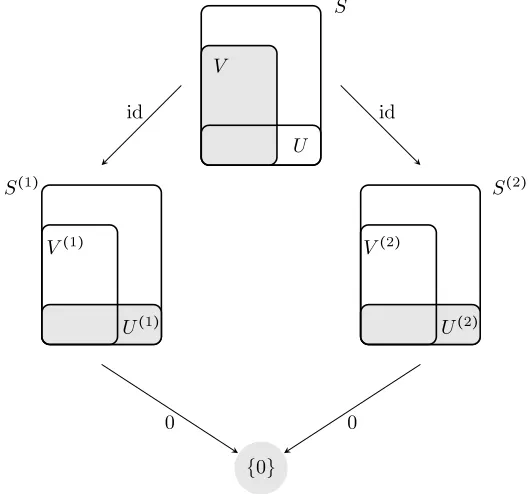
directly, or by noting that this is a special instance of the Clifford construction [21, Section 4.2], with the ingredients arranged in a diamond semilattice as in Figure 2. Let
T(S, V, U) =V ∪U(1)∪U(2)∪ {0}.
It is easy to verify thatT(S, V, U)is a subsemigroup ofW(S). Its gross structure, and the way that it embeds intoW(S), are also illustrated in Figure 2.
LetG= ⟨A∣ R⟩be a finitely presented group and let H be a finitely generated
subgroup ofG. Again, as in Section 5, we assume without loss of generality that the presentation⟨A∣ R⟩is finite and satisfies Conditions (G1), (G2). We are now
going to describe a finite band BG,H. It will be obtained using the T(S, V, U)
construction above whereS=BGis taken to be the band constructed in [8],U will
be the unique minimal ideal ofBG, and V will be a certain subsemigroup of BG
which will depend on the choice of the subgroupH. The details are as follows. Define A1=A∪ {1} and B1=B∪ {1}; furthermore, letA1= {a∶ a∈A1} be a
copy ofA1, and let∞be a symbol not inA1. Set
I=A1∪A1, J=A1∪ {∞}.
Now consider the direct productT = TI(l)× TJ(r),where TI(l) (respectivelyTJ(r)) is
the semigroup of all mappingsI→I(resp.J→J) written on the left (resp. right).
S
V
U
S(2)
V(2)
U(2) S(1)
V(1)
U(1)
{0}
0 0
[image:19.612.173.439.122.369.2]id id
Figure 2. A pictorial representation of the structure of the semi-groupW(S). The subsemigroupT(S, V, U) =V∪U(1)∪U(2)∪ {0}
ofW(S)is shaded in grey.
σandτ constant. This ideal is naturally isomorphic to the rectangular bandI×J,
and we identify the two. Following [8] we haveBG=KG∪LG⊆ TI(l)× TJ(r), where LG is a left zero band which we now describe.
For each(σ, τ) ∈LG we shall have
σ2=σ, τ2=τ, ker(σ) = {A1, A1}, im(τ) =A1.
Therefore, each(σ, τ)will be uniquely determined by im(σ)which must be a
two-element set that is a cross-section of {A1, A1}, and the value (∞)τ ∈ A1. These idempotents are defined in Table 1. Note thate1=e1. From the previous definition
it is easy to see that for any e = (σ, τ) ∈ LG we have that σ∣A1 and τ∣B1 are transformations of A1 and B1, respectively (more precisely, a constant map and the identity). Therefore, if we takeKH=A1×B1 as a rectangular subband ofKG,
Notation Indexing im(σ) (∞)τ
ea= (σa, τa) a∈A1 {1, a} a
ea= (σa, τa) a∈A1 {a, a} 1
er= (σr, τr) r= (ab, c) ∈ R {b, c} a
BG,H=KH∪LG is a subband ofBG. So we have
KH∪LG≤KG∪LG=BG.
Also note thatKG is an ideal ofKG∪LG=BG. Therefore all of the conditions are
satisfied to apply our general construction above and we define the semigroup
BG,H=T(BG, KH∪LG, KG) =T(KG∪LG, KH∪LG, KG)
We now make some observations about the semigroupBG,H.
● BG,H is a finite band with fiveD-classesLG,KH,KG(1),KG(1), and{0}with
theirJ-order illustrated in Figure 3. Compare with Figure 2, noting that
KH corresponds to the intersectionV ∩U.
● We have isomorphisms
LG∪KG(1)≅LG∪KG(2)≅LG∪KG=BG,
via the obvious bijections,x↦xforx∈LG andx↦x(i) forx∈KG.
● The elements ofLG are
ea (a∈A1), ea (a∈A1), er(r∈ R),
which are defined in Table 1.
● The elements ofKH are pairs(a, b),a∈A1,b∈B1 which can be identified with pairs of constant maps.
● The elements ofKG(i) are pairs
(a1(i), a(2i)), a1(i)∈A(1i)∪A
(i)
1 , a (i)
2 ∈A (i)
1 ∪ {∞(
i)
}.
It follows from the definition of the construction T(S, V, U) that, with the other notation introduced above, the elements(σ, τ) ∈LG,(a, b) ∈KH,(a1(i), a(2i)) ∈KG(i)
multiply in the following way:
(σ, τ)(a, b) = (σ(a), b) (a, b)(σ, τ) = (a, bτ)
(σ, τ)(a(1i), a(2i)) = (σ(a1)(i), a(2i)) (a1(i), a(2i))(σ, τ) = (a1(i),(a2τ)(i)) (6.1)
(a, b)(a(1i), a(2i)) = (a(i), a(2i)) (a(1i), a(2i))(a, b) = (a(1i), b(i)),
while for(a(1)1 , a(1)2 ) ∈KG(1) and(a(2)3 , a(2)4 ) ∈KG(2) we have
(a(1)1 , a(1)2 )(a(2)3 , a(2)4 ) = (a(2)3 , a(2)4 )(a(1)1 , a(1)2 ) =0.
Within a single D-class the multiplication is the usual rectangular band multipli-cation. An illustration of the band BG,H in given in Figure 3. It shows the five D-classes, the indexing sets of each of these D-classes, and their D-class poset ordering.
7. The maximal subgroups of IG(BG,H)
We shall now describe the maximal subgroups of IG(BG,H) showing that they
are all either trivial or isomorphic toG, thus establishing Theorem 5.1.
As a consequence of the property (IG3) from [17] and results of [1], the regular
D-classes of IG(BG,H) will be in a natural bijective correspondence with the D
-classes ofBG,H; to emphasise this correspondence, we shall denote theD-classes in
IG(BG,H)byLG,KH, K
(1)
G , K
(2)
G and {0}. The maximal subgroups of IG(BG,H)
A1
A1
LG
R
KH
A1
B1
KG(1)
A(1)1
A(11)
A(1)1 ∞(1)
KG(2)
A(2)1
A(12)
A(2)1 ∞(2)
{0}
Figure 3. An illustration of the structure of the finite bandBG,H.
band—so that each H-class consists of a single idempotent—it follows that each regularD-class ofIG(BG,H)is the union of its maximal subgroups.
Proposition 7.1. The maximal subgroups of IG(BG,H) contained in LG, KH or {0} are trivial, while those contained inK
(1)
G orK
(2)
G are isomorphic toG
Proof. All the statements follow from Theorem 4.2. Since LG is a left zero
semi-group, it follows that for every generatorf ofLG we havef =1 (defining relations
(4.8)), and so the group is trivial. Recall that theD-classKHofBG,H is anA1×B1 rectangular band. Consider the action of ea = (σ, τ) ∈LG on KH: σ acts as the
constant map on A1 with value a, while τ acts as the identity map on B1. It follows thatea singularises every square of the form(a, a1;b, b1)witha1∈A1 and
b, b1∈B. By varyinga∈A1we see thatall the squares are singular, and hence the presentation from Theorem 4.2 again defines the trivial group. TheD-class{0} is
trivial, and hence its counterpart{0}is trivial as well.
Let us now consider the D-class K(Gi), i=1,2. The only idempotents ofBG,H
acting onKGare those fromLG∪KH. However, the idempotents fromKH act by
1 a1 a2 . . . ∞
1 1 1 1 . . . 1
a1 1 1 1 a1
a2 1 1 1 . . . a2
⋮ ⋮ ⋮ ⋱ ⋮
1 1 a1 a2 1
a1 1 a1 a2 . . . a1
a2 1 a1 a2 a2
⋮ ⋮ ⋮ ⋮ ⋮
J
[image:22.612.233.381.121.324.2]I
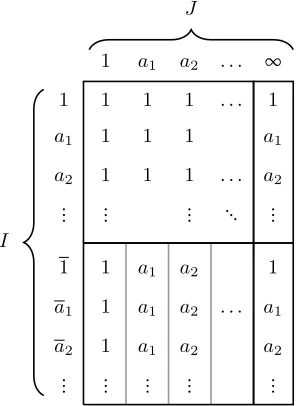
Figure 4. The relationship between the generatorsAand gener-ators F = {fij ∶ i ∈ I, j ∈ J} of G, where I = A1∪A1 and J = A1∪ {∞}.
the maximal subgroups of IG(BG,H) inside K
(i)
G are isomorphic to the maximal
subgroups of the free idempotent generated semigroup over the band LG∪KG(i)
in the D-class corresponding to KG(i). The band LG∪KG(i) is isomorphic to that
constructed in [8], where it is proved that the maximal subgroups in question are
isomorphic toG, as required.
It will be helpful for our subsequent exposition to outline briefly how the above mentioned argument from [8] proceeds. It is a Tietze transformations argument, starting from the presentation given by Theorem 4.2 in terms of the generators
fij, i∈ I =A1∪A1, j ∈J =A1∪ {∞}. A systematic analysis of singular squares
induced by the idempotentsea and ea fromLG shows that large collections of the
above generators are equal to each other. More specifically, it is proved that all the generatorsfax, with (a, x) ∈ (A1×A1) ∪ {(1,∞)} ∪ (A1× {1}) ∪ {(1,∞)}, are
equal to 1, and that for each a∈ A the generators fa,∞, fx,a (x ∈ A1) and fa,∞
are all equal. Renaming formally all the generators in this latter group asa, and considering the remaining singular squares induced by the idempotents er ∈ LG (r∈ R)yields the original presentation⟨A∣ R⟩ofG. The relationship between the
original generatorsAand the generatorsfij is summarised in the table in Figure 4,
and will be referred to throughout the technical argument in the following section.
8. Proof of the Undecidability Result
As it was already mentioned in the previous section, the fact thatBG,H has five D-classes is reflected in five corresponding regularD-classes ofIG(BG,H).
Further-more, eachD-class of BG,H is a rectangular band, so eachD-class of IG(BG,H)is
completely simple, and so isomorphic to some Rees matrix semigroup (without a zero element) over any of the (mutually isomorphic) maximal subgroups of that
D-class. We have seen above that all of theD-classesLG,KH and{0}have trivial
maximal subgroups and so they are each rectangular bands, isomorphic toLG,KH
and {0}, respectively. We have also seen above that K
(1)
G and K
(2)
G are
isomor-phic completely simple semigroups each with maximal subgroup isomorisomor-phic toG. We now determine the structure matrices in the Rees matrix representations of
completely simple subsemigroupsK(1)G andK(2)G ofIG(BG,H).
Let F = {fij ∶ i ∈ I, j ∈ J}, where, as before, I = A1∪A1, J = A1∪ {∞}.
By Lemma 4.3 we have computable mappings, defined by the equations (4.11) and (4.12), where:
π(i)∶ (KG(i))∗→I× (F∪F−1)∗×J,
ρ(i)∶I× (F∪F−1)∗×J → (KG(i))∗,
which induce mutually inverse isomorphisms betweenK(Gi) and the fixed Rees ma-trix semigroup M[G;I, J;P] where P = (fij−1)j∈J,i∈I. So, taking the transpose of
the table in Figure 4 and inverting all the entries gives a Rees structure matrix for
the isomorphic completely simple semigroupsK(1)G andK(2)G . The main result we want to establish is the following.
Proposition 8.1. For allw∈ (F∪F−1)∗ the equality
(1(1),1(1))(1(2),1(2)) =ρ(1)(1, w−1,1)ρ(2)(1, w,1)
holds in IG(BG,H)if and only if wrepresents an element of H.
Remark 8.2. Once again, a comment about the nature of the above equality: it purportedly holds in IG(BG,H), which in turn is defined by a presentation
(specif-ically, (3.1)). Accordingly, the two terms should be interpreted as words over the generating set forIG(BG,H), which is in fact the entirety of elements ofBG,H;
how-ever, when treating it as an alphabet, we will denoted this set byE. The elements
(1(1),1(1))and(1(2),1(2))are single idempotents (belonging to KG(1) andKG(2)
re-spectively), whileρ(1)(1, w−1,1)andρ(2)(1, w,1)are wordsE∗ by the definition of ρ.
To establish this proposition, we first need a criterion for certain equalities of
words from E∗. Given words u1, u2 ∈ E∗ both representing elements of K
(1)
G in
IG(BG,H), and words v1, v2 ∈ E∗ both representing elements ofK
(2)
G , we want to
know when the equalityu1v1=u2v2 holds inIG(BG,H). To this end, fori=1,2, let
L(K(Gi))denote the set of words overErepresenting elements ofK
(i)
G inIG(BG,H).
The following lemma describes these two sets.
Lemma 8.3. Let w∈E∗ and i∈ {1,2}. Then w represents an element of K
(i)
G if
Proof. We prove the assertion for i = 1; the case i = 2 is analogous. According
to Theorem 3.6, w represents an element of K(1)G if and only if it has the form
w =uev, where e∈ KG(1), and ueLe and evRe in BG,H. From the definition of
BG,H (and Figure 3), it is clear that left/right multiplying an idempotente′∈KG(1)
by any element from LG∪KH∪KG(1) results in an idempotent in the L-/R-class
of e′, whereas multiplication by an element from KG(2)∪ {0} yields 0. It follows
that precisely the words from(LG∪KH∪KG(1))∗ are available foruandv, yielding
w∈ (LG∪KH∪KG(1))∗, with at least one letter (namelye) fromKG(1), as required.
Lemma 8.4. Let (u, v) ∈ L(K(1)G ) × L(K(2)G ). If u ≡ u′f where f ∈ LG ∪KH
then (u′, f v) ∈ L(K(1)G ) × L(K(2)G ). Similarly, if v≡ f v′ where f ∈ LG∪KH then
(uf, v′) ∈ L(K(G1)) × L(K(G2)).
Proof. This is an immediate consequence of Lemma 8.3
This lemma forms the basis of some relations which we shall now define on the setL(K(1)G ) × L(K(2)G ).
Definition 8.5. For(u1, v1),(u2, v2) ∈ L(K (1)
G ) × L(K
(2)
G )we write
(u1, v1) ≈ (u2, v2)
if and only if one of the following three conditions is satisfied:
(i) u1=u2 andv1=v2hold inIG(BG,H);
(ii) u1=u2f andf v1=v2hold inIG(BG,H)for some f∈LG∪KH;
(iii) u1f =u2 andv1=f v2hold inIG(BG,H)for some f∈LG∪KH.
Note that≈is a reflexive and symmetric relation on the setL(K
(1)
G ) × L(K
(2)
G ).
Now let∼denote the transitive closure of the relation≈onL(K
(1)
G ) × L(K
(2)
G ). Note
that (u1, v1) ∼ (u2, v2) does not imply u1 =u2 or v1= v2 in IG(BG,H). However,
if u1 = u2 and v1 = v2 in IG(BG,H) then by definition (u1, v1) ∼ (u2, v2). Thus
the equivalence relation∼onL(K
(1)
G ) × L(K
(2)
G )induces a well-defined equivalence
relation on the setK(1)G ×K
(2)
G .
Lemma 8.6. Let (α, β),(α′, β′) ∈ L(K(G1)) × L(KG(2)). If αβ≡α′β′ then (α, β) ∼ (α′, β′).
Proof. Without loss of generality we may suppose that∣α′∣ > ∣α∣. Writeα′≡αγ and β≡γβ′. Since
αγ≡α′∈ L(K
(1)
G ) ⊆ (LG∪KH∪KG(1))∗ and
γβ′≡β∈ L(K
(2)
G ) ⊆ (LG∪KH∪KG(2))∗,
it follows that γ ∈ (LG∪KH)∗. Write γ ≡ γ1γ2. . . γr where each γj ∈ LG∪KH.
Then
(α, β) = (α, γ1γ2. . . γrβ′) ≈ (αγ1, γ2. . . γrβ′) ≈. . .≈ (αγ1γ2. . . γr, β′) = (α′, β′),
Lemma 8.7. Let (u, v) ∈ L(K(1)G ) × L(K
(2)
G ). Let w ∈ E∗ be a word obtained from the word uv by the application of a single relation from the presentation for IG(BG,H). Then the word w admits a decomposition w ≡ αβ where (α, β) ∈
L(K(G1)) × L(K(G2))and(u, v) ∼ (α, β).
Proof. Recall that the defining relations ofIG(BG,H)are all of the formef =gwhere (e, f)is a basic pair (meaning{e, f} ∩ {ef, f e} ≠ ∅) and ef =g holds in the band
BG,H. Keeping in mind thatL(K
(1)
G )is the set of all words fromE∗ representing
elements ofK(G1), if the relation that is applied to transform uvinto w is applied entirely within the subwordu, transforming it intou′, and hence transforming uv
into u′v ≡w where u′=u in IG(BG,H), then the lemma trivially holds by taking α≡u′andβ≡v. Similarly the lemma is easily seen to hold if the relation is applied
entirely within the subword v. The only remaining case left to consider is when
u≡u′e,v≡f v′,w≡u′gv′andwis obtained fromuvby applying the relationef=g
from the presentation ofIG(BG,H). Since
u′e≡u∈ L(K
(1)
G ) ⊆ (LG∪KH∪KG(1))∗ and
f v′≡v∈ L(K
(2)
G ) ⊆ (LG∪KH∪KG(2))∗,
it follows thate∈ (LG∪KH) ∪KG(1) andf∈ (LG∪KH) ∪KG(2). As{e, f} is a basic
pair, and the D-classesKG(1) and KG(2) are incomparable in the J-class order in
the bandBG,H, it follows that we cannot have both e∈KG(1) and f ∈KG(2). This
means that we must havee∈LG∪KH orf∈LG∪KH (or possibly both).
Suppose first that e ∈ LG ∪KH. Then setting α ≡ u′ and β ≡ gv′ we have w≡u′gv′≡αβ and
(u, v) = (u′e, f v′) ≈ (u′, ef v′) ≈ (u′, gv′) = (α, β).
Here(u′, ef v′) ∈ L(K(G1)) × L(KG(2))by Lemma 8.4 sincee∈LG∪KH.
Finally, the case thatf∈LG∪KH follows by a dual argument. This deals with
all possible cases, and thus completes the proof.
The following lemma shows the importance of the relation∼in connection with
the word problem.
Lemma 8.8. Let (u1, v1),(u2, v2) ∈ L(K (1)
G ) × L(K
(2)
G ). Then u1v1 = u2v2 in
IG(BG,H)if and only if(u1, v1) ∼ (u2, v2).
Proof. (⇐) Clearly it suffices to prove if (u1, v1) ≈ (u2, v2) then u1v1 = u2v2, so suppose that (u1, v1) ≈ (u2, v2). In all three cases (i)–(ii) of Definition 8.5 it is
immediately seen thatu1v1=u2v2 inIG(BG,H).
(⇒) Let(u1, v1),(u2, v2) ∈ L(K(
1)
G ) × L(K
(2)
G ), and suppose thatu1v1=u2v2 in
IG(BG,H). This means there is a sequence of words fromE∗
u1v1≡w1=w2=. . .=wk≡u2v2,
such that for each j, the word wj+1 is obtained from wj by the application of a
single relation from the defining relations ofIG(BG,H). Working along this sequence
wj admits a decompositionwj≡αjβj such that(αj, βj) ∈ L(K
(1)
G ) × L(K
(2)
G )and
(u1, v1) ∼ (α1, β1) ∼ (α2, β2) ∼. . .∼ (αk, βk).
Finally, u2v2 ≡ wk ≡αkβk with (u2, v2),(αk, βk) ∈ L(K(
1)
G ) × L(K
(2)
G ) and so by
Lemma 8.6 it follows that(αk, βk) ∼ (u2, v2), and thus(u1, v1) ∼ (u2, v2).
Next we record how the elements from LG ∪KH act on K
(1)
G and K
(2)
G in
IG(BG,H).
Lemma 8.9. Lete= (σ, τ) ∈KH∪LG and let(i, w, j) ∈I× (F∪F−1)∗×J. Further choose arbitrary i0∈im(σ)andj0∈im(τ). Then
ρ(1)(i, w, j)e=ρ(1)(i, wfi−1
0jfi0,jτ, jτ)
and
e ρ(2)(i, w, j) =ρ(2)(σ(i), fσ(i),j0f −1
ij0w, j)
both hold inIG(BG,H).
Proof. We prove the first equality only; the second follows by a dual argument. Sincei0∈imσthe rules of multiplication given by (6.1) imply that
e(i(1)0 , j(1)) = (i(1)0 , j(1))and(i(1)0 , j(1))e= (i(1)0 , jτ(1)) (8.1)
in BG,H. Hence {e,(i(1)0 , j(1))}is a basic pair, and the above relations are among the defining relations forIG(BG,H). By the definition of the mappingρin equation
(4.12) we have
ρ(1)(i, w, j) ≡ (i(1)1 , j1(1)). . .(i(1)k−1, jk(1)−1)(i(1)k , jk(1)) ≡u(i(1)k , jk(1)) (8.2)
for somei1, . . . , ik∈I,j1, . . . , jk∈J. Notice that necessarilyi=i1 andj=jk. Also,
recall that the structure matrix for the Rees matrix representation ofK(G1)is given byP = (fij−1)j∈J,i∈I. It follows that the element (i0, fi0,jτ, jτ)is an idempotent in this Rees matrix semigroup, and hence
(i(1)0 , jτ(1)) =ρ(1)(i0, fi0,jτ, jτ) (8.3)
inIG(BG,H). Now we have
ρ(1)(i, w, j)e≡u(i(1)k , jk(1))e≡u(i(1)k , j(1))e (by (8.2))
=u((i(1)k , j(1))(i(1)0 , j(1)))e (since (i(1)k , j(1))L(i(1)0 , j(1)))
=u(i(1)k , j(1))((i(1)0 , j(1))e)
=u(i(1)k , j(1))(i(1)0 , jτ(1)) (by (8.1))
=ρ(1)(i, w, j)(i(01), jτ(1))
=ρ(1)(i, w, j)ρ(1)(i0, fi0,jτ, jτ) (by (8.3))
=ρ(1)(i, wfi−1
0jfi0,jτ, jτ) (by (4.14)).
as required.
Lemma 8.10. Supposeu1, u2∈ L(K (1)
G ),v1, v2∈ L(K (2)