doi:10.4236/cs.2011.23016 Published Online July 2011 (http://www.SciRP.org/journal/cs)
An Improved Chirplet Transform and Its Application for
Harmonics Detection
Guo-Sheng Hu1, Feng-Feng Zhu2 1
School of Computer, Shanghai Technical Institute of Electronics and Information, Shanghai, China
2
School of Mathematics Science, South China University of Technology, Guangzhou, China E-mail: jamhu8@sohu.com, Zhuffeng@126.com
Received January 2, 2011; revised March 1, 2011; accepted March 8, 2011
Abstract
The chirplet transform is the generalization form of fast Fourier Transform, short-time Fourier transform, and wavelet transform. It has the most flexible time frequency window and successfully used in practices. However, the chirplet transform has not inherent inverse transform, and can not overcome the signal recon-structing problem. In this paper, we proposed the improved chirplet transform (ICT) and constructed the in-verse ICT. Finally, by simulating the harmonic voltages, the power of the improved chirplet transform are illustrated for harmonic detection. The contours clearly showed the harmonic occurrence time and harmonic duration.
Keywords:Harmonics, Improved Chirplet Transform (ICT), S-Transform, Time-Frequency Representation
(TFR)
1. Introduction
In many power quality analysis and disciplines, the con-cept of a stationary time series is a mathematical ideali-zation that is never realized and is not particularly useful in the detection of power quality disturbances in power systems. Although the Fourier transform of the entire time series does contain information about the spectral components in a time series, for a large class of practical applications such as voltage signals in power systems, this information is inadequate. So in the year of 1996, Stockwell, Mansinha and Lowe presented a new S trans-form that provides a joint time-frequency representation (TFR) with frequency-dependent resolution [1] while, at the same time, maintaining the direct relationship, through time-averaging, with the Fourier spectrum. Sev-eral have been proposed in the past; among them are the Gabor transform [2], the related short-time Fourier trans-forms [3], the continuous wavelet transform (CWT) [4], and the bilinear class of time-frequency distributions known as Cohen’s class [5], of which the Wigner distri-bution [6] is a member. The S transform was defined as following [1].
2 2
2π
2
, e
2π
t f j ft
f
S f h t t
It is easy to prove that
e d .
.
(1)
,
d
S f H f
(2) where H f
is the Fourier transform of h t
. Itfol-lows that h t
is exactly recoverable from S
,f
.Thus
,
d e
j2πftd .h t
S f f (3) The S-transforms have successfully been used in power system disturbance detection and identification [7]. Another time-frequency representation, Chirplet trans-form (CT), was defined by Mann Steven in 1992 [8].
2 2 2
2 1
, e e d
2π
t b
i t qt
C b h t t
. (4)
, d .
However, CT does not satisfy basic characters (2) and (3) and inconvenience in practical applications. So, in this paper, we present an improved Chirplet transform satisfying (2) and (3), moreover, the novel Chirplet transform is an extension of the S-transform.
This paper is organized as follows. The improved Chirplet transform is presented in Section 2, and the nu-merical algorithm is introduced in Section 3; Several simulated power quality harmonic waveforms are de-tected and identified using the proposed method in Sec-tion 4; Finally, The conclusions and references are given.
2. The Improved Chirplet Transform
Chirplet transform is considered as the “phase correc-tion” of the CWT. The CWT of a function
is defined by [4]
, W b a
h t
,
W b a h t w t b a t
(5)where is a scaled replica of the fundamental mother wavelet. The dilation a determines the “width” of the wavelet and thus controls the resolution. Along with (5), there exists an admissibility condition on the mother wavelet [4] that must have zero mean.
w
w
w w
The improved chirplet transform of a function h t
is defined as a CWT with a specific mother wavelet de-fined as
2 2 2 2 2π 2, e e
2π
t f iq
i ft qt
f iq
w t f
. (6)note that the frequency f and constant q.
The improved chirplet wavelet in (6) does not satisfy the condition of zero mean for an admissible wavelet; therefore, it is not strictly a CWT, Written out explicitly, the improved chirplet transform is
2 2 2 2 2π 2 , e e 2πt b f iq
i f q t b IC b f
f iq
h t t
d ..
(7)
It is obvious that Equation (7) degenerates to be an S-transform as q0 [1].
If the improved chirplet transform is indeed a repre-sentation of the local spectrum, one would expect a sim-ple operation of averaging the local spectra over time to give the Fourier spectrum. It is shown as follows
,
d
IC b f b H f
(8) where H f
h t
is the Fourier transform of . It fol-lows that is exactly recoverable from
h t
IC b f
,
.Thus
,
d e
i2πftdh t IC b f b f
. (9)Proof:from
2 2 2 2
2 2 2 2 2 2 2 2 2 2
e e d e
1
e d
2π e d 2π .
t b f iq t b f iq
iq t b
u
u
b b
u set u f iq b t
f iq u f iq
d we can get
2 2 2 2 2 2 2 2π 2 22π 2
2π
, d
e e d d
2π
e d e e d
2π
e d ( ).
t b f iq
i ft q t b
t b f iq i q t b i ft
i ft
IC b f b
f iq
h t t b
f iq
h t t b
h t t H f
.Then (9) is the inverse of the above equation.
Alike FFT, STFT, WT, and CT, the improved chirplet transform has the linear property. This is an advantage over the bilinear class of time-frequency representations (TFR’s). The presence of the cross terms makes it diffi-cult to reliably estimate the signal. The improved chirplet transform can be written as operations on the Fourier spectrum H f
of h t
2 2 2
2π
2π
, e f iq i b
IC b f H f
e d
(11)Proof:
2 2 2 2 2 2 2 2 2 2 2 2 2 2π 2π 2π2π 2π
2π 2
2π
2 2
2π
e e d
( )e e e d d
e e d e d
e e
2π
( ,
i b f iq
i f t f iq i b
f iq t b
f iq i ft
t b f iq
i ft q t b
H f
h t t
h t t
f iq
h t t
IC b
). f d109
3. The Discrete Improved Chirplet
Transform
1
0 1
, 0 N .
m m
IC jT h
N NT
(14)with j m, , and n0,1, 2, , N1. The discrete im-proved chirplet transform suffers the familiar problems from sampling and finite length, giving rise to implicit periodicity in the time and frequency domains. The dis-crete inverse of the improved chirplet transforms (13) and (14) is
Let h kT
, denote a discrete timeseries corresponding to signal with a time sam-pling interval of T. The discrete Fourier transform is given by
0,1, 2, , 1
k N
h t
2π1 0
1N e i nk N
k
n
H h kT
NT N
.N
(12)
1 1 2π0 0
1 , ej nk.
N N
N
k j
n
h kT IC jT
N NT
(15)where . In the discrete case, the im-proved chirplet transform is the projection of the vector defined by the time series
0,1, 2, , 1
n
h kT onto a spanning set of
vectors. The spanning vectors are not orthogonal, and the elements of the improved chirplet transform are not in-dependent. Each basis vector (of the Fourier transform) is divided into localized vectors by an element- by-element product with the N shifted Gaussians such that the sum of these N localized vectors is the original basis vector.
N
4. Examples
4.1. The Signal TFR Figure Using the Improved Chirplet Transform
Using (11), the improved chirplet transform of a dis-crete time series h kT
is given by (letting f n NT and jT)2 2 2
2π 2π
1 0
, e
m
i mj N
n iq N
m
n m n
IC jT H
NT NT
e . (13)
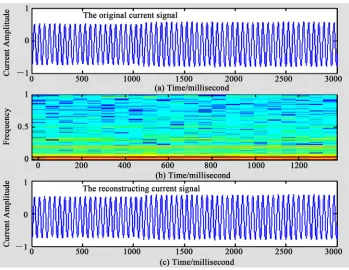
Equations (7) and (9) are the improved chirplet transform (ICT) for the time-frequency representation (TFR) and its inverse ICT for the signal reconstruction. In the fol-low figures, Figure 1(a) is the A-phase current signal of
the inductor motor with single phase grounding. Figure 2(b) shows the TFR of the A-phase current signal of the
motor using (7). The reconstruction signal using (9) is illustrate in Figure 2(c). From Figure 1, we know (7)
and (9) are very effective for representing a time fre-quency feature of a signal and reconstructing from TFR. where , . For the , it is equal to
the constant defined as 0
[image:3.595.123.472.437.707.2]n qq NT
2 n04.2. The harmonics Detection
Figures 2 and 3 demonstrate the class of time series for
which the improved chirplet transform would be useful;
they highlight the advantages of such an approach as compared with other techniques.
Considering a simulating segment harmonic voltage with zero initial phase as follows.
sin 2 50 0 0.3
sin 2 50 sin 2 150 0.3 0.6
sin 2 50 0.2 0.6 1.4
sin 2 50 sin 2 350 1.4 1.7
sin 2 50 1.7 2
pi t t
pi t pi t t
f t pi t t t
pi t pi t t
pi t t
(16)
350 Hz
150 Hz 50 + 0.2t Hz
[image:4.595.111.483.497.704.2]50 Hz
Figure 2. The simulating voltage with zero initial phase (a), and its ICT contour (b).
50 + 0.2t Hz
350 Hz 150 Hz
50 Hz
111
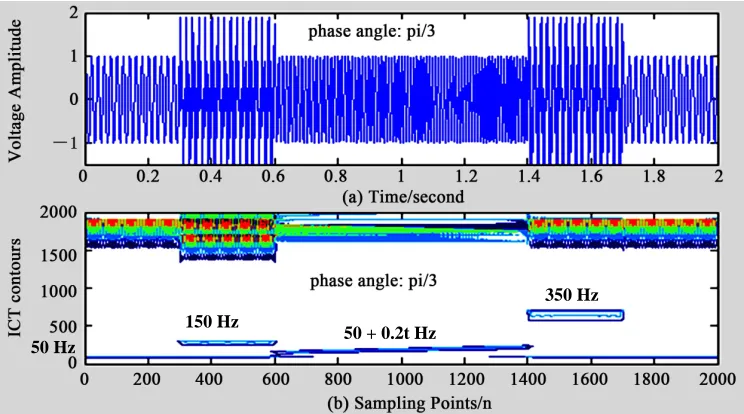
The voltage signal divided into 5 time segments. In the first time interval, the voltage constrains only a fre-quency: 50 Hz. At time 0.3, the voltage constrains an-other harmonic: 150 Hz. In the time interval 0.6 t 1.4, the voltage constrains a linear time changing harmonic. Then at 1.4 s, the harmonic, 350 Hz, added to the signal. Finally, the voltage retain normally at 1.7 s.
The sampling frequency is 1000 Hz. Figure 2 (a) is
the improved chirplet transform plot of (16). Figure 2(b)
is the contour plot of the signal (a) using (13) and (14). Form Figure 2(b), we find the ICT contour illustrates the
work frequency 50 Hz, two harmonic frequency 150 Hz and 350 Hz, and the linear time changing frequency 50 + 0.2 t Hz.
Moreover, the contour in Figure 2(b) clearly shows
the harmonic occurrence times and durations.
In order to investigate the influence of initial phase, we modulating the above simulating voltage signal with pi/3 phase. From Figure 3, we find that the initial phase
does not influence the harmonic detection.
5. Conclusions
The chirplet transform is the generalization form of fast Fourier transform, short-time Fourier transform, and wavelet transform. It has the most flexible time fre-quency window and successfully used in practices. However, the chirplet transform has not inherent recon-structing formulae. So we proposed the improved chir-plet transform (ICT) and constructed the inverse ICT. Finally, the power of the improved chirplet transform is apparent from the above examples.
6. References
[1] R. G. Stockwell, L. Mansinha and R. P. Lowe, “Location
of the Complex Spectrum: The S-Transform,” IEEE Transactions on Signal Processing, Vol. 44, No. 4, 1996,
pp. 998-1001. doi:10.1109/78.492555
[2] D. Gabor, “Theory of Communication,” Journal of Insti-tution of Electrical Engineers, Vol. 93, No. 3, 1946, pp.
429-457.
[3] R. N. Bracewell, “The Fourier Transform and Its Appli-cations,” McGraw-Hill, New York, 1978.
[4] S. Mallat, “A Wavelet Tour of Signal Processing,” 2nd Edition, Academic Press, Waltham, 2001.
[5] L. Cohen, “Time-Frequency Distributions—A Review,”
Proceedings of the IEEE, Vol. 77, No. 7, 1989, pp. 941-981. doi:10.1109/5.30749
[6] F. Hlawatsch and G. F. Boudreuax-Bartels, “Linear and Quadratic Time-Frequency Signal Representations,” Pro-ceedings of Signal Processing Magazine, Vol. 9, No. 2,
1992, pp. 21-67.
[7] M. V. Chilukur and P. K. Dash, “Multiresolution S -Trans-form-Based Fuzzy Recognition System for Power Quality Events,” IEEE Transactions on Power Delivery, Vol. 19, No. 1, 2004, pp. 323-330.
doi:10.1109/TPWRD.2003.820180
[8] S. Mann and S. Haykin, “The Chirplet Transform: Physi-cal Considerations,” IEEE Transactions on Signal Proc-essing, 1995, Vol. 43, No. 11, pp. 2745-2761.
doi:10.1109/78.482123
[9] G.-S. Hu, F.-F. Zhu and Y.-J. Tu, “Power Quality Dis-turbance Detection and Classification Using Chirplet Transform,” Lecture Notes in Computer Science, Vol.
4247, 2006, pp. 34-41. doi:10.1007/11903697_5
[10] Z. Ren, G. S. Hu, W. Y. Huang and F. F. Zhu, “Motor Fault Signals Denosing Based on Chirplet Transform,”
Transactions of China Electrotechnical Society, Vol. 17, No. 3, 2002, pp. 59-62.
[11] G. S. Hu and F. F. Zhu, “Location of slight Fault in Elec-tric Machine Using TrigonomeElec-tric Spline Chirplet Trans-forms,” Power System Technology, Vol. 27, No. 2, 2003,