THE PASSAGE OF STARCH THROUGH THE
STOMACH OF THE SHEEP
BY R. A. WELLER AND F. V. GRAY
From the Division of Biochemistry and General Nutrition of the Commonwealth Scientific and Industrial Research Organization, University of Adelaide,
South Australia
(Received 4 February 1953)
Micro-organisms are now known to be the agents responsible for many important chemical changes in the rumen contents. By the fermentation of polysaccharides they produce large quantities of the lower fatty acids which are absorbed and utilized by the host; they digest a considerable part of the protein in the fodder and resynthesize proteins during their own growth and proliferation; they are capable of converting suitable forms of non-protein nitrogen to protein, and can synthesize many of the vitamins. The accurate assessment of the extent to which such processes take place, however, presents major difficulties—difficulties bound up with the fact that the rumen is a reservoir into which more or less continuous supplies of food, water and saliva enter, and from which some products of the fermentation are absorbed, while others, together with food residues, pass to lower levels of the alimentary tract. As a consequence, the extent to which various compounds are digested, released or synthesized, cannot be determined from the concentrations of these substances in the rumen, and so indirect methods of investigation must usually be applied to such problems.
The present work is concerned with some aspects of the fate of starch during its passage through the compound stomach of the sheep. In the past it was often thought that significant quantities of starch might escape destruction, or alterna-tively that new starch might be synthesized and stored in the micro-organisms to be passed on to lower levels of the alimentary tract for digestion as in other animals.
EXPERIMENTAL
(1) Sampling and analytical procedures
A sheep with permanent fistulae of the rumen and abomasum provided the samples from these two compartments of the living animal; other samples were obtained from slaughtered sheep.
Fistula sheep. The procedure for the establishment of abomasal fistulae has
The passage of starch through the stomach of the sheep 41
Slaughtered sheep. The abdomen was opened immediately after slaughtering
and the organs isolated from one another by tapes tied at the levels of the reticulo-omasal and omaso-abreticulo-omasal orifices and at the pylorus. The contents were then removed and where necessary smaller samples were selected for analysis.
General treatment of samples. Each sample was weighed, filtered through muslin
(about 40 threads/in.) and the solid residues squeezed as dry as possible. These solids were then washed twice with water, the washings being added to the first filtrate. In general, the volume of water used in each washing of the solids from the reticulum, rumen and abomasum was approximately that of the first filtrate. When the concentration of solids was low the volume of wash water was cor-respondingly reduced. In the case of the omasal contents water was added to give a thin, creamy consistency, and this mixture was then treated similarly to the contents of the other compartments.
The total volume of the combined filtrate was measured and aliquot samples taken for the determination of starch. The sizes of the aliquots were chosen so that the reducing sugars finally determined in the 5 ml. aliquot of hydrolysate (q.v.) would be equivalent to 0-5-2-5 mg. maltose. Further samples were taken for counting the Protozoa, and the solids were reserved for the determination of lignin.
Determination of starch. To the aliquot of the above filtrate three volumes of
ethanol were added and the mixture allowed to stand overnight for the complete precipitation of starch and micro-organisms. The precipitate was separated and washed with ethanol by centrifuging, and dried at 700 C. Preparation of starch
extract. The starch of the precipitate was rendered water-soluble by refluxing for
30 min. with 25 ml. of a mixture of 95 % ethanol containing 1 % by volume of cone. (36%) HC1 solution. After centrifuging while still hot, the precipitate was washed with ethanol, dried at 700 C , and 30 ml. of water added to dissolve the starch.* The mixture was refluxed for 30 min., cooled and the volume adjusted to 50 ml.; it was then centrifuged, and the clear extract used in the hydrolysis of starch.
Hydrolysis of starch. Aliquots (20 ml.) of the extract were taken for hydrolysis of
the starch by the salivary a-amylase method of Hassid, McCready & Rosenfels (1940). After clarification of the digest and the accompanying blank, the volumes were adjusted to 50 ml., centrifuged, and 5 ml. aliquots taken for the determination of the reducing sugars formed. This determination was made by the procedure of Hanes (1936), employing the alkaline ferricyanide method, and expressing the reducing sugars as maltose. Finally, Hassid's value—0-890 mg. maltose per mg. starch—was used to calculate the amount of starch present.
Counting of Protozoa. The ciliate Protozoa were counted in a haemocytometer
cell. Formalin was added to stop all movement of the organisms, and whenever necessary their concentration was altered by centrifuging and resuspending in a suitable volume of water. By this means all suspensions counted had approxi-• The residue after extraction with water showed no iodine-staining reaction, and parallel analyses carried through without the starch being dried from ethanol at 700 C. also indicated that
mately the same concentration of Protozoa. In all instances duplicate counts, each of at least 500 Protozoa, were made.
It was established that the distribution given by counts of the Protozoa was Poissonian, and the concentration of the organisms was estimated with a standard deviation of 2-06%.
Determination of Lignin. The solid residues in the muslin cloth were soaked in
ethanol, squeezed free of excess liquid and dried at 40° C. for 48 hr. After several days' equilibration with air the solids were weighed, ground to pass a sieve with holes 0-5 mm. in diameter, and 1 g. samples used for the determination of lignin by the 72 % rlgSC^ method. The procedure used included a preliminary refluxing for 1 hr. with 5 % H2SO4 and the reaction with 72 % HaSC^ was allowed to con-tinue for 16 hr. at 16-20° C.
(2) Experiments and results
The distribution of starch in the stomach contents. In the preparation of samples
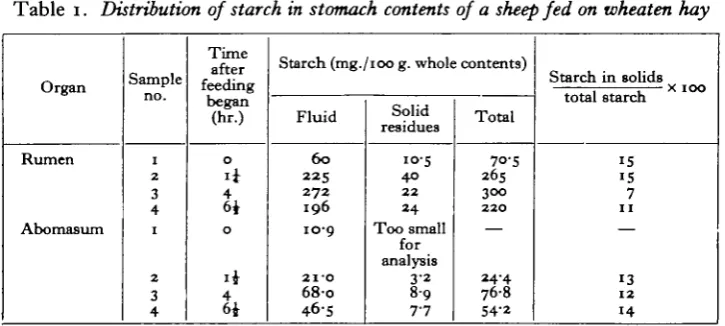
[image:3.595.117.480.392.555.2]a small part of the starch remains in the solid fraction despite thorough washing. Observations on the distribution of starch between solids and liquid in the rumen and abomasal contents at various times after feeding are given in Table 1.
Table 1. Distribution of starch in stomach contents
Organ
Rumen
Abomasum
Sample no.
1 2
3 4
1
2
3 4
Time after feeding
began (hr.)
0
i j
4 6*
0
i i 4 6i
Starch (mg.
Fluid
6 0 2 2 5 2 7 2
196
IO-9
2I-O
68-0 46-5
of a sheep fed on wheaten hay
'100 g. whole contents)
Solid residues
1 0 5 4 0
2 2
2 4 Too small
for analysis
3-2
8 9 7-7
Total
7°'5 265
300 2 2 0
—
24-4
76-8 54-2
Starch in solids
i r— x 100
total starch
15 15
7
1 1
13
1 2
14
The distribution of starch between bacteria and ciliate Protozoa in the rumen contents. Rumen contents were sampled and separated into liquid and solid portions
as described. The first filtrate was kept separate from the washings and both were gently centrifuged. The point at which all the Protozoa but a minimum of bacteria were thrown down was decided by microscopic examinations of the supernatant fluid. The various fractions were then examined for their starch content. The numbers of ciliate Protozoa in the first filtrate and in the residual fluid contained in the washings were also determined. The data are summarized in Table 2.
The stability of starch in the abomasum. Four samples of abomasal material
respec-The passage of starch through the stomach of the sheep 43
tively. There was no significant change in the starch content of the incubated samples.
Starch and lignin in the rumen and abomasum of a sheep fed on diets of varying starch content. Six experiments were carried out, and three types of fodder were
employed to give starch concentrations ranging from 0-4 to 18-5 % of the weight of fodder eaten. Lucerne hay provided the low-starch diet, various samples of
Table 2. Distribution of starch between bacteria and Protozoa in the fluid portion
of a sample of rumen contents
First filtrate Residual liquid* Weight (g.) 221 35
No. of ciliate Protozoa
115 x 1 0 ' 13-6 x 10*
Starch (mg.) Protozoal sediment 573 90 Super-natant 139 70
• Calculated as difference between weight of sample of rumen contents and the combined weights of first filtrate and residual solids.
Table 3. Starch and lignin in the rumen and abomasum Fodder- 800 g. Wheaten hay: |-3 %• «• « « * day.
Time of sampling 9.30 a.m. 10.30 11.30 12.30 p.m. 1 -45 3-oo 4.40 7.10 10.40 6.30 a.m. 9-3° Rumen contents Starch (g./kg.) 0524 2'34 2-88 2-82 320 334 2-59 2 1 4 1-40 0-702 0403 Lignin (g./kg.) 8-85 662 411 4 1 8
369 508 569 576 642 887 1038 Ratio Starch Lignin 0059 O-354 0700 0-675 0-875 0-656 O-455 0372 0218 0079 0039 Abomasal contents Starch (g./kg-) 0-092 0099 0-150 0208 0425 0-574 0673 0-622 0563 0236 0-127 Lignin (g./kg.) 381 4-00 125 1-25 i-53 862 6-8o 625 1082 5-87 368 Ratio Starch Lignin 0-024 0025 0-120 0-166 0278 0-067 0099 o-ioo 0052 0-040 0034
• Feeding started at 9.30 a.m. immediately after the first samples were taken.
44
and Fig. i. A summary of the relevant findings in five of the experiments is given in Table 4 to show the amounts of starch calculated to pass through the abomasum in 24 hr.# In Table 5 starch/lignin ratios in the rumen and abomasum are compared.
0-9
0-8
0-7
0-6
3 0-3
0-2
0-1
Rumen
0-2
0-1
Abomasum
Mean ratio for 24 hr.=-0-077
E
^ T
-Time of day
Fig. i. Starch/lignin ratios in the rumen and abomasum.
Table 4. Starch passing through the abomasum in 24 hr.
No.
1 2 3 4 5
Fodder
Lucerne hay, 800 g. Wheaten hay, 800 g. Wheaten hay, 600 g. Wheaten hay, 800 g. Wheaten hay 600 g.,
potatoes 200 g.
Starch fed ( g )
2 9
20-9
41 4 2
I 48
Mean ratio Starch Lignin during 24 hr. in abomasum*
00152 00339 00865 0077 0-151
Lignin fed
fe.) 71 63 41 55 5 i
Starch passing through abomasum
in 24 hr. (g-)
I - I 2 ' I 3 6 4"2 7-8
• Computed from graphs as in Fig. 1.
Starch and Protozoa in the stomachs of slaughtered sheep. T h e results of the
determination of starch and Protozoa in the rumen, reticulum and omasum of slaughtered sheep are given in Table 6. All of these animals were fed on wheaten hay prior to being slaughtered.
The passage of starch through the stomach of the sheep
Table 5. StarchjUgnin ratios in the rumen and abomasum
45
Exp. no.
4
6
Mean ratio starch/lignin
Rumen
0318 O-439 0 3 7 0
Abomasum
0-077 0-151 0053
Table 6. Starch and Protozoa in the fluid portion of the contents of the rumen,
reticulum and omasum of slaughtered sheep
Sheep
1
2
3
4
Organ
Rumen Reticulum Omasum Rumen Reticulum Omasum Rumen Reticulum Omasum Rumen Reticulum Omasum
Ciliate Protozoa (numbers/100 ml.
fluid)
44 X io' 58x10' 23 x io' 46 x io' 50 x io' 8 x 1 0 '
48 x I O '
48 X IO« i o x i o ' 42 x i o ' 41 x i o '
12 X IO'
Starch (mg./ioo ml.
fluid)
5i 54 29 136 162 33 35 26 13 140 72 59
DISCUSSION
The constitution of the starch or starch-like polysaccharides in the stomach contents of ruminants has not yet been established. There can be little doubt that it varies from time to time, since there may be present a variety of plant starches, as well as the starch synthesized by the micro-organisms. Numerous references have been made to the iodine-staining polysaccharides formed in the micro-organisms of the rumen, but until recently no detailed examination of them has been attempted. Masson & Oxford (1951) have isolated such material from rumen holotrichous ciliates fed on glucose and have produced evidence in favour of regarding the polysaccharide as starch rather than glycogen; oligotrichous ciliates were also examined. But it was concluded that the final decision as to the consti-tution of the polysaccharides must await further studies.
The nature of the polysaccharides present in the bacteria of the rumen has received less attention. It may be noted that the polysaccharide formed in
Clostridium butyricum from sucrose has been shown to be of the amylopectin type
(Hobson & Nasr, 1951). This organism is known to be present in the caecum of the pig and may occur in the rumen. But it may not in any way be representative of the bacterial population of the rumen.
amylopectin and 20 % amylose; and in so far as the mixed starches in the stomach contents may contain a different proportion of amylopectin (or yield different amounts of reducing sugars under the influence of salivary a-amylase), so the conversion factor for calculating starch from these reducing sugars may need modification.
It is stressed that the meaning of the term ' Starch' as used in the present work must be qualified in this way. With this proviso there is no need to avoid the use of the term in dealing with the starches of unknown constitution in the stomach of the sheep.
(1) Distribution of starch in the stomach contents. The observations summarized in Table 1 indicate that by far the larger part of the starch is to be found in the fluid portion of the contents. Only 7-15 % remained in the solids after they had been washed free of the residual fluid with water. This small residue may have been lodged in bacteria closely attached to the plant tissues, or in the plant material itself.
It is, of course, already realized that both the amount of starch in the rumen and its distribution between Protozoa and bacteria may vary widely with the nature of the fodder and the time after feeding. The examination of a sample of rumen contents drawn within a few hours of feeding a sheep with wheaten hay (Table 2) suggests that a very considerable part of the starch may be present in the ciliate Protozoa. Unfortunately, it is not possible to separate the Protozoa completely from the bacteria by centrifuging. Nevertheless, the partition of starch between ciliate Protozoa and bacteria in this particular sample can be determined if it is assumed that the same proportions of bacterial starch were spun down from the first filtrate and from the residual liquid (in the form of washings).
If there were 5 mg. of protozoal starch in the sediment of the first filtrate the distribution of starch could be written:
Sediment: Protozoal starch Bacterial starch Supernatant: Bacterial starch*
And on the assumption made above
( 5 7 3 - 5 ) : i39 = (c>o- 13-65/115) : 70.
Therefore protozoal starch = 5+13-65/115 = 576 mg. = 66 % of the total starch. The calculation is made possible by the fact that the proportion of Protozoa to bacteria is different in the first filtrate and in the residual fluid. Although it is unlikely that the assumption on which it is based is strictly true, the result may be of interest as an approximation. It should be noted that the numbers of Protozoa found in sheep fed on wheaten hay are usually much smaller than those found in pasture-fed animals.
(2) The stability of starch in the abomasum. It has already been indicated by Heald (1951) that starch is not degraded in the abomasum. This was confirmed in the present work by the fact that no change was found in the starch content of abomasal material incubated at 39-400 C. for 1 or 3 hr.
• Separate tests showed no starch remaining after centrifuging at 17,000 x^. First filtrate
S 573-5
139
Residual liquid 13-65/ns
90—i3-6S/iis
The passage of starch through the stomach of the sheep 47
(3) The amount of starch reaching the abomasum. Heald (1951) estimated that in 24 hr. about 5 g. of 'glucose-containing carbohydrate' (referred to also as 'combined-glucose' and approximately equivalent to starch) was present in the micro-organisms of the digesta passing through the abomasum of a sheep fed on chopped hay (concentration of starch not stated). The estimation was made from the observed concentration of ' combined-glucose' in the abomasal contents, and the assumed passage of 400 ml. of the contents through the organ in 1 hr.—an assumption based on the results of the experiments of Phillipson, Green, Reid & Vowles (1949). While the result can be considered to be in close agreement with the present findings, it gives no indication of the relationship between the amount of starch fed and the amount reaching the small intestine. In the present work this relationship was examined, and at the same time an approach was used which allowed all the data for any one computation to be derived from the same animal. Because lignin as determined in these experiments has been shown to be an undigested fraction of the fodder (Gray, 1947; see also Kane, Jacobson & Moore, 1950), the amount passing through the abomasum in 24 hr. must be equal, within small limits of variation, to the amount eaten, provided the animal consumes each day a constant weight of a fodder of constant composition. If, under such circum-stances, the concentrations of starch and lignin in the abomasal contents are measured at sufficiently frequent intervals, it is possible to compute the amount of starch passing through the organ from the mean ratio of starch to lignin during the day. Table 4 summarizes the results obtained from five experiments in which these measurements were made. It can be seen that an increase in the amount of starch fed from 3 to 150 g. per day led to only a small increase (from 1 up to 8 g.) in starch passing through the abomasum. It is clear from these results that the passage of starch to the small intestine is not sufficient to be an important nutri-tional factor in sheep, even when diets high in starch are being fed.
are very much reduced in the fluid portion of the omasal contents. It seems that such a reduction could only come about through destruction of some of the micro-organisms and their content of starch. In fact, the destruction may be even more extensive than these changes in concentration suggest, because there is evidence (Garton, 1951) that a considerable amount of water may be absorbed through the walls of the omasum.
Finally, microscopic inspection of omasal contents shows that most of the larger Protozoa there are no longer motile, and that many distorted and broken organisms are present. Similar observations have apparently been made elsewhere (Cuthbert-son, 1952).
SUMMARY
1. The greater part of the starch in the stomach of the sheep is present in the fluid portion of the contents, and a large proportion of it may be carried in the ciliate Protozoa of the rumen.
2. Starch/lignin ratios in the stomach contents suggest that there may be an extensive destruction of starch in the omasum, and this is strongly supported by the lowered concentrations of both starch and Protozoa in the omasal liquid.
3. A maximum of only 7-8 g. of starch was calculated to pass through the abo-masum daily when the ration contained 148 g. starch. When 20-40 g. of starch were fed the quantity passing through was about one-tenth of the quantity ingested, and when the ration contained only 2-9 g. starch, r i g , reached the abomasum.
The authors are much indebted to Mr I. G. Jarrett and Mr B. J. Potter for the preparation of fistulae in the sheep, to Dr E. A. Cornish, Department of Mathe-matical Statistics, Commonwealth Scientific and Industrial Research Organization, for statistical examination of the data used to determine the accuracy of the counting of Protozoa, and to Mr H. R. Marston, F.R.S., Chief of the Division, for his constructive criticism in the preparation of the manuscript.
REFERENCES
CUTHBERTSON, D. P. (1952). The Rowett Research Institute. Proc. Roy. Soc. B, 140, 1-17. GARTON, G. A. (1951). Observations on the distribution of inorganic phosphorus, soluble calcium
and soluble magnesium in the stomach of the sheep. J. Exp. Biol. 38, 358-68. GRAY, F. V. (1947). The digestion of cellulose by sheep, J. Exp. Biol. 24, 15-19.
HANES, C. S. (1936). The determination of starch in plant tissues, with particular reference to the apple fruit. Biochem. J. 30, 168-75.
HASSID, W. Z., MCCREADY, R. M. & ROSENFELS, R. S. (1940). Determination of starch in plants. Industr. Engng Chem. (Anal, ed.), 12, 142—4.
HEALD, P. J. (1951). The assessment of glucose-containing substances in rumen microorganisms during a digestion cycle in sheep. Brit. J. Nutr. 5, 84—93.
HOBSON, P. N. & NASR, H. (1951). An amylopectin-type polysaccharide synthesised from sucrose by Clottridium butyricum. J. Chem. Soc. pp. 1855—7.
JARRETT, I. G. (1948). The production of rumen and abomasum fistulae in sheep. J. Coun. Sci. Industr. Ret. Autt. 21, 311-15.
KANE, E. A., JACOBSON, W. C. & MOORE, L. A. (1950). A comparison of techniques used in digestibility studies with dairy cattle. J. Nutr. 41, 583—96.
MASSON, F. M. & OXFORD, A. E. (1951). The action of ciliates of the sheep's rumen upon various water-soluble carbohydrates, including polysaccharides. J. Gen. Microbiol. 5, 664-672. PHILLIPSON, A T., GREEN, R., REID, R. S. & VOWLES, L. E. (1949). The passage of food through