Abstract—This paper focuses on the evaluation of critical stresses of biomaterials of spherical shape under radial and axial compression employing Hertz contact theory and finite element method. The mechanical properties of UTC tomatoes were determined with a compression test rig for radial and axial compression contacts with metal plate. The maximum contact pressure Pmax was evaluated as 0.063MPa while the maximum
shear stress was 0.022MPa. The finite element analysis gave the von mises stresses for axial and radial contacts as 0.001699MPa and 0.012271MPa. The design yield stress was predicted for UTC tomatoes and specified as 0.0012MPa for UTC containers design for transportation. The results of this study will therefore be relevant in the design of transportation for fruits of spherical shape.
Index Terms—contact stress, hertzian stresses, principal stresses, shear stress, sphericity
I. INTRODUCTION
RUIT and vegetables are highly susceptible to mechanical damage during harvesting, handling, transportation and storage. The damage causes them to rot quickly, reduces quality and increases loss [1]. In order to minimise mechanical damage the handling and transportation stresses must be kept under a certain value, it therefore became necessary that during design and optimization of machine for handling, cleaning, transporting, and storing, the physical attributes of improved UTC tomato variety and their relationships must be known [2]. Designing such equipment without consideration of these properties may yield poor results. Therefore the determination and consideration of these properties have an important role [3].
Initial work on tomato based on transportation and handling cultures has been undertaken using compression experiments
and it has been shown that force‐ deformation data can be obtained up to cell bursting. Reference [4] gave the mechanical properties of two tomato varieties at various stages of maturity by whole fruit compression test. Reference [5] also reported the effects of compression on the structure of red tomato using magnetic resonance imaging while [6] characterized the mechanical behavior of single tomato fruit cells using high strain-rate micro-compression testing.
Christopher C. Ihueze is a Professor of design and production technology in the Department of Industrial/Production Engineering, Nnamdi Azikiwe University Awka, Nigeria (Phone: +23437065761, e-mail:
Christian E. Okafor is a PhD student in the Department of Industrial/ Production Engineering, Nnamdi Azikiwe University Awka, Nigeria (e-mail: [email protected]).
Dr. Peter O. Ogbobe is with Technology Incubation Center Enugu (National board for Technology Incubation), Nigeria (e-mail: [email protected]).
Reference [7] reported compression tests results for transverse and longitudinal directions of tomato fruit at different ripening phases and tests of bending and stretching on tomato peduncle. In general, there exist some studies on mechanical behavior of some agricultural products as found in [8]-[12]. But despite an extensive search, no published literature was found on the detailed physical and mechanical behavior under compression loading of improved UTC tomato variety.
Reference[13] established 11 models for the prediction of orange mass based upon dimensions, volume and surface areas. Reference [14] alsoexamined some orangeparameters, such as coefficient of sphericity, mean geometrical diameter, apparent specific mass, an orange pile specific mass, rind ratio, and packing coefficient. Also [15] subjected orange fruit of Tarocco variety to conventional parallel plate compression tests while assessing precisely the contact area of the fruit under squeezing at different deformation levels via two different visual methods, and successfully converted the typical force–deformation curves into true stress–strain relationships, as an attempt to assess the real mechanical properties of Tarocco orange fruit and to develop more efficient on-line non-destructive sorting rules.
In citrus fruits the relationship between puncture force and firmness is concealed by the differences in the tissue types directly under the puncture probe. Moreover, such tests are generally inadequate for fruit sorting and should be replaced with another one capable of assessing the mechanical properties of citrus fruits in a more objective and reproducible way [16], hence this study targets a holistic bridge of the gap by utilizing compression test rig [17] in determining some relevant mechanical properties of UTC tomatoes fruit under axial and radial loading.
Other studies related to this study are those of [18] who worked on elastic and visco-elastic properties of radially compressed corn cob and that of [19] who worked on the hardness and elastic properties of tropical seed grains and tomato fruit.
II. THEORETICAL RELATIONS RELAVANT TO STUDY The following relations necessary for the computation of the mechanical and biological properties of material are adapted from [20]-[23].
𝜇 =𝑇𝑟𝑎𝑛𝑠𝑣𝑒𝑟𝑠𝑒 𝑠𝑡𝑟𝑎𝑖𝑛 𝐴𝑥𝑖𝑎𝑙 𝑆𝑡𝑟𝑎𝑖𝑛 =
𝐴𝑖− 𝐴0
𝐴0
𝐴𝑥𝑖𝑎𝑙 𝑆𝑡𝑟𝑎𝑖𝑛 (1) 𝐸 = 𝐹𝐿0
𝐴0∆𝐿 (2)
Finite Design for Critical Stresses of
Compressed Biomaterials under Transportation
Christopher C. Ihueze, Christian E. Okafor and Peter O. Ogbobe
𝜑 = 𝐷𝐿𝐷𝑇 𝑚𝑎𝑥𝐷𝑇 𝑚𝑖𝑛 1 3
𝐷𝐿 (3)
𝐷 = 𝐴𝐵 (4)
𝐺 = 𝐸
2(1 +µ) (5) 𝜎 = 𝐹
𝐴 (6)
For large deformations characteristic of loaded biological materials, the contact area between the material and the loading device do not remain constant [18]. Therefore the calculation of stress as force per unit cross-sectional area is not valid. Hence Hertz contact stress theory for calculating contact stresses in spherical and cylindrical materials can be employed for biological materials.
Contact stresses relations can be evaluated in line with the experimental procedures of [24] such that the moving platen has diameter d1= ∞ (flat surface) and the test piece has d2 (curved surface) during loading with a force of magnitude F when the biological material is deformed. Hertz contact stresses relations are presented as follows by [23] for spherical material as
a = 3F 8
(1 − 𝜇12)/E1+ (1 − 𝜇12)/E2
1/d1 + 1/d2
3
(7)
Equation (7) reduces to
a = 3F 8
(1 − 𝜇12)/E1+ (1 − 𝜇12)/E2
1/d2
3
(8)
When the moving surface is a plate as applicable in this study,
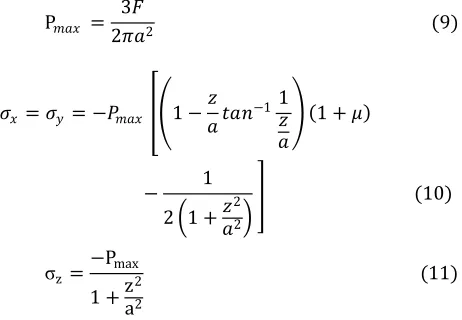
P𝑚𝑎𝑥 =
3𝐹
2𝜋𝑎2 (9)
𝜎𝑥= 𝜎𝑦 = −𝑃𝑚𝑎𝑥 1 −𝑧𝑎𝑡𝑎𝑛−11𝑧
𝑎
1 + 𝜇
− 1
2 1 +𝑧𝑎22
(10)
σz=
−Pmax
1 +za22
(11)
By employing the concept of Mohr’s circle and equation (10) and equation (11) the value of shearing stress is expressed as
𝜏𝑥𝑧= 𝜏𝑦𝑧 =
𝜎𝑥− 𝜎𝑧
2 =
𝜎𝑦− 𝜎𝑧
2 (12 )
Reference [23] also reported relations for computation of hertzian stresses of cylindrical shaped surfaces in contact. Hertz contact stress theory is applicable on the assumption that the stress response behaviour of material is essentially that of linear isotropic material.
III. MATERIAL AND METHODS
The improved UTC tomatoes were used in this study. The first step of this experimentation is to determine the approximate shape of the materials by computing the sphericity of the material. The equivalent diameter D (for transverse loading) values were calculated with (1) and (2) of [26] and [27]. Subsequently, the original cross-sectional area through which the force is applied A0 andfinal cross-sectional
area Ai were computed. The sphericity is a shape index of
fruit, which indicates the difference between the actual shape of fruit and the sphere [22]. The replicated samples of tomatoes were radially loaded as shown in Fig. 1 and Fig. 2 using compression test rig of [17].
(a)
(b)
Fig. 1(a), (b) Depiction of Radial Loading 2a
d2
y
z
x F
[image:2.612.47.278.484.644.2]IV. EXPERIMENTAL RESULTS
[image:3.612.308.554.202.357.2]Engineering Property Results of UTC Tomato under Radial and axial compression are presented in Table I. The experimentations and computations gave an average contact radius and maximum contact pressure of 0.011m and 0.063MPa respectively using appropriate values in (8) and (9) and proportionality limit range force of 16N. An approximate elastic modulus of 0.2MPa and a Poisson’s ratio of 0.3 were evaluated at the proportionality limit of the material. The radial loading gave an elastic modulus of 0.2MPa and a Poisson’s ratio of approximately 0.3.
TABLE I
ENGINEERING PROPERTY RESULTS OF UTC TOMATOES UNDER RADIAL AND AXIAL
COMPRESSION Loading Elastic
Modulu s MPa
Poisson ’s Ratio µ Sy MPa Su MPa Fractur e Strengt h Sf
MPa Bulk Modulu s MPa
Maximu m force (N)
Axial compressi on
0.1628 0.26 0.00 9
0.01 5
0.014 0.0647 9
19
Radial compressi on
0.2158 0.26 0.00 9
0.01 7
0.012 0.0856 6
20
A. Estimation of sphericity
Sphericity is considered important in the designs for biological products. Equation (13) of [28] expressed as
𝜓 = 𝜋
1 3 6𝑉𝑝
2 3
𝐴𝑝 (13)
was used with Table II to evaluate the sphericity of the UTC tomato fruit after the computation of the volume and surface area of the tomato fruit with relations of Table II. The approximate surface area relation of ellipsoid of Table II credited to Knud Thomsen was cited by [29] and can be found in en.wikipedia.org/wiki/Ellipsoid. The sphericity value of 0.996 obtained with (13) suggests that the shape of UTC tomato can be approximated to sphere. Similar computation with (3) also gave sphericity value of 1.17 with 𝐷𝐿= 45.29𝑚𝑚 , , 𝐷𝑇𝑚𝑎𝑥 = 63.95𝑚𝑚
[image:3.612.311.576.404.639.2]𝐷𝑇𝑚𝑖𝑛 = 61.96𝑚𝑚.
TABLE II
ESTIMATION OF ROUNDNESS FOR IMPROVED UTC TOMATO VARIETY: A = RADIUS OF MINOR AXIS OF
TOMATO (TRANSVERSE) = B = R, C = RADIUS OF MAJOR AXIS OF TOMATO (LONGITUDINAL), H = 2C
(AXIAL DIMENSION)
Assu med shape
Volume (𝑽𝒑)
Surface area(𝑨𝒑) Sphericit y(𝝍)
Ellip soid
4
3 𝜋𝑎𝑏𝑐 4𝜋 𝑎
1.6𝑏1.6+𝑎1.6𝑐1.6+ 𝑏1.6𝑐1.6
3
1/1.6 0.919
Cyli nder
𝜋𝑟2ℎ 2𝜋𝑟(𝑟 + ℎ) 0.856
Sphe re
4
3𝜋𝑟3
4𝜋𝑟2 0.996
B. Computations for Contact Stresses for Radial Loaded UTC Tomatoes
The Hertz theory variables were computed with (7)-(12) and with material properties data reported in [30] as in Table I after establishing the shape of UTC tomato as sphere and presented in Table III.
TABLE III
EVALUATED HERTZIAN STRESSES OF RADIALLY COMPRESSED TOMATO
z/a σx
(MPa) σz (MPa) τmax (MPa) σx /Pmax (MPa) σz/
Pmax
(MPa)
τmax/Pmax
(MPa)
0
-0.0589 -0.0736
0.0 074
-0.8 -1 0.1
0.5
-0.0133 -0.0589 0.0 228 -0.1803 -0.8 0.3098
1
-0.0021 -0.0368 0.0 174 -0.0289 -0.5 0.2355
1.5 3.3220 8E-05 -0.0227 0.0 114 0.0 005 -0.3076 0.1541
2 0.0004
-0.0147 0.0 076 0.0 055 -0.2 0.1027
2.5 0.0004
-0.0102 0.0 053 0.0 056 -0.1379 0.0718
3 0.0004
-0.0074 0.0 039 0.0 048 -0.1 0.0524
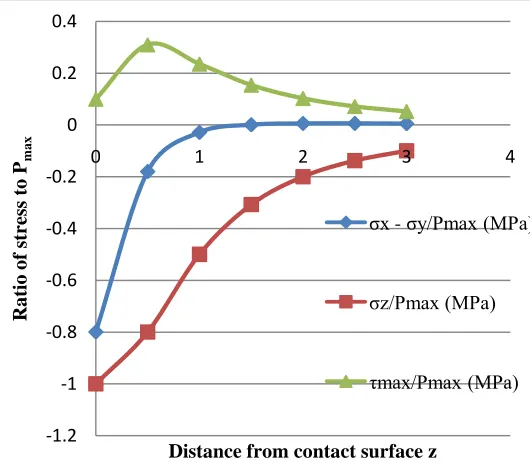
The results of Table III are presented as a ratio of the maximum contact compressive pressure in Fig. 2.
Fig. 2 Magnitude of the stress components below the surface as a function of the maximum pressure for radially compressed tomato fruit
-1.2 -1 -0.8 -0.6 -0.4 -0.2 0 0.2 0.4
0 1 2 3 4
Ra tio o f st ress t o P m ax
Distance from contact surface z
σx - σy/Pmax (MPa)
σz/Pmax (MPa)
[image:3.612.38.305.665.741.2]V. FINITE ELEMENT ANALYSIS OF CRITICAL STRESSES
The ANSYS finite element software was applied to obtain the maximum surface stresses and the yield
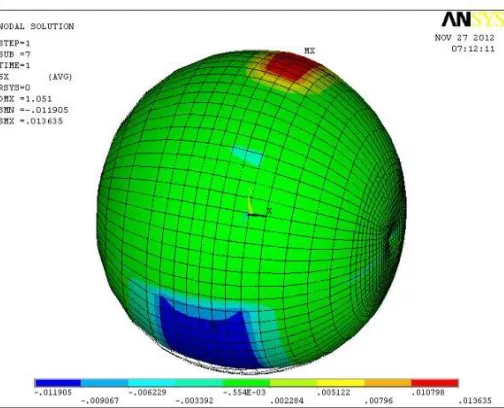
[image:4.612.322.571.51.250.2]Fig. 3 X-component orthogonal stress distibution for radial compression
[image:4.612.51.303.99.303.2]Fig. 4 Y-component orthogonal stress distibution for radial compression
Fig. 5 von Mises stress distribution for UTC tomatoes under radial compression
Fig. 6 X-component orthogonal stress distibution for axial compression
[image:4.612.311.568.283.497.2] [image:4.612.313.575.528.709.2]Fig. 8 von Mises stress distribution for UTC tomatoes under axial compression
The stresses of radially and axially compressed UTC tomatoes experimentally determined are reported in Table I. The ANSYS analysis gave results of surface stresses of compressed UTC tomatoes in Fig. 3-Fig. 8.
VI. DISCUSSION OF RESULTS
Table I exhibits the mechanical properties of compressed UTC tomatoes. Table III and Fig. 2 also show that the failure of radially compressed tomato fruit is governed by the shearing stress which has maximum value of 0.31Pmax slightly below the contact surface. The maximum contact pressure Pmax was computed as 0.063MPa for UTC tomatoes.
Hertz theory was used to evaluate the maximum shear stress as 0.022MPa as depicted in Fig. 2 and Table III. The normal stress in the radially compressed UTC tomatoes is greater in transverse direction where the shear stress is maximum as shown in Fig. 2 and Table 3. Fig. 3 and Fig. 4 show the maximu stress distribution in x and y direction as 0.013635MPa and 0.014524MPa for radially compressed UTC tomatoes. Fig. 5 describes the possible axial failure of sample with the red portions while Fig. 6 and Fig. 7 depict x and y maximum stress components distribution as 0.0067693MPa and 0.007699MPa for axially compressed UTC tomatoes. These are the principal normal stresses of the axially compressed biomaterial. Also Fig. 8 describes circumferential radial failure of axially compressed biomaterial.
The ANSYS finite element method evaluated the yield stress as 0.001699MPa and 0.012271MPa for axial and radial contacts as found in Fig. 8 and Fig. 5 through the application ofvon Mises stress criteria and these values are smaller than the maximum principal stress of -0.073622694MPa presented in Table III. The ANSYS predicted yield stress corresponds to the the bioyield stress of 0.009MPa predicted by [30] for radial compression test of UTC tomatoes whose stress- strain plot is shown in Fig. 9. Fig. 9 also shows that the biomaterial is ductile as fracture strain was more than 5%. Hence failure
prediction by ductile failure theory of von Mises criterion is correct.
Fig. 9 Stress-strain plot depiction for mechanical properties of UTC tomatoes under radial compression
It is the opinion of many authorities that this maximum shear stress is responsible for the surface fatigue failure of contacting elements. The explanation is that a crack originates at the point of maximum shear stress below the surface and progresses [23]. The design yield stress is therefore predicted for UTC tomatoes and specified as 0.0012MPa for design of UTC containers for transportation and storage.
[image:5.612.294.556.83.252.2]The reports of the study complied with the application of the distortion energy theory or the von Mises criterion which suggests that the safe stresses or the stresses bellow the yield stresses must be less than the principal stresses as shown in Fig.10 and as reported in [31]. The stress intensity for radially compressed UTC tomatoes is shown in Fig. 11 which is the classical understanding of von Mises stress theory. The von Mises stresses are found below the principal stresses as depicted in Fig. 5, Fig. 8 and Fig. 11.
Fig.10 Depiction of principal stress ellipse for von Mises failure prediction:𝜎1 = maximum stress at principal plane 1,𝜎2 = maximum stress at principal plane 2, 𝜎𝑦 = yield stress equivalent to von Mises stress.
0 5000 10000 15000 20000
0 0.05 0.1 0.15 0.2 0.25
S
tr
ess(
M
Pa
)
[image:5.612.325.539.491.638.2]Fig. 11 ANSYS depiction of intensity of stresses (principal stresses) for radially compressed UTC tomatoes
VII. CONCLUSION
The maximum pressure due to the metal container contact with the fruits on transportation was evaluated and found to be less than the compressive strength of the fruits. The shearing stresses was also found to be greater than the other principal stresses associated to geometric shape of the fruit for containerization and transportation design. The maximum pressure, maximum principal stresses and maximum shearing stresses were found to be a maximum near the contacting surfaces of the container with the fruits on transportation. The results of this study will therefore be relevant in the design of structures for storage and transportation for fruits.
REFERENCES
[1] L. Xiaoyu and W. Wang. Study on compressive properties of apple. J Northwestern Agric University 26: 107–108. 1998.
[2] A. Taheri-Garavand, R. Shahin, K. Alireza. Study on some morphological and physical characteristics of tomato used in mass models to characterize best post harvesting options. Australian Journal of Crop Science 5(4): 433-438. 2011.
[3] J. Blewett, K. Burrows, C. Thomas. A micromanipulation method to measure the mechanical properties of single tomato suspension cells. Biotechnology Letters 22: 1877–1883. 2000.
[4] R. Thiagu, C. Nagin, K.V. Ramana. Evolution of mechanical characteristics of tomatoes of two varieties during ripening. J. Food Agric. 2(62): 175-183. 1993.
[5] J.J. Gonzalez, K. L. Mccarthy MRI method to evaluate internal structural changes of tomato during compression. J. Texture Stud. 29(5): 537-551. 1998.
[6] C.X Wang, J. Pritchard, C. R Thomas. Investigation of the m echanics of single tomato fruit cells. J. Texture Stud. 1(37): 597-606. 2006. [7] L Jizhan, L. Pingping, L. Zhiguo. Hardware design of the end effect or
for tomato-harvesting robot. Trans. Chin. Soc. Agric. Machinery, 39(03): 109-112. 2008.
[8] C. Ozarslan. Physical properties of cotton seed. Biosystems Engineering 83 (2), 169–174. 2002.
[9] C. Aydin, H. Ogut, L. Konak, Some physical properties of Turkish mahlep. Biosystems Engineering 82 (2), 221–234. 2002.
[10] M. Guner. Determination of mechanical behaviour of bean, reddish bean and lentil under compression loading. Journal of Agricultural Sciences 9 (2), 206–212. 2003.
[11] E. Dursun and M. Guner. Determination of mechanical behaviour of wheat and barley under compression loading. Journal of Agricultural Sciences 9 (4), 415–420. 2003
[12] S. Calısır and C. Aydın. Some physico-mechanic properties of cherry laurel (Prunus lauracerasus L.) fruits. Journal of Food Engineering 65, 145–150. 2004.
[13] A. Tabatabaeefar, M Khanali, M. Ghasemi-Varnamkhasti, H. Mobli Mass and volume modelling of tangerine (Citrus reticulate) fruit with some physical attributes. Int Agrophy 21: 329-334. 2007.
[14] M. Sharifi, S. Rafiee, A. Keyhani, A. Jafari, H. Mobli, A. Rajabipour, and A. Akram. Some physical properties of orange (var. Tompson). Int. Agrophysics, 21, 391-397. 2007.
[15] F. Pallottino, C. Costa, P. Menesatti and M. Moresi. Assessment of the mechanical properties of Tarocco orange fruit under parallel plate compression. Journal of Food Engineering, 103(3), 308-316. April 2011.
[16] N. N, Mohsenin. Physical Properties of Plant and Animal Materials. Gordon and Breach, New York. 1980.
[17] C. C. Ihueze, O.O. Otuu, A. I. Oriaku and E. C. Okafor. Development of a Compression Test Rig for Evaluation of Mechanical Properties Related to Design for Containerization and Transportation of Fruits, Journal of Engineering and Applied Sciences (A Publication of the Faculty of Engineering Nnamdi Azikiwe University Awka, Nigeria), 6(1), 56-59. 2010.
[18] U.G.N Anazodo. Elastic and Viscoelastic properties of agricultural products as related to harvesting and post-harvest processes. International Journal for Agricultural Mechanization in Developing Countries. 13(2) pp spring 1982. 1982.
[19] G. O. I Ezeike. Quasi-Static Hardness and Elastic Properties of some tropical seed grains and tomato fruit. International Agrophysics 2 (1), pp. 15-29. 1986.
[20] P.P. Benham and F.V. Warnock. Mechanics of Solids and Structures, Pitman Books Limited, London. 1981.
[21] N.M. Belyaev. Strength of Materials, Mir Publishers MOSCOW. 1979. [22] N. N Mohsenin. Physical Properties of Plant and Animal Materials.
Gordon and Breach, New York. 1980.
[23] P. E Shigley and C. R Mischke. Mechanical Engineering Design. Sixth Edition, McGrew-Hill, New York. 2001.
[24] Z. Ma, and K. Ravi-Chandar, Experimental Mechanics, Vol. 40, No.1, 39-45. 2000.
[25] J. E. Shigley & C. R. Mischke Mechanical Designers Workbook: Corrosion and Wear. McGraw Hill. 1989.
[26] G. S. J. Tudor, and S. J Thomas. Equivalent diameters of elliptical fields, The British Journal of Radiology, 7, 941–943. 2004.
[27] Z. Zue. Agrobiology. China agriculture press. Beijing. pp. 5-7. 1994. [28] H. Wadell. “Volume, Shape and Roundness of Quartz Particles”. Journal
of Geology 43(3):250-280,1935
[29] X. Dongrong, C. Jiali, B. Ravi, H. Xuejun, L, Jun, C. Weidong and S. P. Bradley. “The ellipsoidal area ratio: an alternative anisotropy index for diffusion tensor imaging” Magnetic Resonance Imaging 27. 2009. 311-323.
[30] C.C. Ihueze and E. C Okafor. Limiting stresses and elastic properties of biological material under axial and radial compression as related to their handling and containerization , Journal of Engineering and Applied Sciences (A Publication of the Faculty of Engineering Nnamdi Azikiwe University Awka, Nigeria), 7(1), 5-10. 2011.
[31] A. Andriyana. “Failure Criteria for yielding “ Centre de Mise en Forme des Materiaux, CEMEF UMR CNRS 7635. Spring 2008
[image:6.612.48.298.51.239.2]