©IJRASET: All Rights are Reserved
2458
Correlation between Bond Energy and
Electronegativity Differences in a Few
Semiconductors
D.V. Raghuram
1, R. R. Reddy
2, P. M. Prasad
3 1, 2Department of Physics, Hindu College, GunturAbstract: Studies of bond energies of diatomic molecules are of great importance in thermochemistry, astrophysics and combustion physics. The bond energies of diatomic molecules and various semiconductors are evaluated. The bond energies are experimentally verified by thermal mass and spectroscopic techniques. The present method is an improvement over Pauling’s relation. The bond energies evaluated by this present method are in excellent agreement with that evaluated by other methods. For e.g., in the case of BN (Boron Nitride) the bond energy, DAB obtained by present study is 86.88 and that obtained by Pauling
equation is 86.62. In the case of GaSb, it is 43.66 by the present equation is 43.66 by the Pauling equation it is 43.66. Also the average percentage deviation by the present study is 15.00, by the Pauling equation it is 14.20 and by Match et al it is 14.66. the studies of bond energies of various semiconductors taken up by the author are in good agreement with the evaluated equations proposed by literature, Pauling and Matcha.
Keywords: Electronegativity, ionicity, energy gap, bond energy
I. INTRODUCTION
In the chemical approaches taken for the approximate prediction of band gaps of semiconductors, correlations have been proposed between band gaps and various other quantities like single bond energies1 , heats of formation per mole2, heats of formation per
equivalent3, atomic numbers4, electronegativities5 etc. Some of these approaches especially those seeking relationships between
bond energy and band gaps have also been presented in the form of reviews either detailed6 or synoptic1 .
According to Welker’s postulate7 the energy gap depends on binding energy and the effective charges of atoms, the energy gap
being related to a great number of parameters8-10 that are directly or indirectly connected with the binding energy or the lattice
energy - of these the bond length taken by Goodman11 leads to a linear relation between ‘E
g’ and ‘d’, where ‘Eg’ is the energy gap
and ‘d’ is the bond length in diamond structures. According to Pauling12, the covalent bond energy between two atoms sharing equal
number of electrons at a minimum bond distance, is proportional to the reciprocal of bond length. So, the energy gap of a pure covalent semiconductor of diamond type structure will exhibit a similar relationship as a function of bond strength or an inverse function of bond length. Suchet13 after a study of the importance of the covalent coordination and of the structure type in the
prediction of the semiconductivity of inorganic compounds, relates the atomic and structural results to the value of the energy gap by means of empirical formulae allowing the computation of homopolar and heteropolar contributions to this value. The energy gap has a tendency to be progressively increasing in going from element of II-IV compound semiconductor. This tendency is a result of increasing degree of ionicity in the chemical bond. The difference between covalent and ionic bonding is the charge transfer that is involved in forming an ionic bond. Ge and Si are considered to be covalent semiconductors while lead salts are considered as polar semiconductors. Information concerning charge transfer and hence the degree of ionicity can be obtained by computing the static and optical dielectric constants. Pauling’s12 procedure gives fairly accurate estimate of bond energy between two uni-valent atoms
held together by a single bond. However, this approach emphasizes the correlation between ionicity and type of bonding through electronegativities. Degree of ionicity in a chemical bond can be understood through bond energy. It was well emphasized by Pauling14 in a graph between electronegativity difference and amount of ionic character. Recently Manca1,15 has attempted to
calculate the energy of a single bond for different semiconductors crystalizing in the diamond and blende structures by means of Pauling relation16. In this equation he utilised the work on electronegativities of elements by Gordy and Thomas17.
©IJRASET: All Rights are Reserved
2459
valency, statistical calculations of equilibria at high temperatures, chemical bonding and in other problems, bond energies play a fundamental role. Astrophysicists, chemists and spectroscopists are therefore concerned with the determination of reliable values for bond energies of the diatomic molecules. Thermal and mass spectroscopies are the most important experimental methods used to evaluate bond energy values18-20.
In view of the above importance a study of investigation of bond energies of various semiconductors is taken up.
II. METHODOLOGY
For calculations of bond energies some of the methods available are
A. Thermochemical Process
In this process the bond energy of NaCl is obtained by the equation
D(Na-Cl) = ∆Hs + ∆Hdiss + ∆Hf --- (1)
Where D(Na-Cl) is the required bond energy, ∆Hs is the heat of sublimation of Na metal per mole, ∆Hdiss is the heat of dissociation
of Cl2 molecule into Cl atoms per mole, ∆Hf is the heat of formation of NaCl per mole in its standard state. The bond energy in
eq.(1) is the heat of atomization of NaCl. In the case of NaCl, only one shared electron pair is involved in the bonding. In the case of complex compounds like Ta2O5 more than one bond (i.e., shared electron pair) is involved and hence a suitable normalizing
factor must be used to obtain from eq.(1). The heat of atomization per mole is normalized with respect to the participating valencies to obtain heat of atomization per equivalent, which is the bond energy. For example heat of atomization per equivalent (i.e., the bond energy) for Ta2O5 is of the heat of atomization per mole as calculated from eq.(1).
The bond energies thus obtained after second order corrections (e.g., spin correlation stabilization energies and coordinate valence) as discussed by Howald21 are the actual values of the average bond energies as obtained from experimental and theoretical data. The
accuracy of these energies is limited only by the accuracy of the thermodynamic data used in computing them. Vijh22 concluded that
this procedure is strictly valid for alkali halides only, because alkali halides do not involve in any coordinate bonds.
B. Pauling Process
Pauling14 stated that the energy of an actual bond between unlike atoms is greater than the energy of a normal covalent bond
between the same atoms. This additional energy is due to ionic resonance or ionic character i.e., D(A-B) ≥ [D(A-A) + D(B-B)] --- (2) If the additional ionic resonance energy is indicated by ∆ then eq.(2) can be written as
∆ = D(A-B) ─ [D(A-A) + D(B-B)] ---(3)
This postulate of additive law is not valid for alkali hydrides. When quantum mechanics is applied to study electron bonds, arithmetic mean can be replaced by geometric mean. The values of energies for normal covalent bonds obtained using geometric mean is involved is more satisfactory than that obtained using arithmetic mean.
∆(A−B) = D(A−B) ─ [D(A−A) + D(B−B)] --- (4)
∆(A−B) is obtained directly from heats of reaction using the relation
∆(A−B) = 30 (XA – XB ) ---(5)
Where XA and XB are the Pauling electronegativities of the atoms. The bond energy (K cal/mole) is evaluated through Pauling’s14
relation.
D(A−B) = [(D(A−A). D(B−B ) ] + 30 [∆X ] ---(6)
C. Matcha Process
Matcha23 used simple quantum mechanical theory to study the interaction of potential between two atoms and obtained an
appropriate form of bond energy, electronegativity relationship which is valid for both ionic as well as covalent bond. The final equation obtained is
DAB = (1-f) DAB + [R Dion - ] --- (7)
Ect is the energy associated with partial charge transfer, DAB is the average covalent bond energy, f is the effective charge
transferred in the curve crossing region during bond formation and Re is the inter nuclear distance of the molecule.
©IJRASET: All Rights are Reserved
2460
DAB = (1-f) DAB +252 --- (8)
A comparison between and i (ionic character defined by Pauling) suggests a strong correlation between these quantities. This
suggests such that DAB can be related to ∆X by replacing by
Where I = 1− ∆
Matcha gave a relation for the construction electronegativity scale as
DAB = DAB + [ 252 - Re DAB] ---(9)
The term in the square brackets is approximately constant (169) for a series of bonds. Thus the above equation can be written as
DAB ≈ DAB + 169 ( ) --- (10)
Replacing by
DAB≈ DAB + 113 i ---(11)
To increase the accuracy of this equation, Matcha added two adjustable parameters k & i, Thus DAB = DAB ki --- (12)
For smaller values of ∆X, ki becomes
K 1−
Matcha found that k= 103 and α = 0.29
Finally DAB = DAB + K 1− --- (13)
D. Reddy et al., process:
The Pauling’s empirical relation16 fares badly when applied to ionic bonds. The error in estimated ionic bond energies is as much as
190%. So Reddy et al.,24-26 worked out a relation, using which they calculated bond energies of both ionic and covalent molecules.
The relation developed by them24-26 is simple and straight forward, which is deduced as follows.
The empirical relation for bond energies proposed by Pauling is
DAB=DAB + 30 [∆X ] ---(14)
Where DAB = [(DAA. DBB ) ] and ∆X = XA – XB (Pauling electro negativity difference).
Equation (14) gives a reasonable accurate estimates of covalent bond energies. Matcha23 derived an equation
DAB = DAB ( 1-f ) + 252 ( ) --- (15)
It was later transformed to the following form with adjustable parameters k and i as,
DAB = DAB + k i --- (16) (where k=103)
For ionic cases Reddy et.al., derived an empirical relation
DAB = DAB ( 1- 0.2075 ∆X re ) + 52.29 ∆X --- (17)
On comparison of equations (15) and (17) we get
= 0.2075 ∆X --- (18)
But Matcha23 gave = ---(19)
From equations (18) and (19)
i = 0.31125 ∆X --- (20)
substituting the value of I from equation (20) and k= 103 in Matcha’s relation (16), Reddy et al., obtained
--- (21)
©IJRASET: All Rights are Reserved
2461
Table 1.
Single Bond Energies (K CAL / MOLE)
S. No. Molecule Single bond energy(K cal / mole)
1 B-B 70.00
2 Ai-Al 45.00
3 Ga-Ga 27.00
4 In-In 24.00
5 Si-Si 53.00
6 Zn-Zn 164.30*
7 Cd-Cd 90.13*
8 N-N 40.00
9 P-P 48.00
10 As-As 35.00
11 Sb-Sb 70.60
12 S-S 64.00
13 Se-Se 41.00
14 Te-Te 30.00
[image:4.595.72.525.343.740.2]15 C-C 83.00
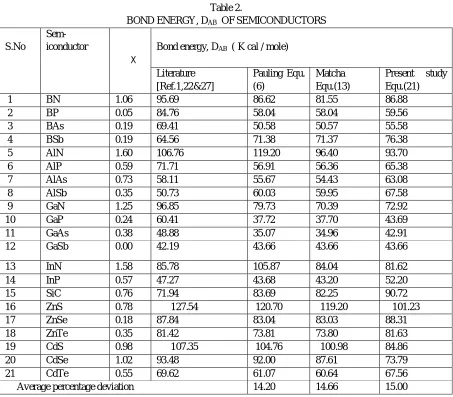
Table 2.
BOND ENERGY, DAB OF SEMICONDUCTORS
S.No
Sem-iconductor
∆X
Bond energy, DAB ( K cal / mole)
Literature [Ref.1,22&27]
Pauling Equ. (6)
Matcha Equ.(13)
Present study Equ.(21)
1 BN 1.06 95.69 86.62 81.55 86.88
2 BP 0.05 84.76 58.04 58.04 59.56
3 BAs 0.19 69.41 50.58 50.57 55.58
4 BSb 0.19 64.56 71.38 71.37 76.38
5 AlN 1.60 106.76 119.20 96.40 93.70
6 AlP 0.59 71.71 56.91 56.36 65.38
7 AlAs 0.73 58.11 55.67 54.43 63.08
8 AlSb 0.35 50.73 60.03 59.95 67.58
9 GaN 1.25 96.85 79.73 70.39 72.92
10 GaP 0.24 60.41 37.72 37.70 43.69
11 GaAs 0.38 48.88 35.07 34.96 42.91
12 GaSb 0.00 42.19 43.66 43.66 43.66
13 InN 1.58 85.78 105.87 84.04 81.62
14 InP 0.57 47.27 43.68 43.20 52.20
15 SiC 0.76 71.94 83.69 82.25 90.72
16 ZnS 0.78 127.54 120.70 119.20 101.23
17 ZnSe 0.18 87.84 83.04 83.03 88.31
18 ZnTe 0.35 81.42 73.81 73.80 81.63
19 CdS 0.98 107.35 104.76 100.98 84.86
20 CdSe 1.02 93.48 92.00 87.61 73.79
21 CdTe 0.55 69.62 61.07 60.64 67.56
©IJRASET: All Rights are Reserved
2462
III. RESULTS AND DISCUSSIONIn order to evaluate the bond energies of different semiconductors, we use the experimental homo nuclear bond energies of constituent atoms of the semiconductor and Pauling electronegativity reported in Lide27, Pauling14 Manca1 and Sandersen28. The
estimated bond energies from equations (6), (13) and (21) are presented in table 2. Bond energies obtained with the above formulae are in excellent agreement with the literature values1,22,27. The average percentage deviation in table 2 indicates that the calculated
values obtained with the above formulae are in good agreement with the literature values. The magnitude of the electronegativity difference between two atoms indicates the degree of ionicity. It has been observed from the tables that the magnitude of ∆X of the semiconductor is below 1 in most of the cases. It indicates the nature of the bonding is covalent. It is noted that when different species of atoms are involved in covalent bonding, their electronegativities may influence their bonding. Electronegativity describes the pre-disposition of an atom to absorb electrons, its units are the square root of bond strength. Thus an atom with higher electronegativity will be more reactive chemically than one with a lower electronegativity. When the electronegativities with an atom engaged with covalent bonding are similar, this factor has little influence on bonding. However, when the difference in electronegativities of the two compounds is equal to or more than about 0.2 units, small amounts of ionic bonding may take place along with the covalent bonding. Larger electronegativity differences involve higher degree of ionicity in the bonding. It is probable that perfectly pre covalent bonding normally does not exists in compounds because no two atoms have identical electronegativities, small degrees of ionicity are present . BP, BAs, BSb, GaSb and ZnSe are some semiconductors will fall in this category. A careful observation of the table 2 reveals that their bond energies are below 90 K cal/mole.
According to Paulling14, the percentage of ionic bonding in a compound increases from ionicity 0.2 to 0.63 to 0.89 as difference
between the electronegativity values of its elements increases from 1 to 2 to 3, where the values of electronegativity is not sufficiently accurate in comparing the relative degree of ionicity in different compounds. The percentage of ionic bonding based on Pauling’s criterion, is estimated to be 22 % in CdS and ZnS. The value of ionicity quoted by Phillips29 are accurate in comparing the
pualing’s14 values. The above study is extended to understand the relation between ionization potentials, energy gaps and optical
electronegativity of few semiconductors.
The above work is a part of M.Phil., submitted by the author at S.K University in 1996.
REFERENCES
[1] P. Manca, J. Phys. Chem. Solids, 20, 268(1961).
[2] W. Ruppel, A. Rose and H.J Gerritsen, Helv. Phy. Acta., 30.238 (1957). [3] A. K. Vijh, J. Phys. Chem. Solids, 29, 2233 (1968).
[4] R. H. Bube, ‘Photoconductivity of Solids’, Wiley, New York (1960). [5] N.B. Hannay, ‘Solid State Chemistry’, Prentice Hall, New York(1967).
[6] H. Gaatos and A. Rosenberg, ‘The Physics and Chemistry of Ceramics’, Gorden and Breach. [7] H. Welker, Z. Naturf, 7a,774 (1952); 8a, 248 (1953).
[8] C.H.L Goodman, Proc. Phys. Lond., B67, 258 (1954). [9] T. Miyaucht, J. Phys. Soc. Japan, 12, 308 (1957). [10] F.N.Z Hooge, Phys. Chem., 24, 275 (1960). [11] C.H.L. Goodman, J. Electronics, 1,115 (1955). [12] L. Pauling, J. Phys. Chem. Solids, 58, 662 (1954).
[13] J.P. Suchet, J. Phys. Chem. Solids, 12, 74 (1959); 16,265 (1960).
[14] L. Pauling, ‘The Nature of the chemical bond’, Oxford & IBH Pub. C0., Delhi (1969). [15] R.R Reddy, R. Viswanath and T.V.R. Rao, Proc. of Ind. Natn. Sci. Acad., 56, 421 (1990).
[16] L. Pauling, ‘The Nature of Chemical bond’, Cornell University Press, Ithaca, New York, 58-75 (1942). [17] W. Gordy and D.E. Thomas, J. Chem. Phys., 24, 439 (1956).
[18] G. Herzberg, ‘Molecular Spectra and Molecular Structure’, Van Nostrand, New York (1955). [19] D.L Hildenbrand and E. Murad, J. Chem. Phys., 51,807 (1969).
[20] M.R. Litzow and T.R. Splading,’ ‘Mass Spectrometry,’ American Elsevier, New York (1973). [21] R. Howald, J. Chem. Educ., 45, 163 (1968).
[22] Ashok K. Vijh, J.Phys. Chem. Solids, 30, 1999 (1969). [23] R.L. Matcha, J.Am. Chem. Soc., 105, 4859 (1983).
[24] R.R. Reddy, T.V.R. Rao and R. Viswanath, J. Am. Chem. Soc., 111, 2914 (1989). [25] R.R. Reddy and R. Viswanath, J. Astro phys. Astr., 10, 157 (1989).
[26] R.R. Reddy, T.V.R. Rao and R. Viswanath, Ind. J. Phys., 63B, 376 (1989).
[27] David R. Lide, ‘CRC Hand book of Chemistry and Physics’, 74 ed., CRC press, New York (1993-94). [28] R.T. Sandersen, J. Am. Chem. Soc. 105, 2259 (1983).