E-Commerce
Aditya Desai1, Harshali Patil2
1
Student, Mumbai Educational Trust, India 2
Professor, Harshali Patil, Mumbai Educational Trust, India.
Abstract: Wireless transactions led to huge competitions. As a result many companies adopted the concept of online trading. Selling goods and services door to door. The main objective was to increase the business growth.
In this paper patterns are presented which are used in e-commerce applications. These applications are web based.
I. INTRODUCTION
With evolution of World Wide Web, e-commerce applications started running on a go. Particularly e-commerce applications are type of web applications with proper definition of products, navigation and valid domains. E-commerce made door to door delivery of goods and other services.
Developing an e-commerce application is a big challenge. It focuses not only on what users need to buy but also on making online shopping easy.
II. MARKET SIZE
The Indian market has witnessed a huge growth in e-commerce strategy.
During previous year the Indian e-commerce market has grown upto US$38.5 billion and expected to reach US$200 billion by 2026. With use of internet on mobile phones the e-commerce market has taken huge elevation.
There are many companies In India which are hosting e-commerce web applications. The currently growing market in e-commerce in India is the electronic segment. Per day transactions carried out are at an average of 1-1.2 millions.
Many companies invested in this business such as: Investment done by Amazon was 6200 crore.
Fig:2 : Market sale in various years
Investments done by Venture Capitals were US$9.6 billion.
In terms of service providers India has got its own versions such as Flip kart, snap deal, amazon.in, make my trip and so on.
III. TYPES OF SERVICES
A. Business to Business (B2B)
This is also known as electronic data interchange which is usually operated via internet. The information passed is between two businesses. This sums up to around ninety-four percent of total e-commerce transactions.
B. Business to Consumer(B2C) This are solely carried out via internet.
In this field the consumer requests for specific service from a business online.
C. Business to Employee(B2E)
B2E is a type of service which is made available for employees for providing information regarding organisation.
D. Consumer to business(C2B)
C2B is type of service which helps growth of business sector of particular organisation. Here the consumer requests for a specific service which is made online.
IV. BUSINESS TO ADMINISTRATION(B2A)
In this kind of transaction deals are made between companies and public administration. It provides different types of services such as security, employment, legal documents and so on.
V. WEB AND MOBILE DEVELOPMENT
With the development of mobile technology and optimised e commerce applications provided customers seamless shopping experience.
VI. SEARCH ENGINE OPTIMIZER(SEO)
With the facility of SEO, it helped the customers to find the right type of service. As well also provides various e-commerce portals which could provide the requested service.
VII. WEB DESIGN
To provide services various web applications are provided. Web sites are designed in such a way that it eases navigation and makes search easy.
VIII. PAYMENT PROCESSING
Various portals provide secure mode of payment. Such as Cash on delivery, payment through credit cards with one time password (OTP) message services. This could also offer pleasant shopping experience to consumers.
IX. DATA SECURITY
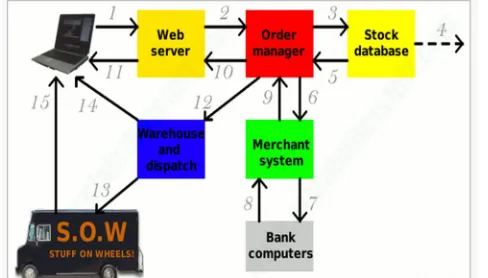
[image:2.612.186.430.577.716.2]1) Initially customer logs into e commerce website and searches for its desired product via browser over internet. 2) Customer then sends request to the web server.
3) The order manager receives the order.
4) A query is send to the database to find out what customer needs is actually available or not.
5) If the product is not available then communication with stock manager is made to place new orders. 6) The stock database confirms the order and estimated delivery date is provided.
7) After the ordered is confirmed the order manager connects with merchant system for payment options. 8) Various modes of payment such as credit or debit cards mode, paypl, paytm are provided to customer. 9) Merchant system which provides online payment option contacts with bank for account details.
10) After this extra check is done , bank computers contacts back with merchant system which notifies regarding enough funds. 11) The merchant system contacts order manager to finally place the order once funding is completed.
12) The order manager contacts the warehouse and requests to place order at provided address.
13) Once payment is done, card details of that particular customer is saved for further shopping and faster delivery of products.
X. IMPACT ON CUSTOMERS
E-commerce allows customers to buy products from where ever they are rather than visiting any store. It helps customers to choose wide range of products. E-commerce allows customers to compare prices with other domain products. Also customer reviews section in website allows any customer to wisely make any decisions.
By chance if customer regrets purchasing any product, facilities such as return policy or exchange policy or cash back are provided.
XI. E-COMMERCE WEBSITE DESIGN
The most challenging task is to design a e-commerce website. Factors such as usability like easy to use, reliable in was the website should be 24 * 7 available for customers and secure related to card details as many think entering card details is risky.
Such website are to be developed from scratch and gain own merchant systems for secured payment transactions. A proper domain name contributes to locate the webpage. Few famous domains are : ebay, flipkart, amazon. It is also important to figure out how to get products to customer.
In such case there is no need of any warehouse or flee trucks. Once order is placed, which ever merchandised is linked is responsible for delivery of product and is taken care by hosting company.
In order to sell product online it will be necessary to find and infrastructure to place the product. There will be a need to set up facility to accept payment online.
It is also necessary to maintain an ecommerce website with content maintained accurately and constantly. Online selling has many benefits such as:
No rent for shops,
Reaching a global audience, Competing with larger business.
Ecommerce website will be having data about customers , so it is necessary to keep data secure.
A. E-Merchandise
E-Merchandise refers to sale of variety of products which are available for customers. Now a days products are displayed online first rather than in stores.
Getting a valid and trusted dealer is also a big task. To sell product online many offers are provided.
Fig3: Types of ecommerce companies
XII. FUTURE OF ECOMMERCE IN INDIA
India is a country with many challenges and growing economy which could give rise to growth of e-commerce and catch several of regional competitors such as flipkart, ebay, amazon.
When it comes to buying of clothes and jewellery Indian customers like to feel and touch their product and then buy. To come across such situation e-commerce companies such as amazon have their outlets in some parts of India. E-commerce have always attracted Indian customers to get a view on style and design patterns of products or availability of any goods.
Around more than 70% of Indian customers who shop online prefer cash on delivery COD mode of payment.
During demonetisation when 500 and 1000 rs. note were banned, CoD option for online payment fell by 15%-30%. In such case online retailers had to attract consumers by assuring safe transaction by credit and debit cards or by any online payment system such as paypal.
In case of online shopping , customers loyalty is harder to earn. In some cases products are likely to be damaged or mix up.
To tackle such issues logistic divisions are used in business models: as flipkart does with ekart.
With e-commerce being online buying and selling of goods, this lead to m-commerce. M-commerce is buying and selling of goods over wireless handheld devices.
E-commerce websites applications have been customised in such a way that they could be visible on mobile. All the customer needs to have is internet connection.
With help of mobile browsers , customers can shop without being access to personal computers. With mobile banking and payment facilities such as one time password OTP are provided which helps authentication of user.
A. Advantages
1) Fast buying and selling of products. 2) Easy to reach out to customers. 3) No need of physical visit to stores. 4) Quality of service
XIII. CONCLUSION
Many businesses are represented worldwide with help of e-commerce. E-commerce provides many opportunities in case of business representation.
In future the companies which take e-commerce seriously will be successful in future. Many companies reap benefits by re -designing their business processes.
E-commerce technology allows consumers to access benefits of any business and companies all over the world.
XIV. ACKNOWLEDGEMENT
The acknowledgement is a small attempt to explicit my gratitude to all the ones who've assisted us at some point of the route of making ready this paper. I'm significantly indebted to explicit giant delight and sense of gratitude towards to my manual and mentor prof. Harshali Patil for her consistent help and valuable encouragement.
REFERENCES
[1] All the above research content is gathered with help of following sources:
[2] https://www.statista.com/topics/871/online-shopping/ [3] https://www.ibef.org/industry/ecommerce.aspx