ISSUES AND CHALLENGES IN E
Department of Commerce, G.G.D.S.D.
ARTICLE INFO ABSTRACT
E-commerce is widely considered the buying and selling of products over the transaction that is completed solely through electronic measures can be considered e
commerce is subdivided into three categories: business to business or B2B, business to consumer or B2C and consumer to consumer or C2C also c
is used to refer to the growing practice of conducting financial and promotional activities with the use of a wireless handheld device. The term m
that the transactions may be conducted using cell phones, personal digital assistants and other hand held devices that have operate with Internet access. E
Security framework and is specifically applied to the c
Computer Security, Data security and other wider realms of the Information Security framework. E commerce security has its own particular nuances and is one of the highest visible security components that affec
purpose of this research paper is to identify factors affecting the adoption of M significant growth of M
transferring to M
emerging level in India. The astounding rate growth in mobile penetration in India, higher mobile technology and networking is coming day by day. Now a m
or phone call but also be used for many other activities like browsing of net chatting or other virtual activities. This paper’s theoretical c
India and to
Copyright © 2015 Nitish Nayyar. This is an open access article distributed under the Creative Commons Att distribution, and reproduction in any medium, provided the original work is properly cited.
INTRODUCTION
Electronic commerce, or e-commerce, refers to economic activity that occurs online. E-commerce includes all types of business activity, such as retail shopping, banking, investing and rentals. Even small businesses that provide personal services, such as hair and nail salons, can benefit from e commerce by providing a website for the sale of related health and beauty products that normally are available only to their local customers. Electronic commerce draws on technologies such as mobile commerce, electronic funds transfer, supply chain management, Internet marketing, online transaction processing, electronic data interchange (EDI), inventory management systems, and automated data collection systems. Modern electronic commerce typically uses the World Wid Web at least at one point in the transaction's life although it may encompass a wider range of technologies such
*Corresponding author: Nitish Nayyar,
Department of Commerce, G.G.D.S.D. College, Hariana Hoshiarpur (Punjab).
ISSN: 0975-833X
Vol.
Article History:
Received 05th August, 2015 Received in revised form 22nd September, 2015 Accepted 07th October, 2015 Published online 30th November,2015
Citation: Nitish Nayyar, 2015. “Issues and Challenges in E Research, 7, (11), 22959-22963.
Key words:
E-commerce, M-commerce,
Advantages of E-commerce and M-commerce, Limitations, Security Issues, M-Commerce Applications.
REVIEW ARTICLE
ISSUES AND CHALLENGES IN E-COMMERCE AND M-COMMERCE: A REVIEW
*
Nitish Nayyar
of Commerce, G.G.D.S.D. College, Hariana-144208, Hoshiarpur
ABSTRACT
commerce is widely considered the buying and selling of products over the transaction that is completed solely through electronic measures can be considered e
commerce is subdivided into three categories: business to business or B2B, business to consumer or B2C and consumer to consumer or C2C also called electronic commerce. M
is used to refer to the growing practice of conducting financial and promotional activities with the use of a wireless handheld device. The term m-commerce is short for mobile commerce, and recognizes at the transactions may be conducted using cell phones, personal digital assistants and other hand held devices that have operate with Internet access. E-commerce Security is a part of the Information Security framework and is specifically applied to the components that affect e
Computer Security, Data security and other wider realms of the Information Security framework. E commerce security has its own particular nuances and is one of the highest visible security components that affect the end user through their daily payment interaction with business. The purpose of this research paper is to identify factors affecting the adoption of M
significant growth of M-commerce application is remarkable in India. More and more con transferring to M- commerce to achieve better and fast transaction into market. M
emerging level in India. The astounding rate growth in mobile penetration in India, higher mobile technology and networking is coming day by day. Now a mobile phone is not only use for text SMS or phone call but also be used for many other activities like browsing of net chatting or other virtual activities. This paper’s theoretical contribution is to explain how’s
India and to identify clear contexts and assistant mechanism.
is an open access article distributed under the Creative Commons Attribution License, which distribution, and reproduction in any medium, provided the original work is properly cited.
commerce, refers to economic commerce includes all types of business activity, such as retail shopping, banking, investing and rentals. Even small businesses that provide personal air and nail salons, can benefit from e- commerce by providing a website for the sale of related health and beauty products that normally are available only to their local customers. Electronic commerce draws on technologies onic funds transfer, supply chain management, Internet marketing, online transaction processing, electronic data interchange (EDI), inventory management systems, and automated data collection systems. Modern electronic commerce typically uses the World Wide Web at least at one point in the transaction's life-cycle, although it may encompass a wider range of technologies such
Department of Commerce, G.G.D.S.D. College, Hariana-144208,
as e-mail, mobile devices social media, and telephones as well. E-commerce differs from e- business in that no commercial transaction, an exchange of value across organizational or individual boundaries, takes place in e
and selling of products, services by business and consumers through an electronic medium, without using any paper documents. Less than a decade after the E
revolution and its associated global impact on the business environment, it appears that another step has been taken evolution of networked computing. Transitioning from wired to wireless networks, the latest buzz in the industry is mobile commerce or m- Commerce
commerce, M-commerce is the term used to describe the growing trend of using networks that interface with wireless devices, such as laptops, handheld computers or mobile phones to initiate or complete online electronic commerce transactions. It May also be seen written as M
Mobile commerce involves all ki
by the use of mobile phone. The rapid growth of mobile telephony has provided a foundation for M
E-commerce activities carried out via a mobile device, such as
International Journal of Current Research
Vol. 7, Issue, 11, pp.22959-22963, November, 2015
INTERNATIONAL
Issues and Challenges in E-Commerce and M-Commerce: A Review”
COMMERCE: A REVIEW
144208, Hoshiarpur (Punjab), India
commerce is widely considered the buying and selling of products over the internet, but any transaction that is completed solely through electronic measures can be considered e-commerce. E-commerce is subdivided into three categories: business to business or B2B, business to consumer or
alled electronic commerce. M-commerce is a term that is used to refer to the growing practice of conducting financial and promotional activities with the use commerce is short for mobile commerce, and recognizes at the transactions may be conducted using cell phones, personal digital assistants and other hand commerce Security is a part of the Information omponents that affect e-commerce that include Computer Security, Data security and other wider realms of the Information Security framework. E-commerce security has its own particular nuances and is one of the highest visible security
t the end user through their daily payment interaction with business. The purpose of this research paper is to identify factors affecting the adoption of M-commerce. The commerce application is remarkable in India. More and more consumer is commerce to achieve better and fast transaction into market. M-commerce is emerging level in India. The astounding rate growth in mobile penetration in India, higher mobile obile phone is not only use for text SMS or phone call but also be used for many other activities like browsing of net chatting or other virtual ontribution is to explain how’s M-commerce is developing in
ribution License, which permits unrestricted use,
mobile devices social media, and telephones as well. business in that no commercial transaction, an exchange of value across organizational or individual boundaries, takes place in e-business. The buying services by business and consumers through an electronic medium, without using any paper Less than a decade after the E-Commerce revolution and its associated global impact on the business environment, it appears that another step has been taken in the evolution of networked computing. Transitioning from wired to wireless networks, the latest buzz in the industry is mobile
Commerce (Bushell, 2001). Mobile
e-commerce is the term used to describe the g networks that interface with wireless devices, such as laptops, handheld computers or mobile phones to initiate or complete online electronic commerce transactions. It May also be seen written as M- commerce or m-commerce. Mobile commerce involves all kind of electronic transactions by the use of mobile phone. The rapid growth of mobile telephony has provided a foundation for M-commerce namely commerce activities carried out via a mobile device, such as
INTERNATIONAL JOURNAL OF CURRENT RESEARCH
a cell phone it is called M-commerce. M-commerce also refers to the transaction conducted via mobile device or Wi-Fi network. M-Commerce could be viewed as a subset of E-Commerce. The name “M-Commerce” arises from the mobile nature of the wireless environment that supports mobile electronic business transactions. Devices, including digital cellular phones, Personal Digital Assistants (PDAs), pagers, notebooks, and even automobiles, can already access the Internet wirelessly and utilize its various capabilities, such as
e-mail and Web browsing, for example (Little, 2001).
Related works
Electronic Commerce is the very rapid growing field in today’s scenario. It is used for Purchasing Order i.e. for buying and selling electronic goods and all other type of things. And there is need for development of a number of e- commerce protocols, which ensure integrity, confidentiality, atomicity and fair exchange. The main difference in M-commerce definition with E- commerce uses the wireless net for performing financial, services and purchases. In other words in M-commerce all kinds of treads such as consumer, business-to-business and consumer-to-consumer are there.
M-commerce is not possible without a secure environment,
especially for those transactions involving monetary value. Depending on the point of views of the different participants in an m-commerce scenario, there are different security challenges. The main advantage of M-commerce comparing to E- commerce also exists in. In fact while the use of E- commerce is provided only when the user is at his/her own home or workplace or in any other location he/she has to access media such as, Internet. M-commerce merely need the Mobile-phone. However this doesn’t bear the meaning that M-commerce is limited to ordinary applications like reading E-mail or reporting. Within the pass of time the services and ample abilities of M-commerce are getting more popular and more complete than the E- commerce. Generally, M-commerce has several major advantages to consumers
Purpose of study
* Study the Overview of E-commerce and M- commerce. * Understand the relationship between M-commerce and
E-commerce.
* Discuss the current advantages and disadvantages of E-
commerce and M-commerce.
* Analysis of Global e-commerce sales are growing
* Identify the M-Commerce Applications
* Discuss M-COMMERCE VERSUS E-COMMERCE
* Study of Security Issues in Online marketing
Advantages and disadvantages of E-commerce
Advantages
Faster buying/selling procedure, as well as easy to find products. Buying/selling 24/7. More reach to customers, there is no theoretical geographic limitations. Low operational costs and better quality of services.
No need of physical company set-ups. Easy to start and manage a business. Customers can easily select products from different providers without moving around physically.
Disadvantages
Any one, good or bad, can easily start a business. And there are many bad sites which eat up customers‟ money. There is no guarantee of product quality. Mechanical failures can cause unpredictable effects on the total processes. As there is minimum chance of direct customer to company interactions, customer loyalty is always on a check. There are many hackers who look for opportunities, and thus an ecommerce site, service, payment gateways; all are always prone to attack.
[image:2.595.322.548.234.394.2]Source: [http://en.wikipedia.org/wiki/File:Global_ecommerce_sales.jpg]
Fig. 1. Global e-commerce sales are growing at more than 19% per year
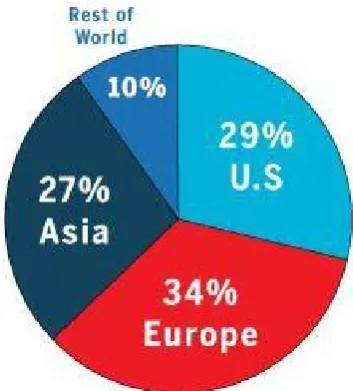
Source:[http://en.wikipedia.org/wiki/File:Gloabl_ecommerce_sales_by _region.jpg]
Fig. 2. Global e-commerce sales by region
Why we are seeing interest in E-commerce
The reason is the several E-commerce benefits which is enjoyed by both customers and merchants at the same time, a real win-win situation. Here's a summary of E-commerce benefits for you to view and consider.
[image:2.595.344.521.444.640.2]• The market for a Web based business is not bound by any geographical constraints. This means lesser or NIL growth inhibitors due to various restrictions existing in different geographical regions.
• The transaction costs go down tremendously in a well s up site. The company saves on the costs of the people needed to interact with the customers, demonstrate the wares time and again, and take orders. All this gets automated online.
• Better, more inviting, convenient and comprehensive presentation of goods is conducive to greater sales. For instance, if you are at Amazon, you can take a look at what other people who ordered a book also purchased.
• Facilities such as being able to compare costs of several stores at the same time, keep a tab on your se
flexibility of being able to add, remove, and even come back later to carry on choosing instead of closing the deal in one online session itself are quite convenient to a customer. • The Web business can be integrated into the regular
business cycle and give customers more information than ever before. For instance, customers at Dell can see exactly at what stage their order is, at any given point of time. • Improved customer interaction, at practically no cost, is a
big asset to the company. By putting information on frequently asked questions on their website, organizations are saving costs by reducing the number of customer service representatives. Eventually which means that, the benefits of saved costs will be passed on to the customer lowering costs at the other end of connection, too? • Small and large firms alike have the opportunity to set
and conduct business on the internet. The barriers to entry to the e-commerce are miniscule.
• An inexpensive advertising medium for o
allows organizations an opportunity for publicizing their products and services at minimal cost.
• Helps expand into new markets by virtue of its global reach.
Open your product and services to a new customer base and to maintain a leading edge technology position and image in the market place and against your competitors.
commerce benefits are being gradually recognized the world over. Most of the businesses, big or small, are now setting up bases on the internet to reap the benefits of this golden era of e commerce.
Five reasons why mobile commerce in India m than online commerce
E-Commerce industry is booming in India, and M
is following its lead. With both big and small online businesses developing special mobile websites and apps, it is evident that even they have realised how prominent this platform is. In a
country where there are over930 Mnmobile subscribers
against 160 Mn Internet users (Including 86 Mn mobile Internet users) it is quite possible for M-Commerce to become even bigger than E-Commerce, because of the reasons mentioned below :-
Affordability of Mobile Devices
It is no denying fact that mobile devices like cell
tablets are far more affordable than desktops and laptops, and The market for a Web based business is not bound by any geographical constraints. This means lesser or NIL growth inhibitors due to various restrictions existing in different
he transaction costs go down tremendously in a well set up site. The company saves on the costs of the people needed to interact with the customers, demonstrate the wares time and again, and take orders. All this gets
Better, more inviting, convenient and comprehensive oods is conducive to greater sales. For instance, if you are at Amazon, you can take a look at what other people who ordered a book also purchased.
Facilities such as being able to compare costs of several stores at the same time, keep a tab on your selections, the flexibility of being able to add, remove, and even come back later to carry on choosing instead of closing the deal in one online session itself are quite convenient to a customer. The Web business can be integrated into the regular ess cycle and give customers more information than ever before. For instance, customers at Dell can see exactly at what stage their order is, at any given point of time. Improved customer interaction, at practically no cost, is a
ny. By putting information on frequently asked questions on their website, organizations are saving costs by reducing the number of customer service representatives. Eventually which means that, the benefits of saved costs will be passed on to the customers -- lowering costs at the other end of connection, too?
Small and large firms alike have the opportunity to set-up and conduct business on the internet. The barriers to entry
An inexpensive advertising medium for organizations, it allows organizations an opportunity for publicizing their
Helps expand into new markets by virtue of its global reach.
Open your product and services to a new customer base and to ding edge technology position and image in the market place and against your competitors. All these e-commerce benefits are being gradually recognized the world over. Most of the businesses, big or small, are now setting up bases on the internet to reap the benefits of this golden era of
e-Five reasons why mobile commerce in India may get bigger
Commerce industry is booming in India, and M-Commerce is following its lead. With both big and small online businesses developing special mobile websites and apps, it is evident that nt this platform is. In a mobile subscribers against 160 Mn Internet users (Including 86 Mn mobile Commerce to become Commerce, because of the reasons
It is no denying fact that mobile devices like cell phones and tablets are far more affordable than desktops and laptops, and
[image:3.595.331.537.89.296.2]an average Indian consumer doesn’t have much disposable income in his hand to buy high end devices.
Fig. 3. Why M-Commerce is on Rise
Plus, one doesn’t even really need expensive smart
shop online or make mobile transactions. According to
areportby Avendus, there were over 36 Mn smart
in India, but over 431 Mn Internet capable mobile devices in use in India as of December 2012, thus forming a strong consumer base for m Commerce. Moreover, due to their mobility and affordability, even tablets are high in
India.
Mobile Internet Connectivity
M-Commerce customers are not bound by limited wired and WiFi Internet connections. In the last 3
users who access the Internet through a 3G connection has grown to round 22 Mn. Now compare this with the 15 Mn fixed line broadband connections a
years, there is a notable difference. Even though E
has spread its roots throughout the country, it still hasn’t reached the places where people have no broadband or no computer. M-Commerce could and will change this.
Security
Mobile platforms are still relatively free from viruses and other threats. And even in case of a fraudulent activity, credit tracking by GSM/GPRS/GPS is easy and quick. Thus increasing the credibility, and giving better assurance to the sceptical India population. Also, seldom do people part from their phones, so there are less chances of misuse of login information that may happen on computer systems.
Bridging Gap Between E-Commerce and Conventional Stores
Brick and mortar stores are getting a lot
stores, which are luring their customers away by offering better product prices and discounts. When a person goes out for shopping, mobile acts as a conduit between the two poles, an average Indian consumer doesn’t have much disposable
high end devices.
Commerce is on Rise
Plus, one doesn’t even really need expensive smart phones to shop online or make mobile transactions. According to by Avendus, there were over 36 Mn smart phone users Mn Internet capable mobile devices in use in India as of December 2012, thus forming a strong Commerce. Moreover, due to their mobility and affordability, even tablets are high indemandin
Mobile Internet Connectivity
customers are not bound by limited wired and WiFi Internet connections. In the last 3-4 years, the number of users who access the Internet through a 3G connection has grown to round 22 Mn. Now compare this with the 15 Mn fixed line broadband connections accrued over the last 17 years, there is a notable difference. Even though E-Commerce has spread its roots throughout the country, it still hasn’t reached the places where people have no broadband or no
Commerce could and will change this.
Mobile platforms are still relatively free from viruses and other threats. And even in case of a fraudulent activity, credit tracking by GSM/GPRS/GPS is easy and quick. Thus increasing the credibility, and giving better assurance to the ia population. Also, seldom do people part from their phones, so there are less chances of misuse of login information that may happen on computer systems.
Commerce and Conventional
people compare prices online before buying something. This could be, and is being used by retailers to their benefit by offering location based services, barcode scanning, and push notifications to improve the customer experience of shopping in physical stores.
Greater Target Audience for Advertisements
The problem with online advertising is that people have to be ‘online’ to view it. Several E-Commerce players in India have come out with TV commercials to advertise their websites. However, mobile is a better platform to do the same. Even with Government’s regulation on bulk messaging, companies could still target a mass of people collectively by sending promotional content via SMS if a user hasn’t activated the DND service or wants to receive those ads.
Advantages and disadvantages of M-commerce
M-Commerce is a part of E-commerce which is done through mobile phones. It allows the person to do the transaction through mobile phones. It gives each and every person a choice to shop from anywhere. It is a way by which companies and sellers come closer to the end user. Though there are many similarities, there are many differences between M-commerce and E-commerce, such as :-
* Internet connectivity is always needed in E-commerce but
M-commerce does not have such boundaries.
* Video conferencing can also be done through M-commerce but it is not possible in E-commerce.
* M-commerce is costlier than E-commerce.
* M-commerce is much easier than E-commerce.
* Providing wider reach
* Reducing transaction cost
* Streamline business processes
* Competitive pricing
* Reducing time to order
Below are some of its advantages
Convenience
It is a true convenience to do much from a handy device via M-Commerce. With wherever you are, in just a few clicks on your mobile device, you can already do shopping, banking and download media files.
Flexible accessibility
User can be accessible via mobile phones and at the same time be accessible online too through logging on to various mobile messengers like Yahoo and G-talk and other networking platforms. On the other hand, user may also choose not to be accessible by shutting down his mobile device, which at times
can be a good things.
Easy connectivity
As long as the network signal is available, mobile devices can connect and do commerce transactions, mobile to mobile and
even mobile to other devices. No need for modem or WI-FI connectivity set up.
Personalization
Each mobile device is usually dedicated to a specific user,it is personal. You can do whatever you want to your mobile device, modify the wallpaper, change view settings or modify contact information as you send emails or e- payments.
Time efficient
Doing M-Commerce transactions do not require the user to plug anything like personal computer or wait for the laptop to load. Just hit the on button of your mobile device and your ready to go.
The disadvantages of M-commerce
* Technology constraints of mobile devices (memory,
Processing power, display capabilities, input methods).
* User interface is often difficult to learn how to use.
* Use of graphics limited
* WAP and SMS limited to small number of characters and
Text.
* Limited bandwidth
* Small screens of most devices still limit types of file and
data transfer.
* WAP and SMS limited to small number of characters and
text.
* Cost of establishing mobile and wireless broadband
Infrastructure.
* Small screens of most devices still limit types of file and
data transfer (i.e. streaming videos, etc.)
* Standards guiding applications and technology development
and connection(s)
* WAP and SMS limited to small number of characters and
text.
* Use of graphics limited
Conclusion
E-commerce is widely considered the buying and selling of products over the internet, but any transaction that is completed solely through electronic measures can be considered E-commerce. Day by day E-commerce and M-commerce playing very good role in online retail marketing and peoples using this technology day by day increasing all over the world. Mobile commerce involves all kind of electronic transactions by the use of mobile phone. M- Commerce is the term for making business transactions using mobile devices. There are already several existing M- Commerce applications and services nowadays that have been very helpful to us. Some are mobile banking, location maps, and variety of news, mobile shopping, ticketing and mobile file sharing. E-commerce security is the protection of e-commerce assets from unauthorized access, use, alteration, or destruction. Still there is a lot of work, which is to be done for commerce. We just keep in mind that M-commerce is a new Industry in India. Internet connectivity and mobile networking is still not accessible to entire population.
These industries see an astounding rate of growth. M-commerce market grows in India because so many growth drivers are favorable in India such as changing youth’s perception, introduction of trusteeship model, growth of financial area and numbers of smart phone buyers are increasing.
REFERENCES
Deepu Saini and Dr. Vijay Singh Rathore, 2012. “Study & Analysis of Secured E-Commerce Transactions Information Protocols- Purchasing Order”. IJCSMS- Vol. 12, Issue 03, September 2012.
Deshmukh, P., Deshmukh, S. and Thampi, G.T. 2013. “Transformation from E-commerce to M-commerce in Indian Context”, International Journal of Computer Science
Issue, 10 (4).
Khalil Md Nor, Asghar Afshar Jahanshahi, 2011. ”FROM Mobile to mobile commerce: An overview in the Indian perspective” - 2nd International conference on business and
economic research (2nd ICBER 2011) proceeding.
Manjoor Amir, 2010. “Introduction of E-commerce”, E- commerce, Amir Manzoor, 23.
Nikhil Menon, 2011. "E-Commerce: Can the dotcom majors cope with their rising expectations?",The Economic Times
(India) 9 September 2011
Sanjay, K. S. 2007. “The diffusion of mobile commerce in India”, Department of Humanities and Social Sciences, Indian Institute of Technology, Kanpur.
Srikanth, V. and Dhanapal, R. “A Business Review of E- Retailing in India”, International Journal of Business
Research and Management, 1(2),105-121
UNESCO Literacy, www.unesco.org/news/en/education/
themes/education-building -blocks/ literacy.