Abstract-The objective of this paper is to measure word of mouth influence on IT career interest based on family background on Indonesian students. For this purpose we used questionnaire as research instrument. Data as a value to interest, word of mouth and family background variables, was gathered from high school students in Jakarta metropolitan. Further, data was analyzed using multiple groups on Lisrel software. Result shows thatthere’s difference on the influence of word of mouth on computer/IT career interest based on family background. Model relationship between word of mouth and student interest towards computer/IT is moderated by parent education and birth order.
Index Term: career interest, family characteristics, Indonesian students, information technology, word of mouth
I. INTRODUCTION
Career planning period for a young people in Indonesia is stably started when he/she enter high school, in the age between 15-17 years. For instance, career thinking has been started when she/he should decide whether to enter high school and which kind of high school. In Indonesia high school is differentiated to vocational and general. On vocational, student is directed to train her/his skill on particular job such as cooking, tailor, culinary, etc. She/he is expected to search for a job shortly after graduation. On general high school, student is expected to pursue to higher education level having graduate from high school, such as university and institute. Even though the decision is entering general high school, she/he further must decide whether to enroll on exact or social sciences department.
Career choice are largely a function of personal factors (such as personality traits, self-knowledge, occupational knowledge) and environment factors (such as family and school) as reported by previous researchers [1]; [2]. All those decisions are not purely children’s decision. For few children, the decisions might be made by parent, sibling, uncle, auntie, etc. Few children might make decision together with his/her parent or sibling. Although the decision is made by children themselves, in the process of decision making they might be facilitated with useful information
Manuscript receipt on August 2nd 2010.
1Hotniar Siringoringo is a lecturer and researcher in University of
Gunadarma. Postal Address: Jalan Margonda Raya No. 100 Depok 16424, Indonesia. Phone : +628129617275. email :
[email protected], [email protected].
2Yudi Agustono. Direoctorate of Higher Education, Jakarta Indonesia.
Email id : [email protected]
Suryadi Harmanto is a lecturer and researcher in University of Gunadarma. Postal Address: Jalan Margonda Raya No. 100 Depok 16424, Indonesia.
4Anacostia Kowanda. is a lecturer and researcher in University of
Gunadarma. Postal Address: Jalan Margonda Raya No. 100 Depok 16424, Indonesia. email id : [email protected]
given by parent, sibling, friends, neighbor, etc. We call this as Word of Mouth (WOM).
WOM generally is used to trigger customer interest for particular product. However, WOM can be in positive or negative form. Positive WOM have been proved empirically influence behavior, particularly interest towards product ([3]; [4]; [5]; [6]; [7]; [8]; [9]). As such, WOM, whether in positive or negative meaning probably has an impact on student career interest.
Nevertheless career interest is not only influenced by WOM but by many other factors, such as advertising, family background, student personality, etc. Till these dates, most researchers tried to investigate the influence of personal and environment factors individually or simultaneously toward customer interest. In this respect, family background is used to treat as independent variable which influences interest. In education study, many researchers have explored the impact of family background on education attainments [10], [11], [12], [13], [14].
Another view, family background might not influence career interest but moderates. The distinction of family background might bear stronger personal factors influence career choice, or vise versa. Or even among environment factors, WOM for instance will bear stronger effect on career choice on the presence of different family background. Therefore, this study is intended to investigate the moderating effect of family background on WOM and career interest relationship.
This subject is more interesting as government probably needs this information to turn out work force policy, from blue collar to white collars workers. Stopping sending house maids workers abroad is emergencies. With a series of research, it’s expected that government finally capable to promote white collar workers. Considering family dominance in student character formation, this research is intended to evaluate the influence of Word of Mouth (WOM) on student career interest toward IT/computer specialist based on family background.
II. RESEARCH METHOD
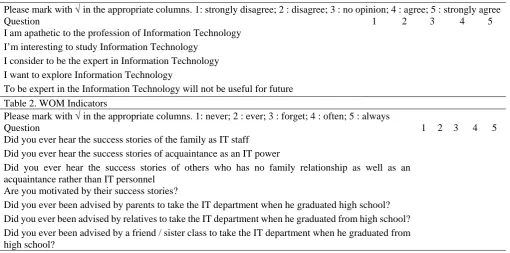
This study uses questionnaire as a research instrument. The questionnaire was developed to measure the interest and WOM in closed question form with five (5) choices in Likert scale, as can be seen in Table 1. Interest indicators were developed based on [15] questionnaire on certain goods brand. Originally, they used 11 questions to measure customer interest in a familiar brand goods. Respondents were asked to fill out the questionnaire after they showed advertisement. However in this research, we used only 5 questions as we didn’t measure the impact of advertisement but word of mouth.
Information Technology Career Interest on High
School Students Based on Family Background
Table 1. Interest Indicators
Please mark with in the appropriate columns. 1: strongly disagree; 2 : disagree; 3 : no opinion; 4 : agree; 5 : strongly agree
Question 1 2 3 4 5
I am apathetic to the profession of Information Technology I’m interesting to study Information Technology
I consider to be the expert in Information Technology I want to explore Information Technology
To be expert in the Information Technology will not be useful for future Table 2. WOM Indicators
Please mark with in the appropriate columns. 1: never; 2 : ever; 3 : forget; 4 : often; 5 : always
Question 1 2 3 4 5
Did you ever hear the success stories of the family as IT staff Did you ever hear the success stories of acquaintance as an IT power
Did you ever hear the success stories of others who has no family relationship as well as an acquaintance rather than IT personnel
Are you motivated by their success stories?
Did you ever been advised by parents to take the IT department when he graduated high school? Did you ever been advised by relatives to take the IT department when he graduated from high school?
Did you ever been advised by a friend / sister class to take the IT department when he graduated from high school?
WOM variable is developed based on the relationship between respondents with information sources. It’s common in Indonesia that siblings, parents, or other relatives in the family have a role in making school decision. However, the information needed is not only from them but also from acquaintances, biographies, or other sources. (see Table 2)
In order to evaluate family background on career interest, we developed conceptual research model as can be described on Fig. 1. Family background which is consists of father education, mother education, and birth order is treated as moderating factor.
Research model further was validated using multiple groups Confirmatory Factor Analysis (CFA). We used multiple group technique as we intended to analyze the existence of moderating factors on the model.
III. RESULT AND DISCUSSION
A. Respondent Profile
Participants for the study were recruited from High School students located in five (5) regions of Jakarta Indonesia, such as South Jakarta, East Jakarta, North Jakarta, West Jakarta, and Center Jakarta. Choosing the participants for the study first based on school rating. Few years back, directorate of primary and secondary education patronize every two (2) schools in each region of Jakarta as top quality based on entering score and school facilities. Between the two schools, we chose the second grade which is called as the second to the top. Within the school, we chose the classes based on their time availability as we didn’t intend to disturb the students on the study time. We entered to the class by chance when the teacher was not present.
We succeeded to recruit 392 respondents consists of 19.90% from South Jakarta, 11.22% from East Jakarta, 26.79% from North Jakarta, 14.8% from West Jakarta, and 27.30% from Center Jakarta. From the point of view of gender, 44.39% is male and 55.61% is female. Based on age,
statistics shows that 2.81%, 30.10%, 35.46%, 26.28% and 5.36% are in the age 14, 15, 16, 17, and 18 years respectively.
B. Moderating Effect on WOM-Career Interest Relationship
WOM and career interest are latent in nature. Those variables were measured using questionnaire. To explore relationship between two latent variables requires Structural Equation Modeling (SEM) technique. In addition, we want to explore moderating effect of family background on the relationship between WOM and career interest. For that purpose we deploy multiple group Confirmatory Factor Analysis (CFA). Data analyzing was done using Lisrel software. Families’ background are represented by father and mother education, as well as birth order. Hypotheses tested are as follow:
H01 : There’s no different among father education level on
word of mouth-career interest relationship
H11 : There’s different among father education level on
word of mouth-career interest relationship
H02 : There’s no different among mother education level on
word of mouth-career interest relationship
H12 : There’s different among mother education level on
word of mouth-career interest relationship
H03 : There’s no different among birth order on word of
mouth-career interest relationship
H13 : There’s different among birth order on word of
mouth-career interest relationship
Summary of output analysis is shown on Table 3. On father education level, calculated 2 is much bigger than 2
table even for test significance () 0.001. Value of 2
table for 33 degrees of freedom (df) is 63.870, compared to 352.84 calculated 2. It reflects the rejection of H0, there’s
[image:2.595.43.554.60.313.2]Table 3. Chi-square result
2
H0 df H1 df differences df
Father education 824.14 255 471.30 222 352.84 33
Mother education 1281.79 176 379.30 159 902.49 17
Birth order 313.303 87 488 87 174.697 0
Mother education level moderation on WOM-career interest relationship is apparently significant. Value of 2
calculated is 902.49 with 17 df and 0.001, compare to 40.790 2 table value. We believe 99.9% that mother education level moderates the relationship WOM on career interest. We categorized mother education level into three (3) levels, i.e. (1) elementary and secondary schools, (3) high school, and (3) degree.
It also obvious the rejection of H0 on moderation of birth
order. Value of calculated 2 is 174.69 with 0 df and 0.001 .
It is much bigger than 2
table value which is 10.828. There are significant different among the role of birth order on WOM and career interest relationship. It will be different the influence of WOM on computer/IT career interest of different birth order.
Fig. 1. Conceptual Research Model
In regards with student interest on computer/IT career, it shows in this study that WOM influence will be different on different family background. The difference on father education level moderates the influence of WOM on computer/IT career interest. Similar finding that the difference on mother education level moderates the impact of WOM on career interest. Birth order as well moderates the impact of WOM on career interest. This result is not surprisingly as different family background might bear different student characteristics. Parent with lower education level for instance might rarely concern with their children school. They have been busy to think how to generate income so that they can maintain family economy.
The moderation of family background on behavior in this study is not surprising although most of previous researches give the evidence of causal relationship. For instance, children in UK from poorer backgrounds have worse educational outcomes than their better off peers and parental income ([10] and [14]. Similarly, [11] and [13], using German data, that parental background is strongly related to the secondary school track of children, and this association between parental class and educational choice..
The influence of WOM on behavior, such as computer/IT career interest in this case in line with previous researches.. Without doubt, many researchers (such as ([3]; [4]; [5]; [6];
[7]; [8]; [9]) argued that, there are innumerable instances where WOM has made a significant impact (positive or negative) on human behavior.
WOM is estimated to play a role in about four out of five consumer decisions ([16]). More ever it is also shown WOM effects at various stages of consumer decision-making. References [17], [18], [19], and [20] found the effect of WOM at information search ; Woodside and Delozier 1976), during trial or sampling of products [21], [22], [23], [24], and then later as an outcome of product consumption [25] and as an alternative to complaining when dissatisfied [26].
Implication of this study to stakeholder is the opportunity to influence student interest to plan future career on IT/computer by deploying low cost tool. IT/computer field of study management for e.g. simply invite and ask their successful alumni to give a presentation on the last year of high school students. Generally successful alumni are voluntary to promote their alma mater.
The value of WOM can be quite large since (1) it costs the retailer virtually nothing, (2) immediate communication channels such as the internet and cell phones permeate modern society, and (3) it is perceived to have an immediate sense of credibility . Another positive value is consumers feel like they are “being sold” less by other consumers than they are by traditional advertising mechanisms, ultimately alleviating some of the suspicions that accompany vested interests [27]
The formation of interest is important to stakeholder. Interest (as distinct from attitudes and beliefs) is considered to be very important in the genesis of human actions and is argued to lead to intentions to act. The most common model in this research tradition, often referred to as the philosophy of action, is some variant of a three-facet model of decision making, based on a distinction between beliefs and desires and their influence on a corresponding intention. Concept of desire has been started when children as young as 2 years old base their understanding and prediction of human action on the concept of desire [28], [29]. By the age of 3 years, the evidence reveals that children develop a simple belief-plus-desire model, although variations exist across cultures and individuals in this acquisition [30], [31], [32], and [33]. For explanations of otherwise puzzling behavior by primates, [35] describes a “mind-reading” perspective, with emphasis on understanding the behavior of others by attributing mental states such as wants, wishes, and desires to them.
Recent developments in attribution theory concerning adults’ intentional actions have also focused on the concept of desire, as distinguished from that of intention [36] and [37]. According to [37], the attribution of intention requires, among other things, that the actor has a desire for an outcome and holds beliefs to the effect that specific behaviorswill lead to particular outcomes.
interest Word of
mouth
Moderating factors Father education Mother education
IV. CONCLUSION
Student family background is empirically proved moderating the effect of WOM on computer/IT career interest. Level of father and mother educations as well as the student birth order moderating the effect of WOM on computer/IT career interest.
The result indicates that in order to promote computer/IT career to student using WOM, one should design different plan for different family background. This information will be very important for university or higher education which offers Computer Science and/or IT field of study.
Despite the merits, this study has some limitation. First, study participants need to be wider. As the career plan stability expected to be started since secondary school, participants to the study can be recruited as well from that level. As this study participants were chosen from second to the top rank public high school in Jakarta, it also important to broaden with lower rank as well as with private schools.
Second, conclusion on this study is limited only to show the difference among factors, it is important to find out the difference within factors. We only show that there’s different among father/mother education level and birth order on WOM-career interest relationship, but not showing which one is different. Therefore it’s needed to further analyse in order to show the difference within father/mother education level and birth order.
REFERENCES
[1] J.L. Holand, Making vocational choices: a theory of
careers, Englewood Clifs, NJ:Prentice Hall, 1985.
[2] R.L.Mullis, A.K. Mullis, and D.Gerwels, “Stability of Vocational Interests among High School Students,”
Adolescence, 131, 33, 1998, pp. 699-708.
[3] D. Tewksbury, P. Moy, and D.S. Weis, “Preparations for Y2K: Revisiting the behavioral component of the third-person effect,” Journal of Communication, 54, 2004, pp. 138-155.
[4] J.D. Jensen and R.J. Hurley, “Third person effects and the environment: Social distance, social desirability and presumed behavior,” Journal of Communication, 55, 2005:pp.242-256.
[5] D.T Allsop, B.R. Bassett, and J.A. Hoskins,. “Word-of-mouth research: Principles and applications,”
Journal of Advertising Research, December 2007,
pp.398-411.
[6] Y. Sun, L. Shen, and Z. Pan, “On the behavioral component of the thirdperson effect,” Communication
Research, 35,: 2008, 257-278.
[7] S.A. Banning,, “TPEs on political participation,”
Journalism & Mass Communication Quarterly, 83(4),
2006,:pp. 785-800.
[8] J. Zhang and T. Daugherty “Third-person effect and social networking: implications for online marketing and word-of-mouth communication,” American Journal of Business, 24 (2), pp. 53-63
[9] M. G Weinberger, C. T. Allen, and W. R. Dillon, “Negative word-of-mouth by dissatisfied consumers: AP pilot study/ 77: negative information: perspectives and research directions," Advances in Consumer
Research, 8, K. B. Monroe, ed., Ann Arbor, MI:
Association for Consumer Research, 1981, pp. 398-404. [10]J. Blanden and P. Gregg, “Family income and
educational attainment: A review of approaches and
evidence for Britain,” Oxford Review of Economic Policy, vol. 20, no. 2, 2004, pp. 245–263.
[11]C. Dustmann, “Parental background, secondary school track choice, and wages,” Oxford Economic Papers, vol. 56, 2004, pp. 209–230.
[12]J.F. Ermisch and M. Francesconi, “Family matters: impacts of family background on educational attainments”, Economica, vol. 68, 2001, pp. 137–156. [13]S. Jenkins and C. Schluter, ‘The effect of family income
during childhood on later-life attainment: evidence from Germany,” IZA Discussion Paper, 2002, no. 604. [14]J. Scott, “Family, gender, and educational attainment in
Britain: a longitudinal study”, Journal of Comparative
Family Studies, vol. 35, 2004, pp. 565–590.
[15] K. A. Machleit, T. J. Madden, and C. T. Allen, “Measuring and modeling brand interest as an alternative ad effect with familiar brands,” Advances in
Consumer Research, 17, 1990 pp. 223-230.
[16]B. B. Stern and S. J. Gould,, “The consumer as financial opinion leader,” Journal of Retail Banking, 10 (2), 1988, pp. 43-52.
[17]D. F. Duhan, S. D. Johnson, J. B. Wilcox, and, G. D. Harrell, “Influences on consumer use of word-of-mouth recommendation sources,” Journal of the Academy of
Marketing Science, 25 (4), 1997, pp. 283-295.
[18], J. Eliashberg and S, M. Shugan, “Film critics: influencers or predictors?,” Journal of Marketing, 61 (2), 1997, pp. 68-78.
[19]P. M. Herr, F. R. Kardes, and J. Kim, “Effects of word-of-mouth and product- attribute information on persuasion: an accessibility- diagnosticity perspective,”
Journal of Consumer Research, 17 (March), 1991, pp.
454-462.
[20]A. G. Woodside and M. W. Delozier, “Effects of word-of-mouth advertising on consumer risk taking,”
Journal of Advertising, 5 (4), 1976, pp. 12-23.
[21], P. F. Bone, “Word-of-mouth effects on short-term and long-term product judgements,” Journal of Business
Research, 32, 1995213-223.
[22]R. E. Burnkrant and, A. Cousineau, “Informational and normative social influence in buyer behavior,” Journal
of Consumer Research, 2 (3), 1975206-215.
[23]J. B. Cohen and E. Golden, “Informational social influence and product evaluation,” Journal of Applied
Psychology, 56 (1), 1972, 54-59.
[24]M. Venkatesan, “Experimental study of consumer behavior conformity and independence,” Journal of
Marketing Research, 3 (November), 1966, 384-387.
[25] M. Richins, “Negative Word-of-mouth by dissatisfied customers: a pilot study,” Journal of Marketing, 47 (Winter), 1983, pp. 68-78.
[26]H. S. Watkins and R. Liu, “Collectivism, individualism and in-group membership: implications for consumer complaining behaviors in multicultural contexts,”
Journal of International Consumer Marketing, 8 (3,4),
1996, pp. 69-78.
[27] R Grewal, T . W. Cline and A Davies, “Early-entrant advantage, word-of-mouth communication, brand similarity, and the consumer decision-making process,”
Journal of Consumer Psychology , Vol. 13 , No. 3 , 2003, pp. 187 – 197 .
[29]H.M. Wellman. The child’s theory of mind. Cambridge, MA: Bradford Books/MIT Press. 1990
[30]S.Baron-Cohen, Leslie, A.M., and Frith, U., “Does the autistic child have a theory of mind?” Cognition, 21, 1985, pp. 37-46.
[31]L.J. Moses. “Young children’s understanding of belief constraints on intention,” Cognitive Development, 8, 1993, pp. 1-25.
[32]T. Tardiff, and H.M Wellman. “Acquisition of mental state language in Mandarin- and Cantonese-speaking children,” Developmental Psychology, 36, 2000, pp. 25-43.
[33]N. Yuill, and A Pearson, The development of bases for trait attribution: Children’s understanding of traits as
casual mechanisms based on desire. Developmental Psychology, 34, 1998, pp. 574-586.
[34]T. Tardiff and H.M. Wellman. Acquisition of mental state language in Mandarin- and Cantonese-speaking children. Developmental Psychology, 36, 2000, 25-43. [35]A. Whiten, Natural theories of mind: Evolution,
development and simulation of everyday mind reading. Oxford, UK: Basil Blackwell Inc. 1991.
[36]B.F. Malle. “How people explain behavior: A new theoretical framework. Personality and Social,”
Psychology Review, 3, 1999, 23-48.