Adapting Event Embedding for Implicit Discourse Relation Recognition
Maria Leonor Pacheco, I-Ta Lee, Xiao Zhang, Abdullah Khan Zehady Pranjal Daga, Di Jin, Ayush Parolia, Dan Goldwasser
Department of Computer Science, Purdue University West Lafayette, IN 47907
{pachecog,lee2226,zhang923,azehady daga,jind,aparolia,dgoldwas}@purdue.edu
Abstract
Predicting the sense of a discourse relation is particularly challenging when connec-tive markers are missing. To address this challenge, we propose a simple deep neu-ral network approach that replaces man-ual feature extraction by introducing event vectors as an alternative representation, which can be pre-trained using a very large corpus, without explicit annotation. We model discourse arguments as a combi-nation of word and event vectors. Event information is aggregated with word vec-tors and a Multi-Layer Neural Network is used to classify discourse senses. This work was submitted as part of the CoNLL 2016 shared task on Discourse Parsing. We obtain competitive results, reaching an accuracy of 38%, 34% and 34% for the development, test and blind test datasets, competitive with the best performing sys-tem on CoNLL 2015.
1 Introduction
The CoNLL 2016 shared task focuses on Dis-course Parsing. Building on the CoNLL 2015 task, this year teams were able to focus on a supple-mentary task, limited to sense classification of discourse relations, given their (gold) arguments (Xue et al., 2016). Identifying the sense is partic-ularly challenging in the case of implicit relations, where explicit connective words (e.g., however, but, because) are not present. Last year, most sub-mitted systems used algorithms traditionally ap-plied for this task, such as Support Vector Ma-chine (SVM) and Maximum Entropy classifiers learned over binary features as input representa-tion. This included the best performing system, which reached an accuracy of 34.45 in the test data
and an accuracy of 36.29 in the blind test data for implicit relations (Xue et al., 2015; Wang and Lan, 2015).
We followed the intuition that obtaining a sig-nificant increase in performance using traditional classifiers and feature engineering would be dif-ficult given the effort that was previously spent on such systems. Neural-network-based classifiers present a different and less explored approach to the discourse sense problem, which can poten-tially lead to considerable improvement. Our sys-tem, described in this paper, takes a step in this direction.
We explore different input representation types and introduce event vectors for this task. Follow-ing the work of (Chambers and Jurafsky, 2009), we look into event chains as a way to represent structure in the discourse arguments. Then, we adapt the skip-gram approach originally used to learn word vectors from sentences (Mikolov et al., 2013b) to learn event vector representations from event sequences. To do so, we draw a clear anal-ogy between words and events, as well as between sentences and event chains. Finally, each input re-lation is represented with the pre-trained event and word vectors of its arguments and a multi-layer neural network is used to classify senses.
2 System Description
The dataset used in the CoNLL shared task corre-sponds to the Penn Discourse Treebank (Prasad et al., 2008), in which pairs of sentences are anno-tated with an optional discourse connective and a sense that best explains the discourse relation be-tween them. The annotation was done over a set of Wall Street Journal articles.
Each relation, either explicit or implicit, con-sists of two arguments, typically composed of short phrases and an associated sense. In the case of explicit relations, a connective is present in the
text. This problem can be stated as a standard multi-class classification problem, where the in-puts correspond to the argument pairs and there is a direct mapping to a finite and known set of labels.
We use two different classifiers for sense iden-tification: a SVM classifier with linear kernel for explicit relations that uses state-of-the-art features and a multi-layer neural network for the implicit relations, which is the main focus of our submis-sion. The following sections describe each of the systems in detail.
2.1 Explicit Discourse Relations
Explicit discourse relation detection depends on identifying explicit discourse connectives. In the sense classification task, the connective and the two corresponding arguments are supplied, there-fore, we trained a linear SVM multi-class classifier to choose from 14 different senses.
We used the syntactic features described in (Lin et al., 2009; Pitler and Nenkova, 2009). We also used the connective string, PoS tags, the connective’s previous word and PoS tag from Lin’s features in our classifier. The features de-scribed in (Pitler and Nenkova, 2009) are ex-tracted using constituency parse trees and con-sist of self-category, parent-category, left-sibling-category and right-sibling left-sibling-category.
(Pitler and Nenkova, 2009) has shown that using only the syntactic features, ignoring the identity of the connective gives better result. As the dis-course usage of a connective may strongly rely on the syntactic context it appeared, we have added Pitler’s pairwise interaction (C-Syn interaction) features between the connective C and each cat-egory feature (i.e., self-catcat-egory, parent-catcat-egory, left-sibling-category, right-sibling- category). The interaction features (Syn-Syn interaction) between pairs of category features are also used.
2.2 Implicit Discourse Relations
Sense classification for implicit discourse relations is notoriously hard. For this reason, we focus our efforts on this task, and explore several types of input representation and neural net architectures to deal with the challenges.
We move from the simple lexical representa-tion of word pairs used in (Lin et al., 2009; Pitler et al., 2009), and explore the benefits of using pre-trained word vectors (Mikolov et al., 2013b) to capture combinations and similarities. Finally,
we introduce the notion of an event to discourse parsing, inspired by the work of (Chambers and Jurafsky, 2009) as a way to represent structured knowledge and long range dependencies. Similar to (Modi and Titov, 2014; Pichotta and Mooney, 2016) we embed the event representation in a low dimension continuous space. More details on the definition of events and the derivation of the event vectors are given in section 2.2.1.
The sense classification task is defined over two arguments. Each argument is represented as two single vectors: a series of concatenated event vec-tors and a series of concatenated word vecvec-tors. A multi-layer neural network architecture receives these inputs to predict senses. The specifications of the architecture used are outlined in section 2.3. 2.2.1 Word and Event Embeddings
A word embedding is a function W → Rn,
mapping words to a dense low-dimensional vec-tor space. Word embedding, recently popularized by (Mikolov et al., 2013b), can be trained to cap-ture semantic and syntactic relationships between words, by mapping related words to vectors that lie close in the embedding vector space.
This property is often used to construct feature representations that can identify similarities and relationships between words. For example, dis-course parsers often use lexical features, consist-ing of the product between words appearconsist-ing in each of the two arguments. While such features can capture relationships between the two argu-ments, this representation is extremely brittle, as small variations in word usage are likely to result in lower performance. Using word embedding, in-stead of the arguments’ words directly, can help overcome such issues.
Despite these advantages, using word embed-ding can potentially have several drawbacks. For example, the relationships captured between words sometimes reflect syntactic dependencies (e.g., determiners tend to be followed by nouns) rather than semantic ones, and word senses are typically ignored when word embedding are con-structed. In addition, word vectors, despite their robustness, still do not capture the input argument structure.
Implicit
Class Words Words + Events Number of Occurrences
Comparison.Concession 0.000 0.000 5
Comparison.Contrast 0.022 0.067 90
Contingency.Cause.Reason 0.256 0.487 78
Contingency.Cause.Result 0.036 0.143 56
Contingency.Condition - -
-EntRel 0.637 0.609 215
Expansion.Alternative - -
-Expansion.Alternative.Chosen alternative 0.000 0.000 2
Expansion.Conjunction 0.520 0.544 125
Expansion.Instantiation 0.000 0.163 49
Expansion.Restatement 0.173 0.260 104
Temporal.Asynchronous.Precedence 0.000 0.000 28 Temporal.Asynchronous.Succession 0.000 0.000 3
Temporal.Synchrony 0.000 0.000 20
[image:3.595.117.481.60.241.2]Total 0.315 0.369 775
Table 1: Accuracy in the development data (Unofficial) by sense classes using different input represen-tations: words, events and words + events
(a) Event Embeddings (b) Word Embeddings
(c) Event+Word Embeddings (d) Event + Word Embeddings in Adaboostlearning
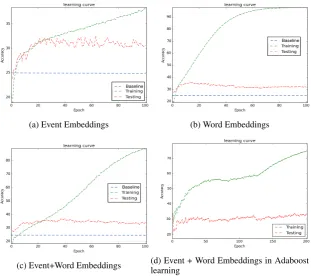
Figure 1: Training and testing accuracy for 100 epochs with three different implicit classifier models in Fig (a), (b), (c). Fig (d) shows the cumulative training and testing accuracy as the number of hypothesis increases from 0 to 200 in adaboost.
task. Simply put, an event can be defined as a verb andsubjectorobjectdependency relationship. An event chain is formed by connecting the events whose argument nodes are coreferent. We adapt the skip-gram model (Mikolov et al., 2013b) to generate event embedding by treating event chains as sentences, in which each event is a word. Note, that unlike word embedding that relies on word proximity and as a result captures syntactic
[image:3.595.149.461.292.568.2]Class Dev Test Blind Dev Test Blind Comparison.Concession 0.0000 0.0000 0.0000 0.5000 0.4667 0.0000 Comparison.Contrast 0.1263 0.0576 0.0000 0.9544 0.9088 0.1633 Contingency.Cause.Reason 0.3673 0.3740 0.2794 0.7568 0.8710 0.0784 Contingency.Cause.Result 0.1892 0.0896 0.0400 0.8889 0.9474 0.8571
Contingency.Condition - - - 0.9318 0.8718 0.9804
EntRel 0.5647 0.5475 0.5195 - -
-Expansion.Alternative - - - 0.9231 0.7692 0.0000
Expansion.Alternative.Chosen alternative 0.0000 0.0000 0.0000 0.9091 1.0000 -Expansion.Conjunction 0.4069 0.3123 0.2269 0.9537 0.9495 0.6194 Expansion.Instantiation 0.2286 0.3604 0.1852 1.0000 1.0000 0.0000 Expansion.Restatement 0.2647 0.2671 0.3282 0.0000 0.4444 0.0000 Temporal.Asynchronous.Precedence 0.0000 0.3636 0.0000 0.9375 0.9459 0.0000 Temporal.Asynchronous.Succession 0.0000 0.0000 - 0.8352 0.7429 0.1562 Temporal.Synchrony 0.0000 0.0000 0.0000 0.8000 0.7742 0.4500
[image:4.595.109.487.60.241.2]Total 0.3818 0.3435 0.3365 0.8968 0.8796 0.4860
Table 2: F1 score (Unofficial) by sense classes for both implicit and explicit classifier.
Pre-Training of Event Embedding The cre-ation of event embeddings follows the Skip-gram model proposed by (Mikolov et al., 2013a). In-stead of using word sequences as input to train the embeddings, we use event chains extracted by connecting events with co-referencing entities. Each entity has a chain of events and each event is represented in a form of verb and dependency pairs.
Specifically, we represent an event eas a pair e = (v, d) where v denotes a verb and d de-notes a grammatical dependency relation between the verb and its entity. Vector representations for events are learned from chains of events ex-tracted from a large corpus (we used the Wikipedia dump). To start, we use Stanford CoreNLP toolkit (Manning et al., 2014) to extract dependency trees and resolve co-referent entities from the corpus. For each entity in the co-reference chain, events are extracted by looking at the adjacent verbv in the dependency tree and its correspondent gram-matical dependency relation d, creating tuples
(v, d)as described above. This way, chains of the formei, ..., ekare extracted and are used as inputs
to the embedding training model.
Similar to the Word2Vec skip-gram model (Mikolov et al., 2013a), we use the following ob-jective function.
J = 1
T
T X
t=1
X
−c≤j≤c,j6=0
log exp(Ve0OVeI)
PE
e=1exp(Ve0VeI)
WhereVe is the vector representation of event
eandeI,eOspecify whether the event is an input
or output (Rong, 2014). Note, that in our model, unlike the Word2Vec model that uses sentences as
inputs, event chains are used as input for generat-ing the event embeddgenerat-ing (i.e., crefers to current event andjrefers to context events in the equation above), thus capturing a higher level abstraction of the sentence semantics.
To make training feasible, we apply negative sampling following the techniques used in the word2vec model, including rare event pruning, high frequency event subsampling and a dynamic window size (Goldberg and Levy, 2014). Five neg-ative samples are sampled for each event.
2.3 Discourse Relation Classifier
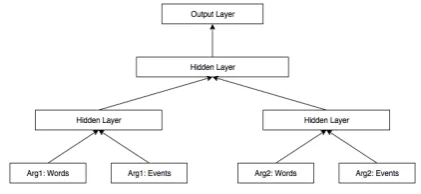
We used a Multi-layer perceptron with three hid-den layers to combine the arguments’ representa-tion in our system. This layout is depicted in figure 2.
Figure 2: Three hidden layer Perceptron taking events and word vectors as input.
[image:4.595.310.521.516.613.2]rate is applied over all the hidden layers for the purpose of regularization. The activation function for all the hidden layers is the rectified linear func-tion, which sets up a threshold such that all the values less than zero will be clipped to zero. In ad-dition to this setting, we applied a drop-out rate of
20%over all the input layers. We argue that due to the high dimensionality of a combined represen-tation of event and word embeddings, using drop-out even on the input layer can boost the model performance by avoiding overfitting.
The number of hidden units is tuned using a sep-arate validation set. Events and word vectors are concatenated in the input layer, where the maxi-mum number of events and words in an argument is taken from the entire date set in order to fix the size of the input and padding is performed on both sides if the number of words and/or events are less than the maximum value. In this study, we used the word embedding pre-trained on Google news corpus, which is widely used in NLP com-munity (Mikolov et al., 2013a). For each word in this discourse parsing task, if it is in the embed-ding corpus, we used its mapped vector; if it is not in the embedding corpus, it is initialized to random values very close to zero. As we trained our own event embedding, we dealt with all the extracted events in a similar fashion as word embedding.
In the final model, the number of hidden nodes is 175 for agument one, 350 for agument two, and the number of units in the hidden layer stacked on them is 700.
During training, we used stochastic gradi-ent descgradi-ent with mini-batches to minimize our loss function, which we defined as the negative log-likelihood of the data. The standard back-propagation algorithm is used to compute the gra-dient. The whole training process is performed on an Nvidia GTX 980 GPU.
3 Experiments
Since our main focus is implicit relations, we car-ried out a series of experiments to test the three different input representations in the implicit sense identification task. In all these experiments, we used a neural network architecture, and used as a baseline a simple lexical classifier based on word pairs. Since during the development of the system we only had direct access to the train and devel-opment folds, most of our experiments were per-formed on the development data set alone.
Word pairs have been widely used for implicit sense classification (Lin et al., 2009; Pitler et al., 2009), and most systems submitted to CoNLL 2015 shared task incorporated word pairs as a fun-damental part of their feature set. In table 3 we can see the aggregated results for this simple ap-proach using Support Vector Machines on the de-velopment dataset. For this test, the top 500 word pairs ranked by information gain were used.
Input Precision Recall F1
Word Pairs 0.24 0.26 0.25
Word Vectors 0.29 0.31 0.30
[image:5.595.314.517.193.238.2]Event + Word Vectors 0.37 0.37 0.37
Table 3: Performance metrics on the development data for the implicit classifier
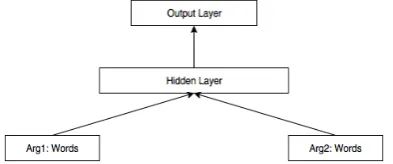
[image:5.595.319.516.487.569.2]The best performing systems, however, had to go beyond simple word pairs to reach scores near 0.35. To prove the effectiveness of looking at words in a richer space, we tested a very simple neural network architecture on word vectors. This architecture incorporated only one hidden layer to combine both arguments into a single representa-tion and an output layer with a softmax funcrepresenta-tion was built on top to classify the sense. The layout for this simple architecture can be observed in fig-ure 3. The input word vectors are concatenated in the input layer with padding and unknown words are initialized to random values very close to zero (see section 2.3).
Figure 3: Single hidden layer perceptron taking word vectors as input.
Results using word vectors can be observed in table 1. We can see that there is a significant improvement in the general case, reaching to an accuracy of 0.315 in the development data. We attribute this improvement to the word vectors ability to capture similarities implicitly between words as well as providing a distributed continu-ous representation allowing words to be combined in the hidden layer.
Class Dev Test Blind Dev Test Blind Total 0.3805 0.3445 0.291 0.8968 0.8796
-Table 4: Official TIRA F1 score for both implicit and explicit classifier.
input using the architecture described in section 2.3. After some experimentation, we decided to keep word vectors as a way to expand the infor-mation encoded in events, where the reference to the entities and other helpful lexical information is lost. Table 1 shows the improvement attained when throwing event vectors into the picture. We can observe a stable boost in performance among all classes, except EntRel, where there is a slight drop in accuracy. Total accuracy improves from 0.315 to 0.369 using event vectors, a result that is competitive with the best performing system in CoNLL 2015.
Figure 1 (a)-(c) shows the learning curve of the implicit classifier for all input types and architec-tures. The baseline corresponds to the word pair classifier with an accuracy of 0.25. We can observe that using word embedding overfits quickly, as the neural network starts to memorize the the training set vocabulary. Using event embedding helps com-bat overfitting, and the best behavior is obtained when combining the two embedding types. In this case, the learning curve in the development set reaches a higher peak. We can see the combined model overfits as the number of training epochs increases, albeit slower compared to word embed-ding alone. We tried to slow overfitting even fur-ther by experimenting with random sampling from training data set and combining multiple hypothe-sis using Adaboost, Figure 1 (d) shows the learn-ing curve resultlearn-ing from these attempts. While overfitting is indeed slower, performance suffers. We speculate that increasing the number of epochs until training accuracy reaches the optimum, may give even more competitive performance.
Tables 2 and 4 include our final results. On ta-ble 2 we can observe the performance by class on the three evaluation datasets: development, test and blind test for both the implicit and the explicit classifier. In our preliminary experiments for the implicit case, we obtained a very low score for infrequent classes. For this reason, we opted for removing infrequent classes from the training set and improved overall results, increasing F1 score from 0.36 to 0.38 for the development data.
Table 4 includes the official results obtained
through TIRA (Potthast et al., 2014). Due to tech-nical difficulties, we had to use an older model for the blind test set, that was trained over all labels (including the infrequent ones). The improvement from 0.291 to 0.3365 corresponds to the elimina-tion of infrequent labels from the training proce-dure. Similarly, the system used for the blind data did not include the explicit classifier. For this rea-son, the result is omitted in table 4.
We looked at the class distribution in the dataset in table 1, and identified common senses that our classifier fails to distinguish. Analyzing the con-fusion matrix we identified the following: It is hard to differentiate Expansion.Instantiation from Ex-pansion.Restatement and Contingency.Cause.Result from Contingency.Cause.Reason, and finally, the rest of the classes get confused withExpansion.Conjunction,
which is the biggest class afterEntRel.
4 Conclusion
We presented our submission for the CoNLL 2016 shared task, focusing on implict discourse sense identification1. We looked into deep learning ap-proaches, as it seems that approaches that manu-ally craft features have reached their peak. We ex-plored different input representations for the prob-lem and reached competitive results with CoNLL 2015 best performing system without engineering features directly.
Two types of embedding were combined: Google News pre-trained word vectors (Mikolov et al., 2013b) and our main contribution, event vectors inspired by the work of (Chambers and Jurafsky, 2009) and (Modi and Titov, 2014). We showed that event embedding for argument pairs can provide rich semantic information for the im-plicit discourse parsing task, significantly improv-ing the performance of word pairs alone, even when using a very simple neural network model.
Our experiments suggest several possible future directions. First, improving event representations to include more structure seems promising. We also intend to explore using more complex learn-ing architectures.
1To submit a complete system we developed a different
[image:6.595.172.421.60.95.2]References
Nathanael Chambers and Dan Jurafsky. 2009. Un-supervised learning of narrative schemas and their
participants. In Proceedings of the Joint
Confer-ence of the 47th Annual Meeting of the ACL and the 4th International Joint Conference on Natural Lan-guage Processing of the AFNLP: Volume 2 - Volume
2, ACL ’09, pages 602–610, Stroudsburg, PA, USA.
Association for Computational Linguistics.
Yoav Goldberg and Omer Levy. 2014. word2vec explained: deriving mikolov et al.’s
negative-sampling word-embedding method. arXiv preprint
arXiv:1402.3722.
Ziheng Lin, Min-Yen Kan, and Hwee Tou Ng. 2009. Recognizing implicit discourse relations in the penn
discourse treebank. In Proceedings of the 2009
Conference on Empirical Methods in Natural Lan-guage Processing: Volume 1 - Volume 1, EMNLP ’09, pages 343–351, Stroudsburg, PA, USA. Associ-ation for ComputAssoci-ational Linguistics.
Christopher D. Manning, Mihai Surdeanu, John Bauer, Jenny Finkel, Steven J. Bethard, and David Mc-Closky. 2014. The Stanford CoreNLP natural lan-guage processing toolkit. InAssociation for Compu-tational Linguistics (ACL) System Demonstrations, pages 55–60.
Tomas Mikolov, Kai Chen, Greg Corrado, and Jeffrey Dean. 2013a. Efficient estimation of word represen-tations in vector space.CoRR, abs/1301.3781. Tomas Mikolov, Wen-tau Yih, and Geoffrey Zweig.
2013b. Linguistic regularities in continuous space word representations. InProc. of NAACL.
Ashutosh Modi and Ivan Titov. 2014. Inducing
neu-ral models of script knowledge. In Proceedings of
the Eighteenth Conference on Computational Nat-ural Language Learning, pages 49–57, Ann Arbor, Michigan, June. Association for Computational Lin-guistics.
Karl Pichotta and Raymond J. Mooney. 2016. Learn-ing statistical scripts with LSTM recurrent neural
networks. InProceedings of the 30th AAAI
Confer-ence on Artificial IntelligConfer-ence (AAAI-16), Phoenix, Arizona.
Emily Pitler and Ani Nenkova. 2009. Using syn-tax to disambiguate explicit discourse connectives in
text. InProceedings of the ACL-IJCNLP 2009
Con-ference Short Papers, pages 13–16. Association for Computational Linguistics.
Emily Pitler, Annie Louis, and Ani Nenkova. 2009. Automatic sense prediction for implicit discourse re-lations in text. InProceedings of the Joint Confer-ence of the 47th Annual Meeting of the ACL and the 4th International Joint Conference on Natural Lan-guage Processing of the AFNLP: Volume 2 - Volume
2, ACL ’09, pages 683–691, Stroudsburg, PA, USA.
Association for Computational Linguistics.
Martin Potthast, Tim Gollub, Francisco Rangel, Paolo Rosso, Efstathios Stamatatos, and Benno Stein. 2014. Improving the Reproducibility of PAN’s Shared Tasks: Plagiarism Detection, Author
Iden-tification, and Author Profiling. In Evangelos
Kanoulas, Mihai Lupu, Paul Clough, Mark Sander-son, Mark Hall, Allan Hanbury, and Elaine Toms,
editors, Information Access Evaluation meets
Mul-tilinguality, Multimodality, and Visualization. 5th International Conference of the CLEF Initiative (CLEF 14), pages 268–299, Berlin Heidelberg New York, September. Springer.
Rashmi Prasad, Nikhil Dinesh, Alan Lee, Eleni Milt-sakaki, Livio Robaldo, Aravind Joshi, and Bonnie Webber. 2008. The penn discourse treebank 2.0. In
In Proceedings of LREC.
Xin Rong. 2014. word2vec parameter learning ex-plained.arXiv preprint arXiv:1411.2738.
Jianxiang Wang and Man Lan. 2015. A refined
end-to-end discourse parser. InProceedings of the
Nineteenth Conference on Computational Natural Language Learning - Shared Task, pages 17–24, Beijing, China, July. Association for Computational Linguistics.
Nianwen Xue, Hwee Tou Ng, Sameer Pradhan, Rashmi Prasad, Christopher Bryant, and Attapol Rutherford. 2015. The conll-2015 shared task on shallow
dis-course parsing. In Proceedings of the Nineteenth
Conference on Computational Natural Language Learning - Shared Task, pages 1–16, Beijing, China, July. Association for Computational Linguistics. Nianwen Xue, Hwee Tou Ng, Sameer Pradhan,
Bon-nie Webber, Attapol Rutherford, Chuan Wang, and Hongmin Wang. 2016. The conll-2016 shared task
on multilingual shallow discourse parsing. In