Augmented Reality in E-Learning - Review of
Prototype Designs for Usability Evaluation
Dr. Shiv Kumar Goel1, Preeti Singh2
1
Deputy Head of Master of Computer Application (MCA) Department, Vivekanand Education Society‘s Institute of Technology (VESIT), Chembur, Mumbai, Maharashtra
2
Third Year Student, Master of Computer Applications, Vivekanand Education Society’s Institute of Technology(VESIT), Chembur, Mumbai, Maharashtra.
Abstract: The concept of e-learning has reached beyond use of PowerPoint presentations and audio-visual contents. After virtual reality (VR), augmented reality (AR) based systems are preferred to support teaching and learning activities along with these e-learning systems. As an emerging technology, AR has become a point of interest for researchers in education field. So this paper will review some of the prototypes developed for educational purposes and compare their usability for finding benefits of AR. It also focuses on use of web 2.0 tools along with AR in educational environments.
Keywords: Augmented Reality; e-learning; usability; web 2.0.
I. INTRODUCTION
Educational globalization and advanced economy has brought essential changes at individual dimension, just as corporate dimension; the improvement of innovations and the enhancement of access to them produced speedy changes at the dimension of human recognition, growing new needs and individual abilities for testing. The most recent decade, through the globalization of the advanced business condition has created new individual propensities with respect to requirements for utilization, acknowledged types of introduction and acquiring of items in the computerized condition, consequently building up a dimension of computerized immersion which would already be able to be incorporated to the conventional class; surpassing this dimension was activated and dependent on the expansion of human limit of seeing the truth, helped by a satisfactory innovative foundation. From this viewpoint, at worldwide dimension, the 60s propelled another test opening another way, that of enlarged reality (AR), and incommensurable conceivable outcomes for utilizing its applications in every one of the regions of financial movement. From that point forward, augmented reality had combined as innovation, fusing complex applications and frameworks in an ever increasing number of fields of the worldwide economy; the quick development of cell phones and the virtualization of the advanced condition have arranged a promising domain for huge usage of AR arrangements at worldwide dimension.
The purpose of this review is to find how much of AR’s benefits are applied with e-learning systems. The primary objectives of this survey are:
1) Usability evaluation of AR based systems and benefits they achieved. 2) Finding usability of AR along with web 2.0 tools in educational systems
II. BACKGROUND
A. Augmented Reality
Azuma et. al.[1] characterizes AR as 3-D virtual articles are coordinated into a 3-D genuine condition progressively. So the essential prerequisites of AR are:
It requires the mix of virtual components and genuine condition.
It requires three-dimensional enlistment with the end goal that the virtual components are adjusted to the genuine condition.
It requires is ongoing intelligence with the virtual components. In this way, the virtual components must act like a genuine component in the genuine condition. This may mean, however isn't constrained to, the AR framework reacting to changes in the point of view of the client, changes in lighting conditions, impediment and other physical laws.
B. Augmented Reality Learning Experiences
The Augmented Reality, as a cutting edge interface, bears an alternate method for connection with data. This cooperation can be utilized to configuration better learning encounters. We characterize the term Augmented Reality Learning Experiences (ARLEs) to allude to learning encounters encouraged by AR innovation. A few instances of ARLEs for different subjects resemble material science, science, topography and arithmetic, just as, instructive amusements for essential training. Beside these substance, ARLEs can be utilized for space science, science, geometry and social legacy. These sorts of substance rely upon the capacities of AR to: 1) Illustrate spatial and temporal concepts.
2) emphasize relationships between real and virtual objects. 3) provide intuitive interaction.
4) visualize and interact in 3D
C. AR Affordances and Benefits
The analysts structured their ARLE to exploit the affordances of AR innovation. These affordances are gotten from the very idea of AR: the ongoing reconciliation of virtual components to a genuine situation. By the definition, augmented reality bears:
1) Genuine Explanation: To show content and different images on true articles. 2) Relevant Perception: To show virtual substance in a particular setting
3) Vision-haptic Portrayal: To engaged embodied collaborations with virtual substance. Aside from the common affordances of AR, structure systems have been connected to the formation of progressively viable ARLEs. In ARLEs, specialists have utilized the accompanying procedures:
4) Empower Investigation: planning AR content that is non-straight and energizes further examination. 5) Advance Coordinated Effort: Structuring AR content that expects understudies to trade thoughts.
6) Guarantee Inundation: Structuring AR content that enables understudies to focus more and be locked in at a steady dimension.
III. LITERATURE REVIEW
A. About AR
As per Azuma et.al.[1] Augmented Reality innovation is anything but another issue. It has been utilized in fields, for example, military, medication, building plan, automated, tele-mechanical, assembling, upkeep and fix applications, shopper structure, mental medicines, and so on. The creators have considered the advantages of innovation in different fields.
B. About AR and Web2.0 in Education
IV. METHODS
A. Meta-Analysis
We directed an orderly writing survey dependent on crafted by Ericson et al. [4]. Their meta-examination expected to quantify the effect of ARLEs in K-12 (pre-school, grade school, and secondary school) instructive settings. Their examination of 503 articles demonstrate that the impacts related with innovation have not changed significantly throughout the years. The mean impact size of innovation connected to instruction watched is 0.56 or low to direct impact.
The approach for the methodical writing survey is as per the following:
1) Search for Prototypes: A writing look was led in year 2013-2014, distributed in IEEE Xplore Digital Library, Science Direct, Springer, and Elseveir and so forth. The inquiry is restricted to diary articles and meeting procedures that are written in English. 2) Inclusion Criteria: The substance important to instructive applications and for the most part concentrating on advanced
education was considered for this study. Consequently, for the exploration paper to be incorporated, the accompanying criteria must be met
a) The examination paper must have something like a starter working ARLE model.
b) The model ought to be connected to learning another idea or ability. c) The substance ought to be applicable to auxiliary or advanced education.
d) The paper reports an impact measure or gave a way to ascertain the impact estimate (reports both mean and standard deviation). Applying these criteria resulted in 4 articles.
3) Data Gathering: We computed the effect size (d) using formula: d= (xe - xc)/s (1)
Where, xeis the mean of experimental treatment that using AR and xcis the mean of control and s is pooled standard deviation
obtained as: s=(se + sc)/2 (2)
Where seis standard deviation of experimental treatment and scis the standard deviation. We interpret the calculated effect size based
on Cohen's recommendation, that is, an effect size of 0.8 or higher is considered large, around 0.5 is considered moderate, and around 0.2 is considered small.
B. Qualitative Analysis
1) The Search for Prototypes: Search for prototypes was carried out in the same way as in meta analysis. The articles considered for meta analysis are also included for qualitative analysis
2) Inclusion Criteria: For inclusion in qualitative analysis, we focused on the evaluation technique and benefits achieved. So, the criterion for effect size was relaxed.
3) Data Gathering: A survey questionnaire was drafted to facilitate the gathering of data from the 10 included articles. The questionnaire has four main parts namely: publication details, prototype description, use of AR, design and results of the user .
V. RESULTS AND DISCUSSION
A. Meta-Analysis Results
There were four articles which reported their values of experimental evaluation. The AR applications used for education and their effect sizes are summarized in Table 1.The mean effect size obtained is 0.511 which is moderate.
TABLE I. Summary of prototype experimental evaluation and effect size
Ref content Participant Control group Exp. group effect
[6] Game of
Go
18 volunteers (age:21-32)
PC based ‘Go’ game learning
AR based ‘ARGo’ game
[10] Interacti ve agent
15 students (age:8-13)
Collaborativ e learning environment
AR based interactive agent to speak
0.525
[11] OOP
course
200 students
e-learning approach using LMS
AR based course content
0.8
[12] English language
course
6 classes Text based
audio-visual data
AR based
immersive e-learning
0.486
B. Qualitative Analysis
We selected ten articles having educational prototypes according to given inclusion criteria. The usability of AR in education is mostly evaluated using survey questionnaires and personal or group interview methods. Some researchers have used combination of such data collection methods. The prototype descriptions and tools described in each article are summarized in Table 2.
TABLE II. Summary of Preliminary Studies Using Survey tools
Ref. Year Prototype Description Tools
[5] 2011 AR based 3D digital
media teaching materials for teaching Physical Science
Triangulation-combined evaluation using interview, observation, questionnaire
[6] 2011 A game of GO, for self
learning
Questionnaire based on IMI, result based on Lickert scale
[7] 2011 2D and 3D models for
learning computer graphics(I/O devices)
Group interview
[8] 2012 AR for architectural
visualization
Own questionnaire, result based on Lickert scale
[9] 2012 Cultural and natural heritage Feedback Survey
[10] 2012 Interactive flower garden with interactive agent in
augmented picture
Observation, result based on Lickert scale
[11] 2013 Mobile software to
support learning experience for OOP
Own questionnaire, result based on Lickert scale
[12] 2011 Authoring tool for e-
learning applications
Experimental evaluation using observation
[13] 2011 Game base introduction to programming Feedback Survey
[14] 2009 Interactive learning
system for conservation of fish
SUS questionnaire result based on Lickert scale
Most articles reported have used questionnaires and evaluated results based on Lickert scale. [2] has used questionnaire based on IMI that is the researchers used a part of the Intrinsic Motivation Inventory (IMI) to analyze four subscales: enjoyment, competence, usefulness, and tension.
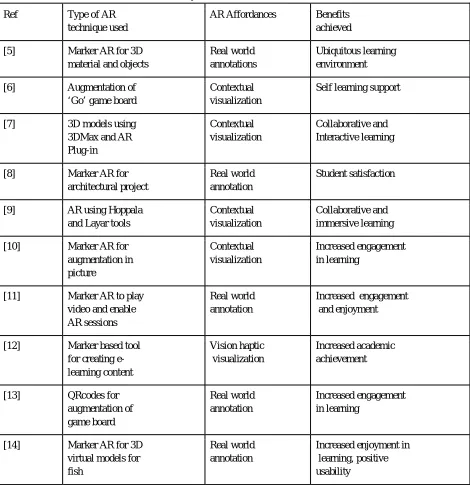
[image:5.612.72.542.179.664.2]There are various ways of using AR technology like marker based AR, AR for projection, AR for GPS based system. For educational setting mostly used is marker AR. The affordances of AR technology implied in the prototype and the other pedagogical benefits achieved are summarized in following Table 3.
TABLE III. Summary of AR affordances and benefits achieved
Ref Type of AR
technique used
AR Affordances Benefits
achieved
[5] Marker AR for 3D
material and objects
Real world annotations
Ubiquitous learning environment
[6] Augmentation of
‘Go’ game board
Contextual visualization
Self learning support
[7] 3D models using
3DMax and AR Plug-in
Contextual visualization
Collaborative and Interactive learning
[8] Marker AR for
architectural project
Real world annotation
Student satisfaction
[9] AR using Hoppala
and Layar tools
Contextual visualization
Collaborative and immersive learning
[10] Marker AR for
augmentation in picture
Contextual visualization
Increased engagement in learning
[11] Marker AR to play
video and enable AR sessions
Real world annotation
Increased engagement and enjoyment
[12] Marker based tool
for creating e- learning content
Vision haptic visualization
Increased academic achievement
[13] QRcodes for
augmentation of game board
Real world annotation
Increased engagement in learning
[14] Marker AR for 3D
virtual models for fish
Real world annotation
Increased enjoyment in learning, positive usability
C. Web 2.0 along with AR
Web 2.0 technology has support for collaboration, social interaction, creative thinking of students in e-learning environments. Some researchers have developed to use benefits of both AR and web 2.0. Hong et.al[15] have developed a system which uses Wearable device with AR interface to share Social network information.
Benefits
1) In medical Training
a) Laparoscopic surgery
b) Endotracheal intubation c) Joint injections
d) Assistance in placing local anesthesia
2) In Chemical Education
a) 3D visualization of molecules, their spatial dynamics and interaction, possibility to form molecules from individual fragments. b) 3D visualization of molecules and crystal lattices
3) In Computer Graphics
a) 3D modelling of graphics
VI. CONCLUSION
We have studied the educational prototypes for their effect size and benefits achieved by them. Combination of AR and web2.0 technologies can give better results in educational achievements. AR increases engagement, immersion and web 2.0 supports collaboration, social interaction. These technologies have been studied separately for benefits in learning systems. Therefore both technologies should be studied for experimental evaluation of their combined use in educational settings.
REFERENCES
[1] Azuma, R. T., “A Survey of Augmented Reality”, Teleoperators and Virtual Environments, pp-355-385, 1997
[2] Mehmet Kesima, Yasin Ozarslanb, “Augmented Reality In Education: Current Technologies And The Potential For Education”, Procedia - Social and Behavioral Sciences 47, pp – 297- 302, 2012
[3] Mihaela Filofteia, “Augmented Reality - State Of Knowledge, Use And Experimentation”, The USV Annals of Economics and Public Administration, Volume 13,Issue 2(18), pp.215-227, 2013
[4] Marc Ericson C. Santos, Angie Chen, Takafumi Taketomi, Goshiro Yamamoto, Jun Miyazaki, Hirokazu Kato, Member, IEEE,“Augmented Reality Learning Experiences:Survey of Prototype Design and Evaluation”, IEEE Transactions On Learning Technologies, VOL. PP, Issue:99,2014(11 December 2013 ) [5] Min-Chai Hsieh*, Hao-Chiang Koong Lin, “A Conceptual Study for Augmented Reality E-learning System Based on Usability Evaluation”, CISME, Vol.1,
No.8 , PP.5-7, 2011
[6] Takahiro Iwata, Tetsuo Yamabe, Tatsuo Nakajima, “Augmented Reality Go: Extending Traditional Game Play with Interactive Self-Learning Support”, 17th IEEE International Conference on Embedded and Real-Time Computing Systems and Applications, pp-105-114, 2011
[7] Malinka Ivanova, Georgi Ivanov, “Enhancement of Learning and Teaching in Computer Graphics Through Marker Augmented Reality Technology”, International Journal on New Computer Architectures and Their Applications (IJNCAA) 1(1), pp. 176-184, 2011
[8] David Fonseca, Isidro Navarro, Ernest Redondo, Albert Sánchez,“Using Augmented Reality and Education Platform in Architectural Visualization- Evaluation of Usability and Student’s level of Sastisfaction”, International Symposiam on Computers in Education, 2012
[9] Francesc Gonzàlez, Luis Villarejo1, Oriol Miralbell, Joan Miquel Gomis, “How to use mobile technology and augmented reality to enhance collaborative learning on cultural and natural heritage? An e-learning Experience”, New Trends on Global Education Conference 2012 (GEC 2012) North Cyprus, 24-26 September, 2012
[10] Sejin Oh, Yungcheul Byun, “The design and implementation of e-learning systems”, 11thInternational Conference on Computer and Information Science,
pp-651-654, 2012
[11] Utku Kose, Durmus Koc, Suleyman Anil Yucesoy, “An Augmented Reality Based Mobile Software to Support Learning Experiences in Computer Science Courses”, International Conference on Virtual and Augmented Reality in Education, pp.370-374, 2013
[12] Hyung-Keun Jee & Sukhyun Lim & Jinyoung Youn & Junsuk Lee, “An Augmented Reality-Based Authoring Tool For E-Learning Applications”, Multimed Tools Appl Vol.68, pp-225–235, 2014
[13] Nicholas Masso and Lindsay Grace, “Shapemaker:A Game-based Introduction to Programming”, The 16 th International Conference on Computer Games, CGAMES, pp-168-172, 2011
[14] Hao-Chiang Koong Lin, 1Min-Chai Hsieh, 1Cheng-Hung Wang, 1Zong-Yuan Sie, 2Shei-Hsi Chang, “Establishment And Usability Evaluation Of An Interactive Ar Learning System On Conservation Of Fish”, TOJET: The Turkish Online Journal of Educational Technology, volume 10 Issue 4,2011,pp-181-187, October 2011