Westfälische Wilhelms-Universität Münster University of Twente
BA Public Administration (Special Emphasis: European Studies) Bachelor Thesis
Supervisor: MA Antonia Graf, Münster
Second Reader: Prof. Ramses Wessel, Twente
Impact of Prostitution Policies in Receiving Countries on
Trafficking in Human Beings for the Purpose of Sexual
Exploitation at the Examples of Germany and Sweden
Miriam Schimannek (332406 / s0159387) Im Hain 39
48165 Münster
Tel. 0049-251-2843881
Index
1. Introduction
2. Theory
2.1 Methodological Approach
2.2 From Regulation to Abolitionism and Back
2.3 Current Research Situation
3. The International Context: United Nations and European Union
4. The Legal Situation in Sweden and Germany
4.1 Germany
4.2 Sweden
5. Statistical Data of Human Trafficking
6. Analysis and Discussion
1. Introduction
One of the most fiercely fought over debates in feminism is that of sex. Sex in form of pornography,
prostitution and everything in between. While the phenomena of mass pornography entered the
debate more recently, that of prostitution did so a lot earlier. In fact the debate about prostitution is
one of the oldest and one of the most dividing ones in feminism. While the one party considers
prostitution as an accompanying evil of patriarchy and poverty - always being forced upon women
and a form of violence against them - the other one acknowledges the existence of voluntary
prostitution and assumes women have a right to consciously choose prostitution as a way to make
money. The one party consequently wants to erase prostitution in order to protect women while the
other wants to legitimate „sex work“ as a profession like any other for the very same reason.
A phenomena that is in parts connected to prostitution is that of human trafficking. Trafficking in
persons occurs for a variety of purposes but always with the same result. Be it cheap labour, forced
begging, prostitution - the trafficked person will always be exploited in one way or another.
Trafficking for the purpose of sexual exploitation, however, makes up the biggest part of this
reasons and therefore links the problem of human trafficking to that of prostitution. Although the
frames have changed several times in which this phenomena is seen and in which it was fought,
feminists have always been united in the fight against trafficking in human beings. As activists
wanted to fight human trafficking for the purpose of sexual exploitation but where divided in their
opinion of prostitution the obvious solution was to keep the issue of prostitution out of the debate
about fighting trafficking.
In current research it seems to be the dominant paradigm to view prostitution and human trafficking
for the purpose of sexual exploitation as two separate social phenomena to be handled individually.
Although it is acknowledged that human trafficking has to be considered when dealing with
prostitution insofar as a varying amount of prostitutes are in fact victims of trafficking, the
connection in the other way (the influence of prostitution laws on trafficking) has only marginally
being tackled - probably not least in order to avoid the highly emotional and morally charged debate
about prostitution when dealing with human trafficking. In my paper I want to examine if this
connection can be made, at the examples of two EU countries that are exemplary for the two above
mentioned approaches to prostitution - Sweden representing the abolitionist approach and Germany
representing the liberal legalising approach. Both countries share the prohibition of trafficking in
human beings for the purpose of sexual exploitation. After an introduction into the theoretical
approaches behind prostitution and a detailed description of the legal situation in the United
Nations, the European Union, Germany and Sweden, I will examine statistical data about trafficking
both countries and the case numbers of human trafficking. A final conclusion will complete the
assessment.
2. Theory
This section will provide the methodological and theoretical background to the paper. After
clarifying the methodological approach and ruling out other variables, I will give an overview over
the theoretical development of approaches towards prostitution and the current research situation.
2.1 Methodological Approach
This paper will be a comparative research study, looking at a difference between two social systems
(the prostitution policies of the two states Sweden and Germany) and comparing it to another
variable present in both systems (human trafficking). For this I will use a secondary analysis of
quantitative data (provided by the governments of the two states) as I do not have sufficient
resources to establish the required data on my own. The data concerning Sweden is issued by the
Swedish National Council for Crime Prevention, a government body that is i.a. responsible for
producing Sweden‘s official crime statistics. The data concerning Germany is issued by the
corresponding German government body, the Bundeskriminalamt.
The extent of trafficking into a country is influenced by a variety of factors, not least its geographic
situation. As shorter transport ways decrease the amount traffickers have to spend on each trafficked
person (and therefore increase their revenues) countries in advantageous geographic positions are
more likely to be the target of traffickers than countries where transportation costs are higher. In
reality this means that Germany with its geographic position at the heart of Western Europe is from
a transportation cost perspective more easily accessible than for example Sweden in Northern
Europe.1 As I do not intend to examine the absolute amount of trafficking into Sweden and
Germany, but only the figures relative to each other considering the introduction of the new
prostitution laws, the level of the absolute figures is not relevant to my analysis. I can therefore
neglect factors that influence the absolute amount of trafficking into a country as I am only
interested in the relative level focusing on the introduction of the new legislation on prostitution. In
order to also rule out other factors that could influence the level of trafficking, possible temporary
factors that do not constitute the background to the absolute amount of trafficking (like for example
geography) but that only occur temporarily approximately during the implementation of the new
prostitution laws have to be examined. Possible temporary factors could be a Europe-wide decrease
in trafficking due to a variety of reasons, a simultaneous modification of legislation concerning
specifically human trafficking or other legislation that affects trafficking in one way or another, or
political factors like a war or armed conflict. The first and third factors can be ruled out immediately
as there was no armed conflict or war in 1999 that affected either Sweden or Germany, nor the
Central and Eastern European Countries (as the main supply countries), and no Europe-wide
decrease in trafficking. In Sweden the legislation on human trafficking was amended in 2002, three
years after the new prostitution laws came into force, while in Germany four years after the new
prostitution laws the laws on human trafficking were amended. A simultaneous change of both laws
did not occur. Therefore I assume that the change in prostitution laws can be examined as a single
variable that might influence human trafficking for the purpose of sexual exploitation.
2.2 From Regulation to Abolitionism and Back
One cannot talk about prostitution without mentioning the two prime approaches that have
developed for handling the phenomenon. At the beginning of the 19th century, during Napoleonic
times, the regulatory model was introduced throughout Western Europe. Prostitution was in
principal allowed but strictly regulated in order to protect „innocent women“ and families.2 It was
seen as a „necessary evil“ - as its existence was unavoidable the only possibility to protect „normal“
society was to keep prostitutes operating under state control in a state system of licensed brothels.
Prostitutes working there had to submit to control mechanisms, like regular medical examinations
and restrictions in movement. In the course of the 19th century and with the introduction of a new
„science of sexuality“ prostitutes were seen as sexually deviant and as spreaders of sexually
transmitted diseases - accordingly the focus of who needed protection changed from „innocent
women“ and families to clients, especially men in the military. In this situation of alleged necessary
prostitution and negative view on prostitutes a counter-movement developed - the abolitionist
movement. This started as a campaign carried by Swiss and English protestants demanding the
repeal of the British 1864 Contagious Diseases Act which forced prostitutes to undergo regular
medical check-ups (especially pelvic examinations) and which was seen as immoral and
unconstitutional. This campaign was joined by feminists, middle-class reformers and working men
for a variety of reasons. Feminists under the leadership of Josephine Butler (1828-1906) criticised
the fact that the Act saw prostitutes as the single transmitters of venereal diseases and did not
include the clients of prostitutes as well. In their view this was an expression of double morality.
They introduced into the discourse the novel view of prostitutes as victims who needed to be
rescued and rehabilitated rather than punished. Men on the other hand were made responsible for
the problem of prostitution because of their unhampered sexual lust.3
At this point it has to be mentioned that abolitionist feminists connected the fight against
prostitution with the fight against trade in human beings, as this was seen as an accompanying
phenomenon. Their strategy was two-fold: On the one hand they opposed the official tolerance of
prostitution and on the other hand they condemned the trafficking in women and their slavery in
brothels - the anti-trafficking norm had a directly link to the anti-prostitution norm.4 At the
beginning of the 20th century prostitution in Western Europe increasingly became prohibited, albeit
to a different extent in individual states. Abolitionism remained the dominant frame in most
countries until the end of the 20th century, when more liberal ideas were introduced in many
countries of Western Europe.
The liberal approach claims that women have a right to prostitute themselves and sees prostitution
as a legitimate work. A denial of the woman‘s right to prostitute herself equals a violation of her
human rights.5 Instead of seeing the prostitute as a victim of structural violence and prostitution as a
reinforcement of male dominance and female subordination like the abolitionist approach, it sees
the prostitute as a sovereign and independent human being able to decide freely whether to work in
the sex industry or not and prostitution as a legitimate profession. The liberal approach does not
deny the fact that there are women being exploited in the business but calls for regulation and
legitimation of prostitution in order to fight criminal acts. It blames the approach of prohibiting
prostitution for actually increasing criminality and pushing the sex industry underground where it is
more difficult to control it. Mirroring the two different paradigms, each approach uses different
language for the issue. While abolitionists keep the terms prostitute and prostitution, liberals
demand a renaming and speak of sex worker and sex work. Additionally while the abolitionist
discourse frequently mentions the prostitute is selling herself (or her body), liberals speak about the
prostitute as providing sexual services. So the language each party uses already frames the issue in a
different way. It is therefore difficult to talk about the topic and at the same time remain neutral, as
already the way how the issue is described reveals a more abolitionist or a more liberal opinion. In
3 Locher (2007)
4Locher (2007)
this paper I decided to keep the terms prostitute and prostitution as it is the older terminology and
was used during abolitionist times as well as earlier times of regulation and might therefore be more
neutral than the new terminology explicitly introduced into the discourse by one party of activists.
Considering trafficking in human beings there are no conflicting opinions of whether or not to fight
it. Human trafficking is handled as a crime by abolitionists and liberals alike. The framework in
which trafficking is and was fought, however, changed over the years. At the end of the 19th
century the dominant discourse was that of „white slave trade“, reflecting the dominant class and
racial assumptions.6 Although trafficking started to be regarded as an international criminal activity,
only white women and girls were recognised as victims. At the beginning of the 20th century and
especially after the two World Wars at level of the United Nations trafficking was re-framed to be
an issue of threatening the dignity and worth of the human person. The term „white slave trade“
was abolished due to its racist and too narrow approach concerning victims.On UN level this
dominant frame only changed in 1993, when with the UN World Conference on Human Rights in
Vienna the slogan „Women‘s Rights are Human Rights“ entered the debate and therefore paved the
way for putting trafficking in human beings into a rights-frame, hence seeing it as a violation of
human rights of (mainly) women. In 1995 on the Fourth World Conference on Women in Beijing
the frame was further adjusted to seeing trafficking as another form of violence against women (and
therefore as a violation of their human rights). 7 On EU level, however, since the problem of
trafficking increased drastically in the 1970‘s and 1980‘s the dominant framework remained that of
illegal immigration until after the conference in Beijing, and only started to change in 1996 when
the Commission for the first time issued a Communication on trafficking in women. The difference
between handling trafficking in a human rights framework and an illegal immigration framework
lies in the approach towards the subjects of trafficking. In a human rights framework they are seen
as victims of a crime that have to be protected, while in an illegal immigration framework they are
being criminalised together with the traffickers as they are breaking a country‘s laws by entering it
illegitimately. While in the latter subjects of trafficking have no right to stay in the foreign country,
in the former they might be protected as victims of a crime and it might even be possible for them
to be allowed to stay. Today, the dominant framework both on UN and EU level is that of human
rights and violence against women.
6 Locher (2007)
2.3 Current Research Situation
Current researchers mainly handle the two phenomena human trafficking for the purpose of sexual
exploitation and prostitution individually. Although it is acknowledged that human trafficking has to
be considered when dealing with prostitution insofar as a varying amount of prostitutes are in fact
victims of trafficking, the connection in the other way (the influence of prostitution laws on
trafficking) has only marginally being tackled. Concerning human trafficking for the purpose of
sexual exploitation research mainly focuses on countries of origin, especially on structural
explanations why from certain countries more women are trafficked than from other. Especially
research on Central and East European countries is extensive (not least because they make up the
main supply countries since the break-down of the Soviet Union in 1990). Worth mentioning here
are the study of Alexandra Geisler „Gehandelte Frauen - Menschenhandel zum Zweck der
Prostitution mit Frauen aus Osteuropa“ (Geisler 2005) and Chris Corrin‘s „Transitional Road For
Traffic: Analysing Trafficking in Women from and Through Central and Eastern Europe“ (Corrin
2005), as well as Jo Goodey‘s „Sex Trafficking in Women from Central and Eastern European
Countries: Promoting a ,Victim-Centred‘ and ,Women-Centred‘ Approach to Criminal Justice
Intervention“ (Goodey 2004). Another research-block is concerned with the policy-side of human
trafficking, that is how policies on human trafficking have evolved internationally and regionally.
Concerning the regional level, Birgit Locher has studied the evolution of policies on human
trafficking in the EU in detail in her study „Trafficking in Women in the European Union - Norms,
Advocacy Networks and Policy-Change“ (Locher, 2007). The so far only study that focuses on the
demand side of human trafficking for the purpose of sexual exploitation (i.e. clients of trafficked
prostitutes) comes from an Italian team of researchers, namely Andrea Di Nicola, Andrea Cauduro,
Marco Lombardi and Paolo Ruspini, who in their study „Prostitution and Human Trafficking -
Focus on Clients“ (2008) try to profile the clients of trafficked prostitutes.
3. The International Context: United Nations and European Union
Of course, in the globalised world of today, countries do not completely stand alone - a bit more so
in the field of domestic politics but much less in the field of international criminality. International
organisations like the United Nations and regional organisations like the European Union do shape
national policies actively (through open agreements) and passively (for example through the
pressure of gaining or keeping power in an international context or a „if we agree to this point
others will agree to that point“-mentality). Therefore in order to get a thorough picture of German
international context of UN and EU. This will integrate Swedish and German legislation into the
broader picture and help understand the developments at the national level.
The United Nations does not have the power to enforce the agreements and conventions that are set
at UN level. If a country refrains from ratifying a convention, then nothing can make them do so.
Even so, conventions are agreed on at UN level and are an accepted (if not the main) source of
international law.8 Until the end of the 20th century one UN convention agreed on in 1949
constituted the main provision for international assessment of human trafficking - the „Convention
for the Suppression of the Traffic in Persons and the Exploitation of the Prostitution of Others“.9 Its
preamble says
„Prostitution and the accompanying evil of traffic in persons for the purpose of prostitution are incompatible with the dignity and worth of the human person.“10
The convention obviously does not distinguish morally between the two phenomena prostitution
and human trafficking but puts it both on the same level of inhumane activities. This is why it
earned much critique from the international community and why until today less than half of the
UN member states (73 out of 192) have ratified it. Interestingly neither Sweden nor Germany did
ratify the convention. The problem was not the condemnation of human trafficking but to agree on a
singular approach to prostitution as the member states displayed all kinds of different approaches
from total prohibition to (near-)total liberation. The link of the trafficking norm to an
anti-prostitution norm as early feminists had done (as I said above), was on international level rather
obstructive to the fight against trafficking.
In December 2000 the UN „Convention on Transnational Organised Crime“ was adopted, which
included the „Protocol to Prevent, Suppress and Punish Trafficking in Persons, Especially Women
and Children“. This protocol included the first international definition of human trafficking that
included trafficking in women for sexual exploitation. Its focus lay on the element of exploitation in
human trafficking rather than the movement across borders. It also refrained from including a
certain normative approach to prostitution into the text. In order to combine forces for the fight
against trafficking in human beings the seemingly unsolvable debate about the „right“ approach to
prostitution was excluded.11 As the definition goes:
8 Woyke (2008)
9 www.un.org (last visited 10.10.09)
10 www.un.org (last visited 10.10.09)
„,Trafficking in persons‘ shall mean the recruitment, transportation, transfer, harbouring or receipt of persons, by means of force or other forms of coercion, of abduction, of fraud, of deception, of the abuse of power or of a position of vulnerability or of the giving or receiving of payments or benefits to achieve the consent of a person having control over another person, for the purposes of
exploitation. Exploitation shall include, at a minimum, the exploitation of the prostitution of others or other forms of sexual exploitation, forced labour or services, slavery or practices similar to slavery, servitude or the removal of organs.“12
It was also clearly stated that the protocol‘s purpose should be among other things the protection of
victims „with full respect for their human rights“13, introducing a victim-centred approach into the
discourse. The convention also clarified the difference between trafficking in and smuggling of
human beings.
„,Smuggling in migrants‘ shall mean the procurement, in order to obtain, directly or indirectly, a financial or other material benefit, of the illegal entry of a person into a State Party of which the person is not a national or a permanent resident.“
While in the first definition the focus lay on the exploitation of human beings, in the second
definition the focus lies on illegal crossing of borders and illegal entry into a state. The main
difference between trafficking and smuggling is that trafficking involves the purpose of exploitation
- theoretically the criminal activity does not end after the illegal immigration but continues in the
exploitation of the human being in the foreign country. Currently 117 out of 133 member states
have ratified the protocol (147 out of 150 member states have ratified the convention to which the
protocol belongs).14 Apart from the EU‘s individual member states, a member of the European
Commission also signed the protocol on behalf of the European Union as a whole.
In the European Union itself collective action on the subject came rather late. Although the
European Parliament had passed several resolutions before 1996, its inferior position in the power
balance of the European institutions meant that actual change could only be made when the
Commission became involved. It did so in 1996 in the spirit of the two above mentioned UN world
12 www.unodc.org (last visited 10.10.09)
13 www.unodc.org (last visited 10.10.09)
conferences when it issued its first „Communication on Trafficking in Women and the Sexual Abuse
of Children“. Consequently, in 1996 and 1997, two initiatives dedicated to the fight against
trafficking were created - the STOP programme in 1996, whose aim was the enhancement of
law-enforcement bodies of the EU member states through for example trainings and exchange
programmes, and the DAPHNE Initiative in 1997 which basically was a fund to support projects
that addressed the immediate consequences of trafficking in human beings (in the EU).15 While the
STOP programme was initially set to run over a period of four years until 2000 and was then
extended until 2002, the DAPHNE programme currently still exists as DAPHNE III until 2013.
At the time of these initiatives the only legal basis on which action against violence against women
could be based was Article 119 of the Maastricht Treaty on gender equality. This changed with the
adaption of the Treaty of Amsterdam (which came into force in 1999), where explicit reference was
made to trafficking in the broader frame of the creation of an „area of freedom, security and
justice“. Although trafficking in persons was only mentioned as one of a series of crimes to be
combated by the EU (next to terrorism, offences against children, illicit drug&arms trafficking,
corruption and fraud), the new treaty nonetheless created a proper legal base for further measures
against it. In order to be better prepared to fight the crimes mentioned, the treaty demands
„(...) closer cooperation between police forces, customs authorities and other competent authorities in the Member States, both directly and through the European Police Office (Europol), (...) closer cooperation between judicial and other competent authorities of the Member States [and]
approximation, where necessary, of rules on criminal matters in the Member States (...)“16
The treaty also lays down a catalogue of how common action in the field of police cooperation
should look like. In general the Treaty of Amsterdam made some important changes concerning the
third pillar of the EU, the intergovernmentally organised policy field of Justice and Home Affairs
(now Police and Judicial Cooperation in Criminal Matters). The treaty transferred the areas of
illegal immigration, asylum, visas and judicial cooperation to the first pillar (European
Community), which is organised supranationaland gives most competencies to the EU. The third
pillar was then renamed Police and Judicial Cooperation in Criminal Matters. In this pillar, as
mentioned above, the Member States transferred very little sovereignty to EU level. The Treaty of
Amsterdam nonetheless strengthened the position of the Union by giving the EU a new tool at hand
- that of framework decisions. The aim of these framework decisions is the harmonisation of
15 Locher (2007)
legislation of the Member States. They are binding as to the result to be achieved, but leave the
methods of implementation to the member states.17 In 2002, the Commission proposed a framework
decision focusing on combating trafficking in persons with the aim to finally find a Europe-wide
approach to trafficking, which was then issued by the Council of the European Union. The
framework decision explicitly mentions trafficking for the purpose of sexual exploitation and gives
a definition of trafficking in persons closely related to the definition of the United Nations
mentioned above. The aim of harmonisation of legislation is clearly seen in Article 3 of the
framework decision:
Article 3.1:
„Each Member State shall take the necessary measures to ensure that an offence referred to in
Articles 1 and 2 is punishable by effective, proportionate and dissuasive criminal penalties, which
may entail extradition.“18
The text also mentions the protection of and assistance to victims of human trafficking and states
that the prosecution of offences should not be dependent on the testimony of the victims of the
offence. It also defines children as particular vulnerable victims and asks for the implementation of
measures that provide the family of the child victim with appropriate assistance.
In 2004 the Council issued a Directive concerning resident permits issued to third-country nationals
who are victims of trafficking in persons and willing to cooperate with the authorities. This was a
huge step forward as it goes far beyond the simple definition of the crime. It attempts to harmonise
the Member State‘s approaches to dealing with the victims of the crime. Although the Directive
does not explicitly sets time scopes it does provide for a „reflection period“ of the victim in which it
should recover and be able to make an informed decision as to whether to cooperate with the
authorities or not. During this period the victim should be granted a minimum standard of living and
be save from being deported.
The Treaty of Lisbon, which is currently still in the ratification process, will abolish the pillar
structure. Instead, competencies of the European Union will be clearly divided in areas of exclusive
competence, shared competence and supporting competence, each with clearly stated procedures.
The fight against human trafficking as part of the creation of the „area of freedom, security and
justice“ falls into the second category, that of shared competences. The Lisbon Treaty also includes
17 Chalmers, Tomkins (2007)
the Charter of Fundamental Rights, which in Article 5 prohibits explicitly the trafficking in human
beings.
4. The Legal Situation in Sweden and Germany
4.1 Germany
Germany, like many other Western European countries, used a regulatory approach to prostitution
until the beginning of the 20th century. Prostitutes had to register and to submit to regular health
checks. During the Nazi regime prostitutes were seen as asocial and sent to concentration camps,
but still in the second half of World War II brothels were erected in concentration camps in order to
increase productivity of forced labourers.19 After the end of the war in the Federal Republic of
Germany prostitution was not explicitly prohibited but seen as an offence against good moral order.
Contracts prostitutes made with their customers were null and void (which consequently led to the
fact that prostitutes of course could not sue a customer unwilling to pay). The „furtherance of
prostitution“ (i.e. pimping, running a brothel etc.), however, was explicitly prohibited and as such a
criminal offence. Advertisement of prostitution was also prohibited. Here, not only the subjects
actually advertising (prostitutes or brothels) but also the person responsible for the advertising
medium was made liable.20
On January 1st, 2002, the new Prostitution Act came into force. This basically legalised prostitution
by removing the label of being „against good moral order“. In Article 1 of the new Act it says that if
sexual acts are carried out for a fee priorly agreed on, this agreement is legally effective.
Consequently the prostitute can sue the customer for payment of sexual acts already carried out.
Article 1.2 specifies that only the prostitute has the right to sue, in order to safe her from forced
delegation of the claim to third parties (i.e. pimps).21 In Article 1.3 it is made clear that the
employer has only limited decisional authority over the employee, which basically aims at securing
the right to sexual self-determination of the prostitute, i.e. the right to reject certain clients and
certain sexual practises if necessary. It also makes clear that this limited decisional authority does
not have any consequences on the legality of the employment. Article 2 specifies the limits to
legalisation. Although pimping and running a brothel is not prohibited any longer, keeping a
prostitute in economic or personal dependency is. This is punished with imprisonment of up to three
years or a fine. Also prohibited is the support of prostitution of minors.
19 http://www.reuters.com/article/lifestyleMolt/idUSL0144799320070710 (last visited 10.10.09)
20 http://www.bmfsfj.de/doku/prostitutionsgesetz/pdf/bundesreg.pdf (last visited 10.10.09)
The Act according to the German government is aimed at improving the working conditions and
security of prostitutes.22 According to the government a prostitute is threatened by numerous
factors. Working independently on the street, threats stem from clients, competing prostitutes or
third parties who make use of the remoteness of the „workplace“ and half-legality of the prostitutes
doings. This situation makes prostitutes turn to pimps and brothel-owners for safety, which again
leads to additional threats of exploitation. From the altered legislation and the legalised framework
of prostitution the government expected a positive influence on this situation, as prostitutes could
then rely on the police for safety and no longer needed to turn to non-state actors to protect
themselves.23 The government also hoped to reduce prostitution-related criminality through a kind
of market-mechanism: If the costs of avoiding prosecution were to high compared to the revenues
in legal prostitution business, then actors would turn to the legal sector and therefore criminality
would be reduced.24 (What is not included in this equation is the revenues of illegal prostitution, i.e.
exploitation of prostitutes.) A third factor of the considerations was that the resources previously
used for the prosecution of „minor“ furtherance of prostitution could now be used for prosecution of
serious criminal offences, like human trafficking.
Actually, the fact that prostitution is made a legal employment - not against „good moral order“
anymore - not only gives the prostitute the legal possibility to sue customers unwilling to pay and
therefore reduces the dependency of prostitutes on pimps or other male superiors for making clients
pay. It also gives prostitute the right to become part of social security systems. Working in a legal
business she can enter compulsory health insurance and pension insurance. Statistics of social
insurance agencies, however, have shown that after the introduction of the Prostitution Act the
number of applications of prostitutes into the systems tended towards zero.25 As with everything in
this area this statement has to be handled with care, as in a survey already more than 80% of
questioned prostitutes were insured, either through their main employment (prostituting themselves
as a side job) or because they are registered as unemployed (registered unemployed persons in
Germany already are insured).26
Apart from legalising prostitution the new Act also secures the right to sexual self-determination of
prostitutes and explicitly prohibits exploitation of prostitutes, which further aims at improving
working conditions for prostitutes. From a theoretical point of view, the Act sees the phenomenon
22 http://www.bmfsfj.de/doku/prostitutionsgesetz/pdf/bundesreg.pdf (last visited 10.10.09)
23 http://www.bmfsfj.de/doku/prostitutionsgesetz/pdf/bundesreg.pdf (last visited 10.10.09)
24 http://www.bmfsfj.de/doku/prostitutionsgesetz/pdf/bundesreg.pdf (last visited 10.10.09)
25 http://www.bmfsfj.de/doku/prostitutionsgesetz/pdf/bundesreg.pdf (last visited 10.10.09)
of prostitution as a given and unalterable social reality which needs to be regulated by the state in
order to improve the situation of prostitutes. The approach in some way resembles that of the 19th
century as it sees prostitution as unavoidable and therefore tries to put it under state control, but
differs in the reasons why it needs to be controlled. While in the past prostitutes were seen as
deviants of which society needed to be protected, today prostitutes are protected by the state in
order for them to freely work in the business which they allegedly (and legally) chose freely.
In Germany the criminal offence of trafficking in human beings for the purpose of sexual
exploitation was introduced into the body of legislation in 1998. Article 180b of the Criminal Code
explicitly defined and prohibited sexual exploitation:
„Whoever, for his own material benefit, exerts influence on another person, with knowledge of a coercive situation, to induce the person to take up or continue in prostitution, shall be punished with imprisonment for not more than five years or a fine. Whoever, for his own material benefit, exerts influence on another person, with knowledge of the helplessness associated with the person’s stay in a foreign country, to get the person to engage in sexual acts, which the person commits on or in front of a third person or allows to be committed on the person by the third person, shall be similarly punished.“
An offence fell under the definition of „serious“ trafficking, implying higher penalties, when the
above mentioned influence on another person included force, threat of appreciable harm or trickery,
or when the perpetrator exerted trafficking professionally.
In 2005 the legislation on trafficking was altered in order to react appropriately to the new UN
Protocol on Trafficking in Human Beings and to the framework decision of the EU of 2002 that
were both mentioned above. The punishment for trafficking was raised to a sentence between six
months and ten years, while the sentence for serious cases remains between one and ten years. The
definition of serious trafficking was extended to include child victims (which before was part of the
paragraph about „regular“ trafficking in human beings) and serious physical abuse of the victim.
Also newly included into the Criminal Code was the furtherance of trafficking in human beings
(sentenced with imprisonment from three months to five years, or in serious cases from six months
to ten years), and trafficking in human beings for the purpose of labour exploitation.
4.2 Sweden
In Sweden the regulatory approach to prostitution was abolished in 1918. Prostitution then was
helping prostitutes finding a way out of the business. Measures included permanent government
funding of municipal prostitute projects, counselling and retraining possibilities.27 Although during
a phase of legalised prostitution, these measures already indicate the abolitionist view of
prostitution being an undesired phenomenon and prostitutes as victims that have to be protected and
supported. In 1999, when the new legislation on prostitution came into force, the Swedish
government explained their standpoint:
„Prostitution is not a desirable social phenomenon. The government considers, however, that it is not reasonable to punish the person who sells a sexual service. In the majority of cases at least, this person is a weaker partner who is exploited by those who want only to satisfy their sexual drives.“28
Following this notion the Swedish government decided to revise their legislation on prostitution and
to alter it appropriately. The basis for the new law is the new definition of prostitution as one form
of male violence against women and children, as stated in the legislation on gross violation of a
woman‘s integrity.29 Consequently, the Swedish Penal Code prohibits the purchase of sexual
services:
„A person who [...] obtains a casual sexual relation in exchange for payment shall be sentenced for the purchase of a sexual service to a fine or imprisonment for at most six months.“30
In 2005, the legislation was extended to also include payments that have been promised or made by
somebody else. The approach to fight prostitution by criminalising the demand side is an expression
of the abolitionist worldview of the lawmakers. Supporting prostitution is also prohibited.
According to the Swedish Penal Code „anyone who promotes, or encourages or improperly exploits
for commercial purposes casual sexual relations entered into by another person in exchange for
payment is guilty of a criminal offence and shall be sentenced to imprisonment for at most four
years for the crime of procuring.“31 Therefore operating a brothel as well as pimping or simply
helping a buyer find a prostitute, next to other actions promoting prostitution, is a crime in Sweden.
27 Kilvington, Day, Ward (2001)
28 Kilvington, Day, Ward (2001)
29 Swedish Ministry of Industry, Employment and Communications Fact Sheet (2005)
30 Swedish Ministry of Industry, Employment and Communications Fact Sheet (2005)
The aim of these laws is the eradication of prostitution via the eradication of demand for
prostitution.
In Sweden, the criminal offence „trafficking in human beings for sexual purposes“ was only
introduced into the body of legislation in 2002. Before 2002, this kind of crime fell under the Aliens
Act defined as the assistance of illegal immigration. The introduction of trafficking in persons for
the purpose of sexual exploitation as an explicitly mentioned criminal offence into Swedish
legislation reflects the general shift of framing in the European Union from an illegal immigration
frame to a human rights and violence frame mentioned above. So, according to the Swedish Penal
Code a person is liable for trafficking in human beings if it „through the use of unlawful coercion or
deception, by exploiting a person‘s vulnerability or by any other similar improper means recruits,
transports, harbours, receives or takes other similar actions towards a person and thereby gains
control over that person“ for several different purposes. Explicitly mentioned are exploitation for
sexual purposes, forced labour or the removal of organs, or other exploitations „in ways that cause
distress for that person“.
5. Statistical Data of Human Trafficking
The UN estimates that annually about 120.000 women and children are trafficked into the European
Union and forced into prostitution. For Germany, it is estimated that annually about 15.000 women
and children are trafficked into the country. The number of cases actually finding their way into the
crime statistics are much lower. On the one hand, this is due to the fact that one case can include
more than one victim. In 2003 for example, in 306 cases there was only one victim while in nine
cases there were more than twenty registered victims.32 On the other hand, the area of trafficking in
human beings naturally implies a high dark figure due to structural problems. Victims of trafficking
are strangers in a foreign country, without passports and often without knowledge of the foreign
language. Without speaking the language, being illegal in the country and without knowledge of the
legal system the threshold of reporting to the police becomes extremely difficult.33 The fear of their
tormentors and at the same time the fear of being punished under the foreign legal system
additionally contribute to the difficulties.
Since the 1970‘s trafficking in human beings is rapidly increasing. The main supply countries have
since then changed more than once. In the 1970‘s and 1980‘s trafficking was mainly a North-South
32 http://www.bundeskriminalamt.de/lageberichte/mh/2003/mh2003.pdf (last visited 10.10.09)
phenomenon.34 In the 1970‘s victims mainly came from East Asia (especially Thailand and the
Philippines), while in the 1980‘s they mainly came from Latin America and the Caribbean
(especially Brazil, Columbia, Chile, Dominican Republic and Ecuador). The collapse of the Soviet
Union in 1990 and the resulting transformation of the Central and Eastern European Countries
(CEEC) resulted in an immense rise of trafficking and a shift of the main supply countries from the
South to the East.
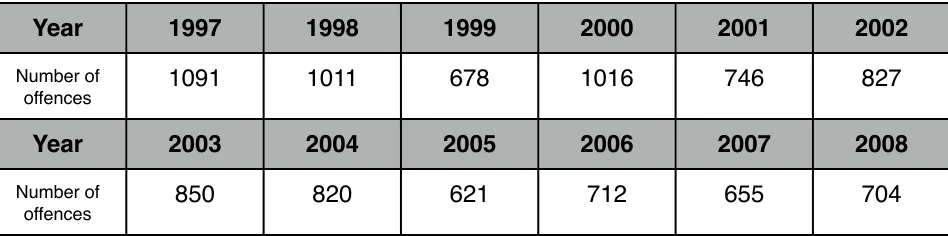
The following table shows the number of cases of human trafficking for the purpose of sexual
exploitation in Germany from 1997 until 2008. Until 2005 the legal basis for these were Article 180
and 181 of the German Criminal Code, after the change of legislation in 2005 it was Article 232 of
the German Criminal Code, both describing the criminal offence ,trafficking in human beings for
the purpose of sexual exploitation‘. As I said above, these numbers do not describe victims but
criminal cases with unspecified numbers of victims.
Year 1997 1998 1999 2000 2001 2002
Number of
offences 1091 1011 678 1016 746 827
Year 2003 2004 2005 2006 2007 2008
Number of
[image:18.595.63.537.330.448.2]offences 850 820 621 712 655 704
Table 1: Number of cases of trafficking in human beings in Germany according to year
The number of cases in Germany are as I said above on a higher level than that of Sweden. What
catches the eye on first sight is the deviant value of the year 1999. While the years 1997, 1998 and
2000 all display case numbers above 1000, the year 1999 displays the third-lowest value of all
twelve years (678). The sharp increase in cases from 1999 to 2000 (to 1016) is then followed by a
sharp decrease to the year 2001 (746). Although the figures are slightly rising from 2001 to 2003 (to
850), in the five years after that the number of cases never rise above that level again. The actual
number of cases lies between 1091 in 1997 and 621 in 2005, which matches a mean average of 811
cases per year. On first sight a downward trend seems apparent. While the years 1997, 1998 and
2000 are the only ones with case numbers above 1000, the years 2005 and 2007 are the only cases
where the number of cases is below 700 (with the exception of 1999). It seems that higher case
numbers tend to appear in earlier years, while lower case numbers are more likely to be in later
years. Actually the mean average of the years 1997 until 2002 lies with 895 above that of the years
2003 until 2008, which have a mean average of 727. The fact that the mean average of the first half
of the years displayed is 167 points higher than that of the second half, clearly shows a decreasing
trend. However, the number of cases in the first half of the years fluctuates a lot more than those of
the second half as the standard deviation reveals. The standard deviation describes the mean
deviation from the mean average, a high standard deviation therefore describes a high fluctuation in
numbers while a low standard deviation describes numbers that are more similar to each other and
display few and small variations. While the standard deviation of the first half of the years is
167,59, that of the second half of the years is with 90,5 much lower (in comparison, the standard
deviation of all years is 190,5). The intervals between lowest and highest values confirm this
finding. While the difference between the highest and lowest value of the first half of the years
amounts to 413, that between highest and lowest value of the second half of the years amounts to
229. In comparison, the difference between highest and lowest value of all years is 470.
Concerning the situation in Sweden, the Swedish National Police Board estimates that annually
about 400-600 women are trafficked into the country.35 As the criminal offence „trafficking in
human beings for the purpose of sexual exploitation“ was only introduced into the Swedish
legislation in 2002, cases falling under this definition only started to be recorded in 2003. The
following table shows the cases of assistance of illegal immigration without specification of the
purpose, as recorded by the Swedish National Council for Crime Prevention. For the years since
2003 the numbers include the cases of human trafficking for the purpose of sexual exploitation
(showing the individual figures of trafficking in brackets) as this offence was, previous to individual
mentioning, already part of the offence of assistance of illegal immigration.
Year 1997 1998 1999 2000 2001 2002
Number of
offences 28 70 121 113 109 114
Year 2003 2004 2005 2006 2007 2008
Number of
[image:19.595.58.540.540.667.2]offences (62/22)84 (63/29)92 (77/44)121 (135/27)162 (488/15)503 (263/15)278
Table 2: Number of cases of assistance of illegal immigration / human trafficking in Sweden according to year
Therefore figures of Sweden can only be analysed in this context under reservations as the actual
criminal offence that is topic of the table concerning Germany has only been monitored in Sweden
since 2003, as mentioned above. Before this, human trafficking has only been considered under
illegal immigration aspects, which of course includes additional offences. The assistance of illegal
immigration does not specify for what purposes this assistance occurs and when the relation to the
illegal immigrant ends. Therefore human trafficking for the purpose of sexual exploitation is only a
partial aspect of the displayed figures until 2002, which ranges from being nearly half of the cases
of illegal immigration (in 2004) to being only a mere thirty-seconds of the cases (in 2007). For the
purpose of this analysis I assume that, as human trafficking for the purpose of sexual exploitation
from 2003 until 2005 ranged about half to one third of the numbers of assistance to illegal
immigration and only after 2005 becomes almost marginal due to the sharp rise of cases of
assistance to illegal immigration, the cases of human trafficking for the purpose of sexual
exploitation which have been prosecuted as assistance to illegal immigration ranged about the same
percentages.
On first sight, an immense increase of assistance of illegal immigration becomes apparent. While
the lowest number (28) is displayed in the first year of the interval (1997), the highest number (503)
is the second last year of the interval (2007). The year 2007 is at the same time the most obvious
deviation of the numbers, apart from this year there seems to be a steady increase in cases. Only in
2003 and 2004 do the cases fall considerably below previous numbers. The mean average confirms
the impression of an immense increase. While the mean average of the first half of the years is 93,
that of the second half of the years is 207. Although the sharp deviation of the value of 2007 has to
be kept in mind. If this value is excluded, the mean average of the other years of the second half of
the interval is with 147 about a quarter lower. The standard deviation reveals that the increase itself
increases, that is, the later the years the sharper the increase in cases. While the standard deviation
of the first half of the years has a value of 36,4, that of the second half of years is with a value of
203,94 about five times as high. Even if the sharp deviation of 2007 is not included, the standard
deviation of the latter half is then with a value of 99,81 still about three times as high.
Concerning the cases of human trafficking for the purpose of sexual exploitation the peak of cases
is not in 2007, as could be expected, but already in 2005. The cases steadily increase from 2003
until 2005 and then steadily decrease until 2008, whereby the number of cases in 2008 lies slightly
below the number of cases in 2003. While the difference between lowest and highest number of
cases is 29, the mean average has a value of 25. The standard deviation has a value of 10,9. The fact
that the standard deviation of the period from 2003 until the peak in 2005 has with 13,9 almost the
same value as the standard deviation of the period from 2005 until 2008 (13,7) shows that the
distribution of cases is almost a perfect parabola, which deviates from the tendency of the cases of
6. Analysis and Discussion
Concerning the question if the introduction of the new legislation on prostitution actually has an
impact on trafficking in human beings for the purpose of sexual exploitation, the development of
the figures after the introduction in comparison to the figures before is of special interest. In
Germany the new legislation on prostitution, which legalised the practise as well as certain types of
furtherance, came into force in 2001. The criminal offence of trafficking in human beings for the
purpose of sexual exploitation existed since the beginning of the interval in question but had been
amended in 1998 and 2005. As mentioned above, one of the considerations of the government for
legalising prostitution had been the hope of decreasing human trafficking through on the one hand a
market-oriented approach („illegal behaviour is not as profitable any more“) and on the other hand
the shift of resources from less severe furtherance of prostitution to illegal human trafficking.
Actually, while there is a sharp fall in cases in human trafficking from 2000 to 2001, cases after
2001 increased again and remained on a higher level until 2005 where the number again fell
sharply. The overall tendency, however, seems to confirm the government‘s expectations as the
number of cases of human trafficking for the purpose of sexual exploitation decreases (as was
mentioned above). If including the first minor change of the legislation on trafficking (in November
1998), it is striking, however, how each change in legislation either concerning prostitution or
trafficking results in a sharp decrease of the number of cases in the following year. (The same year
if the new legislation came into force at the beginning of the year). Actually the three sharpest
decreases coincide with a change in legislation. This could simply be a coincidence, but as this is
the case three times and actually one of the biggest deviations in numbers happens just after the first
amendment of trafficking legislation in November 1998 (from a level of above 1000 before and
after, to 678 in 1999) there must be an explanation for this. It is likely, however, that there are
different reasons depending on which legislation (that of trafficking or prostitution) has been altered
as they have basically different consequences. Concerning the tightening of laws on trafficking, for
two reasons a rise in case numbers after the introduction could be expected. First of all, as each
amendment includes more offences this should result in more cases falling under the legislation on
trafficking. Secondly, the acknowledgement of the seriousness of the problem (through the view
that it is necessary to amend the existent legislation) should be accompanied with an increase in
resources for fighting it, which would lead to more detected cases. However, this is not the case.
Just the opposite: The case numbers drop after both tightenings. This means either that the cases of
human trafficking have actually decreased or that less cases have been detected. Both possibilities
could be the result of a deterrent effect of the expectation of a change in legislation on traffickers.
higher penalties and therefore choose another country as destination or exert even more caution
while operating in the country. As the numbers after each amendment rise again in the second year
after implementation, this effect does not seem to be lasting.
The decreasing effect of the introduction of the new legislation on prostitution seems to be more
long-lasting. Although the number of cases also rises again in the second year after implementation
it never again rises to the level of cases before 2001. So in opposition to the introduction of stronger
laws on trafficking, whose effect seems to be only short-termed, the effect of the introduction of the
new laws on prostitution seems to be long-term. Does this finding confirm the hopes of liberals and
legislators that legalisation of prostitution has a positive (i.e. lowering) effect on human trafficking?
On first sight it seems like that. On the other hand, this trend simply shows that less cases of human
trafficking have been detected, it does not say anything about the actual amount of trafficking. After
the legalisation of prostitution, some opponents argued that the new legislation actually would make
the prosecution of human trafficking more difficult, as it would be more difficult to access
brothels.36 Under the new law brothels are primarily legal businesses, and so only with a clear
initial suspicion of exploitation it is possible for the police to enter these businesses without the
permit of the brothel owner. But, as was mentioned above, especially in the area of human
trafficking it is difficult to gather evidence as the threshold of victims to turn to the police is high.
Accordingly, in a survey made for the German government in order to assess the consequences of
the new prostitution laws, one third of questioned police stations claimed that the abolition of the
criminal offence „furtherance of prostitution“ had made the prosecution of human trafficking more
difficult, as they used this law to access and control brothels and detect cases of human trafficking.37
Accordingly, two thirds did not agree to this. But as prostitution and human trafficking is not spread
equally across Germany (big cities with well-known red-light districts like Hamburg, Cologne or
Berlin have a higher amount of prostitution than smaller cities) and the origin of the police stations
in comparison to their assessment of the new legislation is not examined, these results again have to
be handled with care. It is at least possible that the impression on whether or not the new
prostitution laws had an influence on the combat of human trafficking depends on the amount of
prostitution the police station have to deal with in the first place. A police station of a region with
one established and well-known brothel and a manageable amount of street prostitution might find
it easier to control the legal amount of prostitution and be aware of trafficking developments than a
police station of a city like Hamburg with an ever-changing red-light district with numerous
brothels and a large amount of street prostitution. Unfortunately, as the survey does not clarify this
36 www.emma.de (last visited 10.10.09)
issue, these are only speculations. But as one third of questioned police stations do acknowledge a
negative influence of the new prostitution laws on the prosecution of human trafficking, it is at least
possible that this aspect has an influence on the development of the actual case numbers and
therefore the seemingly downward trend of human trafficking. Therefore what is safe to say is that
the introduction of the new prostitution laws had an influence on human trafficking. However, if the
decreasing influence is only in the numbers, and therefore actually supports human trafficking as the
case numbers go down (through the increased difficulty of detecting cases of human trafficking), or
the influence is on the actual amount of human trafficking, is ultimately a matter of opinion as the
only way to numerical assess human trafficking is by case numbers of detected incidents.
The case numbers for Sweden are more difficult to assess. While unfortunately there are no
numbers of cases of human trafficking from 1998 until 2002, a rise in case numbers of assistance of
illegal immigration is obvious. In 1999, when the new law on prostitution was introduced, case
numbers of assistance of illegal immigration for the first time rise (considerably) above 100.
However, the case numbers from 1997 to 1998 already have more than doubled. All in all the case
numbers from 1997 until 1999 have become four times as high. Therefore case numbers of
assistance of illegal immigration have increased already before the new prostitution laws came into
force. After the introduction the level remains more or less the same until 2002. (Always keeping in
mind that assistance to illegal immigration does not equal trafficking in human beings completely.)
In July 2002, the criminal offence „human trafficking for the purpose of sexual exploitation“ is
newly introduced into the Swedish criminal code. It seems that the new prostitution laws have
virtually no influence on trafficking in persons (until 2002 as part of assistance of illegal
immigration). It is of course possible that the proportion of human trafficking for the purpose of
sexual exploitation compared to other cases of assistance to illegal immigration has changed after
1999, but unfortunately there is no way of reading that into the numbers. There is the additional
problem of human trafficking having a high dark figure as is shown by the fact that the national
police force estimates the number of victims of human trafficking for the purpose of sexual
exploitation at 400 to 600 women in 2003, while actually only 22 cases (which of course could
include more than one victim) have been detected.38 However, according to a study of the Swedish
National Board of Health and Welfare the Swedish police claims that the new prostitution laws
indeed do have a positive effect on human trafficking. In the accompanying report they state that
„the new law against purchasing sex is impeding the establishment of trafficking in Sweden.“39
38 Report of the Swedish National Board for Health and Welfare 2003
Through telephone taps the police found out that traffickers and pimps have more difficulties to find
clients as the demand for sexual services has decreased and they cannot put the women on streets
any more as the risk of discovery is too high. Some of them actually move their business to the
neighbour countries Norway and Denmark, as the report states.40
The case numbers of human trafficking confirm these statements. After a peak in 2005 the case
numbers decrease until a level even lower than that level that prevailed at the introduction of the
offence. This could be evidence for an actual success in the fight against trafficking. As no police
station complains about more difficult circumstances for the prosecution of trafficking through the
new law, like in Germany, and especially keeping in mind the findings of the police mentioned
above, it is likely that the decrease in case numbers reflect an actual decrease of trafficking in
Sweden. However, it is too early to actually claim a lasting effect.
The analysis of the case numbers of human trafficking in Germany and Sweden have shown that the
initial expectations are not as easily confirmed or disproved as expected. On first sight the numbers
seem to confirm the claims of liberals. In Germany case numbers of human trafficking go down,
while in Sweden assistance to illegal immigration goes up. The liberal approach of legalising
prostitution seems to produce better results than the abolitionist approach of criminalising clients of
prostitutes. When looking closer, this claim cannot be maintained, but on the other hand cannot be
clearly proven wrong either. What is clear at least, is that in Germany, legalisation of prostitution
did have an effect on human trafficking. The numbers show that this effect was positive, i.e. case
numbers went down. However, considering statements of police stations, the actual amount of
human trafficking could also have been increased due to the difficulties the new legislation imposes
on prosecution of trafficking. In Sweden on the other hand, the results are even less clear, not least
due to the fact that case numbers especially of human trafficking for the purpose of sexual
exploitation are available only starting from 2002. Including statements from the police, the
criminalisation of clients indeed did have a positive effect on trafficking and actually decreased the
amount of human trafficking in the country. This, however, is not evident from analysing case
numbers alone.
All in all, the approach of using criminal statistics on case numbers of human trafficking for
analysing the connection of prostitution laws and human trafficking has proven to be very difficult,
if not impossible. There turned out to be numerous flaws in this approach. First of all, there is the
obvious problem that recording of data concerning human trafficking in Sweden only started in
2002. The compromise I made by using data on assistance of illegal immigration, to get at least a
broad overview of the developments, is flawed and bears problems of accuracy and usefulness in
general. Secondly, there is the problem of having to use numbers of detected cases, which might not
say much about the actual reality as was hinted in the analysis. The number of detected cases might
be dependent on completely different factors than the amount of trafficking in reality. It could be the
case, for example, that resources for combating a crime had been reduced which reduced the
numbers of detected cases as less money could be spent on it. This does not mirror the actual reality
of the crime and the amount of criminal offences might in fact actually rise due to lesser action of
combating it. In this case the statistics of detected cases would lead into a totally different direction.
A third problem that is related to this is the problem of actually finding data about the actual
situation of trafficking. This is virtually impossible due to the underground nature of the business. If
the „real“ situation of trafficking can only be guessed, however, then drawing a line and proving or
disproving a connection from prostitution laws to human trafficking is only possible with great
reservations. Tendencies and probabilities do most likely point into the right direction, but
ultimately only long-term analysis of a longer period than the 10 years period I used will be able to
offer clear and concrete results.
7. Conclusion
The above explanations have shown that the prostitution policies in receiving countries indeed do
have an effect on the amount and prosecution of human trafficking. However, just exactly how this
influence is shaped is much more difficult to assess. Both countries examined claim that their
approach to prostitution helps reducing human trafficking in their respective countries. Both
country‘s statistics of case numbers of human trafficking seem to confirm this claim. At this point
the analysis‘ result would have been „it does not matter if prostitution is legalised and handled as a
business like any other, or if prostitution is tried to be extinguished by criminalising clients - both
approaches reduce the amount of human trafficking“ or simply that the legislation on prostitution
does not have any influence on the amount of human trafficking, which is simultaneously
decreasing in the last years in both countries. Considering statements of both country‘s police
forces, however, I did not come to these conclusions. Combining the findings of the analysis of the
statistics of case numbers with the impressions of the police I conclude that the legal handling of
prostitution does have an influence on human trafficking. In Germany the influence on human
trafficking is not directly but indirectly through an influence on prosecution of human trafficking.
For a considerable minority of (questioned) police stations the new legislation makes it more
could indeed have the opposite effect of human trafficking, i.e. a flourishing business instead of a
decrease. However, these are only speculations as the actual amount of human trafficking in
Germany can only be roughly guessed. With the change in government in September 2009 yet
another change in legislation about human trafficking could soon enter into force. The conservative
CDU (as main governing party) advocates the introduction of the criminalisation of clients of
forced prostitutes. Clients should then be prosecuted if they acted grossly negligent by ignoring the
fact that they used a forced prostitute (i.e. if they normally could have known that the woman was
forced to provide the sexual service). It might be difficult to prove that clients indeed could have
known that the woman was forced to prostitute herself, but the new law nonetheless might be a
good step in the right direction.
In Sweden, the government‘s consequent approach of wanting to eradicate the phenomena of
prostitution obviously leads to less men carrying out their (alleged) desire of buying sex (or maybe
even prevents them from having this desire in the first place), which is expressed in the increased
difficulty of traffickers to find clients that the telephone taps of the Swedish police have shown. If
more men are deterred from buying sex for fear of prosecution, the market for trafficked prostituted
women in this country becomes smaller. This, however, does not lead to a reduction in trafficking
in general (as a world-wide phenomenon) but to a shift in trafficking. If Sweden as one of
twenty-seven countries in the European Union employs this approach than the problem of trafficking will
not be reduced, but forwarded to another of this twenty-seven countries. If the effect of trafficking
in Sweden in fact is long-lasting, however, is too early to assess. The government‘s official
assessment and report of the success of the new prostitution laws, including the influence on human