Review Article
The role of CD14 159C/T polymorphism
in susceptibility of cancers
Chengdi Wang1*, Jun Shao2*, Rui Zhang1, Xiaqing Sheng3, Lingqiu Dong3, Qian Fang3, Jun Xiao1, Lan Yang1, Nan Chen3, Yangping Wu1, Weimin Li1
1Department of Pulmonary and Critical Care Medicine, West China Hospital, Sichuan University, Chengdu, China;
Departments of 2Public Health, 3Clinical Medicine, West China School of Medicine, Sichuan University, Chengdu,
China. *Equal contributors.
Received April 4, 2018; Accepted October 30, 2018; Epub June 15, 2019; Published June 30, 2019
Abstract: CD14 (cluster of differentiation 14), a kind of lipopolysaccharide (LPS) receptor, plays an important role in the innate immune system. Up to now, accumulating studies have reported the association between CD14-159C/T polymorphism and susceptibility of cancers, with divergent results. We thus conducted this meta-analysis to dem-onstrate the possible association between CD14-159C/T polymorphism and cancer risk. All eligible case-control
studies were identified by searching PubMed, Embase and CNKI database up to November 2017. Pooled odds ratio
(OR) was used to access the strength of association. Subgroup analysis was also conducted based on cancer type, ethnicity and language. Statistical analyses were performed by using STATA 12.0 software. A total of 21 case-control studies involving 11241 participants (4136 cases and 7105 controls) were included in the current meta-analysis. The result indicated that the T allele of CD14-159C/T polymorphism did not confer risk for overall cancers (TT + CT vs. CC: OR = 0.98, 95% CI = 0.83-1.16, P = 0.81; TT vs. CT + CC: OR = 1.13, 95% CI = 0.87-1.46, P = 0.37). However,
a subgroup analysis by cancer type indicated the CD14-159C/T polymorphism was significantly correlated with
acute lymphoblastic leukemia (TT vs. CT + CC: OR = 1.80, 95% CI = 1.37-2.38, P < 0.001; C vs. T: OR = 0.81, 95% CI = 0.67-0.98, P = 0.03) and prostate cancer (TT vs. CC: OR = 0.62, 95% CI = 0.39-0.99, P = 0.04). Nevertheless, we failed to detect any relationship in the subgroup analysis by ethnicity and language. This meta-analysis suggested that CD14-159C/T polymorphism may be associated with acute lymphoblastic leukemia and prostate cancer, but no
significant relationship was found between CD14-159C/T polymorphism and overall cancer. Further well-designed
studies with lager sample size on different cancer types and ethnicities are needed.
Keywords: CD14, polymorphism, cancer, meta-analysis
Introduction
Cancer is a leading cause of death all over the world, and about 14.1 million new cancer cases and 8.2 million mortalities occurred in 2012 worldwide based on GLOBOCAN estimates [1]. Cancer was a multi-factor disease, and the pre-cise etiology of which still remained unclear. So far, a combination of genetic polymorphism and environmental factor was wildly accepted regarding to carcinogenesis [2]. Recently, nu- merous genetic studies have found the associ-ation between several immunity genes and cancer, especially the CD14 (cluster of differen-tiation 14) gene [3].
The CD14 gene is located on chromosome 5q31.3 and consists of 3,900 bp [4]. Wei and
carcino-genesis. There were several single nucleotide polymorphisms (SNPs) identified in the CD14 gene, of which the CD14 159C/T (rs2569190), also reported as CD14 260C/T, was most extensively investigated for the susceptibility of cancer, such as gastric cancer, lymphoblastic leukemia, prostate cancer and so on. However, the results of previous studies were divergent and inconsistent. For example, Hold [9] sug-gested that CD14 159C/T polymorphisms were not associated with gastric cancer risk in Caucasian populations, while Tahara [10] claimed that CD14 159C/T polymorphism was associated with reduced risk of intestinal-type gastric cancer in a Japanese population. In addition, the results of some subgroup analy-sis, such as ethnicity, were still not clear. Although Wei and colleagues studied the 159C/T polymorphism in the CD14 gene, here we intended to perform another meta-analysis, by enrolling more recent studies, to compre-hensively investigate the associations between CD14 159C/T polymorphisms and susceptibili-ty of cancer.
Materials and methods
Identification and eligibility of relevant studies
Two independent authors performed systemat-ic searches in PubMed, Embase and CNKI for relevant studies with the following terms: “CD14” or “cluster of differentiation 14” or “159C/T” or “260C/T” or “rs2569190”, “poly-morphism” or “variant” or “mutation”, and “can-cer” or “carcinoma” or “malignancy” (updated until Nov 10, 2017). The reference language and published date were not limited in our search. Some potential references were acquired by manually searching from review articles. A study was included based on these criteria: (1) case-control studies or cohort stud-ies; (2) evaluating the associations between the CD14 159C/T polymorphism and cancer risk; (3) genotype distributions in the cases and controls were available in order to calculate the odds ratios (ORs). The exclusion criteria were: (1) reviews, conference abstracts, case reports, animal studies or editorials; (2) without detailed genotype frequency of the CD14 159C/T; (3) when studies include the same or overlapped
Data extraction
Eligible studies were checked again by the two reviewers and a consensus was reached prior to further process. The following information were recorded: author, publication year, coun-try, ethnicity, number of cases and controls, gender, age, source of controls, sample, quality control, quality health, cancer type, genotype distributions of cases and controls, genotyping method, and HWE of the control groups, lan-guage, study design and so on.
Quality assessment
The quality of all included studies is assessed by two researchers following Newcastle-Otta- wa Scale (NOS) from three aspects: selection, comparability and outcome, respectively. Studi- es with scores above 5 were regarded as high quality. Disagreements were resolved by dis-cussion with another author.
Statistical analysis
ORs with 95% CIs were used in this meta-anal-ysis to determine the strength of the associa-tion between CD14 159C/T gene polymor-phism and the risk of cancer. We used following genetic models to evaluate the susceptibility: dominant model (TT + CT vs. CC), recessive model (TT vs. CT + CC), homozygote model (TT vs. CC), heterozygote model (CT vs. CC), and allelic contrast model (T vs. C). Besides, sub-group analyses were conducted based on can-cer type and ethnicity.
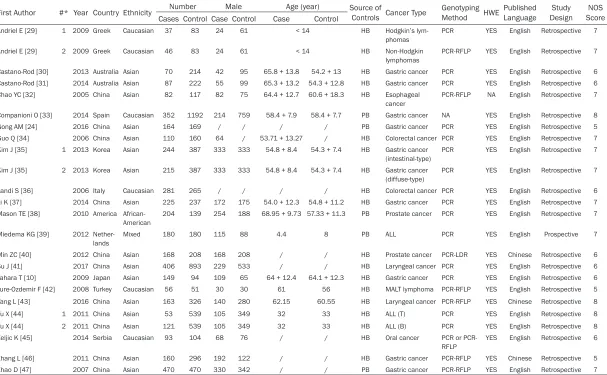
Table 1. Characteristics of case-control studies included in the meta-analysis
First Author #* Year Country Ethnicity Number Male Age (year) Source of Controls Cancer Type Genotyping Method HWE Published Language DesignStudy ScoreNOS Cases Control Case Control Case Control
Andriel E [29] 1 2009 Greek Caucasian 37 83 24 61 < 14 HB Hodgkin’s
lym-phomas PCR YES English Retrospective 7
Andriel E [29] 2 2009 Greek Caucasian 46 83 24 61 < 14 HB Non-Hodgkin
lymphomas PCR-RFLP YES English Retrospective 7 Castano-Rod [30] 2013 Australia Asian 70 214 42 95 65.8 + 13.8 54.2 + 13 HB Gastric cancer PCR YES English Retrospective 6 Castano-Rod [31] 2014 Australia Asian 87 222 55 99 65.3 + 13.2 54.3 + 12.8 HB Gastric cancer PCR YES English Retrospective 6
Chao YC [32] 2005 China Asian 82 117 82 75 64.4 + 12.7 60.6 + 18.3 HB Esophageal
cancer PCR-RFLP NA English Retrospective 7 Companioni O [33] 2014 Spain Caucasian 352 1192 214 759 58.4 + 7.9 58.4 + 7.7 PB Gastric cancer NA YES English Retrospective 8
Gong AM [24] 2016 China Asian 164 169 / / / / PB Gastric cancer PCR YES English Retrospective 5
Guo Q [34] 2006 China Asian 110 160 64 / 53.71 + 13.27 / HB Colorectal cancer PCR YES English Retrospective 7
Kim J [35] 1 2013 Korea Asian 244 387 333 333 54.8 + 8.4 54.3 + 7.4 HB Gastric cancer (intestinal-type)
PCR YES English Retrospective 7
Kim J [35] 2 2013 Korea Asian 215 387 333 333 54.8 + 8.4 54.3 + 7.4 HB Gastric cancer (diffuse-type)
PCR YES English Retrospective 7
Landi S [36] 2006 Italy Caucasian 281 265 / / / / HB Colorectal cancer PCR YES English Retrospective 6
Li K [37] 2014 China Asian 225 237 172 175 54.0 + 12.3 54.8 + 11.2 HB Gastric cancer PCR YES English Retrospective 7 Mason TE [38] 2010 America
African-American
204 139 254 188 68.95 + 9.73 57.33 + 11.3 PB Prostate cancer PCR YES English Retrospective 7
Miedema KG [39] 2012 Nether-lands
Mixed 180 180 115 88 4.4 8 PB ALL PCR YES English Prospective 7
Min ZC [40] 2012 China Asian 168 208 168 208 / / HB Prostate cancer PCR-LDR YES Chinese Retrospective 6
Su J [41] 2017 China Asian 406 893 229 533 / / HB Laryngeal cancer PCR YES English Retrospective 6
Tahara T [10] 2009 Japan Asian 149 94 109 65 64 + 12.4 64.1 + 12.3 HB Gastric cancer PCR YES English Retrospective 6
Ture-Ozdemir F [42] 2008 Turkey Caucasian 56 51 30 30 61 56 HB MALT lymphoma PCR-RFLP YES English Retrospective 5
Yang L [43] 2016 China Asian 163 326 140 280 62.15 60.55 HB Laryngeal cancer PCR-RFLP YES Chinese Retrospective 8
Yu X [44] 1 2011 China Asian 53 539 105 349 32 33 HB ALL (T) PCR YES English Retrospective 8
Yu X [44] 2 2011 China Asian 121 539 105 349 32 33 HB ALL (B) PCR YES English Retrospective 8
Zeljic K [45] 2014 Serbia Caucasian 93 104 68 76 / / HB Oral cancer PCR or
PCR-RFLP YES English Retrospective 6
Zhang L [46] 2011 China Asian 160 296 192 122 / / HB Gastric cancer PCR-RFLP YES Chinese Retrospective 5
Zhao D [47] 2007 China Asian 470 470 330 342 / / PB Gastric cancer PCR-RFLP YES English Retrospective 7
Results
Study selection and characteristics
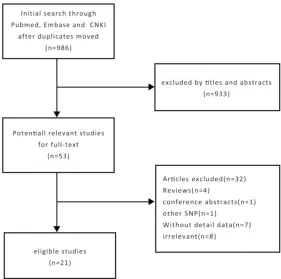
We performed an initial search and obtained 986 articles through the databases of Pubmed, Embase and CNKI. Based on the titles and abstracts, 53 potentially relevant articles were retrieved for full-text evaluation. 32 articles were excluded, including 4 reviews, 1 confer-ence abstracts, 1 article about other SNP, 7 articles without detail data, 8 irrelevant arti-cles. Finally, a total of 21 articles published from 2005-2017 were included in our meta-analysis (Table 1; Figure 1).
The 21 included articles consisted of 4136 cases and 7105 controls. And the total sample size of patient was 11241, ranging from 107 to 1544 per cohort. Because three articles had two cohorts and ethnicities, there were 24 cohorts. 6 cohorts were conducted in Caucasian, 16 in Asian, 1 in African American and 1 in mixed races. The controls were healthy
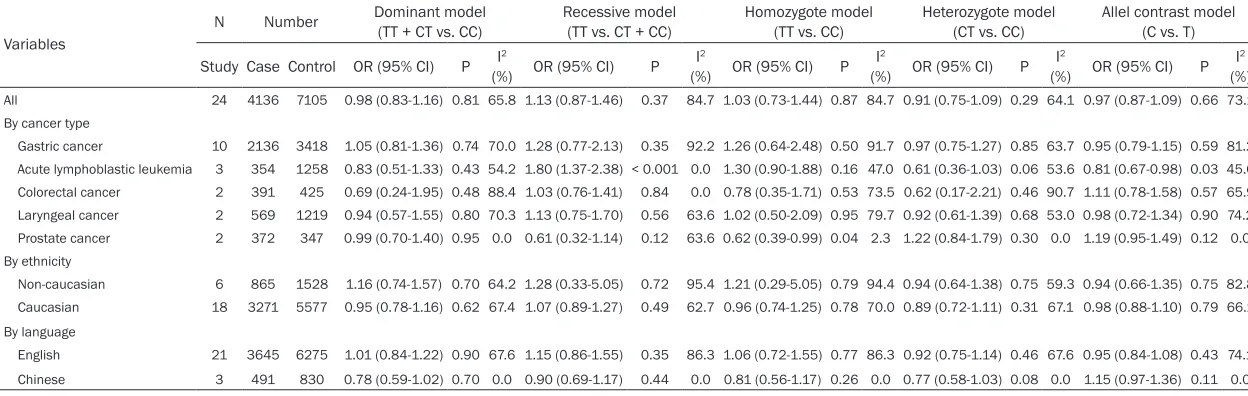
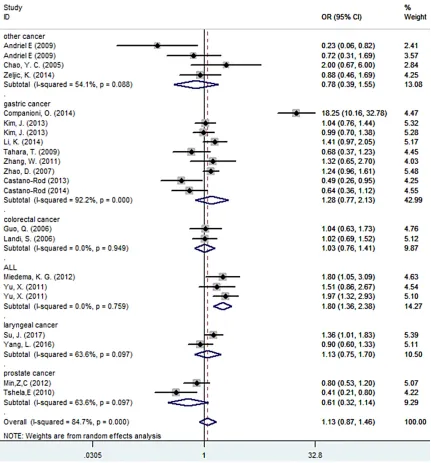
+ CC: OR = 1.80, 95% CI = 1.37-2.38, P < 0.001; C vs. T: OR = 0.81, 95% CI = 0.67-0.98, P = 0.03). Meanwhile, the association between the polymorphism of CD14 159C/T gene and prostate cancer risk was also confirmed (TT vs. CC: OR = 0.62, 95% CI = 0.39-0.99, P = 0.04). However, we failed to detect any association between the 159C/T polymorphism and gas-tric, colorectal or laryngeal cancers. Due to the limited number of included studies, we didn’t perform a subgroup analysis of other cancer types. Furthermore, when stratified by ethnicity and language, no significant association was found in all genetic models (Table 2; Figure 2).
Publication bias and sensitivity analysis
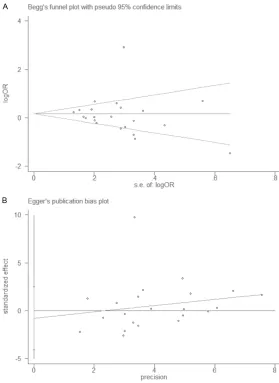
[image:4.612.90.371.71.350.2]Begg’ test (Pr > |z| = 0.135) or Egger’ test (P > |t| = 0.625) didn’t show argument for publica-tion bias (Figure 3). Besides, no significant change was detected in sensitivity analysis. Therefore, the results of current study were reli-able and streli-able.
Figure 1. Flow chart of study selection in this meta-analysis.
Meta-analysis results
To estimate the association between the cancer risk and CD14-159C/T polymorphism, we pooled the ORs and their corresponding 95% CIs. How- ever, no significant associa -tions between the CD14 159C/T polymorphism and cancer risk were found (TT + CT vs. CC: OR = 0.98, 95% CI = 0.83-1.16, P = 0.81; TT vs. CT + CC: OR = 1.13, 95% CI = 0.87-1.46, P = 0.37; TT vs. CC: OR = 1.03, 95% CI = 0.73-1.44, P = 0.87; CT vs. CC: OR = 0.91, 95% CI = 0.75-1.09, P = 0.29; C vs. T: OR = 0.97, 95% CI = 0.87-1.09, P = 0.66).
Table 2. Summary of results from different comparative genetic models
Variables
N Number Dominant model(TT + CT vs. CC) Recessive model(TT vs. CT + CC) Homozygote model(TT vs. CC) Heterozygote model(CT vs. CC) Allel contrast model(C vs. T) Study Case Control OR (95% CI) P (%)I2 OR (95% CI) P (%)I2 OR (95% CI) P (%)I2 OR (95% CI) P (%)I2 OR (95% CI) P (%)I2
All 24 4136 7105 0.98 (0.83-1.16) 0.81 65.8 1.13 (0.87-1.46) 0.37 84.7 1.03 (0.73-1.44) 0.87 84.7 0.91 (0.75-1.09) 0.29 64.1 0.97 (0.87-1.09) 0.66 73.1 By cancer type
Gastric cancer 10 2136 3418 1.05 (0.81-1.36) 0.74 70.0 1.28 (0.77-2.13) 0.35 92.2 1.26 (0.64-2.48) 0.50 91.7 0.97 (0.75-1.27) 0.85 63.7 0.95 (0.79-1.15) 0.59 81.2 Acute lymphoblastic leukemia 3 354 1258 0.83 (0.51-1.33) 0.43 54.2 1.80 (1.37-2.38) < 0.001 0.0 1.30 (0.90-1.88) 0.16 47.0 0.61 (0.36-1.03) 0.06 53.6 0.81 (0.67-0.98) 0.03 45.0 Colorectal cancer 2 391 425 0.69 (0.24-1.95) 0.48 88.4 1.03 (0.76-1.41) 0.84 0.0 0.78 (0.35-1.71) 0.53 73.5 0.62 (0.17-2.21) 0.46 90.7 1.11 (0.78-1.58) 0.57 65.9 Laryngeal cancer 2 569 1219 0.94 (0.57-1.55) 0.80 70.3 1.13 (0.75-1.70) 0.56 63.6 1.02 (0.50-2.09) 0.95 79.7 0.92 (0.61-1.39) 0.68 53.0 0.98 (0.72-1.34) 0.90 74.2 Prostate cancer 2 372 347 0.99 (0.70-1.40) 0.95 0.0 0.61 (0.32-1.14) 0.12 63.6 0.62 (0.39-0.99) 0.04 2.3 1.22 (0.84-1.79) 0.30 0.0 1.19 (0.95-1.49) 0.12 0.0 By ethnicity
Non-caucasian 6 865 1528 1.16 (0.74-1.57) 0.70 64.2 1.28 (0.33-5.05) 0.72 95.4 1.21 (0.29-5.05) 0.79 94.4 0.94 (0.64-1.38) 0.75 59.3 0.94 (0.66-1.35) 0.75 82.8 Caucasian 18 3271 5577 0.95 (0.78-1.16) 0.62 67.4 1.07 (0.89-1.27) 0.49 62.7 0.96 (0.74-1.25) 0.78 70.0 0.89 (0.72-1.11) 0.31 67.1 0.98 (0.88-1.10) 0.79 66.1 By language
English 21 3645 6275 1.01 (0.84-1.22) 0.90 67.6 1.15 (0.86-1.55) 0.35 86.3 1.06 (0.72-1.55) 0.77 86.3 0.92 (0.75-1.14) 0.46 67.6 0.95 (0.84-1.08) 0.43 74.1 Chinese 3 491 830 0.78 (0.59-1.02) 0.70 0.0 0.90 (0.69-1.17) 0.44 0.0 0.81 (0.56-1.17) 0.26 0.0 0.77 (0.58-1.03) 0.08 0.0 1.15 (0.97-1.36) 0.11 0.0
existing in two distinct forms: mCD14 and sCD14 [17]. Along with LPS-binding protein, CD14 acts to transfer LPS to the Toll-like recep-tor 4/MD-2 signaling complex [18, 19]. It medi-ates and initimedi-ates many inflammatory respons -es leading to the increasing of pro-inflammatory cytokines and aggravation of inflammation, which will finally result in many pathological responses including toxemia, endotoxin shock
[image:6.612.92.523.73.536.2]Based on present study, including 4136 cancer patients and 7105 controls from 21 studies, no significant association was detected between CD14 159C/T and overall cancer risk. This was consistent with previous study carried out by Wei and colleagues [5]. Therefore, it seemed that the CD14 159C/T gene polymorphism may not be a risk factor for cancer. However, in the stratified analysis by cancer type, positive results were observed in the subgroup of acute lymphoblastic leukemia (ALL) and prostate can-cer, which showed that CD14 159C/T polymor-phism may be associated with ALL and pros-tate cancer. Unfortunately, we found no statisti-cally significant association between CD14 159C/T variant and gastric cancer although previous studies indicate that there was a sig-nificant association between CD14 polymor -phism with gastric cancer [24, 25]. However,
mechanisms of different subtypes of the same cancer might be different, the polymorphism of CD14 may be associated with some specific subtypes of the cancer instead of the whole cancer [27]. Thirdly, controls of different stud-ies were not defined uniformly. Controls of some studies were selected from the commu-nity while others were from hospitals [28]. Nevertheless, the current study also had some merits. On the one hand, a large number of included studies from different publications significantly increased statistical power of the analyses. On the other hand, based on results of our study, we found a novel mechanism to predict some cancer risk.
In conclusion, results from the current study suggested that the CD14 159C/T polymor-phism may be associated with ALL and pros-Figure 3. Assessment of publication bias by Begg’s funnel plot and Egger’s
test.
[image:7.612.89.368.70.453.2]tate cancer, but no significant relationship has been found between overall cancer and CD14 159C/T polymorphism. Hence, more well-designed studies with larger sample size focus-ing on cancer types or ethnicities are needed to conduct a better comprehensive analysis about the association between CD14 159C/T poly-morphism and cancer risk.
Acknowledgements
This work was supported by the Transformation Projects of Sci-Tech Achievements of Sichuan Province (2016CZYD0001), and the National Natural Science Foundation of China (8140- 0040).
Disclosure of conflict of interest
None.
Address correspondence to: Drs. Weimin Li and Yangping Wu, Department of Respiratory and Critical Care Medicine, West China Hospital, 37 Guo Xue Alley, Chengdu 610041, Sichuan, China. Tel: +86 28 85423001; Fax: +86 28 85423001; E-mail: [email protected] (WML); Tel: +86 1592883- 3243; E-mail: [email protected] (YPW)
References
[1] Torre LA, Bray F, Siegel RL, Ferlay J, Lortet-Tieulent J, Jemal A. Global cancer statistics, 2012. CA Cancer J Clin 2015; 65: 87-108. [2] Bredberg A. Cancer: more of polygenic disease
and less of multiple mutations? A quantitative viewpoint. Cancer 2011; 117: 440-445. [3] Kim J, Cho YA, Choi IJ, Lee YS, Kim SY, Hwang
JA, Cho SJ, Kook MC, Kim CG, Kim YW. Effects
of polymorphisms of innate immunity genes and environmental factors on the risk of non-cardia gastric cancer. Cancer Res Treat 2013; 45: 313-324.
[4] Meyer TE, Chu LW, Li Q, Yu K, Rosenberg PS,
Menashe I, Chokkalingam AP, Quraishi SM,
Huang WY, Weiss JM, Kaaks R, Hayes RB,
Chanock SJ, Hsing AW. The association
be-tween inflammation-related genes and serum
androgen levels in men: the prostate, lung, colorectal, and ovarian study. Prostate 2012; 72: 65-71.
[5] Zhou W, Jia L, Guo S, Hu Q, Shen Y, Li N. The -159C/T polymorphism in the CD14 gene and
phism and asthma risk: an updated genetic meta-analysis study. Medicine (Baltimore) 2016; 95: e4959.
[7] Lin J, Yao YM, Yu Y, Chai JK, Huang ZH, Dong N,
Sheng ZY. Effects of CD14-159 C/T polymor-phism on CD14 expression and the balance
between proinflammatory and anti-inflamma -tory cytokines in whole blood culture. Shock 2007; 28: 148-153.
[8] Triantafilou M and Triantafilou K.
Lipopolysac-charide recognition: CD14, TLRs and the LPS-activation cluster. Trends Immunol 2002; 23: 301-304.
[9] Hold GL, Rabkin CS, Gammon MD, Berry SH, Smith MG, Lissowska J, Risch HA, Chow WH, Mowat NA, Vaughan TL, El-Omar EM. CD14-159C/T and TLR9-1237T/C polymorphisms are not associated with gastric cancer risk in Caucasian populations. Eur J Cancer Prev 2009; 18: 117-9.
[10] Tahara T, Shibata T, Hirata I, Nakano H, Arisawa T. CD14 promoter-159 polymorphism is associ-ated with reduced risk of intestinal-type gastric cancer in a Japanese population. Dig Dis Sci 2009; 54: 1508-1512.
[11] DerSimonian R and Kacker R. Random-effects
model for meta-analysis of clinical trials: an up-date. Contemp Clin Trials 2007; 28: 105-114. [12] Shen Y, Guo S, Yang T, Jia L, Chen L, An J, Wang
T, Wen F. The -173G/C Polymorphism of the
MIF gene and inflammatory bowel disease
risk: a meta-analysis. Int J Mol Sci 2013; 14: 11392-11401.
[13] Mantel N and Haenszel W. Statistical aspects of the analysis of data from retrospective stud-ies of disease. J Natl Cancer Inst 1959; 22: 719-748.
[14] Thakkinstian A, McElduff P, D’Este C, Duffy D, Attia J. A method for meta-analysis of molecu-lar association studies. Stat Med 2005; 24: 1291-1306.
[15] Egger M, Davey Smith G, Schneider M, Minder C. Bias in meta-analysis detected by a simple, graphical test. BMJ 1997; 315: 629-634. [16] Zanoni I, Ostuni R, Marek LR, Barresi S, Bar-
balat R, Barton GM, Granucci F, Kagan JC.
CD14 controls the LPS-induced endocytosis of Toll-like receptor 4. Cell 2011; 147: 868-80. [17] Ziegler-Heitbrock HW, Ulevitch RJ. CD14: cell
surface receptor and differentiation marker. Immunol Today 1993; 14: 121-5.
[18] da Silva Correia J, Soldau K, Christen U, Tobias
Tobias PS, Ulevitch RJ. CD14 is a pattern rec-ognition receptor. Immunity 1994; 1: 509-16. [20] Schutt C. CD14. Int J Biochem Cell Biol 1999;
31: 545-9.
[21] Wu CY, Wang CJ, Tseng CC, Chen HP, Wu MS, Lin JT, Inoue H, Chen GH. Helicobacter pylori promote gastric cancer cells invasion through a NF-kappaB and COX-2-mediated pathway. World J Gastroenterol 2005; 11: 3197-203. [22] Mori N, Sato H, Hayashibara T, Senba M,
Geleziunas R, Wada A, Hirayama T, Yamamoto N. Helicobacter pylori induces matrix metallo-proteinase-9 through activation of nuclear
fac-tor κB. Gastroenterology 2003; 124: 983-92.
[23] Tong X, Li Z, Fu X, Zhou K, Wu Y, Zhang, Y, Fan
H. The association between CD14-260C/T polymorphism and malignant tumor risk: a meta-analysis of 5,603 participants. Tumor Biol 2014; 35: 8707-8713.
[24] Gong AM, Li XY, Xie YQ, Jia ZD, Li YX, Zou YY, Xu CQ, Wang ZY. Association between CD14 SNP -159 C/T and gastric cancer: an independent case-control study and an updated meta-anal-ysis. Onco Targets Ther 2016; 9: 4337-42. [25] Wang J, Guo X, Yu S, Song J, Zhang J, Cao Z,
Wang J, Liu M, Dong W. Association between CD14 gene polymorphisms and cancer risk: a meta-analysis. PLoS One 2014; 9: e100122. [26] Barendregt JJ, Doi SA, Lee YY, Norman RE, Vos
T. Meta-analysis of prevalence. J Epidemiol Community Health 2013; 67: 974-8.
[27] Nidheesh N, Abdul Nazeer KA, Ameer PM. An enhanced deterministic K-Means clustering al -gorithm for cancer subtype prediction from gene expression data. Comput Biol Med 2017; 91: 213-221.
[28] Pateras K, Nikolakopoulos S, Roes K.
Data-generating models of dichotomous outcomes: Heterogeneity in simulation studies for a ran-dom-effects meta-analysis. Stat Med 2018; 37: 1115-1124.
[29] Andrie E, Michos A, Kalampoki V, Pourtsidis
A, Moschovi M, Polychronopoulou S, Athana-
siadou-Piperopoulou F, Kalmanti M, Hatzakis
A, Paraskevis D, Nieters A, Petridou ET. Genetic variants in immunoregulatory genes and risk for childhood lymphomas. Eur J Haematol 2009; 83: 334-342.
[30] Castaño-Rodríguez N, Kaakoush NO, Goh KL, Fock KM, Mitchell HM. The role of TLR2, TLR4
and CD14 genetic polymorphisms in gastric carcinogenesis: a case-control study and me-ta-analysis. PLoS One 2013; 8: e60327. [31] Castañoro-dríguez N, Kaakoush NO, Pardo AL,
Goh KL, Fock KM, Mitchell HM. Genetic poly -morphisms in the toll-like receptor signalling pathway in helicobacter pylori infection and related gastric cancer. Hum Immunol 2014; 75: 808-815.
[32] Chao YC, Chu HC, Chang WK, Huang HH, Hsieh
TY. CD14 promoter polymorphism in Chinese alcoholic patients with cirrhosis of liver and acute pancreatitis. World J Gastroenterol 2005; 11: 6043-6048.
[33] Companioni O, Bonet C, Muñoz X, Weiderpass E, Panico S, Tumino R, Palli D, Agnoli C, Vineis P, Boutron-Ruault MC, Racine A, Clavel-Cha-
pelon F, Travis RC, Khaw KT, Riboli E, Murphy
N, Vergnaud AC, Trichopoulou A, Benetou V, Trichopoulos D, Lund E, Johansen D, Lindkvist B, Johansson M, Sund M, Ardanaz E, Sánchez-Cantalejo E, Huerta JM, Dorronsoro M, Ramón Quirós J, Tjonneland A, Mortensen LM, Overvad
K, Chang-Claude J, Rizzato C, Boeing H,
Bueno-de-Mesquita HB, Siersema P, Peeters PH, Numans ME, Carneiro F, Licaj I, Freisling H, Sala N, González CA. Polymorphisms of Helicobacter pylori signaling pathway genes and gastric cancer risk in the European pro-spective investigation into cancer-eurgastco-hort. Int J Cancer 2014; 134: 92-101.
[34] Guo Q, Zhu J, Xia B. Polymorphism of CD14 gene but not the mutation of TLR4 gene is associated with colorectal cancer in Chinese patients. J Gastroenterol Hepatol 2006; 21: 92-7.
[35] Kim J, Cho YA, Choi IJ, Lee YS, Kim SY, Hwang JA, Cho SJ, Kook MC, Kim CG, Kim YW. Effects
of polymorphisms of innate immunity genes and environmental factors on the risk of non-cardia gastric cancer. Cancer Res Treat 2013; 45: 313-24.
[36] Landi S, Gemignani F, Bottari F, Gioia-Patricola L, Guino E, Cambray M, Biondo S, Capella G, Boldrini L, Canzian F, Moreno V. Polymorphisms
within inflammatory genes and colorectal can -cer. J Negat Results Biomed 2006; 5: 15. [37] Li K, Dan Z, Hu XJ, Gesang LB, Ze YG, Bianba
ZX, Ciren CM, Nie YQ. Association of CD14/-260 polymorphism with gastric cancer risk in Highland Tibetans. World J Gastroenterol 2014; 20: 2688-2694.
[38] Mason TE, Ricks-Santi L, Chen W, Apprey V,
Joykutty J, Ahaghotu C, Kittles R, Bonney G,
Dunston GM. Association of CD14 variant with prostate cancer in African American men. Prostate 2010; 70: 262-269.
[39] Miedema KG, Tissing WJ, TePoele EM, Kamps WA, Alizadeh BZ, Kerkhof M, de Jongste JC,
Smit HA, de Pagter AP, Bierings M, Boezen HM,
Postma DS, de Bont ES, Koppelman GH.
Polymorphisms in the TLR6 gene associated with the inverse association between child-hood acute lymphoblastic leukemia and atopic disease. Leukemia 2012; 26: 1203-1210. [40] Mason TE, Ricks-Santi L, Chen W, Apprey V,
Joykutty J, Ahaghotu C, Kittles R, Bonney G,
polymorphism and the risk of the prostate cancer. Prostate 2010; 70: 262-9.
[41] Su J, Cui J, Xue HT, Tian JH, Zhang JH. Study on the correlation between CD14 gene polymor-phism and susceptibility to laryngeal cancer. Eur Rev Med Pharmacol Sci 2017; 21: 4292-97.
[42] Türe-Ozdemir F, Gazouli M, Tzivras M, Panagos
C, Bovaretos N, Petraki K, Giannakopoulos A, Korkolopoulou P, Mantzaris GJ. Association of
polymorphisms of NOD2, TLR4 and CD14 genes with susceptibility to gastric mucosa-associated lymphoid tissue lymphoma. Anti- cancer Res 2008; 28: 3697-700.
[43] Yang LJ, Wen SX, Lin J, Zhang X. [Effect of CD14 promoter variants on the susceptibility to laryngeal cancer]. Zhonghua Er Bi Yan Hou
Tou Jing Wai Ke Za Zhi 2016; 51: 197-202.
[44] Yu X, Zhang C, Sun A, Jiang L, Zheng J, You Y, Wu D, Zhou Y. Genetic variations in CD14 pro-moter and acute lymphoblastic leukemia sus-ceptibility in a Chinese population. Dna Cell Biol 2011; 30: 777-82.
[45] Zeljic K, Supic G, Jovic N, Kozomara R,
Brankovic-Magic M, Obrenovic M, Magic Z. Association of TLR2, TLR3, TLR4 and CD14 genes polymorphisms with oral cancer risk and survival. Oral Dis 2014; 20: 416-424. [46] Zhang L. Association of gene polymorphisms
with helicobacter pylori related gastric cancer. Chongqing Medical University 2011.