Superelastic Behavior under Cyclic Loading for Coil Spring
of Ti-Ni Shape Memory Alloy
Toshio Sakuma
1and Akihiko Suzuki
2 1Department of Human Welfare Engineering and Assistive Technology, Oita University, Oita 870-1192, Japan 2Division of Mechanical Engineering and Science, Graduate School of Science and Engineering,
Saitama University, Saitama 338-8750, Japan
The superelastic behavior of coil springs of a Ti-Ni shape memory alloy was investigated using loading-unloading cycling tests under isothemal temperatures. The effects of the Ni content and shape memory treatment temperatures on the cyclic behavior in the superelastic deformation were investigated. The deformation behavior within the elastic region of the parent phase scarcely changes during tensile cyclic loading. However, when a martensitic phase is induced by the stress, the deformation behavior changes considerably during cyclic loading. The critical shear stress for inducing martensites and the dissipated strain energy per cycle decrease with an increase in the number of cyclic loadings. Such changes in the superelastic behavior under cyclic loading become large with a decrease in the Ni content of the Ti-Ni shape memory alloy and the increase in the shape memory treatment temperature. [doi:10.2320/matertrans.48.422]
(Received September 29, 2006; Accepted November 24, 2006; Published February 25, 2007)
Keywords: shape memory alloy, titanium-nickel alloy, coil spring, superelastic behavior, temperature of heat treatment for shape memory, nickel content
1. Introduction
Shape memory alloys are receiving attention in various fields. In areas such as engineering and medicine, the applications of shape memory alloys are being studied and are actually in use.1–3)
The coil springs of the Ti-Ni shape memory alloy are widely used for many applications because they can create a large deformation. However, in order to promote the further application of these springs, some improvements in the cyclic behavior are necessary.
The degradation in the cyclic behavior, in which the recovery stress decreases, the residual strain increases, and the dissipated strain energy per cycle decreases with an increase in the number of mechanical cycles, has been investigated.4–8) In thermal cycles, the degradation in the cyclic behavior, including the decrease in the recovery stress and the transformation temperatures, has been investigat-ed.9,10)These investigations pointed out that the mechanism used for the improvement of the characteristics is to suppress the introduction of dislocations by raising the critical stress for slip. Arrangements of alloy elements, heat treatments, etc, have been considered as factors that increase the critical stress for slip.
In this study, in order to clarify the cyclic nature of the superelastic behavior of the coil springs of the Ti-Ni shape memory alloy, the loading-unloading cycling tests were carried out under isothermal temperatures. The effects of the magnitude of the repeated shear strain, the Ni content, and the temperature of heat treatment for the shape memory on the critical shear stress for inducing martensites and the dissipated strain energy are discussed in the superelastic regime.
2. Experiment
2.1 Specimen
The specimens were coil springs made from Ti-Ni shape
memory alloys. The fabrication procedure was as follows: Ti-Ni ingots were made using a high-frequency induction vacuum furnace. The ingots were hot forged and hot extruded, which were followed by cold drawing and intermediate annealing to make wires with diameters of 1.0 mm. The final cold-work rate for wire rods was 34%. These wire rods were processed to coil springs without further heat treatments except for the shape memory treat-ment. The mean diameter of the coil spring was 10 mm and number of active coils was 10.5. The alloys were composed of Ti-50.12 at%Ni, Ti-50.39 at%Ni, and Ti-50.63 at%Ni and were annealed at 673, 723, and 753 K for 3.6 ks to memorize the shape at that time.
[image:1.595.306.548.586.716.2]The transformation temperatures of the specimens were measured by the differential scanning calorimetry (DSC) and are shown in Table 1.
Table 1 Transformation temperatures of Ti-Ni alloys.
Material THT/K Af/K As/K Ms/K Mf/K Rs/K Rf/K
673 312.9 287.0 250.8 200.3 320.4 303.8 Ti-50.63 at%Ni 723 315.7 281.3 252.2 195.2 309.8 298.6 753 311.0 285.6 250.9 210.6 302.1 293.2
673 339.2 322.9 292.5 239.7 329.4 313.4 Ti-50.39 at%Ni 723 336.6 320.0 284.4 250.1 318.5 309.1 753 334.2 319.0 282.3 261.9 313.2 305.9
673 357.5 334.3 312.2 266.1 332.5 322.6 Ti-50.12 at%Ni 723 357.3 337.4 311.2 284.4 332.2 321.2 753 359.8 341.3 316.3 295.3 330.5 319.8
THT: Heat treatment temperature
Af: Reverse transformation finish temperature
As: Reverse transformation start temperature
Ms: Martensite start temperature
Mf: Martensite finish temperature
Rs: Rhombohedral start temperature
Rf: Rhombohedral finish temperature
2.2 Experimental procedure
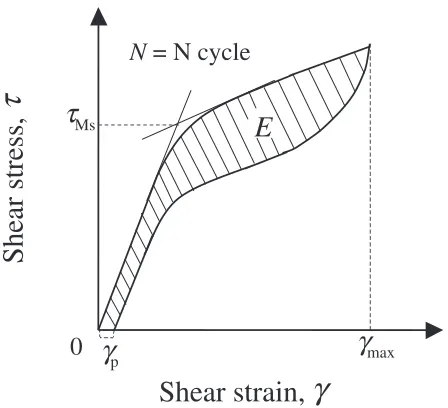
Figure 1 schematically shows the stress-strain curve obtained from the first cycle of the cyclic tests of the coil springs in the superelastic regime. For the superelastic cyclic tests, the specimen was heated at an isothermal temperature
TH (TH¼Af (Table 1) + 10 K) and was elongated to a length corresponding to a given maximum applied shear strainmax(1.2%4.4%), then the specimen was recovered by unloading. The superelastic cyclic tests were repeated for up to 200 cycles.
The shear stress and strain were obtained by the following equations,
shear stress:¼8PD d3
shear strain: ¼ d nD2
where
D: mean diameter of coil spring d: wire diameter
n: number of active coils : deflection
P: load on spring : shear strain
: shear stress:
The dissipation energy per cycle (E) was calculated from the hatched area shown in Fig. 1.
3. Results and Discussions
3.1 Effects of the Ni content and the heat treatment temperature on functions of shape memory alloys in the superelasic regime
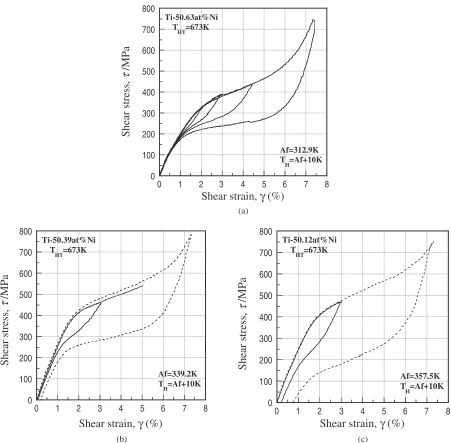
Figure 2 shows the stress-strain curves obtained by coil spring specimens of Ti-Ni shape memory alloys with various Ni contents and temperatures of the heat treatment for shape memory (THT) in the superelastic regime.
It is well known that an increase in the Ni content has the effect of decreasing the transformation temperature and that THT influences the transformation temperature. The
variation in the transformation temperature during thermal loading is reflected in the variation in the critical shear stress required for inducing martensites (Ms) during mechanical loading at a given temperature.
[image:2.595.60.284.70.274.2]According to the definition shown in Fig. 1, theMsvalues and the E values were obtained from stress-strain curves shown in Fig. 2.
Figure 3 shows the variation in Ms at N¼1 cycle with (a) the Ni content and (b) THT. The Ms value decreases considerably with an increase in the Ni content, and slightly increases with the increase inTHT. The decrease in theMs value with an increase in the Ni content is due to the decrease in the elastic shearing modulus with an increase in the Ni content. The shearing moduli were 26 GPa, 25 Gpa, and 22 GPa for Ti-50.12 at%, Ti-50.39 at%Ni, and Ti-50.63 at%-Ni respectively.
The variation inEshows the same tendency as the critical shear stressMs, as shown in Fig. 4. TheE value decreases considerably with an increase in the Ni content, and it increases moderately with the increase in THT. TheEvalue decrease with an increase in the Ni content is because the reverse transformation stress becomes large with an increase in the Ni content. It was pointed out8)that for Ti-Ni alloys with the Ni content exceeding 50.5 at%, the precipitation of Ti3Ni4appears in the alloy on aging and it makes the reverse
transformation stress large.
3.2 Cyclic behavior
3.2.1 Effect of maximum shear strain
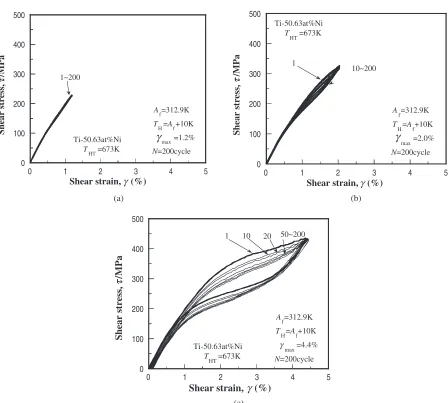
In order to investigate the cause for the effect of cyclic loading on the mechanical behavior of the coil springs of Ti-Ni shape memory alloys, the superelastic cyclic tests were carried out for various maximum applied shear strains. Figure 5 shows the superelastic cyclic stress-strain curves at (a) themaxvalue within the range of elastic deformation and (b) and (c) at the max values within the range of stress-induced transformation. The effect of cyclic deformation is not observed in the elastic deformation. On the contrary, its effect appears during the cyclic deformation accompanying the stress-induced transformation, and its extent depends on the repeated strain level (and also on the level of the applied stress). In Fig. 5 (b) and (c), the shape of the hysteresis loop of the stress-strain curve changes by the repetition of strain. It is understood that the change in the hysteresis loop is because the stress-induced martensites are damaged by cyclic deformation.
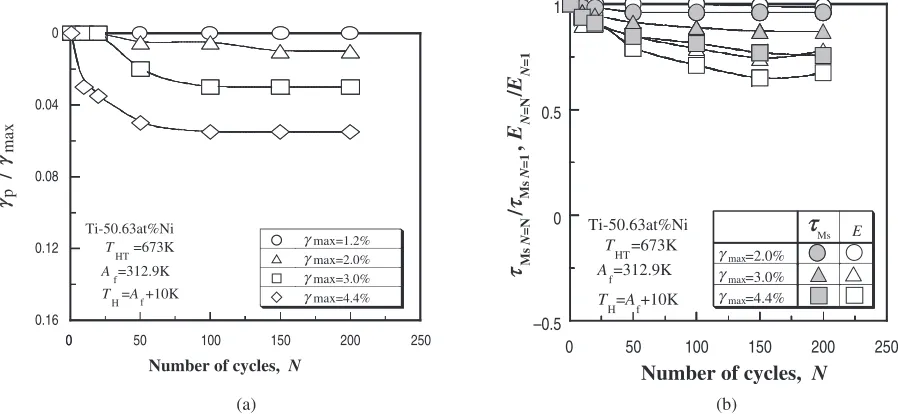
Figure 6 shows the effect of cyclic deformation on (a) the residual strainpand (b)MsandEfor variousmaxvalues. Thepvalues are normalized bymax, andMsandEdata are normalized by the values of the first cycle. They are shown as functions of the number of cycles. The p value increases with the increase in the number of cycles and the max values. The Ms and E values decrease with the increase in the number of cycles and themaxvalues. From these results, it is understood that the amount of the stress-induced martensites influences the degree of functional degradations. It is reported that slip deformation occurs during the deformation process of specimens,11) all of the stress-induced martensites do not disappear, and the residual martensites remain after unloading. The residual martensites
E
N = N cycle
Shear strain,
Shear stress,
τ
Ms
max
0
p
τ
γ
γ
γ
(b)
0 100 200 300 400 500 600 700 800
0 1 2 3 4 5 6 7 8
Shear strain,
γ
(%)
Ti-50.39at%Ni T
HT=673K
Af=339.2K T
H=Af+10K
Shear stress,
0 100 200 300 400 500 600 700 800
0 1 2 3 4 5 6 7 8
Shear strain,
γ
(%)
Ti-50.12at%NiT HT=673K
Af=357.5K T
H=Af+10K
Shear stress,
(c)
τ
/MPa
τ
/MPa
(a)
0 100 200 300 400 500 600 700 800
0 1 2 3 4 5 6 7 8
Shear strain,
γ
(%)
Ti-50.63at%Ni T
HT=673K
Af=312.9K T
H=Af+10K
Shear stress,
τ
/MPa
Fig. 2 Stress–strain curves of coil springs atN¼1cycle for (a) Ti-50.63 at%Ni, (b) Ti-50.39 at%Ni and (c) Ti-50.12 at%Ni.
(a) (b)
250 300 350 400 450
50.05 50.25 50.45 50.65
Ni content ( at% ) T
HT=673K
Critical shear stress for
inducing martensites,
/MPa
ττMs
T
H=Af+10K
N=1cycle
max=3.0%
250 300 350 400 450
660 680 700 720 740 760
Temperature of heat treatment for shape memory, THT/K
Ti-50.63at%Ni
Critical shear stress for
inducing martensites,
/MPa
τMs
T
H=Af+10K
N=1cycle
max=3.0%
γ
γ
Fig. 3 Variation in the critical shear stress for inducing martensitesMsatN¼1cycle with (a) the Ni content and (b) the temperature of
[image:3.595.74.525.70.513.2] [image:3.595.75.510.564.760.2](a) (b)
0 50 100 150 200 250 300
50.05 50.25 50.45 50.65
Ni content ( at% )
-3
T HT= 673 K
T
H= Af+ 10 K N = 1 cycle
max= 3.0%
0 50 100 150 200 250 300
660 680 700 720 740 760
Temperature of heat treatment for shape memory, THT /K
Dissipated strain energy per cycle,
E
/MJ·m
-3
Dissipated strain energy per cycle,
E
/MJ·m
Ti-50.63at%Ni T
H= Af+ 10 K
N = 1 cycle
max= 3.0%
γ
γ
Fig. 4 Variation in the dissipated strain energy per cycleEatN¼1cycle with (a) the Ni content and (b)THT.
(a) (b)
0 100 200 300 400 500
0 1 2 3 4 5
Ti-50.63at%Ni
THT=673K
Af=312.9K
TH=A f+10K
max=1.2%
N=200cycle 1~200
Shear stress,
Shear strain,
0 100 200 300 400 500
0 1 2 3 4 5
Ti-50.63at%Ni
T
HT=673K
A
f=312.9K
T
H=A f+10K
max=2.0%
N=200cycle
10~200
Shear stress,
Shear strain,
1
τ
/MPa
γ
(%)
γ
τ
/MPa
γ
γ (%)
(c)
0 100 200 300 400 500
0 1 2 3 4 5
Shear stress,
Shear strain,
Ti-50.63at%Ni
T
HT=673K
A
f=312.9K
T
H=Af+10K
max=4.4%
γ
N=200cycle
1 10 20 50~200
τ
/MPa
γ (%)
[image:4.595.80.520.76.270.2] [image:4.595.76.524.349.752.2]increase with the number of cycles.8) Therefore, slip deformation and residual martensites are considered to be the causes for the residual strain, which increases with the number of cycles. Furthermore, the cause for the degradation inMs, which decreases with the number of cycles is thought to be due to the internal stress formed by slip deformation. 3.2.2 Effect of Ni content
Ti-Ni alloys with Ni content exceeding 50.5 at% decom-pose on aging at a temperature below 973 K. Further, three phases of Ti3Ni4, Ti2Ni3, and TiNi3appear in this sequence,
which is in the increasing order of the Ni content of the product phases. The precipitation of Ti3Ni4 strengthens the
matrix and improves the recoverability of the shape memory effect.12)
Figure 7 shows the effect of cyclic deformation on (a)p and (b)MsandEfor various Ni content. The effect of cyclic deformation depends on the Ni content. The degree of
degradation (increase inp, decrease inMsand decrease in
E) decreases with the increase in the Ni content. The critical stress for slip is considered to be increased by increasing the Ni content. In case of 50.63 at% Ni, it is thought that Ti3Ni4is
precipitated and the critical stress for slip is raised.
3.2.3 Effect of the temperature of heat treatment for shape memory
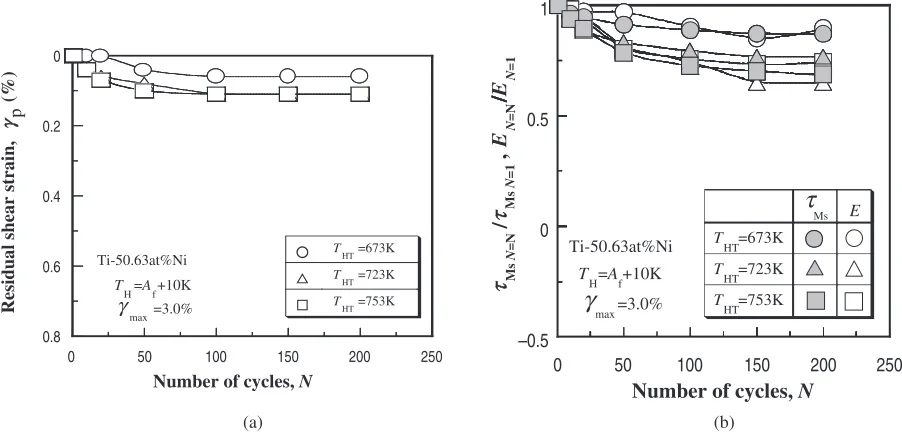
Figure 8 shows the effect of cyclic deformation on (a)p and (b)MsandEfor variousTHT values. It is worth noting that the degradation is suppressed at low THT values. This result indicates that when theTHTvalue is high, the hardening due to a high density of dislocations is not responsible for the increase in the critical stress for slip.
3.2.4 Rate of change in superelastic characteristics with cyclic loading
From Fig. 5–8, it is shown that the superelastic behavior changes considerably in the early stage of cyclic
deforma-(a) (b)
0
f
0
0.04
0.08
0.12
0.16
0 50 100 150 200 250
A f=312.9K
Ti-50.63at%Ni
T HT=673K
Number of cycles, N
max=1.2%
γ γ γ γ
max=2.0% max=3.0% max=4.4%
max
p
/
γ
γ
T
H=A +10K
/
A
T T
E
τ
τ
N
=N
N
=1
–0.5 0 0.5 1
0 50 100 150 200 250
f=312.9K
H=A f+10K
Ti-50.63at%Ni
HT=673K
Number of cycles, N
E Ms
=2.0% =3.0% =4.4%
γ γ γ
Ms
N
=N
Ms
N
=1
,
/
E
max max max
τ
Fig. 6 Effect of cyclic deformation on (a) the residual strainpand (b)MsandEfor variousmaxvalues.
(a) (b)
0
0.2
0.4
0.6
0.8
0 50 100 150 200 250
T
H=A f+10K
T
HT=673K
Number of cycles, N
50.63at%Ni 50.39at%Ni 50.12at%Ni
Residual shear strain,
(%)
p
max=3.0%
γ
/
τ
τ
TT
Ms
N
=N
E N
=N
N
=1
γ
–0.5 0 0.5 1
0 50 100 150 200 250
H=Af+10K HT=673K
Number of cycles, N
E Ms
50.63at%Ni 50.39at%Ni 50.12at%Ni
Ms
N
=1
,
/
E
max=3.0%
τ
γ
[image:5.595.75.524.76.283.2] [image:5.595.75.522.325.548.2]tion. However, when the cyclic number is beyond 100, the changes are hardly significant. This behavior of the coil springs is the same as that of wire specimens.8)
4. Conclusion
The effects of the magnitude of the repeated strain, the Ni content, and the temperature of heat treatment for shape memory on the cyclic superelastic behavior of coil springs of Ti-Ni shape memory alloys was investigated by experimen-tation.
The results are summarized as follows.
(1) The deformation behavior within the elastic region of the parent phase scarcely changes during the tensile cyclic loading. However, when the martensite phase is induced by stress, the deformation behavior changes considerably during cyclic loading and the functional degradation occurs with the number of cyclic loading. (2) The functional degradation depends on the magnitude
of the repeated maximum shear strain, the Ni content, and the temperature of heat treatment for shape memory. The functional degradation increases with an increase in the magnitude of the repeated maximum
applied shear strain, a decrease in the Ni content, and the increase in the temperature of heat treatment for shape memory.
(3) The superelastic behavior changes considerably in the early stage of cyclic deformation. However, when the cyclic number is beyond 100, the changes are hardly significant.
REFERENCES
1) T. Honma: Jour. Jpn. Soc. Mech. Eng.87(1984) 517–522. 2) K. Yamauchi: Jpn. Inst. Met.32(1993) 495–499. 3) M. Miyagi: Jpn. Inst. Met.24(1985) 69–74.
4) M. Kawaguti: Trans. Jpn. Soc. Mech. Eng. A56(1990) 150–155. 5) H. Tobushi: Jour. Soc. Mater. Sci. Jpn.39(1990) 1242–1247. 6) H. Tobushi: Trans. Jpn. Soc. Mech. Eng. A57(1991) 121–126. 7) T. Sakuma: Trans. Mater. Res. Soc. Jpn.26(2001) 327–330. 8) S. Miyazaki: Met. Trans.17A(1986) 115–120.
9) S. Miyazaki: Acta Met.34(1986) 2045–2051.
10) K. Tanaka, H. Tobushi and S. Miyazaki: Mechanical Properties of Shape Memory Alloys, (Yokendo Ltd, 1993).
11) K. N. Melton: Acta Met.27(1979) 137–144.
12) K. Otsuka and C. M. Wayman:Shape Memory Materials, (Cambridge University Press, 1998) pp. 50–53.
(a) (b)
0
0.2
0.4
0.6
0.8
0 50 100 150 200 250
T
H=A f+10K
Ti-50.63at%Ni
Number of cycles, N
T
HT=673K
T
HT=723K
T
HT=753K
Residual shear strain,
γ
(%)
p
max=3.0%
//
T
Ms
N
=N
/
E
τ
τ
N
=N
/
N
=1
–0.5 0 0.5 1
0 50 100 150 200 250
Ti-50.63at%Ni
Number of cycles, N
E Ms
T
HT=673K
T
HT=723K
T
HT=753K
H=A f+10K
Ms
N
=1
,/
E
max=3.0%
γ