Munich Personal RePEc Archive
Emerging economies, emerging
challenges: Mobilising and capturing
value from big data
Amankwah-Amoah, Joseph
2016
1
Please cite as:
Amankwah-Amoah, J. (2016). Emerging economies, emerging challenges: Mobilising and capturing value from big data. Technological Forecasting and Social Change, 110, 167–174.
ABSTRACT
As technology advances and voluminous new data are generated on a daily basis, the ability to harness
and utilise big data not only enhances firms’ competitiveness but also equips governments for the
twenty-first century. This study examines how governments can utilise big data to combat health
challenges. The study focuses specifically on the Ebola outbreak in West Africa to illustrate how various
technologies and techniques were utilised jointly to combat and contain the outbreak. An integrated
technology roadmappping approach was developed which encompasses digital surveillance systems and
traditional monitoring techniques to articulate how governments can capture value from big data to
combat such contagious diseases. Policy and practical implications are identified and discussed.
2
1 Introduction
In recent years, the advancement of information technology coupled with globalisation of the world’s
economy has ushered in the dawn of the field of big data (Goes, 2014; McAfee & Brynjolfsson, 2012;
Woerner & Wixom, 2015). The emergence of large and often unstructured data has become an
increasingly common feature of the global economy. As such, harnessing and utilising insights from big
data cannot only enhance firms’ competitiveness but also lead to effective government policies
(Amankwah-Amoah, 2015; Wamba & Akter, 2015; Bhimani, 2015). The dawn of big data has been
accompanied by increasing consensus that government can play a pivotal role in utilising big data to not
only protect the public but also formulate effective public policy (Davidian & Louis, 2012).
Although past studies have indicated that the time when public policymakers and top executives “could
profess ignorance about the power of data has long passed” (EIU, 2012, p. 19), the precise mechanisms
for governments and policymakers to harness and utilise big data to combat social issues remain unclear.
Surprisingly, much of the academic literature on big data has focused mainly on techniques and methods
without articulating how it can be utilised to combat health issues.
Accordingly, the objective in this paper is to explore how government can utilise big data to combat
healthcare issues. The study focuses specifically on combating contagious diseases and reviews the
technologies utilised. The paper utilises the recent Ebola outbreak in West Africa as a lens through which
to demonstrate how big data aided the drive to report, contain, control and halt the spread of the virus.
The focus is mainly on the Ebola outbreak in West Africa, but not exclusively.
The study makes at least two key contributions to big data and technology roadmappping literature. First,
although scholars recognised that big data should play a pivotal role in combating diseases (Hay et al.,
3 the literature by integrating the streams of research on technology roadmapping (Phaal, Farrukh &
Probert, 2004) and big data (George, Haas & Pentland, 2014; McAfee & Brynjolfsson, 2012) to
demonstrate how technology roadmapping can equip governments and public policymakers in
responding to such adverse shocks. The paper employed the case of the Ebola outbreak to offer a step
forwards in demonstrating how big data can be harnessed to solve social issues.
Second, in spite of the recognition among scholars that technology roadmap is a powerful tool of
strategic planning (Phaal et al., 2004; Geum et al., 2015), there remains a limited insight into how it can
be utilised to help emerging economies combat emerging challenges. The study juxtaposes the two
streams of research on big data and technology roadmappping to develop a framework with potential to
further illuminate our understanding of the subjects. The study also provides unique insights on how
governments can mobilise and capture value from big data.
The rest of the article is structured as follows. In the next section, a review of the existing literature on
technology roadmapping and big data is presented. Then the method of data collection is explained. The
penultimate section presents an overview of a range of tools/techniques utilised towards predicting and
containing the Ebola outbreak. The final section discusses the implications of the findings for public
policy.
2 Technology roadmapping and big data: A review
A roadmap can be seen as a “layout of paths or routes that exists (or could exist) in some particular
geographical space” or a “traveler’s tool that provides essential understanding, proximity, direction, and
some degree of certainty in travel planning” (Kostoff & Schaller, 2001, p. 132). Roadmaps encompass
the identification of tools and techniques required to address issues/problems as well as enhancing
4 2015). Technology roadmaps can be viewed as a tool for strategic planning which entails linking
resources and expertise to future courses of action (Kostoff & Schaller, 2001; Phaal et al., 2004; Galvin,
2004). A technology roadmap can be defined as an “extended look at the future of a chosen field of
inquiry drawn from the collective knowledge and imagination of the groups and individuals driving
change in that field” (Galvin, 2004, p. 101). The term technology roadmapping refers to the process
inherent in the evolution of roadmaps which helps fine-tune decisions and concentrate resources on key
areas (Kostoff & Schaller, 2001). It can be seen as a unique framework for mapping processes and
approaches towards achieving particular short- and long-term objectives. Over the years, the scope of
technological roadmapping has been expanded to include the role of the state in formulating public
policy (Vishnevskiy, Karasev & Meissner, 2015; Walsh, 2004).
One important stream of research has uncovered that technology roadmapping can help firms’ better
respond to adverse environmental shocks by providing routes for scanning the business environment as
well as tracking the performance of employees (Phaal et al., 2004). Indeed, it is widely recognised that
technology roadmaps and the roadmapping processes can enhance “a firm’s, regions, or industry’s
competitive advantage by providing a process that senses the competitive landscape, identifying
opportunities, risks, threats, and competitor ability” (Walsh, 2004, p. 162; Geum, Lee, Lee & Park,
2015). This also helps in the public policy arena by helping governments to channel their limited
resources more effectively and by pinpointing areas with pressing needs (Kerr, Phaal & Probert, 2013).
Another line of research has demonstrated that roadmapping can help to garner support and forge
consensus around the technology requirements and future needs, and in so doing produces synergistic
benefits (Kostoff & Schaller, 2001; Garcia & Bray, 1997). Consequently, roadmapping can equip
decision makers with the tools and approaches to make better investment decisions (Kostoff & Schaller,
5
organisation’s preparedness in meeting future challenges (Garcia & Bray, 1997). However, inability to
map out a clear path to the future can affect a country’s ability to develop and disseminate valuable
knowledge as well as prepare for future challenges (see McDowall, 2012). Indeed, such failure can lead
to declining performance of governments and firms.
2.1 Technology and evolution of big data
Since the turn of the century, the term big data has gained wider currency not only within academic
circles but also among practitioners (Lohr, 2012b; Hay et al., 2013). The concept big data has emerged
from the corridors of technology firms to take centre stage within the mainstream management discourse
(George et al., 2014). Big data can be defined as the “ultralarge bodies of data that have not been
prospectively limited in size or scope by the intent to address specific research questions or disease
conditions, and that grow continuously and rapidly” (Ghani, Zheng, Wei & Friedman, 2014, p. 976).
Big data includes information from sources such as social networks, tweets, blogs and cellphones. Some
of the distinctive features of big data include the volume, variety and velocity (Chen, Chiang & Storey,
2012). The notion of big data encompasses not only data collection but also analysis of data on a large
scale to inform organisational decisions and public policies (McAfee & Brynjolfsson, 2012). The
collections and management of large data is not new and can be traced back more than 7,000 years (EIU,
2011).
However, the speed and mechanisms through which data can reach governments and businesses have
changed. The digital age has been accompanied by a surge in the amount of data available to
governments and businesses (Brennan, Oelschlaeger, Cox & Tavenner, 2014). It has been suggested that
the world creates around five exabytes of data every 48 hours which is equivalent to the amount of data
fast-6 changing world, big data is now at the cornerstone of not only public policy formulation but also business
strategies and marketing tools (Amankwah-Amoah, 2015). Big data also presents an opportunity to
better understand complexities inherent in today’s world.
Past studies have demonstrated that the ability to collect, analyse and comprehend both structured and
unstructured data can enhance firms’ competitive advantage and a country’s preparedness for future
crises (McAfee & Brynjolfsson, 2012). A stream of research indicates that big data methods necessitate
the use of advanced techniques and technologies to facilitate data capture, storage, distribution and
analysis to help make informed managerial and health decisions (Ghani et al., 2014). Business analytics
entails “the techniques, technologies, systems, practices, methodologies, and applications” employed to
analyse big data (Chen et al., 2012, p. 1166). The techniques encompass machine learning and data
mining (Ghani et al., 2014).
Big data analytics encompasses assembling of multiple data and analysing them to identify unique
patterns to make decisions and inform public policy. By monitoring individual behaviour and activities,
data can be utilised to assemble experts such as doctors and nurses in a timely manner. By using the
power of modern computing, countries can make a leap forward in solving problems such as crime,
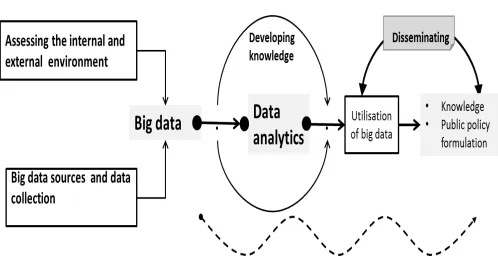
terrorism and public health (Marcus & Davis, 2014). Juxtaposing the technology roadmapping and big
data literatures, Figure 1 was developed. The figure demonstrates technology roadmapping as a
mechanism for making sense of big data, identifying patterns, sources of learning and mechanisms for
knowledge diffusion.
---
Insert Figure 1 about here
---
Recent studies have indicated that the integration of the global economy has been accompanied by new
7 incidence of global epidemics had brought to the fore the need to harness big data to help tackle such
risks. For governments, the advent of large databases means that extracting value from big data is
essential for future success. Although past studies have illuminated our understanding of roadmaps, little
insights have been provided on how governments can marshal technologies in meeting future challenges.
More recently, some scholars have suggested that “the next step of roadmapping applications involved
using this tool to introduce new and emerging technological solutions to social goals” (Vishnevskiy et
al., 2015, p. 434). Over the past few years, more governments’ resources have been deployed to not only
assemble but also analyse big data as the basis for informed public policy (DBIS, 2013). Despite these
important observations, scholars have made little progress in the application of the technology
roadmapping approach to combating social issues. This study seeks to fill this gap in the literature.
3 Research design and data sources
3.1 The research setting: Ebola
The epicentre of the Ebola outbreak was in three countries, namely Guinea, Liberia and Sierra Leone.
This setting is appropriate partly because provides a background to demonstrate how governments and
agencies utilised multiple arrays of data sources to address healthcare issues and emergence. At the time
of the outbreak, the health systems in the three severely countries were generally seen as
under-resourced, understaffed and disjointed to contain such outbreaks or respond to emergencies (Save the
Children (STC), 2015). Indeed, Guinea spent a mere $62 per person on health annually compared with
$3,364 in Britain, whereas Sierra Leone had two doctors per 100,000 people compared with 245 in the
United States (The Economist, 2014f).
By examining how governments and multiple agencies mobilised and utilised data from multiple sources
8 improve their decision making process, governance and combat healthcare emergence (Chandler et al.,
2014; Milinovich, Magalhães & Hu, 2015). In a nutshell, the case-specific event demonstrates how
multiple sources of big data were utilised to make key contributions to wider efforts to address healthcare
emergence in emerging economies characterised by underdeveloped healthcare system.
Nonetheless, the effects extended outside the West African region. Indeed, air passengers from the three
mainly affected countries were screened prior to take-off alongside those with symptoms resembling
Ebola (Carter & Meisel, 2014). Most international direct flights to the three affected countries were
suspended (Mabey et al., 2014). As more of the catastrophic effects of Ebola on people and the countries’
economies came to light, there was a need to explore how big data could help to contain the outbreak.
Prior to 2014, Ebola was largely seen as a neglected disease, but feared largely due to the high mortality
rate. When the Ebola outbreak emerged, it was followed by attempts by the international community to
contain the disease and prevent new infections.
Amassing and disseminating knowledge about the disease was beyond the capacity of any of the affected
countries; therefore collective efforts across countries were required in helping to map resources and
expertise to potentially risky areas. Such a collective approach provided a sound foundation for resources
to be marshalled to help the wider international community be better prepared to manage such risks.
Given that the incubation period for Ebola is 2 to 21 days and there is no effective cure, the ability to
utilise technology to help contain an outbreak was seen as an effective means to mitigate the impact on
wider society (BBC, 2014).
Given that health systems of many developing countries are unable to provide people with essential
services and suffered from misallocation of resources (STC, 2015), harnessing big data can help to
ensure that resources are deployed in a timely and efficient manner. Technological breakthroughs and
9 datasets to be analysed and utilised for the social good. These have helped to improve the quality of
decisions towards tackling global health issues.
By early 2015, the outbreak was gradually being brought under control but the devastating effects for
the industry were evident. In addition, the declining cost of data collection and storage enhanced the
appeal of big data to public policymakers (Komorowski, 2014). By collecting and analysing of reported
cases of new diseases and locations of victims, government could formulate an effective policy to help
allocate resources and treatment. This can also serve as an early-warning system to help public policy
officials in designing their responses.
3.2 Data sources
A case-based research method (Yin, 2003, 2011) was employed to shed light on the subject. The paper
focuses specifically on the Ebola outbreak in West Africa and technologies utilised to help control,
contain and eradicate the outbreak. As Galvin (2004) suggested, the process for assembling and choosing
the content of technology roadmaps entails the examination of multiple issues and stakeholders to help
develop a more robust approach. Given the Ebola outbreak and its impacts on many countries, archival
approach was adopted which entails examining publicly available records of governments and
international agencies (see Welch, 2000; Ellis, 1993). Such archival sources are “critical and under
-utilized research resource” which can be employed to illuminate our understanding as well as advance a
perspective on past events (Forbes & Kirsch, 2011, p. 589; Amankwah-Amoah & Durugbo, 2015).
Furthermore, such archival approach has been found to be effective in seeking to generate new theories,
approaches and “explaining processes of change and evolution” (Welch, 2000, p. 198). To ensure wide
coverage of the voluminous data on the Ebola outbreak, this study adopted three steps from data
10 press releases, locating actions of governments, analysis of technologies and strategies employed to
combat the outbreak, and reporting key technologies used.
The archival records included data on strategies, government policies, surveillance systems and
monitoring techniques from organisations such as the World Bank, World Health Organisation,
International Air Transport Association, African Civil Aviation Authority, International Civil Aviation
Organization and US Centers for Disease Control and Prevention. The press releases of the affected
companies and governments on techniques, strategies and technologies were also examined.
---
Insert Table 1 about here
---
4 Technology and tools for predicting and containing the outbreak
The following sections outline out a range of digital surveillance/internet-based surveillance systems
and traditional monitoring techniques utilised to help combat the disease and outline a path into the
future.
4.1 Digital surveillance systems
Digital surveillance systems often employ modern technologies and seek to analyse big data in the digital
domain to help inform public discussions as well as public health issues (Milinovich et al., 2015).
Emerging technologies can also provide promising opportunities for equipping nations to help fight
contagious diseases. In this direction, technologies that allow easy access to information in a timely
manner provide a good starting point. A number of contemporary technologies were utilised to identify
and contain the outbreak. Social media such as blogs, Twitter, Facebook and online forums presented
voluminous data on current societal perceptions and trends which were monitored in tandem with
11 signs of potential outbreaks. Indeed, social media can provide real-time information on people
movement (Wakefield, 2013).
4.1.1 Mobile mapping
One of the techniques that have been identified to aid the containment effort of Ebola by governments,
medical charities and non-governmental organisations is mobile mapping (Wall, 2014). Mobile phones
are used widely across the developing world. Mobile phone networks produce call data records (CDRs)
which encompass “the phone numbers of the caller and receiver, the time of the call and the tower that
handled it—which gives a rough indication of the device’s location” (The Economist, 2014g, p. 17).
Such information can then be utilised to determine people’s mobility as well as identify where to build
treatment centres.
One of the advantages is that CDRs are immediate and updated in real time which can be utilised by
researchers to gauge potential areas of spread (The Economist, 2014g). This was very much evident in
the recent Ebola outbreak where mobile phone data was used to map out affected areas. Indeed, a sudden
surge in the number of phone calls to “a helpline from one particular area would suggest an outbreak
and alert authorities to direct more resources there … The level of activity at each mobile phone mast
also gives a kind of heatmap of where people are and crucially, where and how far they are moving”
(Wall, 2014, p. nd).
One of the consequences of this is that policymakers were able to decide the best places to set up
treatment centres as well as identify areas to restrict travel to help the outbreak (Wall, 2014). Mobile
phone data can be utilised to determine population movements and therefore how a virus might spread.
The ability to provide instant and timely information can also help potential victims of such viruses to
12
Nevertheless, to date, privacy concerns have often curtailed researchers’ ability to use data stemming
from CDRs in many areas (The Economist, 2014g).
Despite the wider usage of mobile phones and Africa having one of the highest growth markets,
governments in the three Ebola-affected countries were among those that have largely underutilised
mobile data usage to frame public policy. Mobile-phone data have long been utilised by epidemiologists
in combating the spread of the contagious disease. Indeed, such technology has been utilised to map
malaria outbreaks in African countries such as Kenya and Namibia, and modelled population movements
during a cholera outbreak in Haiti in 2010 (The Economist, 2014g).
Furthermore, the use of mobile data faces a number of constraints. First, most mobile phone users in the
affected countries tend to be the young which meant that mobile data captured only a section of the wider
population in an area. Another avenue relates to governments’ ability to force mobile operators to grant
researchers access to such data which restricted efforts to contain the outbreak (The Economist, 2014g).
By being able to identify the high-risk populations, countries would then be able to target their limited
resources to such groups. This would also help in countering the potential for misinformation. In the
case in question, the “Ebola alarmists” contended that the claims by scientists that the disease was
difficult to catch was an attempt to downplay the risk associated (The Economist, 2014c). The
misinformation played a significant role in hampering demand for air travel in unaffected countries in
the regions (Chandler et al., 2014). These suggest that by gleaning insights from big data, governments
would be able to design effective evacuation and quarantine measures to help contain the spread of such
13
4.1.2 Ebola-tracking app
In the last few years, the ability to pinpoint and isolate the exact location of an outbreak has been
identified to equip policymakers to isolate the spread in a timely manner (Smartdatacollective, 2014).
This also helps in deploying resources to combat and contain outbreaks. One major technological
breakthrough in the case of the Ebola outbreak was the emergence of an “Ebola-tracking app” to help in
combating the spread (Wall, 2014). Such innovations in the private sector have proven to be particularly
effective in helping governments to harness data to help solve social issues. The app helped governments
in deciding where to allocate their limited resources. The timely updates also helped healthcare
professionals to upgrade their advice on preventative and control measures to contain the spread. By
marshalling and utilising big data, governments were able to identify and isolate areas, and thereby
provide a basis for better public policy formulation.
During the outbreak, voice and text data were also utilised to gain an understanding of population
movements of people in the affected areas (Smartdatacollective, 2014). Mobile phones also provided an
avenue for health care information to be disseminated to the wider population. Furthermore, mobile
phones can also be utilised to help transmit information about people’s location and positions to form
quarantine measures. Mobile phones also provided mechanisms for government to urge citizens to
volunteer information to help contain the spread. Such an approach can help in advising people to remain
in a particular area to help control the spread of the virus. To an extent, people felt part and parcel of
disease control and information-disseminating efforts. These initiatives and efforts helped to ensure
efficient utilisation of limited government resources as well as dissemination of technical advice to
14
4.1.3 Trend mapping and search engine firms
Over the years, big data has been playing an increasingly important role in forecasting outbreaks to help
governments to be able to devise policies and measures to contain outbreaks. Search engine firms have
increasingly been using technology to forecast flu outbreaks. For instance, multiple internet searches
using terms such as “cold”, “fever” and “Ebola” in a local area can provide a possible indication of an
outbreak. For instance, Google Flu Trends work by combining phrases and words such as “flu” and “flu
symptoms” used to search data collected by search engines (Helft, 2008). The Google service employs
a basket of keywords and phrases connected to flu such as flu symptoms, chest congestion, muscle aches
and so on (Helft, 2008). The billions of flu- and other virus-related searches are being used to help
provide up-to-date information on potential outbreaks.
By combining the words used in a geographical area, it is possible to provide an early-warning signal of
a potential flu outbreak (Helft, 2008). As Crovitz (2013) points out, Google has now amassed expertise
which is better than the US Centers for Disease Control at forecasting flu outbreaks. For instance, Google
collects billions of search terms such as “best cough medicine” and adds location details to track
outbreaks (Crovitz, 2013). The Chinese internet giant Baidu (with more than 160 million daily users)
and the Chinese Centre for Disease Control and Prevention have also explore the use of big data to
forecast flu outbreaks (Deng, 2014).
Recently, search engine firms such as Google and Yahoo have expanded the scope of their operations
to include not only combating viruses that affected computers but also humans (Newman, 2011). One
piece of technology adopted that has emerged in recent years is Google Trends which can allow
individuals, forecasters and scientists to track the popularity of search words and terms (Helft, 2008). It
has been suggested that keywords and phrases used to search such search engines actually represent
15
terms such as “Ebola symptoms” and “Ebola vaccine” in a rural area can help provide an indication of
people’s intention and real-time information. This can be used in tandem with other hospital records in
the area to help inform government decisions.
The rapid expansion and usage of social media means that more and more people are providing instant
messages of their feelings, thoughts and environment to the wider world. This can then be tapped into
to help trace and contain diseases. This also helps to overcome local traditions where individuals may
opt to harbour individuals affected by the virus, thereby providing the conditions for spreading it to close
family members and then the wider community.
Although many Ebola potential victims might remain isolated at home, Google search results provide
an avenue by tracking the number of times individuals within an area search for key terms or phrases.
Indeed, internet search volume surged during the embryonic stage of the outbreak and most Google
searches during 2014 for the term “Ebola” originated from the three affected countries, namely Guinea,
Liberia and Sierra Leone (Milinovich et al., 2015). Data analytics can be fed into wider policy
formulation to help countries prepare for the future eventualities (BBC, 2013). Access to data such as
web pages, browsing habits and smartphone location trails has the potential to enrich our understanding
of human behaviour (Lohr, 2013).
By replicating such access and strategies to gain data, governments would be able to coordinate activities
with healthcare professionals to design and implement successful rapid response as well as being able
to contain potential spread. This also means doctors and public health officials would be able to gain
access to data and thereby design a strategy to ensure implementation. Indeed, in the past Google Flu
Trends was able to “detect the spread of the flu as accurately as and more quickly than the US Centers
16
4.1.4 HealthMap
Another major project geared towards assembling and utilising big data is the HealthMap project which
is associated with the Children’s Hospital Boston supported by Google.org (Helft, 2008). The project
searches through data from an array of sources including blog posts, articles and newsletters, and then
utilises the raw data to create a map that tracks infectious diseases (Helft, 2008, p. A1). By sifting through
millions of social media posts and other online sources, HealthMap was able to predict the Ebola
outbreak about nine days ahead of the World Health Organization formally declaring it as an epidemic
(Smartdatacollective, 2014). HealthMap was able to detect the outbreak partly based on online news
stories and local news stories broadcasting a mysterious fever in Guinea (Milinovich et al., 2015).
HealthMap had the potential to provide real-time access to information and prediction to contain
outbreaks.
By building a digital copy of the physical world, decisions were then made based on assembled data
(Wakefield, 2013). However, such big data analytics required access to rich data such as clinic reports,
media updates and social media which can then provide a basis for identifying danger spots more
accurately and thereby guiding resource deployment decisions (Smartdatacollective, 2014).
Another technology utilised in combating other diseases include Earth-observing satellites. Indeed,
scientists have been using space data in tandem with fieldworkers to predict the risk of diseases such as
malaria and dengue fever (Amos, 2015). The use of such data to track the dynamics of diseases had been
demonstrated to help governments make better and more informed decisions. This can also enable public
policymakers and government to glean knowledge and insights from unstructured big data to formulate
an effective public policy. Scientists have been using satellite information to predict where infections
are likely to occur and thereby enabling governments to tailor their limited resources to where they are
17 Another explanation suggests that the rise of social media sites such as Twitter and Facebook, in tandem
with globalisation and accessibility of cheap mobile phones, has been accompanied by an explosion of
data such as twits, comments and opinion posts (EIU, 2012). The growth of big data is partly stimulated
by the increasing use of social media and rapidly improving access to new sources of data. The explosion
in availability of social media has meant that there is now more promising opportunities for government
to assemble such data to better understand human behaviour and attitudes. As the influence of social
media continues to grow and proliferate through global societies, increasingly more promising
opportunities are being provided for big data to be harnessed to address social problems. As such, data
from search engines and mobile phones helped provide faster access to information on the outbreak
(Deng, 2014). This also provides an opportunity to disseminate information on quarantine measures to
the wider population.
4.2 Traditional monitoring system
In addition to above, governments of the affected countries also relied on traditional methods of data
collection through hospitals and government agencies. Data from hospitals, schools and government
agencies were utilised to gauge the nature of disease spread as well as to help ensure efficient deployment
of government resources. The ability to track outbreaks within the population can equip countries in
devising effective measures to contain them. Under such circumstances, equipping doctors, workers and
frontline staff with the expertise to be able to make sense of big data appeared essential. This is very
important because at times the traditional monitoring system through surveillance from local hospitals
often fails to identify individuals who fail to go to hospital to get professional treatment or advice. This
means there is a need for an effective national strategy that aligns closely the relationship between data
collection and data analysis leading to public policy formulation (Amankwah-Amoah, 2015). Doctors
18 The use of CDRs was partly a shift from the traditional reliance on surveys and national census data.
This means the vast reservoir of data can then be disseminated to the fieldworkers to inform tactical and
strategic actions. As such, the ability to chart a clear map for combating such outbreaks in the future can
equip countries. It is worth noting that the countries have historically demonstrated an ability to collect
data, but quality of analysis for some is generally weak and not effectively linked to resource allocation
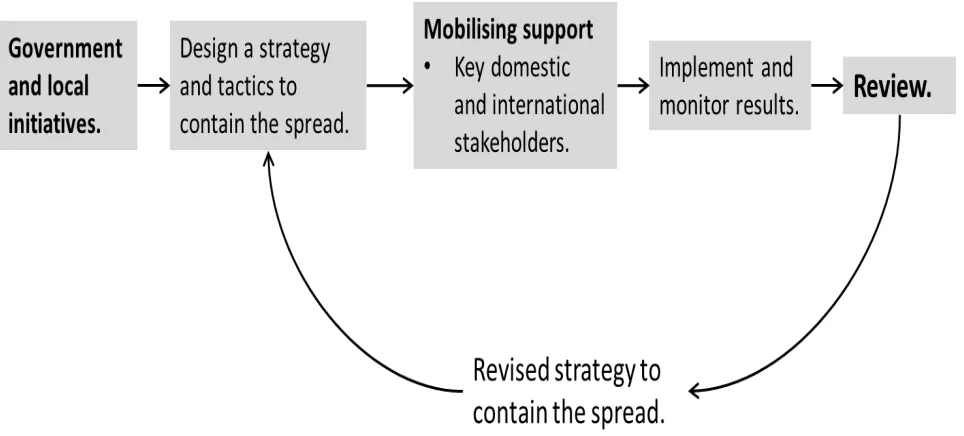
and deployment. The above arguments led to the identification of a roadmap showing how big data can
be utilised to help improve healthcare delivery and combat such outbreaks.
Based on these, an integrated roadmapping of harnessing big data to combat the contagious disease was
developed, as illustrated in Figure 2. The basic structure for utilising big data includes key building of
identifying the data sources, data analytics and public policy formulation.
---
Insert Figure 2 about here
---
5 Integrating monitoring systems and extracting value from big data
Big data analysis can shed light on subtle correlations which smaller data sets might overlook (Marcus
& Davis, 2014). It is apparent that neither the emerging technologies alone nor traditional methods can
effectively combat the spread of contagious diseases. It is worth noting that crunching data alone is
insufficient in fostering understanding of complex datasets.
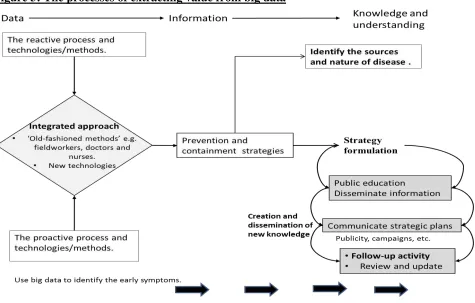
Based on the technologies employed to combat the outbreak, big data can be utilised in both a proactive
and reactive processes, as demonstrated in Figure 3. The reactive mode focuses on adapting and
responding to the outbreak. Dissemination of information in a timely manner can equip healthcare
professionals to diagnose and recommend appropriate treatment or courses of action to help contain any
19 but also to minimise misallocation of attention and resources associated with not sensing potential
problems sooner. The proactive process entails using technologies such as mobile information to help to
identify geographical location areas for potential outbreaks. This means employing complementary
competences and deploying resources to help quarantine efforts.
One key tenet is that the ability to make sense of and utilise the wide reservoir of data can equip countries
to prepare for disasters. For such underdeveloped countries, acquiring knowledge and disseminating it
in a timely manner is essential to enhance their preparedness for future outbreaks (WDR, 1998).
Harnessing and utilising big data could accelerate the pace at which knowledge is created and
disseminated across national borders. This helps to bridge the knowledge and information gaps that often
exist between developed and developing countries. An integration of both the proactive and reactive
approaches appears essential for future success.
---
Insert Figure 3 about here
---
In today’s globalised economy, countries with access to a wider range of data about the spread of
diseases and locations of potential victims stand a better chance of being able to spot problems and take
contingence measures. However, to date relatively few countries are able to extract value from big data
often due to the underdeveloped workforce and obsolete skills (Amankwah-Amoah, 2015).
Furthermore, governments’ ability to craft effective policy is partially rooted in the ability to synthesise
and utilise big data. Figure 4 demonstrates a framework for extracting value from big data.
---
Insert Figure 4 about here
20
6 Discussion and conclusions
The study was designed to explore how government can harness and utilise big data to combat healthcare
issues. Using insights from the Ebola outbreak in West Africa, the analysis indicates that the ability to
harness and utilise big data partly depends on governments’ ability to bring structure and clarity to the
data to generate awareness and responsiveness. The ability to synthesise insights from both the
traditional monitoring systems and modern technologies offers a path towards facilitating knowledge
diffusion and effective government policies. Furthermore, the integration of both the internet-based
surveillance systems and traditional monitoring techniques is essential for governments seeking to
extract value from big data whilst concurrently combating infectious diseases.
6.1 Contributions to practice
From a public policy standpoint, the study indicates that governments can establish national centres to
coordinate and disseminate knowledge on latest technologies about such outbreaks. Such centres can
inform the wider public about new preventative measures, and bring together best practices. There is
also a need to utilise emerging technologies as a key mechanism through which to disseminate
information about other outbreaks.
Perhaps even more importantly, there is also a need for effective coordination between healthcare
professionals to help bring together related competences to utilise big data to address healthcare
challenges. This suggests a need to ensure that future plans to contain any spread of an outbreak should
entail cross-functional teams with expertise from government, industry and academia. In addition, the
analysis also suggests the need for countries to upgrade workforce skills in key aspects of data analytics
and data management to be able to extract value from big data. Building big data analytics capability
21 By narrowing information and knowledge gaps between developing and developed countries, such
emerging or developing economies would be better equipped for such outbreaks (WDR, 1998).
Furthermore, the analysis indicates that big data alone cannot fight all contagious diseases. As Ghani et
al. (2014, p. 977) put it: “big data is not a panacea for all the unanswered questions regarding the delivery,
access, and quality of health care”. This needs to work in tandem with other traditional approaches such
as fieldworkers and nurses to help contain the spread of such viruses.
6.2 Limitations and directions for future research
A possible limitation of this study is that the story of the Ebola outbreak occurred in West Africa, the
findings reported here might be generalised to other context. In addition, this study is largely exploratory
and therefore further examination of the approaches and techniques is required. One area that has
garnered less attention is how big data can be further utilised in developing countries where
technological infrastructure is often at a nascent stage of development such as the three countries affected
by the outbreak.
A promising line of future research would be to examine mechanisms through which government
resources can be orchestrated to accrue maximum value from big data. It is hoped that this study serves
as a preliminary step towards a better understanding of how big data can be utilised to enhance the
capacity of nations to combat contagious diseases.
References
Amankwah-Amoah, J. (2014). A unified framework of explanations for strategic persistence in the wake of others’ failures. Journal of Strategy and Management, 7(4), 422–444.
Amankwah-Amoah, J. (2014). Old habits die hard: A tale of two failed companies and an unwanted inheritance. Journal of Business Research, 67(9), 1894–1903.
22
Amankwah-Amoah, J. (2015c). Explaining declining industries in developing countries: The case of textiles and apparel in Ghana. Competition and Change, 19(1), 19–35.
Amankwah-Amoah, J. (2015d). Solar energy in sub-Saharan Africa: The challenges and opportunities of technological leapfrogging. Thunderbird International Business Review, 57(1), 15–31.
Amankwah-Amoah, J., & Debrah, Y. (2014). Air Afrique: The demise of a continental icon. Business History, 56(4), 517–546.
Amankwah-Amoah, J., & Debrah, Y. A. (2010). The protracted collapse of Ghana Airways: Lessons in organizational failure. Group and Organization Management, 35(5), 636–665.
Amankwah-Amoah, J., & Zhang, H. (2015). “Tales from the grave”: What can we learn from failed international companies? Foresight, 17(5), 528–541.
Amankwah-Amoah, J., 2015a. Safety or no safety in numbers? Governments, big data and public policy formulation. Industrial Manag. Data System, 115(9), 1-10.
Amankwah-Amoah, J., Durugbo, C., 2015. The rise and fall of technology companies: The evolutional phase model of ST-Ericsson's dissolution. Technol. Forecast. Soc. http://dx.doi.org/10.1016/j.techfore.2015.04.005.
Amankwah-Amoah, J., Sarpong, D., 2015. Historical pathways to a green economy: The evolution and scaling-up of solar PV in Ghana, 1980-2010. Technol. Forecast. Soc. //dx.doi.org/10.1016/j.techfore.2015.02.017.
Amos, J., 2015.Satellites track snail disease risk. (Available at: http://www.bbc.co.uk/news/science-environment-31483629. Accessed: 1 May 2015).
BBC. 2013. Big data: Predicting and preventing rugby injuries. (Available at: http://www.bbc.co.uk/news/health-24836161. Accessed: 2 June 2014).
BBC. 2014. Ebola outbreak: Asky bans flights in West Africa. (Available at: http://www.bbc.co.uk/news/world-africa-28550906. Accessed: 2 Jan 2015).
Bhimani, A., 2015. Exploring big data’s strategic consequences. J. of InfoTech. 30, 3066-3069.
Brennan, N., Oelschlaeger, A., Cox, C., Tavenner, M., 2014. Leveraging the big-data revolution: CMS is expanding capabilities to spur health system transformation. Health Affairs, 33(7), 1195-1202.
Chandler, C., Fairhead, J., Kelly, A., Leach, M., Martineau, F., Mokuwa, E. ... & Wilkinson, A., 2014. Ebola: limitations of correcting misinformation. The Lancet, 385 (9975), 1275-1277.
Chen, H., Chiang, R. H., Storey, V. C., 2012. Business intelligence and analytics: From big data to big impact.
MIS quarterly, 36 (4), 1165-1188.
Crovitz, G. L., 2013. Why 'big data' is a big deal. (Available at: http://www.wsj.com/articles/SB10001424127887324077704578364632408717740. Accessed: 2 Jan 2015).
Davidian, M., Louis, T. A., 2012. Why statistics? Science, 336 (6077), 12.
23
Deng, C., 2014. Baidu turns to big data to forecast flu outbreaks. (Available at: http://blogs.wsj.com/digits/2014/06/10/baidu-turns-to-big-data-to-forecast-flu-outbreaks/. Accessed: 2 Jan 2015).
EIU (Economist Intelligence Unit). 2011. Big data: Harnessing a game-changing asset. London: EIU.
EIU (Economist Intelligence Unit). 2012. Big data: Lessons from the leaders. London: EIU.
Ellis, J., Ed., 1993. Keeping archives. Rr Bowker Llc.
Forbes, D., Kirsch, D., 2011. The study of emerging industries: Recognizing and responding to some central problems. J. of Bus. Vent. 26, 589–602.
Galvin, R., 2004. Roadmapping - a practitioner's update. Technol. Forecast. Soc. 71, 101-103.
Garcia, M. L. & Bray, O.H. 1997. Fundamentals of Technology Roadmapping. Albuquerque, NM: Sandia Nat. Labs (SAND97-0665).
George, G., Haas, M. R., Pentland, A., 2014. Big data and management. Acad. Manag. J., 57 (2), 321-326.
Geum, Y., Lee, H., Lee, Y., Park, Y., 2015. Development of data-driven technology roadmap considering dependency: An ARM-based technology roadmapping. Technol. Forecast. Soc. 91, 264-279.
Ghani, K. R., Zheng, K., Wei, J. T., Friedman, C. P., 2014. Harnessing big data for health care and research: are urologists ready? European Urology, 66 (6), 975-977.
Goes, P. B., 2014. Big Data and IS Research. MIS Quarterly, 38 (3), iii-viii.
Hay, S. I., George, D. B., Moyes, C. L., Brownstein, J. S., 2013. Big data opportunities for global infectious disease surveillance. PLoS medicine, 10 (4), e1001413.
Helft, M., 2008. Google uses searches to track flu’s spread. New York Times, November 12, A1
Kerr, C.I.V., Phaal, R., Probert, D.R., 2013. Roadmapping as a Responsive Mode to Government Policy: A Goal-Orientated Approach to Realising a Vision. In M. G. Moehrle, R. Isenmann and R. Phaal (Eds.). Technology Roadmapping for Strategy and Innovation: Charting the Route to Success. Berlin Heidelberg: Springer-Verlag.
Komorowski, M., 2014. A history of storage costs. (Available at: http://www.mkomo.com/cost-per-gigabyte. Accessed: 2 Jan 2015).
Kostoff, R. N., Schaller, R. R., 2001. Science and technology roadmaps. Engineering Management, IEEE Transactions, 48 (2), 132-143.
Lee, C., Song, B., Park, Y., 2015. An instrument for scenario-based technology roadmapping: How to assess the impacts of future changes on organisational plans. Technol. Forecast. Soc. 90, 285-301.
Lohr, S., 2012a. The age of big data. New York Times, February 12, SR1.
Lohr, S., 2012b.How Big Data Became So Big. Aug 11, New York Times, BU3.
24
Lohr, S., 2014. In big data, shepherding comes first. Dec. 14, New York Times, B1.
Mabey, D., Flasche, S., Edmunds, W. J., 2014. Airport screening for Ebola. BMJ, 349, g6202.
Marcus, G., Davis, E., 2014. Eight (no, nine!) problems with big data. April 6, New York Times, A23.
McAfee, A., Brynjolfsson, E., 2012. Big data: the management revolution. Harvard Business Review, 90 (10), 60-68.
McDowall, W., 2012. Technology roadmaps for transition management: The case of hydrogen energy. Technol. Forecast. Soc. 79 (3), 530-542.
Milinovich, G. J., Magalhães, R. J. S., Hu, W., 2015. Role of big data in the early detection of Ebola and other emerging infectious diseases, The Lancet Global Health, 3(1), e20- e21.
Newman, A. A., 2011. Using Google’s data to reach consumers. New York Times, December 23, B3.
Phaal, R., Farrukh, C.J.P., Probert, D. R., 2004. Technology roadmapping - A planning framework for evolution and revolution. Technol. Forecast. Soc. 71, 5-26.
Save the Children. 2015. A wake-up call: Lessons from Ebola for the world’s health systems. London: Save the Children.
Smartdatacollective (2014. What the Ebola crisis has taught us about big data. (Available at: http://smartdatacollective.com/gilallouche/286011/what-ebola-crisis-has-taught-us-about-big-data. Accessed: 2 Jan 2015).
The Economist. 2014a. Unintended consequences. 412 (8903), 50
The Economist. 2014b. Ebola and travel: Flying fear. (Available at: http://www.economist.com/blogs/gulliver/2014/10/ebola-and-travel-0. Accessed: 2 Jan 2015).
The Economist. 2014c. The Ebola alarmists. 413 (8908), 36.
The Economist. 2014d. Ebola's global reach. (Available at: http://www.economist.com/blogs/graphicdetail/2014/10/daily-chart-5. Accessed: 2 Jan 2015).
The Economist. 2014e. Panicking only makes it worse. 412 (8900), 50.
The Economist. 2014f. Fever rising. 412 (8900), 48–50.
The Economist. 2014g. Call for help. 413 (8910), 17.
The Economist. 2015. The toll of a tragedy. (Available at: http://www.economist.com/blogs/graphicdetail/2015/02/ebola-graphics. Accessed: 2 Jan 2015).
The White House. 2014. Big Data and Privacy Working Group Review. Press releases. Washington: Office of the Press Secretary.
25
Wakefield, J., 2013.Tomorrow's cities: How big data is changing the world. (Available at: http://www.bbc.co.uk/news/technology-23253949. Accessed: 2 Jan 2015).
Wall, M., 2014. Ebola: Can big data analytics help contain its spread? (Available at: http://www.bbc.co.uk/news/business-29617831. Accessed: 2 Jan 2015).
Walsh, S.T., 2004. Roadmapping a disruptive technology: a case study: the emerging microsystems and top-down nanosystems industry. Technol. Forecast. Soc. 71, 161–185.
Wamba, S. F., Akter, S., Edwards, A., Chopin, G., Gnanzou, D., 2015. How ‘big data’ can make big impact: Findings from a systematic review and a longitudinal case study. Int J. of Pro. Eco.
(doi:10.1016/j.ijpe.2014.12.031).
WDR (World Development Report) (1998). Knowledge for Development. Washington, D.C.: World Bank
Welch, C., 2000. The archaeology of business networks: the use of archival records in case study research. J. Strateg. Markt. 8 (2), 197–208.
Woerner, S. L., Wixom, B. H. 2015. Big data: extending the business strategy toolbox. J. of InfoTech. 30, 60-62.
World Bank. 2011. World Bank 2011: Conflict, Security, and Development. Washington, DC: World Bank.
World Bank. 2013. Risk and Opportunity: Managing Risk for Development. Washington DC: International Bank for Reconstruction and Development/World Bank.
World Bank. 2014. Ebola: New World Bank Group study forecasts billions in economic loss if epidemic lasts longer, spreads in West Africa. (Available at: http://www.worldbank.org/en/news/press- release/2014/10/08/ebola-new-world-bank-group-study-forecasts-billions-in-economic-loss-if-epidemic-lasts-longer-spreads-in-west-africa. Accessed: 2 Jan 2015).
Yin, R. K., 2003. Case study research: Design and methods. Third edition, Thousand Oaks, CA: Sage Publications.
26
Figure 1: Big data to knowledge dissemination
27
Figure 3: The processes of extracting value from big data
28
Table 1: The approaches to data collection and analysis
Steps Descriptions
Inclusion criteria
Ebola-related technologies used.
Technologies utilised to contain spread and prevent the spread of the outbreak. Stage 1:
Searching
Exploration and review of Ebola-related press releases by governments and international organisations.
Examination of containment measures and technologies adopted by governments. Locating other actions by governments in the affected countries.
Stage 2: Screening
Screening and analysis of the data assembled in stage 1.
Screening and analysis of technologies and strategies employed to combat the outbreak.
Stage 3: Synthesis and findings
Data analysis: making sense of data.
Utilisation of data from multiple sources to inform the analysis.
Employment of diagrams and figures to convey relationships between factors and issues.