Fabrication of Ti-Zr Binary Metallic Wire by Arc-Melt-Type
Melt-Extraction Method
Takeshi Nagase
1;2;*1, Koichi Kinoshita
3;*2, Takayoshi Nakano
2and Yukichi Umakoshi
41
Research Center for Ultra-High Voltage Electron Microscopy, Osaka University, Ibaraki 567-0047, Japan
2Division of Materials and Manufacturing Science, Graduate School of Engineering, Osaka University, Suita 565-0871, Japan
3Department of Mechanical Science and Bioengineering, Graduate School of Engineering Science, Osaka University,
Toyonaka 560-8531, Japan
4National Institute for Materials Science, Tsukuba 305-0047, Japan
Ti-Zr binary metallic wires without toxic elements were developed by an arc-melt-type melt-extraction method for potential application as biomedical materials. The Ti-Zr binary alloy showed high wire forming capability during the melt-extraction process, independent of the Ti concentration. Therefore, it was possible to form rapidly quenched wires using Ti100xZrx(x¼10at% to 80 at%) alloys. Continuous binary
Ti-Zr alloy wires had good white luster, negligible surface roughness, high tensile strength, and high bending ductility. [doi:10.2320/matertrans.MRA2008379]
(Received October 14, 2008; Accepted January 26, 2009; Published March 11, 2009)
Keywords: titanium-based alloy, rapidly quenched wire, melt-extraction method, biomaterial
1. Introduction
Several methods are available for the fabrication of fine metallic wires rapidly quenched from the metallic melt: (1) free-flight melt-spinning method,1) (2) glass-coated melt-spinning method,2–5) (3) in-rotating-liquid spinning meth-od,6,7)(4) spinning in gas atmosphere followed by winding in rotating liquid method8,9) and (5) melt-extraction meth-od.10–13) The in-rotating-liquid spinning method has been improved significantly, and industrial production of high-quality crystalline or amorphous metal wire is now standard. The in-rotating-liquid spinning method is used to industrially produce Fe-Si-B- and Co-Si-B-based metallic amorphous wires with superior mechanical properties, high corrosion resistance and unique soft magnetic properties.14–16)
How-ever, this process requires a liquid cooling medium. It is difficult to fabricate Al-, Mg-, Ti-, and Zr-based alloy wires by this process due to the high reactivity of these alloys, in their molten state, with the liquid cooling medium. Thus far, only Ti-Ni-based crystalline alloy wires containing about 50 at% Ti have been prepared by the in-rotating-liquid melt spinning method for the production of shape memory alloys, as shown in Table 1.17–19)
Melt-extraction without a cooling medium may be used to fabricate continuous metallic alloy wires that have high reactivity in the molten state. Wires of Ti-Cu-Zr amor-phous20)and Zr-based alloys21)have been produced by the
melt-extraction method, but they contain toxic elements such as Cu and Ni. Melt-extracted Ti-based alloy wires without toxic elements have potential application as biomedical materials. Recently, Kobayashiet al.have reported that Ti-Zr binary alloys without toxic elements have superior mechan-ical properties, and hence, they are suitable for biomedmechan-ical applications.22) However, systematic research on the fabri-cation and properties of melt-extracted Ti-Zr alloy wires has not been conducted. The first aim of this study is to fabricate
Ti-Zr binary alloy wires by the arc-melt-type melt-extraction method,21,23) and the second aim is to investigate the
morphology, structure, and mechanical properties of melt-extracted Ti-based alloy wires.
2. Experimental Procedure
In this study, binary Ti-Zr mother alloys (Ti100xZrx, where x¼10, 20, 40, 50, 60 and 80) with different concentrations of Ti and Zr were prepared. The concentra-tions are expressed in nominal atomic percent. Master ingots were prepared by arc melting a mixture of pure Ti and Zr (purity>99.9%) under a highly pure Ar gas atmosphere (purity>99.99%). Rapidly quenched wires were prepared by the arc-melt-type melt-extraction method.
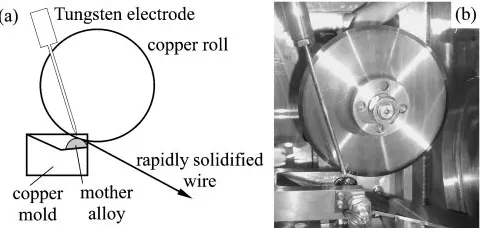
Figure 1 shows (a) a schematic illustration and (b) the corresponding image of the apparatus (NISSIN-GIKEN, NEV-AT3). The diameter of the Cu-roll used in this method was 200 mm, and the angle of the edge was fixed at 60. The rotation speed was maintained at 2000 rpm, and the circum-ferential velocity of the Cu roll was 21 ms1. Mother alloys were arc melted from the master ingots under an Ar gas atmosphere on a water-cooled Cu mold. This apparatus allowed us to control the position of the Cu roll. The
Fig. 1 Schematic illustration of arc-melt-type melt-extraction method used in this study. (a) Schematic illustration of the method and (b) photograph of the apparatus.
*1Corresponding author, E-mail: [email protected] *2Graduate Student, Osaka University
[image:1.595.307.547.633.749.2]Table 1 Rapidly quenched metallic fibers and wires obtained from the metallic melt for Ti-Ni and Ti-Cu based alloys.
Alloy-system Alloy composition Process Constituent Phase Reference
Ti-Ni Ti49:3Ni50:7 In Rotating Liquid Spinning Crystal 17)
Ti-Ni-Cu Ti50Ni42:5Cu7:5 In Rotating Liquid Spinning Crystal 18)
Ti50Ni35Cu15 In Rotating Liquid Spinning Crystal 18)
Ti50Ni30Cu20 In Rotating Liquid Spinning Crystal 18)
Ti50Ni25Cu25 In Rotating Liquid Spinning Crystal 18)
Ti50Ni20Cu30 In Rotating Liquid Spinning Crystal 18)
Ti-Ni-Zr-Hf Ti4050Ni4251(Zr,Hf)316 In Rotating Liquid Spinning Crystal 19)
Ti-Cu-Zr Ti40Zr10Cu50 Melt-extraction Amorphous 20)
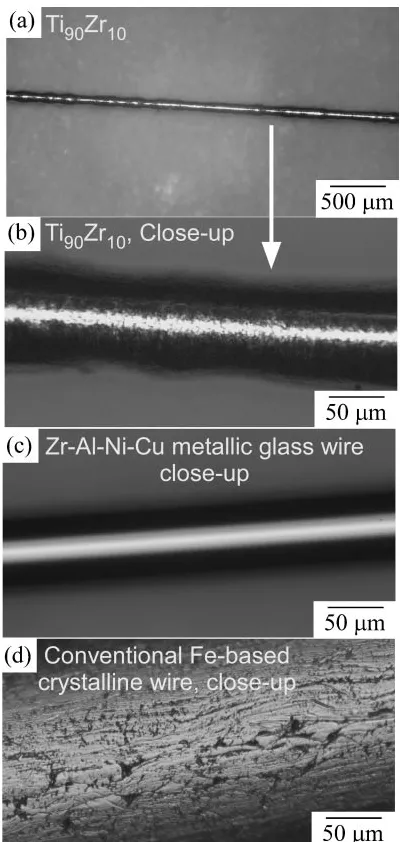
Fig. 2 Appearance of melt-extracted binary Ti-Zr alloy wires and Zr-Al-Ni-Cu metallic glass wire: (a) Ti90Zr10, (b) Ti80Zr20, (c) Ti60Zr40,
[image:2.595.113.483.238.761.2]extraction of the molten mother alloy was performed by moving down the rotating Cu roll. The above conditions are similar to those used for the preparation of Zr-based metallic glass wires, as described in previous papers.21,24) The
constituent phases were identified by X-ray diffraction (XRD) using Cu-K radiation, differential scanning calo-rimetry (DSC) at a heating rate of 0.67 Ks1, and optical microscopy (OM) observation. The surface morphology was examined by OM and scanning electron microscopy (SEM). The tensile property of the wire specimens was measured at a strain rate of4:2104s1 in air by an Instron-type testing machine. Ductility was evaluated by a simple bending test; a ductile wire can be bent through an angle of 180without any fracture.
3. Results
[image:3.595.326.526.70.491.2]Figure 2 shows the appearance of melt-extracted binary Ti-Zr alloy wires together with a melt-extracted Zr65Al7:5 -Ni10Cu17:5 metallic glass wire:21)(a) Ti90Zr10, (b) Ti80Zr20, (c) Ti60Zr40, (d) Ti20Zr80, and (e) Zr65Al7:5Ni10Cu17:5 metal-lic glass. Continuous metalmetal-lic alloy wires can be obtained by using Ti-Zr based binary alloys (Fig. 2(a), (b), (c), and (d)) as well by metallic glass alloy in Fig. 2(e). The fabrication of rapidly quenched Ti-based alloy with a wide compositional range between Ti90Zr10 and Ti20Zr80 was carried out in this study. All the melt-extracted wires showed white metallic luster, similar to that of the melt-extracted Zr-based metallic glass wire and Fe-based metallic crystalline wire prepared by the conventional wire-drawing process. This indicates that an undesired thick oxide layer is not formed during the melt-extraction process.
Figure 3 shows typical examples of the outer surface of the melt-extracted binary Ti-Zr alloy wires (Figs. 3(a) and (b)) together with a Zr-Al-Ni-Cu metallic glass wire for reference (Fig. 3(c)) and Fe-based crystalline wire prepared by the conventional wire-drawing process (Fig. 3(d)). There is some variation in the diameter of the melt-extracted Ti90Zr10wire shown in Fig. 3(a). The close-up image of the Ti90Zr10wire (Fig. 3(b)) shows that its surface is slightly rough; in contrast, the melt-extracted metallic glass wire (Fig. 3(c)) has a mirror surface without any roughness. The surface roughness may be attributed to the crystallization of the melt and/or phase transition during free flight in the Ar gas atmosphere. The occurrence of crystallization was confirmed by XRD analysis and DSC measurement, as explained later. The degree of surface roughness of the melt-extracted Ti90Zr10 wire was less than that of the conventional Fe-based crystalline wire (Fig. 4(d)). Rapid solidification of the Ti90Zr10 melt during free flight in Ar gas may have suppressed crystal growth and the subsequent formation of fine crystals, resulting in the formation of continuous wires with negligible surface roughness.
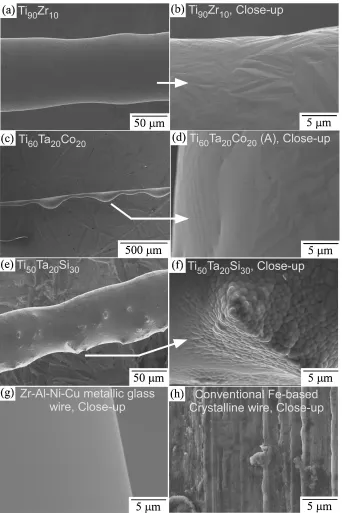
Figure 4 shows the surface morphology of the melt-extracted wires observed by SEM. It is well known that the surface morphology of melt-extracted wires is sensitive to the alloy system, because wetting of the Cu-roll for molten alloy, viscosity, surface tension, and thermal conductivity of the alloy affect the formation of the wire and its solidification behavior.12,13,20,21) The surface morphology of the
melt-extracted binary Ti-Zr alloy wire (Fig. 4(a) and (b)) and that of other alloy wires, melt-extracted Ti-Ta-Co (Fig. 4(c) and (d)) and Ti-Ta-Si (Fig. 4(e) and (f)), are shown as typical examples of a droplet former type and sharp-pointed region former type, respectively. In Fig. 4(a), the variation in the diameter of the Ti90Zr10 alloy can be seen, despite the fact that it is a continuous wire. The degree of variation in the diameter of this alloy is much smaller than that of the droplet former type Ti60Ta20Co20alloy wire (Fig. 4(c)). Strom-Olsen suggested that droplets are formed in a melt-extracted wire when the cooling rate is quite low and insufficient to prevent the formation of Rayleigh waves.13)In this study, the cooling
rate of the melt-extracted Ti-Zr alloy can be considered to be sufficient to form a continuous wire without significant droplet formation. The diameter of the Ti50Ta30Si20 alloy wire (Fig. 4(e)) also varies, and it consists of many sharp-pointed regions; however, the Ti90Zr10 alloy wire does not consist of such undesired regions.
Fig. 3 Surface appearance of melt-extracted binary Ti-Zr alloy wire together with Zr-Al-Ni-Cu metallic glass wire and conventional Fe-based crystalline wire prepared by a wire-drawing process: (a) Ti90Zr10, (b) a
close-up image of Ti90Zr10, (c) Zr65Al7:5Ni10Cu17:5, and (d) a conventional
The close-up image of the Ti90Zr10 alloy wire (Fig. 4(b)) shows that it does not have a mirror surface, which is a typical feature of a metallic glass wire (Fig. 4(g)), but a very fine faceted surface. The Ti60Ta20Co20 alloy wire also has a similar faceted surface (Fig. 4(d)). In the Ti50Ta20Si30 alloy wire (Fig. 4(f)), dendrite formation is observed on the surface. The sharp-pointed regions are attributed to the coarse dendrite formation. The degree of surface roughness of the Ti90Zr10(Fig. 4(b)) and Ti60Ta20Co20(Fig. 4(d)) alloy wires with a fine faceted surface is less than that of the
Ti50Ta30Si20 (Fig. 4(f)) alloy wire with coarse dendrite and the conventional metallic crystalline wire prepared by the wire-drawing process (Fig. 4(h)). Therefore, we see that melt-extracted Ti90Zr10 alloy exhibits a good capability for continuous wire formation. Moreover, the fabricated wire shows small variation in diameter and negligible surface roughness. Binary Ti-Zr alloy wires also have such features, irrespective of their composition.
The constituent phases of the melt-extracted binary Ti-Zr alloy wires were investigated by both XRD analysis and DSC Fig. 4 SEM images of melt-extracted binary Ti-Zr alloy wire, Ti60Ta20Co20 alloy wire (a typical example of droplet former-type);
Ti50Ta20Si30alloy wire (a typical example of sharp-pointed region former-type); Zr-Al-Ni-Cu metallic glass wire and conventional
Fe-based crystalline wire prepared by wire-drawing process; (a) Ti90Zr10, (b) a close-up image of Ti90Zr10, (c) Ti60Ta20Co20, (d) a close-up
image of Ti60Ta20Co20, (e) Ti50Ta20Si30, (f) a close-up image of Ti50Ta20Si30, (g) Zr65Al7:5Ni10Cu17:5, and (h) a conventional Fe-based
[image:4.595.128.470.70.583.2]measurement. Figure 5 shows XRD patterns of melt-extract-ed Ti100xZrx(x¼10, 20, 40, 50, 60, and 80) alloy wires. All the alloys show sharp diffraction peaks originated from the crystalline-(Ti, Zr) phase. Figure 6 shows the DSC curve of the binary Ti-Zr crystalline wire heated at a rate of 0.67 Ks1. The Ti100xZrx(x¼20, 40, 50, 60 and 80) crystalline wire exhibits an endothermic reaction. This is due to the transition from the-phase to the-phase, which is in good agreement with the binary Ti-Zr equilibrium phase diagram.25) Sharp exothermic peaks, typically observed during the crystalliza-tion of an amorphous phase, cannot be observed. These results indicate that melt-extracted wires do not contain a metastable amorphous phase but an-solid solution crystal-line phase, which is predicted by observing the outer surface through OM and SEM, as shown in Figs. 3 and 4.
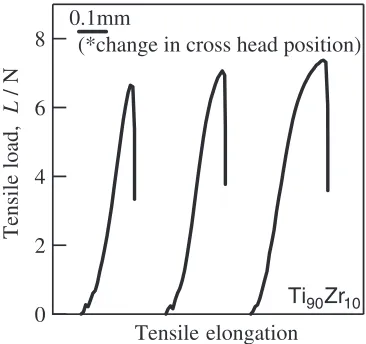
The mechanical properties of the melt-extracted Ti90Zr10 crystalline wires were investigated by a tensile test in air. Figure 7 shows typical examples of tensile load-elongation curves. In this study, tensile stress was not evaluated, because of the variation in the diameters of the wires. The elongation of the wires was measured by determining the displacement of a crosshead and not by using a strain gage. The tensile load-elongation curves of each sample are different because of experimental artifacts resulting from difficulties involved in the chucking of the measured wire, whose diameter was approximately 100mm. The tensile stress is estimated to be
about 900 MPa if the diameter of the wires is assumed to be 100mm. This value can be considered to be comparable to the tensile strengths reported to date: 862 MPa for as-cast Ti50Zr50 alloy37) and 900 MPa for as-cast Ti-Zr alloy with an0= structure.30)All the wires fabricated from the
melt-extracted binary Ti-Zr alloys were bent through an angle of 180 without any fracture. Therefore, ductile metallic wires with high tensile strength can be produced from Ti-Zr alloys in a wide composition range.
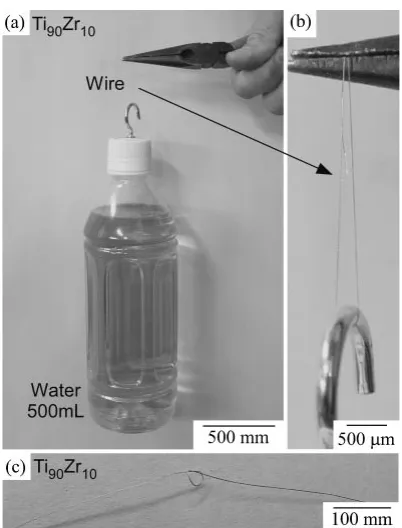
Figure 8 shows the high tensile strength and ductility of the melt-extracted Ti90Zr10 crystalline wire. The
melt-Intensity (arbitrary unit)
80 70 60 50 40 30
2θ°
Ti50Zr50 Ti80Zr20
Ti60Zr40
Ti40Zr60
Ti20Zr80 Ti90Zr10 α-(Ti, Zr)
Fig. 5 X-ray diffraction patterns of melt-extracted binary Ti-Zr alloy wires.
Endo.
∆
H (arbitrary unit) Exo.
1000 900 800 700 600 500
Temperature, T / K Ti40Zr60
Ti20Zr80 Ti90Zr10
Ti50Zr50 Ti60Zr40 Ti80Zr20
Fig. 6 DSC curves of melt-extracted binary Ti-Zr alloy wires obtained at a heating rate of 0.67 Ks1.
8
6
4
2
0
Tensile load,
L
/ N
Tensile elongation
0.1mm
(*change in cross head position)
Ti
90Zr
10Fig. 7 Tensile load-elongation curves of melt-extracted Ti90Zr10 wires.
() The length of tensile test specimens is 10 mm. The elongation of the
[image:5.595.96.246.68.411.2] [image:5.595.343.512.71.337.2] [image:5.595.336.519.397.569.2]extracted wire was not fractured when it was used to lift a heavy load. It should be noted that the wire can be bent through an angle of 180without any fracture despite heavy loading of approximately 500 g, as shown in Fig. 8(b). The wire did not break even when it was tightly squeezed by a pair of needle-nose pliers. The superior ductility of the wire is also confirmed by Fig. 8(c). The high-tensile strength and high bending-ductility properties of the melt-extracted Ti-Zr metallic wires indicates its potential for use in biomedical applications, such as scaffolding for cell adherence, micro-mesh abrasives, micro-wires for stents, and so on.
4. Discussion
In this study, continuous binary Ti-Zr alloy wires with negligible surface roughness were obtained by the arc-melting type melt-extraction method, despite the high reactivity of the alloys in the molten state. Only a few systematic studies have been conducted on the dominant factors that control the formation of continuous metallic fibers and wires during rapid quenching of metallic melt. It is reported that metallic glass alloys show good capability for wire formation by the arc-melt-type melt-extraction method.21,23,24,28,29) The metallic glass formation criterion
cannot be adapted in this study. In the in-rotating-liquid spinning method, the temperature interval between liquidus and solidus is considered to be a very important factor for the formation of a continuous wire.26,27) The wider the temperature interval, the longer the time of coexistence of the liquid and solid. In other words, the free-flight time of the molten metal increases with the temperature interval between liquidus and solidus. A wide temperature interval is
harmful for continuous wire formation because free-floated molten metal in a liquid medium is unstable and easily breakable. The free-flight time of molten metal in an Ar atmosphere is also very important for continuous wire formation by the melt-extraction method. The temperature interval criterion is applicable to both the melt-extraction and in-rotating-liquid spinning methods. The equilibrium phase diagram of the binary Ti-Zr alloy system25) clearly
indicates that the temperature interval between liquid and -(Ti, Zr) solid solution is not large (less than 50 K). It should be noted that the temperature interval is independent of the alloy composition because of the absence of equilibrium intermetallic compounds. The fabrication of continuous melt-extracted Ti-Zr crystalline wires with a wide compo-sition range can be explained on the basis of an adequate temperature interval in the alloy system.
Among many metallic biomaterials, Ti-based alloys con-taining no toxic elements or a small amount of toxic elements have been developed as implant materials because of their high biocompatibility, superior mechanical properties, and high corrosion resistance.30–36)The Ti-Zr based alloy system
is known to use Ti-based alloys for dental casting.30,37)More
recently, Ti-Zr and Ti-Zr-based alloys have been developed for use as new highly biocompatible Ti-based biomateri-als.22,38)Rapidly quenched Ti-Zr metallic wires developed in
this study can be used as Ti-based biomaterials that have high biocompatibility and superior mechanical properties.
5. Conclusion
In this study, binary Ti-Zr alloy wires that can be used to produce biomaterials were prepared by the arc-melting type melt-extraction method. The main results are summarized below, along with our conclusions.
(1) Ti-Zr alloys show high wire forming ability during melt-extraction. Therefore, it is possible to form rapidly quenched wires with a wide composition range between Ti90Zr10 and Ti20Zr80. The adequate temperature interval between liquidus and solidus is considered to be a dominant factor for the fabrication of continuous Ti-based alloy wires with a superior fine surface.
(2) Ti90Zr10 binary alloy wires exhibit good white luster, a small degree of variation in diameter, negligible surface roughness, high tensile strength, and good bending ductility. The arc-melt-type melt-extraction method is effective for the fabrication of new Ti-based metallic crystalline wires for use as biomaterials.
Acknowledgement
This study was supported by a Grant-in-Aid for Scientific Research on Priority Area A, ‘‘Materials Science of Metallic Glasses’’ from the Ministry of Education, Culture, Sports, Science and Technology of Japan (MEXT). This study was partly supported by Priority Assistance for the Formation of Worldwide Renowned Centers of Research—The Global COE Program (Project: Center of Excellence for Advanced Structural and Functional Materials Design)—and a Grant-in-Aid for Scientific Research and Development from MEXT, Japan.
Fig. 8 High strength and ductility of the melt-extracted Ti90Zr10 wires.
[image:6.595.68.269.68.332.2]REFERENCES
1) S. Kavesh: Metallic Glasses, Mat. Sci. Seminar, A.S.M. Conf., (1976) p. 36.
2) G. F. Tayler: Phys. Rev.23(1924) 655–660. 3) H. J. Bunge: Z. Metallkd.67(1976) 720–728.
4) G. W. F. Paradoe, E. Butler and D. Gelder: J. Mater. Sci.13(1978) 786–790.
5) T. Goto and T. Toyama: J. Mater. Sci.20(1985) 1883–1888. 6) I. Ohnaka, T. Fukusako and T. Ohmichi: J. Jpn. Inst. Metals45(1981)
751–758.
7) M. Hagiwara, A. Inoue and T. Masumoto: Mater. Sci. Eng.54(1982) 197–207.
8) Y. Ono, T. Ichiryu, I. Ohnaka and I. Yamauchi: J. Japan Inst. Metals
61(1997) 650–655.
9) Y. Ono: Tetsu-to-Hagane91(2005) 511–520.
10) R. E. Maringer and C. E. Mobley: Vac. Sci. Technol.11(1974) 1067– 1071.
11) R. E. Maringer and C. E. Mobley: U.S. Patent No. 3, 871,439 (1975) March 18.
12) P. Rudkowski, G. Rudkowska and J. O. Strom-Olsen: Mater. Sci. Eng. A133(1991) 158–161.
13) J. O. Strom-Olsen: Mater. Sci. Eng. A178(1994) 239–243. 14) M. Hagiwara, M. Hirami, A. Inoue and T. Masumoto: Materia Japan
31(1992) 464–466.
15) http://www.unitika.co.jp/shinki/MetallicFibers/bolfur.htm
16) http://www.unitika.co.jp/shinki/MetallicFibers/sency.htm
17) H. Ishikawa, S. Kimura and K. Yamauchi: Tokin Tech. Rev.18(1991) 1.
18) H. Ishikawa, S. Kimura and K. Yamauchi: Tokin Tech. Rev.19(1993) 1.
19) NHK SPRING, DAIDO STEEL: Japan Patent, 2001-107164. 20) A. Inoue, K. Amiya, A. Katsuya and T. Masumoto: Mater. Trans. JIM
36(1995) 858–865.
21) T. Nagase, K. Kinoshita and Y. Umakoshi: Mater. Trans.49(2008) 1385–1394.
22) E. Kobayashi, S. Matsumoto, H. Doi, T. Yoneyama and H. Hamanaka: J. Biomed. Mater. Res.29(1995) 943–950.
23) H. Kimura, A. Inoue, K. Sasamori, H. Ohtsubo and Y. Waku: J. Jpn. Soc. Powder Powder Metall.47(1999) 427–432.
24) T. Nagase, K. Kinoshita and Y. Umakoshi: Proc. Mater. Res. Soc. Sympo.1048(2008) pp. Z08-03.1.
25) Binary Alloy Phase Diagrams (2nd ed. plus updates), ed. by T. B.
Massalski and H. Okamoto, (ASM International, Materials Park, OH (1996)).
26) M. Shimaoka, I. Ohnaka, I. Yamauchi and M. Maeda: J. Jpn. Inst. Metals61(1997) 1115–1121.
27) M. Shimaoka and T. Tanaka: Res. Rep. Nara National College Tecnol.
40(2004) 33–38.
28) A. Inoue, A. Katsuya, K. Amiya and T. Masumoto: Mater. Trans. JIM
36(1995) 802–809.
29) A. Inoue, K. Amiya and T. Masumoto: Mater. Trans. JIM35(1994) 485–488.
30) M. Long and H. J. Rack: Biomaterials19(1998) 1621–1639. 31) R. V. Noort: J. Mater. Sci.22(1987) 3801–3811.
32) M. Niinomi: Metall. Mater. Trans. A33(2002) 477–486. 33) M. Niinomi: J. Mech. Behavior Biomed. Mater.1(2008) 30–42. 34) T. Narushima: J. Jpn. Inst. Light Metals55(2005) 561–565. 35) M. Niinomi: SOKEIZAI43(2002) 8–14.
36) T. Hanawa and T. Yoneyama: Metals in Biomaterials, (CORONA Pub., Tokyo, 2007).
37) O. Okuno, A. Shimizu and I. Miura: Jpn. Soc. Dental Mat. Devices4
(1985) 708–715.